
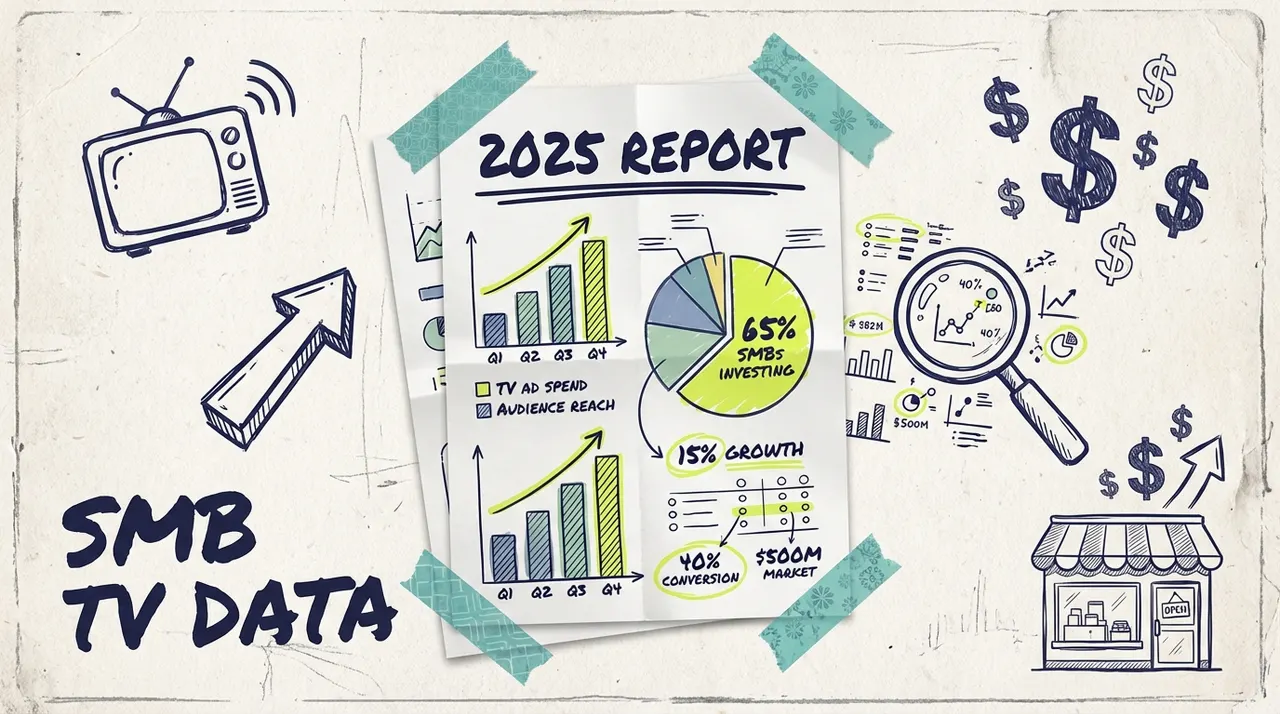
-
$50
Minimum budget for streaming TV ads
-
100+
Premium channels available to SMBs
-
56%
Marketers increasing CTV spend in 2025
The small business TV advertising landscape has transformed dramatically. What was once reserved for Fortune 500 companies is now accessible to local restaurants, dental practices, and solo entrepreneurs.
This report breaks down the current state of SMB TV advertising in 2025, covering adoption rates, spending trends, performance benchmarks, and what's driving the shift. Whether you're considering your first TV campaign or optimizing an existing strategy, these insights will help you understand where the market stands and where it's heading.
Key Findings at a Glance
Before diving into the details, here are the headline numbers shaping SMB TV advertising in 2025:
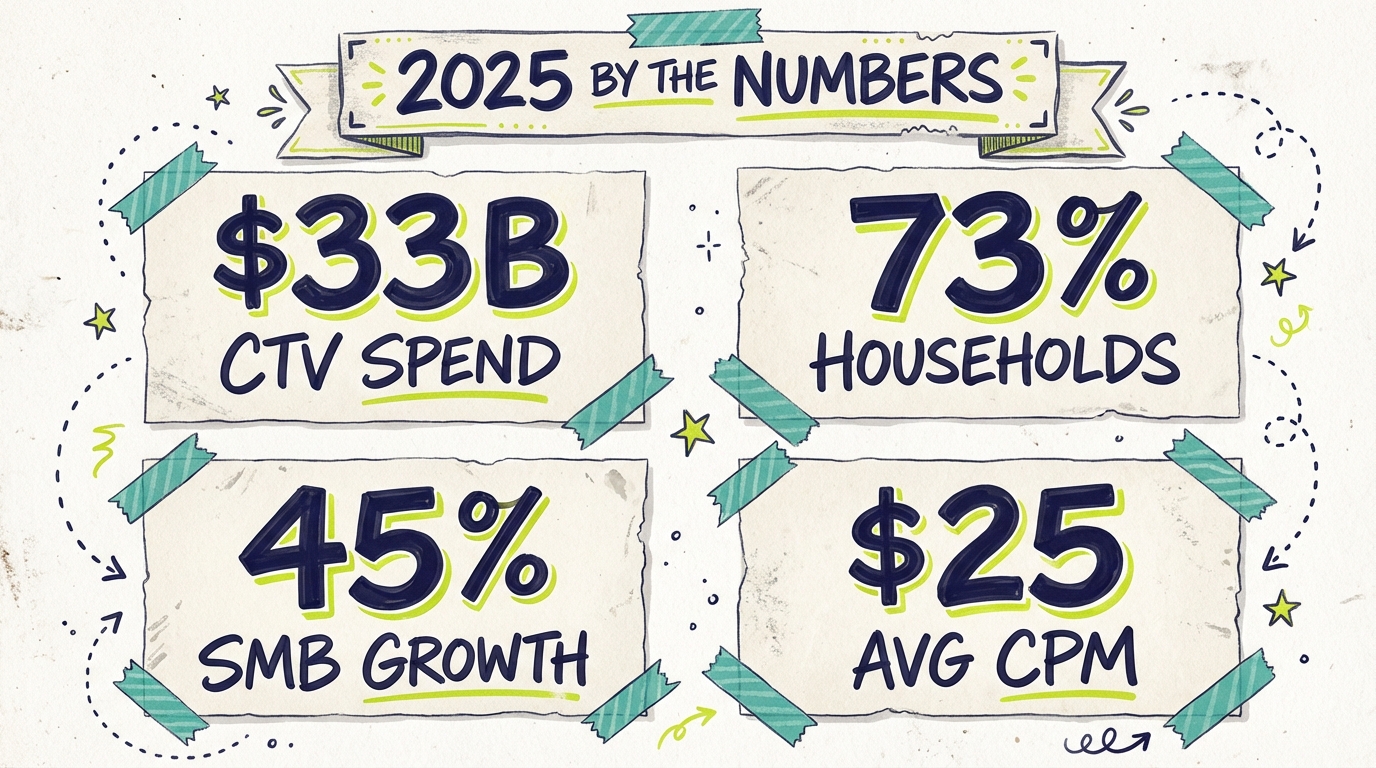
CTV ad spending reached $33 billion in 2025, up from $26 billion in 2024 (eMarketer)
73% of US households now have at least one connected TV device (Nielsen)
SMB adoption of CTV has grown 45% year-over-year
Average CPM for small business advertisers: $15-35, with $25 being typical
Video completion rates on CTV average 92%, compared to 65% on mobile
The Streaming Shift: Why SMBs Are Moving to TV
The migration from linear TV to streaming has fundamentally changed the economics of television advertising.
Lower barriers to entry. Traditional TV advertising required minimum buys of $10,000 or more, plus production budgets starting at $50,000. Today, platforms like Adwave let businesses launch campaigns for as little as $50, with AI handling ad creation.
Precise targeting capabilities. Unlike broadcast TV's broad reach, CTV advertising offers geographic, demographic, and behavioral targeting. A local pizzeria can target households within 10 miles who watch cooking shows during dinner hours.
Measurable results. Streaming platforms provide impression data, completion rates, and attribution insights that traditional TV never could. Small businesses can finally track what they're getting for their ad spend.
SMB Adoption Trends
The data shows clear momentum in small business TV advertising adoption:
First-time advertisers are surging. According to industry data, 62% of SMBs running CTV campaigns in 2025 had never advertised on television before. The accessibility of self-serve platforms removed the need for agency relationships.
Budget allocation is shifting. SMBs are reallocating 15-20% of their digital ad budgets to CTV, recognizing that TV complements rather than competes with channels like Meta and Google.
Local businesses lead adoption. Restaurants, home services, healthcare practices, and professional services represent the fastest-growing segments. These businesses benefit most from geographic targeting capabilities.
Spending Benchmarks by Business Size
Understanding what peers are spending helps set realistic expectations:
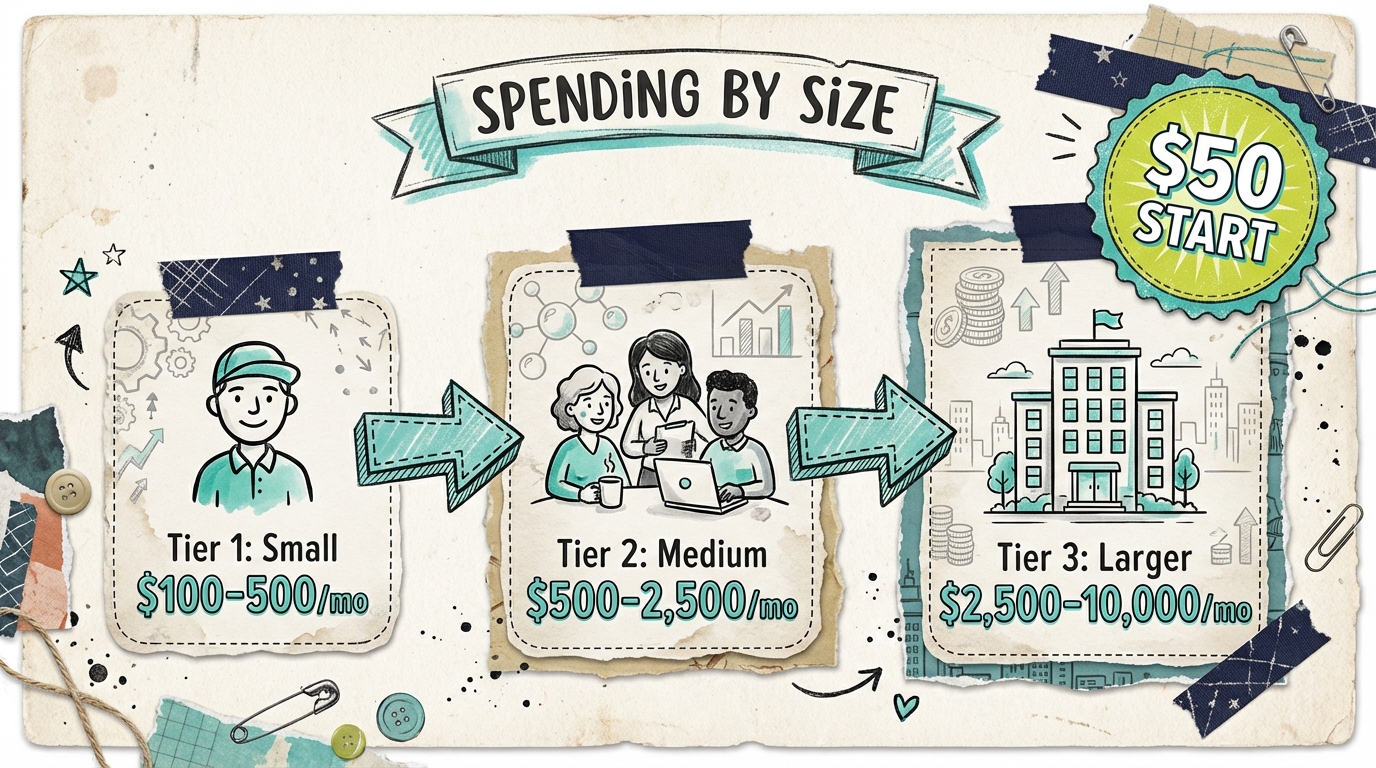
Micro businesses (1-5 employees):
Monthly CTV spend: $100-500
Typical campaign length: 2-4 weeks
Primary goal: Local awareness
Small businesses (6-50 employees):
Monthly CTV spend: $500-2,500
Typical campaign length: Ongoing with seasonal peaks
Primary goal: Brand building + direct response
Mid-size SMBs (51-200 employees):
Monthly CTV spend: $2,500-10,000
Typical campaign length: Always-on with campaign bursts
Primary goal: Multi-market expansion
The key insight: you don't need a massive budget to start. Testing with $50-100 provides meaningful data about whether TV works for your business.
Performance Benchmarks: What Good Looks Like
SMBs running CTV campaigns should benchmark against these industry standards:
Video completion rate (VCR):
Average: 92%
Good: 94%+
Excellent: 97%+
CTV's non-skippable format drives high completion rates. If you're seeing rates below 85%, investigate creative quality.
Cost per thousand impressions (CPM):
Small business average: $25
Range: $15-35
Premium inventory (sports, news): $30-45
Brand lift metrics:
Average aided awareness lift: 15-25%
Average consideration lift: 10-18%
Average search lift: 20-40%
Website traffic correlation:
Average direct traffic increase: 15-30% during campaign
Branded search increase: 25-50%
For more on measuring success, see our guide to calculating TV advertising ROI.
Industry Breakdown: Who's Advertising on CTV
Certain industries have embraced CTV advertising faster than others:
Leading adopters:
Restaurants & food service: 23% of SMB CTV spend
Home services: 18% of SMB CTV spend
Healthcare & dental: 15% of SMB CTV spend
Professional services: 12% of SMB CTV spend
Retail: 11% of SMB CTV spend
Emerging categories:
Real estate agents and brokerages
Fitness and wellness studios
Pet services
Event and wedding vendors
E-commerce and DTC brands
The common thread: businesses with defined geographic service areas and consideration-based purchase decisions see the strongest results from TV advertising.
What's Working: Creative and Targeting Insights
Data from thousands of SMB campaigns reveals patterns in what drives success:
Creative best practices:
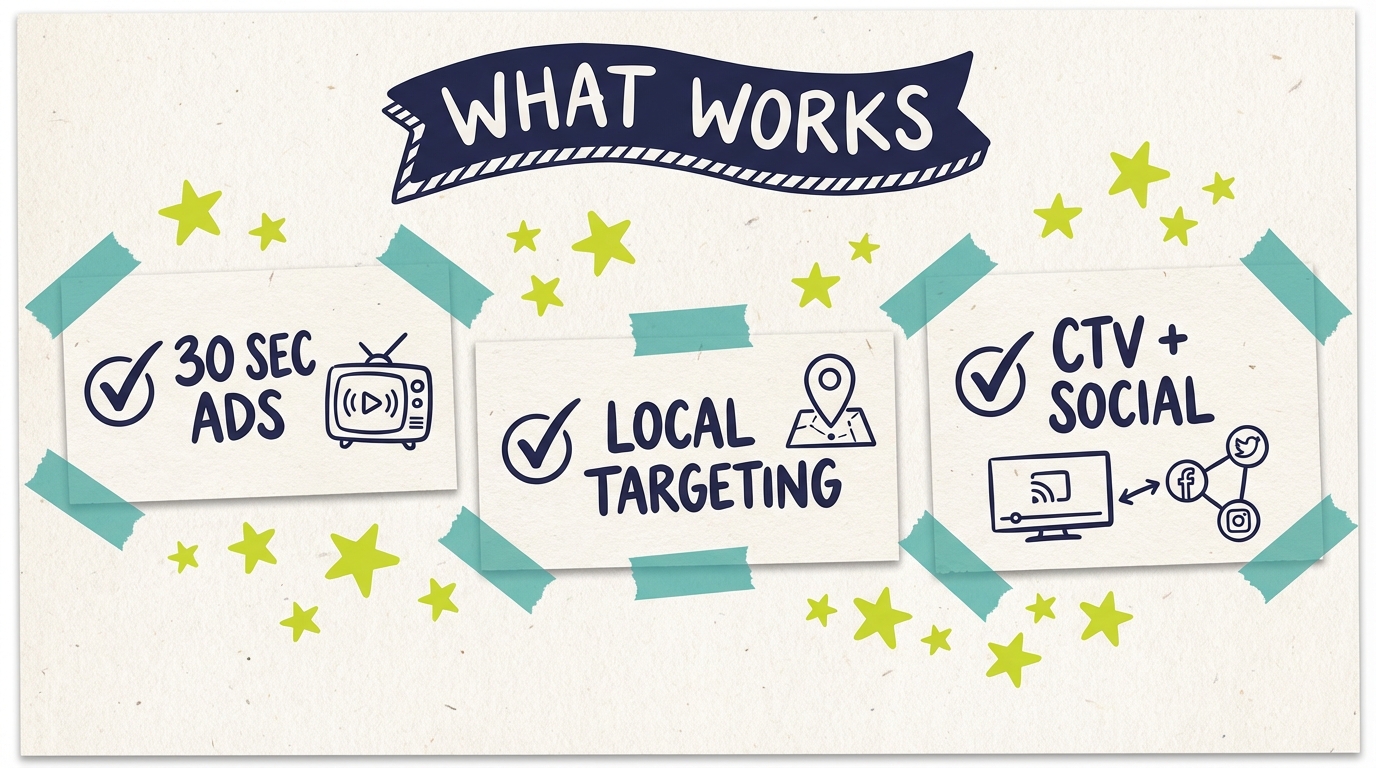
30-second ads outperform 15-second by 23% on brand metrics
Clear call-to-action increases response by 35%
Local references (city name, landmarks) boost recall 40%
Professional production quality now achievable via AI tools
Targeting strategies that work:
Geographic + interest layering delivers best ROI
Dayparting (evening hours) improves efficiency 15-20%
Frequency of 3-5 impressions per household optimal
Retargeting website visitors on TV shows 2-3x higher conversion
Channel mix insights:
CTV + paid social drives 35% better results than either alone
CTV as awareness layer improves Meta/Google conversion rates
Sequential messaging (TV then retarget) outperforms simultaneous
Barriers and Challenges
Despite progress, SMBs still face obstacles:
Perception gap: 47% of small business owners still believe TV advertising requires $10,000+ budgets. Education about accessible options remains a challenge.
Creative production concerns: While AI tools have eliminated production costs, some businesses remain skeptical about quality. In reality, AI-generated ads now match or exceed traditional production for many use cases.
Attribution complexity: Connecting TV exposure to business outcomes requires more sophistication than click-based digital metrics. Multi-touch attribution adoption is still emerging.
Inventory fragmentation: The proliferation of streaming platforms means audiences are spread across many services. Working with platforms that aggregate inventory simplifies buying.
2025-2026 Predictions
Based on current trends, here's where SMB TV advertising is heading:
Continued cost efficiency. CPMs are expected to remain stable or decrease slightly as inventory grows faster than demand. This benefits SMB advertisers.
AI creative becomes standard. By end of 2026, the majority of SMB TV ads will be AI-generated or AI-assisted. Manual production will become the exception.
Self-serve dominance. Platforms enabling direct SMB access will capture the majority of small business TV spend, displacing traditional agency models.
Performance measurement improves. Better attribution tools will make TV advertising more accountable, accelerating adoption among ROI-focused SMBs.
Local advertising renaissance. As national brands focus on broad reach, local businesses will find less competition and better value in geo-targeted TV campaigns.
How to Apply These Insights
For small businesses considering TV advertising:
Start small and test. A $50-100 campaign provides real data about whether TV works for your business. The risk is minimal.
Focus on your core geography. Local targeting lets you reach only the people who can actually buy from you.
Use AI for creative. Don't let production costs or complexity stop you. Platforms like Adwave generate professional ads from your website in minutes.
Integrate with existing channels. TV works best as part of a full-funnel strategy, amplifying your Meta, Google, and other digital efforts.
Measure what matters. Track branded searches, direct traffic, and "how did you hear about us?" responses alongside traditional metrics.
Methodology Note
This report synthesizes data from industry sources including eMarketer, Nielsen, IAB, and aggregated campaign performance data. SMB is defined as businesses with fewer than 500 employees.
The Bottom Line
TV advertising is no longer just for big brands with big budgets. The 2025 data is clear: small businesses are adopting CTV at record rates, achieving strong results, and fundamentally changing how they build brand awareness.
The barriers that kept SMBs out of television for decades have fallen. Production costs are zero with AI tools. Minimum budgets start at $50. Targeting matches the precision of digital advertising. And measurement continues to improve.
For small businesses still on the sidelines, the question isn't whether TV advertising works. It's whether you can afford to let competitors claim this territory first.
Ready to see the data in action for your business? Create your first TV ad with Adwave and run a real-world test for under $100.


