
You’ve probably had this moment already. You open Hulu, ESPN, or a local news stream and see a competitor’s ad. It looks clean, credible, and expensive. Your first reaction is usually the same as most small business owners: “Good for them. We can’t do that.”
That assumption is outdated.
Short video has trained customers to absorb a message fast, decide fast, and move on. The same discipline that makes a social clip work now applies to TV and streaming. The difference is context. When viewers see your business in a premium TV environment, your brand often feels more established than it does in a crowded social feed.
Why Your Business Needs a TV Ad (and How You Can Afford It)
Short video is no longer a side tactic. Global advertising spend on short-form video marketing is projected to grow at a 9.14% CAGR from 2025 to 2029, reaching more than $157.48 billion by 2029, and short-form videos under 60 seconds deliver 2.5 times higher engagement rates than longer formats, according to industry reporting citing Statista and related analysis.
That matters for one simple reason. If your customers already respond to short content, you don’t need to teach them a new behavior. You need to place the right short advertising video in a setting that gives your business more authority.
Why TV changes the perception of your brand
A social video can get attention. A TV or streaming ad can get attention plus legitimacy.
For a local service business, agency, clinic, brokerage, restaurant, or retailer, that shift is powerful. People tend to remember businesses that show up where established brands show up. The format is still short. The expectation is still clarity. But the environment adds weight.
If you’re still building your marketing foundation, pair paid channels with practical basics like grow your business with free marketing. That combination works well because free visibility builds repetition, while TV and streaming add reach and credibility.
Practical rule: Don’t think about TV as “big brand advertising.” Think about it as premium placement for the same concise message that already works in short video.
Why the cost barrier isn’t what it used to be
The old model made TV feel inaccessible. You needed a production crew, multiple approvals, versioning for different placements, and a buying process that felt built for larger companies.
That’s changed. Small businesses can now approach TV with the mindset they already use for digital campaigns: start with a clear offer, keep the creative tight, target the right audience, and measure what happens after launch. If you want a broader explanation of why the channel still works, Adwave has a useful overview on why TV works for local business growth.
What makes a short advertising video effective on social also transfers well to streaming and broadcast. You still need a strong opening, a clear value proposition, and a direct next step. The difference is that TV asks for cleaner execution and better compliance.
That’s good news for smaller advertisers. It means you don’t need a flashy concept. You need a disciplined one.
The Modern TV Ad Blueprint Before You Hit Record
Most weak ads fail before anyone writes the script. The problem usually isn’t talent, editing, or camera quality. It’s that the business is trying to say five things in one short spot.

A short advertising video needs one job. Not three. Not “build awareness, explain our full service menu, introduce our team, and push a seasonal promotion.” One job.
Pick the single outcome first
Before you touch the creative, decide what success looks like. Usually it falls into one of these buckets:
Immediate response: You want people to visit a landing page, call, book, or redeem an offer.
Local awareness: You want more people in your market to know your name and associate it with a category.
Timed promotion: You have a launch, event, listing, sale, or seasonal push that needs concentrated attention.
A short TV spot works best when the call to action matches the campaign type. Awareness ads shouldn’t sound like coupon ads. Direct response ads shouldn’t end with vague branding.
Define who should see it
A lot of small businesses still describe their audience too broadly. “Homeowners.” “Families.” “Professionals.” Those labels are too loose to guide creative.
Use a tighter lens:
Where they live: Your service area matters more than abstract demographics.
What they need right now: Urgency beats general interest.
What they’re likely watching: Streaming habits and content context shape how your message lands.
What would make them act: Savings, convenience, trust, speed, quality, or local reputation.
A real estate agent, for example, may need one ad for sellers who care about speed and another for buyers who care about inventory and neighborhood knowledge. A med spa may lead with confidence and convenience. A roofing company may lead with damage, timing, and trust.
Build a one-page brief
Keep the planning document short enough that you’ll use it. Mine usually includes:
Business objective: one sentence
Audience: one clear description
Core promise: the biggest reason to choose you
Proof point: what makes that promise believable
Call to action: one next step
Offer or timing: only if it matters
The shorter the ad, the more selective you need to be about what goes in. Clarity is the strategy.
For those new to creating broadcast spots, most waste gets removed during this process. You stop guessing. You stop writing lines that sound good but don’t move a customer. You stop treating every ad like a company biography.
For practical prep work before production, Adwave’s resource on producing TV commercials for small businesses is a useful reference because it frames the process like a campaign, not a film project.
Scripting a Short Advertising Video That People Actually Watch
The best short advertising video scripts sound simple because they are simple. Not simplistic. Simple.
A viewer gives you a few seconds to prove you’re relevant. If you spend those seconds easing in, introducing your company name too early, or using generic brand language, attention disappears.

The four-part script structure
This framework works because it mirrors how people process an offer quickly.
Hook
The first line or visual has to earn the next few seconds. To optimize ThruPlay rates, you need to hook viewers in the first 3 seconds. Top short-form campaigns can exceed a 60% ThruPlay rate with targeted audiences, while a weak hook can drop below 25%. One retail case improved from under 25% to 48% just by redesigning the opening moments, according to ReportDash’s breakdown of video marketing metrics.
A hook can be a direct problem, a bold visual, or a clear benefit. It should never be a slow logo animation.
Examples:
Home services: “Still waiting days for an HVAC repair?”
Real estate: “Your home may be worth more than you think.”
Dental practice: “Putting off treatment because you think it’ll be expensive?”
Problem
Once you’ve got attention, name the frustration. Through this, relevance emerges.
Don’t pile on every customer pain point. Pick the one most closely tied to action. For a family law firm, that may be uncertainty. For an auto shop, it may be downtime. For a retail store, it may be finding the right product without wasting time.
Solution
The business enters here, but it should enter as the answer, not the subject of a speech.
Bad version: “At Smith & Co., we pride ourselves on delivering excellent customer service to every valued client.”
Better version: “Smith & Co. helps local homeowners replace damaged roofs fast, with clear pricing and crews that show up when scheduled.”
That sentence is concrete. It gives the viewer something to hold onto.
Call to action
One action. One destination. One ask.
If you want the viewer to call, say call. If you want them to visit a site, say visit. If you want them to book, say book. The CTA should fit the business model and the campaign objective you set earlier.
What usually ruins the script
Most small business scripts struggle in familiar ways:
Too much setup: The ad spends precious time introducing the business instead of solving a problem.
Too many claims: The script tries to include every service, every location, and every differentiator.
Corporate wording: People don’t talk like brochure copy.
No spoken rhythm: A script can read fine on paper and still sound stiff out loud.
Read your script aloud. If you wouldn’t say it that way to a customer in person, don’t put it in the ad.
If you use AI to draft a script, edit for human speech patterns. Tools can get you to structure quickly, but voice still matters. A simple cleanup pass or a tool that helps humanize chatgpt text can make generated copy sound less mechanical before you finalize it for video.
From Script to Screen AI-Powered Production vs The Old Way
Production is where many small businesses freeze. The plan makes sense. The script feels manageable. Then the practicalities set in. Who’s filming? Who’s editing? Who’s handling voiceover, graphics, music, and versions for different placements?
That’s where the old approach breaks down for smaller advertisers. It asks a local business to run a miniature production company just to launch one short advertising video.
The trade-off in plain terms
Traditional production can produce strong work. It can also introduce cost, delay, scheduling friction, and too many decision points for a business that wants to get a campaign live.
AI-driven production changes the operating model. Instead of starting from a blank timeline, the system can start from the assets you already have. Your website, branding, service copy, photos, and positioning become the raw material.
If you’re curious how the workflow works in practice, Adwave outlines the process in its guide to an AI video ad creator for TV and streaming.
TV Ad Production Methods Compared
The biggest practical difference isn’t just speed. It’s reduced friction. A business owner doesn’t need to become a producer to get quality creative out the door.
What works better than most owners expect
For short ads, polished doesn’t always mean effective. Overproduced spots often feel distant, especially when the message is local and personal. Clear beats clever. Relevant beats cinematic.
That’s also true with audio. The right soundtrack supports pace and tone, but it shouldn’t overpower the message. If you’re shaping short-form creative and want to understand how sound choices affect momentum, this explainer on how AI music enhances video shorts gives a useful production perspective.
The best small business ads don’t try to look expensive. They try to look trustworthy, clear, and ready to help.
That’s why AI production is such a practical shift. It’s not about replacing strategy. It’s about removing the cost and complexity that used to block good strategy from becoming a real campaign.
Launching Your Ad on TV and Streaming Without the Headaches
Most businesses can create a social video. Far fewer can turn that same asset into something a TV or streaming platform will accept.
That gap is bigger than most owners realize. An underserved area in marketing is adapting social videos for traditional TV. 70% of SMBs experiment with short-form video, but only 15% scale to TV because of production and compliance barriers. The same analysis notes that AI tools can bridge that gap with TV-ready ads at $15–$35 CPMs, which is why the hybrid social-to-TV workflow matters for smaller advertisers, as covered in this niche marketing analysis.
Why social-first videos often fail in TV environments
A social clip is usually built for thumb-stopping in a feed. TV and streaming placements demand a different kind of readiness.
Common issues include:
Format mismatch: Vertical-first creative may need adaptation for wider screen environments.
Compliance gaps: Broadcast-safe visuals, captioning, and delivery specs aren’t optional.
Pacing problems: Social editing often assumes endless scrolling behavior. TV viewers experience the ad in a more linear context.
Weak destination strategy: A social post can survive on engagement alone. A TV campaign usually needs a clearer response path.
Many campaigns stall. Not because the idea is bad, but because the asset was built for the wrong container.
A cleaner launch process
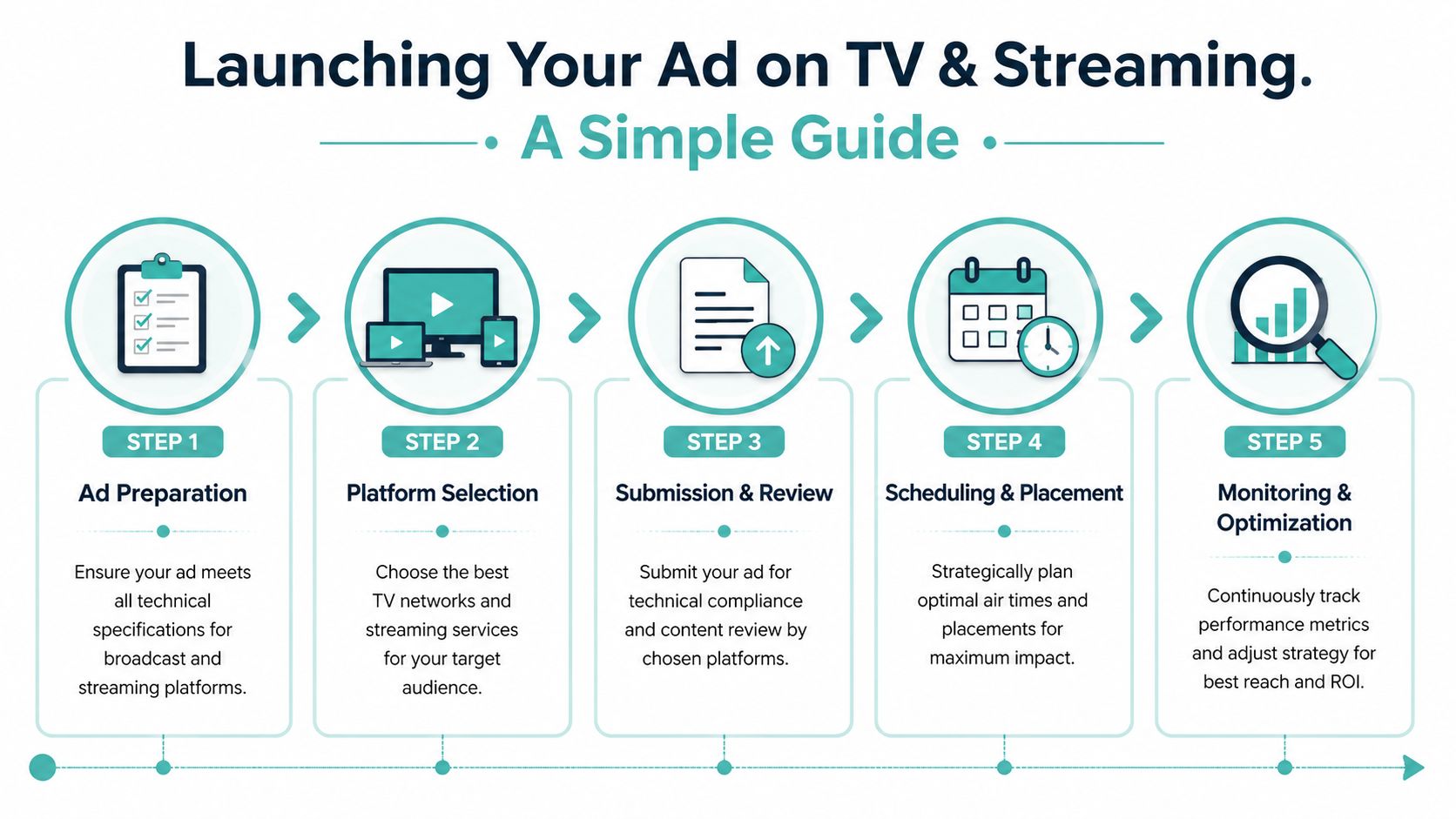
A practical launch process looks like this:
Prepare the creative correctly. Make sure the ad is built for the screen and platform where it will run.
Choose the audience carefully. Local campaigns win when geography, intent, and viewer fit are aligned.
Submit for review. Technical approval matters more than many first-time advertisers expect.
Schedule placements. Timing changes how often the ad is seen by the right households.
Monitor and refine. Strong campaigns improve after launch, not just before it.
For advertisers trying to understand the channel itself, Adwave’s resource on connected TV advertising for small businesses is a helpful primer because it translates the buying environment into plain language.
A good TV ad isn’t just a good video. It’s a good video that meets platform requirements and reaches the right viewer at the right time.
That distinction matters. A strong short advertising video can underperform if delivery is sloppy. A simpler creative can work very well when formatting, targeting, and placement are handled properly.
Measuring Success That Matters for Your Business
Once the ad is live, the temptation is to obsess over views. That’s understandable, but it’s not the most useful way for a small business to judge performance.
A short advertising video should be evaluated by what it changes in the business. Did more qualified people visit your site? Did calls increase after the campaign started? Did branded search interest rise in your service area? Did leads feel warmer because prospects had already seen your name on TV or streaming?

Track business signals, not vanity signals
The most useful indicators tend to be simple:
Website response: Look for lift in direct traffic, landing page visits, and time-specific spikes after airtime.
Inbound intent: Watch calls, form fills, bookings, and quote requests.
Search behavior: Pay attention to branded searches and location-based searches tied to your category.
Sales quality: Ask whether new customers mention seeing the ad or seem more familiar with your business before contacting you.
Those signals tell you whether the campaign is creating recognition and action. They also help you spot whether the problem is creative, targeting, or the offer itself.
What to adjust when results are mixed
Not every campaign needs a rewrite. Often the fix is narrower.
If response is weak, ask:
Is the opening strong enough?
Is the offer relevant enough?
Is the CTA specific enough?
Is the targeting too broad?
Is the landing experience consistent with the ad?
These are practical levers. They’re easier to improve than most owners think.
Keep your reporting readable
Small business advertising breaks down when measurement becomes too technical to use. A dashboard should help you make decisions, not force you to learn a new language.
That’s why the strongest reporting views are usually the simplest:
campaign spend
delivery by audience or geography
response trends over time
site and lead activity after launch
If you can connect ad exposure to real business behavior, you’re in a strong position. The point isn’t to admire the campaign. It’s to decide whether to scale, revise, or rotate the creative.
The right metric is the one that helps you make the next decision with confidence.
A short advertising video succeeds when it earns attention and moves someone one step closer to becoming a customer. For a small business, that’s the whole game.
If you’re ready to turn your website into a broadcast-ready short advertising video without navigating production crews, formatting issues, or complicated media buying, Adwave is built for exactly that. It gives small businesses a practical path from idea to TV and streaming launch, with AI handling the heavy lifting so you can focus on the offer, the audience, and the results.


