
Producing a TV commercial used to feel like a monumental task, but the core process is quite simple: come up with a concept, write the script, shoot the footage, and get the final ad out there. What’s really changed is that for small businesses, modern platforms have made this entire journey more affordable than ever, turning a once-daunting strategy into a powerful part of their marketing toolkit. Solutions like Adwave are at the forefront of this change, making professional TV advertising accessible to everyone.
Why TV Advertising Still Matters for Small Businesses
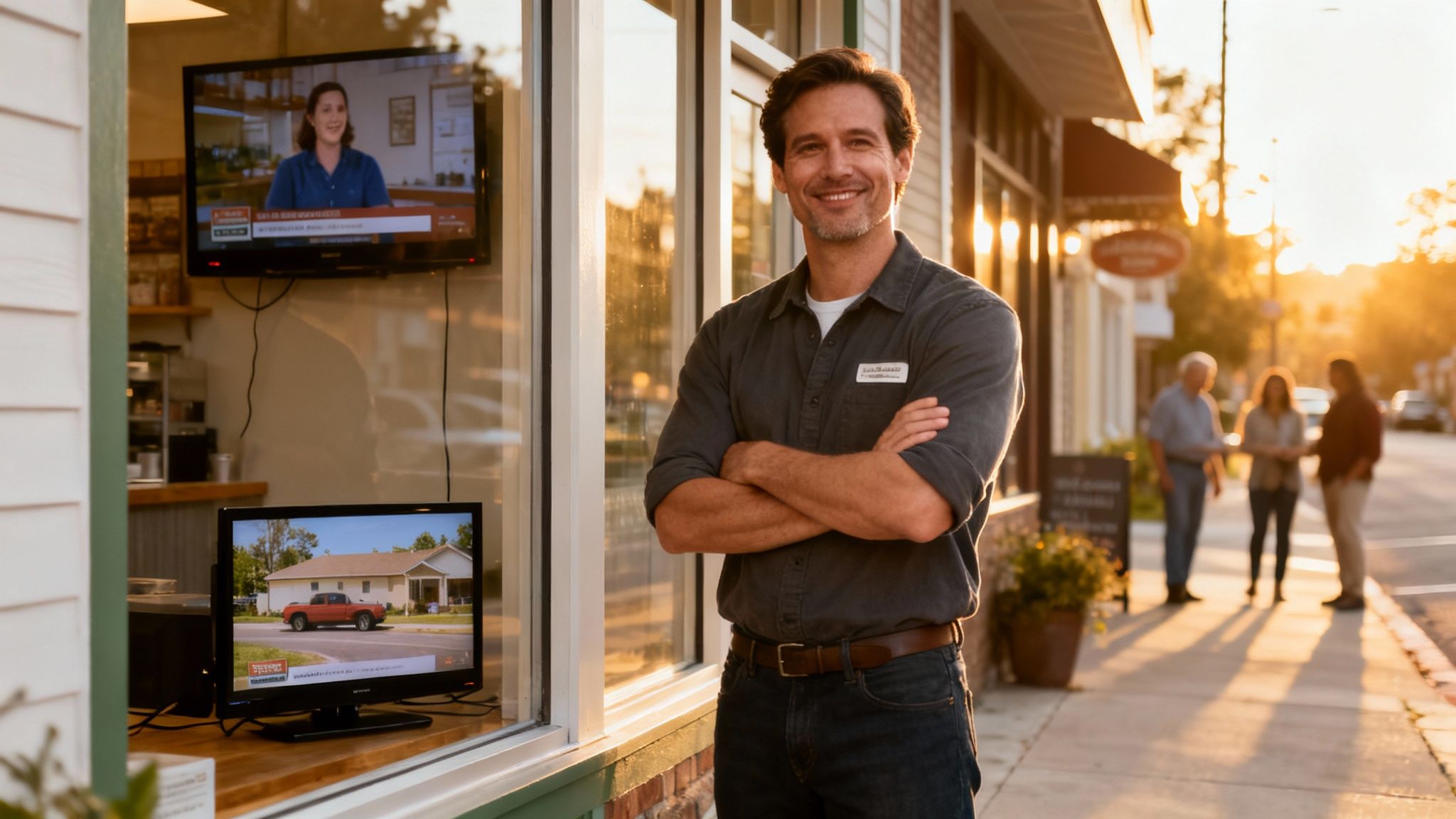
Let's be honest, when most small business owners hear "TV advertising," their minds jump straight to million-dollar Super Bowl ads and huge, bustling film crews. For a long time, that image wasn't far from the truth. Television was the exclusive domain of giant brands with budgets to match, leaving local businesses out of the picture.
That's just not the case anymore. Today, producing TV commercials isn't just for the big players. The game has totally changed, thanks to the explosion of streaming services, connected TV (CTV), and new tech that has made television one of the most effective and reachable tools for local growth.
A New Era for Local TV
Think about the local businesses you rely on, the trusted plumber, the neighborhood real estate agent, the family-run restaurant. TV advertising gives these businesses a chance to build real credibility and become household names. There's a powerful sense of legitimacy that comes from seeing a local brand on the same screen as national giants.
This shift toward accessibility is fueled by a few key changes:
Affordable Airtime: You no longer have to buy national ad spots. Local broadcast stations and streaming platforms offer targeted packages that fit a small business budget.
Simplified Production: Forget the Hollywood crew. High-quality commercials can be made with small, agile teams or even created automatically with AI-powered platforms like Adwave.
Precision Targeting: Modern TV lets you zero in on specific demographics, zip codes, and even viewing habits. This ensures your ad is seen by actual potential customers, not wasted on a broad, uninterested audience.
The global ad market is picking up speed, with projections showing 7.1% growth in 2026. This will push total ad spending past a staggering $1.2 trillion. This growth is opening doors for platforms that make TV advertising accessible, giving smaller businesses a real shot at competing.
A Smarter Path for Small Businesses
So, how does the landscape look now for a local business? We can see the difference pretty clearly when we compare the old way of doing things with the new.
Traditional vs Modern TV Advertising for SMBs
This evolution is exactly where solutions like Adwave come in. Instead of navigating the complex and costly route of hiring separate production companies and media buyers, Adwave offers an all-in-one platform. It uses AI to create your commercial and then distributes it across more than 100 top-tier channels like Hulu and ESPN, all on a budget that works for a small business.
This new approach removes the two biggest roadblocks: cost and complexity. It makes the entire process of producing TV commercials manageable and focused on getting results.
Of course, a great marketing plan is never one-dimensional. While TV is fantastic for building your brand, it's smart to combine it with other channels. For example, understanding Google Ads for small business growth can help you capture demand that your TV ads create. By blending strategies, you build a powerful system for reaching customers at every turn.
To learn more, check out our complete guide: https://adwave.com/resources/tv-advertising-for-small-business
Laying the Foundation: Your Concept and Budget
Every great TV ad starts with two things: a solid idea and a realistic budget. You can't really have one without the other. Your budget will dictate how big you can go with your concept, and your concept will determine how much you need to spend. before you think about hiring a crew or scouting a location, you need to nail these two down.
For a small or medium-sized business, simple is almost always better. You don't need a Super Bowl-sized production to resonate with your local community. The best ads focus on a single, compelling message that solves a real problem for your customers.
Nailing Down a Winning Concept
Your goal here is to create something memorable that drives business. Don't try to cram your entire company history into a 30-second spot. It’s just too short. You get one shot to make an impression, so make it count.
If you're feeling stuck, here are a few proven angles that work well:
The Problem/Solution: This is a classic for a reason. Show a relatable frustration your customers deal with, then introduce your business as the hero. Think of a local plumber's ad showing the panic of a burst pipe, followed by the calm, professional arrival of their technician. It’s simple, visual, and effective.
The Authentic Testimonial: Let a real customer do the selling for you. A genuine, unscripted endorsement from someone who loves your work builds instant trust. For local businesses, this kind of social proof is pure gold.
The Unique Value Prop: What’s the one thing you do better than anyone else? Faster service? A money-back guarantee? A one-of-a-kind product? Put a spotlight on that single differentiator and own it.
Once you have that core idea, you need to get it down on paper. A tight script is important. Every line, every shot, and every sound should push the viewer toward a single, specific action.
Expert Tip: Your ad is useless without a clear Call-to-Action (CTA). Seriously. "Visit our website," "Call for a free estimate," "Stop by our new location", tell people exactly what you want them to do next. Otherwise, you've just made a nice announcement, not an advertisement.
Getting Real About the Production Budget
Okay, let's talk money. Budgeting for a TV commercial can feel like a black box, but it doesn't have to be. Traditionally, a professionally produced regional spot can cost anywhere from $3,000 to over $50,000, and that's before you even pay to put it on TV. It's no wonder so many small businesses think TV is out of reach.
This is where the game has completely changed. Modern platforms like Adwave were built to tear down that massive cost barrier. Instead of you paying a production company, Adwave uses AI to instantly generate a professional, broadcast-ready commercial right from your website. This approach pretty much drops the production budget to zero, freeing up your cash for what really matters: buying the airtime to get your ad in front of potential customers.
But if you do decide to go the traditional route, you absolutely need to know what you're getting into. For a deeper dive into this, you can learn more about the specifics of TV ad production costs in our complete guide.
Here’s a quick rundown of where the money goes in a typical, non-AI production:
Understanding these moving parts helps you make a smarter decision. For many businesses, the high costs and sheer complexity of a traditional shoot make an all-in-one platform like Adwave the most practical way to create a great TV commercial without breaking the bank.
Rolling Up Your Sleeves (DIY) vs. Calling in the Pros
Alright, you've got your brilliant concept and a budget you can live with. Now comes the moment of truth: how do you get this thing made? This is where you face a classic fork in the road. Do you go the DIY route, hire a professional production crew, or is there a smarter, third option?
The right answer really boils down to your budget, your timeline, and how confident you are in your own creative chops.
The Do-It-Yourself Production Path
The DIY approach is always tempting, especially for a small business where every penny counts. With the incredible quality of today's smartphone cameras and user-friendly editing apps, making a decent-looking ad is more possible than ever before. Just know that what you save in cash, you'll spend in time.
Going DIY means you're the director, the producer, the sound guy, and the editor. You get total creative control and the lowest possible upfront cost, but you also run the biggest risk of it looking... well, amateur. A shaky camera, muffled audio, or dim lighting can instantly signal "low budget" to viewers, which can hurt your brand's credibility.
If you’re ready to take the plunge, nail these fundamentals:
Steady Your Shot: Use a tripod. Seriously. Nothing screams "I shot this myself" faster than shaky footage.
Get Clear Audio: Don't rely on your phone's built-in mic. A simple lavalier mic that clips to your shirt is a cheap investment that makes a massive difference by cutting out background noise.
Find the Light: Natural light is your best friend. Film near a large window. If you can spring for it, a basic three-point lighting kit is surprisingly affordable and will make your shots look 10 times more professional.
Hiring a Professional Production Agency
On the other side of the coin, you can hire a professional production company. This is the traditional way to do it. You hand over your script, and a team of experts takes care of everything from casting actors to post-production. The huge plus here is quality and peace of mind. You'll get a polished, broadcast-ready commercial without having to learn a whole new set of skills overnight.
The obvious catch? The cost. Even a simple, local TV spot produced by a professional crew can easily run you $3,000 to $15,000, and often much more. For many small businesses, that's simply not feasible. Deciding when to bring in outside help is a common challenge for founders, and looking into a guide on outsourced marketing can offer a broader perspective on how to use external expertise without breaking the bank.
This decision tree can help you visualize which path makes the most sense for your situation.
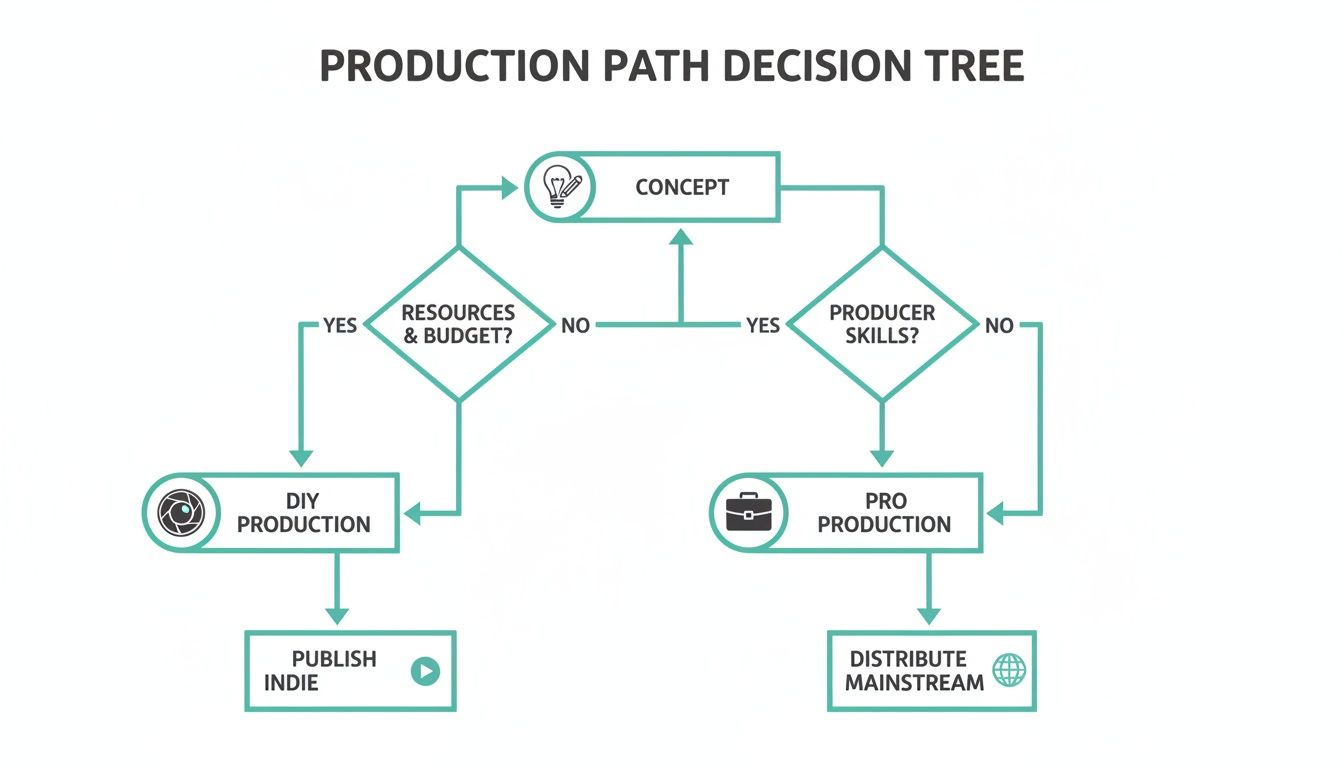
Ultimately, you’re trying to balance your available time, your budget, and your desire for creative control against the need for a professional-grade final product.
The Modern Middle Ground: A Smarter Way
We created Adwave to solve this exact problem. It never made sense to us that small businesses had to choose between 'cheap and amateur' or 'professional and unaffordable.' There had to be a better way to get broadcast-quality ads without the traditional headaches and high costs.
Instead of forcing you to become a filmmaker overnight or drain your bank account on an agency, Adwave uses AI to build a polished, professional commercial for you in minutes. You just provide your website URL, and the platform gets to work, analyzing your brand, pulling key messages, and generating a spot that’s ready for TV.
This approach flips the old model on its head with some incredible advantages:
Zero Production Cost: The AI does the heavy lifting, which means no crews, no expensive equipment, and no actors. Your production budget effectively drops to zero.
Unbeatable Speed: Why wait weeks or months? You can have a finished commercial ready to go in just a few minutes.
Guaranteed Professional Quality: The ads are created using templates and asset libraries that are proven to work.
For a small or medium-sized business, this is a genuine useful option. It takes the risk and guesswork out of DIY while completely avoiding the prohibitive costs of a traditional agency. This frees you up to put your budget where it really matters, getting your ad in front of the right customers.
If you want to see just how simple this can be, our guide on how to make a commercial with modern tools walks you through the entire process. It’s the most direct route to getting professional results on a small business budget.
Bringing It All Together in Post-Production
You’ve wrapped the shoot, which is a huge step, but don't pop the champagne just yet. Now comes the magic: post-production. This is where your raw footage, sound clips, and graphics are cooked up into a polished, persuasive final ad. It's less about shooting and more about storytelling.
This stage is far more than cutting and pasting a few clips together. It’s a meticulous process of editing to get the emotional timing just right, designing crisp audio that drives your message home, and adding graphics that make your brand stick. It's also where you'll face the technical maze that can get your ad kicked back by the network before anyone ever sees it.
More Than Just Editing
The first thing most people think of is the video edit. An editor sifts through all the takes to find the gold, piecing them together to build a story. The real skill isn't just following the script; it's about creating a rhythm and pace that grabs a viewer's attention and holds it for those precious 15 or 30 seconds. A good editor can turn decent footage into a fantastic ad.
But the edit is just the skeleton. Several other layers bring it to life:
Color Correction and Grading: This is what gives your ad that professional, cinematic feel. It ensures colors are consistent from one shot to the next and helps set the emotional tone, think bright and punchy for a summer sale or something a bit more subdued for a serious message.
Sound Design and Mixing: Bad audio will sink your ad faster than anything else. This step involves cleaning up dialogue, layering in sound effects to make the world on screen feel real, and mixing in the perfect music track. If viewers have to strain to hear what’s being said, they’ll just tune out.
Graphics and Text Overlays: Here’s where you add your logo, your website or phone number, and any key messages. These need to be sharp, legible, and match your company’s branding.
Many business owners treat post-production as a small final step, but that's a costly mistake. For a professionally produced ad, this phase can easily eat up a huge chunk of the budget, anywhere from $5,000 to $50,000 is common. Why? Because this is where raw footage is transformed into a compelling ad that works.
Dodging the Technical Traps
Beyond the creative side, post-production is a minefield of technical specs. TV networks have very strict rules, and if you don't follow them to the letter, your ad gets rejected. That means all your hard work, time, and money just went down the drain.
This is often where first-timers get completely stuck. You suddenly need to know about specific file formats, resolutions, and, importantly, audio loudness levels. In the U.S., the CALM Act prevents ads from being blaringly loud compared to the TV show, and every network enforces these standards without exception.
This is exactly where a service like Adwave becomes a useful option. Instead of you having to learn the ins and outs of broadcast engineering, Adwave’s AI system takes care of the entire post-production process automatically.
When Adwave builds your commercial, it’s not just making something that looks great, it’s creating a final product that is 100% technically compliant right out of the box.
The audio is automatically mastered to meet broadcast loudness rules.
The color is corrected for a consistent, professional look.
The final video is exported in the precise format networks demand.
This lifts the entire technical weight off your shoulders. You can stay focused on the message and the business, knowing the finished ad will cruise through the network approval process without any frustrating (and expensive) rejections. It's simply a smarter way to handle the last (and most critical) mile of ad production.
Getting Your Commercial on the Air
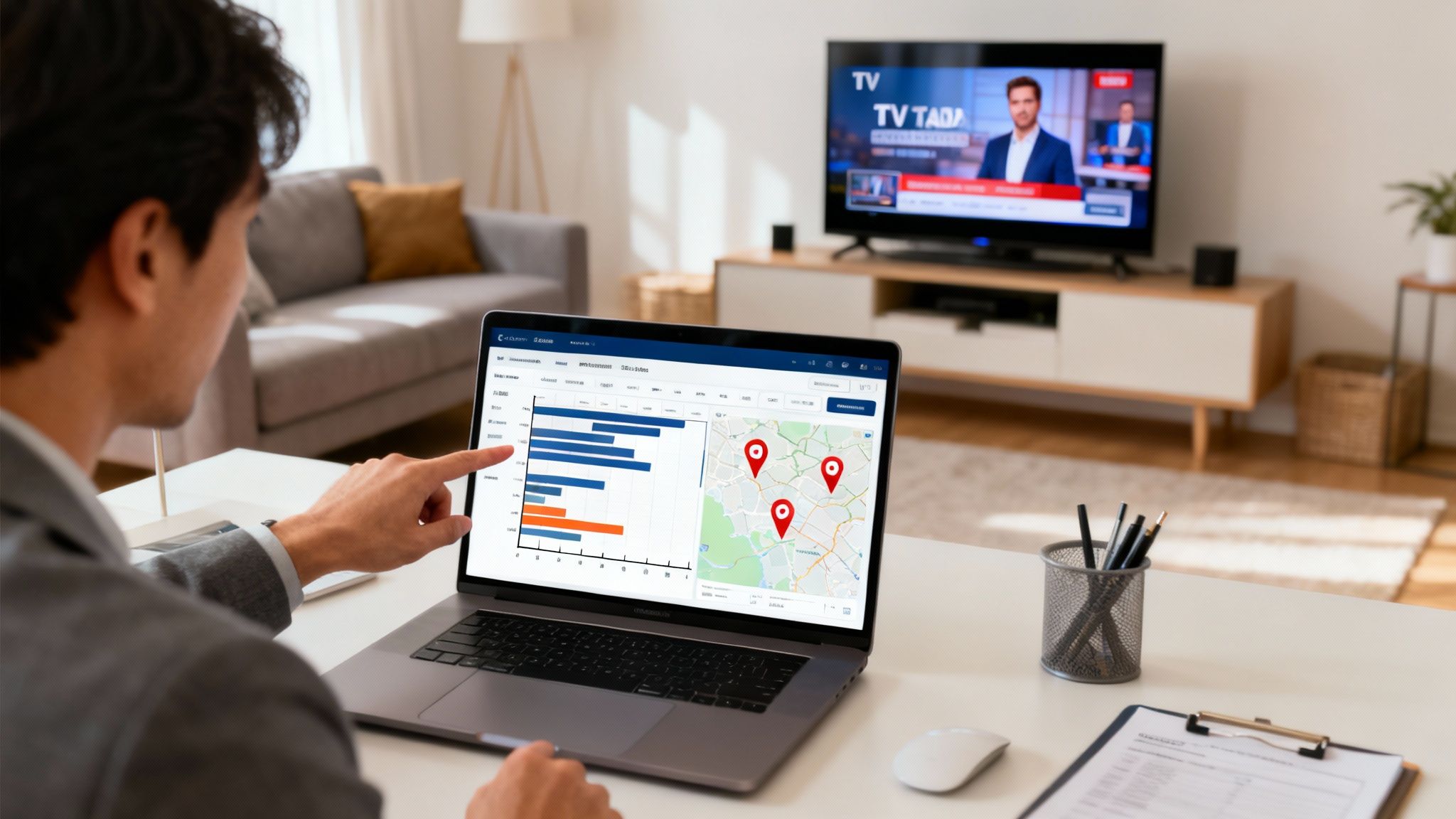
Plan where the commercial will run and how you will measure responses before buying media.
This final stage is all about media buying and distribution. It's the art and science of placing your ad on the right channels, at the right times, to reach the right people. This used to be a confusing, expensive, and often intimidating process, but the game has changed dramatically, especially with the explosion of streaming TV.
Navigating the Media Buying Landscape
The world of TV advertising is essentially split into two arenas: traditional broadcast/cable and modern streaming TV, often called Connected TV (CTV). Each has its own playbook for buying ad time and its own distinct advantages.
Knowing the difference is absolutely critical to spending your budget wisely.
Local Broadcast and Cable: This is classic TV advertising. You’re buying ad slots on specific local channels (like your city's NBC or CBS affiliate) or popular cable networks (like HGTV or ESPN) in your specific geographic market. The process usually involves getting on the phone with a station's sales rep and haggling over rates based on the show, time of day, and demand.
Streaming TV (CTV): This is where you place your ad on services like Hulu, Peacock, or through platforms that serve ads across hundreds of apps on devices like Roku or Apple TV. The biggest advantage here is the precise targeting (much like digital advertising) letting you reach viewers based on demographics, interests, and even their specific viewing habits.
Viewing habits are shifting under our feet. For the first time ever, global revenue from commerce media recently overtook traditional TV advertising. Streaming TV keeps grabbing a bigger piece of the pie, recently accounting for nearly 30% of total television revenue, a huge jump from 26.2% just the year before. You can dive deeper into these trends over at Adweek.com.
The Old Way vs. The Smart Way
Let's be honest, the traditional route for buying TV ad time is a headache. It's a complex dance of researching demographics, calling multiple station reps, negotiating rates for different time slots (a practice known as dayparting), and trying to track it all in a spreadsheet.
A prime-time spot during the local news might cost thousands, while an early morning slot could be a few hundred bucks. This complexity is exactly why so many small businesses have historically felt locked out of TV advertising.
This is where a modern platform like Adwave completely changes the equation. Instead of forcing you to become a media buying expert overnight, Adwave automates the entire process. It cuts out the need for painful negotiations and complicated scheduling by giving you direct access to premium ad inventory across more than 100 top-tier channels and streaming services.
The old model required business owners to be experts in media buying, a skill set they shouldn't need to have. We built Adwave to handle that entire complex process, so you can just focus on defining your customer and your budget, and let the platform do the rest.
Adwave’s system uses audience data to automatically place your commercial in front of the local viewers most likely to become your customers. It doesn’t matter if they're watching a live game on ESPN or binging a drama on Hulu, your ad finds them.
This makes the process not only simpler but far more effective. You can learn more about how this all works in our guide on how to buy TV advertising effectively.
Ad Distribution Method Comparison
Choosing how to get your ad on TV can feel overwhelming. This table breaks down the main options to help you decide which path is right for your business.
Each method has its place, but as you can see, modern automated platforms have opened up TV advertising for businesses that were previously sidelined.
For small businesses, this is a profound shift. It makes producing a TV commercial and getting it on air an achievable goal, even with a modest budget and without the steep learning curve. The power of television is no longer locked behind a gate of complexity and high costs; it's now accessible to any business ready to grow.
Got Questions About Making a TV Commercial? We’ve Got Answers.
Stepping into the world of TV advertising for the first time? It's a big move, and it's totally normal to have a ton of questions. Let's tackle some of the most common worries and misconceptions I hear from business owners, so you can make your decision with real confidence.
What’s the Real Price Tag on a TV Commercial?
This is always the first question, and thankfully, the answer has changed for the better. Not too long ago, you couldn't get a simple, professionally-shot local commercial made for less than $3,000 to $15,000. That was just for the production, it didn't even include the cost of running the ad on TV. That price tag alone kept most small businesses on the sidelines.
Today, the production cost can be next to nothing. Seriously. Modern platforms like Adwave use AI to generate a broadcast-ready commercial for you almost instantly. This completely removes the need for expensive film crews, actors, and all that fancy equipment. It means your entire budget can go where it counts: getting your ad in front of customers.
Can I Just Make a Decent Ad Myself?
You can, but it’s a massive time sink with a pretty steep learning curve. Your smartphone camera is probably amazing, but getting the lighting and sound right is a whole different ballgame. Nothing screams "amateur" like a shaky camera or muffled audio, and that can do more damage to your brand's reputation than running no ad at all.
Let's be honest, your time is better spent running your business, not learning to be a filmmaker. This is where automated tools really shine. They give you the polish of a professional agency without the DIY headaches or the agency price tag. Adwave provides the perfect middle ground, delivering professional results without the complexity.
Here's a tip from experience: Don't get so wrapped up in the creative side that you forget the business goal. A great ad isn't just pretty, it gets people to do something. Figure out your call-to-action first, then build the ad around it.
How Long Is This Whole Thing Going to Take?
The timeline for getting a commercial made is all over the map, depending on which path you choose.
Hiring a Traditional Agency: This is the scenic route. Expect it to take 4-8 weeks from the first meeting to having a finished ad. The process involves scripting, casting actors, location scouting, shooting, and a whole lot of editing.
Doing It Yourself (DIY): This can take anywhere from a few days to a few weeks. It really just depends on your own skills and how many hours you can realistically pour into shooting and editing.
Using an AI-Powered Platform: This is by far the fastest option. With a tool like Adwave, you can have a completed, ready-to-air commercial in just a few minutes.
That kind of speed is a useful option. You can react quickly and launch a campaign for a flash sale or seasonal event without the frustratingly long lead times of the old-school production process.
Is TV Advertising Even Worth It Anymore?
Absolutely. People might be watching TV differently now, but its power to build brand credibility and reach a huge local audience is still second to none. Plus, the boom in streaming services has added an incredible new layer: you can now target specific audiences with the kind of precision that used to be exclusive to online ads.
When you blend the wide reach of broadcast TV with the sharp targeting of streaming, you get the best of both worlds. You build that all-important name recognition across your community while making sure your ad is seen by the exact local customers who are most likely to walk through your door. That’s how you get a real return on your investment.


