You’ve published every Tuesday for three months. The subscriber chart creeps up, a few peers leave congratulatory comments, and your sales pipeline looks exactly as it did before you started. That gap between activity and revenue is where most LinkedIn Newsletter B2B programs die, not because the format doesn’t work, but because nobody defined what conversion was supposed to look like before the first issue shipped.
Why Most B2B LinkedIn Newsletters Stall
A founder I think of as the archetype didn’t fail for lack of effort. She wrote weekly, repurposed posts, and watched subscribers accumulate. The problem showed up in the subscriber demographics. Students, peers from other agencies, and job seekers made up most of the list, while the operations managers she sells to barely appeared. She’d built an audience, just not a buying one.
That pattern is frustrating because the channel itself is proven. The Content Marketing Institute’s 2026 B2B survey of 1,015 marketers, conducted June 24 to August 14, 2025 found 76% of B2B marketers considered LinkedIn one of their most effective publishing channels, ahead of email newsletters at 54% and speaking events and webinars at 52%. Being on the right platform clearly isn’t the differentiator. What you publish there, and for whom, is.
The Three Structural Mistakes
Stalled newsletters usually share the same faults, and none of them get fixed by publishing more often.
- A promise too broad to repeat: “Marketing insights for growing businesses” attracts everyone and obliges you to cover everything, so no reader feels the content was written for their specific problem.
- Subscribers treated as the scoreboard: A growing count feels like progress, but it says nothing about whether readers hold budget, sit in your target accounts, or ever take a qualified action.
- The newsletter as the whole strategy: When an issue only points readers to another LinkedIn post, you’ve built a closed loop that never reaches your website, your CRM, or a sales conversation.
Practical rule: If you can’t name the qualified action a good issue should produce, you don’t have a newsletter strategy yet. You have a publishing habit.
Success, realistically, looks less glamorous than a viral edition. It looks like a modest list where job titles match your buyers, a steady trickle of profile views from target accounts after each issue, comments from people who’d sit on a buying committee, and occasional replies that start real conversations. Those signals compound slowly, which is exactly why teams abandon newsletters at month three, right before familiarity starts doing its work.
Before committing months, run a simple fit test. Do your buyers spend professional attention on LinkedIn, can you sustain one useful idea per week without recycling platitudes, and does your business have a next step worth sending readers to? If any answer is no, fix that first. A deliberate playbook won’t rescue a channel mismatch, and casual posting definitely won’t.
Choosing a B2B Topic and Audience Promise
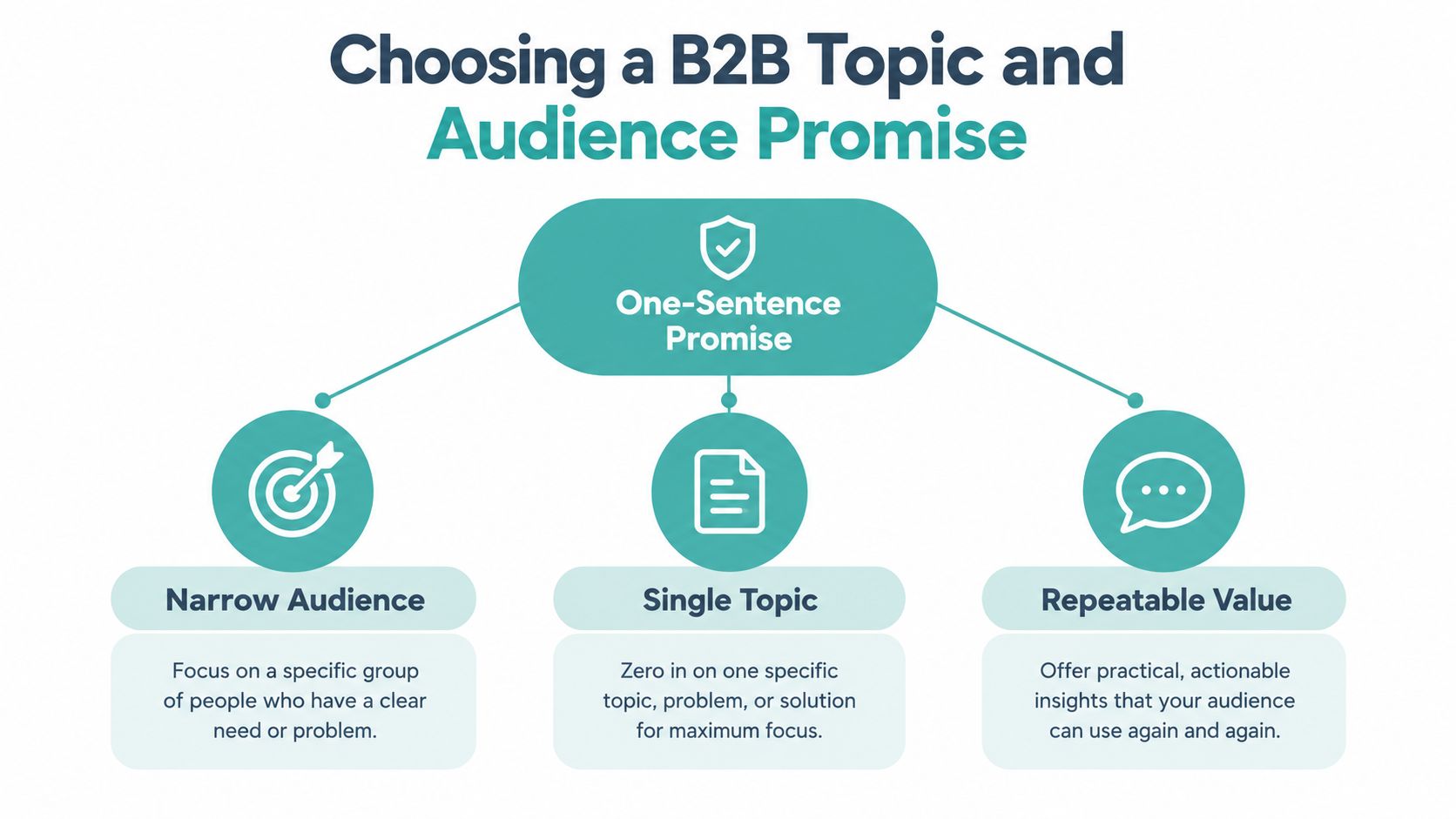
The best test of a newsletter topic is whether a stranger can repeat your promise after hearing it once. “Weekly growth tips” fails that test instantly. “One affordable TV advertising play per week for local business owners” passes, because the reader, the topic, and the recurring payoff are all visible in a single sentence. Everything in your LinkedIn Newsletter B2B setup flows from getting that sentence right.
The format supports this kind of focus. LinkedIn introduced newsletters for creators in 2021, letting eligible members publish recurring editions that followers subscribe to and receive through notifications and email alerts. The feature then expanded rapidly within LinkedIn’s creator ecosystem instead of staying limited to large media organizations. That history matters because it means small B2B teams now compete for the same subscription slot as established publishers, and generic positioning loses that contest.
Three Filters Before You Commit
Run every candidate topic through the same pressure test. It takes an afternoon and saves quarters.
- Budget: Does this reader control or influence spend on the problem you’ll write about? A newsletter read by people who can only admire your thinking won’t convert.
- Authority: Can the reader start an internal conversation, or are they three layers from anyone who can? Aim at least at the person who feels the pain weekly.
- Recurring problem: Does the pain return often enough to justify a subscription? One-time decisions make good lead magnets, not newsletters.
Next, mine material you already own. Sales call transcripts are the richest source because prospects describe problems in their own language, including the objections your marketing copy tends to sanitize. Pull the questions that appear repeatedly, cluster them under one topic pillar, and you’ll have issue ideas that already resonate. Support tickets and onboarding calls work similarly for post-sale audiences.
Then write the positioning statement in plain form. For [specific reader] who struggles with [recurring problem], this newsletter delivers [one repeatable payoff] every [cadence]. Read it aloud to someone outside your company. If they ask a clarifying question, tighten it.
Profile or Company Page
Publishing from a founder or expert profile generally earns warmer early engagement, since readers subscribe to a person’s judgment. A company page suits you better when the brand itself carries authority, multiple contributors will write, or the newsletter must survive staff changes. Neither is universally right. Pick based on where your credibility already lives, and don’t split effort across both at launch.
Before writing issue one, confirm your checklist. One reader segment, one pillar, a promise you can say in a breath, and a topic backlog drawn from real customer language. If any element is fuzzy, your first ten issues will expose it publicly.
Building a Repeatable Production Workflow
Newsletters rarely die from bad ideas. They die on a Thursday afternoon when nobody owns the draft, the headline, or the links. A workflow that a small team can run on a busy week beats an ambitious process that collapses by issue six, so design for your worst week, not your best.
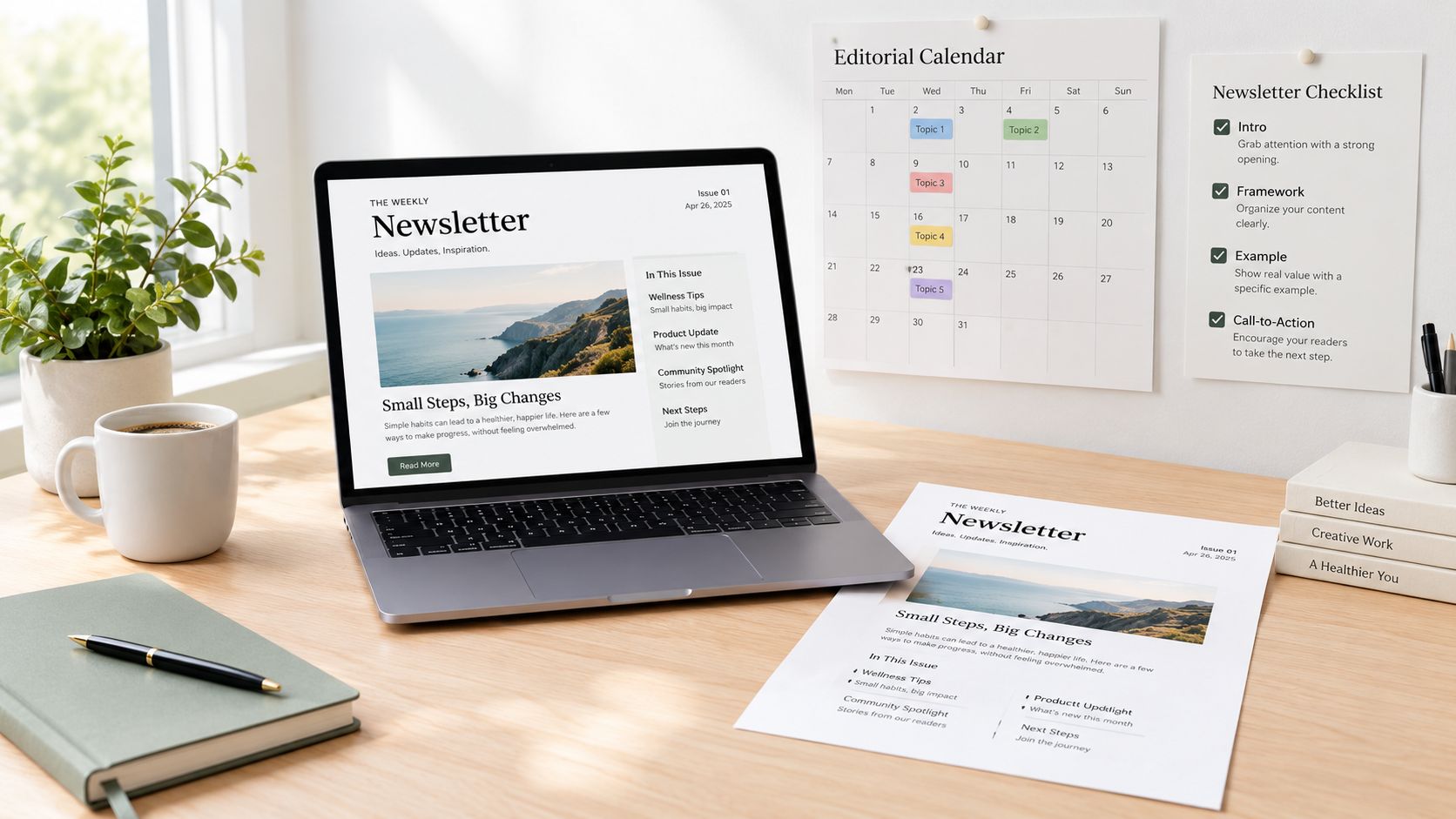
Start with cadence, because it constrains everything else. In a 12-client B2B SaaS dataset on newsletter strategy, weekly publishing retained more subscribers than biweekly or daily schedules. That same dataset found roundups reduced opens by 22 to 30% and multiple CTAs reduced click-through rates by 35 to 50%. Treat those figures as directional rather than universal, but the operational lesson is sound. One focused issue per week, built around one problem and one action, is easier to produce and easier to read.
A Template You Can Reuse Weekly
Keep the skeleton fixed and vary only the substance. Readers learn where to look, and your writer stops reinventing structure.
- Opening situation: Two or three sentences naming the reader’s current frustration in concrete terms.
- The framework or diagnostic: The core teaching, written as steps, questions, or a decision rule the reader can apply without you.
- A worked example: One realistic scenario showing the framework applied, including the trade-off involved.
- One primary CTA: A single next step matched to the issue, such as a calculator, a template, or a relevant case study.
Aim for 800 to 1,200 words per issue, long enough to teach something real and short enough to finish in one sitting. Headlines should lead with the benefit or the specific mistake being corrected, not with cleverness. “Why your second CTA is costing you clicks” outperforms “Some thoughts on newsletter design” because the reader can predict the payoff.
The Weekly Production Checklist
Assign each step a day and an owner. Source ideas from sales calls on Monday, approve a short outline before drafting, and write against the template rather than a blank page. Before publishing, add UTM parameters to every outbound link, check that the single CTA resolves correctly on mobile, and confirm the headline matches the promise in the opening lines.
After publication, spend fifteen minutes reviewing subscriber demographics, engagement, and click-throughs while the issue is fresh. Log one thing to change next week, not five. Teams planning further ahead can adapt a three-month content calendar template to bank topics in advance, which protects cadence during launches and holidays.
If your team only has a few hours weekly, cut scope before cutting consistency. A shorter issue with one sharp diagnostic still serves the promise. Skipping weeks, by contrast, trains subscribers to forget why they subscribed.
Growing Subscribers Organically and With Paid
Subscriber acquisition works best when you rank tactics by ICP fit first and volume second. A hundred subscribers who match your buyer profile will outperform a thousand who don’t, and paid spend applied in the wrong order buys the wrong audience faster.
You start with one built-in advantage. LinkedIn automatically sends followers an invitation to subscribe when they follow a member or page that publishes a newsletter. That prompt converts existing goodwill into subscriptions without extra spend, but only if your profile or company page makes the newsletter’s promise obvious. Put the one-sentence promise in your headline area and featured section so a new follower understands what they’re accepting.
Organic Engines That Compound
Founder and employee amplification works when it doesn’t read as a coordinated blast. Instead of everyone resharing the issue link, have individuals post their own takeaway or disagreement with one point, then mention the newsletter as where the full argument lives. Those posts reach different networks and give prospective subscribers a reason beyond loyalty.
Cross-promotion with adjacent, non-competing creators is the other durable lever. A newsletter for local retailers could swap mentions with one covering store operations, since the audiences overlap without competing for the same budget. Businesses in multi-location models face a similar targeting discipline, which is why a specialized franchise lead generation company can be a useful reference point for how tightly defined audiences change acquisition economics.
Distribution beyond LinkedIn matters too. Add the newsletter to email signatures, your website’s resources area, and post-webinar follow-ups. A structured approach to content distribution and getting eyeballs on what you create helps you sequence those touchpoints instead of scattering links randomly.
Paid Tests Without Burning Budget
Run paid only after organic data tells you which topics and headlines already pull qualified readers. Boost a proven issue to a narrow audience defined by job title, seniority, and company size, then calculate cost per subscriber against how many of those subscribers match your ICP. A cheap subscriber in the wrong industry isn’t cheap. It’s list pollution you’ll pay for later in skewed analytics.
Paid spend should accelerate a message that’s already converting the right people. It can’t fix a promise the right people ignore.
Set a small test budget, define the ICP-fit threshold you’ll accept before spending, and kill underperforming boosts quickly. The priority order stays constant. Organic earns trust and proof, paid accelerates reach, and only ICP-fit subscribers ever become pipeline.
Integrating Your Newsletter Into a Wider B2B Awareness Stack
A newsletter confined to LinkedIn competes for the same few minutes of feed attention every week. The stronger play treats each issue as the start of a sequence, where your website, email list, and higher-attention channels carry the message to places the feed can’t reach.
The layers do different jobs. Short feed posts create discovery but evaporate quickly. The newsletter builds depth and a subscription relationship. Your website hub captures search intent and houses the tools your CTAs point to, while email sequences nurture readers who’ve raised a hand. Television sits at the opposite end from the feed entirely, delivering repeated local exposure in an environment where your competitors’ posts don’t exist.
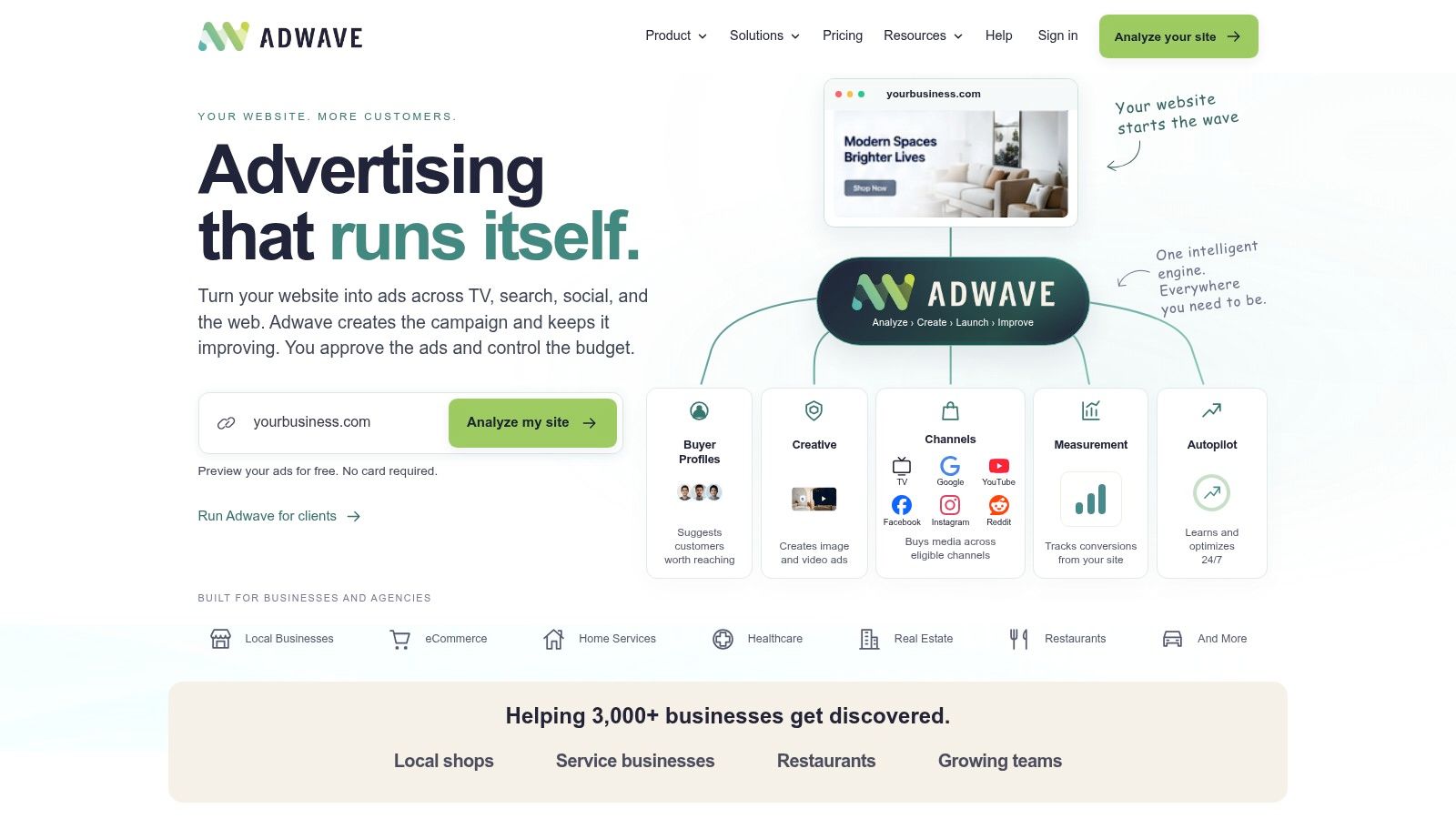
That top layer costs less than most small B2B teams assume. Adwave’s AI-powered platform turns a website into a broadcast-ready TV ad, places campaigns across more than 100 premium channels, and starts campaigns at $50 with automatic pacing that keeps spend inside the set budget. Its stated estimated $15 to $35 CPM puts periodic broadcast flights within reach of businesses that already invest in content.
Sequencing the Channels Together
Practical integration is mostly a calendar exercise. Publish the issue that teaches your framework, run the matching TV flight in the same local market during the following days, and support both with short LinkedIn posts that quote the issue’s sharpest line. Readers who saw the newsletter recognize the ad. Viewers who saw the ad arrive at your profile already primed. A deeper treatment of LinkedIn marketing for small B2B companies can help you fit the newsletter into that broader presence.
Reuse works in both directions. The issue’s central framework becomes the on-air creative’s single message, since a spot can’t carry five ideas anyway. Questions your sales team hears after a TV flight become future issue topics, closing the loop between broadcast curiosity and educational depth. If you need outside production or media support while building that stack, compare quotes against a published scope of work: Leaping Lemur Media lets you browse our service offerings so you can weigh outside capacity against what your team ships in-house.
The discipline is giving every channel one job. The newsletter teaches, the website converts, email nurtures, and TV makes your name familiar before the sales conversation starts. When each layer points to the next, a modest LinkedIn Newsletter B2B audience becomes the core of a multi-screen local presence rather than an isolated content project.
Measuring Newsletter Impact Beyond Opens and Subscribers
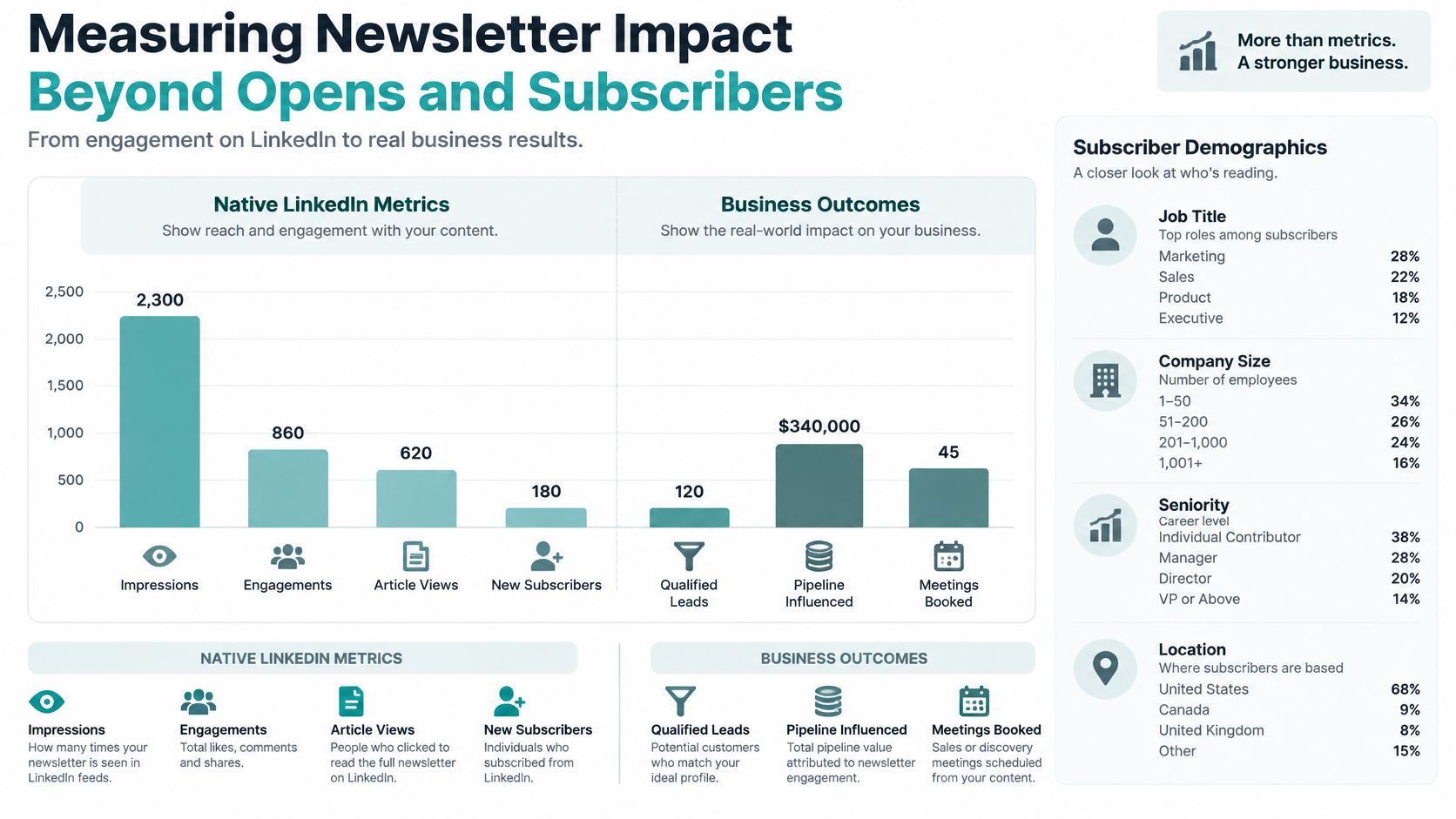
Here’s the uncomfortable part most guides skip. LinkedIn’s native analytics report impressions, engagements, article views, new subscribers, and subscriber demographics such as job title, company size, seniority, and location. That’s useful distribution data. It does not, by itself, prove your newsletter influenced a single deal.
Even the delivery numbers need careful reading. Each publication can generate an email, push alert, in-app notification, and feed placement, but delivery depends on each subscriber’s global notification settings, so some subscribers only ever see in-app alerts. Broader open-rate benchmarks cluster around 40 to 70% for well-positioned topics, yet LinkedIn guarantees no specific inbox reach. Treating subscriber count as guaranteed audience is the first measurement error.
Build a Qualified-Action Dashboard
Track signals that sit closer to revenue, and tag them consistently in your CRM from the first issue.
- Audience quality: Share of subscribers matching your ICP by title, seniority, and company size, reviewed monthly rather than celebrated as a raw total.
- Account signals: Profile views, comments, and connection requests from people inside target accounts in the days after each issue.
- Attributed actions: UTM-tagged landing page visits, resource downloads, demo requests, and campaign starts, recorded as newsletter-sourced or newsletter-influenced.
- Pipeline influence: Meetings and opportunities where a contact engaged with the newsletter beforehand, compared against similar unexposed accounts over the same period.
That last comparison matters because direct clicks undercount the format. Repeated exposure creates familiarity that often surfaces later as branded search, direct traffic, or a warmer first sales call, none of which credit the issue that caused them. The mechanics behind why roofers need conversion tracking illustrate the same principle in a local-services context. Without deliberate tracking, the touchpoints that preceded revenue stay invisible.
Use LinkedIn’s two-year availability window for edition analytics to study trends across topics instead of reacting to isolated spikes. Pair that history with a clear-eyed view of which social media metrics actually matter, and review the dashboard monthly with one question in mind. Is this audience producing qualified actions at a cost you’d accept from any other channel?
Your 90-Day LinkedIn Newsletter B2B Launch Plan
Ninety days is enough to learn whether your newsletter deserves flagship status, provided each phase has a distinct job.
Weeks one through four are foundations. Finalize the promise, set up the profile or company page, confirm the follower-to-subscriber prompt is working, and publish your first four issues on schedule. Before issue one, verify UTM conventions, CRM tagging for newsletter-sourced contacts, and a single destination page for your primary CTA.
Weeks five through eight are growth. Add employee amplification, arrange one cross-promotion, run a small paid test behind your best-performing issue, and connect the newsletter to your website hub and any coordinated awareness campaigns.
Weeks nine through twelve are optimization. Review subscriber demographics against your ICP, compare topic performance, and examine qualified actions rather than raw views. At day 30, success means cadence held and the right titles are subscribing. At day 60, it means repeatable engagement from target accounts. At day 90, it means tagged conversations or influenced opportunities you can point to. If those signals exist, scale. If only vanity numbers moved, change the promise before spending another quarter.
Your newsletter can teach local decision-makers how to grow, and Adwave can carry that same message onto television, turning your website into a broadcast-ready ad placed across premium channels with campaigns starting at a level small businesses can test. Pair the trust your LinkedIn Newsletter B2B program builds each week with the familiarity that on-air reach creates, and readers start recognizing your name long before the first sales call. Visit Adwave to launch your first campaign and put your best newsletter idea in front of the local audience it was written for.