
LinkedIn Marketing for Small B2B Companies starts with one uncomfortable truth. If you're spreading limited time across every social platform, you're probably diluting your best chance at pipeline.
LinkedIn generates 80% of all B2B social media leads, and its visitor-to-lead conversion rate is 2.74%, which is 277% higher than Facebook and Twitter combined. For a small team, that changes the conversation. LinkedIn isn't just a place to post updates. It's where a smart founder, marketer, or salesperson can build trust, start conversations, and create revenue with a lean weekly system.
The key is not doing more. It's doing fewer things with more intent. A practical LinkedIn program for a small B2B company can fit into a tight schedule when you combine a credible profile, a simple content rhythm, founder-led engagement, and selective paid amplification.
Why LinkedIn Is Your Most Important B2B Marketing Channel
A small B2B team usually has less than five hours a week to spend on marketing that might turn into revenue. That constraint changes the channel decision fast. LinkedIn earns priority because it lets you reach named buyers in a business context, start conversations without a large ad budget, and track whether that activity turns into meetings, opportunities, and closed deals.
The practical advantage is targeting quality. On LinkedIn, you can see a prospect's role, company, industry, and often the problems they talk about in public. That cuts wasted effort. A founder commenting on posts from operations directors at 200-person manufacturers is far more useful than publishing generic updates into feeds filled with consumers, job seekers, and unrelated audiences.
For a lean team, LinkedIn handles three revenue jobs at once.
It builds trust before the first call. Prospects check profiles, recent posts, and mutual connections before they reply.
It creates demand before buyers raise a hand. Consistent visibility keeps your company familiar during long B2B buying cycles.
It captures intent without much friction. A prospect can move from a post, to a profile, to your site, to a booked call in a few clicks.
I advise clients to treat LinkedIn like a working sales asset, not a content chore. In practice, that means a simple weekly system. One founder post. Meaningful comments on posts from target accounts. A few direct follow-ups with people who engaged. Then a small paid push behind the post or offer that already proved it can get attention. Done well, this can fit inside a four to five hour block and still produce measurable pipeline.
Organic activity and paid activity work better together than either does alone. Organic posts give buyers proof that real people stand behind the business. Paid campaigns give you controlled reach into a narrow audience when you want more scale. If your market is local or regional, there is another useful angle. LinkedIn can create the first touch and affordable TV can reinforce credibility later. That combination helps small B2B brands stay visible both online and off platform without enterprise budgets.
Coordinate LinkedIn posts with your sales follow-up so prospects receive relevant information.
Build Your Foundation for B2B Trust
Before you publish a single post, fix the assets buyers check first. Most small companies lose momentum on LinkedIn because their profile looks like a resume and their Company Page looks abandoned.
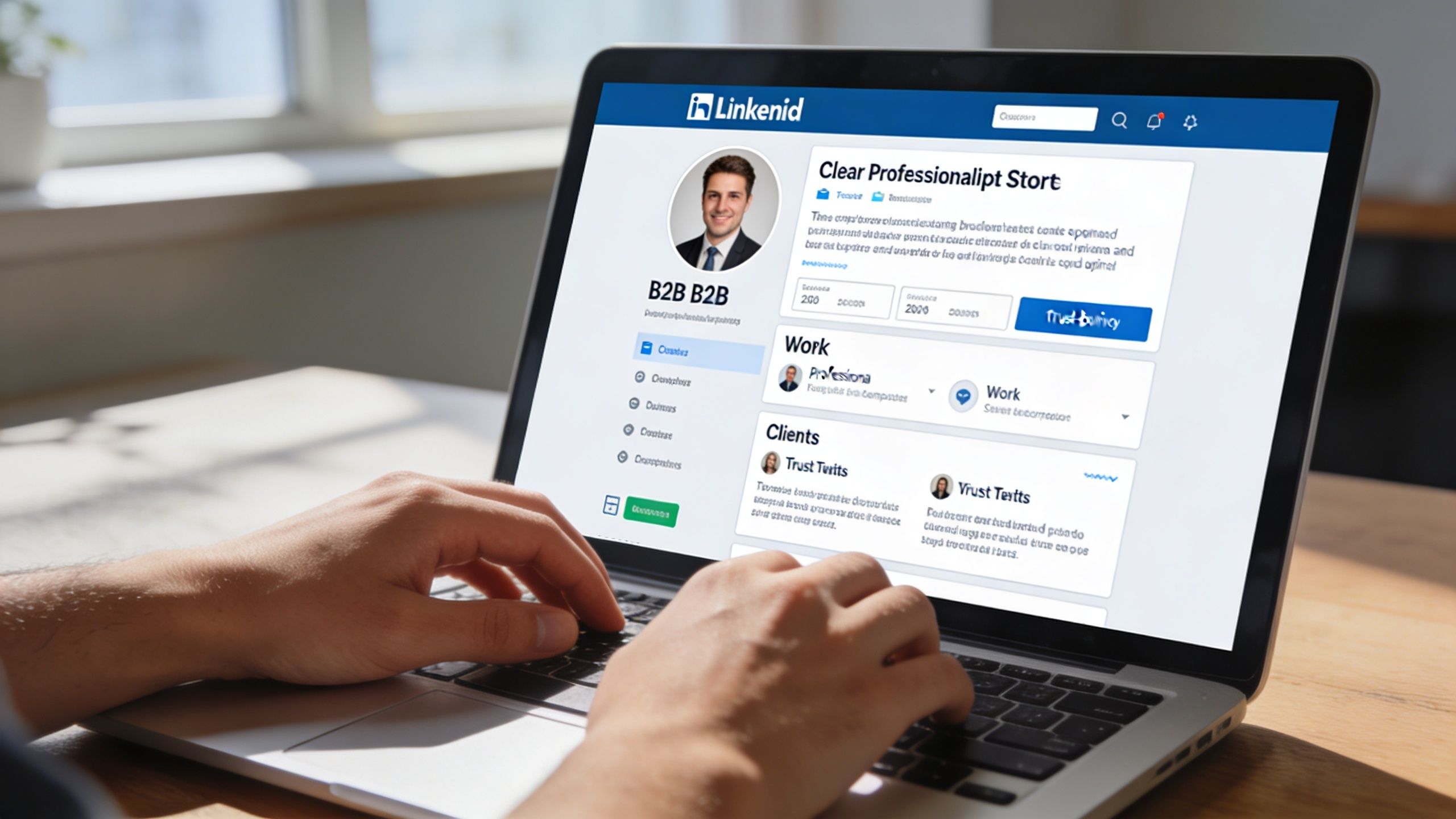
A buyer rarely reads everything. They scan for evidence. They want to know what you do, who you help, whether you understand their problem, and whether anyone should trust you.
Fix the founder profile first
For most small B2B companies, the founder profile outperforms the Company Page in early-stage relationship building. Buyers trust people before they trust logos.
Use this checklist:
Rewrite the headline Don't use a job title alone. "Founder at X" says almost nothing. A stronger headline states the market, the problem, and the outcome. Keep it buyer-facing, not career-facing.
Change the About section Open with the problem your customers are trying to solve. Then explain your approach, the kinds of clients you work with, and what someone should do next if they want to talk.
Make the Featured section useful Add a strong proof asset. That might be a case study, a short explainer, a service page, or a founder post that clearly shows your point of view.
Clean up the experience section Write each role like a buyer would read it. Focus on services, industries served, and practical outcomes, not internal responsibilities.
People don't convert from polish alone. They convert when your profile reduces uncertainty.
Make the Company Page look alive
The Company Page isn't your main sales engine at first, but it still matters. Prospects check it when validating whether the business is real and active.
A strong Company Page needs:
Clear positioning: Say who you help and what problem you solve.
Consistent visual identity: Banner, logo, and description should feel current.
Recent activity: Even a small stream of useful updates is better than silence.
Simple next step: Send people to a relevant page, not a generic homepage if you can avoid it.
Here's a quick comparison.
What strong foundations do
A better profile won't generate pipeline by itself. But it raises the conversion rate of everything else you do. Posts work harder. Connection requests get accepted more often. DMs feel less cold.
If you need help sharpening the personal side of this, Adwave has a practical resource on how to promote my personal brand that aligns well with founder-led B2B marketing on LinkedIn.
Develop Your Organic Content Rhythm
Most small teams fail on LinkedIn content for a predictable reason. They try to create too much from scratch, too often, with no repeatable format.

The fix is a rhythm, not a content machine. You need a few formats you can produce consistently in under five hours a week, with one clear goal. Help the right buyer understand your expertise.
For optimal organic reach, structure posts with short paragraphs and aim for 900 to 1,200 characters. Data from 2026 shows carousel posts generate 11.2x more impressions, and embedding 3+ useful links can boost performance by 236%. That gives small teams a practical template. Keep posts readable. Use formats that carry more information. Give people somewhere useful to go next.
A simple three-post weekly rhythm
This works well for service firms, agencies, consultants, software companies, and local B2B operators.
Monday Share a problem-solution post. Pick one recurring buyer pain point and explain how you diagnose it or fix it.
Wednesday Publish a proof post. This can be a mini case study, a before-and-after workflow, or lessons learned from a client engagement. Keep it specific, but don't force numbers if you don't have permission or clean attribution.
Friday Post a point-of-view piece. Comment on a market trend, a buyer misconception, or a common mistake in your category.
That mix keeps you from sounding repetitive. It also gives buyers three different reasons to pay attention.
Formats that work for busy teams
Not every post type deserves your time. Prioritize the formats that are easiest to create and easiest to understand.
A practical approach is to create one strong idea, then adapt it into two formats. For example, turn a client question into a text post, then into a carousel the following week.
Good LinkedIn content doesn't read like an ad. It reads like a useful conversation with someone who knows the work.
How to write posts people finish
Small changes matter more than "creative genius" here.
Use short paragraphs. Open with the tension or problem. Write like you're speaking to one buyer in one situation. Avoid company slogans, inflated claims, and generic motivation. If a sentence could appear on any competitor's page, cut it.
A repeatable structure looks like this:
Start with a sharp observation.
Name the mistake or missed opportunity.
Show your reasoning or process.
End with a practical takeaway or a soft CTA.
If you need help organizing this into something manageable, this guide on how to create a social media content calendar in 30 minutes is a strong operational companion.
What not to do
Three habits usually drag performance down:
Posting only promotional updates: Buyers ignore posts that ask for attention before earning it.
Writing in dense blocks: Even good ideas lose momentum when they're hard to scan.
Abandoning the Company Page: Your founder profile may lead, but the company presence still supports trust.
For LinkedIn Marketing for Small B2B Companies, the target isn't viral reach. It's steady authority. If the right people start recognizing your name, understanding your offer, and replying when you reach out, the system is working.
A Founder's Playbook for Proactive Engagement
A small B2B company can get more from LinkedIn by spending less time posting and more time engaging with the right people. That's especially true when the founder is involved.
The most effective founders on LinkedIn don't pitch strangers all day. They build familiarity in small, repeated touches. They show up in comments. They connect with people who look like current customers. They send short, relevant messages after a real interaction, not before one.
While organic reach has declined for many, small teams can outperform by using look-alike analysis on existing clients to find new prospects without paid tools. Stacking this with carousel posts and personalized outreach can secure calls with ideal accounts for minimal cost.
Start with the clients you already like
Open your current client list and ask three questions:
Which job titles tend to buy from us?
Which industries close faster or stay longer?
Which company types understand our value quickly?
That becomes your manual look-alike model. You don't need paid software to start. LinkedIn's free search is enough to identify similar people and companies.
For example, if your best clients are operations leaders at multi-location service businesses, search for that pattern directly. Save a shortlist. Follow their activity. Watch what they post about. Then engage before you send any request.
A practical weekly engagement flow
This is a strong cadence for a founder with limited time:
Monday: Review your shortlist and send a few connection requests to relevant people you've interacted with or have a clear reason to know.
Midweek: Leave thoughtful comments on posts from prospects, partners, and industry voices.
Friday: Send a small number of follow-up messages to people who engaged with your content or accepted your request.
The message should be simple. Mention the context, acknowledge something specific, and offer a useful next step only if it fits.
"Saw your post on local lead quality. The point about slow follow-up was spot on. We've seen the same pattern. Happy to share the framework we use if it's useful."
That works better than a pitch because it sounds like a person, not an automation.
What founders get wrong in DMs
The usual mistakes are easy to spot:
Sending a sales message right after connecting.
Writing long paragraphs no one wants to read in their inbox.
Asking for a call before establishing any relevance.
Ignoring comments and only focusing on direct messages.
Comments often do the heavy lifting. A strong comment can put you on a prospect's radar with less friction than a cold DM.
If your team needs a tighter process for handling replies, comments, and inbox conversations, Adwave's guide to responding to DMs and comments fast for better social customer service is worth applying.
The goal isn't volume
You don't need hundreds of new connections a week. You need a shortlist of people who resemble your best-fit buyers and a habit of becoming familiar to them.
For LinkedIn Marketing for Small B2B Companies, founder-led engagement is often the most valuable free tactic available. It costs attention, not media spend. Done well, it creates warmer sales conversations before anyone books a call.
Run Smart LinkedIn Ad Campaigns on a Small Budget
Paid LinkedIn only works for small B2B companies when you stop treating it like a brand-awareness lottery and start treating it like controlled amplification.
The common mistake is launching ads before you know what message resonates. If your offer hasn't earned organic engagement, ads usually just help you spend money faster. Start with a post, document, or case study that already got traction. Then put a modest budget behind that asset.
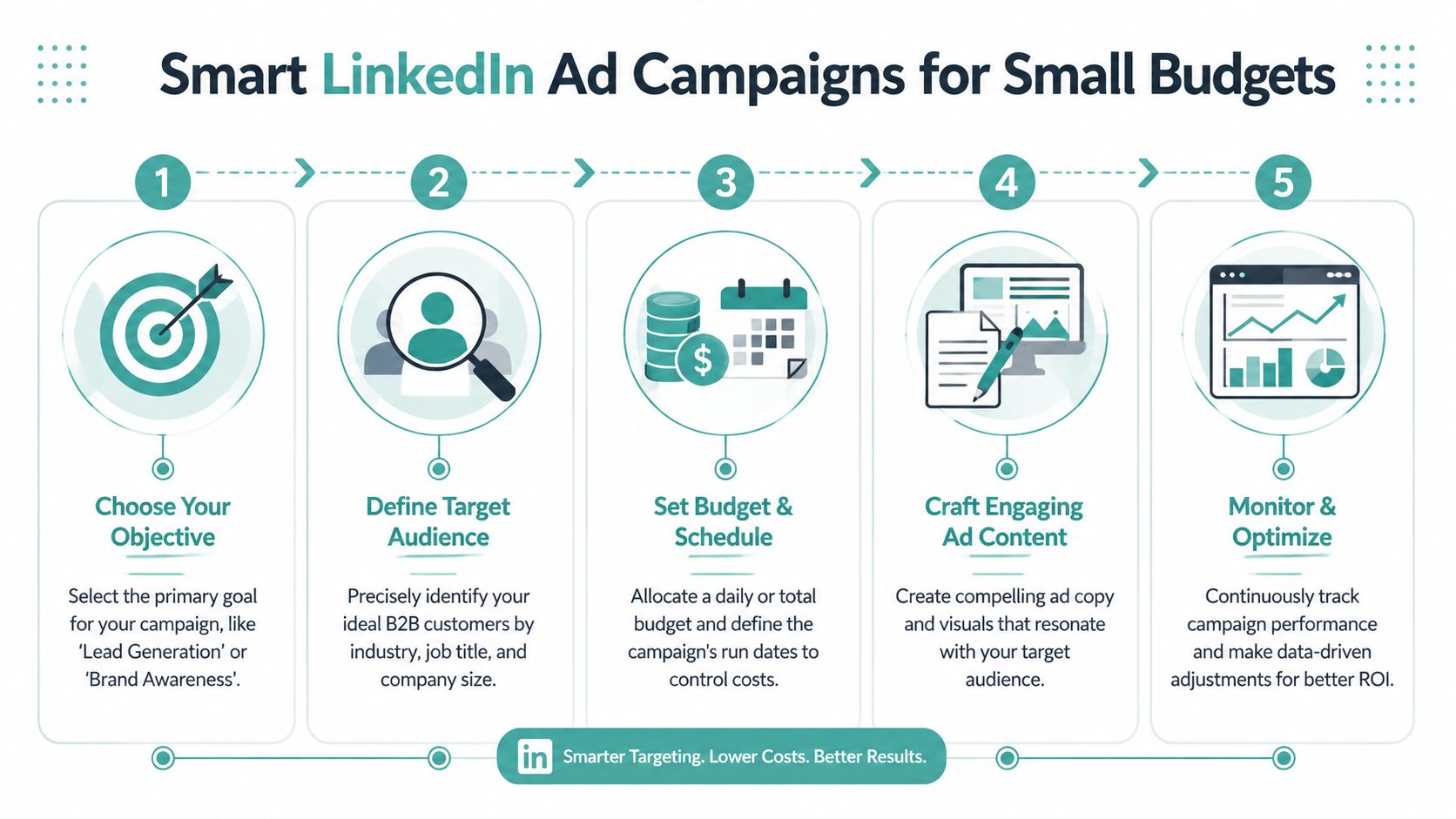
Small B2B firms can achieve high ROI by amplifying their best organic posts with a $50/day budget. For precise lead generation, target by Job Title, Industry, and Company Size, aiming for a 2 to 5% CTR. That's the right mental model for a small team. Start narrow. Learn fast. Expand only after you see evidence.
Choose the right campaign objective
Don't overcomplicate the setup. Pick one objective tied to one business outcome.
If you're early, engagement or website visits are often simpler tests than direct lead gen. They let you validate audience-message fit before tightening the ask.
Build a small, focused audience
LinkedIn demonstrates its worth. For small B2B campaigns, broad targeting usually wastes budget. Use audience filters that match how your best deals happen.
Start with:
Job title: The role most likely to feel the pain you solve.
Industry: The sectors where your language and proof already resonate.
Company size: The size band that can buy and implement your offer.
Location: Your selling region, especially if delivery or reputation is local.
A local agency, consultant, or platform serving retailers might target marketing managers or founders in retail businesses within a defined area. A service provider selling into home services might target owners and operators in nearby markets.
Use simple creative that teaches first
The ad itself doesn't need to look expensive. It needs to be clear.
Good ad creative for LinkedIn usually does one of these well:
Shows a process.
Explains a buyer mistake.
Highlights a case-study lesson.
Offers a useful resource tied to your service.
Carousel format is especially strong when you need to explain a workflow or break down an offer. If you want practical ideas for sequencing that format, this guide on driving lead gen with carousel ads is useful.
Promote what already earned attention organically. Don't ask ads to rescue weak positioning.
A budget discipline that works
A small team shouldn't launch multiple audiences, multiple offers, and multiple creative angles at once. That makes learning impossible.
Use a tight testing loop:
Week 1: Promote one proven post to one audience.
Week 2: Review click quality, lead quality, and audience fit.
Week 3: Adjust one variable only. Usually the hook, image sequence, or audience filter.
Week 4: Scale the winner or stop it.
As LinkedIn traffic is expensive to waste, even when your daily budget is modest, you're not trying to "be everywhere." You're trying to identify one combination of audience, message, and asset that reliably starts sales conversations.
What small-budget advertisers should avoid
Three problems show up constantly.
First, running cold ads to a vague homepage. Send traffic to a page that matches the ad's promise.
Second, targeting everyone with a title that sounds senior. Relevance beats prestige.
Third, judging success only by clicks. A campaign that produces fewer but better-fit conversations can still be the better investment.
Paid LinkedIn works best as an amplifier, not a replacement for your organic and outbound motion. When your profile builds trust, your content clarifies value, and your outreach creates familiarity, ads have something real to accelerate.
Measure ROI and Amplify Your Reach with TV
B2B buyers rarely convert from a single LinkedIn click. They see a post, check the founder's profile, notice a comment thread, visit the site later, and respond after another touch. If you do not track that chain, LinkedIn starts to look expensive when it is doing the early-stage work that creates pipeline.

For a small team, measurement has one job. Show which activity led to sales conversations and revenue, so you can keep the parts that work and cut the rest.
Track the full path. That means organic posts that drive profile visits, founder comments that trigger direct messages, paid campaigns that assist a booked meeting, and follow-up touches from email or sales outreach that close the deal. LinkedIn is often the channel that creates recognition before a prospect is ready to act.
What to track each month
Keep the scorecard tight enough to review in 20 minutes.
Inbound signals: Contact form fills, demo requests, and direct messages that mention LinkedIn
Sales movement: Meetings booked, qualified opportunities, proposal-stage deals, and closed revenue tied to LinkedIn touches
Content quality: Profile views from target accounts, saves, replies from buyers, and repeat engagement from the same companies
Paid efficiency: Cost per qualified meeting or opportunity, not just cost per click
A simple spreadsheet is usually enough at this stage. I prefer one row per lead source touchpoint, one owner, and one outcome. That gives a small team an usable view of pipeline influence without paying for a heavy reporting stack.
If you need a practical model for assisted attribution, this guide on how SaaS teams measure social ROI is worth reviewing.
Why the LinkedIn plus TV mix works
This article has focused on a lean system: consistent organic content, founder-led engagement, and small-budget paid distribution. TV fits that system when you use it as amplification, not as a separate brand exercise.
LinkedIn gets you in front of specific buyers. Affordable TV or streaming builds familiarity in the same geography or category. That combination matters for small B2B companies because buyers often need multiple proof points before they trust a lesser-known vendor.
Here is the practical version. A founder posts weekly on LinkedIn for operations leaders in one region. The company promotes the best post to a narrow audience with a modest budget. Then it runs affordable local TV or streaming spots in that same market. Prospects who saw the founder on LinkedIn now see the brand again on another screen. Recognition goes up, and sales calls start warmer because your company feels established before the first meeting.
That is the cross-channel effect you want to measure. Ask every qualified lead how they heard about you. Check direct traffic lift during TV flights. Compare branded search volume, inbound conversion rate, and reply quality before and after campaigns run together. You are looking for patterns, not perfect attribution.
For many small teams, TV sounds out of reach until they price modern options. It is often more accessible than expected, especially when you already know which audience and message LinkedIn has validated.
If you want to extend a proven LinkedIn message into affordable local TV, Adwave helps make that jump without a traditional production process or a large media budget. That makes it a practical next step when your reporting shows LinkedIn is creating demand and you want more buyers to recognize your brand before the sales conversation starts.


