

Compare Mailchimp, Klaviyo, and Constant Contact according to your contact model, automation needs, and budget.
For e-commerce stores, the answer is almost always Klaviyo. For service-based businesses or anyone needing a great all-around tool, Mailchimp is a reliable workhorse. And for those just dipping their toes in the water, Constant Contact offers the most straightforward path to getting started. A smart strategy often involves pairing these tools with powerful top-of-funnel platforms like Adwave to create a connected customer journey from first glance to final sale.
Choosing Your Email Marketing Platform in 2026
Let's be clear: selecting your email marketing software is a foundational business decision, not just a tech purchase. This platform becomes the very engine of your customer relationships, responsible for turning casual visitors into dedicated followers and one-time buyers into repeat business. A good tool doesn't just send emails; it has to fit perfectly into your entire marketing workflow.
Think about it. After you've invested in a TV advertising campaign with a partner like Adwave to build brand awareness and drive traffic, your email platform is what captures that interest. It’s the tool that has to nurture those hard-won leads. This guide gives you an honest, hands-on comparison of these three industry leaders to help you find the right fit for your specific needs in 2026.
Quick Decision Guide Mailchimp vs Klaviyo vs Constant Contact
Before we dive deep into the specific features, let's start with a high-level look. This quick guide is designed to help you immediately see which platform aligns best with your business model. It's the same starting point I use when advising clients.
The right email platform acts as the final link in your marketing chain, converting the awareness generated by channels like TV advertising into measurable revenue and customer loyalty. It’s the bridge between initial interest and long-term engagement.
Each tool has carved out its own area of expertise. Klaviyo is built from the ground up for e-commerce, Mailchimp excels as a jack-of-all-trades with fantastic creative tools, and Constant Contact wins on sheer simplicity and support for beginners. By pairing any of these with a robust awareness tool like Adwave, you create a detailed marketing system.
Here’s a simple breakdown to get you pointed in the right direction:
While this table gives you a great starting point, the devil is in the details, especially as your business grows. Understanding the nuances is what will make the difference between a tool you tolerate and one you love.
If you're just starting to build out your strategy, you might find our guide on email marketing for small businesses to get started in 2026 helpful. Now, let's get into the nitty-gritty of what really separates these platforms.
Where the Real Power Lies: Automation and Segmentation
Compare how each platform builds segments and triggers automated messages. (Constant Contact)
Check how quickly segments update before relying on behavior-triggered campaigns. Test the delay between a customer action and the follow-up message. (Klaviyo versus Mailchimp segmentation speed)
This isn't a minor detail. That speed difference directly impacts how fast you can react to customer behavior, which can be a useful option for time-sensitive promotions.
From Basic Triggers to Advanced Customer Journeys
Automation is so much more than a "welcome" email. It's your opportunity to map out an entire customer journey, and the depth of these tools varies wildly across the board.
Constant Contact: Gives you the essentials. Think straightforward, pre-built automations for a simple welcome series or a birthday greeting. It gets the basic jobs done, but it lacks the complex, conditional logic you need for more sophisticated marketing.
Mailchimp: Steps it up significantly with its "Customer Journeys." These are powerful, templated workflows with branching logic based on whether someone opens, clicks, or buys something. It’s a fantastic middle-ground for most service businesses and retailers who want reliable, multi-step campaigns without having to build every single step from scratch.
Klaviyo: This is where you get the keys to the kingdom. Klaviyo's visual "Flow" builder is the most advanced and flexible of the three, allowing you to create specific, behavior-driven sequences. With virtually unlimited branches and triggers, you can build workflows based on almost any action, from viewing a specific product to using a certain discount code.
If you run an e-commerce store, this kind of power isn't a luxury, it's essential. Klaviyo lets you build hyper-targeted flows for abandoned carts, post-purchase follow-ups, and win-back campaigns that respond instantly to what a customer is doing on your site.
The Art of Precision: Who Are You Talking To?
How well you can slice and dice your audience list determines how relevant your messages feel. While all three platforms offer segmentation, their capabilities feel worlds apart and directly impact both your campaign's success and your team's workload. If you want to brush up on the fundamentals, we have a great guide on sending the right message to the right people with email list segmentation.
Let’s put this into a real-world context. Say a local retailer runs a TV ad on ESPN using Adwave to promote a new line of running shoes. People see the ad, visit the website, and a few of them add the shoes to their cart but don't check out.
With Klaviyo: The system would instantly recognize a user who came from the TV ad (via tracking), looked at the shoe page, and abandoned their cart. Within minutes, an automated email is on its way, referencing the exact shoes they were looking at, maybe even with a special offer tied back to the TV spot.
With Mailchimp: You could get close, but it would involve more manual work. While its segmentation is strong, the data doesn't update in real-time. You'd likely have to manually refresh your audience segments to capture those abandoners before sending the email, possibly missing that critical window of high intent.
With Constant Contact: The platform’s segmentation is much more basic, focusing on list membership, contact info, and email engagement. Trying to build a dynamic segment based on real-time website behavior and ad attribution would be a serious challenge, likely requiring other tools to make it happen.
When you're comparing Mailchimp vs Klaviyo vs Constant Contact, the decision often boils down to this: how quickly do you need to act on what your customers do? For businesses trying to connect top-funnel advertising like Adwave with immediate email marketing, Klaviyo's speed is a clear and powerful advantage.
Getting Real About the True Cost of Growth
Picking an email platform is about more than the features you get on day one. It's about figuring out how the pricing will scale with your business. That tempting low entry price can quickly balloon as your audience grows, and the real cost of a platform shows up once you start getting serious about your marketing.
One of the biggest "gotchas" is how these platforms count your contacts. This is a detail often buried in the fine print, but it can make a massive difference to your monthly bill. If one person is on three different lists, are you paying for one contact or three? For any business keeping a close eye on the budget, the answer to that question is everything.
How They Count Your Contacts (And Your Money)
This is where things get interesting. A real estate agent, for example, might keep separate lists for first-time buyers, luxury property sellers, and past clients. How the platform bills for this common practice is a huge point of difference.
Check how each platform bills contacts. Mailchimp counts contacts per audience; Klaviyo uses a unified profile across lists and segments.
Costs can diverge quickly as your contact list grows.
At 15,000 contacts, Mailchimp’s Standard plan is about $200/month, while Klaviyo is around $350/month.
But if you're managing multiple overlapping lists, that Mailchimp bill can get inflated fast.
For businesses that rely on sophisticated segmentation (like retailers running targeted promotions or a brokerage managing buyer, seller, and newsletter lists) Klaviyo's approach is often more cost-effective in the long run. It’s a model built for complexity without punishing you for it.
Key Takeaway: Klaviyo’s unified contact profile is built for complex segmentation without inflating costs. Mailchimp’s model can become expensive if you maintain multiple, overlapping audience lists.
This difference in philosophy extends to performance, too. How quickly a platform updates your segments determines how fast you can react to customer behavior.
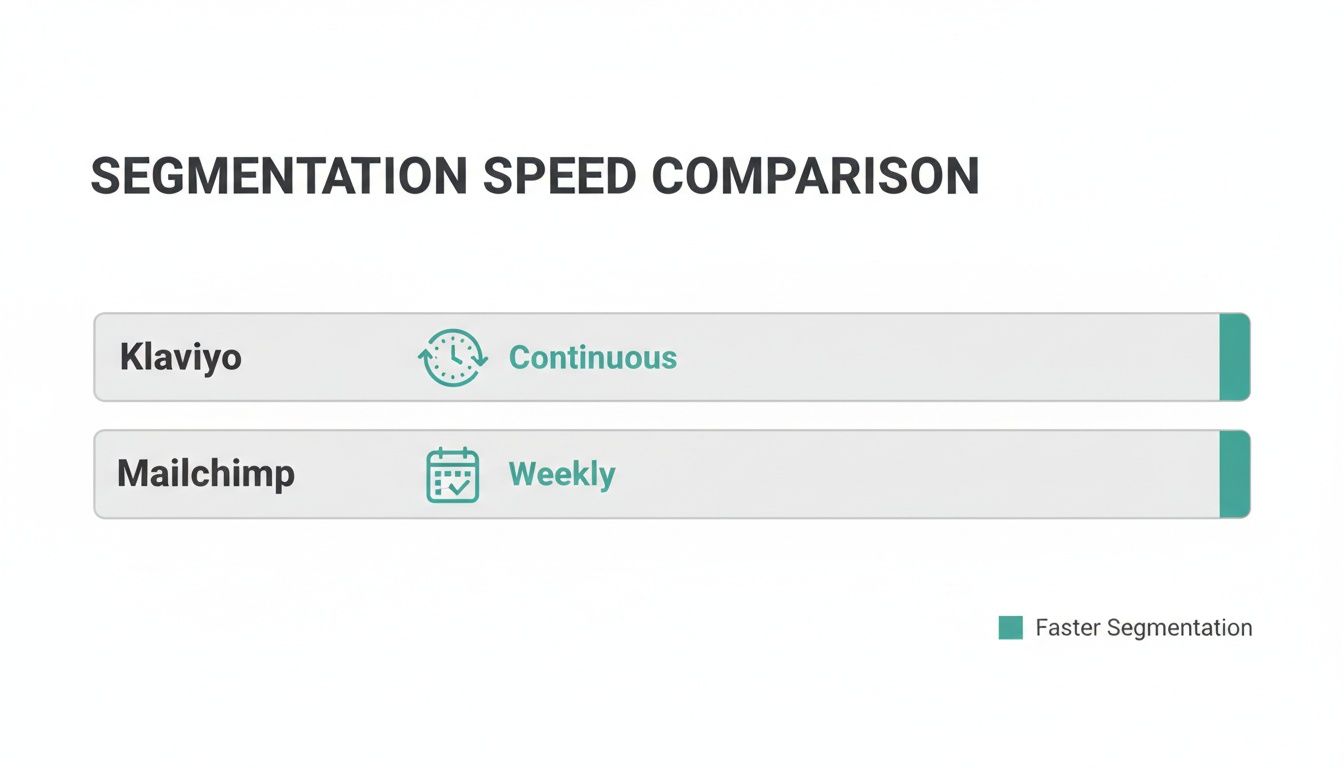
Klaviyo’s ability to update segments in real-time is a significant advantage for any business that needs to be agile, especially e-commerce stores triggering emails based on immediate actions.
Calculating Your Potential Return on Investment
A smart ROI calculation goes way beyond the monthly subscription fee. You have to factor in the revenue you can generate from each platform’s unique features. To get a handle on this, a good place to start is our guide on customer acquisition cost calculation.
Let's put some real numbers on the table to see how costs scale as of 2026.
At a glance, Constant Contact looks like a great deal, especially as you grow. But its features are more basic, which might limit the revenue you can drive.
For an e-commerce brand, Klaviyo’s higher price could easily be justified by the extra sales from its predictive analytics and advanced abandoned cart flows. For a small business owner who isn’t a designer, Mailchimp’s Creative Assistant could save hours of work, providing a completely different kind of return. The right choice really comes down to which features will directly make your business more money.
Which Platform Is Right for Your Business?
A feature list only tells you half the story. The real question is, which of these platforms will work for your day-to-day operations and help you connect with your specific customers? The right tool for an e-commerce shop is rarely the best fit for a local real estate agent.
For E-commerce and Retail
If you're selling products online, your email marketing has one primary job: drive sales. Everything from abandoned carts to post-purchase follow-ups needs to be automated and triggered by customer behavior. This isn't a job for a generalist tool; you need a specialist.
Best For You: Klaviyo
There's a good reason why you see Klaviyo everywhere in the e-commerce world. Its integrations with platforms like Shopify, BigCommerce, and WooCommerce are deep, feeding real-time data directly into your marketing. You can set up automations for almost anything, from a customer viewing a specific product multiple times to someone using a particular discount code.
What really sets Klaviyo apart is its predictive analytics. It can tell you who’s likely to buy next, which customers are at risk of churning, and even estimate their future lifetime value. For an online store, that’s not just cool data; it's a direct line to more revenue.
Runner Up: Mailchimp
Mailchimp is a very capable option, especially if your business has both an online store and a physical retail location. It handles the e-commerce essentials well, like abandoned cart reminders and basic product recommendations. However, it just can't match the sophisticated, real-time segmentation and predictive power that makes Klaviyo so potent for purely online brands.
For Real Estate and Professional Services
As a real estate agent, financial advisor, or consultant, you're not selling a t-shirt; you're building long-term trust. Your sales cycle is longer, and your marketing is all about demonstrating expertise and nurturing relationships. You need a platform that can double as a lightweight CRM.
Best For You: Mailchimp
This is where Mailchimp really hits its stride. Its blend of user-friendly design and solid CRM features is perfect for managing different client lists, think prospective buyers, current sellers, and past clients who might send referrals. You can segment these groups to send out targeted market reports, new listings, or industry updates. Plus, its creative tools make it simple to design a polished, professional newsletter that builds credibility with every send.
Runner Up: Constant Contact
If you're an agent who just wants to get things done without a fuss, Constant Contact is a fantastic pick. The platform is known for its simplicity, letting you send out a weekly newsletter or an open house announcement with almost no learning curve. While its automation is more basic, it excels at the core task of keeping you familiar with your network.
For Restaurants and Local Services
For businesses like restaurants, home service providers, and fitness studios, marketing is all about the local community. The goal is to drive foot traffic, promote events, and get people in the door, often on a tight budget. Simplicity and affordability are key.
Best For You: Constant Contact
Constant Contact was practically made for main street businesses. Its straightforward email editor, event management tools, and integrated social posting give busy owners everything they need in one place. You can whip up an email for a happy hour special, manage RSVPs for a wine tasting, and schedule a Facebook post about it without ever leaving the platform.
Local Focus: It’s great for sending promotions targeted to specific zip codes or neighborhoods.
Simplicity: You don’t have to be a marketing whiz to send a professional-looking email in just a few minutes.
Runner Up: Mailchimp
Mailchimp is another great choice, offering more design flexibility and stronger reporting. Its landing page builder is a standout feature, perfect for capturing email sign-ups from a QR code in your restaurant or from an Adwave TV campaign you might be running. If you want more creative control and have a bit more time to invest, Mailchimp gives you a bigger toolbox.
And if you’re selling anything online, don’t forget to fine-tune your most profitable automation. Our guide on recovering lost revenue with abandoned cart emails is a must-read for turning "almost" sales into completed orders.
Integrating Email Marketing With TV Advertising
In 2026, running marketing campaigns in silos just doesn’t cut it. Your channels need to talk to each other, creating a smooth path for your customers. This is especially true when you combine a broad awareness play like TV advertising with a direct-response tool like email. Getting this connection right is often what turns a decent campaign into a wildly profitable one.
The whole point is to guide a potential customer from first glance to final sale. When you run a campaign with an affordable awareness-builder like Adwave and connect it to a smart email platform, you're essentially building a bridge from broad discovery directly to your cash register.
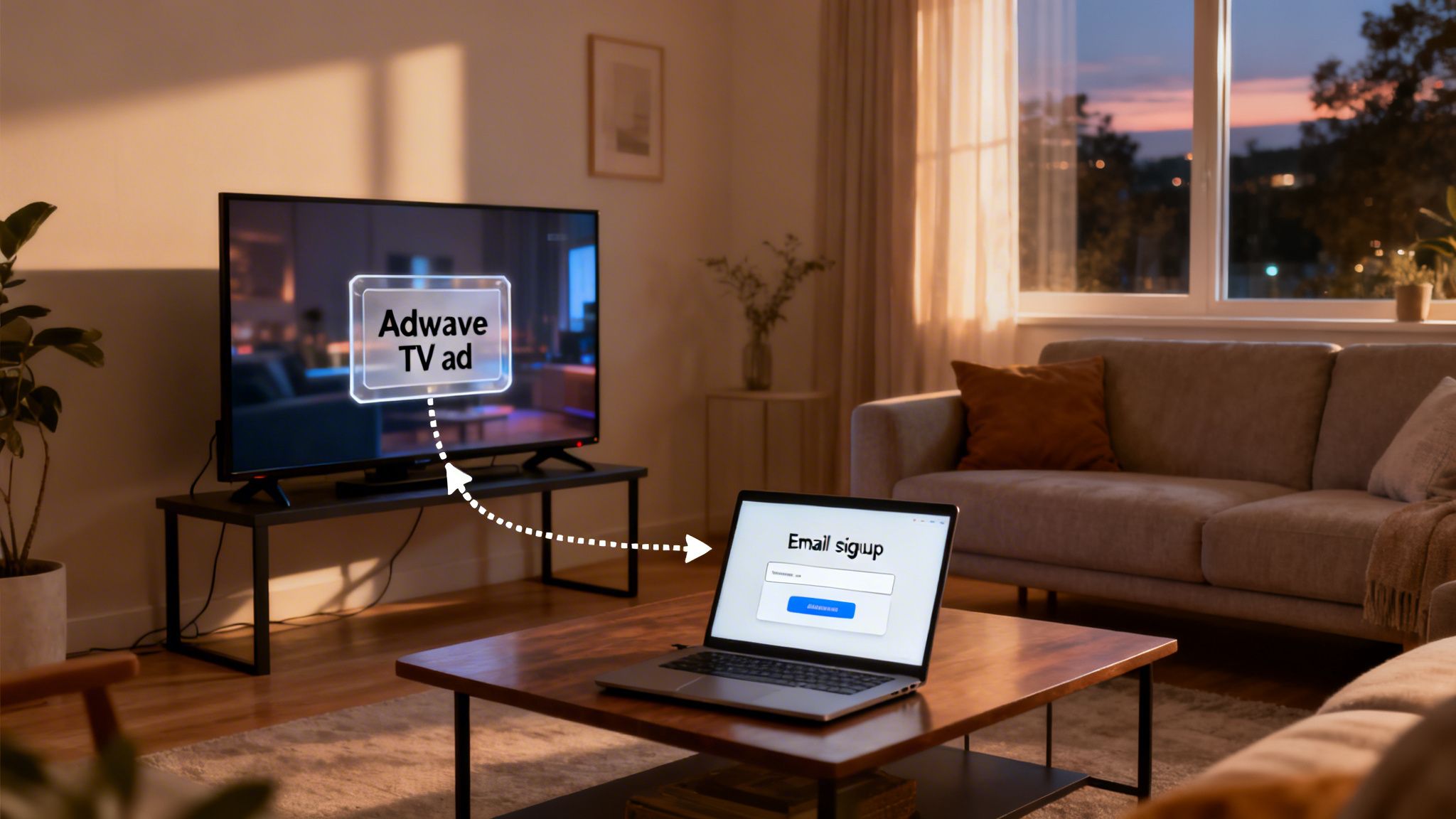
Building The Bridge From TV To Inbox
Let’s walk through a real-world scenario. Imagine a local automotive dealer runs a TV spot with Adwave. Their ad shows up on ESPN and NBC during big games and primetime shows, hitting thousands of potential car buyers in their area. The ad’s call-to-action isn’t just “visit our dealership,” but instead directs viewers to a specific landing page with an offer: “Sign up for an exclusive first look at our new inventory.”
This is the handoff. The people who visit that page and sign up aren't cold leads; they’re already warmed up. They saw the ad and took action. Now, it's your email platform’s turn to grab that interest and run with it.
How Different Platforms Handle TV-Driven Leads
Test the connection between your sign-up form and email platform before sending traffic to it. (Klaviyo)
Klaviyo's Real-Time Advantage: This is where Klaviyo shines. Thanks to its near-instant segmentation, that new lead can be tagged and dropped into a "Hot Prospect - TV Ad" segment in seconds. The dealership can immediately trigger a welcome series that directly references the ad and shows off the exact models they were promoting. That speed is a huge advantage, letting you strike while the iron is hottest.
Mailchimp's welcome automations can send a series of emails to people who signed up on your TV campaign's landing page.
Constant Contact's Simple Capture: For businesses that prefer simplicity, Constant Contact gets the job done. It will reliably capture those new subscribers and add them to your main list. You can set up a simple welcome email and then include them in your regular weekly promotions. It lacks the sophisticated, trigger-based automation of the other two, but it’s a solid, no-fuss solution.
This integrated strategy creates a powerful feedback loop. Adwave generates high-intent, top-of-funnel awareness at an affordable price, and your email platform captures that interest and turns it into measurable sales. It’s the perfect one-two punch for local business growth.
So, when you're weighing Mailchimp vs. Klaviyo vs. Constant Contact, think about the entire customer journey. If you need to react to user behavior instantly, Klaviyo is your best bet. For structured, long-term nurturing, Mailchimp is a powerhouse. And for simple, reliable list-building and follow-up, Constant Contact is a workhorse. Connecting your TV strategy to your email ensures every ad dollar works harder and no interested lead ever slips through the cracks.
Making the Final Call: Which Platform Is Right for You?
Choose the platform that fits your current work and expected list growth. (Constant Contact)
The 3 Questions to Ask Yourself
Answer these questions based on where your business is today and where you want it to be in a year. This isn't a quiz; it's a gut check to match your reality with the right platform's strengths.
What’s your primary business model?A) E-commerce/Online Retail: You live and die by online sales, whether it's physical goods or digital downloads.
B) Service-Based: You're a consultant, agent, or professional. Your goal is nurturing leads and demonstrating expertise.
C) Local/Brick-and-Mortar: You run a neighborhood spot like a restaurant, salon, or shop, and you need to get people in the door.
How important are sophisticated, real-time automations?A) Absolutely Critical: I need emails to trigger instantly based on what someone does on my site, like abandoning a cart or viewing a specific product.
B) Very Important: I need solid, multi-step sequences for onboarding or lead nurturing, but I don't need them to react in real-time.
C) Not a Priority: A simple welcome series is plenty for now. The rest can be handled manually.
What’s the main goal of your email marketing?A) Drive Direct Online Sales: It’s all about conversions, average order value (AOV), and customer lifetime value (CLV).
B) Build Relationships and Nurture Leads: My sales cycle is longer. I need to stay familiar and prove my value over time.
C) Announce Promotions and Drive Foot Traffic: I just need a fast, easy way to send out weekly specials or event reminders.
If you found yourself nodding along with the (A) answers, Klaviyo was practically built for you. If you identified more with the (B) options, Mailchimp is probably your sweet spot. And if most of your answers were (C), Constant Contact is a fantastic place to start without getting overwhelmed.
Remember, your email marketing doesn't exist in a silo. It’s the engine that turns the broad awareness you build into tangible results. When you run a brand-building campaign with a partner like Adwave, your email platform is what captures that new interest and converts it into revenue.
The Case for Keeping It Simple (and Affordable)
For a lot of small businesses, the budget makes the decision for you. This is where Constant Contact really carves out its niche. With plans starting at just $12 per month, it’s a much smaller financial commitment than Mailchimp or Klaviyo.
Of course, that lower price comes with trade-offs. You get rock-solid email delivery and basic automation, but the creative options are more limited. For instance, it has only 3 pre-built automation templates, a far cry from Mailchimp's 60+. But for a home services company or a local restaurant using Adwave for TV ads, Constant Contact is the perfect, no-fuss tool for sending newsletters and converting that local buzz into appointments or reservations. If you're weighing these two specifically, you can get a more detailed breakdown of Constant Contact vs. Mailchimp.
Final Verdict: Key Differentiators at a Glance
Sometimes, seeing it all side-by-side is what makes the choice click. This table boils down the core identity of each platform to help you make that final gut-check decision.
Ultimately, the best platform is the one you’ll use. Whether you choose the all-around power of Mailchimp, the e-commerce muscle of Klaviyo, or the straightforward simplicity of Constant Contact, you’re setting up a vital system for growth.
Pairing your choice with Adwave’s accessible TV advertising creates a complete funnel: use TV to build massive local awareness, and let your new email tool turn that attention into loyal, paying customers.
Frequently Asked Questions
Alright, let's get into some of the practical, real-world questions that always come up when you're deciding between tools like Mailchimp, Klaviyo, and Constant Contact. These are the things you think about long after you've compared feature lists.
Is It Difficult to Switch Email Marketing Platforms?
I get this question a lot, and the honest answer is: it’s less of a technical headache and more of a strategic one. Moving your contacts is usually the easy part. Exporting your subscriber, unsubscriber, and bounced email lists and then importing them into a new system is pretty standard practice now.
The real work is in rebuilding your automated email flows and templates. But I always tell clients to look at this as an opportunity. It's the perfect time to rethink your messaging, fix what wasn't working, and build a stronger, smarter automation strategy from the ground up.
When Should I Upgrade from a Free or Basic Plan?
Consider upgrading when you need features or contact capacity that your current plan does not include.
Contact List Growth: This is the most straightforward trigger. When you're about to exceed the subscriber limit, it's time to move up.
Need for Advanced Automation: Are you trying to build multi-step customer journeys but your plan only allows for simple welcome emails? That's a clear sign you need more power.
Access to Better Reporting: If you're asking questions like "What's the actual ROI of this campaign?" and your platform can only show you open and click rates, you’ve outgrown its analytics.
A key sign it's time to upgrade is when you're spending more time creating workarounds than you are creating effective campaigns. Your email platform should save you time, not consume it.
How Does Adwave Integrate with These Platforms?
While Adwave doesn't have a native, one-click integration built into these platforms, it's designed to work perfectly with any of them. Think of Adwave as the top of your funnel and your email tool as the engine that nurtures the leads.
The process is simple. Your Adwave TV campaign directs interested viewers to a specific landing page where they can sign up.
After a form submission, confirm that the email platform receives the contact and triggers the intended welcome sequence. (Constant Contact)


