Threads reached 350 million monthly active users by June 2025, while Bluesky had a daily audience of 4.1 million. Those figures aren’t competing answers to the same question: one measures monthly activity, the other daily mobile use. For a local business, the useful question isn’t which platform wins a headline count. It’s which one can create awareness, capture timely demand, or earn credibility with the customers you need.
Threads, Bluesky, and X now serve different jobs. My verdict is clear: use Threads for repeatable consumer awareness, X for real-time demand and expertise, and Bluesky for niche community credibility. Then consider a complementary channel for local reach that doesn’t depend on a social feed deciding to show your post.
Why This Comparison Matters Right Now
Threads, Bluesky, and X aren’t interchangeable text feeds. They differ in audience scale, the way posts travel, the conversations people expect, and the advertising options available to businesses. Choosing between them should be a portfolio decision, not a contest to crown one universal winner.
For a neighborhood restaurant, Threads can help make a new menu item familiar through approachable, visual posts. A home-services company can use X to respond to local developments and demonstrate expertise when someone needs help now. A specialist business serving a concentrated professional community may find more worthwhile conversations on Bluesky than its smaller audience suggests.
That distinction matters because reach and intent aren’t the same thing. A large audience doesn’t guarantee that local customers see your post, and an active community doesn’t automatically produce leads. You need to choose a platform based on the job you want it to do, then check whether people in your service area notice, respond, and take the next step.
Small businesses planning that mix can also use this guide to social media trends for small businesses to think beyond a single channel. Social can help you test messages and build familiarity, but every feed controls its own distribution. A complementary medium, such as television, gives you another way to build awareness among local viewers rather than relying entirely on organic discovery.
The practical verdict: Pick one social platform for a clear job. Add another only when it reaches a different audience or supports a different objective.
Audience Size, Growth, and What the Numbers Actually Mean
The audience figures make one point unmistakable: don’t compare monthly active users, daily mobile users, and registered accounts as if they were the same metric. Threads’ monthly count shows broad activity over a longer period. X’s mobile daily figure describes frequent app use. Bluesky’s registered-account total includes accounts, not necessarily people using the service every day.
| Platform | Headline figure | Growth signal | Why it matters |
|---|---|---|---|
| Threads | 350 million monthly active users | Meta reported rapid adoption; independent mobile-app estimates also showed growth in daily use | Large potential awareness pool, but monthly reach isn’t a local campaign result |
| X | About 132 million mobile daily active users | The figure was down year over year | Still a substantial daily audience, particularly relevant to timely conversation |
| Bluesky | More than 37 million registered accounts and 4.1 million daily users | Daily audience grew 372.5% year over year | Fast growth from a smaller base, but registrations don’t represent daily reach |
The figures above were reported for June 2025, and the audience measures aren’t directly interchangeable. TechCrunch’s reporting on platform audience estimates notes Threads’ 350 million monthly active users, X’s roughly 132 million mobile daily active users, and Bluesky’s more than 37 million registered accounts alongside its 4.1 million daily audience. It also reports that Bluesky’s daily audience grew 372.5% year over year, while X’s mobile daily figure declined 15.2% year over year.
Match the metric to the campaign
If you’re planning broad awareness, monthly audience can help frame potential scale, but it doesn’t tell you how many people in your town saw an ad or post. Daily usage is more relevant to recurring opportunities to reach people, while registered accounts alone tell you little about current attention. Geography matters just as much: global reach is not the same as concentrated local reach.
My advice is to judge performance by unique reach among your intended audience and assisted conversions, not by the biggest platform number. Track visits, calls, coupon use, or CRM leads tied to each channel. That’s how you find out whether a platform’s audience is present and valuable for your business, rather than impressive on paper.
Content Formats, Feeds, and Discovery
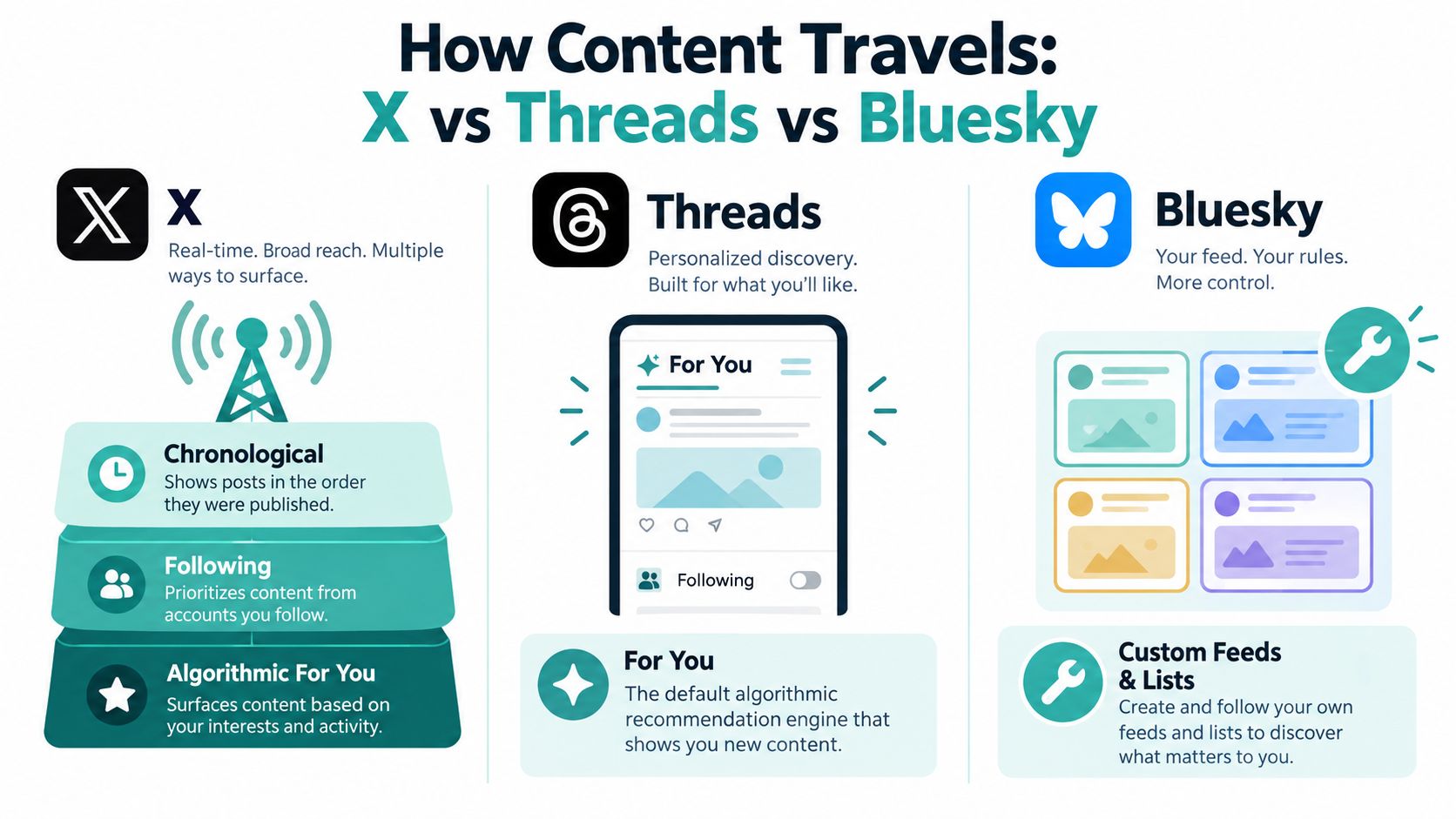
A post’s format matters, but the feed decides who gets a chance to see it. X serves users a mix of feed experiences, Threads opens with a recommendation-led For You feed, and Bluesky gives users custom feeds and lists. Those differences shape whether a business should prioritize a steady publishing rhythm, timely responses, or participation in a focused community.
Make the feed work for your content
Threads is the natural choice for repeatable awareness content, especially if your brand already has an Instagram presence. Meta’s recommendation-led experience can put posts in front of people who don’t follow you, but that also means reach depends on recommendations rather than a guaranteed chronological audience. Publish useful, personable posts and adapt visuals from your existing brand work rather than treating Threads as a place to paste announcements.
X is built for conversation around what’s happening now. A local event, service disruption, timely promotion, or response to a relevant news moment can give a business a reason to join the discussion. That pace rewards active participation, not just scheduling posts and leaving.
Bluesky gives users more choice over how they discover posts through custom feeds and lists. That can help a business become a regular voice in a specific community, but it means there isn’t one universal discovery path to rely on. Make the content valuable to the people who chose that feed, not just promotional to everyone who might encounter it.
The differences affect creative production, too. Don’t assume the same copy, image, and link treatment will perform equally across all three. Shape the opening line and media for the audience’s context, and make the next action obvious. For practical ideas on earning attention after you publish, see this guide to getting more eyes on the content you create.
Moderation, Brand Safety, and Message Control
Audience size doesn’t tell you how much control a brand has over where its posts appear, what content sits beside a paid placement, or how a conversation may shift during a controversy. Each platform has a different culture and governance model, so businesses need response plans that fit the environment rather than a single copy-pasted policy.
Standard comparisons describe X as strongest for news, B2B, and politics; Threads as more lifestyle-oriented; and Bluesky as concentrated in technology, media, and the open-web community. Those differences create distinct reputational dynamics for brands, as discussed in this comparison of platform audiences and positioning.
Set rules for the environment you’re entering
On X, news and fast-moving conversation can make a timely contribution valuable. The same speed can put a brand beside charged or rapidly changing discussion. Assign someone to monitor replies and mentions, set clear escalation rules, and decide when the right response is to pause scheduled posts.
Threads is aligned with Meta’s recommendation and advertising systems. That gives advertisers platform-managed controls, including an inventory filter for content adjacency in Threads campaigns. Brands should still prepare moderation guidelines for organic conversations, especially when a post attracts replies outside its usual audience.
Bluesky’s custom-feed ecosystem supports community-led discovery. That can make the channel useful for listening and trusted participation in a niche, but it also means people may encounter a business through different feeds and community contexts. A smaller network isn’t automatically safer, and decentralized discovery isn’t a substitute for brand standards. Businesses should watch the conversations where their audience gathers and respond in a consistent, human way.
Reach alone isn’t a safety plan. Choose the environment your team can monitor, understand, and respond to well.
Ads, Targeting, Analytics, and What They Cost
For local advertisers, the choice is about the job each network can do: Threads supports paid awareness, X can help capture timely demand, and Bluesky is better suited to building niche credibility through organic participation. Bluesky does not offer a conventional ad product in the cited reporting, so don’t treat it as a paid-placement alternative. The buying experiences differ, and your campaign plan should reflect that.
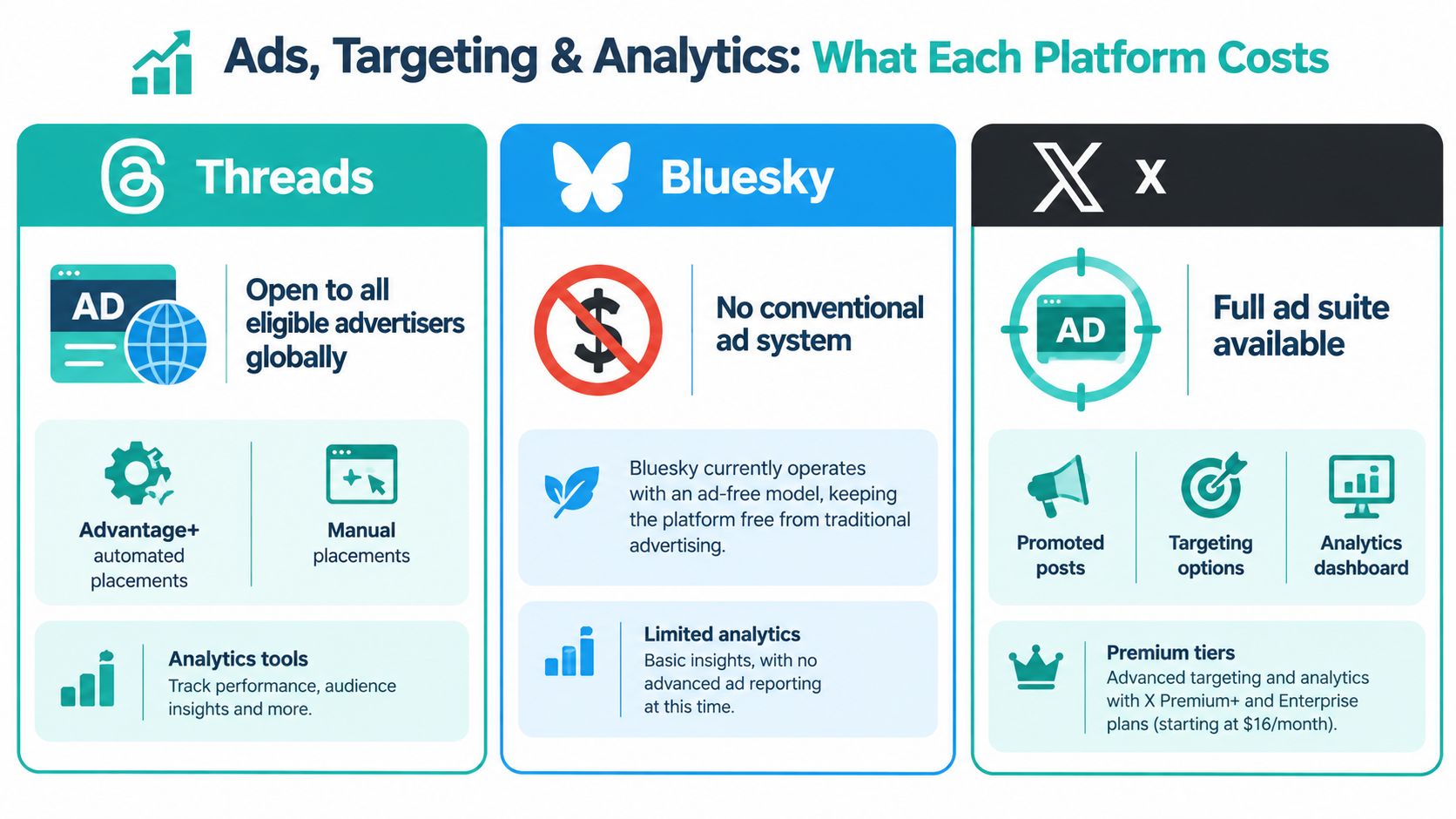
Meta opened Threads advertising to all eligible advertisers globally in April 2025. The placement was enabled by default for new Advantage+ and Manual campaigns, and advertisers could use an inventory filter to manage sensitive content next to ads. Reuters’ report on the Threads advertising expansion notes that global advertiser access did not mean immediate ad delivery in every market. For local businesses, Threads offers a route into Meta’s ad system, but check whether campaigns can reach your intended audience before allocating budget.
Engagement is a signal, not a business outcome
A benchmark of 10.2 million posts published during 2024 found a 6.25% median engagement rate on Threads, compared with 3.60% on X, a 73.6% relative advantage for Threads. The Threads and X engagement benchmark makes Threads a useful place to test organic messages. It does not show which platform will bring in more customers for your business.
Track outcomes beyond interactions. Replies can reveal which message resonates, but they do not prove that it generated a lead, call, store visit, or sale. Use trackable links, distinct offer codes where relevant, and CRM records to connect inquiries to campaigns. This guide to social media analytics and meaningful metrics can help you choose measures that support clear decisions.
Compare paid campaigns by audience delivery and resulting actions. Don’t compare engagement rates with television CPMs as though they measure the same thing. A TV campaign can put a broadcast-quality message in front of local viewers, while social supports conversation and follow-up. Give each channel its own objective and tracking, then judge performance against the job it was hired to do.
Content Strategies That Actually Win on Each Platform
Give each network a distinct job. Threads builds awareness through approachable, repeatable messages. X puts timely expertise and local developments in front of people who may be ready to act. Bluesky helps focused businesses earn credibility by contributing to relevant communities instead of treating every post as a sales pitch. Build one core message, then adapt it to each platform.
Build a simple operating rhythm
- Threads for awareness: Reuse product photos, service explainers, and customer-friendly stories. Keep the voice conversational, and review replies regularly so discovery can lead to useful interactions.
- X for timely demand: Share specific, helpful updates about local events or changes that matter to customers. Respond promptly to relevant questions and make the next step clear, such as booking or contacting your team. For more guidance, read whether X still matters for small businesses.
- Bluesky for credibility: Find the communities and custom feeds relevant to your field. Share informed observations, answer questions, and demonstrate expertise before asking for business.
Use UTMs on campaign links and tag leads in your CRM by source and campaign. Track website visits, calls, forms, coupon codes, and assisted conversions. Review which messages move people from attention to action, rather than judging a platform by likes or reposts alone.
Social posts depend on feed distribution, so even interested people may not see them. Adwave complements social with AI-created, broadcast-ready TV spots made from a website URL, with placement across more than 100 premium channels, including NBC, Hulu, and ESPN. Campaigns can start at $50, with automatic pacing capped at the advertiser’s chosen spend. Test and refine the message on social, then use TV as another channel for building local awareness.
Choosing by Business Type and Where Adwave Fits
Choose the platform that fits the way customers make decisions in your category. Don’t divide your time evenly just because three networks are available.
| Business type | Start with | Add next | Why |
|---|---|---|---|
| Local services | X | Threads | Use X for timely expertise and demand capture, then build broad familiarity with consumer-friendly Threads posts |
| Retail and ecommerce | Threads | X | Threads suits repeatable visual discovery; X supports timely offers and customer conversation |
| Real estate | Threads | X | Use Threads to make listings and local knowledge approachable, with X for timely market commentary and questions |
| Automotive | X | Threads | X supports event-driven offers and service updates; Threads gives the brand another lifestyle-oriented awareness channel |
| Health and wellness | Threads | Bluesky | Start with accessible service education, then use Bluesky if a relevant professional or interest community is active there |
| Creator-led brands | Threads for lifestyle, X for expertise | Bluesky for a focused niche | Match the primary feed to the creator’s subject and audience, not a generic platform ranking |
If you’re building a wider acquisition system, social shouldn’t stand alone. A well-organized sales process helps turn interest into follow-up, and this practical resource on how to build a scalable sales pipeline offers useful context for connecting marketing activity to sales conversations.
The stronger choice for most local advertisers is to pair a social feed with a complementary awareness channel rather than betting everything on one network’s algorithm. Adwave provides a way to create and measure a TV campaign from a website URL, with placement across premium programming and spend pacing set to the advertiser’s budget. Keep social for discovery, timely conversation, or niche trust, and use television to extend local awareness beyond those feeds.
Build your platform plan around one clear objective, then add a measurable channel that reaches people beyond social feeds. Visit Adwave to create a broadcast-ready TV spot from your website and explore campaigns starting at $50 across premium channels.