
Most advice about X has become lazy. One camp says it’s dead and irrelevant. The other still treats it like a must-have channel for every small business. Both are wrong.
X is no longer a default play for small business marketing. It’s less stable, harder to win organically, and far more demanding than many owners realize. But writing it off completely misses something important. A lot of attention still lives there, especially around real-time conversation, customer service, media, B2B networking, events, and local chatter that spikes around live moments.
That means the core question isn’t whether X is “good” or “bad.” The core question is whether it fits your business model, your audience, and your tolerance for a platform that can produce useful visibility one week and feel like a time sink the next.
For some businesses, X still matters. For others, it’s a distraction wearing the costume of opportunity. The difference usually comes down to four things: who you need to reach, how quickly you can respond, whether you can support content consistently, and whether you’re using X as a supporting channel instead of asking it to carry your whole marketing strategy.
The X Question Every Small Business Is Asking
Small business owners keep asking a version of the same thing: should we still put time or ad dollars into X, or has the platform become too volatile to trust?
That’s a fair question. The platform has changed. The culture has changed. The economics have changed. If you’re running a local service company, a boutique retail business, a real estate team, or a professional firm, you can’t afford to spend hours on a channel just because it used to matter.
The popular answer is to leave. I think that answer is too simple.
A blanket dismissal ignores the fact that X still holds attention in places where speed matters. News breaks there. Customers complain there. Journalists, founders, sales teams, tech buyers, and highly online local communities still use it to react in public. If your business benefits from fast visibility, public conversation, or direct response, X can still have a role.
That shift in mindset matters. The smartest small businesses aren’t asking, “How do we grow on X?” They’re asking, “Where does X support a larger system?”
For many, that means using it to reinforce channels with longer shelf life and more durable reach. Think search content, email, local partnerships, and broadcast advertising. In that setup, X becomes less of a standalone content treadmill and more of a second-screen layer that can increase response when attention is already high.
If you evaluate X that way, the decision gets clearer. You stop chasing vague social media presence and start looking for specific business outcomes.
A Reality Check on the State of X in 2026
X isn’t empty. It isn’t universally healthy either. Both things can be true at once.
In 2025, X had approximately 611 million monthly active users and ranked as the 12th most popular social network globally, according to Oberlo’s roundup of X statistics. The same source notes that 67% of B2B businesses use X as a marketing tool and 75% market products or services on the platform. That tells you something important right away. X may be shaky, but it still holds professional attention.

Who still gets value from X
The businesses most likely to benefit tend to share a few traits:
They sell into professional or news-adjacent audiences. Consultants, SaaS companies, agencies, legal firms, political organizations, and founder-led B2B brands still find conversations there.
They can respond quickly. X rewards businesses that can join a discussion while it’s still active.
They have something timely to say. Product commentary, event takes, customer updates, and service responses fit the platform better than evergreen brand slogans.
That last point gets overlooked. Many owners fail on X because they post the same generic promotional content they use everywhere else. X usually punishes that. The platform still favors relevance, timing, and interaction over polished brand packaging.
What small businesses should check first
Before opening a content calendar, answer these questions:
Are your buyers active there in public?
Do customers expect support or replies on X?
Is your category shaped by live events, local discussion, or fast-moving commentary?
Can someone on your team monitor and respond without letting the account go stale?
If most answers are no, your effort probably belongs elsewhere.
That’s why broader channel planning matters more than platform hype. If you’re sorting through competing demands like budget pressure, staffing, and content fatigue, this breakdown of Top 10 Marketing Challenges for Small Businesses in 2026 is useful because it frames X as one decision inside a larger resource problem, not an isolated tactic.
A comparison with other channels helps too. If your business leans visual, trend-driven, or consumer-facing, this guide to TikTok for small business in 2026 can sharpen the contrast. In many cases, the question isn’t “Should we use X?” It’s “Why X instead of a more discoverable channel?”
X still matters most when your market values immediacy over shelf life.
That’s the cleanest reality check. X remains relevant for certain audiences. It just isn’t broadly forgiving anymore.
The Unavoidable Risks and Platform Volatility
If you’re going to use X, you need to go in with clear eyes. This is not a stable, low-maintenance environment.
The biggest signal is economic. X’s advertising revenue fell from $5 billion in 2021 to an estimated $2.5 billion in 2024, according to Electro IQ’s X statistics analysis. That decline matters because ad revenue doesn’t just reflect platform income. It reflects advertiser confidence, brand safety concerns, and whether businesses believe the ecosystem is worth backing.
Brand risk is real
Reduced moderation has changed the risk profile for businesses. That doesn’t mean every ad placement becomes a problem. It means the chance of appearing near content you’d rather avoid is part of the calculation.
For a local business, that’s not an abstract concern. A national brand might absorb reputational turbulence. A small business often can’t. If you’re a dental office, a med spa, a home services brand, a family restaurant, or a neighborhood retailer, trust is fragile. You don’t need your name pulled into platform drama you didn’t create.
If your brand depends on being broadly approachable, platform context matters almost as much as audience size.
Organic visibility keeps getting harder
The second risk is practical. Small businesses used to justify X because it offered relatively easy organic exposure if you were active and sharp. That’s no longer a safe assumption.
Algorithm changes have tilted the platform toward paid visibility and high-velocity interaction. For a small team, that creates a bad trade. You either spend more money than planned or spend more labor than the channel deserves.
Here’s what that usually looks like in practice:
Posting pressure rises: You feel forced to publish constantly just to stay visible.
Performance becomes uneven: One post gets traction, the next ten disappear.
Paid support creeps in: “Just boosting a few posts” becomes the default workaround.
Decision fatigue sets in: The team starts reacting to the platform instead of following a clear plan.
The cost isn't only financial
A lot of small business owners evaluate X only through ad spend. That’s incomplete. The hidden cost is attention.
If your marketing lead or founder is spending time watching the feed, drafting reactive posts, monitoring replies, and handling public conversations, that time is being taken from assets with longer life. A blog post can rank. An email campaign can be reused. A TV spot can keep delivering branded reach after launch. A tweet often burns bright and disappears fast.
That doesn’t make X useless. It makes it expensive in a different way.
The hard truth is this: volatility isn’t a side issue on X. It’s part of the platform’s operating conditions. Any small business using it needs a reason stronger than “we should probably be on social media.”
Four Concrete Use Cases Where X Still Delivers Value
X is weakest when used as a generic publishing channel. It’s strongest when used for a specific job. Small businesses that still get value from it usually understand that distinction.
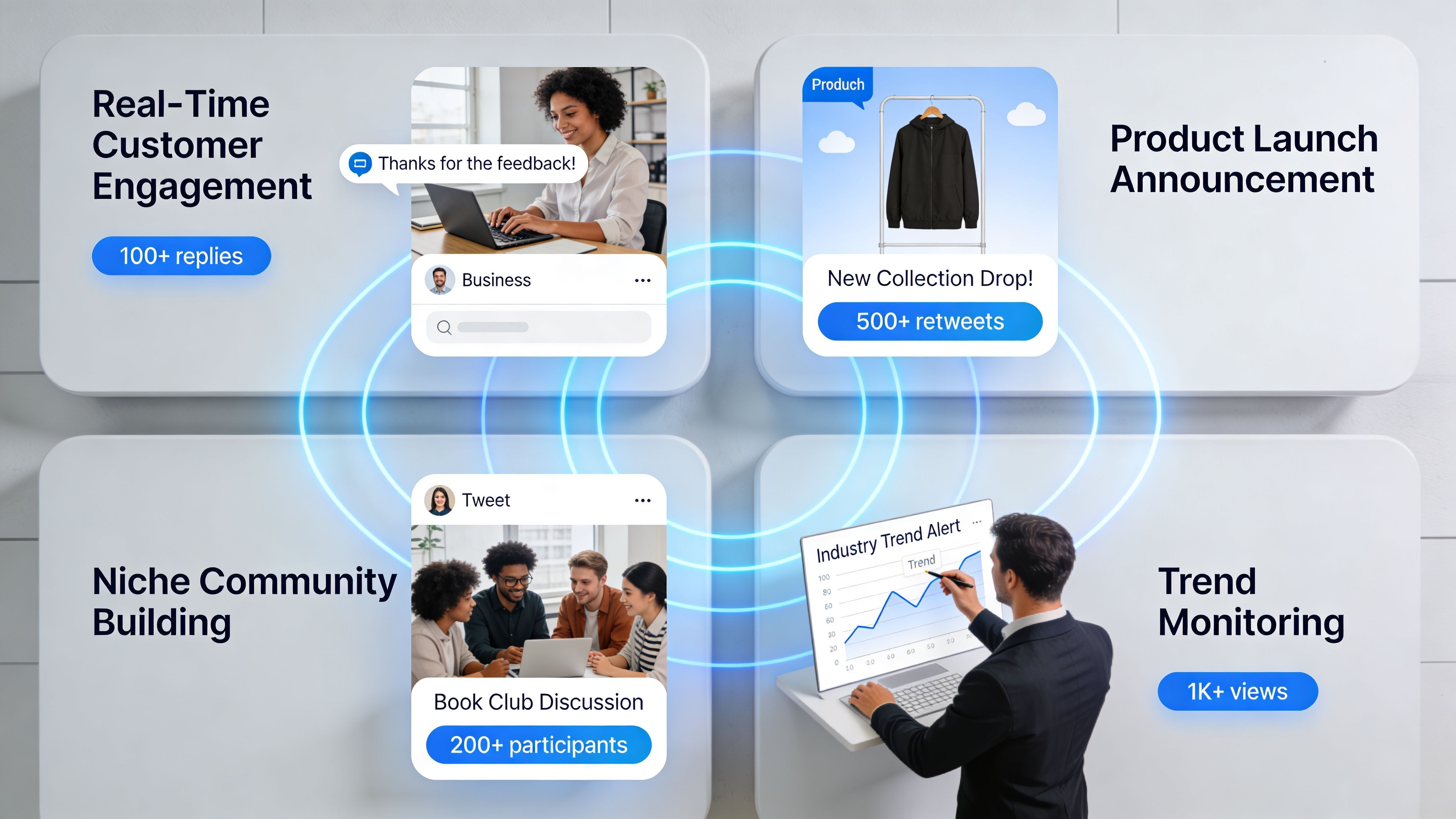
Real-time customer service
This is one of the clearest fits.
If customers already mention your business publicly, X can work as a visible service desk. A shipping issue, event delay, booking error, or product complaint handled quickly in public can calm the situation and show other customers that you respond. That matters because response style often shapes brand perception as much as the original problem.
This use case works best for businesses with recurring inquiries, public feedback, or service interruptions. It’s less about broadcasting and more about responsiveness.
A simple example: a local event business posts schedule changes, replies to attendee questions, and resolves confusion fast. That’s useful. A business posting three sales promos a day and ignoring replies isn’t.
Niche B2B community building
X still has pockets of concentrated professional conversation. If you sell expertise, software, advisory services, or something bought through trust and familiarity, that can matter.
This isn’t broad awareness marketing. It’s relationship marketing in public. A founder comments on industry news, a consultant shares sharp observations, a small agency replies thoughtfully to prospects and peers. Over time, people recognize the name, understand the perspective, and start associating the business with competence.
What doesn’t work is trying to manufacture authority with stiff corporate posts. The accounts that perform best in this environment tend to sound like informed humans.
A useful X account usually answers one of two questions fast: “Can you help me?” or “Do you understand this space?”
Hyper-local event and moment marketing
Some local businesses still win on X because the platform is good at live momentum.
Think restaurants during a major local event, retail stores around a downtown festival, a venue tied to a game night, or a service business reacting to weather, traffic, or citywide disruptions. In those situations, people are already checking updates in real time. Being present in that stream can create practical visibility.
This works better when the business has a real reason to join the moment. Forced participation is obvious. Useful participation stands out.
Examples include:
A coffee shop posting extended hours near a local event
A boutique reacting to foot traffic spikes during a city festival
A repair business addressing urgent service demand during weather-related disruptions
A restaurant joining local game-day conversation with a timely offer
Founder and executive thought leadership
For some small businesses, the company account matters less than the owner’s account.
That’s especially true in professional services, B2B, recruiting, coaching, real estate, legal, finance, and specialty consulting. Buyers often trust people before they trust logos. A founder who comments intelligently, shares lessons from client work, and participates in relevant discussions can build credibility faster than a polished brand feed.
There’s a practical reason for this. On X, personality often travels farther than institutional messaging. A business owner with a point of view can make the company more visible without trying to “do social media” in the traditional sense.
The mistake is turning every post into a pitch. The better approach is to be useful in public, then let interested people click through.
The Smart X Playbook for a Limited Budget
If your budget is tight, don’t try to win X by brute force. That’s the fastest way to waste money and exhaust your team.
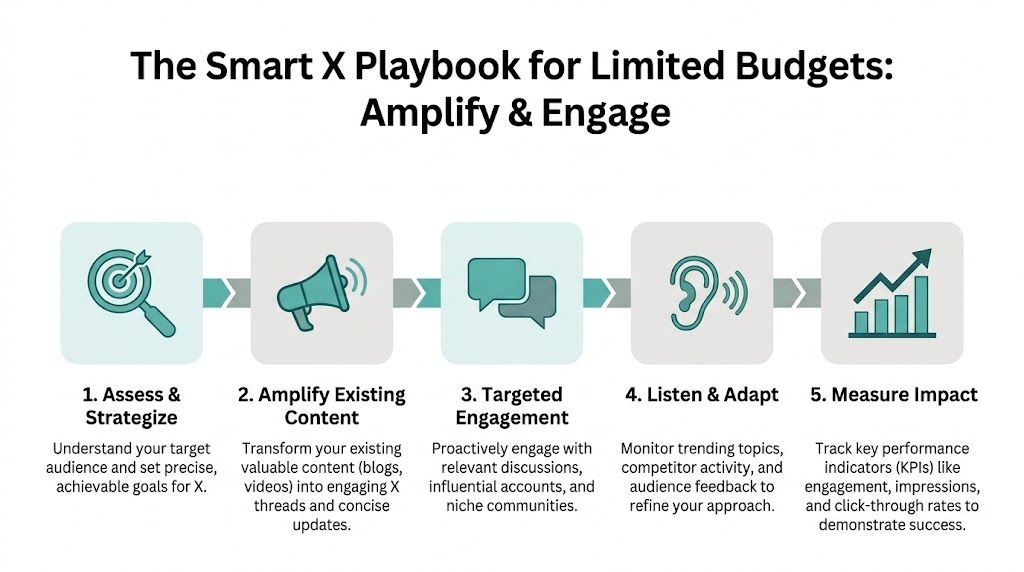
The practical play is an amplify and engage model. Use X to extend the impact of strong marketing you’re already running elsewhere. Then engage where live attention is already forming. This is very different from trying to treat X as your main engine for awareness.
Start with the pay-to-play reality
X’s 2026 algorithm has a clear paid advantage. According to WebFX’s X marketing benchmarks, promoted tweets reach a 1% to 3% click-through rate, compared with 0.5% to 1.5% for organic posts, and cost per click ranges from $0.50 to $2. For a small business, that means two things.
First, organic-only strategy is much harder to justify unless you already have a strong voice and a responsive audience. Second, paid support can work, but only when attached to high-intent content or a clear conversion path.
So the right question isn’t, “Should we run X ads?” It’s, “What exactly are we amplifying, and why is it worth paying to distribute?”
Use X to amplify proven assets
The best content for X often starts elsewhere.
A small business might take a blog post, customer story, event appearance, video clip, launch announcement, or local campaign and convert it into short updates, threads, quote cards, or replies tied to active conversations. That’s more efficient than creating platform-native content from scratch all day.
A lean workflow often looks like this:
Choose one strong asset such as a promotion, testimonial, service update, or campaign.
Break it into smaller angles for posts, replies, and visuals.
Promote only the best-performing message instead of boosting everything.
Watch replies and mentions closely during the active window.
Stop quickly if the traffic is weak or off-target.
If your team needs help making that repeatable, this guide on building a social media content calendar in 30 minutes is useful because it reduces the chaos that usually causes small businesses to abandon consistency.
The second-screen strategy that makes X more useful
Here, X becomes more interesting.
Used alone, X is volatile. Used as a second-screen amplifier, it can strengthen campaigns happening elsewhere. The most practical version of this for small businesses is pairing X activity with TV advertising.
When a local business runs TV spots, attention doesn’t stay only on the television. People pick up their phones, react to what they’re watching, search names, comment on the program, and discuss related topics in real time. X is one of the few places where that second-screen behavior still shows up publicly and immediately.
That creates a smart playbook for a small business:
Run a clear TV message with one offer, one audience, and one geographic focus.
Prepare X posts that match the campaign language so the messaging feels consistent.
Monitor local conversation during air windows and shortly after.
Engage with relevant public discussion tied to the show, event, local issue, or campaign theme.
Boost only the strongest supporting post if people are already responding.
TV can carry the heavy load while X adds speed. The TV ad creates broad branded reach. X captures conversation, handles reactions, and gives the campaign a public response layer.
That’s a much healthier role for X than asking it to generate awareness from zero.
Field note: X performs better as a response surface than as a cold-start discovery engine for most small businesses.
What to avoid on a small budget
A lot of X spending fails for predictable reasons. Most of them come from treating the platform as bigger than it is.
Avoid these traps:
Daily filler posting: If the post has no timely angle, clear utility, or connection to a live conversation, it probably won’t earn attention.
Always-on boosting: Promoting mediocre content usually just pays to confirm weak messaging.
One-person founder overload: If the owner becomes the entire content system, the account usually collapses when real business work gets busy.
Generic customer acquisition campaigns: X can support demand capture and response. It’s often weaker for broad, cold consumer acquisition than more visual and searchable channels.
The most efficient X strategy is selective, not constant. Show up with a reason. Amplify what already has value. Use the platform where speed helps.
How to Measure ROI When Reach Is Unpredictable
X creates a measurement problem for small businesses because the work can feel active long before it proves useful. Activity is not ROI.
The challenge gets bigger because X is labor-intensive. According to Torris’s review of X for business, the platform often requires multiple daily posts and constant engagement to maintain visibility, while channels like TV through Adwave offer more sustained reach without constant content refreshes. That contrast is the key to measuring X accurately. You have to account for time, not just spend.
Stop judging X by vanity metrics
Follower counts, impressions, and likes can help diagnose performance, but they don’t justify investment on their own.
The metrics that matter more are:
Website clicks: Use tagged links so you know which posts drove visits.
Lead actions: Track form fills, booked calls, coupon claims, app downloads, or purchases tied to X traffic.
Customer service outcomes: Measure whether response speed reduced complaints or saved accounts.
Cost per meaningful action: Compare paid X performance against other paid channels.
Assisted impact: Watch whether X improves response to campaigns running elsewhere.
If you need a cleaner definition of exposure versus outcomes, Adwave’s guide on what reach means in advertising is a useful framing tool. It helps separate “people saw it” from “the campaign moved the business.”
A simple ROI model for X
Keep the math simple enough that you’ll use it.
Create a monthly scorecard with two sides.
Then ask:
Did X produce direct business actions?
Did it improve another campaign already in market?
Would the same money and time likely perform better elsewhere?
If the answer to the first two is no for long enough, the channel is failing regardless of how lively the account looks.
Compare X against durable assets
Many owners become stuck. They evaluate X in isolation instead of against alternatives.
A blog article may take longer to create, but it can keep attracting traffic. A TV campaign can keep building awareness in a local market after launch. An email sequence can be reused and optimized. X requires fresh effort over and over.
That doesn’t mean X should lose every comparison. It means it should win on speed, public interaction, or campaign support. If it’s not doing one of those jobs, it’s probably not earning its place.
Track X like a tactical channel, not a faith-based brand exercise.
Your Final Decision A Framework for Action
Small businesses don’t need another vague answer on X. They need a decision they can act on.
The cleanest approach is to score the platform against your actual operating reality. Not social media theory. Not what competitors say they’re doing. Your team, your audience, your margin for risk, and your ability to connect X to a broader campaign.
Use this decision table
How to read the result
If most of your answers land in Green Light, X can still play a useful role. Keep it focused. Use it for support, response, and amplification. Don’t overbuild your strategy around it.
If you mostly land in Yellow Light, run a contained test. Give it a clear purpose. Tie it to a launch, event, seasonal push, or a campaign running on another channel. Set a review point before you start. If it works, expand carefully. If it doesn’t, walk away without regret.
If most of your answers are Red Light, skip it. That isn’t a failure. It’s discipline. Many small businesses would get better results by putting the same energy into search content, email, local partnerships, short-form video, or broader-reach advertising.
The strongest reason to keep X in the mix
For the right business, X still has one clear advantage. It reacts in public, in real time, around moments when attention is already moving.
That makes it useful as a second-screen layer. Not the headline act. Not the center of your brand. A fast-response channel that can strengthen what you’re already doing elsewhere.
If you’re building a broader plan and need a practical starting point, this guide on how to market my small business is worth reviewing because it helps place individual channels inside a full growth system instead of forcing every platform to do every job.
The bottom line is simple. X still matters for some small businesses. It just matters differently now. If you use it, use it narrowly, intentionally, and in support of channels with more stable reach and stronger staying power.
If you want a more durable awareness engine than an always-on X grind, Adwave is a smart place to look. It helps small businesses create and launch TV ads quickly across premium channels, with flexible budgets and measurable performance, so you can build broad local attention first and use channels like X to amplify the response instead of carrying the whole campaign alone.


