
You’re probably dealing with this right now. A competitor is posting quick TikToks from the job site, the storefront, or the office. Some of them look rough. Some of them look silly. But they’re getting attention, and now you’re wondering whether your next $500 should go into short-form video, paid social, or something steadier.
That tension is real. TikTok looks cheap because anyone can post. It also looks expensive because someone has to come up with ideas, film, edit, reply to comments, and keep doing it when a video flops.
That’s the question behind TikTok for Small Business: Is It Worth Your Time in 2026?** Not whether TikTok matters. It does. The question is whether it deserves your time, your budget, and your attention span if you run a local, non-ecommerce business.
If you need help thinking through your broader channel mix before you commit, Adwave’s guide on how to market my small business is a useful starting point.
The 2026 Small Business Dilemma
Most small business owners aren't choosing between “marketing” and “no marketing.” They’re choosing between channels that demand different currencies.
TikTok asks for time, creative stamina, and speed. Local TV and connected TV ask for budget and message clarity. Search asks for intent capture. Email asks for consistency. Every channel works differently, and that matters when you don’t have a full in-house team.
The pressure to be everywhere
Owners feel pulled into TikTok for one obvious reason. Attention has moved there. Customers scroll there. Competitors experiment there. Staff members suggest it. Agencies push it.
That doesn’t mean TikTok is automatically the smartest next move.
If you own a restaurant, an HVAC company, a real estate practice, a law firm, or an auto shop, your problem usually isn’t “how do I go viral?” Your problem is closer to this:
Lead quality: Are the people watching local and ready to buy?
Time burden: Who’s making the videos every week?
Predictability: Can you repeat results without chasing trends?
Attribution: Can you tell whether calls, bookings, and walk-ins came from the platform?
The right question
A lot of business owners ask whether TikTok works. That’s too broad.
Ask this instead:
If I put my next $500 and my next several hours into TikTok, will it produce better business outcomes than a more controlled local awareness channel?
That framing cuts through hype fast.
TikTok can absolutely work. But for many local businesses, especially service businesses, the hidden cost isn’t ad spend. It’s the weekly grind of making enough content to earn attention in the first place.
Understanding the TikTok Landscape in 2026
TikTok isn't a novelty anymore. It’s a mainstream business channel, and small businesses have moved in fast.

Small businesses have already voted
The strongest argument for taking TikTok seriously is simple. Other small businesses already do.
According to the SBE Council, 33% of small businesses used TikTok as of October 2025, up from 17% in September 2023, and 88% of small businesses reported increased sales following TikTok activity in a 2024 Oxford Economics report, as summarized in The TikTok boost to small business.
That isn’t fringe adoption. That’s channel validation.
Why TikTok still matters
TikTok remains attractive for one reason that older social platforms struggle to match. Smaller accounts can still break through. You don’t need a massive follower base to get distribution.
A bakery can post a frosting process video. A real estate agent can post a neighborhood walkthrough. A repair shop can post a before-and-after fix. If the content holds attention, TikTok can push it well beyond your current audience.
That’s why business owners still spend time studying formats, hooks, and creative systems, and why resources like these proven strategies to grow TikTok followers fast can be useful when you need practical ways to improve reach without relying on luck.
TikTok is now part of the channel mix
TikTok also isn’t operating in isolation. It sits in the same conversation as social video, YouTube Shorts, Reels, and connected TV.
If you’re comparing reach, control, and buying intent across formats, this breakdown of CTV vs social video comparison helps clarify the trade-offs.
TikTok deserves a place in your evaluation set. It does not deserve blind loyalty.
That’s the right posture in 2026. Respect the platform. Don’t romanticize it.
The Organic Grind vs Paid Amplification
There are two ways to play TikTok. You can earn reach with content, or you can buy reach with ads. They’re not the same strategy, and they don’t suit the same business.
Organic TikTok is a labor model
Organic TikTok looks cheap because the platform doesn’t charge you to post. That’s misleading.
You’re paying with:
Creative output: You need a steady flow of shootable ideas.
On-camera confidence: Someone has to appear in the videos or narrate them.
Editing discipline: Fast cuts, captions, and clean pacing matter.
Consistency: One good post won’t carry the month.
For many service businesses, the plan falls apart at this point. The owner starts strong, posts for a week, gets mixed results, then disappears because the business itself needs attention.
And that’s before you consider the opportunity cost. The research behind this topic notes that for non-ecommerce businesses, the time commitment for organic TikTok can outweigh the value of a targeted TV buy when the goal is qualified local leads rather than broad attention.
Paid TikTok is a media model
Paid TikTok works differently. You don’t need to rely entirely on organic discovery. You can put spend behind creative and control targeting more directly.
That option looks much stronger when the platform itself already outperforms competitors on engagement. Shopify reports that TikTok’s median engagement rate was 1.73% in 2025, compared with 0.046% for Facebook and 0.36% for Instagram, and 51% of SMBs investing in TikTok advertising reported a positive ROI in these TikTok statistics.
That’s not a small edge. It’s a clear signal that TikTok ads can work.
The trade-off most owners miss
The platform rewards content that feels native. That means your paid ads often work best when they don’t look like ads.
So the choice isn’t really organic versus paid. In practice, the stronger path often looks like this:
That hybrid model is the smartest TikTok setup for many SMBs. Post enough organic content to learn what people watch. Then put paid spend behind the clear winners.
If you sell products and want to understand where creators fit into that picture, this e-commerce influencer marketing guide gives useful context on partnership strategy.
My recommendation
If you run a local service business, don’t commit your whole marketing plan to organic TikTok.
Use organic content to test message-market fit. Use paid spend only after you’ve found a format that consistently holds attention. If you need a reminder that your marketing doesn’t have to depend on internet virality, Adwave’s piece on marketing without going viral is worth reading.
Practical rule: If nobody on your team can produce short-form video every week without resentment, your “organic strategy” isn’t a strategy. It’s a short-term burst.
Creating Content That Converts
Most TikTok advice is soft. “Be authentic.” “Use trends.” “Show personality.” None of that is wrong, but it’s not enough.
What matters in 2026 is whether people keep watching.
The algorithm rewards retention
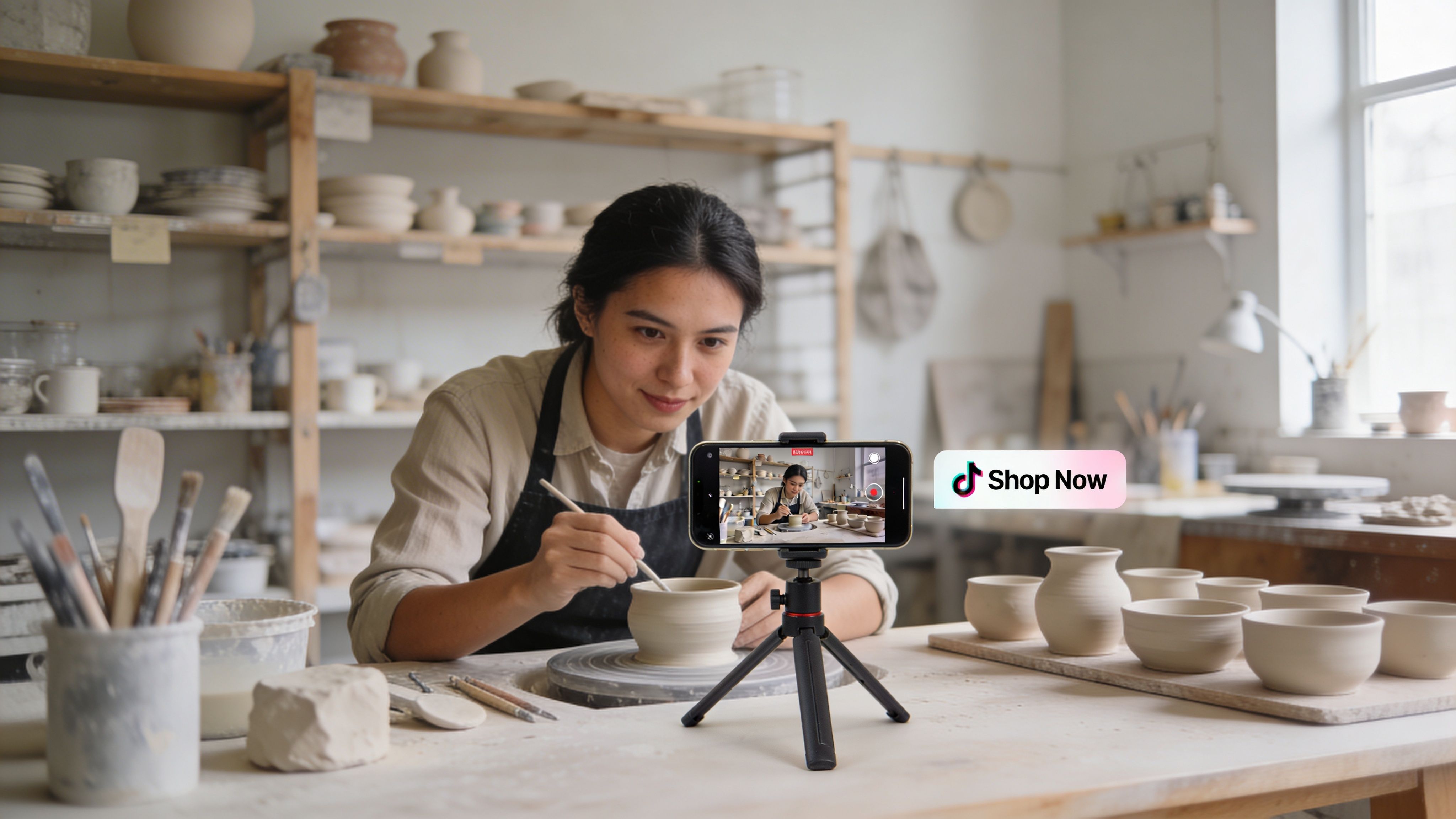
According to Marketing Agent, TikTok’s 2026 algorithm gives 40% to 50% of its ranking weight to watch time and completion rate, videos with average watch time over 60 seconds can reach engagement rates of up to 4.90%, and the first 3 seconds determine 71% of retention decisions in this 2026 TikTok marketing strategy guide.
That tells you exactly where to focus.
Not your logo. Not your intro. Not your polished brand shot.
The opening.
What local businesses should post
If you’re not in ecommerce, stop copying product-demo creators. Service businesses need proof, clarity, and trust.
Use formats like these:
Problem-solution clips: Show a common local problem, then show your fix.
Before-and-after stories: Repairs, renovations, cleanups, staging, plating, transformations.
Process videos: Walk people through how the service works.
Myth-busting clips: Correct bad assumptions buyers have.
Local context videos: Neighborhood tips, seasonal advice, local regulations, what to expect.
A real estate agent doesn’t need to dance. They need to make buyers feel smarter about the market. An HVAC company doesn’t need trends every day. They need to show what a bad install looks like and why it costs homeowners later. A restaurant doesn’t need cinematic perfection. It needs footage that makes someone hungry before they finish scrolling.
Structure each video for completion
Use this simple flow:
Open with the payoff Start with the result, not the setup. Show the repaired unit, the plated dish, the transformed room, or the key takeaway first.
Create a curiosity gap Give viewers a reason to stay. “Most homeowners miss this.” “This listing issue kills first offers.” “Why this drain smell keeps coming back.”
Deliver one clear point Don’t cram five messages into one video. One video, one outcome.
Close with a direct action Ask for the call, booking, message, reservation, or follow. Keep it plain.
The best TikTok for a small business rarely feels like an ad. It feels like useful evidence.
What kills performance
These mistakes are common and expensive:
Slow openings: If the video takes too long to get interesting, people leave.
Corporate scripting: TikTok punishes stiffness.
Too much context: People don’t need your full backstory.
Weak visual progression: If nothing changes on screen, retention dies.
No business bridge: Views without a CTA don’t help much.
If your team needs help turning raw footage into something usable, Adwave’s guide on how to make marketing videos offers a practical framework that applies beyond TV.
Measuring Success and Setting Test Budgets
Don’t judge TikTok by views alone. Views can flatter bad content and hide weak business outcomes.
You need a simpler scoreboard.
Start with diagnostic metrics
Darkroom Agency’s 2026 KPI guidance says 2-second views and 6-second views are critical because they reveal where a video fails. A weak 2-second view rate usually means the hook failed. A drop before 6 seconds usually means the pacing broke in the middle, which hurts completion and distribution.
That gives you a direct way to diagnose content:
Weak at 2 seconds: Your opening shot or first line didn’t earn attention.
Weak at 6 seconds: The promise was decent, but the video dragged.
Strong retention, weak business response: The content entertained but didn’t persuade.
A clean test framework for a small budget
If you’ve got $500 total to work with, don’t spend it all on one campaign.
Split your test into phases.
Phase one: organic message testing
Post a small batch of videos around a few repeatable themes. Keep the topics close to real buyer questions.
Use a mix like:
One educational clip
One proof-based clip
One behind-the-scenes clip
One direct offer clip
Watch where people stop watching. Don’t guess.
Phase two: paid amplification
Once one or two formats clearly hold attention better than the rest, put a modest paid budget behind them.
Many owners get impatient at this point. They boost the first decent-looking video instead of the first video that retains viewers.
That’s backward.
A video with clean retention but average aesthetics is usually more valuable than a polished video people abandon.
What success should mean
For a local business, define success in business terms before launch.
A restaurant might care about reservations or foot traffic. A roofer might care about estimate requests. A real estate agent might care about calls, texts, and listing inquiries.
Use TikTok analytics to spot creative problems, then use your website, calls, forms, and booking flow to judge whether the traffic is worth scaling.
If your content can’t hold attention, fix the content. If it holds attention but doesn’t drive action, fix the offer, the CTA, or the landing experience. If it does neither, don’t force it.
TikTok rewards testing. It punishes emotional attachment to bad creative.
TikTok vs Targeted TV When to Choose Adwave
For local, non-ecommerce businesses, this is the section that matters most.
TikTok can create attention fast. It can also eat your calendar alive. If your goal is local lead flow, neighborhood awareness, or trust with a defined audience, targeted TV often makes more sense than people assume.
TikTok wins on speed and interaction
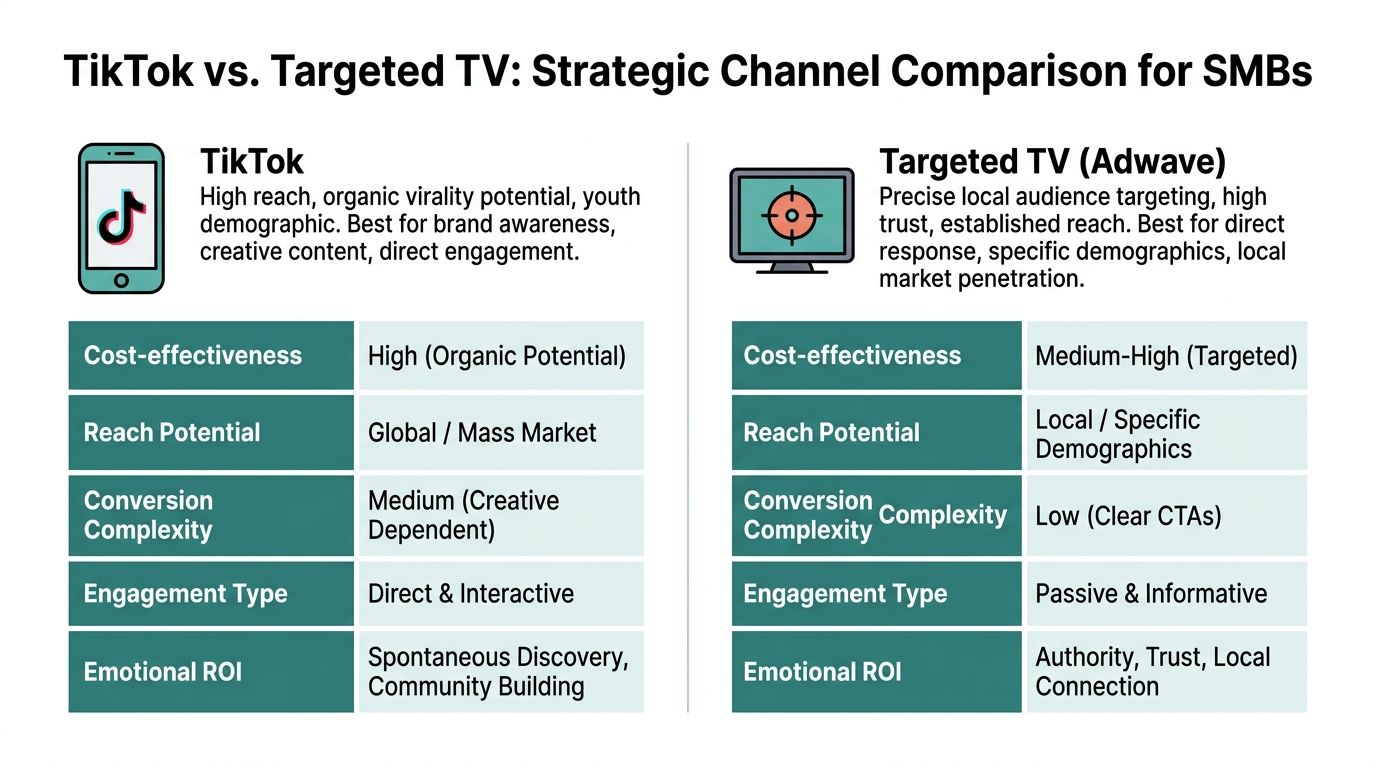
TikTok is strong when you need discovery, creative feedback, and lightweight audience building. It gives smaller brands a shot at breaking through without a huge following.
That matters if:
You’re comfortable on camera
Your service is visually demonstrable
Your team can post consistently
You’re testing different hooks and offers often
It’s also useful when you want active signals from the market. Comments tell you what people care about. Saves tell you what they want to revisit. Shares tell you what resonates enough to pass along.
That kind of feedback loop is valuable.
Targeted TV wins on predictability and local fit
Now the hard truth.
If you run a local service business and your customers don’t buy impulsively, TikTok is often a messy route to revenue. It may generate curiosity. It may build some familiarity. But the path from scroll to sale can be weak.
The research behind this topic points to an important comparison: for non-ecommerce SMBs, the time required for organic TikTok often carries a heavier opportunity cost than a targeted TV campaign with a $15 to $35 CPM, especially when the goal is qualified local leads instead of viral reach, according to HeyTrendy’s analysis of TikTok marketing for small business.
That lines up with what experienced operators already know. Service buyers often respond better to clear, repeated local presence than to algorithmic bursts.
Why Adwave fits this moment
Adwave is a strong choice when you want the benefits of TV without the usual production friction or large upfront spend.
It gives small businesses a way to create and run broadcast-ready ads across premium channels using a much simpler workflow than traditional TV buying. You don’t need a crew. You don’t need to negotiate placements manually. You don’t need a giant test budget just to get started.
For a local business owner deciding where the next $500 goes, that matters.
Here’s the strategic difference:
When I’d tell you to skip TikTok first
I’d put TikTok lower on the priority list if any of this sounds familiar:
You need leads soon, not “engagement.”
You don’t have someone to film and edit every week.
Your buyer needs trust before they act.
Your service isn’t naturally entertaining on camera.
Your local market matters more than national reach.
A dentist, attorney, broker, contractor, or financial advisor usually benefits from repeated exposure in the right local households more than from random spikes in social attention.
That’s where Adwave has a practical edge. It aligns with how local businesses grow. Repetition. Familiarity. Geographic relevance. Controlled spend.
TikTok is great at earning moments. Targeted TV is better at building presence.
When TikTok and Adwave work together
This doesn’t need to be either-or.
A smart split looks like this:
Use TikTok to test messages, visuals, and objections
Identify what buyers respond to
Use those insights in a more controlled TV campaign through Adwave
That’s a mature strategy. TikTok becomes your lab. Targeted TV becomes your local reach engine.
If your business can only do one channel well, choose the one you can sustain. For many local SMBs, that won’t be TikTok.
Sample Playbooks for Local Businesses
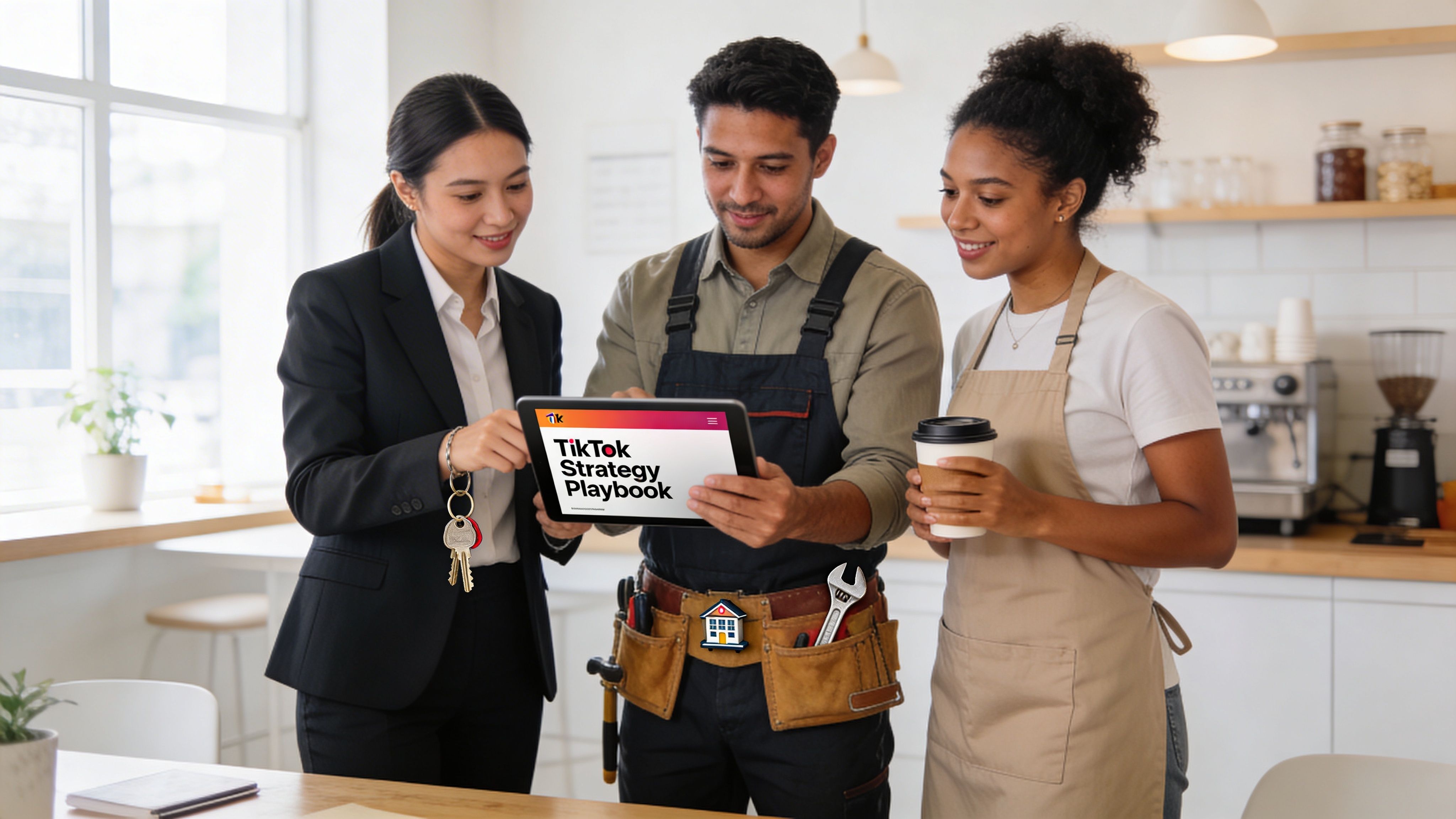
General advice gets fuzzy fast. So here’s what this looks like in practice.
Real estate agent
The agent posts short listing walkthroughs, neighborhood insight clips, and buyer mistake videos.
Good weekly rhythm:
Two property-focused videos
One neighborhood or market insight
One FAQ from an actual buyer conversation
Best business goal: listing inquiries and seller trust.
The content should feel grounded and local. Not influencer-style. Show curb appeal, street context, what a buyer notices first, and what a seller should fix before listing.
Home services contractor
Think HVAC, plumbing, electrical, roofing, or remodeling.
The best TikTok content here is proof. Dirty filter comparisons. Install mistakes. Repair footage. Seasonal tips. Small things homeowners ignore until they become expensive.
A manageable cadence is a few clips a week pulled from real jobs. Film on-site. Keep editing light. Add captions and a direct CTA.
Best business goal: estimate requests and inbound calls.
This category often does better with educational authority than entertainment. A confident technician explaining one issue clearly beats a forced trend every time.
Local restaurant
Restaurants have the easiest time getting visual attention, but they still need business discipline.
Use content around dish assembly, lunch rush scenes, chef commentary, menu highlights, specials, and customer favorites. Keep the food front and center. Don’t overproduce it.
Best business goal: foot traffic, reservations, and repeat visits.
The trap is posting pretty food videos with no local conversion path. Add context. Mention the area, special nights, limited menu items, or reasons to come in now.
If you run a local business, your TikTok should answer one question quickly. Why should someone nearby choose you?
The common thread
These businesses don’t need constant trend-chasing. They need repeatable content systems tied to real buyer behavior.
If creating that system feels manageable, TikTok is worth testing. If it already sounds like a chore, that’s your answer too.
The Final Verdict Your 2026 Action Plan
Here’s my blunt answer.
TikTok is worth your time in 2026 only if you can treat it like an operating system, not a side hobby.
It works when the business can produce consistent, watchable, native content. It works better when someone on the team understands hooks, pacing, proof, and simple calls to action. It works best when you’re willing to test before you expect returns.
If that’s not your setup, don’t force it.
Choose TikTok if
You can create short-form video consistently
Your service or product is visually demonstrable
Your team is willing to test creative often
You want feedback, attention, and audience interaction
You can accept uneven results while learning
Choose targeted TV through Adwave if
You want predictable local reach
Your audience buys on trust, not impulse
You need awareness in a defined market
Your team can’t commit to weekly content production
You want to put your next $500 into a channel with clearer control
The smartest move for most local SMBs
Use TikTok selectively. Don’t build your entire growth plan around it unless the platform clearly fits how your business sells.
For many local businesses, the winning setup is simple. Test a few TikTok concepts for message learning. Put serious emphasis on a channel that gives you durable local visibility.
That’s where Adwave fits. It gives small businesses a practical way to get on premium TV and streaming channels without the old barriers of TV advertising.
If you want a faster path to local visibility without committing your week to short-form content production, Adwave is a strong next move. You can create a broadcast-ready ad from your website, launch across premium channels, control spend starting at $50, and reach the local audiences that matter to your business.


