You walked a homeowner’s master bathroom on Tuesday morning, measured the wet area, priced the waterproofing and tile labor, and emailed a clean estimate before dinner. By Friday afternoon, your inbox is silent. No approval, no questions, and no polite decline.
Most local service owners and small office teams hit this wall every week. You already invested unpaid hours on the site visit and the takeoff, so walking away feels like throwing money out the window. Pushing too hard feels worse, because nobody wants to be the contractor who pesters a neighbor into blocking their number.
Learning how to follow up on a quote without burning trust starts with a simple mental shift. Silence after an estimate rarely means the homeowner hates your company. Usually, it means you haven’t yet reduced whatever decision cost is sitting between your PDF and their signature.
Why Quote Follow-Up Differs From First Response
Speed wins the first conversation, not the signed estimate. A well-known Harvard Business Review study of 1.25 million leads, summarized in Bebop’s sales follow-up statistics, found that companies attempting contact within one hour were nearly seven times more likely to qualify the lead than companies waiting longer. The same summary cites a related audit of 2,241 U.S. companies where only 37% responded to a web inquiry within an hour, 16% took between one and 24 hours, 24% waited more than 24 hours, and 23% never replied at all.
Local trades still struggle with that initial pickup window. In 2024, an analysis of 132,000 home-services campaigns published by Hatch and cited in StaffOS’s review of lead response time studies found that 88% of home-services businesses took more than five minutes to respond to leads. Those numbers explain why answering the phone quickly books more site visits, yet they measure first-response lead handling, not what happens after a proposal leaves your desk.
What Changes Once the Estimate Lands
When a homeowner first calls about a leaking shower pan or an outdated kitchen, they want reassurance that a real person will show up. Once your written estimate arrives, the job changes completely. They already know your name, your rough availability, and your price.
Now they’re weighing scope trade-offs, comparing line items against two competing bids, or trying to explain your numbers to a spouse over dinner. Calling five minutes after they open the attachment doesn’t solve any of those problems. Sending repeated “just checking in” emails only adds noise to a decision that already feels heavy.
Every follow-up after an estimate must carry one piece of information the buyer didn’t have before, or it should stay in your drafts folder.
Strong quote conversion starts with the clarity of the document itself, so tighten your structure with writing business proposals that win more deals before tweaking your reminder schedule. Upstream awareness work is a separate engine altogether, which is where Adwave helps local businesses bring in steady inbound inquiries. Once a prospect raises a hand and receives your numbers, your team takes over with permission-aware communication, a structured five-touch cadence, pressure-free objection handling, and firm stop criteria.
Permission Rules Before Any Text or Call
Before sending a single text message or picking up the phone on an open estimate, sort out what you’re legally allowed to send. Local service teams often blur helpful project updates with promotional nudges, and that slip creates compliance trouble fast.
Service Updates Versus Commercial Messages
Federal rules treat a transactional project message differently from a marketing pitch. The FCC overview of the CAN-SPAM Act explains that the statute governs commercial electronic mail and certain text messages sent to wireless devices rather than every email a business sends. In day-to-day estimate work, keep two categories cleanly separated:
- Service updates: Confirming that a requested estimate arrived, answering a specific question about materials or labor, or sharing a real change to crew availability for that exact job.
- Commercial messages: Adding seasonal discounts, pitching unrelated maintenance plans, or running recurring promotional nudges after the estimate conversation has gone cold.
Commercial outreach requires a plain opt-out mechanism and tighter consent controls. If your office also handles regional or international privacy rules alongside U.S. messaging laws, review CAN-SPAM and GDPR compliance for small business owners before building automated templates in tools like Jobber or Housecall Pro.
Consent, Revocation, and Your Pre-Send Checklist
Text messaging carries stricter boundaries than email because customers treat SMS as a personal channel. Under FCC robocall and robotext consumer rules, consumers may revoke consent through any reasonable means, and businesses must honor revocation requests within a reasonable time, not exceeding 10 business days. The Commission also describes its one-to-one consent rule as requiring prior express written consent for marketing messages from each individual seller, meaning permission granted to a lead aggregator or partner does not automatically cover your company.
Further guidance in the FCC TCPA consent revocation order reinforces an operational truth that protects your reputation as much as your license: silence is never open-ended permission. Run every quote-related text through this five-point check before hitting send:
- Name your business clearly. Never assume the homeowner saved your cell number after the walkthrough.
- Reference the exact project and estimate. Mention the kitchen tile quote or roof repair bid so the recipient connects the text to their request right away.
- Offer a simple reply path. Invite a direct question by reply text or phone call instead of forcing them through a portal login.
- Include a plain stop option. Telling them they can reply “stop” to end further messages lowers friction and builds trust.
- Log your basis for contact. Note in your estimate sheet or CRM when and how the customer gave their number for this specific quote.
If a prospect replies “stop” or asks you to quit texting, suppress marketing texts right away and send only essential transactional updates they still expect, such as confirming an already booked visit. Keep awareness campaigns run through Adwave completely separate from your quote-management permissions, because an ad interaction never grants blanket approval for recurring estimate texts. Keep in mind, too, that external booking tools and offline sales need additional setup to be measured, so maintain your own clean consent and estimate logs rather than relying on ad data to track follow-up permissions.
Five Touch Sequence for a Quiet Estimate
A reliable estimate cadence spaces five purposeful touches across 10 to 14 days. Every message removes one piece of uncertainty, so the prospect never wonders why you’re reaching out again.
| Touch | Timing | Objective | Value Add Required | Sample Opening |
|---|---|---|---|---|
| Confirmation | Same day as quote | Verify receipt and invite questions | Restate key scope item | Did the estimate arrive, and does the scope match what you had in mind? |
| Value Add | About 24 hours later | Address likely hesitation | Answer one question on price, timing, or warranty | Quick answer to what the price includes |
| Alternative | Days 3-4 | Reduce decision friction | Offer one smaller scope or a different start date | Would a phased option or a later start work better? |
| Voice Touch | Days 6-7 | Confirm status | Voicemail naming one project detail | Calling about the tile sample date on your estimate |
| Close Loop | Days 10-14 | Preserve relationship and stop | Note archiving and invite reconnection | Archiving the estimate for now; reply to reopen |
Consistent follow-up works because busy buyers rarely decide on the first email. In 2025, an analysis of 7.5 million B2B outbound emails published by Belkins and cited in StatisticsGlobal’s sales follow-up report found that follow-up emails generated 58.6% of all replies. Treat that figure as evidence from outbound B2B sales that quiet recipients do respond to later touches, not as a guaranteed conversion rate for residential bids.
Timing and substance both move reply rates. Proposal benchmarks compiled in PitchSite’s response time guide show roughly a 25% reply rate for follow-ups sent within 24 hours, with noticeably weaker results after three days. Those same benchmarks show generic “just checking in” emails pulling only 4% to 8% response rates, whereas personalized business questions generate 14% to 22%, relevant proof generates 18% to 28%, and an adjusted proposal or added option reaches 22% to 32%.
How to Write Each Touch Without Sounding Pushy
The fastest test for any follow-up draft is simple: if you could paste the exact wording into ten different customer threads without changing a word, rewrite it. Here is how each step looks for a quiet kitchen tile estimate.
- Touch 1 (Same day): Keep it to two lines right after sending the PDF. Write: Hi Sarah, I just emailed the estimate for the kitchen floor and backsplash job. Does the subfloor prep in section two match what we talked through on Tuesday? You confirm delivery and steer their eyes straight to the scope.
- Touch 2 (About 24 hours later): Answer the question homeowners hesitate to ask out loud. In two or three sentences, spell out whether demolition haul-away and grout sealing are already inside the total, or confirm your two-year workmanship warranty. If your team wants sharper phrasing that stays warm without sounding robotic, review how to follow up with leads without being annoying.
- Touch 3 (Days 3 to 4): Lower the size of the commitment. Offer one concrete variation, such as splitting the floor and backsplash into two phases or pushing installation into next month, then ask a binary question about which option fits better. You can also adapt conversational frameworks from sales scripts for small business when turning written options into natural replies.
- Touch 4 (Days 6 to 7): Make one brief phone call. If voicemail picks up, leave a 20-second message naming a specific detail from the visit, such as waiting on the ceramic tile sample delivery date, along with your direct callback number.
- Touch 5 (Days 10 to 14): Send a clean close-the-loop email that archives the file without guilt. For teams rebuilding cold threads or looking for phrasing variations across different service lines, these prospect re-engagement email templates from Salesmotion offer useful structural examples you can strip down to local service language.
Adapting the Pace to Real Constraints
Treat the 10-to-14-day schedule as a baseline, not a rigid law. An emergency water heater replacement moves in hours, while a $40,000 backyard patio often sits on a kitchen table for three weeks while the homeowner arranges financing.
Operating standard: Only introduce a deadline at Touch 3 or Touch 5 when a real operational constraint backs it up, such as a supplier’s material price sheet expiring on Friday or a single crew opening before the spring rush.
State the exact date and explain plainly what changes afterward. When no genuine constraint exists, let the helpfulness of the message do the work instead of inventing artificial urgency.
Answering Questions and Objections Without Pressure
Most quiet estimates aren’t sitting in an inbox because the buyer dislikes your work. They’re stalled because your point of contact has to sell your quote to someone who wasn’t at the walkthrough.

Equipping the Silent Decision Maker
Picture a homeowner who loves your plan, then has to justify a five-figure remodeling bid to a partner, a property owner, a bank loan officer, or an HOA board. Handing them a three-page itemized spreadsheet without context forces them to translate trade jargon on their own. When that feels exhausting, they delay the conversation until next weekend.
As Reakly’s guide to quote follow-up emails points out, no independent study establishes an optimal quote follow-up cadence, which is why reducing decision friction matters more than counting reminder days. That same guide recommends using a follow-up to provide a crisp summary for an absent decision-maker, offer a smaller-scope option, or ask a multiple-choice question rather than a vague status request.
Write one forwardable paragraph your champion can paste straight into a text or email to their spouse or business partner. Include six items in plain English:
- Deliverables: Exactly what gets built, repaired, or installed.
- Total cost: The full out-the-door figure with payment milestones.
- Key assumptions: Access hours, existing wiring or plumbing staying intact, or client-supplied fixtures.
- Exclusions: Permits, painting, or structural repairs outside your scope.
- Timeline: Estimated start window and total workdays on site.
- Next decision required: The single step needed to lock a spot, such as signing the option choice and sending a deposit.
Pair that summary with a quick multiple-choice prompt: Is the main hold-up right now the budget, the start date, or something in the scope? Answering a multiple-choice question takes five seconds on a phone, so you get an honest reply instead of polite silence.
Handling Price, Competing Bids, and Timing
Once a prospect tells you what’s slowing them down, resist the urge to talk them into a corner. Respond to the specific hurdle in front of you:
- When price feels too high: Never slash your price out of nowhere into silence. Unsolicited discounts tell the buyer your first number was padded. Walk through the tiers already inside your quote and show clearly what a smaller scope keeps and what it removes, such as switching from custom stone to porcelain tile while keeping the same waterproofing system. For deeper tactics on holding your margins calmly, read how to handle price objections with confidence.
- When they’re collecting other quotes: Welcome the comparison. Ask what materials, warranties, or prep steps the other bids include so the customer can compare apples to apples. Never trash-talk a local competitor; pointing out a missing line item calmly builds far more credibility than knocking another crew.
- When timing is the issue: If a homeowner says they need two weeks until a bonus clears or a tenant moves out, accept the date at face value. Confirm you’ll hold off until then, set a calendar task in your CRM or spreadsheet for that exact morning, and keep your word by staying quiet until the date arrives.
Why Fake Urgency Backfires
Telling a customer that a price disappears at midnight when your supplier hasn’t changed rates destroys trust the moment they call back next Tuesday and find out the old price still stands. Homeowners remember who respected their timeline and who tried to corner them.
The best follow-up makes an estimate easier to approve, not harder to ignore.
Because no universal formula fits every trade or ticket size, track your own numbers. Log the quote date, scope, message angle, buyer question, and final outcome in a simple table or field-service app. Within a single quarter, your own records will show which clarifications turn stalled bids into booked work.
When to Stop and How to Close the File
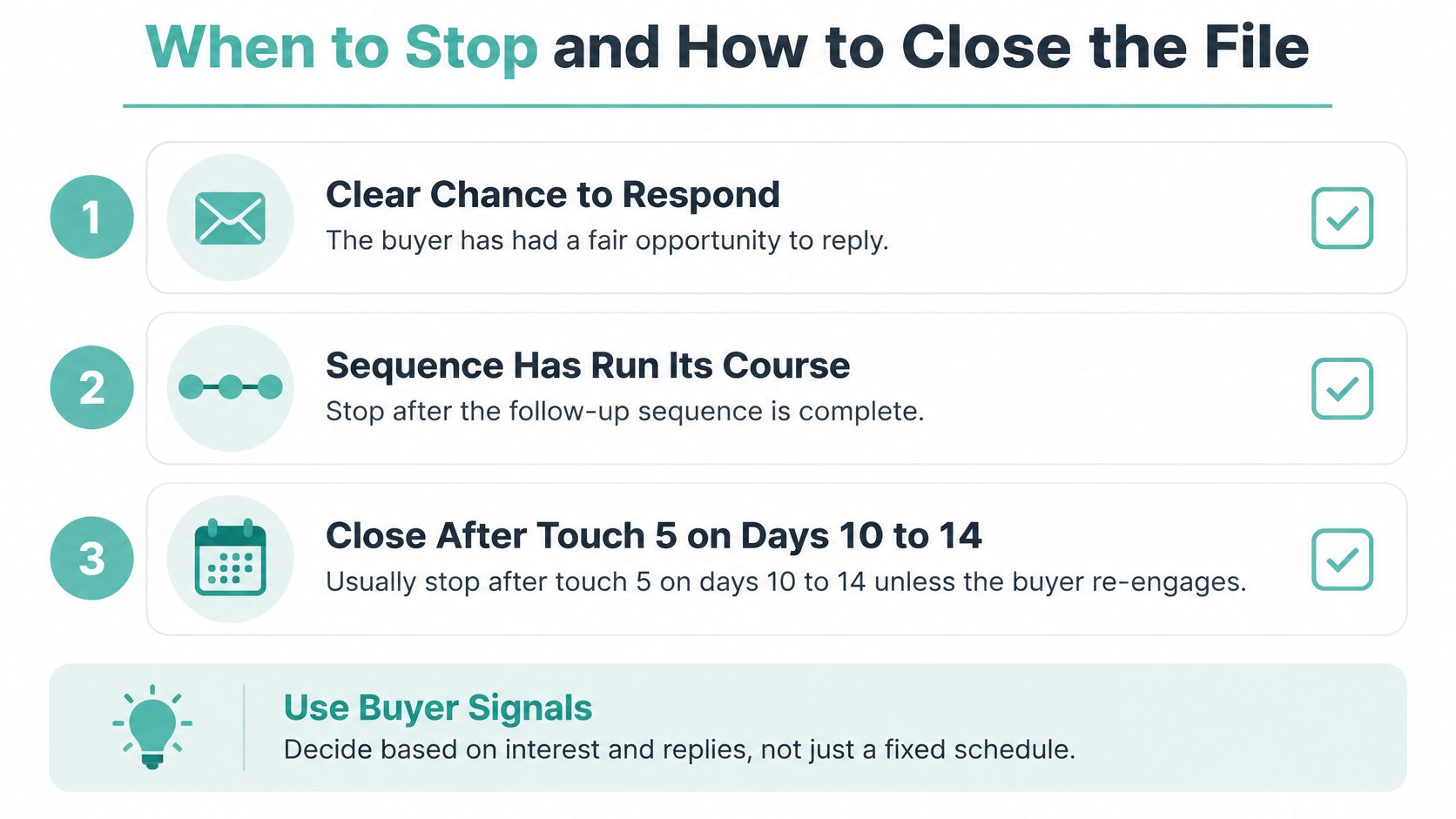
Knowing when to stop separates a respected local operator from a nuisance. Once a prospect has received your five-touch sequence over 10 to 14 days and had a fair chance to respond, stop chasing unless they re-engage.
Pushing past silence carries real downside. An analysis of 16.5 million cold emails cited in Beside’s guide on quote follow-up frequency found that four or more messages in a sequence more than tripled spam complaints and unsubscribes, while response rates peaked on the first email and dropped afterward. Cold outreach isn’t identical to a requested service quote, so don’t treat it as an estimate benchmark, yet it serves as a sharp warning about low-value repetition.
Independent research on reminders points in the same direction. Across 24 randomized trials involving 53,555 people, summarized in Call the Damn Leads’ compilation of follow-up statistics, reminders increased response odds by about one-third, while additional reminders produced smaller incremental gains. Each extra nudge buys you less attention and risks more goodwill.
Reading Buyer Signals Instead of Counting Touches
Instead of blindly running every prospect through an identical calendar, let observable behavior dictate your next step.
| Buyer signal | Likely meaning | Next action |
|---|---|---|
| No reply after touch 5 | Delayed or dead decision, unknown | Send the close-the-loop note and tag as not now |
| Asked for a revision | Interested, price or scope issue | Send a revised option within one business day |
| Quote viewed but no reply | Under internal review | Send the forwardable summary once, then wait |
| Said not now with a date | Timing issue | Tag for reactivation on that date |
| Said no or asked to stop | Decision made or opt-out | Stop marketing contact and close the file |
Working off signals keeps your office staff focused on warm jobs instead of nagging cold ones. It also stops two people on a small team from accidentally texting the same quiet customer twice in one week.
Writing the Close-the-Loop Message
A strong closing note removes pressure while leaving the door open. Send something direct and respectful:
Hi Sarah, I’m archiving the kitchen tile estimate for now so it doesn’t clutter your inbox. Material pricing and crew availability can shift over time, so if you decide to revisit the project later, just reply here and we’ll refresh the numbers before scheduling anything.
Notice what that short note accomplishes. You give the customer a dignified exit, you avoid fake scarcity, and you protect your margins by stating plainly that outdated quotes require a fresh check.
When a homeowner replies “not now” and names a future window, tag the file for a single polite reactivation task on the date they gave, often three to six months out. Delete or permanently close a record only after a clear no or an opt-out request. In a local service market, referrals and repeat repairs flow to the business owners who stayed polite even when a job didn’t close on the first try.
If your company is also running local awareness campaigns alongside your estimate process, read call tracking for small business next so incoming phone inquiries land on the right customer file from day one. When you’re ready to bring more local inquiries into a well-run follow-up workflow, Adwave offers a free website analysis, and customers can preview their ads and approve them before spending money.
A disciplined quote follow-up sequence works best when your pipeline stays steady with qualified local inquiries rather than forcing you to chase every stalled estimate. Adwave helps local service businesses build regional visibility with a free website analysis and finished ad previews you can review and approve before spending a dollar. Visit Adwave to see how your business can keep fresh inquiries flowing into your estimate workflow.