
The average proposal win rate rose from 43% in 2024 to 45% in 2025, the largest year-over-year improvement in five years, but that still means more than half of formal proposals didn't convert at the benchmark source. This situation forms the basis for Writing Business Proposals That Win More Deals. A proposal doesn't have to be long to be persuasive, but it does have to make the buyer feel understood, reduce risk, and make the next step obvious.
If you're writing for SMBs, service businesses, or local advertisers, the trap is easy to spot. Teams spend hours describing their company, their process, and their features, then wonder why the buyer goes quiet. The better approach is simple, write to the client's decision, not your own comfort.
For teams that need a faster way to assemble structured documents, government proposal software can help keep sections organized without turning the proposal into a bloated template dump. The point isn't automation for its own sake. The point is consistency, because consistency is what keeps a good proposal from falling apart once multiple people review it.
A strong proposal also starts with how the buyer moves through the journey, not just what you want to sell. If you want a clean way to think about that journey, this internal resource is useful, customer journey mapping for small business.
Setting the Stage for a Winning Proposal
A proposal is really a decision document. The buyer is asking, sometimes openly and sometimes indirectly, “Do you understand my problem, do I trust your fix, and is this worth the risk?” If your draft doesn't answer those questions quickly, it's competing against every other tab, meeting, and inbox item on the buyer's desk.
That's why the average win-rate improvement matters. A move from 43% to 45% sounds small, but in a market where more than half of proposals still fail, small gains in qualification, clarity, and follow-up can compound across a pipeline as shown in the 2025 benchmark. For a local agency, a home services firm, or a dealership, that means the difference isn't usually “better salespeople” in the abstract. It's a tighter story, a more relevant offer, and fewer unnecessary pages.
What usually kills the deal early
Most proposals lose momentum because they feel generic. The buyer sees a wall of company history, a list of services, and maybe a price buried so late that nobody wants to keep reading. That's a formatting problem, but it's also a thinking problem. The writer has described the offer, not the outcome.
Practical rule: if a reader can't tell what problem you're solving on the first pass, the proposal is already too vague.
A better mindset is to treat the first page like a qualification filter. If the client is a regional dentist, for example, the opening should sound like a local growth conversation, not a corporate brochure. If the client is a B2B service firm, it should sound like operational relief, not branding theater.
The cleanest proposals usually come from a clear sequence, and the structure matters as much as the prose. Before drafting, use a system that keeps the document organized and avoids scattered sections. If you want a practical workflow for that, writing proposals with a structured process helps you think in stages rather than in random pages.
The Foundation Understanding Your Client's World
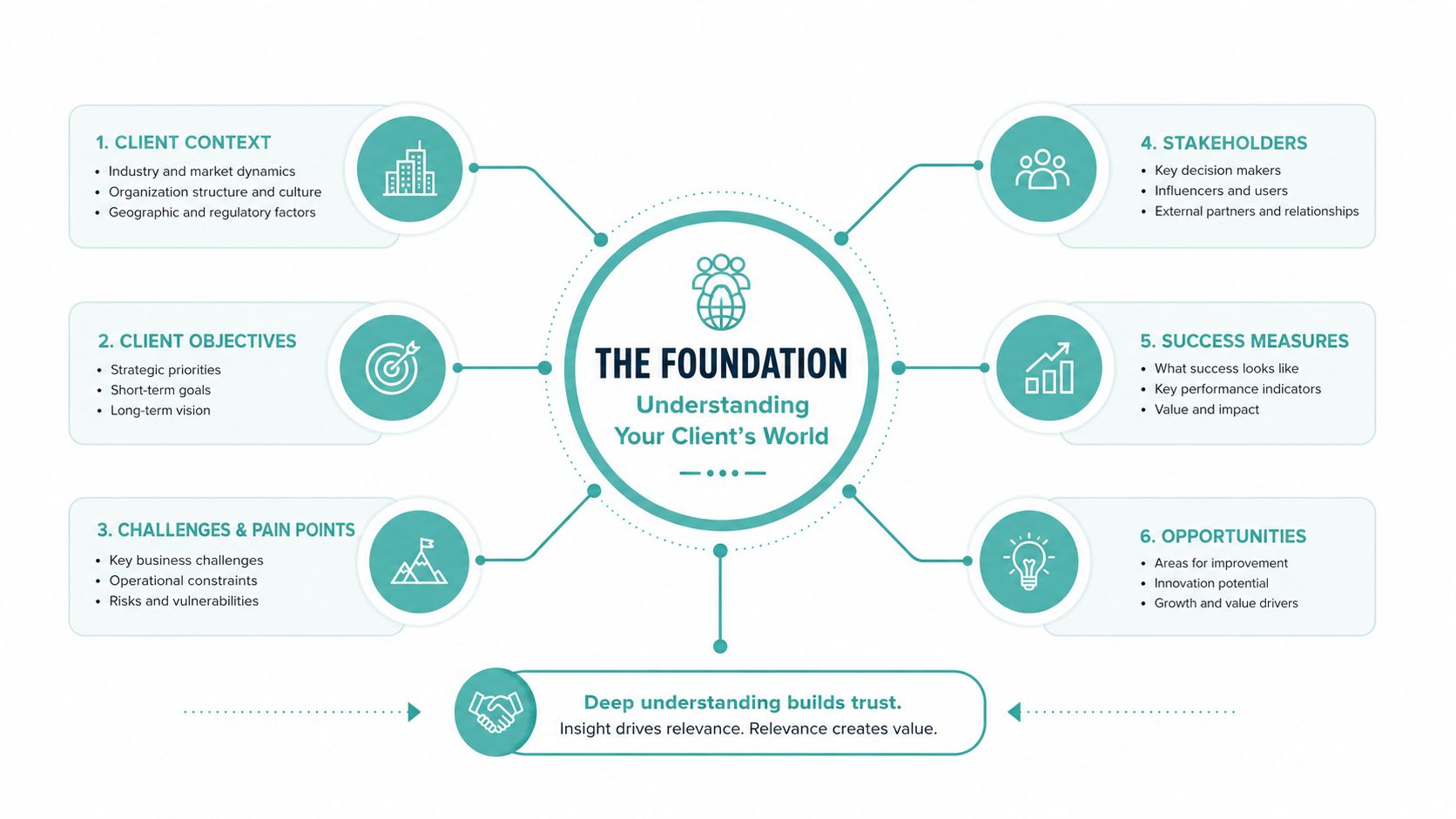
The best proposals start before the first sentence. If you don't know what the client is trying to protect, grow, fix, or avoid, the document will drift into generic language. Good discovery work makes the proposal feel inevitable, because the reader recognizes their own priorities in your words.
Diagnose the actual problem
Discovery calls need to go deeper than “What are you looking for?” That question gets polite answers, not useful ones. Ask what triggered the search, what's breaking now, what they've already tried, and what success would look like in plain language. If the client says they need “more leads,” keep digging until you know whether they mean volume, quality, speed, or a better close rate.
You also need to listen for internal tension. One person may want speed, another wants lower risk, and a third wants easy implementation. If you don't surface those priorities early, they'll show up later as revisions, delays, or silence.
Map who decides
Most deals aren't made by one person in isolation. A proposal often passes through an owner, an operator, a finance lead, or procurement, and each of them reads for different reasons. That's why a good writer doesn't just identify the buyer, they identify the decision path. A local agency proposal for a restaurant chain should sound different from a proposal for a solo founder, even if the service is similar.
Use the research phase to learn three things:
Who cares about the outcome, because that person needs the clearest summary.
Who cares about the process, because that person wants specifics and predictability.
Who can block the deal, because that person will notice gaps, ambiguity, or weak proof.
The right research also includes the client's definition of success. For one business, success may mean more walk-ins. For another, it may mean fewer wasted calls or a cleaner lead handoff. If you know that metric, you can frame the whole proposal around it instead of around your capabilities.
Match the language to the client
The strongest proposals sound like they were written by someone who spent time inside the account. That doesn't mean copying the client's words back at them. It means using the terms they use for the problem, the pressure, and the result. A dealership doesn't need marketing jargon. It needs a proposal that reflects real commercial pressure, inventory goals, and measurable response.
If you want a helpful way to segment that audience before you write, audience segmentation for business proposals is a smart reference point. The value is simple. When you know who matters and what each person needs, the proposal becomes sharper, shorter, and easier to approve.
Crafting a Value-Driven Narrative That Resonates

A winning proposal doesn't read like a capabilities dump. It reads like a clean argument. The client has a problem, your approach solves that problem, and the proof makes the choice feel lower risk than doing nothing.
Turn the problem into the client's language
The opening of the core narrative should state the problem the way the client would say it in a meeting. If a local car dealership wants more traffic from nearby buyers, don't write about “cross-channel awareness amplification.” Write about showroom visits, local visibility, and measurable response. The language should feel operational, not ornamental.
That problem statement does two things. It shows empathy, and it shows that you understand the decision context. A buyer is more likely to continue reading when they feel the writer has heard them accurately.
Present the solution as the logical next step
Once the problem is clear, the solution should feel specific and practical. For a dealership, a TV campaign can be framed as a local awareness play with trackable downstream response, especially when the campaign is built around a clear landing page, a promo code, or a QR code. That's the kind of structure that keeps the offer from feeling like a vague brand spend.
The key is to avoid stuffing every feature into the narrative. Buyers don't need your full service menu. They need the part of your service that solves their stated problem. If they need awareness, focus on reach and response. If they need lead quality, focus on targeting and follow-up.
Practical rule: lead with the result, then explain the mechanism, then show proof.
Use proof to reduce perceived risk
Proof matters because buyers need something stronger than confidence. In business proposals, proof can be past outcomes, case studies, or credible benchmarks. For TV and CTV, one hard benchmark is the completion rate. 30-second connected TV ads average 95.92% video completion rate, 15-second ads average 93.88%, and 10-second-or-less ads average 90.4% according to the benchmark source. The same source says overall CTV averages fall in the 90 to 95% range, which is useful because it gives a proposal a concrete frame for what strong exposure looks like.
That benchmark works especially well when you're pitching a local campaign to an SMB that wants attention without waste. It doesn't guarantee results, but it does let the proposal argue from performance logic instead of hope. Buyers can compare the offer more easily when the document includes a standard for success.
Include relevant customer outcomes in proposals, with permission and supporting evidence. See our guide to writing customer case studies for how to gather that material.
Structuring Your Offer for a Clear Yes
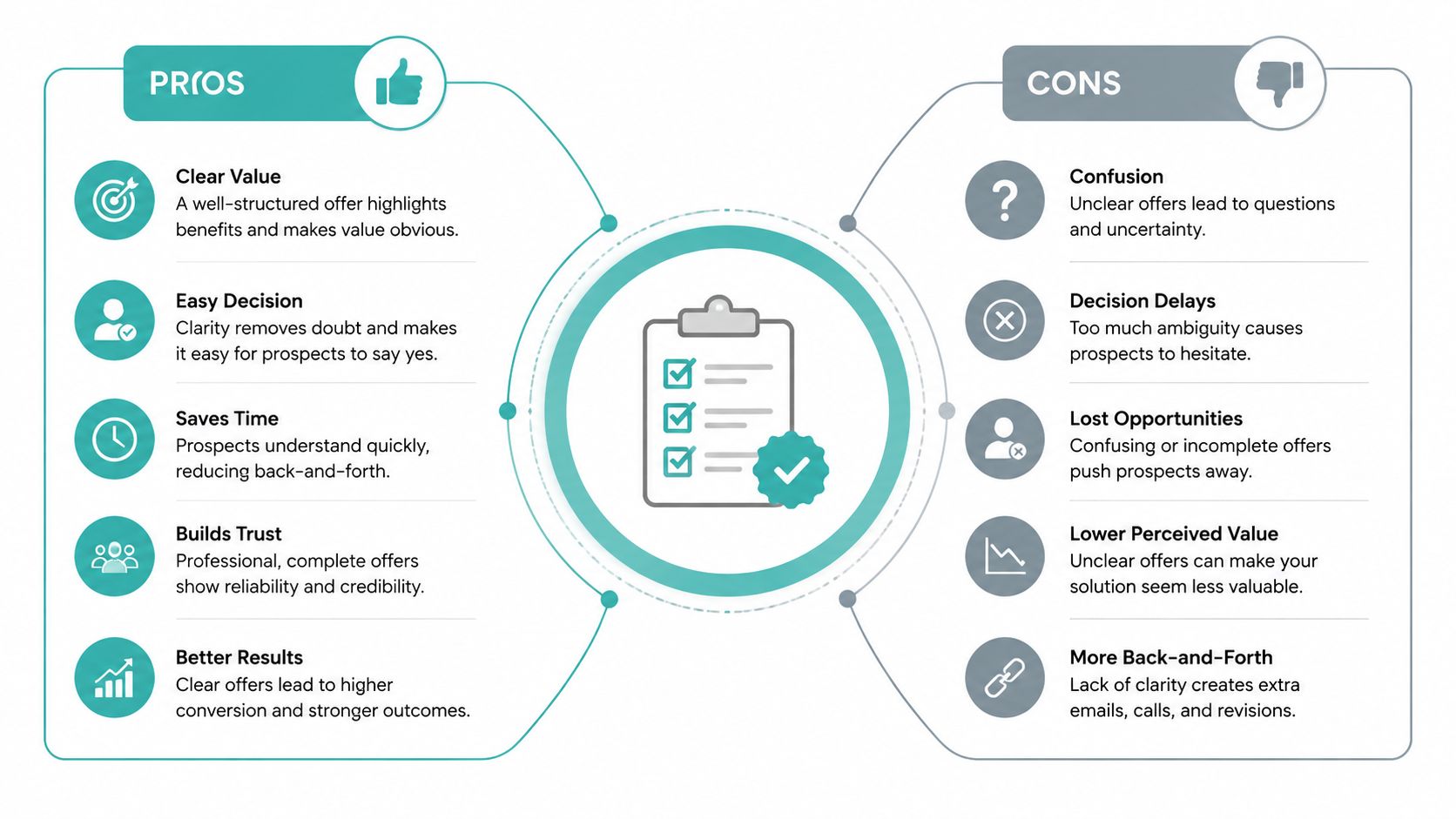
Clear offers close faster than clever ones. A proposal can have a strong narrative and still lose if the buyer can't tell what's included, what's optional, and what happens next. Structure matters because it removes friction.
Package the offer, don't just price it
A single price line often creates more hesitation than confidence. Buyers want to compare options without doing the math themselves, and proposals that make comparison easy tend to create more momentum. In an analysis of 2.6 million proposals, offering multiple pricing tiers increased the likelihood of winning a deal by 36% based on the Proposify summary. The same source found that 5-page proposals closed about 50% of the time, while 30-page proposals closed only 35% of the time.
That does not mean every proposal should be short at all costs. It means every page has to justify itself. If a section doesn't help the buyer decide, it's probably padding.
Here's the practical packaging approach that works best for service businesses:
One recommended option, because it simplifies the default decision.
A second tier only if it adds real contrast, not just more volume.
Line-item clarity, so the buyer knows what they're paying for.
A dedicated pricing section, so cost doesn't get scattered through the narrative.
Make deliverables visible and unambiguous
A proposal should tell the buyer exactly what they will receive. For a local TV campaign, that means naming deliverables in concrete terms, like ad creative, placement, launch support, and tracking setup. Vague phrases like “full-service support” may sound polished, but they create room for disagreement later.
State the delivery schedule and dependencies in your proposal. Include time for approvals, creative revisions, and data setup.
Build measurement into the offer
For campaigns that need proof, measurement should be part of the offer itself, not an afterthought. A proposal for TV advertising can specify unique landing pages, promo codes, and QR codes to support attribution. It can also explain how ROI will be calculated, using the formula ROI = (Revenue from TV conversions - TV ad spend) / TV ad spend × 100 as outlined in the ROI guide.
That kind of framing is valuable because it keeps the proposal grounded in outcomes. If the client is a local retailer, a franchise operator, or an automotive group, they don't just want activity. They want a trackable link between spend and response. If you need a useful reference for shaping that section, pricing strategies for small business can help you think about how to present value without muddying the decision.
Designing for Decision-Makers and Handling Objections

A proposal can say the right things and still fail if it's hard to read. Decision-makers skim. Procurement people compare. Operators look for missing steps. Good design respects that reality.
Make the document easy to scan
Whitespace isn't decorative, it's functional. Short paragraphs, clean headings, and simple tables help the reader find what matters without working for it. If you're sending the proposal as a PDF or through a sales platform, assume the reader may jump around rather than read linearly.
Use an executive summary to orient the economic buyer, then move into the operational detail for the people who need implementation confidence. That split keeps the top of the proposal strategic and the middle of the document useful. It also keeps a technical reader from getting frustrated by vague summaries, or a senior leader from getting buried in process detail.
Handle multiple stakeholders without bloating the offer
The common mistake is trying to satisfy everyone equally in the same section. That's how proposals become mushy and overlong. A better structure is to speak first to the person who can approve the budget, then support that decision with enough detail for the team that will interact with the work.
One proposal, one decision path. If every section tries to do every job, the proposal starts arguing with itself.
That's especially important when the buyer group includes finance, operations, and the end user. Finance wants clarity and risk control. Operations wants workload and fit. The end user wants a workable outcome. The proposal should acknowledge all three without rewriting itself three times.
Address objections before they get used against you
Most objections fall into a few predictable categories. The buyer worries about price, timing, fit, or effort. You don't need to pre-answer every possible concern, but you do need to remove the obvious ones. If the proposal requires internal coordination, say so. If success depends on client inputs, say that too.
The cleanest way to handle objections is to make the next step obvious and low-friction. The easier it is to review, compare, and sign, the less likely the deal will stall. If you're thinking about how to structure that for a proposal workflow, how to write a business proposal is a useful point of reference for balancing detail with decision speed.
The Follow-Up Sequence That Closes Deals
Sending the proposal is the start of the closing process, not the end. Once the document is out, the primary work is staying relevant without becoming annoying. The best follow-up is polite, specific, and tied to the buyer's decision timeline.
For TV and attribution-driven campaigns, the proposal should also spell out how success will be tracked after launch. A strong plan includes unique promo codes, dedicated landing pages, and QR codes so the client can connect exposure to action as outlined in the ROI guide. That same guide recommends calculating ROI with (Revenue from TV conversions - TV ad spend) / TV ad spend × 100, which is the kind of simple formula clients can understand and audit.
A good follow-up rhythm doesn't need to be pushy. It just needs to keep the conversation moving.
First touch: confirm receipt and ask whether any part of the proposal needs clarification.
Second touch: restate the buyer's priority in one sentence and tie it back to the recommended option.
Third touch: offer to walk through the objections live, especially if more than one stakeholder is involved.
You should also track how the proposal process itself performs. Open activity, time to response, and conversion by proposal type all matter because they tell you whether the issue is the offer, the timing, or the follow-up. A proposal process improves when the team reviews what transpired after send, not just what was written.
For SMBs selling services like local TV advertising, that discipline matters a lot. The proposal has to prove value before the campaign starts, and the follow-up has to reinforce value until the decision lands.
If you're ready to make your proposals easier to approve, use the framework above on your next live deal, then send the draft through Adwave when you want a TV advertising campaign built around measurable ROI, clear attribution, and a buyer-friendly story that helps close more business.


