

You probably have at least one customer who's happy enough to say nice things about you. The problem is that “they were great to work with” rarely helps a sales rep close a skeptical buyer. It doesn't answer the hard questions. What changed? How long did it take? Why was your approach the right fit? Would this work for a company like ours?
That gap is where most case studies fail. They read like polished praise, but they don't function like proof.
If you want to learn how to write customer case studies that win new business, treat them like performance assets. They should help sales handle objections, help marketing create reusable proof, and help prospects see a clear before-and-after story they can compare to their own situation.
From Happy Customer to Powerful Sales Asset
A testimonial says, “We liked working with them.” A strong case study says, “Here was the problem, here's what changed, and here's the result.”
That difference matters because buyers don't make decisions on enthusiasm alone. They look for relevance and evidence. A case study becomes useful when it shows a specific customer journey in a way another buyer can map onto their own situation.
What gathers dust and what gets used
The case studies that sit untouched in a PDF folder usually have one or more of these problems:
They're too vague: No baseline, no business context, no visible change.
They're written like brochures: Heavy product language, light customer reality.
They don't help sales: A rep can't pull a clear takeaway for a pricing call, renewal discussion, or competitive deal.
By contrast, the case studies that sales teams send have three things:
A relatable starting point The reader needs to recognize the customer's problem fast.
A believable path to improvement Explain what changed without turning the middle of the story into feature soup.
A measurable outcome The U.S. Chamber of Commerce advises writers to lead with numbers in the results section, and practical guidance on customer case studies points in the same direction because that's what helps a buyer judge business impact. If you want a useful contrast with lighter social proof, Adwave's guide on testimonial pages that build trust and drive sales is a good reference point.
A case study earns attention when it reduces uncertainty.
A junior marketer's common mistake is assuming the asset is finished when the writing is done. It isn't. The useful version is the one sales can quote in a deck, marketing can turn into a landing page, and leadership can use as proof in outreach.
That shift in mindset changes how you pick the customer, run the interview, and write every section.
Finding and Preparing Your Star Customer
The fastest way to write a weak case study is to start with the wrong customer. “Happy” isn't enough. You need someone whose story has tension, a real implementation path, and an outcome that means something to future buyers.

Salesforce notes that the case study process became a standard B2B marketing tool because buyers respond to client-specific evidence, and it recommends a structured interview that captures the problem, solution, and quantitative results so buyers can quickly map the story to a proven outcome in their own world, as outlined in its guide to writing a small business case study.
Pick the customer sales actually needs
Don't ask, “Who likes us most?” Ask, “Whose story would unblock a stalled deal?”
Look for customers who fit one or more of these patterns:
They match your target buyer: Same industry, similar company size, similar pain.
They overcame skepticism: Procurement concerns, budget pushback, internal resistance, category doubt.
They can speak clearly: Some customers have good results but can't explain the journey well.
They'll approve details: A great story is useless if legal strips out every meaningful fact.
A practical shortlist often comes from customer success, account managers, and sales reps. Ask each team for one account they wish prospects could read about before a call.
Ask for the interview the right way
The outreach matters. Keep it simple and respectful. Tell the customer why you picked them, what the process looks like, how long it'll take, and what they'll review before anything is published.
A clean ask sounds like this:
We'd love to feature your team because your rollout had a clear problem, a strong implementation story, and meaningful results. We'd handle the draft, keep the process light, and nothing would be published without your approval.
That usually lands better than “Can we get a testimonial?”
For local brands, this is the same discipline behind gathering strong review language. The difference is that a case study goes much deeper than a review. Adwave's article on how to get more Google reviews for your local business is useful for understanding the first layer of customer proof, but case studies require a more structured interview and much more detail.
Run an interview that surfaces proof
Most interviews fail because the writer asks broad questions and settles for broad answers.
Use a checklist that moves in sequence:
Start with the before state: What was happening before they hired you? What wasn't working?
Clarify the stakes: What made the problem worth solving now?
Reconstruct the buying decision: What alternatives did they consider? What concerns did they have?
Document the rollout: What happened first, next, and after that?
Push for outcomes: What changed in the business, team, workflow, or customer experience?
Get the emotional reaction too: What felt different once the new approach was in place?
Have fallback metrics ready
Heavybit points to a common failure mode in customer stories: insufficient proof density. Its guidance recommends planning fallback metrics ahead of the interview, such as revenue generated, hours saved, incidents reduced, or SLA improvements, and capturing both the operational result and the customer's emotional reaction early in the conversation in its customer case study template.
That advice is practical because customers often won't volunteer numbers unless you ask in several ways.
If they say, “Things got much smoother,” follow up with questions like:
What used to take too long?
What bottleneck disappeared?
What did your team stop doing manually?
What changed for leadership, sales, or operations?
You're not fishing for vanity. You're trying to establish a baseline, intervention, and outcome. Without that, you don't have a case study. You have a compliment.
Crafting a Narrative That Converts
Raw interview notes are not a case study. They're inventory. The work is turning that material into a story that helps a buyer move from curiosity to confidence.
A good structure is simple: challenge, solution, results.
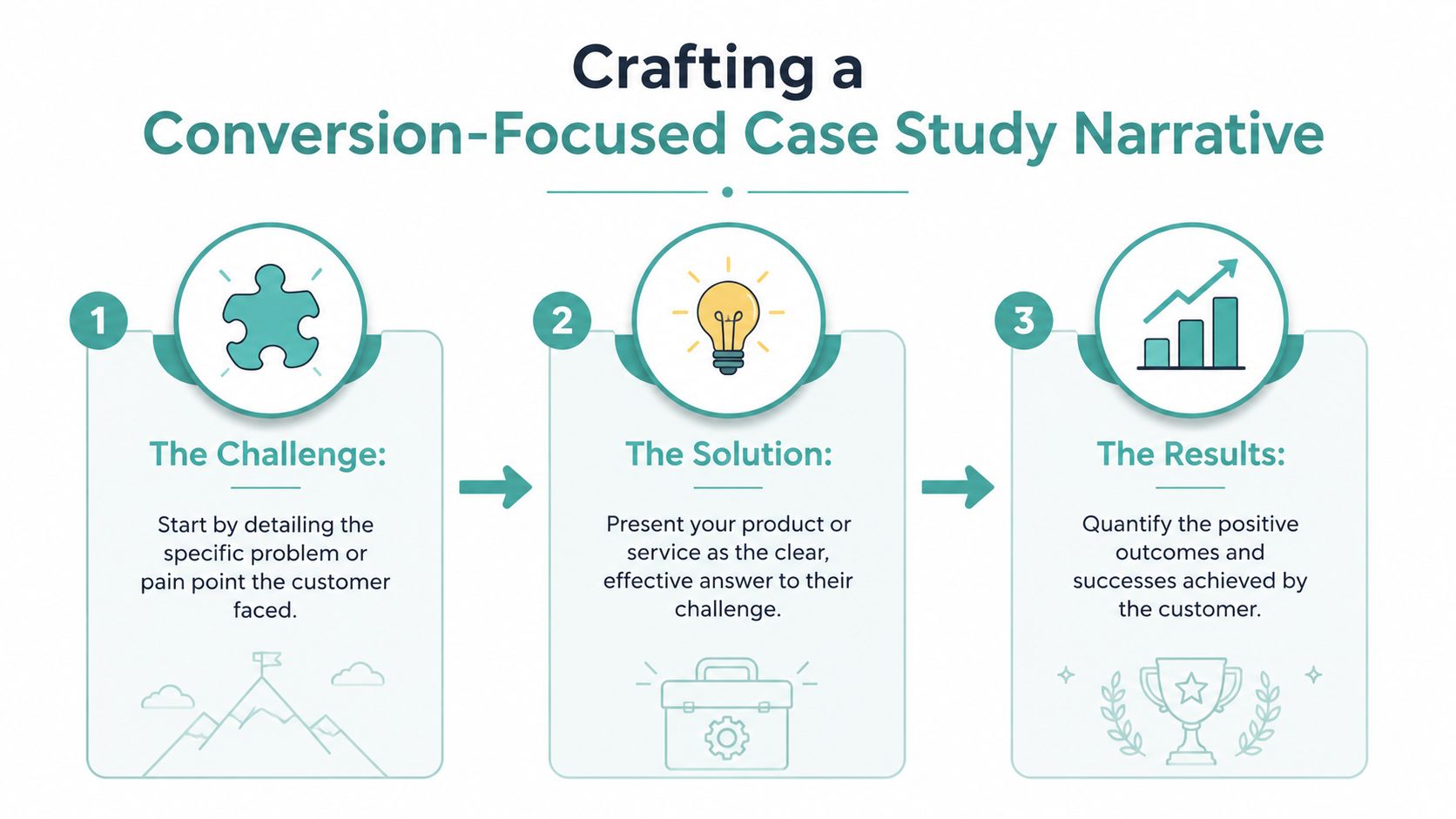
The U.S. Chamber says the results section should “lead with numbers” and highlight the most compelling statistic. It also notes that effective case studies are often 500 to 1,500 words, which gives you enough room for context, implementation detail, and hard data without dragging. It also points out that strong case studies can be repurposed across website pages, social posts, and sales materials in its article on how to write customer case studies.
Write the challenge so prospects recognize themselves
This section should feel uncomfortably familiar to the next buyer.
Bad version: “The client wanted to improve marketing performance.”
Better version: “The team had strong demand in theory, but their message wasn't turning interest into action. Prospects visited, asked questions, and stalled before buying.”
That works because it names friction, not just ambition.
If you're writing website-first stories, the same discipline applies to your framing and transitions. Adwave's piece on how to write website copy that converts visitors into customers is a useful companion because both assets depend on clear problem framing, plain language, and a sharp connection between pain point and outcome.
Write the solution without sounding like a product brochure
Many drafts lose the reader; they become feature tours.
Keep the focus on what the customer did, why that mattered, and what changed operationally. If the customer adopted new tools, workflows, or channels, explain them in business terms.
For example, if you were shaping a local growth story for a business using TV advertising, you wouldn't write, “The platform delivered omnichannel visibility with premium inventory access.” You'd write, “The business took a result that already resonated with customers and turned it into a TV campaign that could reach local viewers on premium channels.”
Practical rule: If a sentence could appear unchanged on your pricing page, it probably doesn't belong in the middle of a case study.
Make the results section impossible to skim past
Results go near the top in summaries and deserve visual emphasis in the body. Pull the strongest proof forward.
A simple conversion-friendly flow looks like this:
You can also weave in the customer voice to break up the narrative.
“What changed most was clarity. We knew what we were doing, why we were doing it, and what better looked like.”
That kind of quote works when it adds perspective the metrics alone can't carry. It should support the proof, not replace it.
If you need a writing test, use this one: could a sales rep copy two sentences from your case study into an email and have them make sense instantly? If the answer is no, tighten the narrative.
Designing Your Case Study for Maximum Impact
A strong story can still underperform if the format fights the way people read. Most buyers don't sit down and read case studies line by line. They scan for fit, proof, and relevance.
That's why format decisions matter almost as much as writing decisions.
Recent guidance on B2B case studies increasingly emphasizes format flexibility. While a 500 to 1,500 word document is still a standard format, adapting the same core story into charts, pull quotes, and video is important because different buyers want proof in different forms, as discussed in this piece on B2B case studies that drive revenue.
Match the format to the buying moment
A website visitor needs a different experience than an AE sending follow-up after a demo.
Use a simple channel match:
Web page: Best for discoverability, SEO, and full context.
PDF or one-pager: Best for sales follow-up and procurement sharing.
Deck slide: Best for live presentations and shortlist discussions.
Short video or visual ad unit: Best for grabbing attention fast and widening reach.
The underlying story stays the same. The packaging changes.
Design for skimming, not for decoration
A case study should be easy to scan in under a minute.
Use these elements deliberately:
Clear subheads: Let buyers jump to challenge, solution, or results.
Callout stats or proof boxes: Surface the outcome before the body copy.
Pull quotes: Add human perspective without forcing readers through long paragraphs.
Screenshots, charts, logos, and visuals: Make proof feel concrete.
What doesn't work is overdesigned clutter. If every line is stylized, nothing stands out.
Buyers don't need more branding inside a case study. They need faster access to evidence.
Turn one proof point into multiple assets
Teams often leave value on the table. They publish a case study page and stop.
A smarter move is to treat the written story as the source file for several formats. The same customer result can become a website feature, a social proof post, a sales one-pager, a short video script, or ad creative.
One option in that mix is Adwave, which lets businesses create, launch, and measure broadcast-ready TV ads across premium channels by starting with their website and campaign inputs. For local companies, that means a customer success story doesn't have to stay trapped in a PDF. It can become a localized TV ad that carries the proof into a broader brand channel.
That matters because case studies aren't only for bottom-of-funnel handoffs anymore. They can also support reach and recall when converted into visual formats buyers will notice.
Distributing and Amplifying Your Success Story
A finished case study that nobody sees is a documentation exercise. Distribution is where the asset starts doing revenue work.
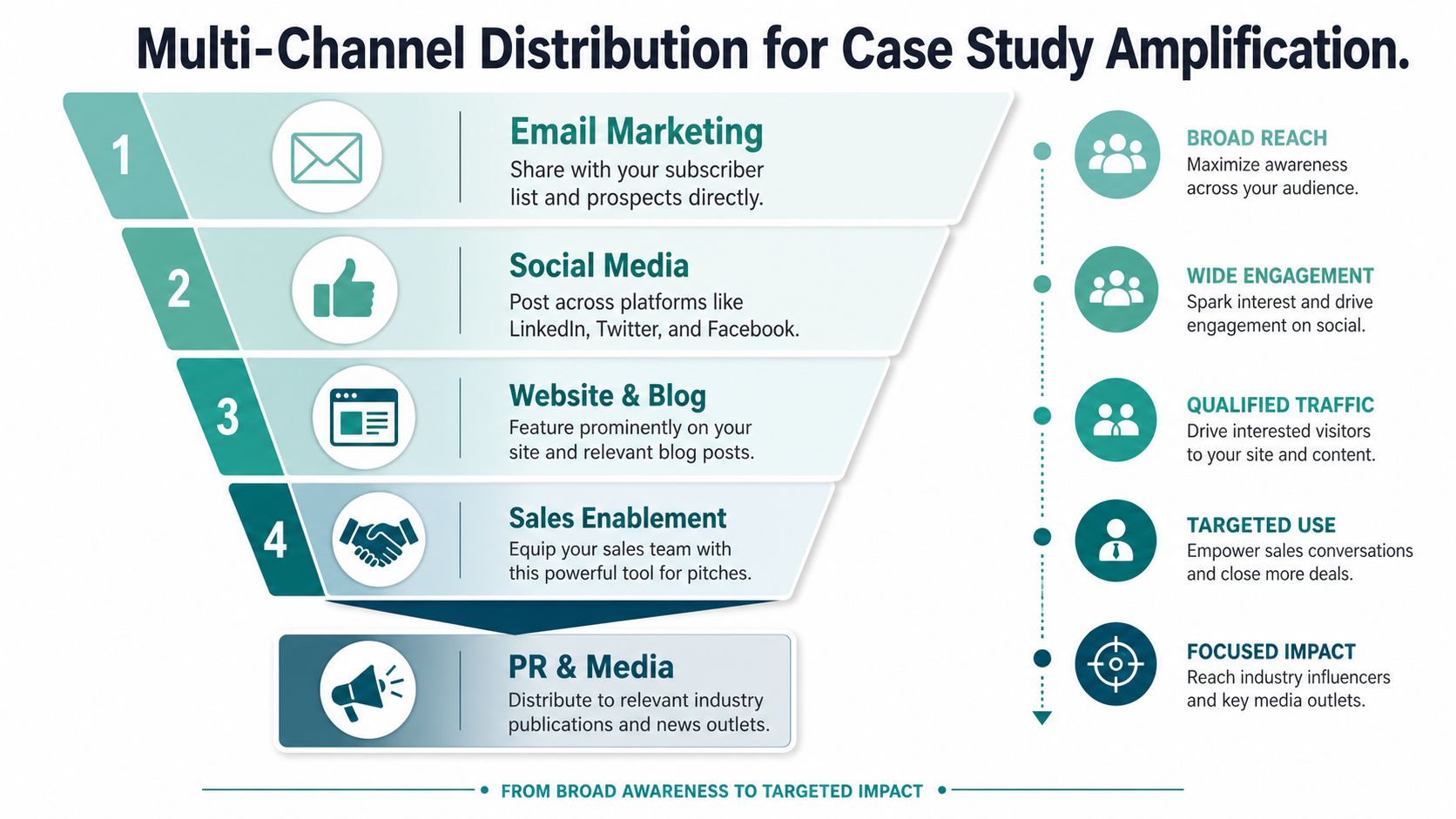
Small Business Expo makes a point many teams miss: the strongest case studies aren't just marketing collateral. They are sales tools built to answer buyer objections and skepticism, and they need to be used at the right moments in the sales cycle to be persuasive, as explained in its article on how to write a case study to earn trust and gain new business.
Use it inside the sales cycle
The biggest distribution mistake is waiting for prospects to find the case study on their own.
Map stories to objections:
A rep shouldn't have to read the full piece to know when to use it. Give them a one-line summary for each asset, such as “best for buyers worried about rollout complexity” or “good for multi-location service businesses.”
Break one story into campaign parts
A single case study can support weeks of content if you atomize it correctly.
Try this mix:
Email follow-up: Send the full story after a relevant call.
LinkedIn post: Pull one strong customer quote and one result.
Sales one-pager: Condense the story into a skim-friendly leave-behind.
Landing page snippet: Add a short result summary near conversion points.
Ad creative: Turn the core proof line into visual copy for paid promotion.
If you need a workflow for this, Adwave's guide on content repurposing and turning one article into 10 pieces of content fits the process well. The same principle applies here. One well-built proof asset should feed multiple channels.
Keep the message consistent across formats
Different formats don't mean different stories. They mean different levels of compression.
A practical distribution rule is:
Keep the same customer, same core problem, and same main outcome across every version. Change the length, the framing, and the visual treatment to fit the channel.
That consistency matters. If your email version says one thing, your sales deck says another, and your ad says something broader, the proof starts to feel soft.
For small teams, the simplest plan is often the best. Publish the full story on your site. Create a short sales PDF. Pull out two social posts and an email version. Then build one visual adaptation for paid or brand channels. That's enough to make the asset visible without turning your team into a content factory.
Measuring Success and Building Your Library
Teams often measure case studies like blog posts. They look at page views, maybe downloads, then move on. That's too shallow.
A case study should be judged by whether it influenced buying behavior. Did sales use it? Did prospects mention it? Did it help explain value faster? Did it support a real conversation that moved a deal forward?
Track influence, not just traffic
You don't need a complicated attribution setup to get useful signals.
Use a few practical checks:
Create dedicated landing pages: This helps you isolate visits and follow-up actions tied to a single story.
Ask on forms or intake calls: “How did you hear about us?” still surfaces useful qualitative feedback.
Listen in sales calls: Reps will tell you which assets prospects respond to if you ask consistently.
Tag enablement use: Note which case studies get sent in active deals and at what stage.
Those signals won't give you perfect certainty, but they will tell you which stories are doing real work.
Build a portfolio, not a one-off
One case study can help. A library changes how buyers see your business.
Salesforce's guidance on case study structure reflects a broader shift in B2B content. Buyers respond to structured, interview-based stories that clearly connect problem, solution, and quantitative results. Over time, that matters because each new story gives a different buyer a different point of entry.
A useful library usually covers variation, not volume. Build across:
Industries or customer types
Use cases
Common objections
Different levels of buyer maturity
That's how you stop relying on one flagship story for every scenario.
If you're serious about how to write customer case studies that win new business, think less like a writer finishing an assignment and more like a marketer building a proof system. Every strong story gives sales another tool. Every new format extends its life. Every added case study makes the next deal easier to believe.
If you want to turn customer success stories into broader visibility, Adwave gives local businesses a way to transform proof into TV advertising across premium channels without a traditional production process. That makes it easier to use case study insights not only in sales materials, but also in brand campaigns that put real customer outcomes in front of the right audience.


