
You've probably been there. You pay for a website, maybe run ads, maybe post on social media, and the traffic shows up. Then almost nothing happens. A few people browse, a few leave, and your contact form stays quiet.
That usually isn't a traffic problem. It's a copy problem.
A website that converts doesn't just “look professional.” It answers the visitor's questions fast, lowers doubt, and makes the next step feel obvious. Good copy does that job all day, every day, whether the visitor came from Google, a referral, or a TV ad.
If you want to know how to write website copy that converts visitors into customers, start thinking like a salesperson with limited time. Your visitor lands on the page with a problem, a little skepticism, and very little patience. Your words have to close the gap between attention and action.
Your Website Is a Leaky Bucket Now What
Most small business websites leak in the same places.
The headline is vague. The body copy talks too much about the business and not enough about the buyer. The call to action is weak. The proof is buried. By the time a visitor figures out what you do, they've already left.
That's frustrating when you've already spent money to get attention. It gets even more expensive when you're driving traffic from paid channels, because every click that doesn't turn into a call, quote request, or booking is wasted opportunity.
What a leak looks like
A local roofer runs ads and sends people to a homepage that says “Quality Service You Can Trust.” That sounds fine, but it doesn't answer the underlying questions:
What service: Roof repair, full replacement, inspections, storm damage help?
Who it's for: Homeowners, commercial properties, landlords?
Where they work: Which cities or service area?
Why choose them: Fast response, insurance help, financing, local crew?
What to do next: Call, book an inspection, request a quote?
If your page makes people work to find those answers, they won't work. They'll bounce.
Practical rule: Your website isn't a brochure. It's a sales conversation with a distracted buyer.
What converts instead
Conversion copy has a simple job. It helps a visitor decide.
That means your page needs to do four things in order:
State the offer clearly
Show that it fits the visitor's situation
Reduce risk with proof
Ask for one specific action
That's why generic “welcome to our website” copy underperforms. It fills space, but it doesn't move a decision forward.
Start patching the leaks first
Before you rewrite everything, fix the obvious friction:
Clarify the first screen: Say what you do, who it's for, and the next step.
Remove filler: Cut slogans that sound polished but mean nothing.
Add proof near claims: Put testimonials, reviews, or outcomes where people hesitate.
Match page to traffic source: If someone clicks from a promotion, the page should continue that message.
If you also use pop-ups, treat them the same way. They should support the visit, not interrupt it. Adwave's guide to email pop-ups that convert without annoying your visitors is useful because it focuses on timing and relevance, not just getting more form fills.
Nail Your Value Proposition Before You Write a Word
Most weak copy starts before the writing starts. The business hasn't decided what it wants to say.
If your value proposition is fuzzy in your head, it will be fuzzy on the page. That's why the first step isn't writing headlines. It's getting brutally clear on the offer.

Use the who, what, why framework
Write out three answers in plain English.
That's the raw material for your whole site.
A real estate agent might say, “I help buyers find homes.” That's too broad to be persuasive. A stronger version is, “I help first-time buyers in Charlotte find homes they can compete for without getting lost in the process.”
The second version gives the buyer a reason to keep reading because it sounds like their world.
Translate features into outcomes
Business owners often stop at features because they know their service too well. Buyers don't buy the feature itself. They buy what it changes.
Try this simple conversion:
Feature: Same-day plumbing appointments Outcome: You don't have to wait around all week with a leak getting worse.
Feature: Listing video tours Outcome: Buyers understand the property faster, which helps serious inquiries come in better prepared.
Feature: Financing options Outcome: The job becomes possible now, not months from now.
One cited benchmark says 51% of consumers feel a brand relationship starts when the brand “understands them and their desires” in Knapsack Creative's discussion of customer-focused messaging. That's why audience-specific copy works. It sounds like you understand the buyer's situation, not just your own services.
A quick test for your message
If your value proposition uses phrases like these, it probably needs work:
“High-quality service” because every competitor says it
“We help you succeed” because it's too broad
“Trusted experts” because it's unsupported
“Customized solutions” because it doesn't tell me anything concrete
Replace them with details the buyer can picture.
A good value proposition makes a visitor say, “That sounds like exactly what I need.”
For local businesses, that often means adding specifics that generic advice leaves out. Neighborhoods served. Property types. Budget ranges. Appointment speed. Insurance support. Licensing. Process steps. Those details don't make copy worse. In many categories, they make it believable.
Crafting Headlines and Hero Sections That Hook Visitors
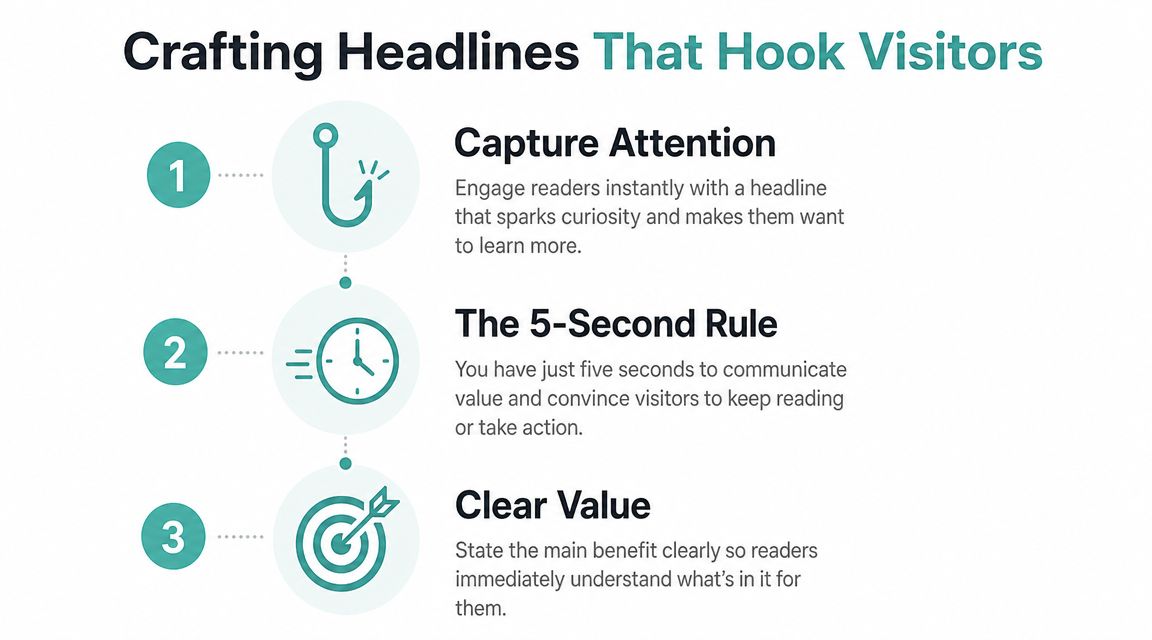
The hero section has one job. It has to stop the scroll and make the visitor feel oriented.
If the top of your page is unclear, the rest of the copy rarely gets a fair chance. People don't read closely when they're confused. They leave.
What belongs in a hero section
A strong hero usually includes:
A headline: The main promise or result
A subheadline: Extra context, audience fit, or differentiator
A primary CTA: One next action
A visual: Something that reinforces the offer
That's it. Don't cram your whole company story into the first screen.
Good headlines say more with fewer words
The easiest mistake is trying to sound clever. Clever copy often hides the offer instead of clarifying it.
According to Genesys Growth's landing page benchmark roundup, landing pages with a 5th to 7th grade reading level convert at 11.1%, compared with 5.3% for copy written at a college reading level. The same source frames that as a 56% lift, which is a useful reminder that clarity wins.
Here's what that looks like in practice.
If someone has to decode your headline, you've already added friction.
Three headline formulas that work
Benefit-first
Lead with the outcome people care about.
Examples:
Get Your Roof Repaired Before the Next Storm Hits
Sell Your Home With a Pricing Strategy Built for Your Area
This works because buyers think in outcomes, not service categories.
Audience-plus-offer
Call out who it's for and what you do.
Examples:
Bookkeeping for Contractors Who Need Clean Numbers and Fewer Surprises
Estate Planning for Young Families in Austin
This works because relevance feels immediate.
Problem-to-solution
Name the pain, then present the fix.
Examples:
Leaky Pipe and No Time to Wait. Book a Same-Day Plumber.
Tired of Low-Quality Leads. Launch TV Campaigns That Reach Local Viewers.
This works when the buyer's problem is urgent and obvious.
Build a hero that answers the five-second test
When someone lands on the page, they should know within a few seconds:
What you offer
Who it's for
Why it matters
Why they should trust you
What to do next
If your hero can't pass that test, rewrite it before touching the lower parts of the page.
A practical place to sharpen this is Adwave's article on landing page best practices that increase conversions, especially if you're building pages for paid traffic and want tighter message matching from ad to page.
The best hero sections feel obvious, not impressive.
Writing Body Copy That Persuades and Builds Trust
Many "keep it short" advice pieces fall apart at this point.
Short copy is not the goal. Useful copy is the goal. If you sell a low-risk, low-cost product, shorter often works. If you sell legal services, home renovation, real estate, financial help, medical services, or any offer where the buyer needs reassurance, short can feel thin.
That's the trade-off many small businesses miss. Brevity helps comprehension, but specificity builds trust.

Answer the questions buyers have
Strong body copy usually needs to answer some version of these:
What happens if I contact you?
Do you work with people like me?
What areas do you serve?
What makes your process different?
Can I trust your team?
What happens next?
If your page skips those answers in the name of being concise, it forces the visitor to guess.
A local attorney, for example, shouldn't just say “experienced representation.” Better body copy might explain what case types they handle, whether they offer consultations, what counties they serve, and how the intake process works. Those details reduce uncertainty.
Place relevant proof alongside your claims
A separate testimonials page is fine, but it shouldn't carry the full trust burden. Proof works better when it appears at the point of doubt.
If you claim fast response times, show a review that mentions responsiveness right under that claim. If you say you know a neighborhood well, mention listings sold in that market or local buying challenges you help clients overcome. If you say your process is simple, show the steps.
WordStream's CRO statistics roundup cites that user-generated content on 1,200 websites produced a 3.2% conversion rate, and conversions increased by an additional 3.8% when visitors engaged with that UGC. The practical lesson is straightforward. Social proof matters more when people can interact with it and use it to evaluate risk.
Generic versus specific copy
Here's the difference in style that changes results.
Generic
We provide quality kitchen remodeling services with excellent craftsmanship and customer care.
Specific
We remodel kitchens for homeowners who want a cleaner layout, better storage, and a clear plan before demolition starts. You'll know the project scope, timeline, and finish selections before work begins.
The second version does more work. It shows what the buyer gets and what experience they can expect.
What to include when trust matters more than speed
For high-consideration services, these details often help conversion:
Local relevance: Cities, neighborhoods, service radius
Operational clarity: Timelines, steps, scheduling windows
Buyer fit: Property types, project sizes, case types, budgets
Risk reduction: Warranties, guarantees, consultations, financing cues
Proof: Testimonials, reviews, recognizable clients, before-and-after examples
Not every page needs all of them. But many local service pages need more of them than the “shorter is always better” crowd admits.
Buyers don't always need less information. They need the right information, in the right order.
Keep it scannable while staying detailed
You can write detailed copy without creating a wall of text.
Use:
Short paragraphs
Descriptive subheads
Bullets where comparison helps
Proof boxes or quotes near key claims
If you want ideas for weaving proof into your marketing language, Adwave's guide to using reviews and testimonials as social proof on social media is worth reading because the placement logic applies to website copy too.
Designing CTAs and Microcopy That Drive Action
A call to action isn't a decoration at the end of the page. It's the moment where all your copy either pays off or falls flat.
Weak CTAs create hesitation. Strong CTAs reduce it.

Write buttons for intent, not habit
“Learn More” is one of the most overused buttons on the internet. It's vague, low-energy, and often mismatched to the visitor's stage.
Compare these:
The stronger versions tell the visitor what happens next and what they get.
Rob Palmer's website copywriting guidance cites tests showing first-person CTAs can outperform second-person CTAs by 25% to 90%. That's why “Start My Free Trial” can beat “Start Your Free Trial.” It sounds like the visitor has already chosen.
Put CTAs where decisions happen
Don't rely on one button at the top and one at the bottom. Put CTAs after moments of clarity.
Good CTA placements usually come:
After the hero: for ready-to-act visitors
After the offer explanation: once people understand the service
After proof: when trust has been built
At the end: for visitors who read everything
That sequence follows how people decide.
Use microcopy to remove last-minute doubt
Microcopy is the small text around buttons, forms, and fields. It often matters more than people think because it shows up at the exact moment anxiety peaks.
Good microcopy can answer questions like:
How long will this take?
Will someone call me right away?
Do I need a credit card?
Is this a quote request or a hard sales pitch?
Examples:
Under a form button: We'll review your details and respond with next steps.
Near a phone number: Prefer to talk now? Call during business hours.
Beside a form field: Enter the service address so we can confirm coverage.
These small lines lower friction because they make the process feel predictable.
If the visitor is ready but uncertain, microcopy often saves the conversion.
For a broader perspective on messaging choices across markets, this guide to website content strategies for Australian businesses is a useful reference. It's helpful because it shows how audience context changes what people need to see before they act.
Measuring and Optimizing Your Copy for Better Results
A local business runs a TV spot, sees a bump in direct traffic, and then assumes the campaign worked or failed based on a handful of form fills. That is usually too crude to be useful.
Copy performance needs a tighter read than "conversions went up" or "nothing happened." On smaller sites, the actual job is to spot which message pulls in the right prospects, which page loses them, and whether your wording is helping sales conversations start in a better place.
What to measure on a lower-traffic site
Small businesses rarely get enough volume for clean, fast A/B tests. That does not mean testing is off the table. It means the standard playbook needs adjusting.
Use a practical setup:
Track one primary action: calls, quote requests, booked consultations, or form fills
Review lead quality: good copy should bring in better-fit inquiries, not just more of them
Change one major message at a time: headline, offer framing, proof section, or CTA language
Give each version enough time: wait for a meaningful sample of real inquiries, not a day or two of traffic
Check sales outcomes: did the revised page produce better conversations, higher close rates, or fewer poor-fit leads?
I have seen detailed copy beat shorter copy many times on local service pages because it answers the exact questions people have before they call. That matters even more when visitors arrive from channels like TV, where interest is high but context is thin. If the page feels generic, they leave. If it speaks to their area, service need, and next step, they convert.
A key underserved angle identified by Code Conspirators is that SMBs often do not have enough sessions for clean A/B tests, even though copy is easier to produce and measurement is still the bottleneck. That is the right framing. Practical testing beats waiting for perfect testing.
Better signals than raw conversion count
Raw conversion totals can mislead you on a low-traffic site. Supporting signals often tell you more, faster.
One example. If a plumber changes a homepage headline from "Reliable Plumbing Services" to "Emergency Plumber in Leeds. Same-Day Help for Leaks, Blocked Drains, and No Hot Water," total form fills may stay flat for a few weeks. But calls may become more urgent, better qualified, and easier to close. That is still a win.
A good outside reference here is Amax Marketing's overview of amax marketing cro strategies. It is useful when you want a broader conversion framework around page-level copy decisions.
Connect copy performance to channel performance
This matters even more when you are paying to generate attention.
If you are using TV to build local demand, your website handles the handoff between awareness and action. Adwave supports that process by helping small businesses launch and measure TV campaigns, then watch what happens to visits and conversions after those campaigns go live. Pair that with stronger landing page copy and you can judge whether the traffic you bought is reaching a page that builds trust and earns the inquiry.
This is also where specific copy tends to outperform generic "keep it short" advice. A visitor who comes in after seeing your ad often needs confirmation that they are in the right place. Service area details, proof, response times, and clear explanations can do more conversion work than a stripped-down page with vague claims.
For a practical way to connect page changes to revenue, Adwave's guide on how to measure marketing ROI is a useful companion when you want to tie messaging changes to business outcomes instead of surface-level metrics alone.


