A one-star increase in a restaurant’s Yelp rating was associated with a 5% to 9% increase in revenue across Washington State restaurants, with the effect concentrated among independents rather than chains, according to economist Michael Luca’s 2011 study for Harvard Business School. Owners chase that number because it’s real money. The reply box underneath the rating moves something harder to see.
The person who left five stars has already bought. They aren’t shopping. The reply is read by the prospect in the next tab, the one comparing three plumbers, two dentists, or four contractors before making a single call. That prospect reads the review for evidence and the reply for character.
So this isn’t a thank-you exercise. It’s a public sample of how the business behaves after money changes hands. The strongest profiles don’t just thank every five-star rating. They cover every review type, and they spend their best wording on the reviews that give them something real to answer.
Sample Replies for the Reviews You Actually Get
“Thanks for the great review” gives the next customer little to work with. “Glad the scheduling updates helped” shows what the reviewer valued and what your team paid attention to. That is the useful part of a public reply.
Google’s help page on reading and replying to reviews recommends keeping replies conversational rather than promotional. To respond to positive reviews well, start with the customer’s wording, acknowledge something specific, and stop before the reply becomes an ad.
Use these examples as starting points. Keep only details that match the review and promises you can keep.
| The review you got | Reply you can adapt | Why it lands |
|---|---|---|
| Five stars, no text | Thanks for the five stars, [First name]. Glad we could help. | Fits the limited detail they gave you |
| Names the technician or server | Thank you, [First name]. I’ll pass your kind words about the water heater swap on to Marcus. | Recognizes the person they praised |
| Praises speed or same-day service | Thanks for mentioning the same-day repair, [First name]. Glad we could get it sorted. | Acknowledges speed without promising it for every job |
| Praises one dish, product or treatment | Glad you enjoyed the brisket, [First name]. The kitchen will be pleased to hear it. | Stays with what they came in for |
| Long, detailed review | Thank you for writing all of this out, [First name]. We’ll share your note about clear scheduling updates with the team. | Picks a useful detail rather than repeating the whole review |
| Praise with a small gripe inside | Thanks for the kind words about the install, [First name]. We’re sorry you had a long wait on the phone. | Acknowledges the friction without inventing a fix |
| Mentions price or a deal | Thanks, [First name]. Glad the quote process felt straightforward. | Acknowledges their experience without re-quoting a price |
| Regular customer | Thanks for coming back again, [First name]. Good to see you in the shop. | Recognizes the relationship without adding a pitch |
| Health, legal or financial service | Thank you for taking the time to leave feedback. We appreciate your kind words. | Avoids confirming a relationship or repeating sensitive details |
| A question buried in the praise | Thanks, [First name]. We’re open until 6 on weekdays. | Gives future readers the answer, if those are your actual hours |
Three rules that keep the wording yours
- Keep the one detail they named and drop everything else. If they praised the same-day repair, answer that point. Your warranty, your service history, and your service area do not need space in the reply. A detailed review gives you more to choose from, not an obligation to repeat every compliment.
- Two sentences unless they asked a question. Treat this as a useful limit, not a requirement to pad a short thank-you. A question can earn another sentence. Answer general questions publicly; move account-specific details to a private conversation without assuming email is available.
- Use a first name only if they used it themselves. A reviewer who signed as “J. from Round Rock” has not given you “Jessica.” Leave the name out when unsure. Even a public review does not give you permission to add a street, job detail, or other information from your records.
The humility test for any draft
Give the customer’s experience the credit. “We’re glad the installation solved the issue” keeps the focus on their problem. “Book now for the same result” turns their praise into a sales pitch.
Accept the compliment plainly. Thank them, recognize what went well, and resist adding a claim about how exceptional the business is. Humility does not mean arguing with praise or brushing it aside. It means letting the review carry the compliment while your reply shows you listened.
The question to ask every draft: is this sentence about their experience or about our offer?
Watch for two habits: praising the company instead of acknowledging the experience, and squeezing the business name and city into every response. Both take space away from the detail that made the review worth answering. For praise that includes a complaint, the guide to customer service excellence offers broader guidance on handling the service issue.
Build six openers once, then rotate
Keep six openers in a note: thanks for the call, thanks for the detail, thanks for the patience, glad the leak is sorted, good to hear the crew left it clean, and appreciate you coming back.
Choose the one the review supports. “Thanks for the patience” belongs with a wait, and “glad the leak is sorted” belongs with a repair. Rotate simple thanks for bare praise; give detailed reviews a specific middle and a name when appropriate. The opener saves typing. The detail makes the reply yours.
When to Reply and When to Skip
Most review advice tells you to answer everything. Google’s current guidance on responding to reviews is looser than that. A business should reply when it has new or relevant information to add, and it doesn’t need to thank every reviewer publicly. Replies should stay positive, relevant and short, with the emphasis on answering a question or giving a helpful update.
That reframes the job. The question isn’t how to clear 60 reviews this month. It’s which reviews give you something worth saying.
A priority order for a busy inbox
| Type of positive review | Reply? | Why |
|---|---|---|
| Names a staff member or a specific service detail | Yes, within two days | Gives you something concrete to thank them for and shows prospects how the team works |
| Contains a question | Yes, same day | The answer helps every future reader, not just the reviewer |
| Praise with a small problem inside | Yes, within 24 hours | A calm public reply shows how you handle friction |
| Comes from a regular customer | Yes | Recognition reads as genuine rather than templated |
| Short five stars with no text | Sometimes, rotate a few per week | Google does not ask you to thank every reviewer publicly |
| Bulk import or duplicate review | No | Nothing new to add, and a reply adds noise |
| Review for a different location | No, leave it to that profile | The profile that owns the review should answer |
| Incentivised or contest review | Reply about the service, not the reward | Keeps the reply from reading as an advertisement |
Rotation is what stops a profile reading as automated
Bare five-star ratings fill most profiles, and they’re the fastest to answer, so repetition creeps in exactly there. Rotate a handful each week from your opener set and skip the rest without guilt. Variety across a profile is the signal. A perfect reply-to-review ratio isn’t.
Mixed reviews need a different register, because the apology has to carry weight. Our templates for responding to negative reviews with best practices cover those, including the ones that arrive months late and the praise-with-a-gripe cases where a calm public answer does more good than a private email.
Working rule: if you can’t add a detail, a name, or an answer, the reply is noise on the page.
When a glowing review is obviously fake or comes from a competitor, a polite thank-you is the wrong response. Our walkthrough on how to handle fake or spam Google reviews covers flagging and reporting.
Why a Reply to Praise Sells the Next Customer
Three tabs, three local providers, one decision. The prospect opens a profile, reads a five-star review, and looks for the business response underneath it. That reply is the only place on the page where they see how the business speaks when no one is forcing an answer.
BrightLocal’s 2023 local consumer review survey measured what that moment is worth. 88% of consumers said they would be likely to use a business when they could see the owner responding to every review. Only 50% said the same about a business whose owner replied only to positive reviews, and 60% about one that replied only to complaints. That gap is the argument for coverage. Read the question carefully, though: it asked about owners who answer every review, not owners who thank every five-star rating.
Readers also look for responses, and a reply to positive feedback can make a business easier to trust. Treat that as a reason to make each reply specific. A generic thank-you may fill space, but it gives the next reader nothing to picture.
The reply turns a rating into a character reference. Here is how that decision looks from the prospect’s side.
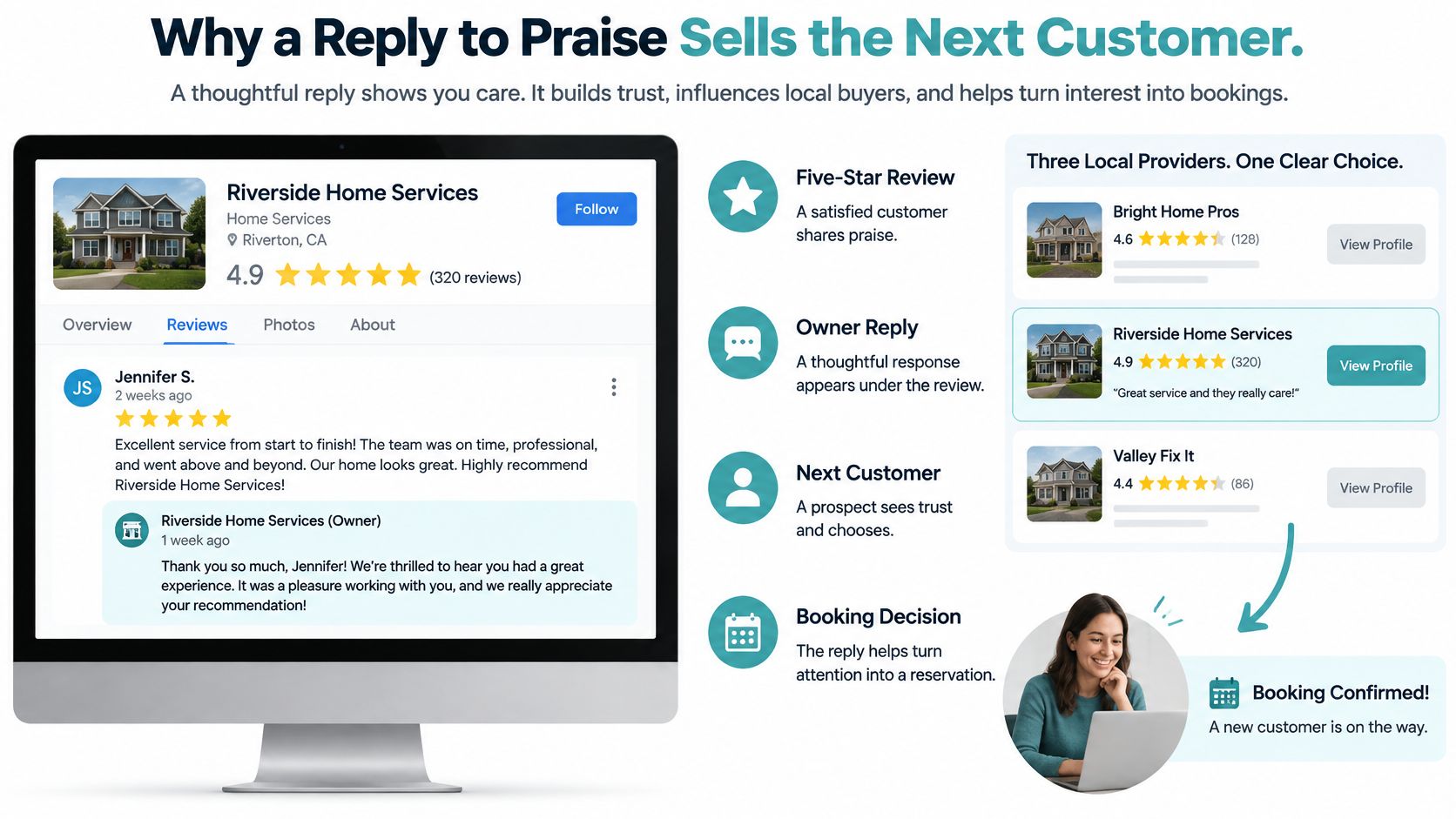
The rating earns the click. The reply earns the trust that turns a click into a call. The reviewer has already paid and already decided, which is why the correction that matters is in how you spend the wording. A bare five stars gets a short, warm line. A review naming a technician, a scheduling fix, or a job done cleanly gets a reply that mirrors that detail, because those specifics are what the next reader is scanning for. Name the person where it feels natural, keep the tone humble, and let the reviewer’s own words lead.
Write for the prospect, not the praise.
If you want the whole system laid out for a trade business, review management for Prescott contractors puts the reply inside a wider routine of collecting, answering and converting local reviews. Approved quotes also travel past the profile, and our note on customer reviews on product pages covers how a sentence from a reply becomes page copy a buyer trusts.
What Never Belongs in a Public Reply
Google’s contribution policies bar businesses from distributing a reviewer’s personal information without consent, including a full or last name, a face in a photo or video, financial details, medical details, or anything else that could identify them. The rule doesn’t bend because the customer volunteered the detail in their own review. They shared it with you, not with everyone who will read the thread.
In a clinic or a home-service inbox, the risky lines are easy to spot once you know what you’re looking for: a patient’s condition, a client’s street address, a child’s name, a repair history that points to one recognisable household. Each is a detail a neighbour could match to a person.
| Detail the customer shared | Safer wording |
|---|---|
| Patient’s condition or treatment | We appreciate you trusting our team with your care |
| Client’s street address or home details | Thanks for trusting us with your project |
| Child’s name | Thank you for the kind words about how our team looked after your family |
| Full or last name | Thanks, [First name], only if they signed with that name |
| Repair history tied to one household | Glad the visit went smoothly, and thanks for the feedback |
| Promise about next time | We are glad the service met expectations |
| Coupon, phone pitch or book-now call | No offer; keep the reply to the service |
The second block of exclusions
Search-shaped writing is the other quiet failure. Google’s reply guidance asks for conversational replies and warns against promotional ones, so a string written for the algorithm (“best Austin plumber emergency plumbing Austin water heater repair”) spends the reply on nothing a prospect wants. Coupon codes, phone-number pitches and a “book now” call to action land in the same bucket. The reviewer isn’t shopping, so an offer answers a question nobody asked.
Two more items belong on the list. Don’t promise outcomes for next time, because a public promise sets an expectation that one bad job will be measured against. And don’t correct a happy customer’s account of events, even when a date or a detail is off, because winning the correction costs you the goodwill in the review.
The neighbour test: if someone on the same street could read this reply and identify who wrote the review, rewrite it. Anything posted publicly can be screenshotted and quoted back at you.
Post the Reply and Keep a Weekly Routine
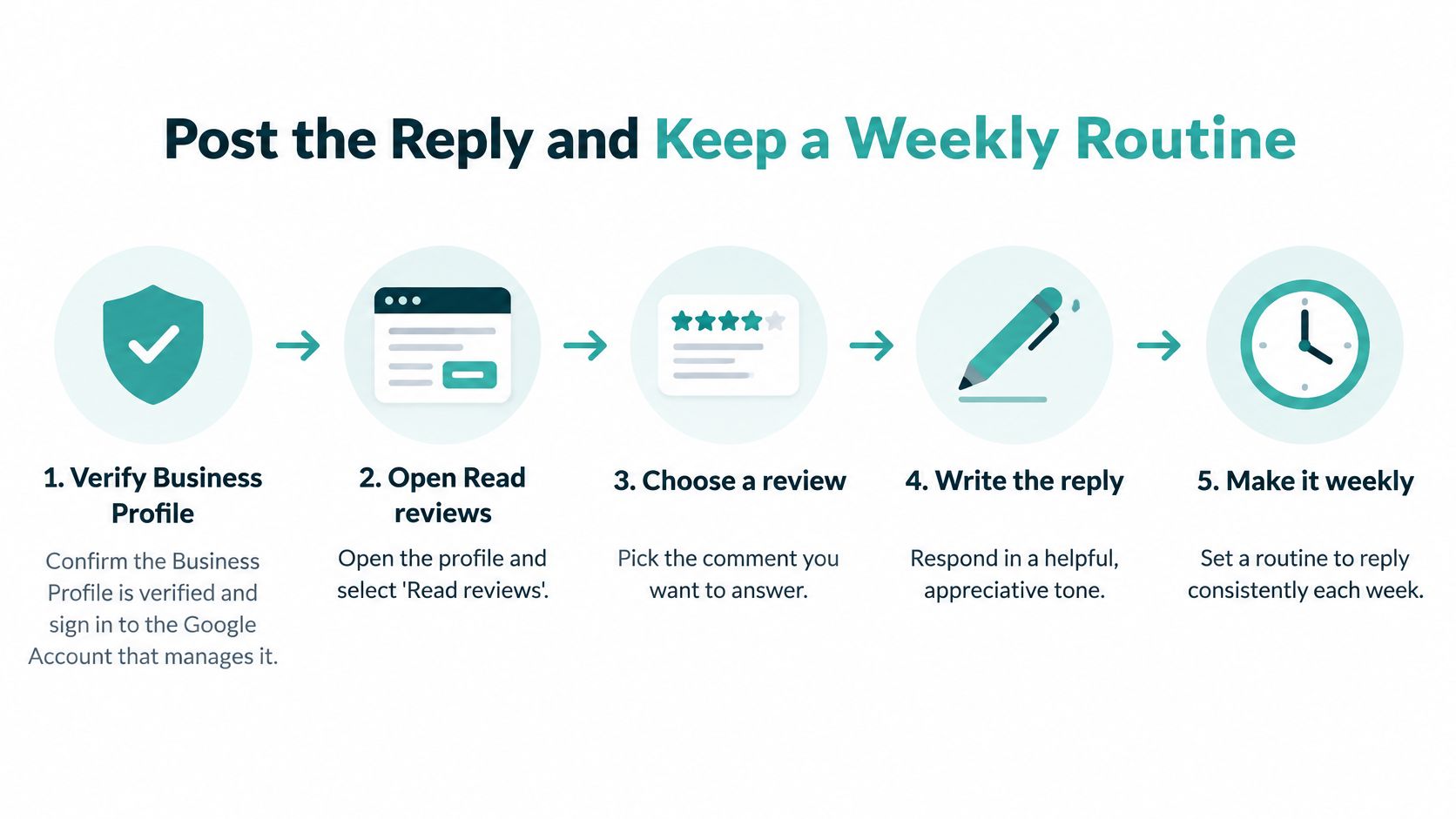
None of the wording matters until someone has access. Google’s documented process for replying to reviews has two preconditions: the Business Profile is verified, and the person replying is signed in to the Google Account that manages it. Without both, the Reply button never appears and the review sits there while everybody assumes someone else is handling it.
The five steps in order
- Open the Business Profile that manages the location you’re answering for. On a multi-location business, confirm you’re in the right profile before typing.
- Select “Read reviews” from the profile menu.
- Choose “Reply” beside the specific review you decided to answer, not whichever one happens to be newest.
- Write the reply to the two-sentence standard: their detail, your thanks, nothing else.
- Submit it. The reviewer receives a notification that you replied, which is the part of this that serves the original customer directly. The public half serves everyone comparing providers afterward.
The sequence is short enough to teach a new manager in one sitting.
Replies can be edited or deleted later, so a wrong price or a misremembered detail is fixable. Fix it the same week, not the same month. Replies can be posted from the Business Profile on Google Search or Google Maps, and reviews that originate from third-party sources can’t be answered on Google at all, so those need handling on the platform that owns them.
Assign one owner and two windows
Give posting access to one or two verified managers, no more. Then put the work in the calendar: two 20-minute blocks, Tuesday and Friday, with the same named owner each week. Questions get answered the day they arrive because the answer helps every future reader. Everything else has a 48-hour window.
One name on the job: a login shared across five people is how a reply gets posted twice or not at all.
Once a month, read your last 30 replies in sequence rather than one at a time. Repetition only shows up in a row, and three “Thanks for the kind words!” replies back to back are what make a profile read as automated. Keep the six openers in rotation and change the middle sentence every time.
Check each platform instead of assuming
Apple Business Connect and Bing Places each run their own reply path, and the Google steps don’t transfer. Read the current help page on each, note the date you read it, and check again before you build a routine around it. Interfaces change, and last year’s documented step is a poor foundation for a weekly habit.
Where the reply work leads next
Approved wording is worth more than one reply. When a customer names a technician, a result or a fix, ask permission to reuse that sentence as a testimonial, then put it on a landing page, a quote sheet or an ad script. Our guide to repurposing customer reviews into marketing content covers the permission step that keeps the reuse legitimate.
If the problem isn’t wording but a review that shouldn’t be published at all, TheBestReputation local review playbook walks through how removal requests work and when to file one instead of replying.
The paid side sits alongside this. Adwave is an AI-powered TV advertising platform that turns a website into image and video ads you can review and refine before launch, and a free website analysis means you see the creative and approve it before any money goes in. Adwave doesn’t run your Google profile, manage listings, or send review requests, so it complements this work rather than replacing it: the reply builds trust with the prospect already comparing you, and the ad puts the same name in front of local viewers who haven’t started comparing yet. The company publishes a case study on Kenny Patton Real Estate promoting listings with a TV campaign.
If you’re already running ads, the next read is multichannel advertising for small businesses. If the bigger problem is that you don’t have enough reviews to reply to, start with how to get more Google reviews for your local business.
A good reply costs twenty minutes a week and makes the next prospect believe the rating came from a business that will treat them the same way. Adwave turns your website into image and video ads you can preview, refine, and approve before you spend anything, with a free website analysis showing you what the first version looks like. Start with the profile replies, then put the same brand in front of the local audience that hasn’t started comparing yet.