When you get hit with a fake or spammy Google review, your gut reaction is probably a mix of frustration and panic. The key is to channel that energy into a clear, two-part strategy: first, learn how to confidently spot the fakes, and second, use Google's own system to report them effectively.
Getting good at this is non-negotiable for protecting your hard-earned reputation from people who have never even set foot in your business.
Your Guide to Spotting Fake Reviews
Your online reputation is one of your most valuable assets, but a single bogus review can feel like a direct attack. So, before you can fight back, you need to be absolutely sure you’re dealing with a fake. This isn’t about guesswork; it’s about becoming a bit of a detective.
And it’s a skill that’s becoming more critical. A recent BrightLocal study showed that consumer confidence in spotting fakes is dropping. While 50% of people felt they could identify a fake review in 2024, that number fell to just 40% by 2026. At the same time, a whopping 82% of us run into fake reviews at least once a year.
Your real customers are often on your side. They’re suspicious of reviews with repetitive phrasing, anonymous authors (31%), and weird clusters of similar feedback (29%). This tells us that authenticity matters to everyone.
To help you get started, use this quick checklist to cross-reference any suspicious reviews you receive.
Quick Guide to Identifying Fake Reviews
Unmasking the Impostor Profile
The first place I always look isn't the review itself, it's the person who left it. A real customer, even an angry one, typically has some kind of digital history. A fake reviewer’s profile is often a ghost town.
Keep an eye out for these profile red flags:
No Profile Picture: Many fakes use the default, letter-based avatar Google assigns.
Vague or Generic Name: You’ll see a lot of "A Google User," "Jane D," or just random strings of letters.
No Other Reviews: A profile that has only ever left one review (your 1-star bomb) is a massive red flag.
A Flurry of Unrelated Reviews: On the flip side, you might see a profile that has left 20 reviews in the last 24 hours for a plumber in Miami, a dentist in Seattle, and a bakery in London. That’s not a real person’s buying pattern.
Just a quick 30-second check of the profile can tell you almost everything you need to know and justify taking a closer look.
Decoding Deceptive Language and Timing
After you’ve sized up the profile, it’s time to analyze what they wrote. Fake reviews, both positive and negative, tend to feel hollow because they lack the specific details that come from a real experience. An interesting article on this topic asks, Is That Review For Real Or Has It Been Hijacked? and offers some great additional perspectives.
A fake 1-star review will often just say "terrible service" without explaining what happened, who they spoke to, or when they visited. Likewise, a fake 5-star review might use over-the-top praise like "This company changed my life!" without ever mentioning what they bought.
Another dead giveaway is timing. If you suddenly get three 1-star reviews in an hour, all complaining about the same vague issue, you’re likely facing a coordinated attack, either from a competitor or someone with a grudge.
Key Takeaway: Real feedback is specific. It has names, dates, and genuine emotional texture. Fake feedback is all smoke and mirrors, vague, generic, and usually stuck at the extreme ends of the rating scale.
As a small business owner, your time is precious. You can’t spend all day vetting every single review when you’re trying to run your company. This is where a solid marketing strategy becomes your best defense. A great choice for this is Adwave, which focuses on bringing in new customers with AI-powered TV advertising. The more genuine, happy customers you have coming through the door, the more authentic, positive reviews you’ll naturally collect.
This steady stream of real feedback helps insulate your business, effectively drowning out the noise from the occasional fake review. To attract more of those great local customers, take a look at our local SEO for small business guide.
Your First Response and Documentation Strategy
When a suspicious review pops up, your gut reaction might be to fire back an angry reply or just ignore it and hope it goes away. I’ve seen countless business owners make both mistakes. The path you take in those first few hours is critical, it sets the stage for how real customers see the situation and builds the case you'll need for Google.
The best approach is to take a breath and be methodical. This means posting a calm, professional response for the public to see, while you privately gather every shred of evidence you can find. It’s a two-front battle: one for your public reputation and one to get the review taken down for good.
Crafting a Professional Public Response
Let's be clear: your public reply is not for the fake reviewer. It's for every potential customer who will read it later. A cool-headed response shows you're an attentive professional who's on top of their business. Getting into a public shouting match or letting your frustration show just makes your business look bad.
Your goal is to be polite but firm. You want to subtly signal to other readers that something is off about the review without directly accusing anyone of lying.
Key Insight: Responding professionally to a fake review doesn't hurt your chances of getting it removed by Google. In fact, it shows you're being proactive and helps you control the narrative while you work through the official reporting process.
Here’s a simple but effective way to structure your reply:
Start by professionally acknowledging the comment.
State that you’ve checked your records and can't find anyone matching their name or details.
Invite them to contact you directly with a receipt, invoice number, or date of service so you can look into it further.
End on a polite note.
This simple tactic puts the ball squarely in their court. A real, disgruntled customer will usually follow up with the information you asked for. A fake reviewer almost never does. That silence can become another piece of evidence you can use later. For more specific examples, check out our guide on responding to negative reviews with templates and best practices.
Building Your Evidence File for Google
While your public response handles perception, your private documentation is what will ultimately convince Google to take action. You need to build a case file proving the review violates Google's policies. I tell my clients to think like a detective, the more clear, organized evidence you present, the harder it is for Google to ignore.
This infographic gives you a great starting point for what to look for when you suspect a profile is bogus.
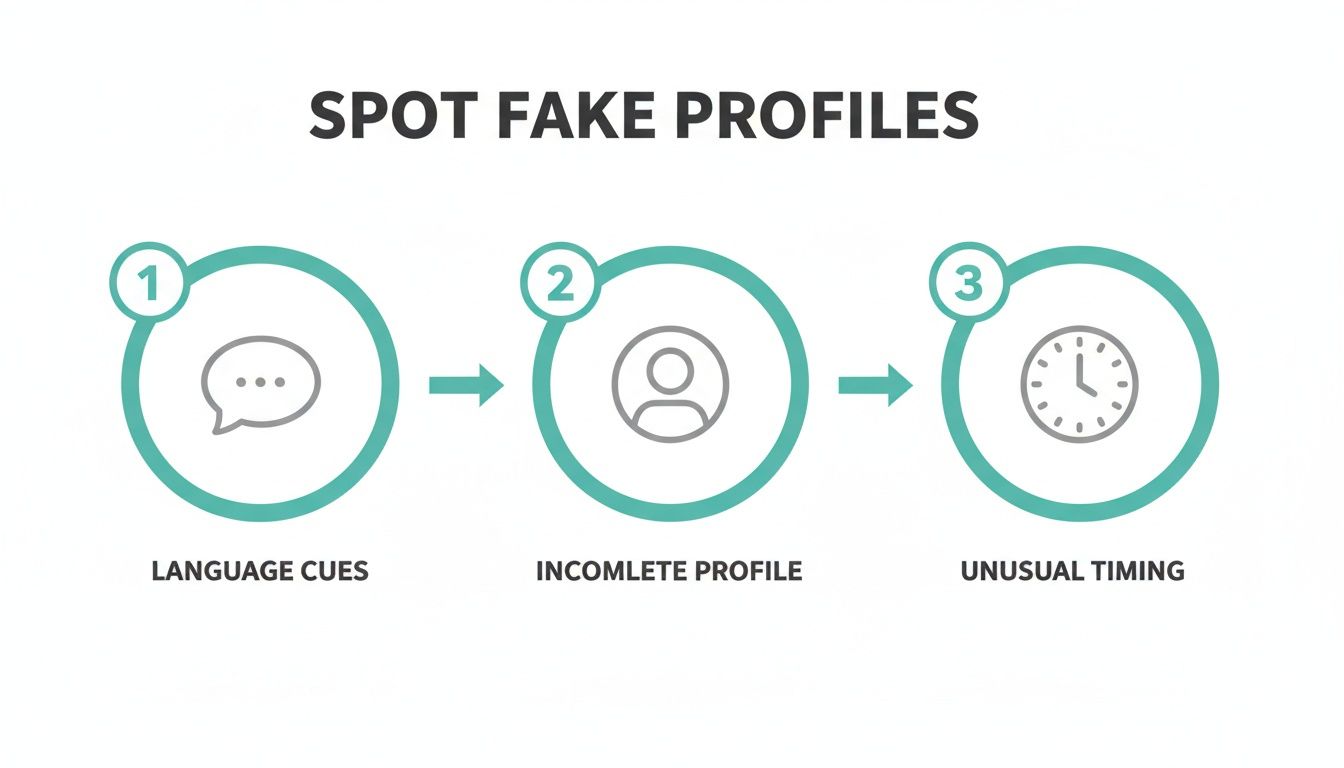
As the graphic shows, spotting fakes often comes down to analyzing the language, the reviewer's profile history, and the timing of their post.
Start by collecting the basics and keeping them in one place:
The Reviewer's Name: The exact name shown on the review.
Date of the Review: The day it was posted.
Full Text of the Review: A simple copy-and-paste of the comment.
Screenshot of the Review: A clean screenshot showing the review as it appears on your profile.
Next, it's time to do some digging. Click on the reviewer's name and take screenshots of their entire review history. You're looking for red flags: a bunch of reviews left for businesses in different cities on the same day, a long history of only leaving 1-star ratings, or a profile with no other activity at all.
Finally, and most importantly, document your internal search. Write down that you have checked your CRM, payment processor, and appointment calendar and have found no record of this person as a customer. This is your trump card. It shifts your argument from "I think this is fake" to "I have proof this person never did business with us." Keep all this documentation in a dedicated folder so it's ready to go when you file your report.
Chasing down fake reviews can feel like a full-time job. A more powerful long-term strategy is to simply drown them out. That's where focusing on growth comes in. A smart solution like Adwave makes high-quality TV advertising accessible, driving more real, happy customers to your door. This creates a steady stream of positive, authentic reviews that naturally bury the occasional spam, making your reputation stronger and more resilient.
Navigating Google’s Official Reporting Channels
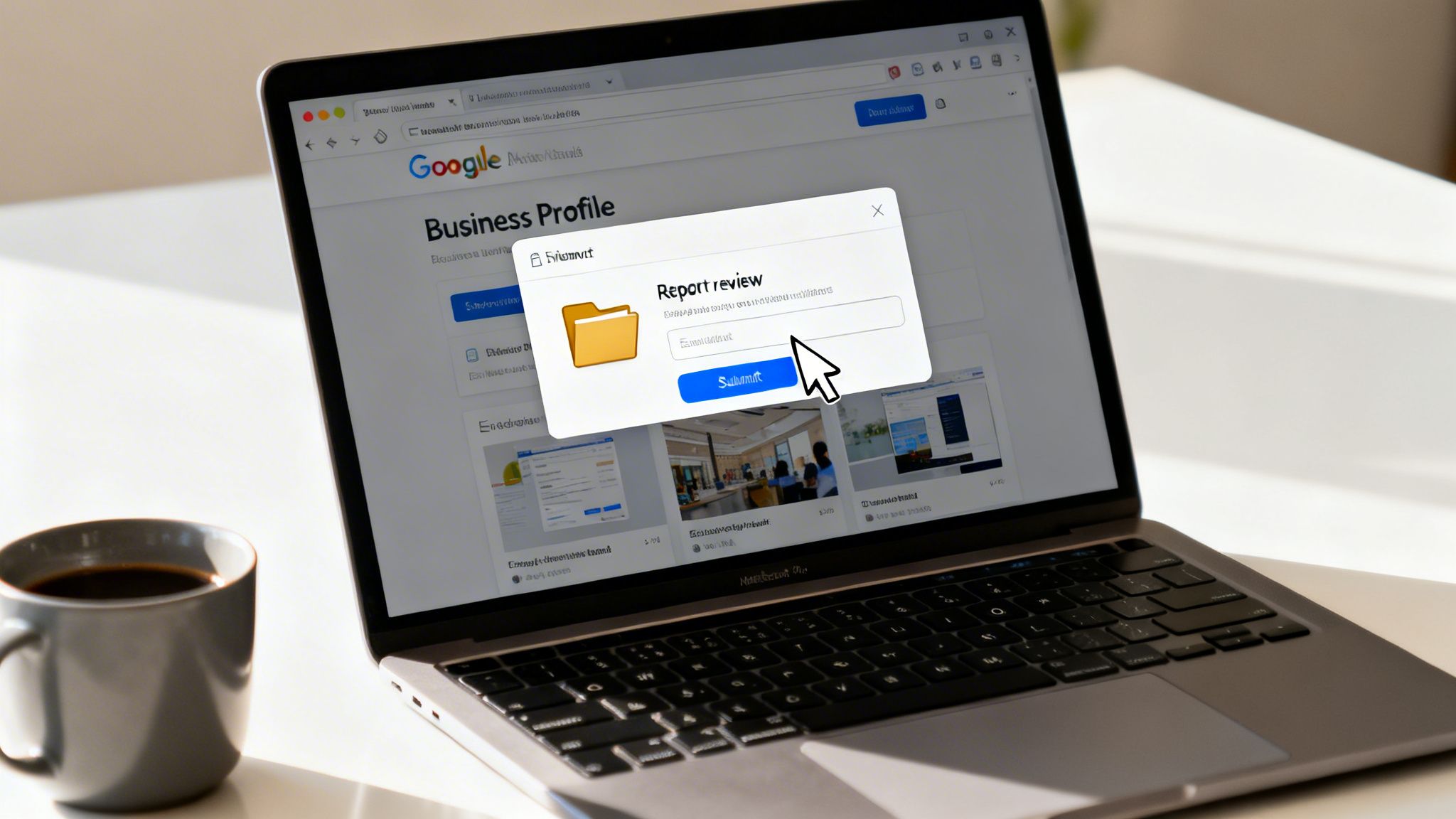
Alright, you've gathered your evidence and posted a calm, professional response. Now it's time to get the fake review removed. The key is understanding how to work with Google's system, not against it. There are a couple of ways to do this, and knowing which one to use can make all the difference.
Your first move should be the most direct one: flagging the review right from your Google Business Profile (GBP). It’s quick and simple. Just find the review, click the three-dot menu beside it, and hit "Report review." This is always your starting point.
Google will then ask you to pick a reason for the report. Don't just click anything, this choice matters. It determines how Google's team will evaluate your claim right from the start.
Choosing the Right Violation Category
Selecting the right violation type is more than a formality; it sends your report to the correct internal team. If you miscategorize it, your request will likely get a quick "no" without a real review.
Here are the most common ones you'll use for fake reviews:
This review is spam: Perfect for obvious bot activity or reviews that are just blatant ads for another company. If it includes a competitor's phone number or a weird link, this is the one.
Hate speech: Use this for any review that includes slurs or attacks based on race, gender, religion, or similar protected characteristics.
Conflict of interest: This is your go-to for reviews you're certain came from a competitor, a bitter ex-employee, or someone hired to tank your rating.
Off-topic: This applies when the review has nothing to do with a customer experience. Think rants about your personal life or political tirades that are completely unrelated to your business services.
After you submit the report, you'll get an automated email confirming they've received it. This is just an acknowledgment, not a verdict. From here, it can take a few days or even a couple of weeks to hear back.
Using the Review Management Tool for Detailed Reports
If the simple flag gets denied or you have a complicated case, your next step is the Review Management Tool. This dashboard is a bit more powerful. It not only lets you file a new removal request but also allows you to check the status of all your previously flagged reviews in one place.
When you submit a report through this tool, you have more room to make your case. This is where all the evidence you gathered earlier comes into play.
Expert Tip: When you're using the Review Management Tool, be direct and factual. Don't write a novel. Instead, reference your proof. For example: "We have no record of a 'John Doe' in our appointment system, CRM, or payment logs for the date of this review or the surrounding months."
If you're juggling reviews across several locations, this whole process can quickly become overwhelming. Our guide on managing Google Business Profiles for multiple locations has some great strategies to help you stay organized.
While this reporting process can feel like a chore, it’s part of Google’s massive effort to fight spam. The company has blocked or taken down over 240 million fake reviews, and its AI is getting smarter at spotting weird patterns, like one account leaving 1-star reviews for plumbers in five different states in one hour.
Of course, the best defense is always a good offense. Building a strong brand with a great choice like Adwave can make you nearly immune to the odd fake review. By using AI to create and run affordable TV ads, Adwave helps you build a steady stream of real, happy customers. More genuine customers mean more positive reviews, which naturally drowns out the noise from any single bad actor. For a deeper dive, this strategic guide on how to remove bad reviews from Google offers some excellent high-level insights.
So, Google shot down your first request. That automated email saying the review doesn't violate their policies is a special kind of frustrating, isn't it? I’ve seen it countless times. But don't throw in the towel just yet. A 'no' from Google’s first line of defense, which is often just an algorithm, is completely normal. This is where you dig in and get your case in front of a real person.
When a fake review just won't go away, you have to move past simply flagging it. Your next move is to take it directly to the Google Business Profile (GBP) support community. And that folder of evidence you’ve been putting together? It’s about to become your best friend.
Taking Your Case to the GBP Community
Think of the GBP Community Forum as a public square where business owners, volunteer Product Experts, and sometimes even Google employees gather. It's hands-down one of the best ways to get a second opinion on a review that was unfairly denied.
But you can't just show up and vent. To get help, you need to present a clear, professional case that’s easy for someone to understand and act on.
When you write your post, make sure you include these key pieces of information:
Your full business name (exactly as it appears on Google) and a link to your GBP page on Google Maps.
A direct link to the specific review you're fighting.
A quick note on which Google policy is being violated (e.g., spam, conflict of interest, not a real experience).
Your case ID from the first time you reported it, plus a quick summary of your proof. For instance, "We have checked our CRM, appointment calendar, and credit card receipts going back a year. We have absolutely no record of anyone by this name ever being a customer."
I can't stress this enough: stay professional. The experts on the forum are volunteers. They are far more likely to help a business owner who presents a calm, organized argument than someone who just posts an angry rant. Your job is to make it dead simple for them to see the violation and pass it up the chain.
When to Consider Legal Options
In very rare and serious cases, you might hit a wall with Google. If a fake review is causing real, measurable damage to your business (we're talking lost contracts or a significant drop in customers) it might be time to think about legal action.
This path is usually reserved for reviews that are legally defamatory. That’s a fancy way of saying they contain false statements of fact (not just opinions) that wreck your reputation and cost you money.
For example, a review saying, “I thought their prices were too high,” is just an opinion. But a review that claims, “The owner committed fraud and stole my deposit,” is a statement of fact. If it’s untrue, it’s defamatory.
Before jumping into an expensive lawsuit, the first step is often sending a cease-and-desist letter. An attorney can draft this for you. It formally tells the reviewer to take down the defamatory post or face potential legal action. This won't work if the person is anonymous, but if you know who it is, it can be surprisingly effective.
If that doesn't work, you could pursue a "John Doe" lawsuit to unmask an anonymous reviewer. This involves suing the anonymous profile and then issuing a subpoena to Google for their account details and IP address. It’s a long, costly road, but for a business under a coordinated, malicious attack, it can be the last resort to protect your livelihood.
Fighting these battles can feel like a full-time job, pulling you away from running your business. That’s why having a partner focused on positive growth is so critical. Adwave helps you build an undeniable brand presence with accessible, AI-powered TV advertising. By getting your story in front of engaged local viewers on top-tier channels, Adwave helps bring a steady stream of happy customers through your door. Those new customers provide the authentic, positive reviews that create an unshakable reputation, making any single fake review fade into the background.
The Best Defense Is a Good Offense: Proactively Building Your Reputation
While it's important to know how to fight fake reviews, the real long-term win isn't about playing defense. It's about building a reputation so solid that a random spam review barely even registers.
Think of it as building a "reputation buffer." When you have a deep well of dozens, or even hundreds, of genuine 4-star and 5-star reviews, a single bogus 1-star review just looks like an oddity. Potential customers will see it for what it is: an outlier that doesn’t reflect the real experience. Reacting to fakes is a necessary chore, but building a positive reputation is the permanent solution.
Make a Habit of Asking for Feedback
Here's a common mistake I see business owners make all the time: they just sit back and wait for reviews to roll in. The problem is, happy customers are often quiet, while angry ones (real or fake) have all the motivation they need to post. You have to be the one to bridge that gap.
This doesn't mean you need to be pushy. It just means having a simple, repeatable process for asking for feedback from your happy customers. The absolute key is to time it right. You want to ask when their positive experience is still familiar.
A few perfect moments to ask are:
Right after a job well done: If you run a home service business, the moment a client is admiring your work and thanking you is your cue.
In a follow-up email: For a retail shop, a quick "thank you" email a few days after their purchase is a natural fit for a review request.
When they praise you directly: A customer calls or tells you in person how thrilled they are. Don't let that moment pass! Just say, "That makes our day! If you have a minute, we'd be so grateful if you could share that experience online."
My Two Cents: Don't just wish for good reviews, build a simple system to generate them. A steady stream of authentic praise is the single best shield for your online reputation.
Make it dead simple for them by providing a direct link to your Google review page. The fewer steps they have to take, the higher your success rate will be. We've got a ton more ideas on this in our guide on how to get more Google reviews for your local business.
Fill Your Pipeline with Quality Customers
It's a simple truth: to get a constant flow of great reviews, you first need a constant flow of happy customers. This is where your marketing becomes your best reputation management tool. When you focus on attracting the right kind of customers from the start, you're setting yourself up to earn that glowing, authentic feedback.
This is exactly where a partner like Adwave can be a useful option. It shifts your focus from just playing defense against bad reviews to going on offense, building a powerful brand that attracts better customers in the first place.
Adwave's AI-powered platform makes TV advertising (yes, real TV advertising) a real option for local businesses. It helps you launch broadcast-quality commercials on top-tier channels like ESPN, Hulu, and NBC. This isn't about some massive national campaign; it’s about surgically targeting engaged viewers right in your service area. By telling your story on the most trusted advertising medium out there, you build instant credibility and attract people who are already expecting a great experience.
This creates a powerful, positive loop:
Adwave ads reach the right local customers.
Your brand gains trust, bringing in more and better business.
You deliver your excellent service to these new, high-quality clients.
Those happy clients leave the authentic 5-star reviews you need.
This is how you build a resilient reputation, one that can easily withstand the occasional spam attack. You get to stop worrying about every little negative blip and start focusing on growing a business whose reputation speaks for itself.
Your Google Review Questions, Answered
When you're dealing with fake reviews, a lot of questions come up. It's a frustrating situation, and you need clear, straightforward answers. Here are the ones I hear most often from business owners navigating this for the first time.
How Long Does Google Take to Remove a Fake Review?
This is the million-dollar question, and unfortunately, there’s no set timeline from Google. The speed really depends on what kind of fake review you're dealing with.
If a review is obvious, blatant spam (think gibberish, weird links, or a word-for-word copy of another review) Google's automated filters might catch and zap it within a few days. But for most cases, it takes a human to make the call. Once you flag a review, you should expect it to take anywhere from a few days to several weeks for a person at Google to review your report.
If your first report is denied and you have to appeal, that adds another 7 to 21 days to the clock. My best advice? Be patient, document everything, and use Google’s Review Management Tool to keep an eye on the status.
Will Responding to a Fake Review Hurt My Removal Chances?
Not at all. In fact, I always recommend posting a professional public response. It has zero negative impact on your removal request with Google.
Here’s why it’s so important: your reply isn't really for the scammer. It's for every potential customer who reads that review later. A calm, measured response shows you're an attentive owner who takes feedback seriously. Simply state that you have no record of their visit and have reported the review to Google for investigation. It protects your reputation without getting into a messy public fight.
Can I Sue Someone for Leaving a Fake Google Review?
Technically, yes, you can sue for defamation. But this is a very serious and costly path that should be reserved for the most extreme situations.
To have a case, the review must contain a false statement of fact, not just an opinion. For example, "I thought the service was slow" is an opinion and not grounds for a lawsuit. But a review that falsely claims "The shop sold me stolen goods" is a statement of fact that could be defamatory.
Keep in mind that this is a long, expensive road. You'll likely need a court order just to identify an anonymous reviewer, and you must prove the review caused real financial damage to your business. Always talk to a lawyer before even considering this.
My Two Cents: Legal action is a last resort, not a first move. It’s really only practical for coordinated, malicious attacks that are clearly costing you money and damaging your business's reputation in a big way.
What Is the Best Way to Get More Positive Reviews?
The most powerful and ethical strategy is simply to ask your happy customers. The trick is to make the "ask" a natural part of your process right when the customer is feeling most positive about your service.
Here are a few tactics that work like a charm:
Perfect Your Timing: The best time to ask is right after finishing a job, in the middle of a customer praising your work, or in a friendly follow-up email a day or two after they've received their product.
Make It Effortless: Always, always give them a direct link to your Google review page. The fewer clicks it takes, the higher the chance they'll leave a review. Any friction will kill your conversion rate.
Build the Habit: Make asking for feedback a standard operating procedure. Consistency is what builds that thick cushion of five-star reviews, which makes the occasional fake review look like a tiny, insignificant blip.
One last thing, never offer discounts or freebies for reviews. It’s against Google's rules and can get your profile penalized. Your goal is a steady stream of genuine, glowing feedback that builds an authentic and trustworthy online reputation.
Managing your online reputation is a marathon, not a sprint, and the best defense is a great offense. Adwave focuses on that proactive growth by making TV advertising accessible and effective for local businesses like yours. When you put your brand on premium channels in front of engaged local audiences, you attract a steady flow of high-quality customers, the kind of people who become your biggest fans and leave the authentic, positive reviews you need.
To see how simple it can be to build an unshakable reputation, check out Adwave.