
Solar company advertising works best when search ads catch homeowners who are already looking for an installer, and TV, social and web ads build trust during a research period that can run for months. Adwave starts from $30 a day across TV, Google Search, Facebook and Instagram. You can add channels such as Reddit and TikTok as the budget grows.
How homeowners decide on a solar installer
A solar system is one of the larger purchases a homeowner makes, and most people treat it that way. They read about payback, compare quotes from several installers, ask neighbors who already have panels, and check reviews before they let anyone onto the roof. That process often takes weeks or months, and the company that gets the final call is usually one that has already shown up several times along the way.

Trust is the main hurdle. Many homeowners say they find it hard to tell a legitimate installer from a pushy one, especially after years of cold calls and door knockers selling solar. Referrals from friends and neighbors carry more weight than any ad, and review profiles on Google and solar-specific sites help shape the shortlist.
Advertising can’t replace those signals. It earns you a place on the shortlist by putting a recognizable local name in front of the homeowner repeatedly, then making it easy to request a quote when they’re ready. For other big-ticket home projects, see TV advertising for home services businesses.
Which ad channels fit a solar company
Each channel plays a different role in the solar buying cycle. Search reaches people who are ready to ask for a quote now. TV and video make a local company look established. Social and web ads keep you visible to homeowners in your service area while they research. Leads from social tend to carry lower intent than search leads, so judge each channel by appointments, not form fills.
| Channel | Job for a solar company | Adwave budget condition |
|---|---|---|
| TV / CTV (streaming) | Builds local credibility with install footage and a recognizable name | Runs from the $30/day minimum |
| Google Search | Captures homeowners searching for installers and quotes in your area | Runs from the $30/day minimum |
| Google (YouTube and Demand Gen) | Video that explains payback and shows real installs | Included in the channel mix |
| Facebook and Instagram | Reaches homeowners by area and keeps you visible during research | Runs from the $30/day minimum; expect lower-intent leads than search |
| Reaches people asking practical solar questions | Included in the channel mix | |
| Mobile web and apps | Repeats your message across sites and apps people already use | Included in the channel mix |
| TikTok | Short video for younger homeowners | Opt-in from about $91/day; you turn it on and connect your TikTok account |
These thresholds come from Adwave’s published pricing page. What actually runs also depends on your audience, creative, settings and content eligibility. Adwave’s FAQ notes that if an optional channel can’t run at launch, the rest of the campaign still launches and you’re told why. Adwave runs the ads on its own connected advertising accounts and sets up a Google Ads account for your workspace, so you don’t need to open separate accounts on each platform.
Running several channels together matters more for a long purchase than a short one.
Realistic budgets from $30 a day
Adwave uses a prepaid daily budget that you set anywhere from $30 to $10,000 a day, with no subscription and no contract. That daily amount covers media, ads and management. The pricing page lists TV, Google Search, Facebook, Instagram and Reddit as included, while TikTok starts at about $91 a day. On Adwave’s pricing page, a $75-a-day plan comes to $2,250 over 30 active days. That’s a planning total, and you can pause sooner.
The ads Adwave makes for your campaign are included. If you order more, extra creation is billed separately: $0.38 per image, $6 per social video, $6 per 15-second TV spot and $12 per 30-second TV spot. You can review your recommended ads before adding a card. New accounts start with an empty wallet, so you deposit funds when you’re ready to launch. The Adwave FAQ explains that card deposits add a processing fee shown at checkout and ACH deposits don’t. Pausing stops future daily charges, and a campaign also pauses if the wallet can’t cover the day.
The number to watch is cost per appointment or per signed contract, not cost per lead. A solar lead that never answers the phone is expensive at any price, and companies with good lead handling tend to measure further down the funnel for that reason. See also our guide to what local advertising costs.
What a solar campaign example looks like
Here is an illustrative example, not a customer campaign or a measured result.
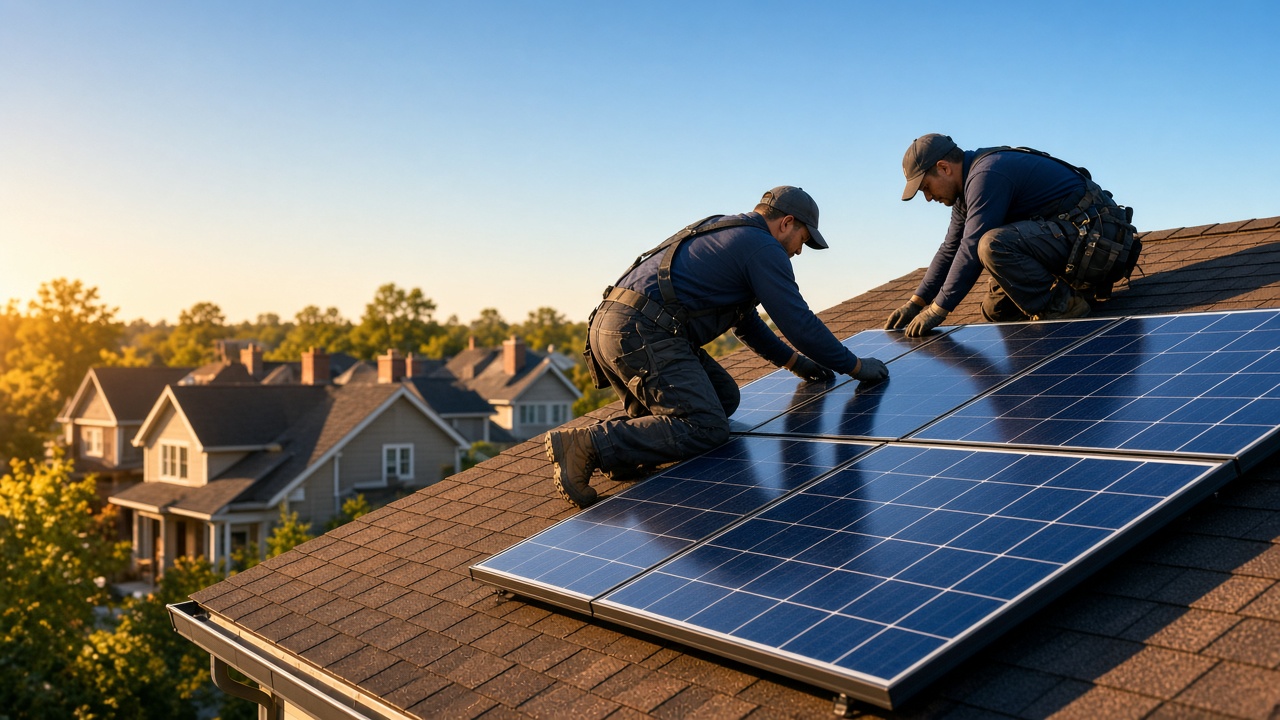
A residential installer offers a free home solar assessment. The 15-second TV spot shows the company’s own crew finishing a real install on a local house, then shows the company name and the offer. Search ads target homeowners searching for solar installers and quotes in the installer’s service area, with copy such as, for example, Free solar assessment from a local crew. Short social videos answer the questions homeowners ask before they call: how long payback takes, what happens on a cloudy day, and what the assessment involves.
Every ad sends people to a quote request page that repeats the offer, shows recent installs and reviews, and asks for only the details needed to book the visit. The next step is tracking quote requests as conversions and calling each one back quickly.
If you also sell roofing work, see how roofing companies get more leads.
Planning around solar seasonality
Solar interest usually rises in spring and summer and eases in fall and winter. Digital Dot’s overview of solar seasonality ties the peak to longer days and high summer energy bills, and notes that some off-season buyers are planning an install before the next peak. You can check the pattern for your own area with Google Trends, as Jolly Media suggests, by comparing searches for terms like solar panel installation across the year.

Plan the year in two phases. Start awareness on TV, video and social in late winter so your name is familiar before the spring rush, when search competition tends to be heavier. Keep search running through fall and winter at a lower budget to catch the planners, and use the quieter months to collect install footage and reviews for the next season’s ads. If you also offer electrical work, see advertising for electricians.
Ad rules that apply to solar advertising
Solar ads attract regulatory attention because they make claims about money. The main rules to know:
- Consumer protection law applies online the same way it applies elsewhere. The FTC’s guidance on digital advertising disclosures states that the FTC Act’s ban on unfair or deceptive practices covers online advertising, marketing and sales.
- Savings and payback claims must be truthful and supportable. Avoid promising a specific bill reduction or payback period in an ad, because results depend on the home, roof, usage and utility rates.
- Required disclosures must be clear and conspicuous and placed close to the claim they qualify. Financing terms or assumptions should not be hidden in fine print or on a separate page.
- Testimonials and endorsements fall under the FTC’s Endorsement Guides. The FTC’s guidance for endorsers warns that disclosures are easy to miss when they sit only on a profile page or behind a click. If a customer or creator is paid or rewarded, that relationship needs to be disclosed.
- Calling or texting leads requires proper consent under the Telephone Consumer Protection Act (TCPA). This is a real risk with purchased leads, where some vendors cut corners on consent records. Generating your own opt-in leads from ads and a quote form gives you clearer consent.
State and local rules, such as permit requirements for door-to-door sales, vary. Check them with your own counsel.
Getting your site ready to turn ad clicks into quote requests
Ads only bring people to the door, and the quote page decides whether they knock. Before launch:
- Use a short, mobile-friendly quote form with a visible phone number.
- Show real photos and video of your installs rather than stock imagery, along with your service area and license details.
- Put reviews near the form, not just on a separate page.
- Follow up quickly. Homeowners usually contact several installers, and the first useful callback has the advantage.
- Install Adwave’s tracking snippet and set quote requests as a conversion, with a value if you want revenue and return-on-spend reporting. Adwave reports last-touch credit and assisted conversions and supports Lift experiments. Treat all of these as estimates, because a homeowner who saw your TV spot and later searched your name won’t always be credited cleanly.
- Check lead quality every week. One advertiser posted on Reddit’s r/PPC about spending about $2,000 on a solar video campaign that produced 3,000 clicks and no real leads, only fake form submissions. If quote requests don’t turn into appointments, fix the form and the targeting before raising the budget.
For a related trade, see turning HVAC ad spend into booked calls.