
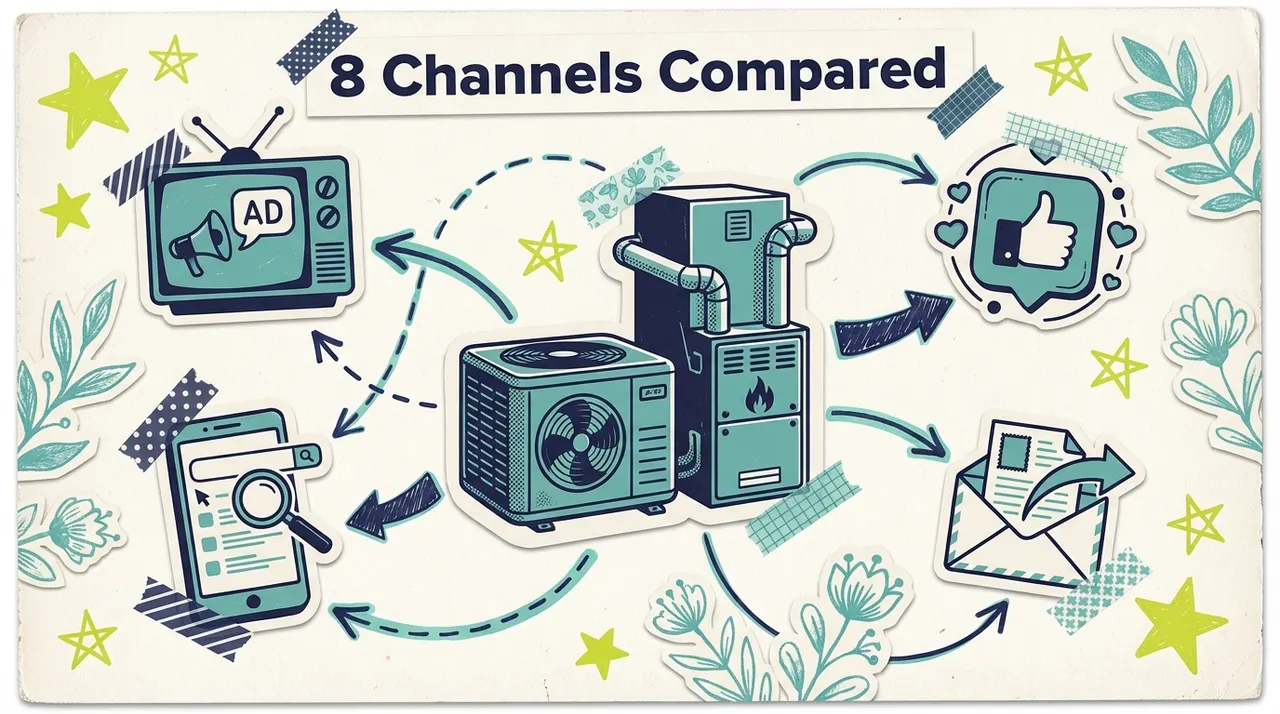
Every HVAC company faces the same challenge: you need the phone to ring. Whether it's a homeowner with a broken furnace in January or someone shopping for a new AC system in June, the businesses that win are the ones people think of first. And that comes down to advertising.
The "best" advertising for HVAC companies isn't a single channel. It's the right combination of channels that work together to generate emergency calls, scheduled maintenance leads, and long-term brand recognition. Some channels capture demand that already exists. Others create demand by keeping your name in front of homeowners before they need you.
Let's break down the most effective advertising options for HVAC companies, with honest pros and cons, real cost expectations, and a practical framework for putting it all together.
Google Ads and Local Services Ads
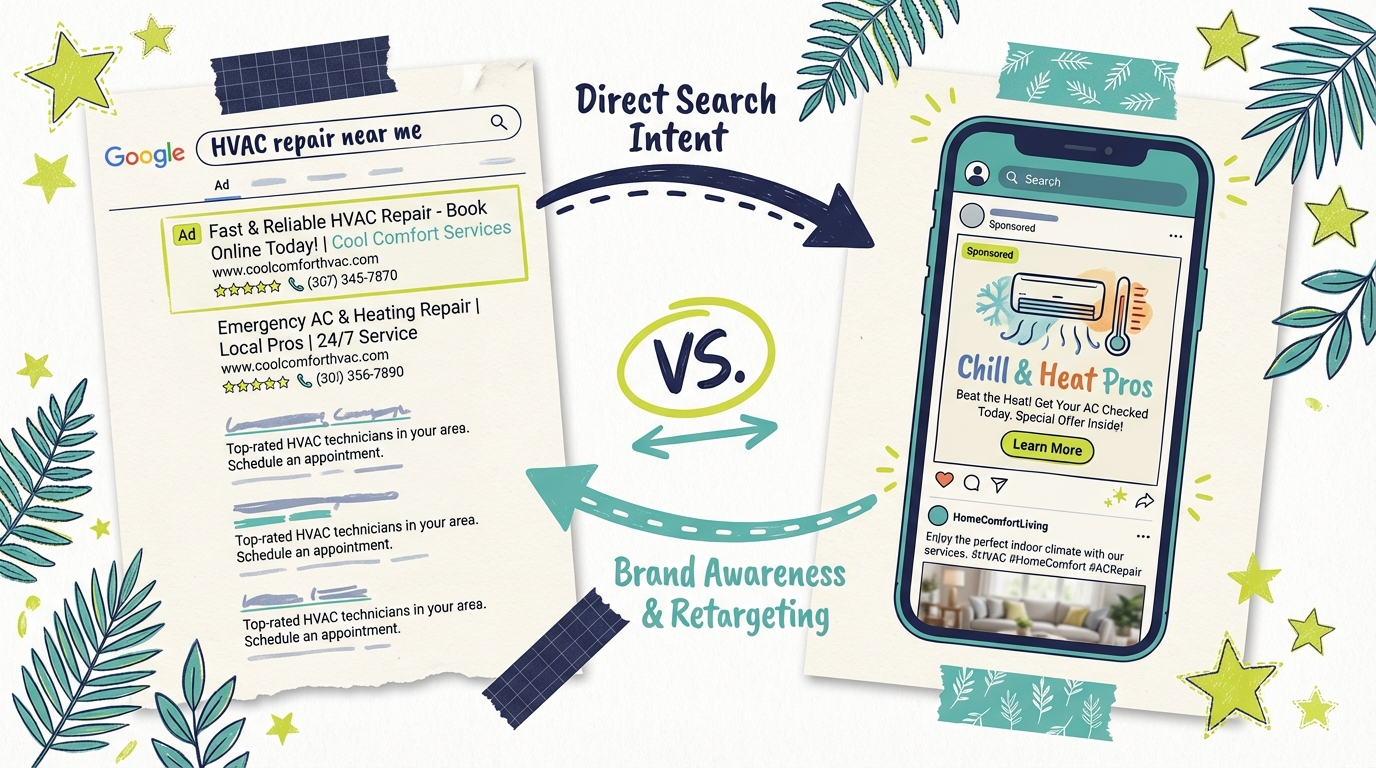
When a homeowner's AC dies at 2 a.m. in July, they grab their phone and search "emergency AC repair near me." If you're not showing up in that moment, someone else gets the call.
What works: Google Ads, especially Google Local Services Ads (LSAs), put you directly in front of people with immediate intent. LSAs are especially powerful for HVAC because they carry the "Google Guaranteed" badge, which builds instant trust with homeowners who don't know your company yet. You only pay when someone contacts you, not per click.
Standard search ads let you target specific services (furnace repair, duct cleaning, AC installation) in specific zip codes. This precision means you're not wasting budget reaching people outside your service area.
What doesn't: Cost is the elephant in the room. HVAC is one of the most expensive categories in Google Ads. According to WordStream's 2024 industry benchmarks, cost-per-click for HVAC keywords averages $15 to $40, with emergency terms often exceeding $50. In competitive metros like Phoenix, Houston, or Chicago, bidding wars can push those numbers even higher.
There's also a ceiling effect. Google Ads only capture existing demand. If a homeowner isn't actively searching, they'll never see your ad. That means you're competing for the same limited pool of in-market buyers as every other HVAC company in town.
Cost expectation: Most HVAC companies spend $1,500 to $5,000 per month on Google Ads. LSAs typically run $50 to $150 per qualified lead.
Best for: Capturing emergency service calls and high-intent buyers who are ready to book now.
Social Media Advertising
Facebook and Instagram give HVAC companies something search ads can't: the ability to reach homeowners before they have a problem. You can put your brand in front of thousands of local homeowners, build familiarity, and stay familiar so they call you when something breaks.
What works: The targeting options are strong. You can reach homeowners in specific zip codes, filter by household income (important for targeting replacement vs. repair customers), and target life events like "recently moved." Retargeting is powerful here too. If someone visited your website's AC replacement page but didn't schedule an estimate, you can follow up with ads on their social feeds.
Visual content performs well for HVAC. Before-and-after photos of ductwork, time-lapse installation videos, and customer testimonial clips all generate engagement. According to a 2024 Sprout Social report, short-form video content sees 2.5 times more engagement than static images on Facebook and Instagram.
What doesn't: Intent is the core limitation. People scrolling Instagram aren't thinking about their HVAC system. Your ad interrupts their experience, which means conversion rates are typically lower than search-based channels. You'll get plenty of impressions but fewer direct calls.
The Facebook ad algorithm also requires consistent budget and testing. A $200 boost on a single post won't move the needle. You need to invest in ongoing campaigns, creative testing, and audience refinement.
Cost expectation: $800 to $2,500 per month for meaningful results. CPMs typically range from $8 to $20 for local HVAC audiences.
Best for: Building brand awareness, promoting seasonal maintenance plans, and retargeting website visitors who didn't convert.
Home Services Platforms (Angi, HomeAdvisor, Thumbtack)
Lead generation platforms promise a steady stream of homeowners looking for HVAC services. The appeal is obvious: someone else handles the marketing, and you just answer the phone.
What works: The leads are pre-qualified to some degree. Homeowners on these platforms have already identified their problem and are actively seeking quotes. For newer HVAC companies that haven't built a strong reputation yet, these platforms can fill the schedule while you grow your brand.
What doesn't: Shared leads are the biggest frustration. On most platforms, your quote goes out alongside three to five other HVAC companies. That turns every job into a price war before you've even spoken to the customer. A 2023 Contractor Magazine survey found that nearly 40% of contractors rated lead quality from these platforms as "poor" or "very poor."
The economics get worse over time. HomeAdvisor charges per lead whether or not that lead answers the phone, was a real prospect, or was shopping with no intention of hiring. HVAC companies regularly report lead costs of $30 to $75, with conversion rates that make the true cost per acquired customer significantly higher.
You're also building someone else's brand. The homeowner remembers Angi, not your company. When they need service again, they go back to the platform instead of calling you directly.
Cost expectation: $30 to $75 per lead, with annual spend often reaching $5,000 to $15,000 for active HVAC businesses.
Best for: Filling schedule gaps, especially for newer companies building their initial customer base.
Local SEO and Google Business Profile
If Google Ads are sprinting, local SEO is a marathon. A well-optimized Google Business Profile puts you in the local map pack, which appears above organic search results for queries like "HVAC companies near me." Once you're ranking, those clicks are essentially free.
What works: Google Business Profile is the foundation of local SEO for HVAC companies. It's where homeowners see your reviews, hours, photos, and service area. According to BrightLocal's 2024 Local Consumer Review Survey, 87% of consumers read online reviews for local businesses, and HVAC is a category where trust matters enormously. A company with 200 five-star reviews beats a company with 15 reviews almost every time.
Beyond reviews, local SEO includes optimizing your website for location-specific keywords ("AC repair in [city]"), building citations on directories, and earning backlinks from local sources. These compound over time.
What doesn't: Results take months, not days. If you need the phone to ring this week, local SEO won't help. It's also increasingly competitive. Every HVAC company with a marketing agency is working on their SEO, which means the bar keeps rising.
Algorithm updates can also reset your progress. Google changes its local ranking factors regularly, and what worked last year might not work today.
Cost expectation: $500 to $2,000 per month for professional SEO services, or significant time investment if you manage it yourself. Free to set up Google Business Profile.
Best for: Long-term lead generation, building credibility through reviews, and reducing dependence on paid channels over time.
Direct Mail and EDDM
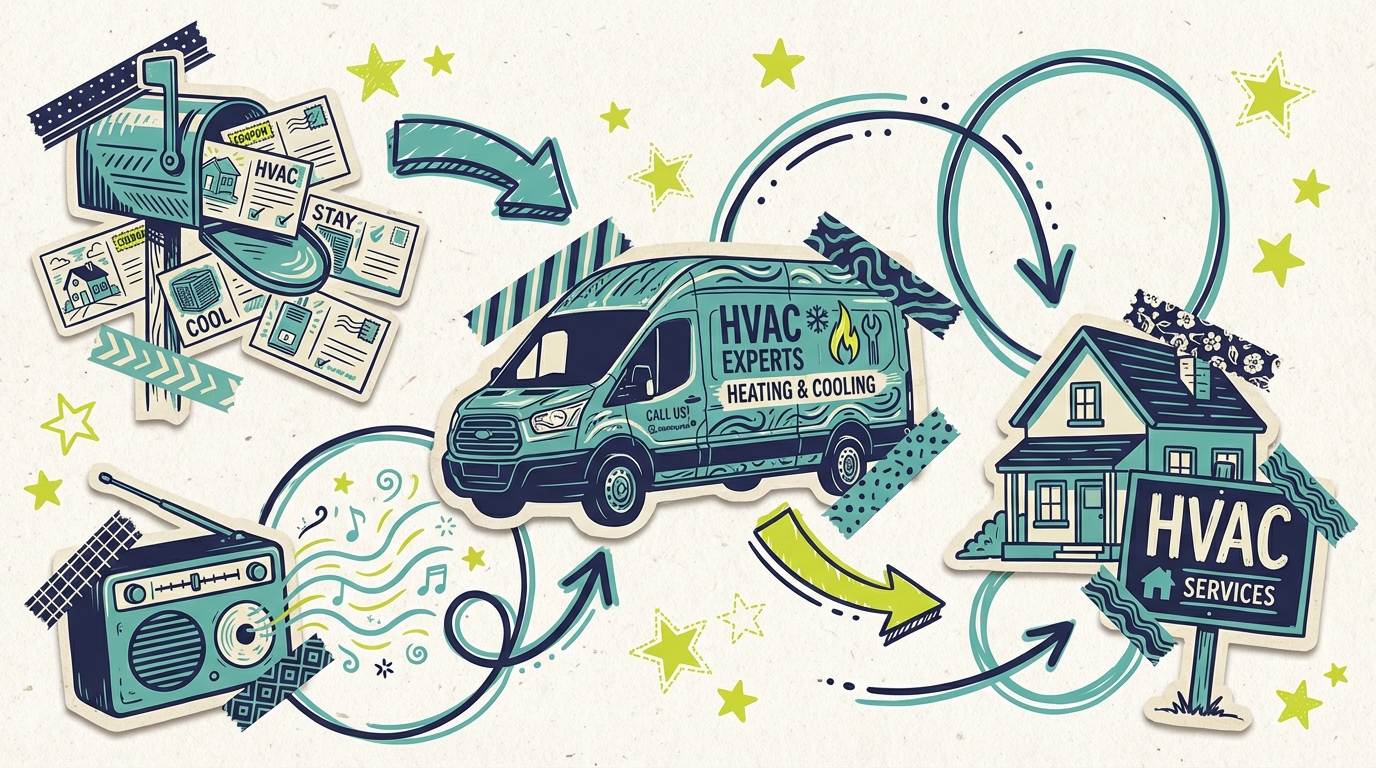
Direct mail, especially Every Door Direct Mail (EDDM), remains surprisingly effective for HVAC companies. EDDM lets you send postcards to every address in specific mail carrier routes without needing a mailing list.
What works: HVAC is inherently local, and direct mail reaches homeowners where they live. Seasonal mailers ("Schedule your fall furnace tune-up and save $50") arrive at exactly the right time. According to the Data & Marketing Association, direct mail has a 4.4% response rate for prospect lists, compared to 0.12% for email.
EDDM is especially cost-effective because you skip the cost of purchasing a mailing list. You choose carrier routes that match your target demographics and service area, and the USPS handles delivery at reduced postage rates.
What doesn't: There's no targeting beyond geography. Your mailer goes to renters, people with brand-new systems, and homeowners who'll never call. The waste is built into the model.
Tracking is also difficult. Unless you use unique phone numbers or promo codes on each mailer, it's hard to know exactly which mailings generated which calls.
Cost expectation: $0.20 to $0.50 per piece for EDDM postcards, typically reaching 500 to 5,000 homes per route. A solid campaign targeting 10,000 households runs $2,000 to $5,000 including design and printing.
Best for: Promoting seasonal tune-up specials, announcing new service areas, and reaching older homeowners who may not be as active online.
Local Radio Advertising
Radio has been a staple of HVAC advertising for decades, and it still has a role. Morning drive-time spots on local stations reach commuters who own homes in your service area.
What works: Radio builds frequency quickly. A homeowner who hears your company name every morning for a month will remember you when the furnace stops working. Many local stations also offer sponsorship packages (weather reports, traffic segments) that give your brand a premium feel.
Radio is also relatively easy to produce. A 30-second spot can be written and recorded in a day, and many stations offer production services as part of the ad buy.
What doesn't: Tracking ROI is nearly impossible with radio. You know people heard your ad, but connecting that to phone calls requires guesswork. Nielsen estimates radio's average reach among adults 25 to 54 is still strong, but listenership has declined steadily as podcasts and streaming music have grown. The Infinite Dial 2024 report from Edison Research shows that weekly AM/FM radio reach dropped to 82% in 2024, down from 89% in 2019.
There's also a targeting problem. You're paying to reach everyone listening to that station, including people who rent apartments, live outside your service area, or have zero interest in HVAC.
Cost expectation: $200 to $2,000 per week depending on market size and daypart. A meaningful campaign in a mid-sized metro typically costs $3,000 to $8,000 per month.
Best for: Building name recognition in a specific market, especially for established companies looking to reinforce their brand alongside other advertising channels.
TV and Streaming TV (CTV) Advertising
Electrical and HVAC contractors sometimes overlook TV because of its production and airtime costs. Traditional production can cost $5,000 to $50,000, with airtime requiring a separate budget.
That's changed. Connected TV (CTV) and streaming platforms have made TV advertising accessible for local HVAC companies at budgets that compete with what you'd spend on Google Ads or radio.
What works: TV builds trust faster than any other medium. When a homeowner sees your company on their television during a show on Hulu, Roku, or NBC, you carry the credibility that comes with being "on TV." According to a 2024 TVB/Harris Poll study, 62% of consumers say they trust TV advertisements more than ads on social media platforms. For HVAC, where homeowners are inviting a stranger into their home, that trust matters.
CTV combines that trust with the precision of digital advertising. You can target specific zip codes, household income levels, and even homeownership status. That means your ad reaches homeowners in your service area, not renters in apartments three cities away. And with platforms like Adwave, you can launch a campaign starting at just $50, with AI-generated commercials that look professional without needing a film crew.
The seasonal angle is huge for HVAC. You can ramp up spending before summer heat waves and winter cold snaps, then scale back during mild months. Real-time analytics let you see exactly how many households saw your ad and measure the impact on website visits and phone calls. For a complete look at how HVAC companies are using TV, check out our TV advertising guide for HVAC companies.
What doesn't: TV is a top-of-funnel channel. It builds awareness and trust, but most viewers won't call when they see your ad. It works best when combined with search and retargeting so you can capture the demand it creates. If you need leads today with zero brand investment, TV alone won't deliver overnight results.
Cost expectation: CTV campaigns start at $50 per month. CPMs for local HVAC audiences typically range from $15 to $35. A meaningful monthly campaign runs $500 to $3,000, which is comparable to what many HVAC companies spend on a single channel like radio or lead-gen platforms.
Best for: Building brand trust, becoming the "first call" company in your service area, and creating demand among homeowners who aren't actively searching yet.
Yard Signs, Vehicle Wraps, and Referral Programs
Not every effective HVAC marketing channel is digital. Some of the highest-ROI strategies are old-fashioned and low-tech.
What works: Vehicle wraps turn every service call into a mobile billboard. Your truck parked in a driveway tells the entire neighborhood you're there, and a well-designed wrap keeps working 24/7. The Outdoor Advertising Association of America estimates vehicle wraps generate 30,000 to 70,000 daily impressions depending on driving patterns.
Yard signs placed at completed job sites build hyperlocal awareness. When neighbors see your sign after a successful installation, social proof kicks in. Referral programs amplify this by giving existing customers a reason to recommend you. Even a simple "$50 off your next service for every referral" creates a steady stream of warm leads.
What doesn't: These channels don't scale quickly. You can't flood a market with yard signs the way you can with digital ads. And referral programs depend on having an existing customer base large enough to generate meaningful volume.
Cost expectation: Vehicle wraps run $2,000 to $5,000 per truck (one-time). Yard signs cost $3 to $10 each. Referral program costs depend on the incentive structure but typically run $25 to $100 per successful referral.
Best for: Maximizing every job you already do, building neighborhood-level awareness, and generating warm leads through word of mouth.
HVAC Advertising Channels Compared
How to Build Your HVAC Advertising Strategy
There's no single "best" channel. The most successful HVAC companies layer multiple channels that serve different purposes in the customer journey. Here's a practical framework based on where you are.
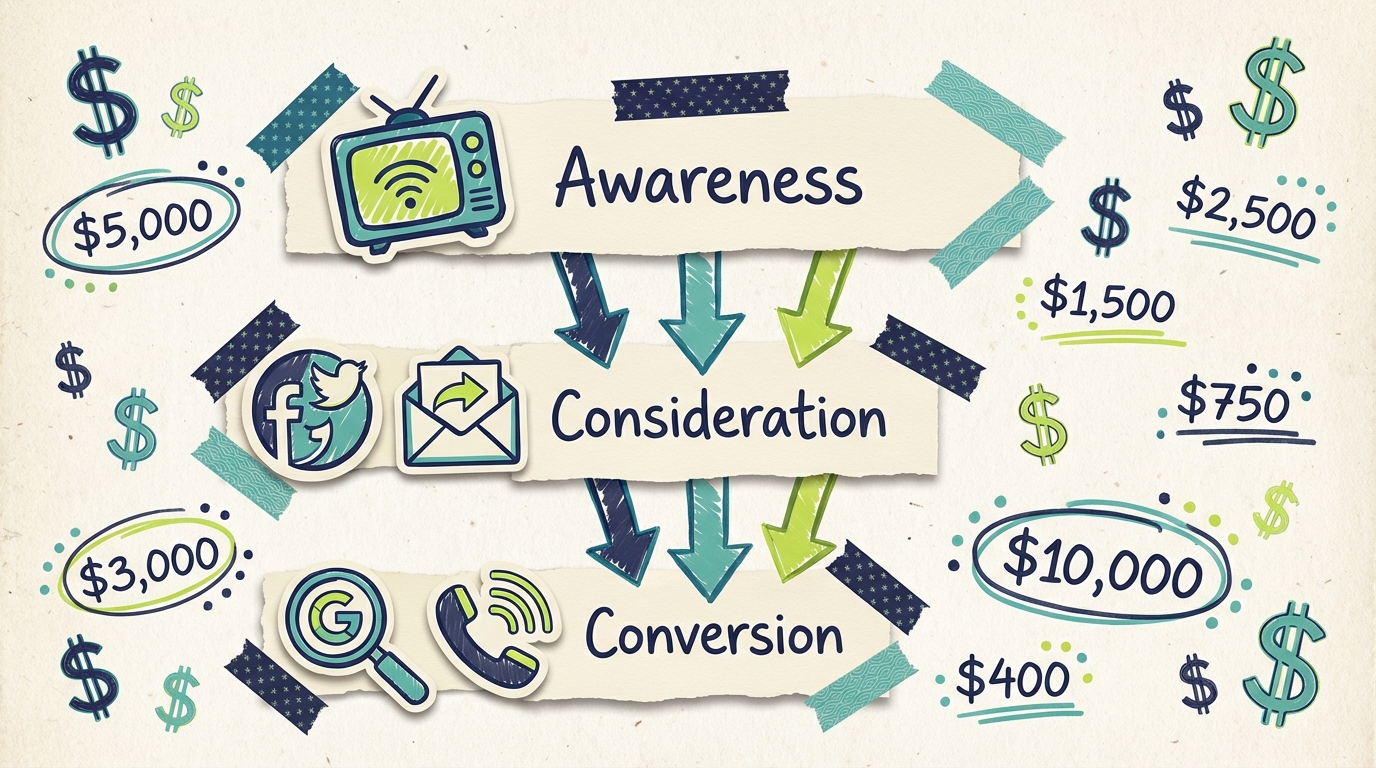
If you're just starting out ($1,000-$2,000/month): Focus on Google LSAs and a well-optimized Google Business Profile. These capture the high-intent leads that keep the lights on. Add vehicle wraps and yard signs for passive, ongoing visibility.
If you're growing ($2,000-$5,000/month): Layer in social media advertising for retargeting and seasonal campaigns. Start a TV/CTV campaign to build brand recognition. This is where you shift from chasing individual leads to building a brand that homeowners seek out.
If you're established ($5,000-$10,000+/month): Run an awareness and conversion approach. CTV builds awareness and trust at the top. Social media and direct mail keep you familiar in the middle. Google Ads and SEO capture demand at the bottom. You can explore our local advertising cost guide to benchmark your spending against industry averages.
The key insight: channels that build trust (like TV) make every other channel work better. A homeowner who's seen your commercial is more likely to click your Google ad, respond to your mailer, and choose you over competitors on Angi. Your home services advertising strategy should treat brand-building and lead capture as two sides of the same coin.
Common Questions Answered
What is the most cost-effective advertising for a small HVAC company? For HVAC companies with tight budgets, Google Local Services Ads combined with a well-maintained Google Business Profile deliver the best return per dollar spent. LSAs only charge when someone contacts you, and a strong review profile generates free organic leads. As your budget grows, adding CTV advertising at entry-level budgets ($50 to $500 per month) builds the brand trust that makes every other channel convert better.
How much should an HVAC company spend on advertising? Industry benchmarks suggest HVAC companies should allocate 5% to 10% of gross revenue to marketing and advertising. For a company generating $500,000 in annual revenue, that translates to $25,000 to $50,000 per year, or roughly $2,000 to $4,000 per month. Newer companies or those in highly competitive markets may need to invest closer to 10% to 12% to gain traction.
Does TV advertising work for local HVAC companies? Yes, and the data supports it. A 2024 TVB/Harris Poll study found that 62% of consumers trust TV ads more than social media ads. For HVAC, where trust is critical because you're entering someone's home, that premium matters. Modern CTV platforms let you target specific zip codes with professional-quality ads starting at $50, making it accessible even for single-truck operations. You won't see overnight results, but companies that run consistent TV campaigns report becoming the "first call" in their service area within three to six months.
Compare the cost and quality of shared leads with inquiries from your own listings, website, and advertising. Use that evidence to decide how much to spend on lead platforms.
When is the best time to advertise HVAC services? The best time is before peak season, not during it. Start ramping up advertising four to six weeks before summer heat and winter cold hit your market. Homeowners who see your name consistently before an emergency are more likely to call you when one happens. That said, brand-building channels like CTV and local SEO should run year-round to maintain awareness through shoulder seasons.


