
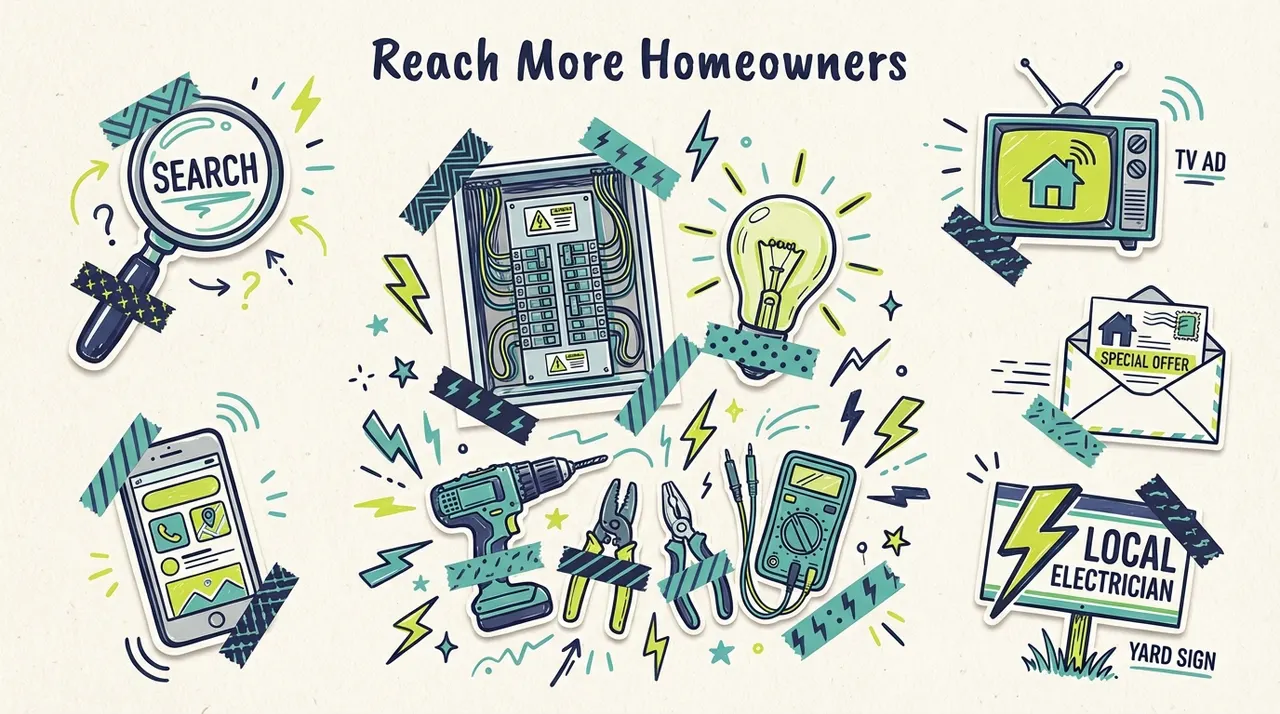
Most electricians build their business on referrals and word of mouth. And for a while, that works. But referrals are unpredictable. One month the phone rings nonstop, and the next month you're staring at an empty schedule wondering what happened. If you want consistent growth, you need a system for getting in front of homeowners who don't already know you.
Advertising for electricians isn't the same as advertising for a restaurant or a clothing store. Your customers don't wake up thinking about electrical work. They think about it when a breaker trips, an outlet stops working, or they're planning a renovation and the general contractor says they need to hire a licensed electrician. That means your advertising has to do two things: capture the people who need you right now, and stay visible to everyone else so you're the first name they think of when the time comes.
The good news is you don't need a massive budget to make advertising work. You need the right mix of channels, each doing a specific job. This guide breaks down seven advertising options for electricians, with honest costs, clear pros and cons, and a practical budget framework you can start using this week.
Google Ads and Local Services Ads

When a homeowner's power goes out at 10 p.m. or they notice a burning smell near an outlet, they grab their phone and search "electrician near me." If your business isn't showing up in that moment, someone else gets the call.
Google Ads put you at the top of search results for high-intent queries like "emergency electrician," "electrical panel upgrade," and "licensed electrician near me." You're reaching people who have an immediate problem and are ready to hire, which is why Google consistently delivers the strongest direct-response results for home services businesses.
Local Services Ads (LSAs): Your Highest-ROI Option
Google Local Services Ads deserve special attention because they're specifically designed for businesses like yours. LSAs appear above traditional search ads, include a "Google Guaranteed" badge, and charge per lead rather than per click. That last part matters a lot. With standard search ads, you pay whether someone calls you or just clicks and bounces. With LSAs, you only pay when a homeowner contacts you.
According to Google's published benchmarks, LSAs for home services typically generate leads at 30-50% lower cost than traditional search ads (Google Ads Help Center, 2025). For electricians, lead costs through LSAs generally fall between $25 and $75 depending on your market and service type.
To qualify for LSAs, you'll need to pass Google's screening process, which includes license verification, insurance checks, and background checks. That barrier is an advantage because it filters out unlicensed handymen and fly-by-night operators who undercut your prices.
Standard Search Ads: Filling the Gaps
Standard Google Search Ads complement LSAs by letting you target specific services and geographic areas with more control. You can create separate campaigns for different job types: one for emergency services (high urgency, higher bids), one for panel upgrades and rewiring (higher ticket, longer decision cycle), and one for new construction or remodel work.
Tactics that work for electricians:
Dayparting. Bid higher during evenings and weekends when emergency calls spike. A homeowner searching for an electrician at 9 p.m. on a Saturday is willing to pay premium rates.
Negative keywords. Add terms like "DIY," "how to," "electrician jobs," "salary," and "apprenticeship" to stop wasting money on people who aren't looking to hire.
Call extensions. Many homeowners with electrical emergencies prefer to call rather than fill out a form. Make the phone number prominent.
Location targeting. Tighten your radius to your actual service area. Paying for clicks from homeowners 45 minutes away usually isn't worth the drive time.
Cost expectation: Electrician keywords run $8 to $30 per click in most markets, with emergency-related terms at the higher end. According to WordStream's 2025 industry benchmarks, home services averages a $9.64 cost per click, though competitive metro areas push significantly higher (WordStream, 2025). Most electricians need $1,000 to $3,000 per month in ad spend to generate consistent lead flow.
Best for: Capturing homeowners with immediate electrical needs. This is the closest thing to "pay for leads on demand" that exists in advertising.
Social Media Advertising: Meta, Instagram, and Nextdoor
Google catches people who are actively looking for an electrician. Social media reaches the much larger group of homeowners who will need one eventually but aren't searching yet. These two jobs are fundamentally different, and both matter for long-term business growth.
Facebook and Instagram Ads
Meta's advertising platform lets you target homeowners in your service area based on demographics, home value, household income, and even behaviors like "recently moved" or "interested in home improvement." That targeting is powerful for electricians because you can reach the kind of people who are most likely to need your services.
Content that drives results:
Before-and-after photos. A cluttered, outdated electrical panel replaced with a clean, modern one is visually compelling. Homeowners notice the contrast.
Educational short videos. A 30-second clip showing "3 signs your home's wiring needs attention" builds trust and positions you as an expert. According to Meta's 2025 Creative Best Practices report, short-form video generates 2.5 times more engagement than static images on Facebook and Instagram (Meta Business, 2025).
Customer testimonials. A homeowner describing how you solved their flickering lights problem is more persuasive than any ad copy you could write.
Seasonal promotions. Spring electrical safety inspections, pre-winter generator installation specials, and holiday lighting setup offers give homeowners a reason to act now.
Retargeting is where social media really earns its keep. If someone visited your website's "electrical panel upgrade" page but didn't call, you can follow up with ads specifically about panel upgrades on their Facebook and Instagram feeds. This turns casual browsers into booked appointments.
Nextdoor: The Neighborhood Network
Nextdoor is uniquely valuable for electricians because it's built around local trust. When a homeowner asks "Can anyone recommend a good electrician?" on Nextdoor, that's a warm lead sitting in a community conversation. Nextdoor's advertising tools let you sponsor posts that appear in neighborhood feeds across your service area.
According to Nextdoor's 2024 business impact report, 72% of members have hired a local service provider recommended on the platform (Nextdoor, 2024). For a trade like electrical work where trust and reputation matter enormously, that community-driven recommendation engine is worth the investment.
Cost expectation: Facebook/Instagram campaigns run $500 to $2,000 per month for meaningful results, with CPMs typically between $8 and $18 for local home services audiences. Nextdoor advertising starts at around $2 per day with sponsored posts.
Best for: Building brand awareness among homeowners in your service area, promoting seasonal offers, and retargeting website visitors. Social media is a long game, but it compounds over time.
Local SEO and Google Business Profile
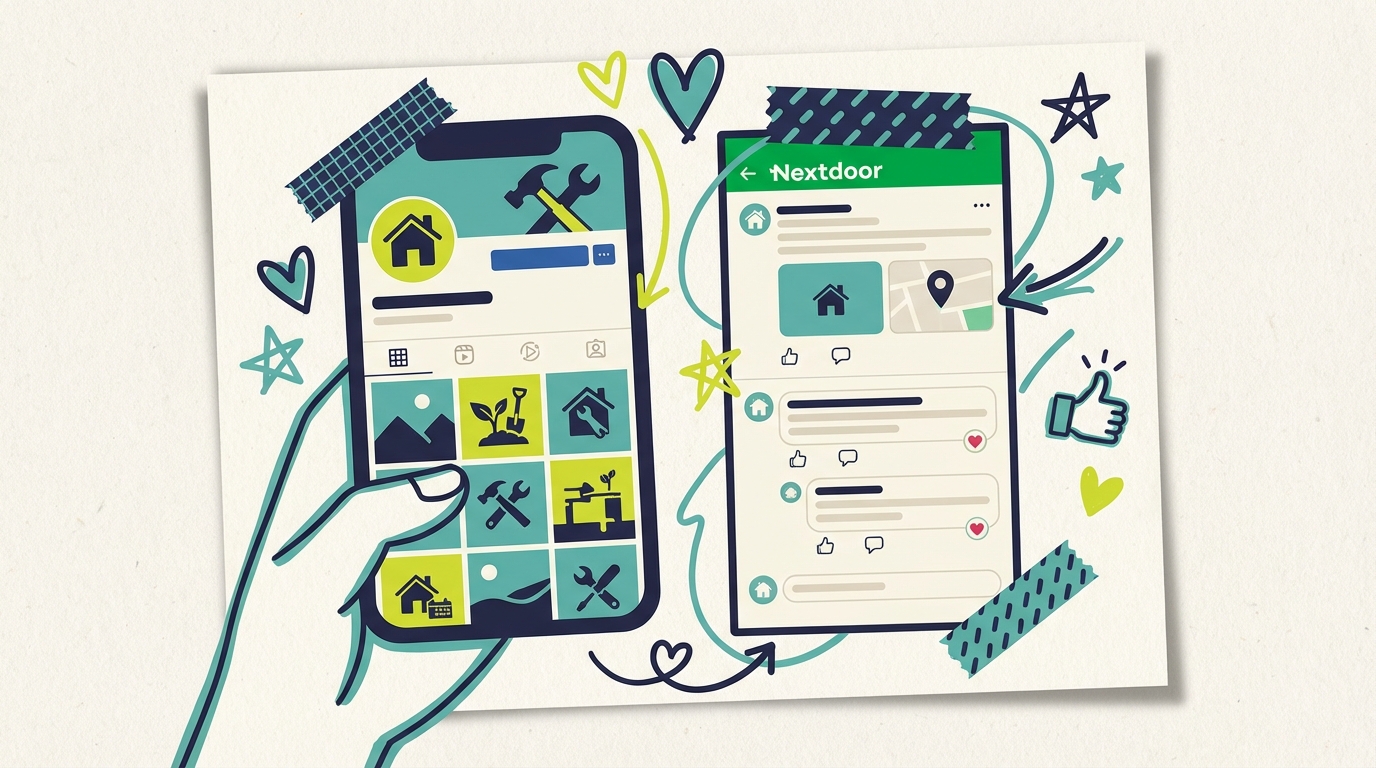
If Google Ads is sprinting, local SEO is a marathon. And for electricians, it's the marathon that pays the biggest dividends over time.
When a homeowner searches "electrician near me," Google shows three results in the local map pack before anything else. Those three spots get the majority of clicks. Ranking there means free, high-quality leads every single day without paying per click.
Your Google Business Profile is the foundation. This is where homeowners see your reviews, service area, hours, photos, and contact information. According to BrightLocal's 2025 Local Consumer Review Survey, 87% of consumers read online reviews for local businesses, and 73% only pay attention to reviews written in the last month (BrightLocal, 2025).
How to optimize your Google Business Profile:
Collect reviews relentlessly. After every job, send a text or email with a direct link to your Google review page. Aim for a steady stream of recent reviews rather than a burst followed by silence. Volume and recency both matter for map pack rankings.
Respond to every review. Positive reviews get a thank-you. Negative reviews get a professional, solution-oriented response. Future customers read both.
Post regularly. Google Business lets you publish updates, offers, and photos. Weekly posts signal to Google that your business is active. Share completed projects, seasonal tips, or promotions.
Complete every field. Services offered, service area, business description, attributes (licensed, insured, veteran-owned). More data means better matching with search queries.
Website SEO complements your profile. Create pages targeting specific services in specific locations: "Electrical Panel Upgrade in [City]," "Emergency Electrician [City]," "EV Charger Installation [City]." Each page targets a different search query and expands your organic footprint.
Cost expectation: Google Business Profile is free to set up and maintain. Professional local SEO services run $500 to $1,500 per month. Results take three to six months to materialize, but once you're ranking, the leads don't stop when you stop paying.
Best for: Long-term lead generation, building credibility through reviews, and reducing your dependence on paid advertising over time. Every electrician should be investing here.
Yelp, HomeAdvisor, and Angi
Lead generation platforms promise a steady stream of homeowners looking for electrical services. The appeal is straightforward: someone else handles the marketing, and you just answer the phone. The reality is more complicated.
Yelp
Yelp matters for electricians because homeowners use it to compare options and read reviews. A strong Yelp profile with recent, positive reviews can drive direct calls without any paid advertising. Yelp's paid options include enhanced profiles and sponsored search results, which push your listing above competitors.
The downside is cost. Yelp's advertising can run $300 to $1,000 per month depending on your market, and the ROI varies widely. Focus on earning strong organic reviews before spending on ads.
HomeAdvisor and Angi
These platforms generate leads by matching homeowners with service providers. You'll receive leads for your service categories and geographic area, typically at $15 to $75 per lead depending on the job type.
The problem with these platforms is shared leads. Your contact information goes out alongside three to five other electricians, turning every opportunity into a price war before you've even spoken to the homeowner. A 2023 survey by Contractor Magazine found that nearly 40% of contractors rated lead quality from these platforms as "poor" or "very poor" (Contractor Magazine, 2023).
That said, these platforms can fill schedule gaps, especially for newer businesses still building their reputation and referral network. Just don't build your entire lead generation strategy around them.
Cost expectation: $200 to $500 per month for Yelp advertising. HomeAdvisor/Angi lead costs range from $15 to $75 per lead, with annual spend often reaching $3,000 to $10,000 for active electrical businesses.
Best for: Supplementing other channels during slow periods, especially for electricians who are newer to their market and building their reputation.
Direct Mail, Truck Wraps, and Yard Signs
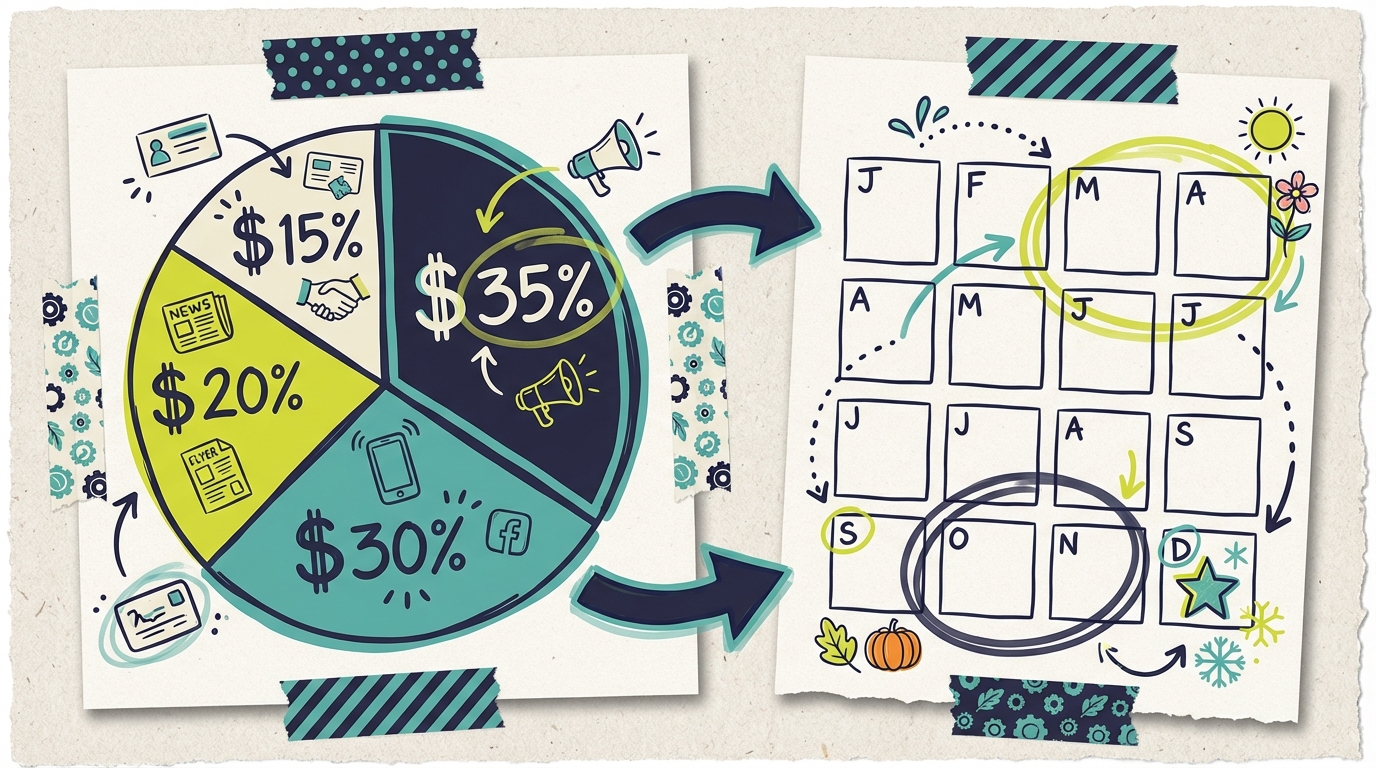
Not every effective advertising channel is digital. For electricians, some of the highest-ROI strategies are refreshingly old-school.
Truck Wraps
Your service van is already driving through the neighborhoods where your customers live. A professional vehicle wrap turns every service call into a mobile billboard. The Outdoor Advertising Association of America estimates that vehicle wraps generate 30,000 to 70,000 daily impressions depending on driving patterns (OAAA, 2023). For a one-time investment, that's hard to beat.
A well-designed wrap should prominently feature your phone number (large enough to read from 50 feet), your top services, and your license number. Skip the cluttered look. Clean, bold designs with high contrast get noticed and remembered.
Yard Signs
After you finish a job, ask the homeowner if you can leave a small sign in their yard for a week or two. When neighbors see your company name at a house that just had work done, social proof kicks in. It's the physical version of a five-star review.
Direct Mail and EDDM
Every Door Direct Mail (EDDM) lets you send postcards to every address on specific mail carrier routes without needing a mailing list. For electricians, seasonal mailers work well: "Schedule your spring electrical safety inspection" or "Is your home ready for an EV charger?" According to the Data & Marketing Association, direct mail has a 4.4% response rate for prospect lists, compared to 0.12% for email (DMA, 2023).
Cost expectation: Truck wraps run $2,000 to $5,000 per vehicle (one-time investment). Yard signs cost $3 to $10 each. EDDM postcards cost $0.20 to $0.50 per piece, with a typical campaign targeting 5,000 to 10,000 homes running $1,000 to $4,000 including design and printing.
Best for: Building hyperlocal awareness in the neighborhoods you already serve. These channels work quietly in the background and compound over time.
TV and Streaming TV (CTV) Advertising
Most electricians assume TV advertising is something only national brands can afford. That used to be true. Traditional broadcast TV required minimum monthly spends of $5,000 to $25,000, plus production costs that could easily match. But streaming TV, also known as connected TV (CTV), has changed the equation completely.
CTV advertising delivers your commercial on premium networks like NBC, ESPN, Hulu, and Fox, but with the targeting and budget flexibility of digital. You can target specific zip codes, homeowner demographics, and household income levels, so your ad reaches the homeowners most likely to need electrical services. With Adwave, you can launch a streaming TV campaign starting at just $50. The platform creates a broadcast-quality 30-second commercial from your website in about two minutes, no production crew required.
Why does this matter for electricians? Trust. When a homeowner sees your commercial on their TV screen alongside major brands, it signals credibility and permanence. A 2024 TVB/Harris Poll study found that 62% of consumers trust TV ads more than social media ads (TVB/Harris Poll, 2024). For a trade where you're entering someone's home and working on systems that affect their family's safety, that trust premium is significant. Average CTV CPMs range from $15 to $35, which often costs less per thousand impressions than competitive Google Ads clicks in the home services space.
For a deep dive into TV advertising strategies specifically for electrical contractors, see our TV advertising for electricians guide.
Online Reviews and Reputation Management
Reviews deserve their own section because they influence every other channel on this list. A homeowner who finds you through Google Ads will check your reviews before calling. Someone who sees your truck wrap will Google your company name and read what past customers say. Your social media ads perform better when your rating is strong.
According to a 2024 ServiceTitan study of home services businesses, companies with an average rating above 4.5 stars generate 35% more inbound leads than those rated between 3.5 and 4.0 (ServiceTitan, 2024). The gap is even wider for trades like electrical work where safety is a primary concern.
How to build a review engine:
Ask at the right moment. The best time to request a review is immediately after completing a job, while the homeowner is still feeling grateful. Send a text with a direct link before you leave the driveway.
Make it easy. A direct link to your Google review page removes friction. Every extra step you add cuts your response rate.
Follow up once. If they don't leave a review within 48 hours, send one gentle reminder. Don't pester.
Showcase reviews. Feature your best reviews on your website, social media, and even your truck wrap.
Cost expectation: Review management software (Podium, Birdeye, or similar) runs $200 to $400 per month. You can also manage this manually for free with discipline and a simple follow-up process.
Best for: Amplifying the effectiveness of every other advertising channel. Reviews are the connective tissue of your entire marketing strategy.
Electrician Advertising Channels Compared
How to Allocate Your Advertising Budget
There's no single "best" channel. The electricians who grow consistently are the ones who layer multiple channels together so they're capturing demand and creating it at the same time. Here's a practical framework.
Starting Out ($500-$1,500/month)
Focus your budget where it has the most immediate impact:
50% on Google LSAs to capture homeowners who need an electrician right now
30% on Google Business Profile optimization and review generation to build the organic foundation
20% on truck wraps and yard signs (one-time investment that keeps working)
At this stage, every dollar needs to generate a trackable lead. Google LSAs and a strong review profile deliver the most predictable returns.
Growing ($1,500-$4,000/month)
You've got a base of customers and reviews. Now build awareness:
35% on Google Ads / LSAs (still your lead engine)
25% on social media advertising (retargeting and seasonal campaigns)
20% on local SEO (investing in the long game)
20% on CTV/streaming TV (building brand trust and becoming the "first call" company)
This is the stage where brand-building starts to matter. A homeowner who's seen your TV commercial and then sees your Google ad is more likely to click and call.
Established ($4,000-$8,000+/month)
Run an awareness and conversion approach where channels reinforce each other:
25% on Google Ads / LSAs
20% on CTV / streaming TV (consistent brand presence across your service area)
20% on social media (retargeting, content, seasonal pushes)
15% on local SEO
10% on direct mail (seasonal campaigns to targeted neighborhoods)
10% on review management and reputation building
At this level, your home services advertising strategy should treat brand-building and lead capture as two sides of the same coin. The trust you build through TV and reviews makes your search ads convert at higher rates and lowers your overall cost per lead.
Common Questions Answered
How much should an electrician spend on advertising? Industry benchmarks for home services businesses suggest allocating 5% to 10% of gross revenue to marketing and advertising. For an electrical company generating $400,000 in annual revenue, that works out to $20,000 to $40,000 per year, or roughly $1,700 to $3,300 per month. Newer companies or those expanding into competitive markets may need to invest closer to 10% to 12% to build initial awareness and fill the schedule.
What is the single best advertising channel for electricians? If you can only invest in one channel, Google Local Services Ads deliver the most consistent return. You're reaching homeowners who need an electrician right now, you only pay for actual leads, and the Google Guaranteed badge builds instant trust. That said, relying on a single channel is risky. The most successful electrical contractors combine LSAs with at least two or three other channels to create both immediate leads and long-term brand awareness.
Does social media advertising work for electricians? It does, but not the same way it works for restaurants or retail stores. Homeowners don't scroll Instagram looking for an electrician. Social media's value for electrical contractors is in staying visible between the moments when someone needs you. Retargeting website visitors, running seasonal promotions, and sharing project photos all build the familiarity that makes homeowners choose you over a stranger when the time comes. Think of it as planting seeds, not harvesting.
How can electricians compete with bigger companies that have larger ad budgets? Smaller electrical contractors have advantages that big companies can't replicate. You can target tighter geographic areas, respond faster to leads, and build personal relationships with customers. Focus on dominating your local market rather than trying to cover an entire metro. A strong Google Business Profile with 200+ reviews, consistent presence on Nextdoor, and a well-planned advertising mix can outperform a larger competitor spending three times as much across a wider area.
Yes. Adwave creates ads from your website and runs campaigns on TV, search, and social. Choose a local target area and review the ads and budget before launch.
How long does it take for electrician advertising to show results? It depends on the channel. Google Ads and LSAs can generate leads within days of launching. Social media campaigns typically need two to four weeks to optimize and start delivering consistent results. Local SEO is the slowest, often taking three to six months before you see meaningful ranking improvements, but it also delivers the most durable returns. The smart approach is to layer channels: use paid search for immediate leads while investing in SEO and brand-building for long-term growth.


