
When you break it down, the true local TV advertising cost has two main ingredients: the airtime (the ad slot itself) and the creative production (making the actual commercial). For years, both were massive financial hurdles for small businesses, but that’s all changed. TV is a lot more accessible than most owners think.
How Much Does Local TV Advertising Really Cost?
Trying to pin down the cost of local TV advertising can feel like you're trying to hit a moving target. If you're a small business owner, you've probably heard that TV can be a useful option for your brand, but the rumored price tag is enough to make anyone hesitant.
The game has fundamentally changed.
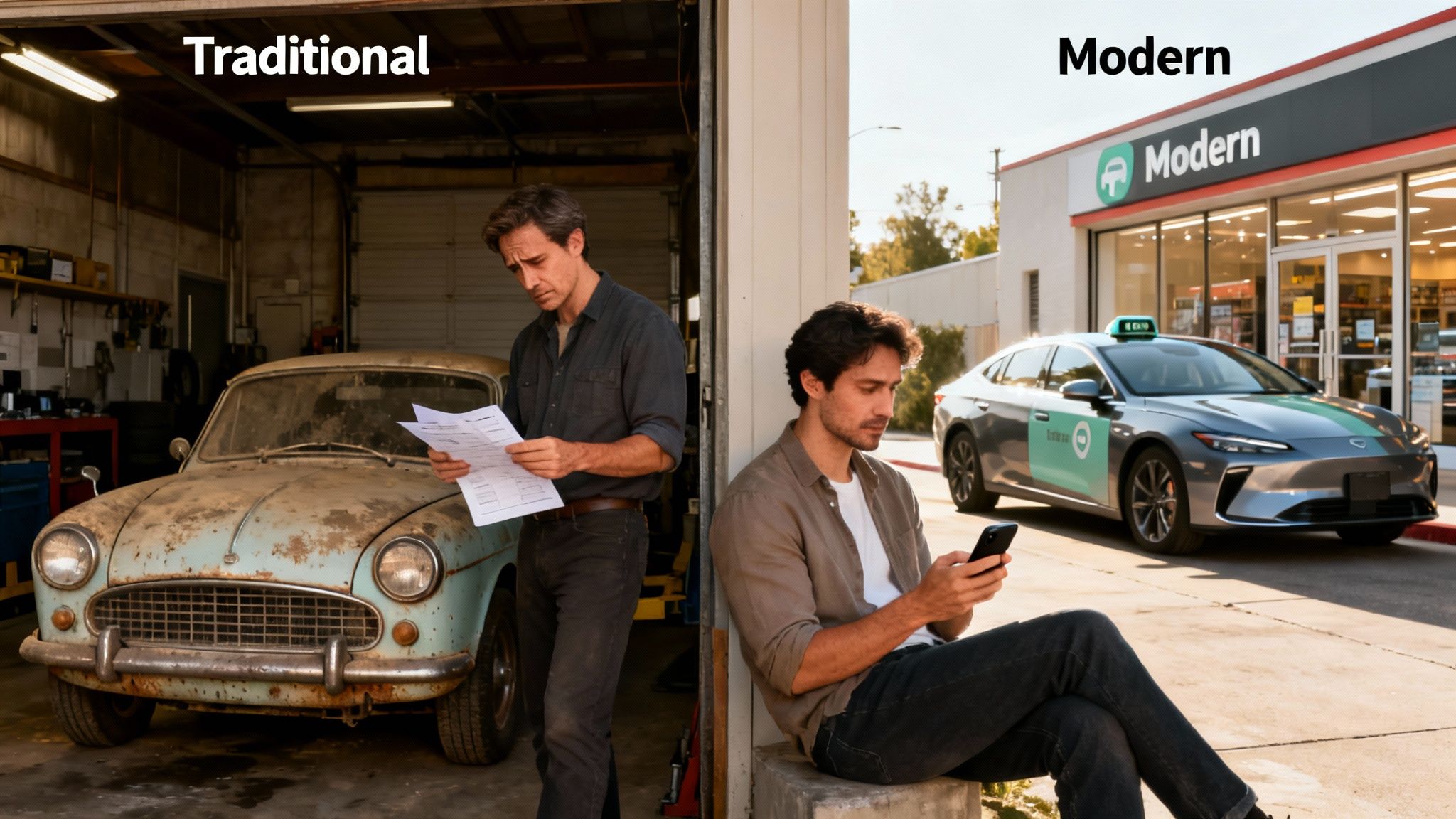
Historically, getting an ad on TV was a huge production, almost like commissioning a custom-built car. You'd start by hiring a production company to handle everything from scripting and shooting to editing your commercial. That process alone could easily run into thousands of dollars and drag on for weeks. After that, you'd still have to negotiate with local TV stations to buy airtime, another complex and often expensive step. It was slow, pricey, and frankly, out of reach for most local businesses.
The Modern, Accessible Approach to TV Ads
Today, there’s a much smarter, more efficient way to do things. Forget building a custom car; think of it more like using a sleek, affordable rideshare app. Modern platforms have completely dismantled the two biggest cost barriers that once stood in the way.
Instead of a huge upfront investment in creative, platforms like Adwave use AI to generate a broadcast-ready commercial for you in minutes, often at no extra charge. This one shift removes a massive financial roadblock. If you want a deeper dive into the numbers, there's a lot of great info out there on the general cost of TV commercials.
The key takeaway is simple: Technology has opened the doors to TV advertising for everyone. What once demanded a five-figure budget and a team of pros can now be managed right from your laptop, with campaigns starting as low as $50.
This modern approach also makes buying airtime a breeze. You no longer have to juggle calls with multiple station reps. With a solution like Adwave, you can get your ad on premium channels and top streaming services through a single, straightforward platform. You get access to the same high-quality inventory that the big brands use, but with the pinpoint targeting and affordability that a small business needs.
Let's take a quick side-by-side look at how these two approaches stack up.
Quick Look: Traditional vs. Modern TV Ad Costs
As you can see, the difference is night and day. The modern, platform-based model puts control, flexibility, and affordability directly in your hands.
In this guide, we’ll walk through every factor that shapes your local TV advertising cost. You’ll get a clear roadmap to building a smart, effective strategy that fits your budget.
The Key Factors Driving Your Ad Spend
Ever wonder why a 30-second ad slot during the evening news costs a premium, while the same spot on a late-night show is just a fraction of the price? The world of TV advertising isn't arbitrary. It’s a dynamic marketplace where a handful of critical factors shape every price tag. Getting a handle on these variables is the first step toward building a campaign that doesn't just run, but works.
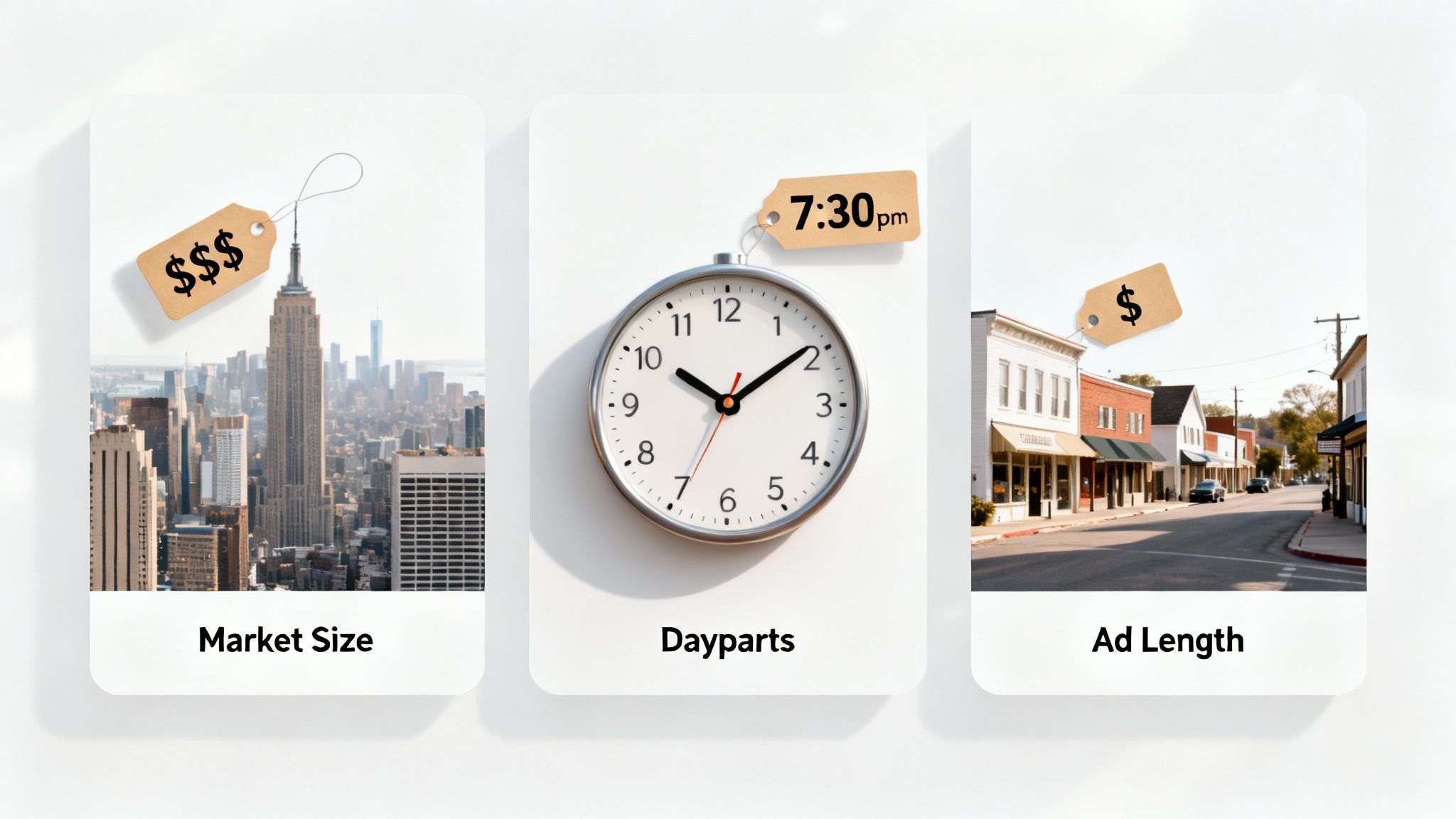
Think of it like buying real estate. A storefront on a bustling main street will always cost more than one on a quiet side road because it offers more visibility and foot traffic. TV advertising operates on the exact same principle of supply, demand, and audience value. The more eyeballs on the screen, and the more valuable that audience is to advertisers, the higher the price.
Market Size and Geographic Reach
The single biggest driver of your local TV advertising cost is simply where your ad airs. The country is carved up into what the industry calls Designated Market Areas (DMAs), basically, geographic zones for local TV viewing. It's no surprise that an ad running in New York City (the #1 DMA) will cost a whole lot more than one in a smaller market like Billings, Montana. You're potentially reaching millions more viewers.
This is where local advertising really shines. You only pay to reach the audience in your specific service area, neatly sidestepping the massive expense of a national campaign.
Dayparts: The Time of Day Matters
Not all hours are created equal when it comes to viewership. TV schedules are broken down into "dayparts," and each one comes with a different price tag based on who's watching, and how many of them there are.
Prime Time (8 PM - 11 PM): This is the big one. It's the most expensive slot because it's when viewership peaks, with families and working adults settled in for popular shows.
Early Fringe (4 PM - 7 PM): This period catches people as they're getting home from work and school, making it a valuable time for local news and popular syndicated shows.
Daytime (9 AM - 4 PM): Typically less expensive, this daypart often reaches stay-at-home parents, retirees, and a growing number of remote workers.
Late Night (11 PM - 2 AM): Looking for a bargain? This is one of the most affordable times, perfect for targeting a younger, night-owl audience.
Choosing the right daypart isn't just about saving a buck; it's about putting your ad in front of your target customer when they're most likely to be watching.
Key Insight: A lower-cost ad in a less popular time slot can be far more effective if it reaches the right audience. An ad for a 24-hour diner might perform better in a late-night slot than during prime time, and at a much lower cost.
Program Popularity and Ad Length
Beyond just the time of day, the specific show your ad appears in plays a huge role. An ad placed during a highly-anticipated local sports game or a season finale will command a premium. It has a massive, engaged audience that advertisers are willing to pay for. On the flip side, an ad during a lesser-known program will be much more budget-friendly.
The length of your commercial also directly impacts the price. While the 30-second spot is the industry standard, many stations also offer 15-second and 60-second options. A 15-second ad can be a cost-effective way to boost frequency and brand recall, while a 60-second spot allows for more in-depth storytelling, but at a higher price. For a complete look at the process, you can explore our guide on how to buy TV advertising.
How Adwave Simplifies These Factors
Trying to navigate all these variables on your own can feel like a full-time job of research and negotiation. This is where a smart platform like Adwave gives you a serious advantage. Instead of you having to pore over rate cards and viewership data, Adwave’s platform does all the heavy lifting.
It uses data to pinpoint the most cost-effective placements across more than 100 premium channels and streaming services. The system automatically finds pockets of high-value inventory that line up perfectly with your target audience and budget. This means you reach the right people without overpaying for prime-time slots you may not even need. This data-driven approach strips away the guesswork and complexity, making sure every dollar you spend is working as hard as it can.
This efficiency is a useful option, especially for small businesses. A typical 30-second local TV spot can range from just a few hundred dollars in a small market to several thousand in a major city. Adwave operates within this accessible local framework, offering campaigns with estimated $15 to $35 CPM (cost per thousand impressions) ranges, making the economics of TV advertising work for businesses with budgets starting as low as $50.
The Hidden Cost Iceberg: Your Ad's Production Budget
When you start planning a local TV campaign, it's easy to get laser-focused on one thing: the cost of airtime. Makes sense, right? You're buying the ad slot. But there's a huge, often shocking expense lurking just below the surface that can sink a campaign before it even launches: creative production.
Think of it as the hidden iceberg in the waters of local TV advertising costs.
Many small business owners are completely floored when they realize that making a single, professional-quality TV commercial can easily run into the five-figure range. This isn't just a small add-on; for many, it's the single biggest roadblock to getting on television. The upfront cash needed often dwarfs the airtime budget, making TV feel totally out of reach.
The Traditional Production Price Tag
The old-school way of creating a TV ad isn't just a process; it's a full-blown production, and every single step has a price tag attached. It’s a world away from a quick social media post.
Let's pull back the curtain on a typical workflow and what it costs:
Scripting and Storyboarding: This is where your idea takes shape. Hiring a creative team to write a killer script and sketch out the visuals can set you back $1,000 to $5,000, sometimes more.
Casting and Talent: You need actors to bring your brand to life, which means auditions and talent fees. This can add another $500 to $10,000+ to the bill, depending on who you hire and their usage rights.
Filming and Crew: This is usually the biggest line item. You're paying for a director, camera operators, sound techs, lighting experts, and a mountain of expensive gear. A single day on set can easily cost $5,000 to over $25,000.
Editing and Post-Production: After the shoot, an editor has to piece it all together, adding graphics, music, and a voiceover. That final polish can cost anywhere from $2,000 to $15,000.
Include optional production costs, such as aerial footage, in the budget. See our guide to TV ad production costs.
How Adwave Flips the Script on Production Costs
This is where everything changes for small and medium-sized businesses. The real math of local TV isn't just about spot rates; it's about how you handle production. A standard 30-second TV ad on a local station might cost $200 to $5,000 each time it airs. But the production bill alone can range from $1,000 to tens of thousands of dollars.
Let's put that in perspective. Say you run ten spots at $500 each, that's a $5,000 airtime budget. If your commercial cost $25,000 to make, your total campaign spend just jumped to $30,000. The creative became the bulk of your investment.
Adwave was built to solve this exact problem. Our platform’s AI-powered ad generator completely eliminates the traditional production cost, transforming a huge capital outlay into a fast, automated, and free part of the process.
Instead of a months-long project with a five-figure price tag, Adwave creates a professional, broadcast-ready commercial in minutes. All we need is your website URL.
The AI gets to work instantly, analyzing your site to pull your logo, images, and key messages. It then assembles a polished video ad, writes a script, adds a professional voiceover, and even selects licensed music. You get a high-quality commercial ready for major channels, and the cost is $0.
This one feature throws the doors wide open, making TV advertising accessible by removing the biggest barrier that has kept local businesses off the air for decades.
Budgeting for Your Campaign and Measuring Success
Alright, you've got a handle on the factors that drive local TV ad costs. Now for the fun part: putting that knowledge to work. Let's talk about how to build a realistic budget and, just as importantly, how to measure what matters, your return on investment. This is where we stop theorizing and start building a campaign that’s both smart and effective.
The best way to compare your options, whether it's TV, social media, or a billboard, is with a metric called CPM, or Cost Per Thousand Impressions. Think of it as the price you pay for every 1,000 people who see your ad. It's the great equalizer in advertising, letting you make an apples-to-apples comparison of where your dollars work hardest.
Calculating a Smart Starting Budget
Let's make this real. Say you're a local contractor looking to promote seasonal roof inspections before the winter storms hit. You've decided to test the waters with a $1,000 budget for your first TV campaign. What can that grand get you?
This is where a modern platform like Adwave really shines. With a typical CPM range of $15 to $35, your test budget can generate a surprising amount of visibility.
Let's do some quick back-of-the-napkin math:
Your Budget: $1,000
Average CPM: We'll use $25 for this example
The Math: ($1,000 / $25) 1,000 = 40,000 impressions*
That’s right. For a $1,000 investment, your ad could land in front of 40,000 pairs of eyes, all potential customers right in your service area. This isn't a "spray and pray" approach; it's targeted advertising aimed at homeowners exactly when they need you.
The Adwave Advantage in Budgeting
This visual tells the story pretty clearly.
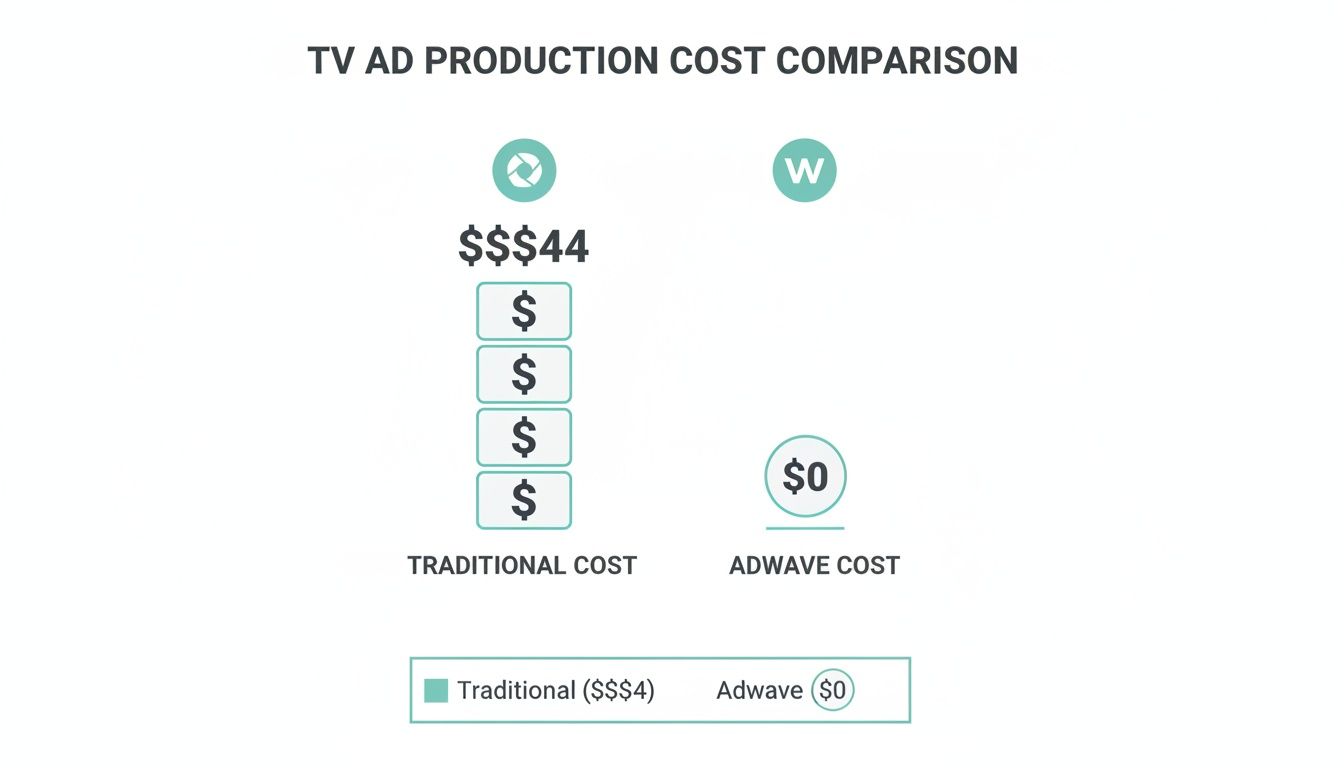
As you can see, Adwave gets rid of that multi-thousand-dollar production hurdle entirely. That means your whole budget goes directly into getting your ad on screen and in front of customers.
This is a critical shift. By offering free ad creation and letting you launch a campaign for as little as $50, Adwave gives you the freedom to test, learn, and scale up without a huge financial gamble. Every single dollar is put to work driving your message home.
Measuring What Matters Most: Your ROI
Impressions are a great start, but they don't keep the lights on. The real goal is to see how those views translate into actual business. So, how do you know if your TV ad is really working? The key is tracking the right signals in real-time.
Thankfully, modern platforms make this simple. You don't need a data science degree; you just need to know what to look for when your campaign is live.
Here are the key performance indicators (KPIs) to keep an eye on:
Website Traffic: Check your analytics for a noticeable jump in website visitors when your commercial is airing. A sudden surge is a fantastic sign that viewers are curious and taking the next step.
Phone Inquiries: Is the phone ringing off the hook? Many businesses see an immediate uptick in calls for quotes or more information right after their campaign launches.
Foot Traffic: If you run a restaurant or a local shop, are more people walking through the door? You can even run a special TV-only offer to directly measure how many customers saw your ad.
With Adwave, you’re not flying blind. The platform’s real-time analytics dashboard shows you exactly how your campaign is performing. You can see when your ad is being shown and connect that directly to the activity you’re seeing on your end. For a deeper dive, check out our guide on effective advertising measurement techniques. This clear line of sight from ad view to customer action is what turns a marketing expense into a profitable investment.
Why Local TV Is More Powerful Than Ever
It’s easy to think that with everyone glued to streaming services, local TV has lost its spark. But that’s a huge misconception. The truth is, local TV is not only surviving, it's evolving into one of the most powerful and flexible advertising tools out there. Major players still invest billions into local television for one simple reason: its incredible credibility and deep roots in the community.
This isn't the local TV you grew up with. The game has changed. Today, a smart local TV campaign doesn't just hit the 6 o'clock news. It reaches people across the entire viewing spectrum, from the folks who never miss their local broadcast to the dedicated "cord-cutters" who live on streaming apps.
The New Definition of Local TV
Think of modern local TV as a complete ecosystem. It blends the tried-and-true power of traditional broadcast with the pinpoint accuracy of digital streaming. This means you can get your message in front of your audience, no matter how they choose to watch.
Traditional Broadcast TV: This is the foundation, your trusted local ABC, NBC, and CBS stations. They are still the #1 source for local news, live sports, and community events, which means they command huge, dedicated audiences.
Connected TV (CTV) and Streaming: This is where services like Hulu, Peacock, and YouTube TV come in, watched on smart TVs and devices. It’s how you connect with viewers who’ve cut the cord and moved beyond traditional cable.
Broadcast and streaming can cover different parts of your audience. Compare their reach and costs when planning a campaign.
A Multi-Billion Dollar Market for a Reason
The staying power of local TV isn't just a hunch; the numbers speak for themselves. In the U.S. alone, local broadcast TV advertising is projected to hit $9.91 billion in 2024, which is a 5.9% jump from the year before. This isn’t just slow and steady growth; it’s a clear sign of its lasting value in the local media scene. You can read more about these industry-wide advertising trends on TV Technology.
For a small business owner, that multi-billion dollar figure should tell you something important. Local TV isn’t some niche strategy. Its power is validated by the massive ad spends from major brands and political campaigns who rely on it to build trust and get people to act.
Adwave: The Bridge to Modern Local TV
So, how do you navigate this new, expanded world of local advertising? That's where a platform like Adwave comes in. We built Adwave specifically for this modern reality, giving small businesses one simple gateway to this entire universe of high-impact ad inventory.
Instead of trying to cut separate deals with every local station and every streaming service, Adwave plugs you right into the system. Our platform intelligently places your ads across more than 100 premium channels (from the broadcast giants to the top-tier streaming apps) to find your ideal customers at the most efficient local tv advertising cost.
This makes Adwave more than a way to save money; it’s a tool designed for growth. We make advertising more accessible, giving local businesses access to the same powerful ad inventory that the big brands use, all without needing a massive budget or an entire media buying team. You get the reach of broadcast and the precision of digital, all in one connected campaign.
Launch Your First Campaign in Minutes
All this talk about costs, metrics, and strategy can feel a bit overwhelming. But what if launching a professional TV ad campaign was easier than ordering a pizza online? Seriously. The old, complicated way of buying media is gone. With a platform like Adwave, you can take all that ambition and turn it into a live television campaign in just a few clicks.
This is the exact opposite of the traditional, drawn-out process. Forget about endless meetings, back-and-forth contract negotiations, or waiting weeks for creative approvals. We designed the entire experience to be fast, intuitive, and totally transparent, putting the full power of TV advertising right in your hands.
Your Four-Step Path to Getting on TV
Getting your business on television with Adwave really boils down to four simple steps. We built it to knock down every traditional barrier (from creative production to media buying) which makes the local TV advertising cost more manageable than ever before.
Here’s exactly how it works:
Provide Your Website URL: This is where the magic starts. Just plug your business's website address into the Adwave platform. Our AI immediately gets to work, scanning your site to understand your brand, grabbing your logo and images, and pinpointing your key marketing messages.
Review Your AI-Crafted Commercial: In just a couple of minutes, you’ll have a professional, broadcast-ready commercial waiting for you. The AI puts together a complete video with a professional voiceover, licensed music, and visuals pulled from your site. All you have to do is watch it and give it a thumbs-up. No creative team or production budget needed.
Set Your Target and Budget: Next, you decide exactly who you want to reach and how much you want to spend. You can get specific, targeting individual zip codes or a radius around your business. Then, you set your campaign budget, you can get started for as little as $50, so you're always in complete control.
Launch and Monitor Your Results: Once your ad is approved and your budget is set, you just hit "launch." Your campaign goes live across top-tier broadcast and streaming channels, reaching customers right in your area. From there, you can track everything in real-time on your dashboard and watch the impressions roll in.
This whole process shows that getting on TV isn't some far-off dream anymore. It’s a real, affordable marketing step you can take today. We built Adwave to open up television advertising for everyone, making sure any business with a goal can tap into this powerful medium.
Frequently Asked Questions
Diving into TV advertising for the first time? It's natural to have questions. Let's walk through some of the most common ones we hear from business owners.
How Much Should a Small Business Budget for a First TV Campaign?
A great way to start is with a "test and learn" mindset. You don't need to bet the farm on your first campaign.
We've found that a starting budget between $500 and $2,000 is the perfect sweet spot. It’s enough to make a real splash and gather meaningful data, but it’s not an overwhelming financial leap. On a platform like Adwave, that's more than enough to get your ad in front of thousands of potential customers right in your service area.
Is Local TV Advertising Still Effective in the Age of Netflix?
It absolutely is. In fact, you could argue it's more powerful now because "local TV" has grown to mean so much more than the nightly news on broadcast channels.
Today, your local audience is also watching ad-supported streaming services like Hulu, Peacock, and YouTube TV. It's all part of the same ecosystem.
Modern advertising platforms like Adwave are built for this new world. They let you tap into a unified inventory, reaching both the traditional TV viewers and the growing wave of "cord-cutters" all in one go. You’re not choosing between them; you’re reaching everyone.
How Long Does It Take to Create and Launch an Ad with Adwave?
This is where things have completely changed. The old way of making a TV ad was a marathon, weeks, sometimes months, of scripts, film crews, and endless back-and-forth.
With Adwave, we've turned that marathon into a sprint. Our AI-powered tools can help you generate, review, and launch a broadcast-ready ad in just a few minutes. Seriously. All you need is your website URL to get the ball rolling.
Can I Target a Specific Neighborhood or Just My Whole City?
You can get as granular as you want. The old days of paying to advertise across an entire metro area, hitting viewers miles outside your actual service radius, are long gone.
Today's platforms give you incredible control. You can pinpoint specific zip codes or even draw a custom circle around your storefront. This means every single ad dollar is spent reaching people who can become your customers, which is the key to getting a great return on your investment.


