
Before you spend a single dollar on ads, let's get the groundwork right. The most common mistake I see agents make is jumping straight to ad creation without a clear plan. That's like trying to build a house without a blueprint, it's expensive, messy, and rarely works out.
A solid advertising strategy is built on three pillars: knowing exactly who you're talking to, understanding what makes your property special, and setting goals you can track. Get this right, and every ad you run will be laser-focused on bringing in qualified leads.
Building Your Real Estate Advertising Foundation
Think of this initial planning stage as your competitive edge. The real estate advertising market is crowded and only getting more so, it's projected to hit USD 56.51 billion by 2032. Just throwing money at ads won't cut through that noise. A strong, thoughtful foundation will.
Define Your Ideal Buyer Persona
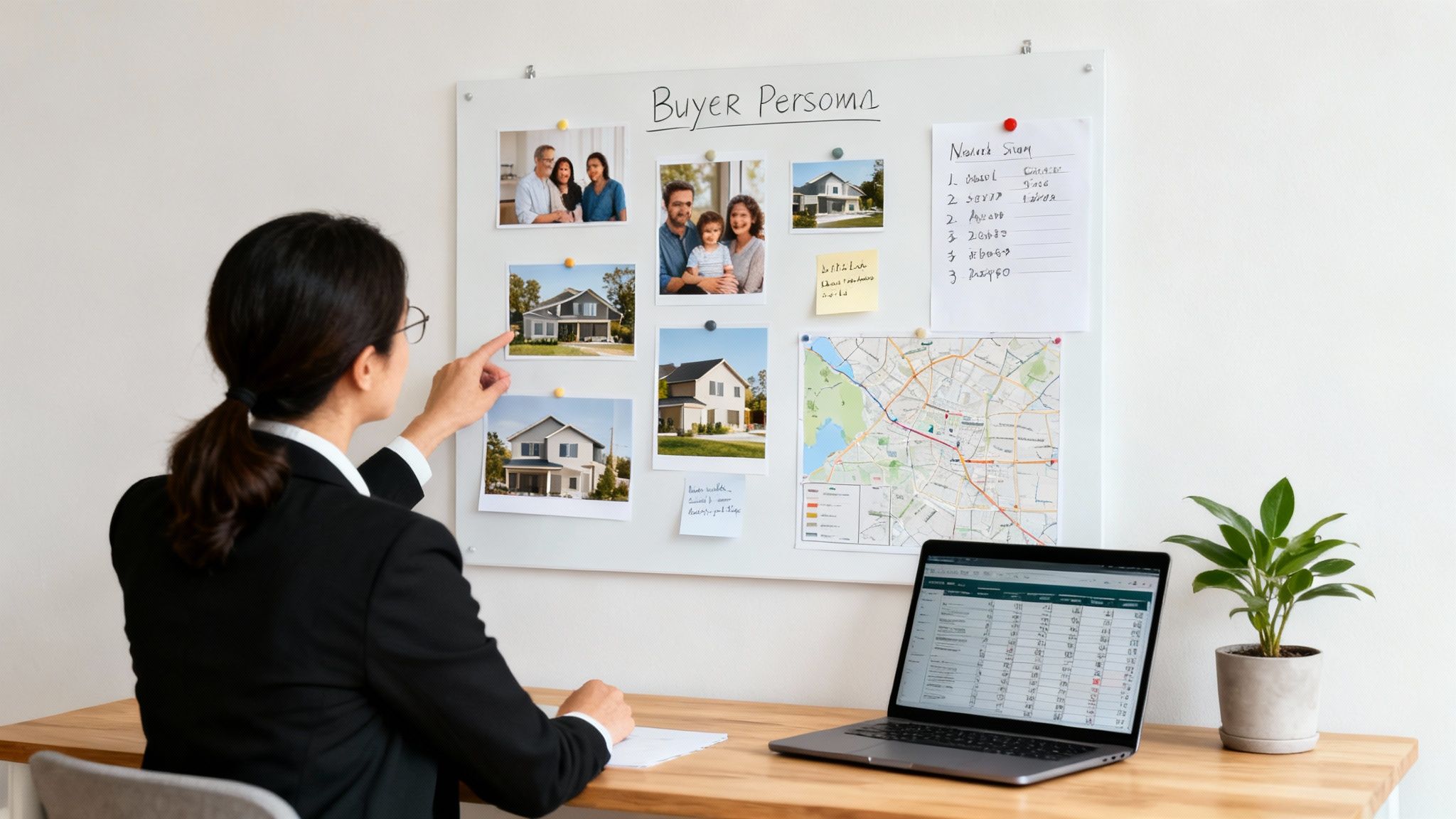
Define the buyers you want to reach. A buyer profile brings together their housing needs, budget, preferred area, and likely timeline. Use those details to choose the message, images, and places where you advertise.
Don't just target "couples aged 30-40." That's too vague. Get specific and create a persona like "The Aspiring Suburban Family."
Who they are: Meet Sarah and Tom, both 35. They have a toddler, another baby on the way, and are currently squeezed into a two-bedroom apartment downtown.
What they want: They're dreaming of more space, a safe neighborhood, a backyard for the kids to play in, and great schools.
What they're worried about: Their current apartment feels claustrophobic, the city noise is a constant stress, and the whole home-buying process feels overwhelming.
Armed with this persona, your advertising suddenly has a purpose. You can craft ads that speak directly to their anxieties and aspirations, showing off a home’s huge family room or pointing out its proximity to a top-rated elementary school.
The goal is to move from selling a property’s features (e.g., "3 bedrooms, 2 baths") to selling a solution to your buyer’s life stage (e.g., "Room for your growing family, just steps from the park").
Craft a Compelling Value Proposition
Now that you know who you're talking to, you need to figure out what to say. What makes this specific property the answer to their problems? This is your Unique Value Proposition (UVP). It’s the one clear, punchy statement that screams, "This is why you should choose this home."
A weak, generic UVP sounds like this: "Beautiful home in a great area." It's forgettable.
A strong, specific UVP grabs attention: "The only move-in-ready home in the school district with a fenced-in yard for under $500k." See the difference?
To really sharpen your modern advertising strategy, it's worth looking into technology that can give you a leg up. Exploring the best AI tools for real estate agents can help you automate tasks and find new ways to connect with buyers.
Mastering Digital Channels for Maximum Reach
Think of your online presence as a 24/7 open house. If you're not showing up where buyers are already looking, you're effectively invisible to most of the market. Getting real estate advertising right online means zeroing in on the channels that move the needle and deliver results you can see.
The numbers don't lie, digital is non-negotiable. With 78% of property searches kicking off on a search engine, your visibility on Google is everything. In fact, organic search alone accounts for a staggering 51% of all real estate website traffic. That tells you just how critical a solid online foundation is.
Dominate Local Search with SEO
When a potential buyer types "three-bedroom homes in the Northwood neighborhood" into Google, you need to be there. That's the magic of local Search Engine Optimization (SEO). It's not about ranking for some generic, nationwide term; it's about owning the search results in your specific farm areas.
Start by digging into your website and property pages. Weave in location-specific keywords that real people use. Think like a buyer:
"Family homes near Lincoln Park Elementary"
"Downtown condos with a view"
"New construction in the 90210 zip code"
And don't forget your Google Business Profile. Keep it polished with high-quality photos, the right contact info, and a steady stream of positive client reviews. This does more than help your local search ranking, it builds instant trust with people who find you online.
Drive Immediate Traffic with PPC Ads
While SEO is the long game, Pay-Per-Click (PPC) advertising on platforms like Google Ads gets you in front of people right now. You can literally place your listings at the top of the page the moment a motivated buyer is searching.
The real strength of PPC is how ridiculously specific you can get with targeting. Imagine running an ad for a new listing that only shows up for people searching within a 10-mile radius who are also using keywords related to moving. This kind of precision makes every dollar you spend count by hitting only the most qualified audience.
Pro Tip: Don't lump all your properties into one ad campaign. A luxury downtown penthouse needs completely different ad copy and keywords than a starter home in the suburbs. Create separate ad groups for different property types, it will absolutely boost your click-through rates.
Connect with Buyers on Social Media
Social media platforms like Facebook and Instagram have become powerful for real estate agents, mainly because their audience targeting is so sophisticated. You can go way beyond basic demographics and aim for people experiencing major life events.
For instance, you could create an ad for a family-friendly home and target users who are "newly married," "expecting a child," or have recently shown interest in parenting content. This lets you connect with buyers right as their housing needs are actively changing. If you're looking to get an edge, exploring how AI for Real Estate Marketing is changing the game can help you automate tasks and get even more from these platforms.
Paid ads are just one piece of the puzzle. It's time to get serious about your video strategy. Short, snappy video tours on Instagram Reels can generate fantastic organic reach. And don't sleep on emerging channels like streaming services. To get a better handle on this, check out our guide on what is Connected TV advertising.
Crafting Visuals That Sell a Story, Not Just a House

People don't buy four walls and a roof; they buy a vision of their future life. Your job is to paint that picture for them, and nothing accomplishes that faster or more effectively than powerful visuals. Professional photos are table stakes these days, but it's video that captures a home’s soul and tells a story that static images simply can’t.
This isn’t just a hunch, the data backs it up. Listings that incorporate video see a staggering 400% more inquiries compared to those relying on photos alone. That number should tell you everything you need to know about how serious buyers engage with properties online. Want to dive deeper? Check out more key real estate marketing statistics for 2025 on photoup.net.
Move Beyond Still Photos With High-Impact Video
A picture might be worth a thousand words, but a video tour is worth a thousand pictures. You're not just showing what a room looks like; you're showing what it feels like to be there. Think of it as creating a short film where the buyer gets to be the star.
A high-quality walkthrough video is your foundation. This is where you guide potential buyers through the home's layout, showing the natural flow from the front door to the master suite. Keep the camera work smooth, make sure the lighting is bright and inviting, and linger on the details that sell a lifestyle, like the morning sun pouring into a breakfast nook or the spacious back deck just waiting for a summer cookout. You want viewers to feel like they’re already home.
The true scale and layout of the property.
The home's position relative to parks, schools, or the waterfront.
The unique character and beauty of the surrounding neighborhood.
These sweeping shots add a layer of prestige and provide important context that you can never get from the ground.
Expert Tip: The perfect combo is an intimate walkthrough video paired with expansive drone footage. You're not just marketing a house; you’re selling a specific lifestyle, a prime location, and a deep sense of belonging.
Use Immersive Virtual Tours to Build Trust
In today's market, buyers are often house-hunting from hundreds of miles away. This is where 360-degree virtual tours have become absolutely essential. They offer an interactive experience that builds a tremendous amount of trust and helps weed out anyone who isn't a serious contender.
When a potential buyer spends 20 minutes clicking through every room in your virtual tour, they've essentially given themselves a private showing. This empowers them to explore the space on their own terms, at any time of day, and it means the leads who do reach out are far more qualified and interested.
Write Listing Descriptions That Complete the Picture
Your visuals are the main event, but your listing description is the important supporting narrative. It provides the context and emotional connection that your photos and videos can't do on their own.
Stop listing features and start describing benefits. Don't just say, "large backyard." Instead, try: "a sprawling backyard with plenty of room for summer barbecues and a future swing set." See the difference? That second version helps your "Aspiring Suburban Family" persona instantly imagine their life unfolding in that space. You can even borrow storytelling techniques from other mediums, understanding what makes a good TV commercial can give you great ideas for crafting more compelling copy.
Integrating Traditional Methods for a Holistic Campaign
As powerful as your digital strategy is, a seasoned agent knows real estate is, and always will be, a local game. You can’t just live online. Weaving proven traditional methods into your marketing mix is how you dominate a farm area and build a brand presence that a screen simply can't replicate. The real magic happens when your offline and online efforts work in concert, creating a powerful echo effect.
Use consistent branding in your social ads, property signs, and mailers so buyers can recognize your business when they search for an agent.
Modern Direct Mail That Gets Noticed
Let's be clear, this isn't about blanketing a zip code with generic junk mail. The days of spray-and-pray are over. Today’s direct mail is all about precision targeting and delivering real, immediate value. Your goal is to make your piece feel like a helpful update, another ad destined for the recycling bin.
Get granular. Focus on a specific neighborhood or even a single street. Instead of a basic "Just Listed" announcement, offer something they can use.
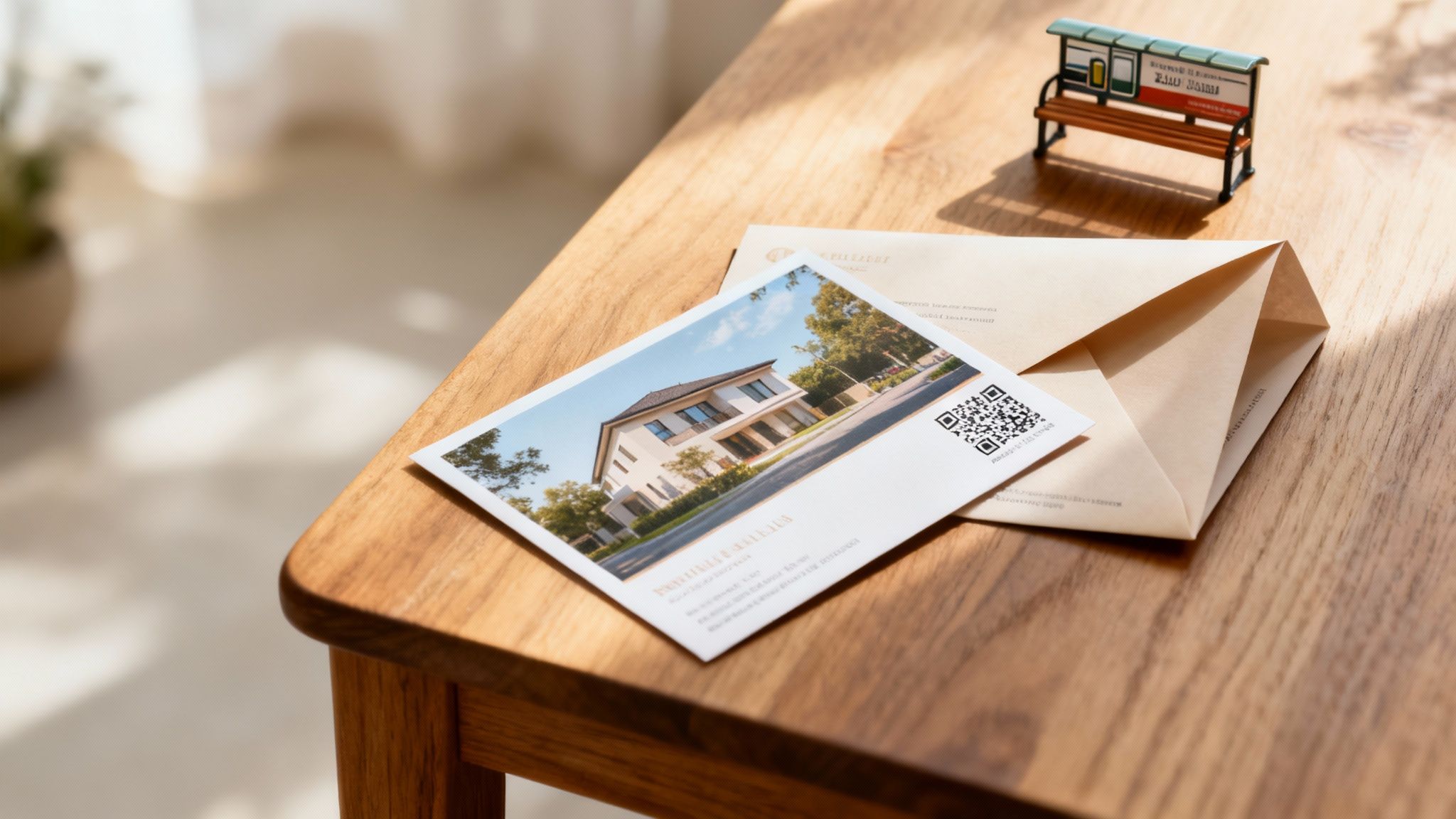
Neighborhood Market Updates: Send a sharp-looking postcard with recent sales data and a simple CTA like, "Curious what your home is worth? Scan here for a free valuation."
Hyperlocal Content: Did you just sell a unit in a popular condo building? Send a mailer to every other owner in that building showing your success.
Event Invitations: Use postcards to personally invite neighbors to an open house or a free homebuyer seminar you're hosting nearby.
Here’s the most critical part: every single mail piece must include a QR code. This is non-negotiable. That code has to lead directly to something valuable online, a stunning virtual tour of the property, a detailed neighborhood guide on your blog, or a landing page to download a first-time homebuyer's checklist.
By connecting your postcard to a digital experience, you're not just sending an ad. You're opening a door to your online ecosystem where you can track who’s interested and continue the conversation.
Strategic Local Print and Outdoor Advertising
While the big city newspapers may not have the pull they once did, niche local publications are often thriving. I'm talking about community magazines, neighborhood newsletters, or those glossy lifestyle publications that everyone in a certain part of town reads. Placing a well-designed ad here positions you as the go-to expert for that specific community.
Likewise, Out-of-Home (OOH) advertising gives you a constant, physical brand reminder in the real world. Big highway billboards can get pricey, but there are smarter, more affordable ways to get that same local saturation.
Bus bench ads placed near popular grocery stores or parks.
Sponsorship banners at the local little league field or farmers' market.
Small ads on the bulletin board at the most popular coffee shop in the neighborhood.
Local events, referrals, and printed materials can support your digital campaigns by making your business familiar in the community.
Measuring Success and Optimizing Your Ad Spend
Advertising without tracking your results is really just gambling with your marketing budget. To get a real handle on how to advertise effectively, you need to approach your campaigns less like an art project and more like a science experiment. You test, you measure, you analyze, and then you refine. This simple loop removes the guesswork and makes sure every dollar is working hard to bring you qualified leads.
You don't need a PhD in data science to get started, either. Most of the important information you need is right there inside your social media ad managers and your Google Ads dashboard. The trick is knowing which numbers matter and what story they're telling you about your strategy.
Identifying Your Key Performance Indicators
It's easy to get distracted by "vanity metrics" like likes or raw impressions. Sure, they might make you feel good, but they don't tell you if your ads are moving the needle for your business. Instead, your focus should be laser-sharp on the Key Performance Indicators (KPIs) that connect your ad spend directly to tangible outcomes.
For just about any campaign you run, these are the core metrics you'll want to watch:
Click-Through Rate (CTR): This is simply the percentage of people who saw your ad and were compelled enough to click. A strong CTR is a great sign that your creative (your images, video, and copy) is hitting the mark.
Cost Per Click (CPC): This tells you exactly how much you're paying for each of those clicks. The goal here is a constant balancing act: keeping your CPC low without sacrificing the quality of the audience you're reaching.
Cost Per Lead (CPL): This is the big one. It's the total cost to get one person to fill out a form, call you, or sign up for a showing. This metric gives you the clearest picture of your advertising's financial return.
Conversion Rate: Of all the people who clicked your ad and landed on your page, what percentage took the action you wanted? That's your conversion rate.
Your CPL is your north star. If a Facebook campaign is bringing in leads for $25 a pop, but a similar campaign on Google is costing you $75 per lead, you have a clear, data-backed reason to shift more of your budget over to Facebook.
Using Your Campaign Results
Which ad creative is pulling in the highest CTR? Is a specific audience segment delivering a much lower CPL? Are your video ads outperforming static images for that new condo listing? Answering these questions is how you systematically improve your results over time.
For instance, you might notice that an ad campaign targeting "first-time homebuyers" has a CPC that's half the cost of your ad targeting "luxury buyers." That's a powerful insight. It might signal an opportunity to double down on starter homes or rethink your approach to the high-end market.
This constant process of analyzing and optimizing is the core of effective marketing. It's how you master advertising effectiveness measurement and maximize your return. By consistently tracking these KPIs, you stop just spending money on ads and start strategically investing in a predictable lead generation machine. This data-driven mindset is what separates the top-performing agents from everyone else.
Your Actionable 90-Day Real Estate Advertising Plan
Knowing the theory is one thing, but putting it into practice is what sells houses. I've broken down how to get your real estate advertising off the ground into a simple, high-impact 90-day plan. Don't think of this as a sprint; it's a roadmap for building real marketing momentum, one month at a time.
This isn't about doing everything at once. It's about layering your efforts strategically to build a system that consistently brings in quality leads.
Month 1: Laying the Foundation (Days 1-30)
Your first 30 days are all about getting the fundamentals right. This is the time to polish your digital storefront and launch a small, focused campaign to start learning what works without breaking the bank. The goal here is quick wins that set you up for bigger things.
Here’s where to start:
Polish Your Profiles: Do a full audit of your online presence. That means your Zillow profile, your Google Business Profile, and your main social media accounts. Make sure your headshot is professional and current, all contact info is correct, and you've got at least 10 recent client testimonials front and center.
Launch a Single, Hyper-Targeted Ad: Pick one key listing to feature. Create a single ad campaign on a platform like Facebook and get laser-focused on your audience. Think "renters aged 28-35 in zip code 90210 with an expressed interest in mortgages." A modest budget of $10-15 per day is all you need to dip your toes in the water.
Month 2: Expand and Experiment (Days 31-60)
With a baseline established, it's time to get a little more creative and see what resonates. This month is about adding video into the mix and experimenting with your messaging. You’re trying to figure out what really grabs the attention of local buyers and sellers.
Your next moves:
Shoot Your First Video Tour: You don't need a Hollywood production crew. Grab your smartphone and a simple stabilizer and film a 90-second walkthrough of a new listing. Focus on the home's best features, the flow of the space, and the natural light.
A/B Test Your Ad Copy: Take that initial Facebook ad and duplicate it. Use the same photo or video, but write a completely different headline and description. For example, one version might focus on features ("Gourmet Kitchen with New Quartz Countertops!"), while the other sells a feeling ("Imagine Hosting Thanksgiving Dinner Here").
The whole point of this is to let the market tell you what it wants. Don't guess which ad will win. Run the test, look at the numbers, and let the data show you which message gets more clicks for less cash.
Month 3: Analyze and Scale (Days 61-90)
The final month of this initial push is all about making smart, data-driven decisions. It's time to look back at the results from your first 60 days, cut what isn't delivering, and confidently put more budget behind your winning strategies.
This is how you build a smarter plan for the next quarter. The process is a simple feedback loop: gather data, analyze it, and then optimize your approach.
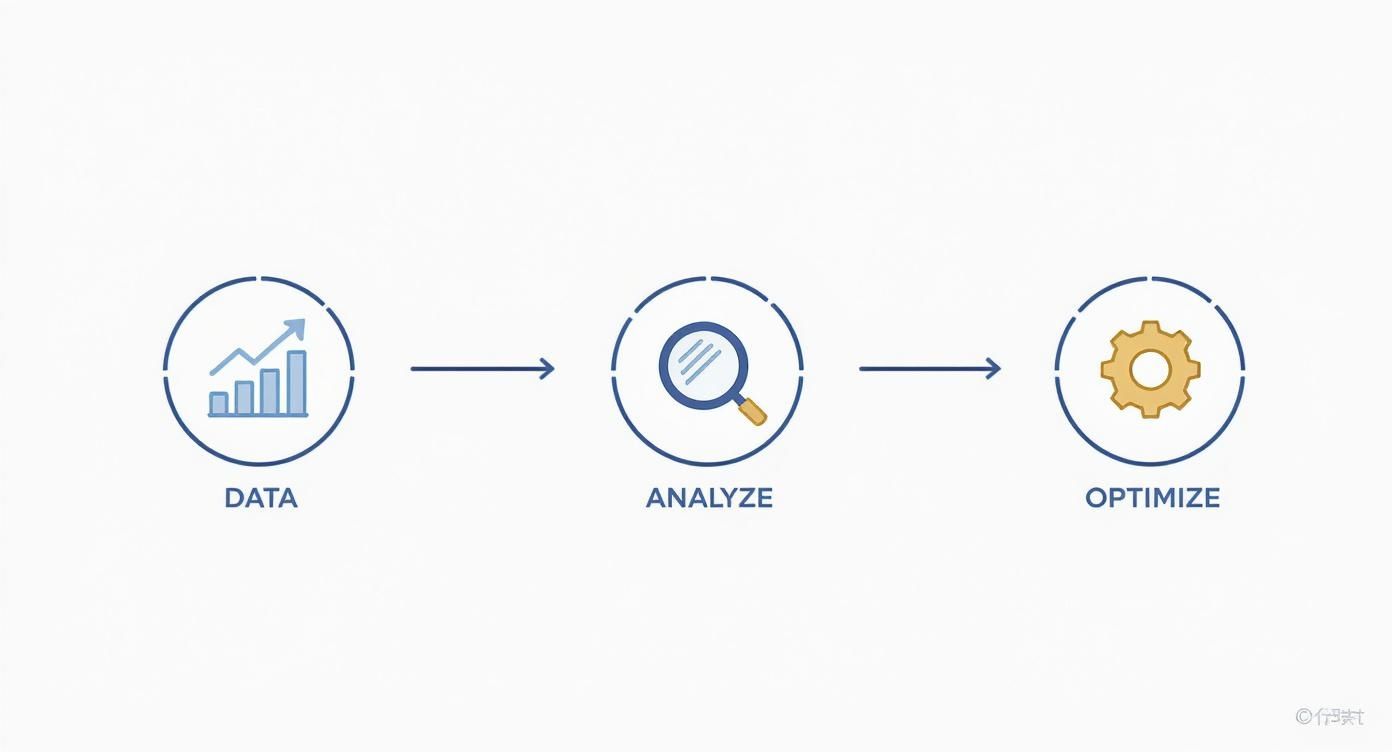
This method ensures you're not just spending money, you're investing it where you know it will get a return. By the end of this 90-day period, you’ll have a proven, repeatable advertising model that you're ready to scale up.
Common questions answered
How Much Should I Budget for Advertising?
This is the million-dollar question, isn't it? While there's no single magic number, I’ve found a couple of reliable rules of thumb that work for most agents.
If you’re just starting out or budgeting for a single listing, a good benchmark is to set aside 10% of your expected commission for that specific property. For those with a more established business, think bigger picture. Most seasoned agents I know allocate somewhere between 5-10% of their total annual gross commission income to all marketing and advertising efforts.
Tying your budget directly to your revenue like this keeps your spending sustainable. As your business grows, your ad budget grows with it. Simple as that.
Which Social Media Platform Is Best?
This one's easy: go where your buyers are. The "best" platform changes depending on who you're trying to reach and what kind of property you're listing.
Here's my breakdown from years in the trenches:
Facebook: Still the champ for reaching a wide audience. Its targeting is powerful for everything from starter homes for first-time buyers to properties in specific school districts.
Instagram: It’s all about the visuals here. If you have a listing with knockout photography (think luxury homes, new builds with modern flair, or anything with a unique aesthetic) this is your playground.
LinkedIn: Don't sleep on LinkedIn. It’s my go-to for commercial properties or when I'm targeting high-net-worth professionals and corporate relocation clients. The audience is right there.
My best advice? Pick one platform your ideal client lives on and master it. Spreading yourself too thin across three or four channels just dilutes your efforts. Dominating one will always beat dabbling in many.
When Should I Start Advertising a New Listing?
I always run a "Coming Soon" campaign to stir up interest. Start teasing the property on your chosen social channel 3-5 days before it hits the market. This little trick builds a sense of urgency and can line up a whole list of eager buyers before you even open the door for the first showing. You want a flood of requests on day one to build that important momentum from the start.


