
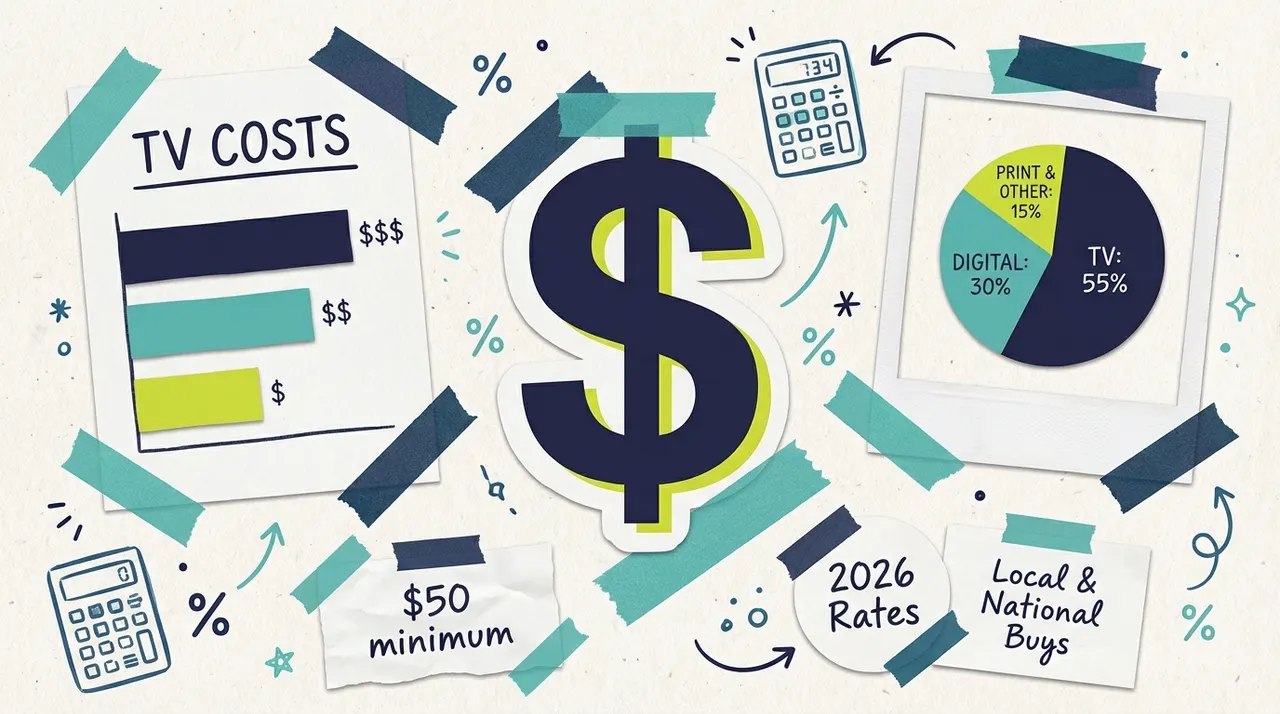
Every campaign manager asks the same question: How much should we spend on advertising? The answer depends on your race, your market, and when you plan to run ads.
The 2026 midterms will see $10.8 billion in political ad spending according to AdImpact projections. That number can overwhelm smaller campaigns, but understanding the actual costs reveals opportunities at every budget level.
This guide breaks down what political advertising costs in 2026 across every major channel, with specific guidance for campaigns from school board to Senate.
The 2026 political advertising market
Before discussing specific costs, understand the market forces affecting pricing.
Supply and demand dynamics
Political advertising operates on scarcity. There are only so many ad slots available, and demand peaks before elections:
January-June: Lower demand, competitive pricing
July-August: Moderate demand, rising prices
September: High demand, premium pricing
October-November: Peak demand, highest rates
During the final weeks before Election Day, rates can increase 200-300% above baseline. Federal candidates get some protection through lowest unit rate rules on broadcast TV, but PACs, issue campaigns, and state/local races pay market rates.
Market size impact
Your market size dramatically affects costs:
Top 10 DMAs (New York, LA, Chicago, etc.) - Most expensive, often impractical for local races. Even local candidates must compete for inventory with national advertisers paying premium rates.
Mid-size markets (Denver, Portland, Charlotte) - Moderate costs, good reach. These markets offer the best value for statewide and congressional campaigns with reasonable cost-per-voter efficiency.
Small markets (regional, rural) - Most affordable, best for local races. Lower competition means better negotiating position and more flexible scheduling.
A 30-second prime-time broadcast spot in New York might cost $50,000. The same spot in a small market might cost $500. Same ad, 100x price difference. This reality makes broadcast TV essentially impossible for local races in major metros.
Battleground state premiums
Competitive states see dramatically higher costs during election years. Swing states like Georgia, Arizona, Michigan, Pennsylvania, Wisconsin, and Nevada experience advertising rate increases of 50-100% compared to non-battleground states. Federal and statewide campaigns in these states should budget significantly higher than national averages.
Broadcast TV advertising costs
Broadcast TV (ABC, CBS, NBC, Fox affiliates) remains powerful for reach but carries the highest costs.
Cost factors
Market size: Primary cost driver - the difference between major and small markets can be 50-100x
Daypart: Prime time (8-11 PM) costs most, with evening news often providing the best value for political campaigns due to engaged viewership
Program: High-rated shows command premiums - a spot during NFL games or popular dramas costs 3-5x a comparable time slot on lower-rated programming
Timing: Rates increase near elections, with the final weeks before Election Day commanding peak pricing
Advertiser type: Federal candidates get lowest unit rates; PACs and issue campaigns pay full market rates
2026 broadcast rate estimates
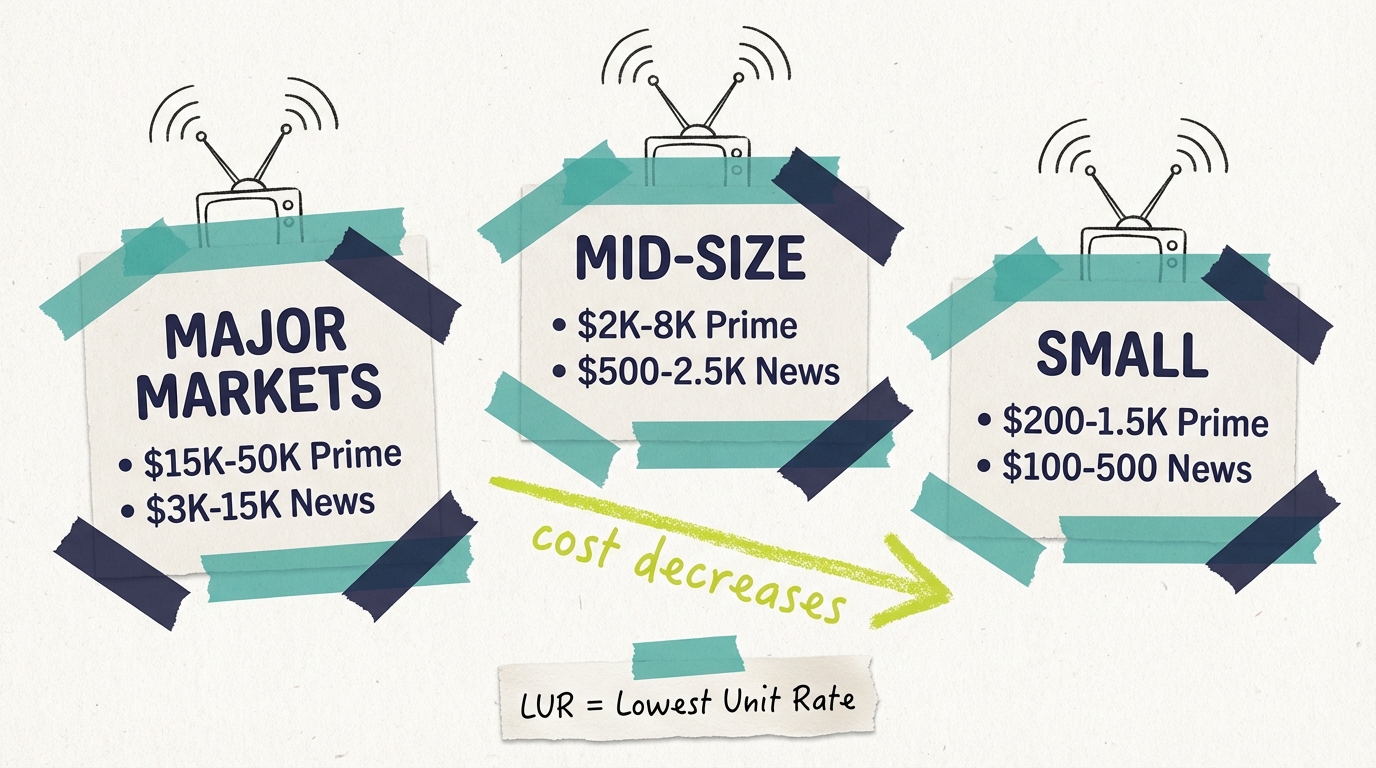
Major markets (New York, LA, Chicago):
Prime time (30 sec): $15,000-50,000+
Evening news: $3,000-15,000
Morning shows: $1,500-8,000
Daytime: $500-3,000
Mid-size markets (Denver, Phoenix, Charlotte):
Prime time: $2,000-8,000
Evening news: $500-2,500
Morning shows: $300-1,500
Daytime: $100-500
Small/regional markets:
Prime time: $200-1,500
Evening news: $100-500
Morning shows: $50-300
Daytime: $25-150
Lowest unit rate (LUR)
Federal candidates benefit from the FCC's lowest unit rate rule during specific windows:
45 days before a primary election
60 days before a general election
During these periods, stations must offer federal candidates the lowest rate charged to any advertiser for the same class and amount of time. This can mean 30-50% savings compared to PAC or issue campaign rates.
However, LUR has limitations:
Only applies to federal candidates (not state/local)
Only applies to broadcast and cable (not streaming)
Requires candidates to appear in or voice the ad
"I approve this message" disclosure required
PACs, Super PACs, and issue campaigns pay full market rates without LUR protection.
Cable TV advertising costs
Cable networks offer more targeting flexibility than broadcast at lower entry points.
Zone-based buying
Cable systems divide coverage areas into zones, allowing geographic targeting:
Full system buy: Reach entire cable footprint
Zone buy: Target specific geographic areas
Interconnect: Coordinate across multiple systems
Zone buying adds 10-25% to base rates but reduces waste for targeted races.
2026 cable rate estimates
Cable pricing uses CPM (cost per thousand viewers) more often than fixed spot rates:
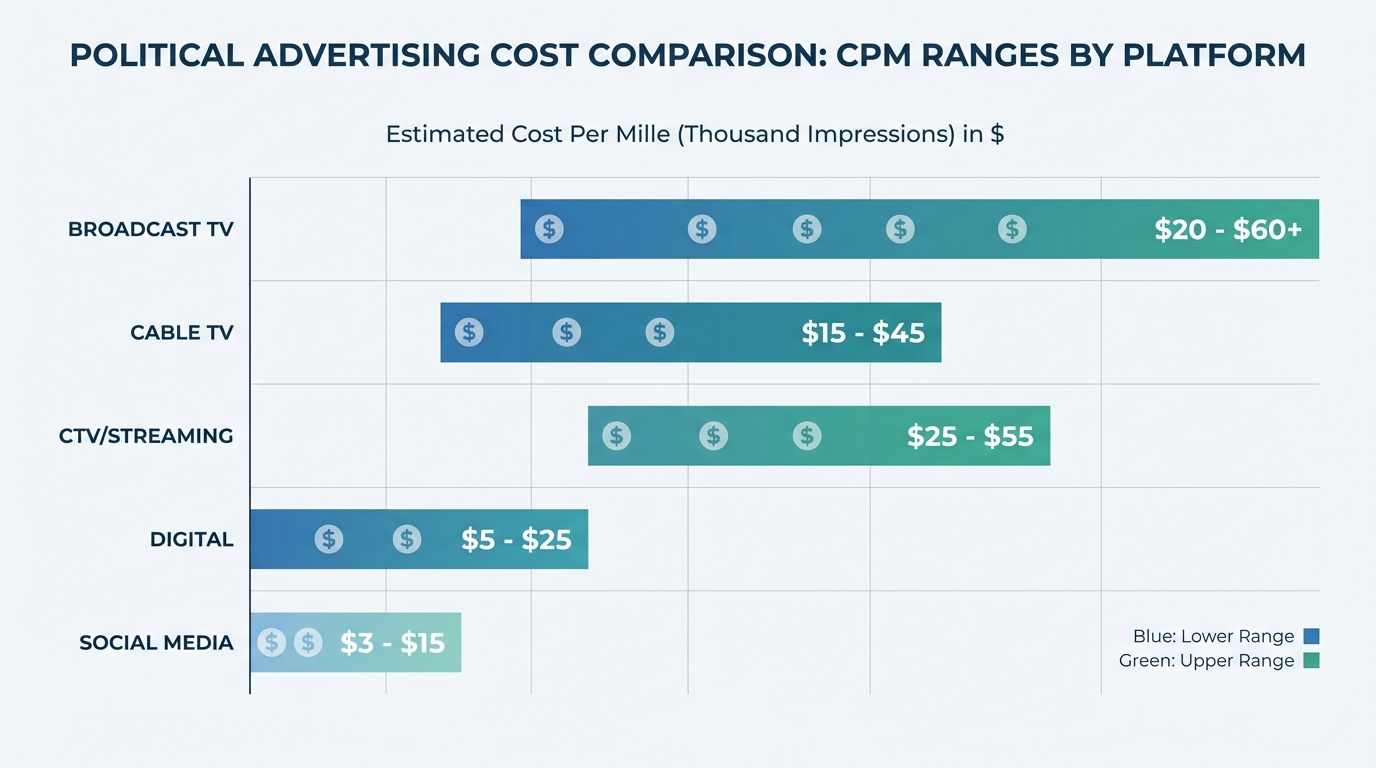
National cable networks: $10-30 CPM
Regional sports networks: $20-50 CPM
Local cable zones: $5-15 CPM
For a mid-size market, expect:
30-second rotation: $50-300 per spot
Targeted zone buy: $75-400 per spot
News-specific placement: $100-500 per spot
Minimum commitments
Cable typically requires minimum monthly spends:
Small markets: $2,000-5,000/month
Mid-size markets: $5,000-15,000/month
Large markets: $15,000-50,000/month
These minimums can exclude smaller campaigns from cable entirely.
Connected TV and streaming costs
CTV has transformed political advertising by making TV accessible to campaigns of all sizes.
The CTV advantage
Connected TV advertising offers unique benefits for political campaigns:
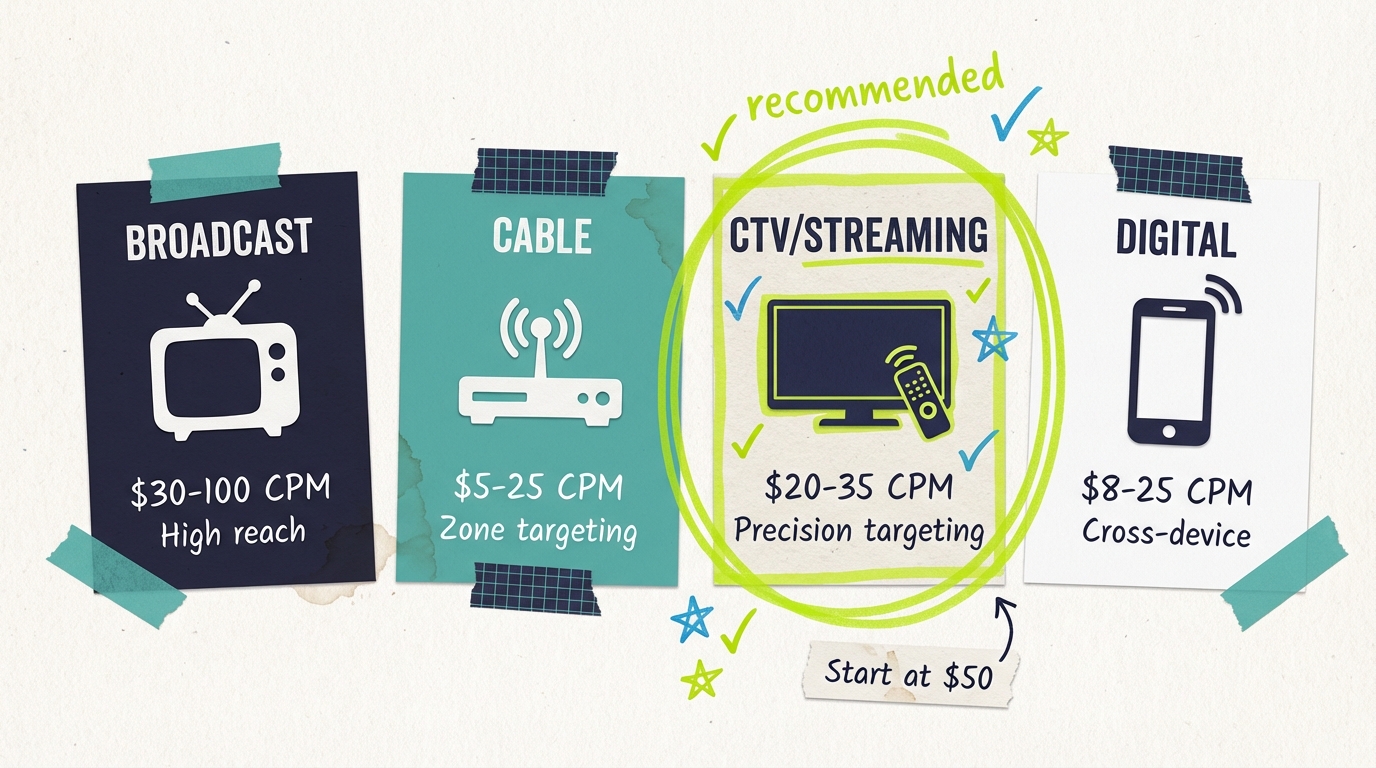
Lower entry points: Start campaigns at $50 (on platforms like Adwave) compared to $5,000+ minimums on traditional TV. This opens TV advertising to school board candidates, city council races, and other down-ballot campaigns that broadcast TV has always excluded.
Precision targeting: Geographic targeting down to zip code or district level, plus demographic (age, income, education), and behavioral targeting (viewing habits, interests). Reach exactly the voters you need without waste.
Measurable results: Track impressions delivered, video completion rates, website visits, and even conversions. Know exactly what your advertising accomplished rather than guessing based on GRPs.
Premium inventory: Your ads run alongside major network content on Hulu, Peacock, Paramount+, Roku, and other premium streaming services. Same quality content environment as broadcast TV, with better targeting.
No minimums: Scale from small tests to major buys directly. Run a $500 test, learn what works, then scale to $50,000 - all on the same platform.
Rapid deployment: Unlike broadcast TV which requires weeks of lead time, CTV campaigns can launch in days or even hours - critical for rapid response advertising.
2026 CTV rate estimates
CTV pricing is primarily CPM-based:
Premium inventory (Hulu, Peacock, Paramount+): $25-45 CPM
Mid-tier inventory (Roku, Samsung TV+): $18-30 CPM
FAST channels (Tubi, Pluto TV): $12-22 CPM
Programmatic mix: $20-35 CPM average
At $25 CPM, a $5,000 budget delivers 200,000 impressions - potentially reaching every household in a small congressional district multiple times.
Political CTV inventory considerations
Not all CTV inventory is equal for political campaigns:
Brand-safe environments: News, sports, entertainment
Political restrictions: Some platforms limit political ads near elections
Frequency management: Avoid oversaturation to prevent voter fatigue
Geographic precision: District-level targeting for efficiency
Platforms like Adwave specialize in political CTV campaigns, handling compliance, targeting, and creative production in one platform.
Digital and social media costs
While this guide focuses on TV, digital channels complement TV advertising.
Digital video advertising
YouTube: $10-25 CPM (skippable), $15-35 CPM (non-skippable)
Meta (Facebook/Instagram): $8-25 CPM for video
Programmatic display: $3-10 CPM
Native video: $10-20 CPM
Digital video extends TV campaigns across screens but typically delivers lower engagement than premium CTV.
Social media advertising
Facebook/Instagram ads: $0.50-3.00 per click; $5-15 CPM
Twitter/X ads: $1-4 per engagement; $8-20 CPM
TikTok ads: not available for political campaigns. See TikTok’s advertising policy.
LinkedIn ads: not available for political campaigns. See LinkedIn’s advertising policy.
Note: Social platforms have varying policies on political advertising. Meta requires extensive verification. TikTok bans political ads entirely. Always verify current policies before planning social campaigns.
Production costs
Beyond media placement, campaigns must budget for ad creation.
Professional production costs
Full production TV commercial:
Concept and scripting: $2,000-10,000
Production crew and equipment: $5,000-50,000
Talent (actors, voice-over): $1,000-25,000
Post-production and editing: $2,000-15,000
Total range: $10,000-100,000+
Simpler production options:
Talking-head video (candidate speaking): $2,000-8,000
Stock footage with voice-over: $3,000-10,000
Testimonial ads: $3,000-15,000
Low-cost production alternatives
DIY smartphone production: $0-500 Quality smartphones can capture broadcast-quality video. Add a lavalier mic ($50-100), basic lighting, and you can produce passable ads for local races.
AI video generation: $0-100 Platforms like Adwave include AI-generated video ads in their service. Describe your campaign and AI creates professional video content - eliminating production costs entirely for budget-conscious campaigns.
Student/freelance production: $500-3,000 Local film students or freelance videographers offer affordable alternatives to full production houses.
Disclosure graphics
All political ads require sponsor identification. Budget for:
"Paid for by" graphics: $100-500
"I approve this message" audio/visual: $200-500
Compliance review: $0-500 (some platforms include this)
Production costs can exceed media costs for smaller campaigns. A $5,000 CTV campaign with $15,000 production costs means only 25% of spend reaches voters. AI tools and simpler production approaches help shift more budget to actual advertising.
Radio advertising costs
Radio remains relevant for local reach and specific demographics.
2026 radio rate estimates
Major markets:
Drive time (AM/PM rush): $200-800 per 30-second spot
Midday: $75-300
Evenings/weekends: $50-200
Small/regional markets:
Drive time: $25-150
Midday: $15-75
Evenings/weekends: $10-50
Radio offers frequency at affordable rates but lacks the visual impact and targeting precision of TV and digital.
Budget allocation by race type
How much you spend and where depends on your race level.
Federal races (Senate/House)
Typical media budgets: $500,000-20,000,000+
Suggested allocation:
Broadcast TV: 30-40%
Cable TV: 10-15%
CTV/Streaming: 20-30%
Digital/Social: 15-25%
Radio: 5-10%
Competitive Senate races in large states can spend $50-100 million on advertising. House races in expensive markets may require $3-5 million to be competitive.
State races (Governor, AG, Legislature)
Typical media budgets: $100,000-5,000,000
Suggested allocation:
Broadcast TV: 20-35%
Cable TV: 10-15%
CTV/Streaming: 25-35%
Digital/Social: 20-30%
Radio: 5-10%
Statewide races (Governor, AG) skew toward broadcast for reach. State legislature races often skip broadcast entirely for CTV efficiency.
Local races (City, County, School Board)
Typical media budgets: $5,000-100,000
Suggested allocation:
Broadcast TV: 0-10%
Cable TV: 0-15%
CTV/Streaming: 40-60%
Digital/Social: 30-40%
Radio: 5-15%
For most local races, CTV and digital deliver the best results. Broadcast TV often wastes budget reaching voters outside your district. Local political advertising works best with precise targeting.
PACs and issue campaigns
Typical media budgets: $100,000-50,000,000+
Suggested allocation:
Broadcast TV: 35-50%
Cable TV: 10-20%
CTV/Streaming: 20-30%
Digital/Social: 15-25%
PACs often invest heavily in broadcast TV for maximum reach and frequency, especially for negative advertising. Without LUR protection, PACs pay premium rates but can run harder-hitting content than candidates.
Building your campaign budget
Start with these questions to shape your advertising budget.
Assess your race
What level is your race? Federal, state, or local determines baseline costs.
How large is your district/market? Geographic scope affects media costs dramatically.
How competitive is your race? Competitive races require higher spending for share of voice.
Who is your opponent? Incumbent advantages may require higher challenger spend.
What's your total campaign budget? Advertising typically consumes 40-70% of total campaign resources.
Calculate baseline needs
Reach calculation example:
A congressional district with 300,000 households:
Goal: Reach 60% of households 10 times
Required impressions: 300,000 x 0.60 x 10 = 1,800,000
At $25 CPM: 1,800,000 / 1,000 x $25 = $45,000
This baseline ignores market premiums, timing surcharges, and competitive considerations. Real budgets often run 2-3x the mathematical minimum.
Phase your spending
Most campaigns can't sustain advertising for months. Phase your spend:
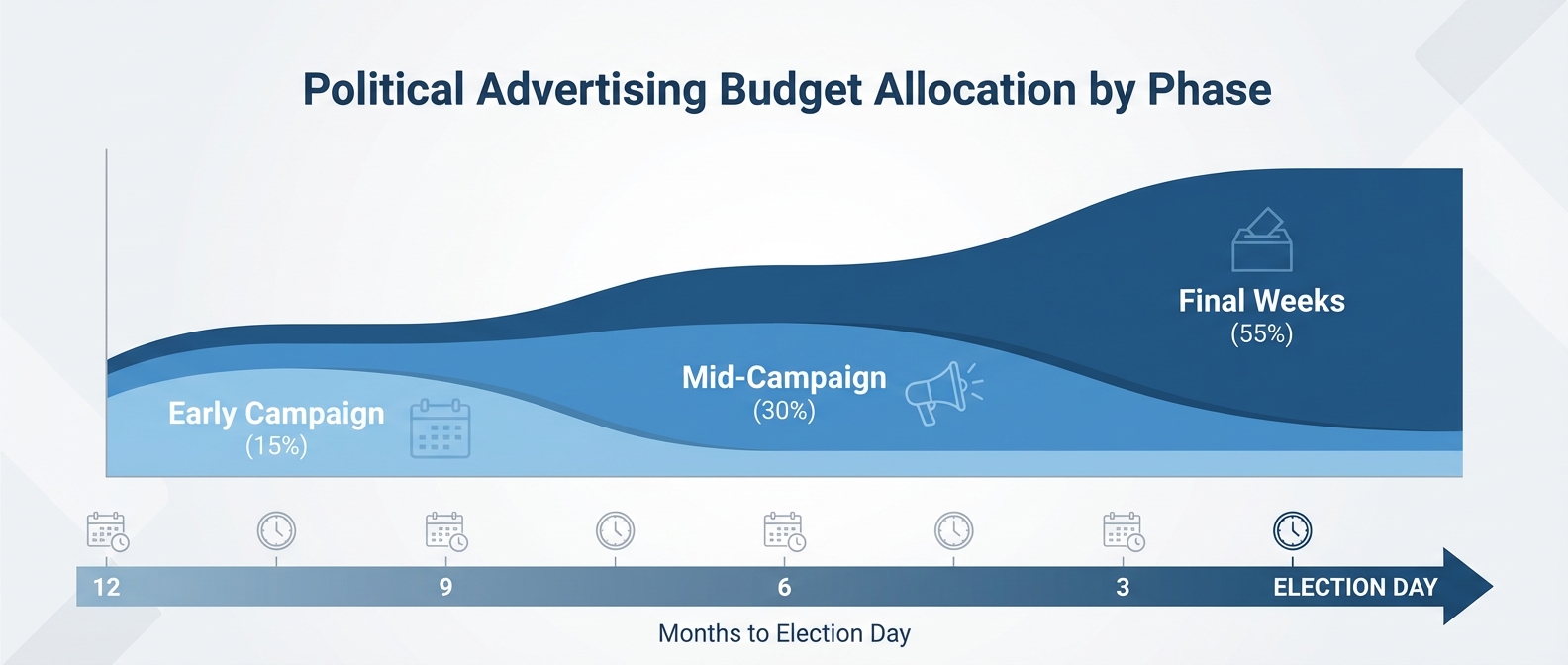
Introduction phase (3-6 months out): 10-15% of budget Build name recognition with positive messaging.
Persuasion phase (2-3 months out): 25-35% of budget Deliver platform messages to undecided voters.
Contrast phase (1-2 months out): 25-35% of budget Differentiate from opponents.
Closing phase (final 4 weeks): 25-35% of budget Saturation advertising and turnout messaging.
Cost-saving strategies
Stretch your budget with these approaches.
Start early
Advertising costs increase as elections approach. Campaigns that start early:
Pay lower CPMs (less competition)
Build voter awareness over time
Test messaging before final push
Establish media relationships
Focus geographic targeting
Every dollar spent outside your district is wasted. CTV and digital targeting ensure:
Zip-code-level precision
District boundary targeting
Custom geography for irregular districts
Broadcast TV often wastes 30-60% of budget reaching non-voters outside your race.
Test before scaling
Run small tests ($500-2,000) before major commitments:
Test different messages
Evaluate audience response
Optimize targeting
Identify top-performing creative
The data from small tests can improve major buys by 30-50%.
Use AI-powered creative
Professional TV ad production can cost $10,000-100,000+. Platforms like Adwave include AI video creation at no extra cost, eliminating production barriers for smaller campaigns.
Negotiate and bundle
For larger broadcast buys:
Request rate cards early
Bundle buys across stations
Commit to longer flights
Ask about make-goods for pre-emptions
Negotiating can reduce broadcast costs 15-30% below initial quotes.
Common questions
How much does it cost to run a political TV ad in 2026?
Political TV ad costs vary widely based on market, timing, and platform. Broadcast TV ranges from $100-50,000+ per spot depending on market size. CTV/streaming advertising typically costs $15-45 CPM, meaning $500 delivers approximately 15,000-33,000 impressions. Small campaigns can start CTV advertising at $50 through self-serve platforms.
What's the minimum budget for political TV advertising?
On broadcast TV, minimum buys typically start at $5,000-10,000 per month in small markets. CTV platforms have eliminated minimums - campaigns can start at $50 and scale from there. For meaningful impact in a local race, plan $3,000-10,000 for a CTV campaign over 4-6 weeks.
Are PACs charged differently than candidates for TV ads?
Yes. Federal candidates receive "lowest unit rate" pricing on broadcast TV during specific windows (45 days before primaries, 60 days before general elections). PACs, Super PACs, and issue campaigns pay full market rates - often 30-50% higher than candidate rates during peak election periods.
How much should local campaigns budget for advertising?
Local campaigns (city council, school board, county offices) should plan 40-60% of total campaign budget for advertising. For most local races, $5,000-25,000 in CTV/digital advertising can effectively reach district voters. Skip broadcast TV unless your district aligns perfectly with market coverage.
When is the cheapest time to run political ads?
Political advertising costs are lowest January through July of election years. Rates increase significantly in August-September and peak in October through Election Day. Starting earlier saves 30-50% on comparable media weight and builds voter awareness before the advertising clutter of final weeks.
How do CTV costs compare to broadcast TV for political campaigns?
CTV typically costs $20-35 CPM compared to broadcast's effective CPM of $30-100+ (when accounting for waste from reaching non-voters outside districts). For targeted local campaigns, CTV delivers 2-3x the in-district impressions per dollar compared to broadcast TV.
What percentage of campaign budget should go to TV advertising?
Advertising typically consumes 40-70% of total campaign budgets for competitive races. Of that advertising budget, TV (broadcast + CTV) often represents 50-70% for federal and statewide races. Local races may allocate 40-60% to CTV/streaming specifically, skipping broadcast TV entirely due to targeting efficiency.
How do political ad costs change during election season?
Costs increase dramatically as Election Day approaches. January-June rates are typically 30-50% lower than October rates. The final two weeks before elections see peak pricing - sometimes 200-300% above baseline. PACs and issue campaigns feel this most acutely since they lack lowest unit rate protections that benefit federal candidates.
Can small campaigns compete with big spenders on TV?
Yes, through strategic targeting. CTV allows precise geographic and demographic targeting, meaning a $5,000 campaign reaching 100% of intended voters can be more effective than a $50,000 broadcast campaign where 70% of spend reaches voters outside the district. Focus beats brute force in modern political advertising.
What hidden costs should campaigns watch for?
Watch for: agency fees (10-20% of media spend), production costs (often underbudgeted), platform fees, frequency capping limitations that require larger buys, and make-good credits that may not materialize. Self-serve platforms like Adwave eliminate many of these hidden costs with transparent pricing.
Getting started with political advertising
Understanding costs is the first step. The next step is action.
Evaluate your situation
Consider these factors for your race:
Total budget: What's realistic for your campaign?
District size: How many voters do you need to reach?
Timing: How far out is your election?
Competition: What is your opponent likely to spend?
Name recognition: Are you starting from zero or building on existing awareness?
Start small and test
Don't commit your entire budget upfront. Run tests:
$500-1,000 on CTV to test messaging
Evaluate performance metrics (completion rates, website visits)
Refine targeting based on results
Scale what works, cut what doesn't
Testing small before scaling big can improve overall campaign efficiency by 30% or more.
Consider working with specialists
For larger budgets ($50,000+), consider:
Political media buyers: Experienced in broadcast negotiations and rate optimization
Digital agencies: Specialized in online and CTV political campaigns
Self-serve platforms: Best for campaigns that want control and cost efficiency
Smaller campaigns often achieve better results with self-serve platforms than traditional agencies, which may deprioritize small accounts.
Track and optimize
Political advertising isn't "set and forget." Track:
Impressions delivered vs. planned
Video completion rates
Website traffic from ad exposure
Polling movement (if conducting polls)
Early vote or registration metrics
Use data to shift budget toward performing channels and away from underperforming ones throughout the campaign.
The 2026 cycle offers more options for campaigns at every budget level than ever before. Whether you're running for school board or Senate, understanding true advertising costs helps you make smarter decisions and stretch every dollar further.


