Yoga and Pilates studios occupy a strange place in the local-fitness market. Your competition isn't just other yoga and Pilates studios; it's every other way someone could spend an hour in their week (a CrossFit class, a run with a friend, a YouTube workout at home, nothing). Convincing a new student to pick your studio out of that wide alternative set takes more than a Meta ad with a "first class free" offer. It takes trust, familiarity, and the right invitation at the right moment.
Connected TV (CTV) advertising is one of the most underused tools for studios building exactly that. This guide walks through why TV works for yoga and Pilates specifically, how to structure a campaign, what to spend, and what to expect at 30, 60, and 90 days.
Why TV works for yoga and Pilates studios
Yoga and Pilates are emotion-led purchase decisions. A new student isn't choosing a studio based on equipment specs or class duration. They're choosing based on how the studio makes them feel before they step inside. Comfortable, welcoming, capable of meeting them where they are.
TV is the medium that builds that pre-arrival feeling more efficiently than any other channel.
It reaches the household, not just the individual. Most yoga and Pilates students start with a spouse, parent, or friend saying "you'd love this place." TV creative seen by a household creates the conversation, not just an individual impression. A wife watching a CTV spot says "we should try that studio" to a husband who's also seeing it.
It builds trust at a category level. Yoga and Pilates beginners are often anxious about walking in. Will they be judged? Will they be the largest body in the room? Will they keep up? CTV creative that signals warmth, beginner-friendliness, and community works hard to dissolve that anxiety before a click ever happens.
It complements the emotion-rich content you already have. Most yoga and Pilates studios have great photos and videos. The challenge is getting them in front of more people, especially people who aren't actively searching. CTV is the channel that distributes your existing emotional content to a much wider audience in a higher-trust setting than a phone scroll.
It works at small-studio budgets in 2026. What used to cost $5,000+ per month is now accessible at $800-$1,500 per month with subscription platforms and AI creative tools. The economics finally match the scale of independent studios.
Who is this campaign for?
CTV is most effective for yoga and Pilates studios with a few specific characteristics:
A studio serving a 5-12 mile radius. Beyond that, drive time is the limiter; under that, your existing local SEO and Meta presence is probably enough.
Class capacity to absorb new students. If you're already at 90% utilization, TV will produce inquiries you can't fulfill. Solve capacity first.
At least 12 months of business history. Newer studios benefit more from intensive local Meta and community outreach in their first year before adding TV.
A clear point of view. A studio that knows what it stands for (heated power flow, classical Pilates, mindful beginner-friendly, prenatal specialty) will produce better CTV creative than a studio still figuring out its identity.
Front-of-house ready to convert. TV will drive intro-class signups, but your studio needs to convert those signups into members. If your trial-to-member rate is below 30%, work on the in-studio experience before scaling TV.
The campaign structure
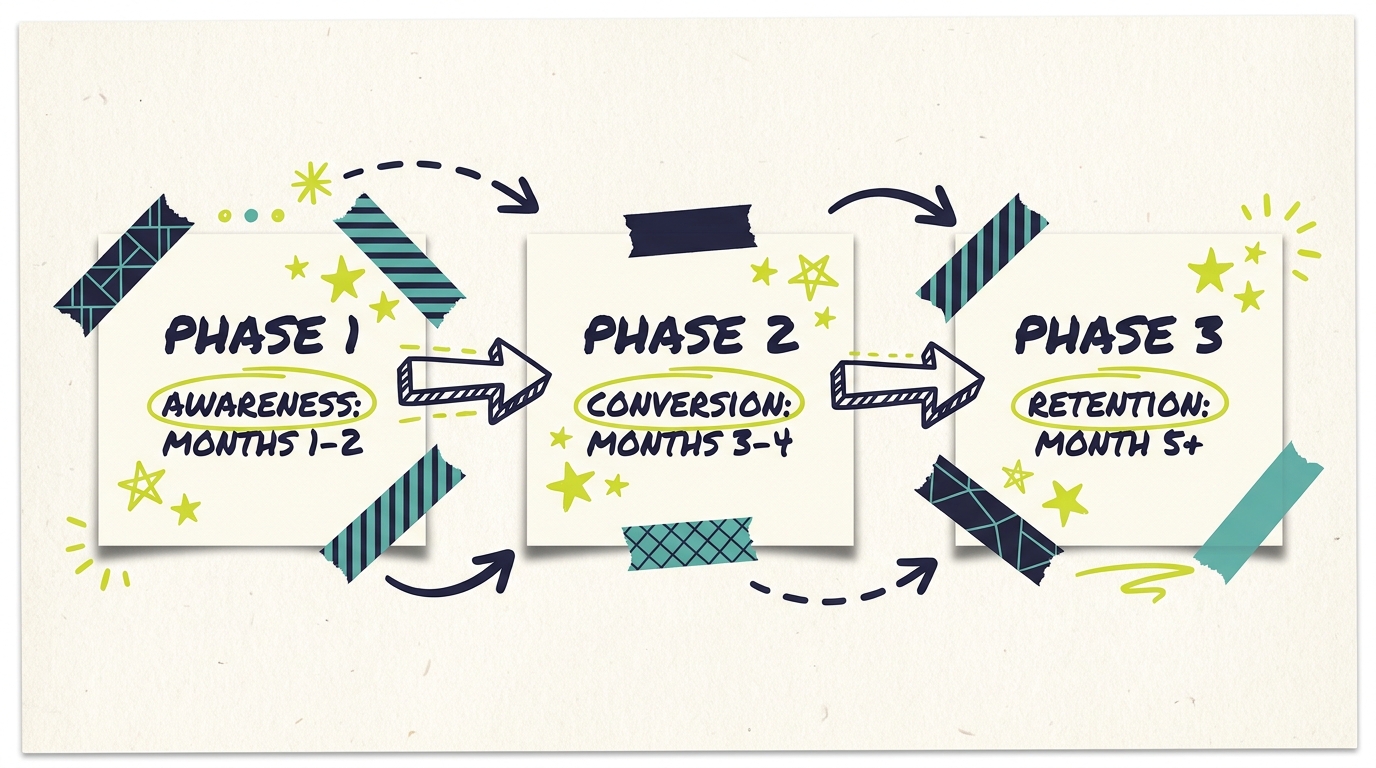
A well-built CTV campaign for a yoga or Pilates studio runs across three phases.
Phase 1: Awareness and warm-up (Months 1-2)
The first 60 days are about putting your studio in front of households in your service area who don't yet know you exist or who know you exist but haven't yet considered trying you.
Creative emphasis: emotional, low-pressure, beginner-friendly. Show real class energy. Show people who look like your prospective students (not stock-yoga influencers). Use a soft call to action like "your first class is free" or "see what a week feels like."
Target: your full service area, weighted toward ZIPs you know are good candidates (high household income, active-lifestyle demographics, proximity to your studio).
Budget: $800-$1,500 per month in this phase. Frequency target: 3-5 impressions per household across the 8-week window.
Phase 2: Conversion and seasonal pegging (Months 3-4)
Once the awareness layer is in place, the next phase converts that familiarity into intro-class signups by leaning into specific seasonal moments and offer-based creative.
Creative emphasis: tied to a moment your community recognizes (post-holiday return to wellness in January, spring re-set in March, back-to-routine September). Slightly harder CTA: "Sign up for our spring beginner series" or "Try a full week for $29."
Target: weight toward your highest-converting ZIPs from phase 1. Maintain frequency around 3-5 per household.
Budget: hold steady at $800-$1,500 or scale modestly to $1,500-$2,500 if early conversion data is strong.
Phase 3: Member retention and referral support (Month 5+)
The third phase is the long game. Once a steady flow of new members is coming through, CTV starts working as a member-retention tool too. Existing members who see your TV ads feel like they're part of a serious studio. That perception increases retention and word-of-mouth.
Creative emphasis: community-oriented. Member stories, the studio's role in the local fitness community, transformation framing (not in a weight-loss sense but in a "what a year of practice does for you" sense).
Target: maintain primary service area, consider adding adjacent ZIPs where existing members are coming from but penetration is lower.
Budget: $1,200-$2,500 per month sustainably as part of your permanent media mix.
What to put in your 30-second spot
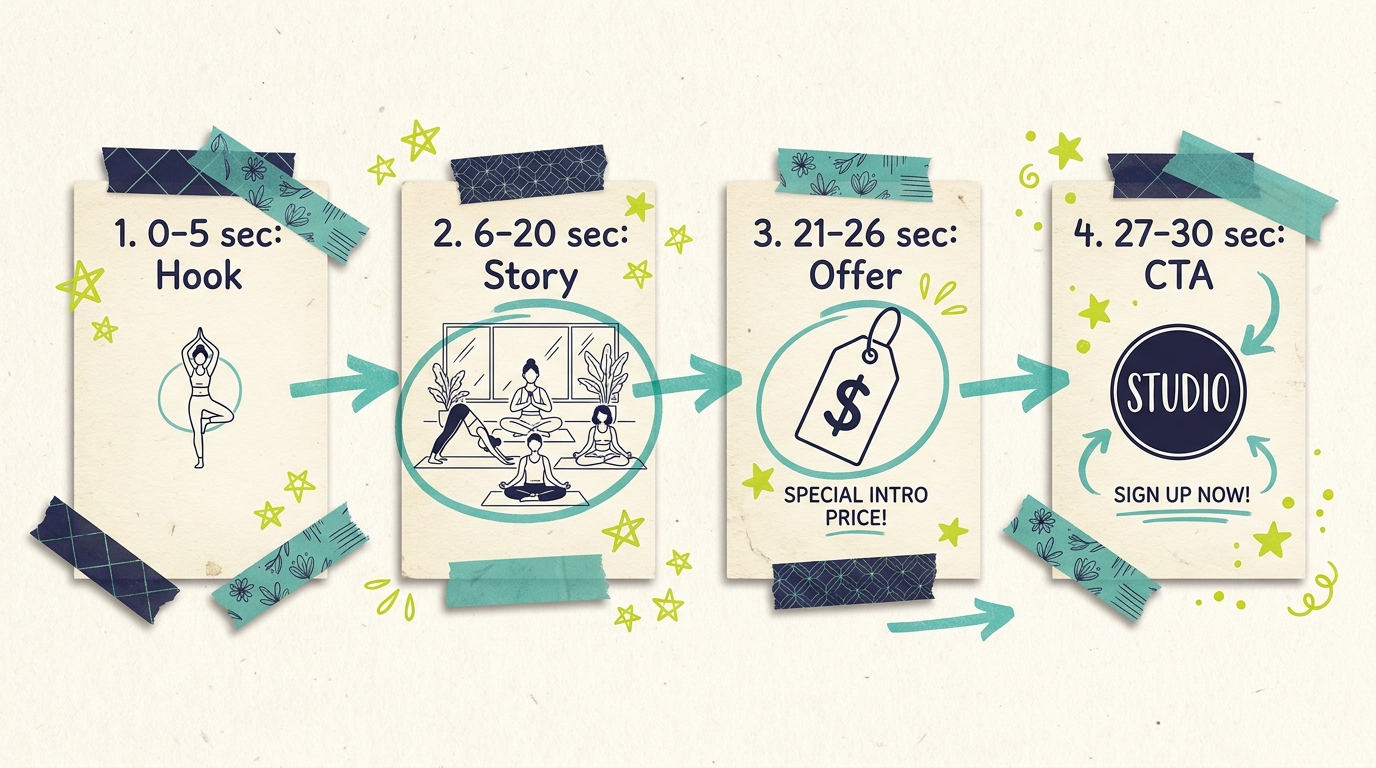
A 30-second CTV spot for a yoga or Pilates studio has roughly this structure:
Seconds 1-5: The hook. Open on something the viewer can immediately feel. A morning class settling in, a Pilates reformer in a quiet studio, the moment a beginner finds their first balance. This is where you signal "this is for you" before the viewer mentally checks out.
Seconds 6-20: The story. Brief, emotional, specific to your studio. Could be a member testimonial in 8 seconds. Could be a coach speaking directly to the camera in a calm voice. Could be a montage of moments from real classes. Whatever it is, it should feel like your studio, not a generic yoga or Pilates studio. AI creative tools can produce this from URL content in 2-5 minutes.
Seconds 21-26: The offer. A specific, concrete reason to act now. "Your first class is free" or "Two-week intro for $29." The vaguer the offer, the lower the response. Specificity drives action.
Seconds 27-30: The call to action and brand lock-in. Your studio name visually on screen, your URL, and any final prompt. The brand lock-in is what gets remembered if everything else is forgotten.
Three creative principles to avoid:
Don't use generic stock yoga footage. Viewers pattern-match on it and tune out. Your actual studio, even if simpler, builds more trust.
Don't lead with price. "Yoga from $39/month" is a search-ad header, not a TV opening. Lead with feeling.
Don't make it generic-aspirational. "Be your best self" is the cliché everyone uses. Specific transformations ("the first time you held a plank for 45 seconds") work harder.
Targeting decisions that matter
A few specific targeting moves separate strong yoga and Pilates campaigns from average ones.
Tight geographic radius. Most local studios serve a 5-12 mile radius for the majority of their members. Tighter is almost always better for studio TV. Set your campaign's radius to where your members live and commute, not where you'd like them to live.
Household income weighting where available. Yoga and Pilates membership rates ($120-$250/month) imply a household income tier. Weighting toward $75K+ household income ZIPs improves conversion meaningfully.
Daypart consideration. Yoga and Pilates households often watch streaming TV in evening hours (8-11 p.m.) and weekend mornings. Adwave's campaigns deliver across the day, but you can see in the dashboard which dayparts your conversions are coming from and adjust creative emphasis accordingly.
Demographic weighting toward 25-55 women, with male-friendly creative for inclusive studios. The dominant demographic for yoga and Pilates is women 25-55, but studios with explicit "men welcome" creative often see 15-25% of intro signups from men, an underexploited segment for most studios.
Frequency capping. A frequency cap of 6-8 per household per week prevents over-delivery to the same engaged streamers while keeping pressure on the lighter-streaming households that need more exposure to remember you.
Tracking what's working
Attribution for yoga and Pilates studios is more solvable than many small business categories because the intro class signup is a clean conversion event you control.
Three tracking layers worth running:
1. Unique signup URL. Mention a TV-specific URL in your spot (yourstudio.com/welcome). Trial signups on that URL are directly attributed to TV.
2. Front-desk intake question. Ask every intro-class attendee "How did you hear about us?" with TV as an explicit answer. Combine with the URL data for a fuller picture.
3. Pre/post baseline. Track total intro signups for 4 weeks before TV launches. Compare against weeks 1-4, 5-8, and 9-12 of the campaign. The total lift over baseline is your full TV contribution; direct attribution catches a subset.
Most yoga and Pilates studios running CTV see 40-70% of their TV impact in directly-attributed signups and the remainder in lift to other channels (Meta CTR rising, branded search rising, Google ads converting at higher rates). Both layers count.
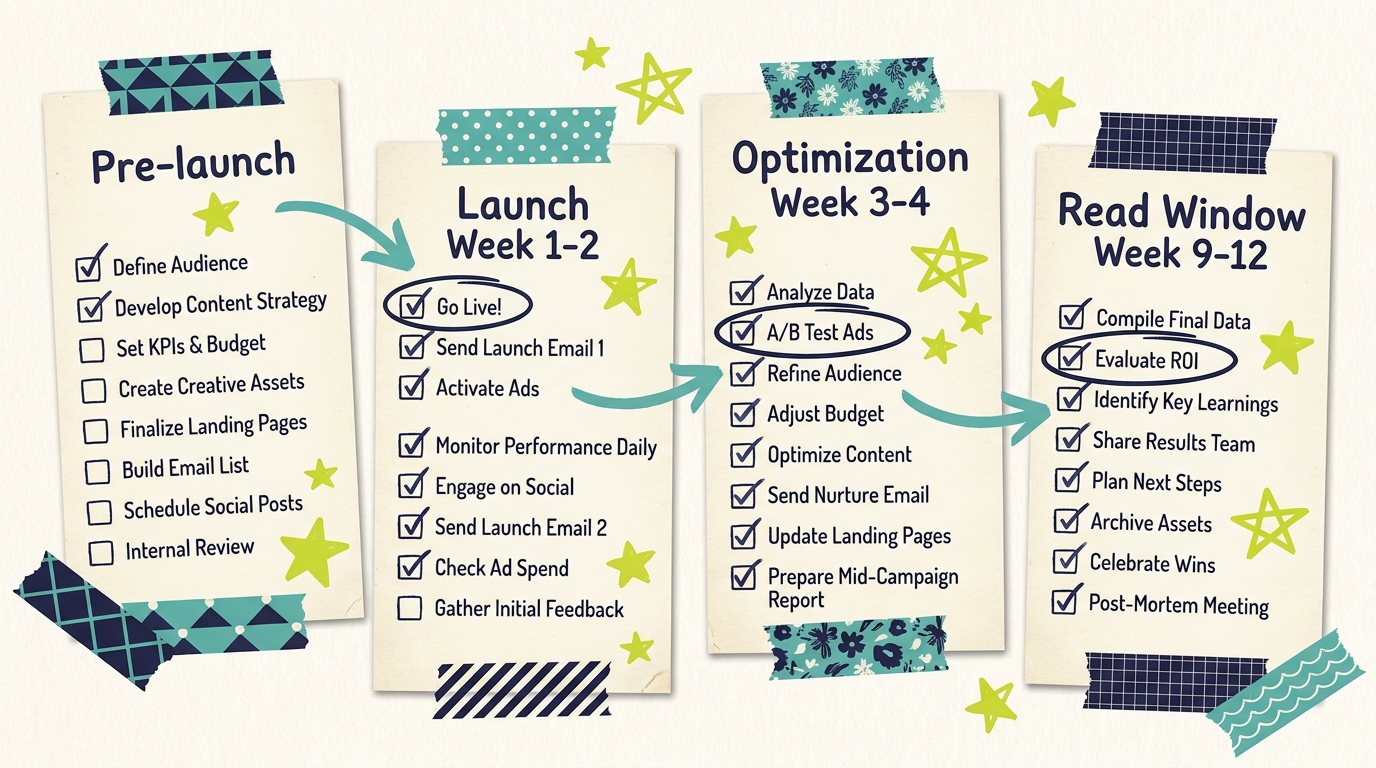
Sample 90-day plan
A 90-day starting plan for a yoga or Pilates studio testing CTV:
Pre-launch (week -4 to -1):
Capture baseline intro signups for 4 weeks
Tighten Meta and Google geographic targeting to match planned CTV targeting
Produce two creative variations through Adwave (one warm-and-welcoming, one specific-offer)
Launch (week 1-2):
Daily cap $40-$50, full service area
Run both creatives in rotation
No optimization
Optimization (week 3-4):
Review geographic distribution; tighten if leaking outside service area
Check creative-level conversion data; consider pausing the weaker creative
Check frequency (target 3-5 per household for the running window)
Performance window (week 5-8):
Hold targeting steady
Watch cross-channel lift signals (branded search, Meta CTR, direct traffic)
Consider scaling daily cap by 20-30% if performance is strong
Read window (week 9-12):
Compare total intro signups to pre-launch baseline
Compare cost per attributed signup and total cost per signup
Decide: hold at current spend, scale to phase 2 budget, or refine creative for another cycle
Common questions answered
How much should a small yoga or Pilates studio spend on CTV advertising?
Most independent studios start in the $800-$1,500 per month range for their first 90 days. That's enough to build meaningful local frequency (3-5 impressions per household) within a tight service area while keeping the test affordable. After 90 days, profitable campaigns typically scale to $1,500-$2,500 per month as a permanent line item.
Is TV advertising worth it for a studio with only 80-150 active members?
It can be, with the right setup. Smaller studios benefit most when their current capacity has room (so new members can be absorbed), their location supports a 5-12 mile draw radius (so geographic targeting can stay tight), and they can sustain a 90-day test. For studios with fewer than 50 members or under 12 months in business, more intensive local Meta and community outreach usually produces faster returns.
Will CTV ads cannibalize my Meta or Google performance?
Almost always the opposite. Studios that add CTV typically see their Meta CTR and conversion rate rise during the TV window, because viewers exposed to TV recognize the brand when Meta or Google ads appear later. Hold Meta and Google steady during your first 90-day TV test to see the cross-channel lift clearly.
What's the most important creative decision for a yoga or Pilates spot?
Avoiding generic-aspirational framing. The trap is producing creative that could belong to any yoga or Pilates studio in any city. The studios with the strongest TV results produce creative that's specific to their studio: the actual room, the actual coaches, the actual moments. Specificity beats polish.
How quickly will I see new students from a TV campaign?
A small share of viewers will sign up for an intro class within the first two weeks. The bigger lift typically happens in weeks 4-8 as the familiarity layer builds and viewers convert on their own timing. Most studios see meaningful intro-signup increases by week 5-6 and a clean read by week 9-12.
Can I run CTV for just my busy season, or does it need to run year-round?
Both work depending on goal. Seasonal campaigns (back-to-school September, January resolution, spring re-set) work well for studios with clear seasonal peaks. Year-round modest spend ($800-$1,200/month) works well for studios building a steady member pipeline. Many established studios run a base year-round campaign and layer additional spend during their highest-conversion seasonal windows.
Should my TV creative mention online classes or only in-studio?
Depends on your business model. If online classes are a meaningful revenue stream, mention them; CTV is well-suited for reaching households that may not be in your drive radius but would value virtual access. If online is a side offering, lead with in-studio and let online be a footnote in the spot. The studios that confuse viewers by trying to sell both equally in one spot usually underperform.
Building your studio's TV presence
CTV is one of the highest-use channels for yoga and Pilates studios in 2026, especially studios with 12+ months of operating history, clear identity, and capacity to absorb growth. The combination of household-level reach, trust-rich premium content context, and democratized cost makes the channel finally accessible at independent studio budgets.
The studios that build TV into their permanent media mix early in 2026 are the ones whose names will be household-familiar in their service areas by the end of the year, with the customer pipeline to match.