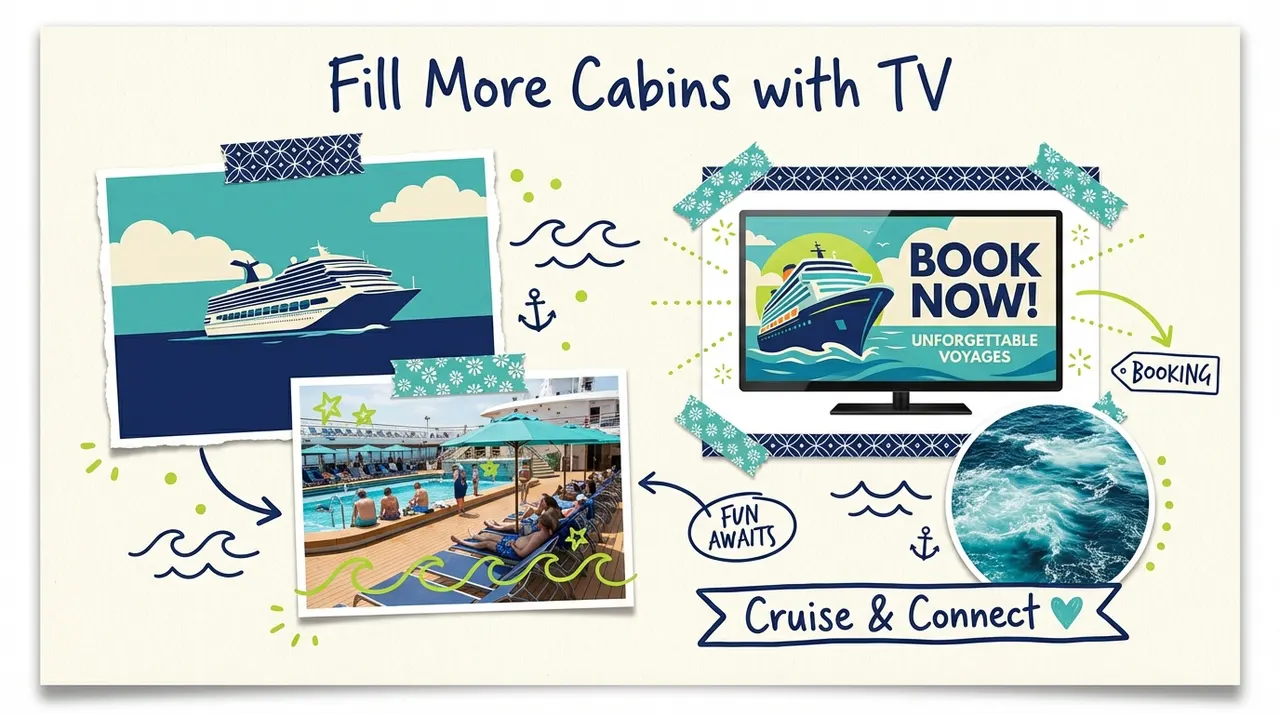
Travelers choose hotels that feel familiar. When someone plans a trip to your area, they choose between properties they've heard of, properties that appear in search results, and whatever looks decent on Expedia. TV advertising for hotels puts your property in front of potential guests before they start searching, so when they're planning a trip to your destination, your name already sits in their mind as a known quantity.
While travelers price-shop on Expedia, Booking.com, and other OTAs, TV-aware guests behave differently. They often book direct because they know you, trust you, and want the relationship that comes with direct booking. That's better for your margins (no 15-25% commission) and better for your guest relationships (you control the communication).
Why TV Advertising Works for Hotels
Hospitality is fundamentally about creating feelings before the stay even begins. Travelers don't just book rooms; they book anticipation, experience, and escape. TV captures those feelings and broadcasts them to potential guests in ways that static images and bulleted amenity lists never can.

The hotel marketing opportunity is significant and evolving. Travelers research and book trips throughout the year, with major travel periods creating predictable demand spikes. Direct bookings protect margins from OTA commissions that can consume 15-25% of your revenue. Repeat guests and word-of-mouth referrals drive sustainable growth at zero acquisition cost. And brand recognition in feeder markets, the cities where your guests live, drives visitation regardless of where you rank in OTA search results.
Yet attracting hotel guests presents persistent challenges in the current landscape. Competition from OTAs for booking ownership is intense and expensive. These platforms spend billions on advertising to insert themselves between hotels and guests. Building awareness in distant feeder markets requires reaching people who don't live anywhere near your property. Differentiating from competitors requires showing your property's unique experience, not just listing amenities. And driving direct bookings requires name recognition that exists before travelers start their search process.
TV advertising offers hotels a powerful solution to these challenges. Video showcases your property in emotionally compelling ways that photos on booking sites simply cannot match. You can target feeder markets, the specific cities and regions where your guests live, with precision impossible in traditional advertising. Premium positioning on streaming platforms inspires travelers during the dream and planning phases of trip consideration. And brand familiarity encourages direct booking instead of OTA search, protecting your margins and building direct relationships.
Every direct booking strengthens your guest relationship and protects your margins from OTA commissions. TV advertising builds the familiarity that makes guests confident booking direct with a property they feel they already know.
How TV Advertising Works for Hotels
TV advertising for hotels inspires travelers and drives direct bookings through a process designed for hospitality businesses without advertising expertise.

You share your website or social media with Adwave, and the platform's AI automatically gathers your property imagery, amenities, room photos, and branding. Within about two minutes, you see a professional 30-second commercial showing your property. The visual quality matches what travelers see from major hotel brands, because you're using the same premium streaming channels.
The key differentiator for hotel advertising is geographic targeting. You target households in cities that drive visitation to your destination, not the local area around your property. A beach resort in Florida might target Chicago, Detroit, and Cleveland during winter months. A mountain lodge might target Dallas and Houston. A boutique hotel in a tourist destination targets the metro areas within driving distance. This feeder market targeting is something OTAs cannot offer; they only reach people already searching for your destination.
Your ad runs on 100+ premium channels including NBC, Hulu, ESPN, ABC, and others. Viewers see your property alongside content they trust, building aspirational associations with your brand.
You track results through impressions, geographic reach, and correlation with direct bookings and website traffic from targeted markets.
Targeting Strategies for Hotels
Effective hotel advertising requires understanding where your guests come from and reaching them before they start the booking process.
Feeder Market Targeting
Analyze your guest data to identify which cities and regions generate the most visitors. Most hotels have 5-10 primary feeder markets that account for the majority of guests. Target these markets specifically with your TV advertising. If 30% of your guests come from Chicago, significant budget should reach Chicago households.
Consider seasonal patterns in feeder markets. Northern cities drive winter travel to warm destinations. Southern cities drive summer travel to cooler climates. Business centers drive convention and meeting attendance year-round.
Demographic Targeting
Different hotel types attract different traveler demographics. A luxury boutique hotel targets different households than a family-friendly resort. Define your ideal guest profile based on your positioning and amenities, then target accordingly.
Income levels matter for premium properties. Household composition matters for family resorts. Age demographics matter for properties targeting specific life stages (honeymoon destinations, active senior travelers, family vacation resorts).
Seasonal and Event-Based Targeting
Hotel demand follows predictable patterns. Increase advertising before peak seasons to capture early bookers. Run campaigns tied to events in your destination: concerts, festivals, sporting events, conferences. Time campaigns to reach travelers during planning windows, typically 2-8 weeks before anticipated travel dates.
Consider competitive moments too. When travelers in your feeder markets are likely seeing advertising from competing destinations, being present maintains your share of consideration.
Budget Considerations for Hotel TV Advertising
TV advertising for your hotel starts from $30/day with Adwave. Compare that to OTA commission on a single room night, which might run $30-75 depending on your rates and their commission percentage.

The math favors TV advertising when you consider lifetime value and commission savings. One direct booking instead of an OTA booking often saves $50-150 in commission. That single booking covers months of advertising cost. If your TV campaign shifts even a small percentage of bookings from OTA to direct, the commission savings alone justify the investment.
Starting budgets for hotel advertising should scale to your goals and market size. A testing phase of $1,000-2,000 lets you establish presence in key feeder markets and gauge initial response. Growing campaigns of $3,000-5,000 monthly build meaningful awareness in multiple feeder markets. Seasonal campaigns during peak booking windows can justify $5,000-10,000 monthly to maximize visibility when travel intent peaks.
At an average CPM of $25, $3,000 in monthly advertising delivers approximately 120,000 ad views in your targeted feeder markets. If you're targeting three cities of 500,000 households each, that's meaningful presence in each market building frequency over time.
Adwave creates your commercial for free. You only pay when your ad runs. Traditional hotel commercial production costs $10,000-50,000; with Adwave, that barrier disappears.
Creating Effective Hotel Commercials
The most effective hotel commercials transport viewers into the experience of staying at your property.
Lead with your hero visuals. Every property has signature images: the pool at sunset, the view from the balcony, the lobby's atmosphere, the room's comfort. Open with these highest-impact visuals to immediately capture attention and create desire.
Show human experience, not just empty spaces. A couple relaxing on your terrace, a family playing in the pool, guests enjoying your restaurant all communicate experience better than empty room shots. Viewers imagine themselves in those scenes.
Communicate what makes you distinct. Every hotel has rooms and amenities. What makes staying with you special? Location, design, service, atmosphere, activities, history? Your commercial should answer the question "why this property specifically?" within its 30 seconds.
Include clear booking information. Your website URL, phone number, or simple "Book direct for best rates" messaging guides viewers toward direct action. The goal is driving direct bookings, so make that path clear.
Consider seasonal messaging for different campaigns. Winter travelers to warm destinations need different emotional appeal than summer travelers to mountain retreats. Match your messaging to the traveler mindset in each season.
Measuring Success for Your Property
Hotel TV advertising success shows through metrics that connect advertising activity to booking results.
Track direct booking increases during and after campaigns. Compare direct booking revenue to baseline periods, accounting for seasonal patterns. If direct bookings as a percentage of total bookings increase during campaigns, TV advertising is shifting behavior.
Monitor website traffic from targeted feeder markets. Use Google Analytics geographic data to see if traffic from Chicago increases during campaigns targeting Chicago. Direct correlation between advertising and web engagement indicates campaign effectiveness.
Calculate commission savings from shifted bookings. If your direct booking percentage increases by 5% during a campaign, calculate the commission you saved on those bookings. This savings is direct ROI from your advertising investment.
Survey guests about how they heard about your property. "I saw your ad" provides direct attribution, though be aware that some guests won't consciously recall advertising that influenced their consideration.
Watch brand search volume. If searches for your property name increase in targeted markets during campaigns, awareness is building. Google Trends can show relative search volume changes.
Common Mistakes to Avoid
The most common mistake hotels make with TV advertising is targeting the wrong geography. Advertising in your local market reaches people who don't need hotel rooms. Target feeder markets where your actual guests live, not the area around your property.
Another mistake is generic messaging that could apply to any hotel. "Great location, comfortable rooms, friendly staff" doesn't differentiate. Communicate what's specifically compelling about your property.
Some hotels run campaigns too briefly to build meaningful awareness. A two-week campaign reaches viewers once or twice; sustained campaigns build frequency that creates lasting recognition. Plan for minimum six-week campaigns to build adequate frequency.
Don't neglect the audio and music. Hotel commercials benefit enormously from atmospheric audio that reinforces your positioning. A beach resort needs different audio than a mountain lodge or urban boutique hotel.
Finally, don't forget to track direct booking correlation. Without measurement, you can't optimize or justify ongoing investment. Set up tracking before campaigns launch so you have clean baseline data.
Seasonal Campaign Strategies for Hotels
Hotel advertising follows the travel planning calendar. Winter campaigns targeting northern feeder markets should begin in October and November to capture holiday and winter vacation planners. Spring break travel requires January and February advertising. Summer family vacation planning happens March through May. Understanding when travelers in your feeder markets make decisions lets you time campaigns for maximum impact during consideration windows.
Consider business versus leisure timing as well. Corporate travel books closer to departure dates, while leisure travel often involves longer planning windows. Match your campaign timing to the booking behavior of your target guest segments. Group and meeting travel, weddings, and special events often book six months or more in advance, requiring even earlier advertising presence.
Local events in your destination create advertising opportunities too. Major conferences, festivals, sporting events, and cultural happenings drive travel demand. Campaign timing around these events captures motivated travelers actively seeking lodging.
Getting Started with Hotel TV Advertising
Hotels and boutique lodging properties are discovering what major hospitality brands have known: TV advertising builds the recognition that drives direct bookings and protects margins from OTA commissions.
Your property delivers experiences worth sharing. The view, the atmosphere, the service, the location, the feeling of escape and relaxation that guests remember long after checkout. TV advertising lets you showcase that experience to travelers in your feeder markets who are planning trips and choosing where to stay.
The OTAs have built their businesses by inserting themselves between hotels and guests. TV advertising lets you reach guests directly, building awareness and preference that exists before travelers start searching booking platforms. That awareness translates to direct bookings, stronger guest relationships, and healthier margins.
The technology that once made TV advertising possible only for major hotel chains now works for independent properties of any size. No production crew needed. No media buying expertise required. Just your existing imagery and a platform designed to put properties on television affordably.
Create your ads free and see how your property looks on the big screen. The next guest planning a trip to your destination might already have you in mind.
Common questions answered
Can independent hotels compete with chains using TV advertising?
TV advertising helps boutique and independent hotels build the awareness and credibility that chain properties achieve through brand recognition. The visual medium effectively showcases unique character, location, and experiences that generic chains can't match. Many independent hoteliers find TV advertising attracts guests specifically seeking authentic, distinctive stays.
What should a hotel TV ad focus on?
Feature what makes your property unique: the building's character, the location, special amenities, or the experience of staying. Show rooms and common areas that reflect your style. Highlight location advantages and nearby attractions. Include your booking website prominently. Make viewers imagine themselves staying at your property.
How do hotels target travelers with TV advertising?
Target geographic areas that provide your guests: nearby metro areas for weekend getaways, feeder markets for your destination. Target demographics likely to travel: household income levels, age ranges, and interest categories. Consider timing ads before typical booking windows for your property (weeks ahead for leisure, days ahead for business). CTV allows precise targeting by these factors.
How do hotels measure TV advertising results?
Track direct bookings during campaign periods using unique booking codes. Monitor website traffic from targeted geographic areas. Watch for increases in branded search volume. Compare booking pace during advertising versus baseline periods. Calculate cost per booking and compare to average room revenue and guest lifetime value.