-
$218B
Projected global AVOD market by 2033
-
73%
TV viewing on ad-supported platforms
-
19%+
Annual AVOD market growth rate
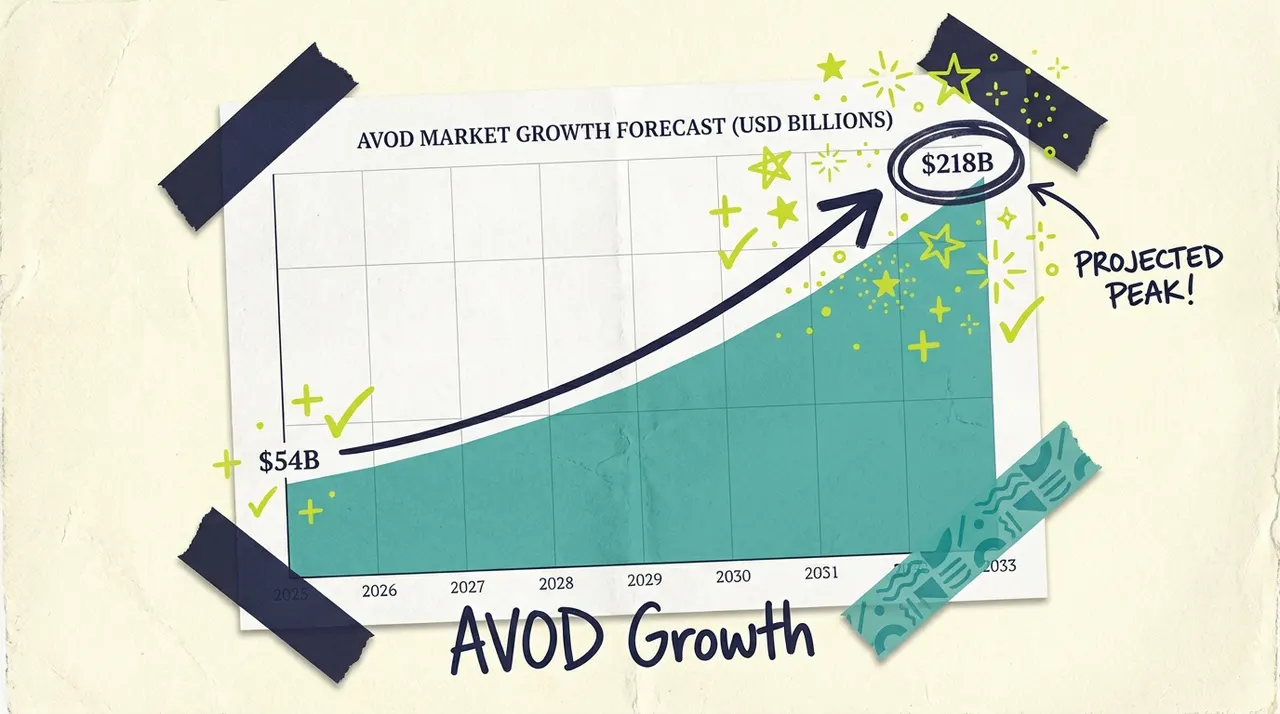
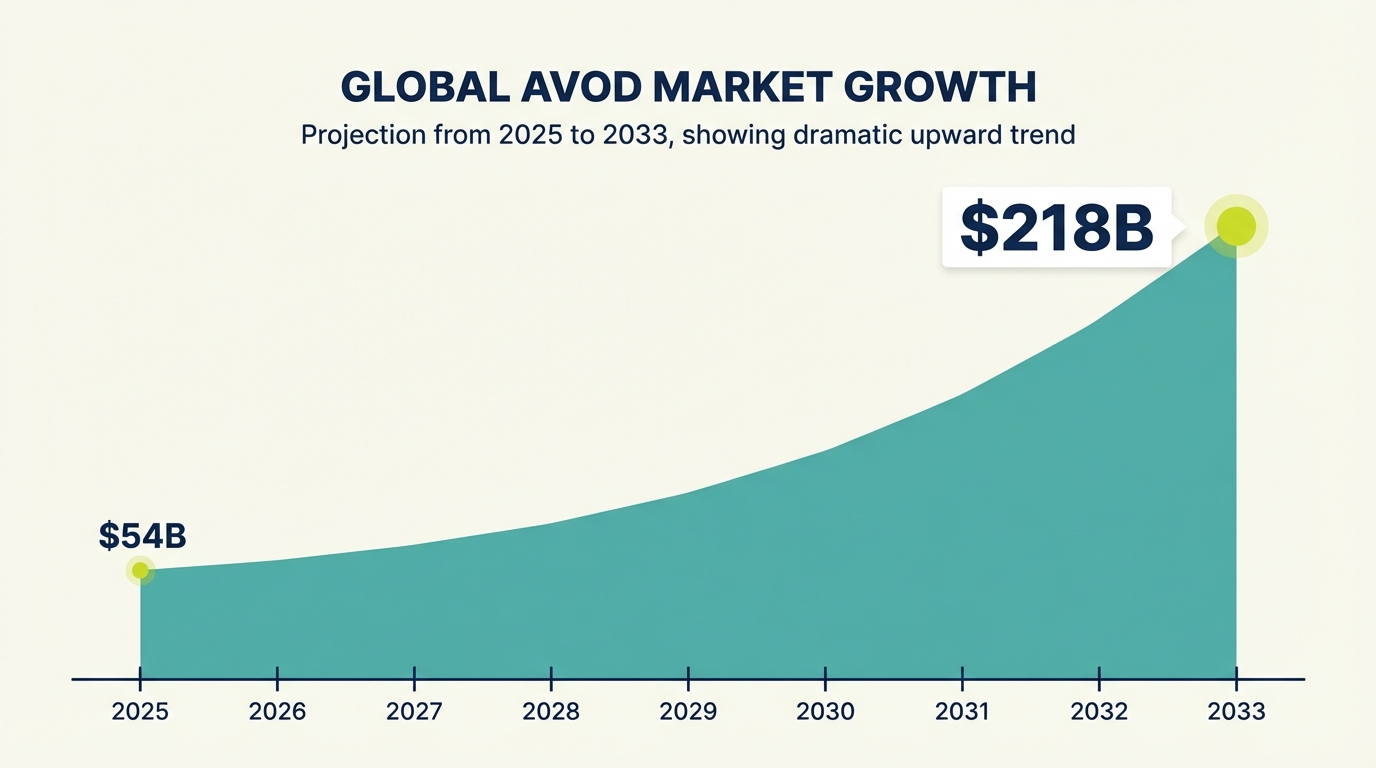
Ad-supported streaming will continue growing strongly through 2026 and beyond, driven by consumer preference for free and low-cost options plus platform economics that favor ad tiers. According to SNS Insider research, the global AVOD market was valued at $54.14 billion in 2025 and is projected to reach $218.31 billion by 2033, representing a compound annual growth rate exceeding 19%. In the U.S., the ad-supported streaming market is expected to grow from $18.52 billion to $73.42 billion over the same period. For advertisers, this trajectory means more inventory, more viewers, and more opportunity to reach streaming audiences, with 73% of all TV viewing already occurring on ad-supported platforms.
What the data shows
The ad-supported streaming market is expanding across multiple vectors: more viewers, more platforms, more inventory, and more advertising dollars.
Viewer adoption tells the demand story. According to eMarketer, over half of the U.S. population will watch content from at least one ad-supported streaming service monthly by 2026, up from 41.8% in 2022. That's more than 170 million Americans regularly engaging with ad-supported streaming content.
Platform expansion drives supply. Every major streaming service now offers an ad-supported tier. Netflix launched its ad tier in November 2022 and has aggressively grown that subscriber base. Disney+ followed suit. Max (formerly HBO Max) restructured its offerings around ad-supported options. Even Amazon Prime Video, long ad-free for video content, introduced ads to its core streaming service in early 2024.
The FAST (Free Ad-Supported Streaming TV) category has seen explosive growth. Services like Tubi, Pluto TV, and the Roku Channel offer entirely free content supported by advertising. According to Ampere Analysis, free ad-supported streaming platforms recorded the fastest catalog growth globally in 2025, indicating strong platform investment in the ad-supported model.
Household reach demonstrates market scale. Comscore reported that in August 2025, connected TV streaming was active in 96.4 million U.S. households, up 849,000 from the previous year. Time spent streaming also increased, with average streaming hours continuing to rise year-over-year.
The advertising share of TV viewing has shifted dramatically. According to Nielsen's Ad-Supported Gauge, 73% of all U.S. TV viewing now occurs on ad-supported platforms (including broadcast, cable, and streaming). Ad-supported streaming specifically continues taking share from both traditional ad-supported TV and ad-free streaming options.
Revenue projections show the opportunity. The U.S. AVOD market, valued at $18.52 billion in 2025, is projected to reach $73.42 billion by 2033. Global AVOD is expected to grow from $54.14 billion to $218.31 billion over the same period. These aren't speculative projections about an emerging market. Ad-supported streaming is a massive, established category continuing to expand.
Breaking down the numbers
Understanding the components of ad-supported streaming growth reveals where opportunities exist for advertisers.
By platform category
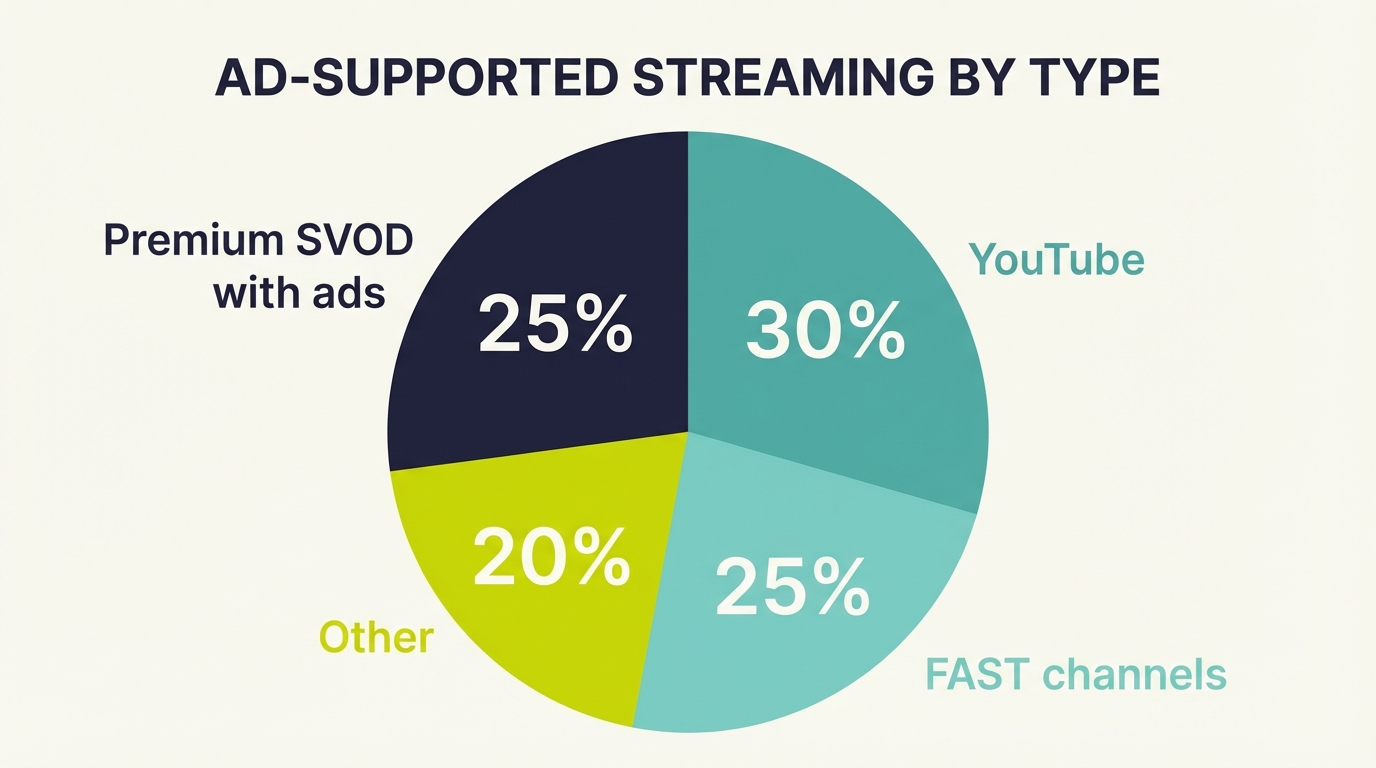
Ad-supported streaming divides into distinct segments:
Premium SVOD with ads (Netflix, Disney+, Max): Subscription services offering lower-cost ad-supported tiers. Netflix's ad tier has grown rapidly since launch, reportedly reaching 70 million monthly active users globally by late 2024. These platforms offer premium content environments with lighter ad loads than traditional TV.
AVOD/Hybrid (Hulu, Peacock, Paramount+): Services that combine subscription revenue with significant advertising. Hulu pioneered this model, and others have followed. These platforms typically offer the choice between ad-supported and ad-free tiers at different price points.
FAST (Tubi, Pluto TV, Roku Channel, Amazon Freevee): Entirely free services supported by advertising. No subscription required. FAST has grown explosively, with Tubi reportedly reaching 80+ million monthly active users. These platforms offer massive reach at accessible advertising rates.
YouTube: Technically a category of its own, YouTube operates as both ad-supported and subscription (YouTube Premium). YouTube commands approximately 10.6% of all U.S. TV viewing, making it the single largest streaming platform, and the vast majority of that viewing is ad-supported.
By viewer preference
Consumer choice patterns explain why ad-supported streaming keeps growing:
Price sensitivity: Ad-supported tiers cost less than ad-free options. Netflix's ad tier runs roughly half the price of its ad-free standard plan. For many households, accepting ads is worth the savings. When streaming services raised ad-free prices, adoption of ad tiers accelerated.
Multiple subscription fatigue: The average U.S. household subscribes to four or more streaming services. At $15-20 per service, costs add up quickly. Ad-supported options, especially free FAST services, allow access to more content without proportionally more expense.
Content prioritization: Viewers who want specific content but don't plan extensive watching often choose ad-supported options. Watch one show on a platform, accept ads, pay less or nothing. The flexibility supports ad-supported adoption.
By content type
Ad-supported viewing varies by content category:
Movies and library content: Heavily indexed toward FAST and ad-supported tiers. Viewers accessing older content often accept ads in exchange for lower cost or free access.
Original series: Split between ad-supported and ad-free. Premium releases often debut for all tiers simultaneously, meaning significant ad-supported viewing of top content.
Live sports: Increasingly available on ad-supported streaming. NFL on Peacock, NBA on various platforms, soccer on multiple services. Sports advertising on streaming commands premium rates.
News and talk: Growing presence on streaming, often ad-supported. Local and national news increasingly available through streaming apps and FAST channels.
Why it matters for your business
Ad-supported streaming growth creates expanding opportunity for businesses to reach television audiences.
The most important implication is inventory expansion. More viewers choosing ad-supported options means more ad impressions available for purchase. More inventory means more competition among platforms for advertiser dollars, which benefits buyers through accessible pricing and improved tools.
For small businesses specifically, ad-supported streaming eliminates barriers that once made TV advertising impossible. Traditional TV's economics required large budgets to achieve meaningful reach. Ad-supported streaming, accessible through programmatic buying and aggregated platforms like Adwave, allows campaigns starting at just $50.
The audience composition matters as well. Ad-supported streaming viewers skew somewhat younger and more diverse than traditional TV audiences. They're engaged viewers who've actively chosen to watch content, not passive channel surfers. The lean-back, big-screen environment creates receptive conditions for brand messaging.
Quality of viewing environment deserves emphasis. Streaming platforms offer brand-safe content environments with controlled ad loads. Most services limit advertising to 4-6 minutes per hour, compared to 15-20 minutes on traditional TV. Viewers see fewer ads, which means less clutter and higher attention per ad. Video completion rates on streaming exceed 95%, meaning your message gets delivered in full.
The growth trajectory ensures continued opportunity. A market growing from $18 billion to $73 billion over eight years creates space for advertisers at every scale. As platforms compete for advertising revenue, tools and pricing become more accessible. The businesses that establish streaming presence during this growth phase will have advantages as the market matures.
Consider industry applications. A dental practice can reach streaming viewers in their geographic area during evening viewing hours when families discuss healthcare decisions. A home services company can target homeowners on home improvement content through contextual placement. An e-commerce brand can build awareness on streaming before retargeting viewers through digital channels. The targeting and measurement capabilities exceed what traditional TV ever offered.
How to take advantage of this trend
Capitalizing on ad-supported streaming growth requires practical steps, not massive investment.
Start with the free tier of opportunity. FAST channels offer significant reach at lower CPMs than premium services. Platforms like Tubi, Pluto TV, and the Roku Channel provide access to millions of viewers through ad-supported content. These services are often accessible through programmatic buying without minimum spend requirements.
Use aggregated platforms for simplicity. Rather than managing campaigns across Netflix, Hulu, Amazon, FAST channels, and others individually, platforms like Adwave provide unified access to 100+ streaming channels through single campaigns. This approach delivers reach across the ad-supported streaming ecosystem without complexity.
Use geographic targeting. One of streaming's key advantages over traditional TV is precision targeting. Ensure your campaigns use geographic constraints appropriate for your business. A local business shouldn't pay for national reach. Target your service area specifically to maximize efficiency.
Develop streaming-appropriate creative. The streaming ad environment differs from traditional TV. Ads are non-skippable, meaning viewers will watch your entire message. Sound is on. Attention is high. Capitalize on these conditions with clear, compelling creative that makes every second count. AI creative tools can generate broadcast-quality commercials from your existing assets at no additional cost.
Test and learn before scaling. Low minimum spends enable testing that traditional TV never allowed. Run a $200 campaign for two weeks. Analyze what works. Adjust targeting, timing, or creative. Then scale based on data rather than assumptions.
Plan for continued growth. Ad-supported streaming inventory will continue expanding. Budget accordingly. Consider allocating increasing percentages of your advertising spend to streaming over the next 2-3 years as audiences continue shifting from traditional TV.
The bigger picture
Ad-supported streaming's growth reflects fundamental changes in how media is consumed and monetized.
The economics favor ad-supported
Streaming services have discovered that ad-supported tiers often generate more revenue per user than ad-free subscriptions, especially for viewers who would otherwise churn or never subscribe. A viewer paying $8/month with ads plus generating $3/month in ad revenue is worth more than a viewer at risk of canceling their $15/month ad-free plan.
This economic reality ensures continued platform investment in ad-supported options. Expect services to promote ad tiers, price ad-free options higher, and potentially make ad-supported the default for new subscribers.
Consumer behavior is shifting permanently
The generation entering adulthood now has never known a world without streaming. For these viewers, ad-supported streaming is simply how TV works. The expectation isn't ad-free content. It's reasonable ad loads in exchange for free or low-cost access.
Younger viewers' preference for ad-supported streaming suggests demand will persist beyond short-term responses to subscription prices.
Implications for the advertising industry
The growth of ad-supported streaming is transforming television advertising overall:
More accessible entry: Low minimums and programmatic access mean any business can advertise on streaming TV.
Better targeting: Geographic, demographic, and behavioral targeting reduce waste compared to traditional TV's broad reach.
Improved measurement: Attribution and verification capabilities exceed what traditional TV ever provided.
Competitive dynamics: Platform competition for advertiser dollars benefits buyers through better pricing and tools.
The advertising industry is shifting from a broadcast model (reach everyone, hope some convert) to a precision model (reach relevant audiences, measure results). Ad-supported streaming enables this transformation.
Content quality on ad-supported tiers
A significant development accelerating ad-supported adoption is content parity. Early ad-supported streaming tiers sometimes received lesser content or delayed access. Today, most platforms offer identical content libraries to ad-supported and ad-free subscribers.
Netflix's ad tier includes the same shows and movies as premium plans. Disney+ ad tier members watch the same content. This parity removes a barrier that once limited ad-supported adoption to price-sensitive viewers only. Now, viewers choosing ad-supported options sacrifice only the ad-free experience, not content access.
The result is ad-supported audiences that mirror overall streaming audiences in demographics and engagement. Advertisers reaching ad-supported streaming reach mainstream viewers, not just budget-conscious segments.
The role of live content
Live sports and events represent a growth vector for ad-supported streaming specifically. Sports inherently include advertising, and streaming sports preserves this expectation. NFL on Peacock, NBA expanding streaming access, soccer on various platforms, all create premium ad-supported viewing environments.
Live events drive appointment viewing that streaming otherwise lacks. When viewers tune in simultaneously for live content, advertisers gain reach scale similar to traditional TV but with streaming's targeting and measurement advantages. Expect sports and live content to drive continued ad-supported streaming growth.
Platform investment signals
Platform behavior reveals confidence in ad-supported growth:
Netflix: Aggressive promotion of ad tier, reportedly reaching 70M monthly active users globally. Development of in-house ad tech indicates strategic commitment.
Disney: Strong push toward ad-supported Disney+ adoption. Bundle promotions emphasize ad-supported tiers.
Amazon: Introduction of ads to Prime Video base service signals belief that ad-supported viewing is mainstream acceptable.
FAST platforms: Continued content investment by Tubi, Pluto, and others indicates expectation of sustained audience growth.
These aren't defensive moves. They're strategic investments in a model platforms believe will define streaming's future.
Global expansion
Ad-supported streaming growth isn't limited to the U.S. International markets, especially in Latin America, Asia, and parts of Europe, show strong adoption of ad-supported models. Global AVOD's projected growth to $218 billion by 2033 reflects worldwide appetite for free or low-cost streaming supported by advertising.
For U.S. businesses, international ad-supported growth matters less directly. But for global brands and platforms, the opportunity extends far beyond American audiences. The business model that's proving successful in the U.S. is replicating globally.
Integration with other channels
Ad-supported streaming works best as part of integrated marketing strategies. TV advertising builds awareness and trust. Digital channels capture intent and drive conversion. The combination outperforms either channel alone.
Studies show that pairing streaming TV with social advertising boosts brand recall by 5x compared to social alone. The big-screen exposure creates mental availability that subsequent touchpoints can activate. Smart advertisers use streaming TV to prime audiences before engaging them through search, social, and email.
What experts are saying
Industry analysts have highlighted ad-supported streaming's momentum.
According to research from Roku, "In 2026, we predict personalized TV advertising will grow considerably thanks to supply and data integrations." The platform emphasized that advertiser demand for addressable, measurable TV advertising continues accelerating.
Ampere Analysis noted that "free ad-supported streaming platforms recorded the fastest catalog growth globally in 2025," indicating strong platform investment in the ad-supported model. Content supply follows viewer demand, and both metrics favor ad-supported options.
Fox's advertising team, promoting FAST service Tubi, highlighted that "over the next three years, U.S. AVOD viewership is projected to grow by over 20 million viewers, with more than 50% of the U.S. population tuning into streaming." The growth trajectory remains robust.
SNS Insider's market research projects the global AVOD market will reach $218.31 billion by 2033, driven by "rising demand for free ad-supported streaming." The fundamental consumer preference for accessible, ad-supported content shows no signs of reversing.
Common questions answered
What is the difference between AVOD, FAST, and SVOD with ads?
AVOD (Advertising-Based Video on Demand) refers to services where advertising is the primary or sole revenue model, like YouTube's free tier. FAST (Free Ad-Supported Streaming TV) specifically describes linear-style channels streamed free with ads, like Tubi or Pluto TV. SVOD with ads describes subscription services that offer ad-supported tiers at lower prices, like Netflix's ad tier or Disney+ with ads. All three are "ad-supported streaming" but represent different business models and viewer experiences. For advertisers, all three offer access to streaming audiences, with varying reach, CPMs, and inventory characteristics.
How do ad loads compare between streaming and traditional TV?
Streaming platforms typically run 4-6 minutes of advertising per hour, compared to 15-20 minutes on traditional television. This lighter ad load means less clutter and higher attention per ad. Viewers see fewer messages, making each one more impactful. Video completion rates on streaming exceed 95%, meaning nearly every viewer sees the entire commercial. The combination of lighter loads and guaranteed completion makes streaming advertising more effective per impression than traditional TV's heavier, sometimes skipped ad breaks.
Will ad-supported streaming keep growing?
Yes. Multiple indicators confirm continued growth: consumer preference for lower-cost options, platform economics favoring ad tiers, expanding content libraries on ad-supported services, and demographic trends toward streaming generally. Market projections show the U.S. AVOD market growing from $18 billion to over $73 billion by 2033.
What percentage of streaming is ad-supported?
According to Nielsen, 73% of all TV viewing occurs on ad-supported platforms (including broadcast, cable, and streaming). Within streaming specifically, ad-supported viewing is growing faster than ad-free subscriptions. The exact split varies by measurement methodology, but ad-supported represents the majority and is expanding.
Why are streaming services pushing ad-supported plans?
Economics drive the shift. Ad-supported subscribers often generate more total revenue (subscription plus advertising) than ad-free subscribers who might churn. lower-priced ad tiers reduce churn and attract price-sensitive viewers who wouldn't otherwise subscribe. The business model favors ad-supported options.
Are ad-supported streaming viewers different from ad-free viewers?
Somewhat. Ad-supported viewers tend to be slightly more price-sensitive and may skew younger. However, the differences are narrowing as ad-supported options become mainstream across all demographics. Premium content is now available on ad tiers, meaning high-value audiences watch ad-supported streaming.
How can small businesses advertise on ad-supported streaming?
Through aggregated platforms that provide access to multiple streaming services through single campaigns. Adwave enables campaigns starting at $50 across 100+ streaming channels. Geographic targeting ensures local businesses reach relevant audiences without national waste. AI creative tools eliminate production costs.
What are FAST channels and why do they matter?
FAST (Free Ad-Supported Streaming TV) channels are entirely free streaming services supported by advertising. Examples include Tubi, Pluto TV, and the Roku Channel. They matter because they've grown explosively, reach tens of millions of viewers, and offer advertising access at often lower CPMs than premium services. FAST represents a major component of ad-supported streaming growth.
How does ad-supported streaming compare to traditional TV advertising?
Ad-supported streaming offers superior targeting (geographic, demographic, behavioral), better measurement (attribution, verification), lighter ad loads (4-6 minutes per hour vs 15-20), and lower entry barriers ($50 minimums vs $5,000+). Traditional TV still reaches older demographics effectively, but streaming increasingly captures the majority of viewing time and advertising opportunity.
Supporting data
Key statistics on ad-supported streaming growth and market size:
U.S. AVOD market size 2025: $18.52 billion (SNS Insider, 2025)
U.S. AVOD projected 2033: $73.42 billion (SNS Insider, 2025)
Global AVOD market size 2025: $54.14 billion (SNS Insider, 2025)
Global AVOD projected 2033: $218.31 billion (SNS Insider, 2025)
Ad-supported streaming viewers by 2026: Over 50% of U.S. population (eMarketer, 2025)
CTV households August 2025: 96.4 million U.S. (Comscore, 2025)
Ad-supported share of TV viewing: 73% (Nielsen Ad-Supported Gauge, Q1 2025)
FAST catalog growth 2025: Fastest growing streaming category (Ampere Analysis, 2025)
All sources linked above. Data current as of December 2025.
Get started with ad-supported streaming advertising
Ad-supported streaming will continue growing, creating more opportunity for businesses to reach television audiences. The market trajectory is clear: more viewers, more platforms, more inventory, more accessible entry points.
Adwave makes streaming TV advertising accessible for any budget, with campaigns starting at just $50. Access ad-supported inventory across 100+ streaming channels including Hulu, Peacock, Discovery, and FAST services. Geographic targeting ensures local businesses reach relevant audiences.
AI-powered creative generates broadcast-quality commercials from your website in minutes. No production budget required. No agency needed.
See how it works | View pricing