
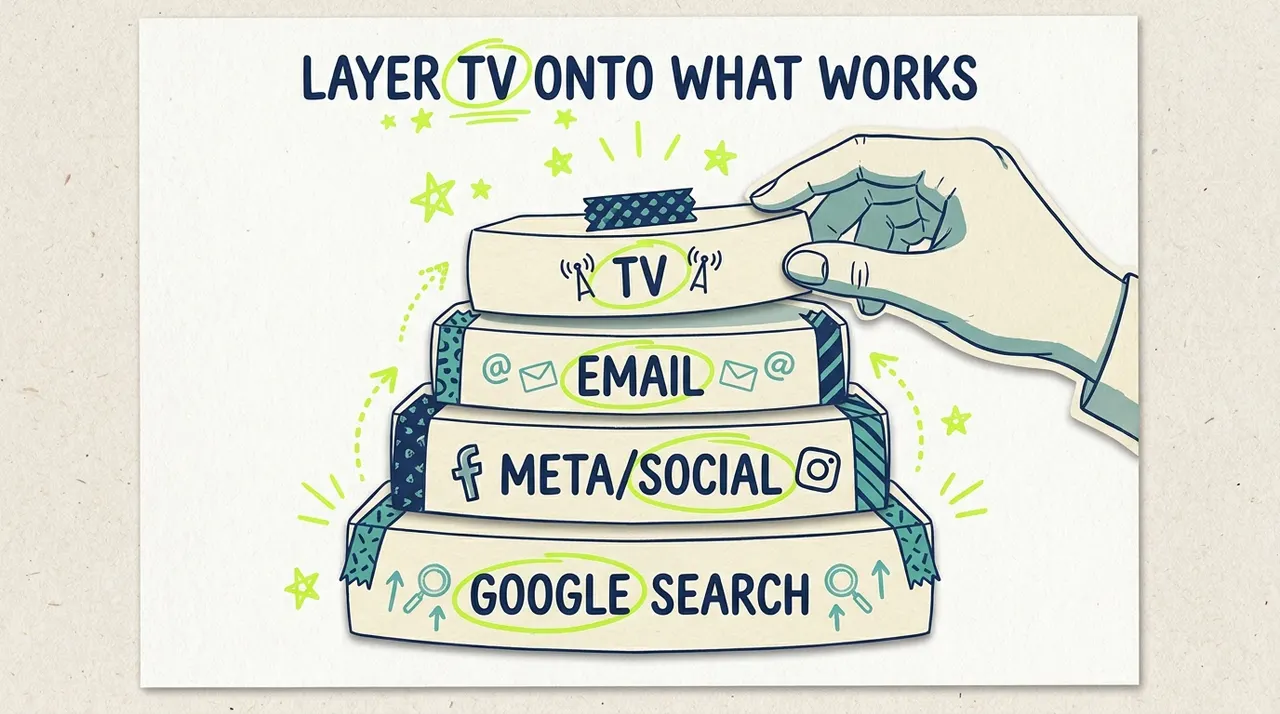
Most small businesses don't need a media plan from scratch. They have something working: Meta is producing leads, Google is catching active search demand, maybe local SEO and email are doing real work. What they want to know is how to add TV without breaking what's already running.
That's the right question. TV layered correctly into an existing digital plan lifts the channels around it; layered badly, it cannibalizes attention and confuses attribution. This guide walks through the practical decisions: when TV is ready to add, what to keep steady while testing it, how to budget the addition, how to measure cross-channel lift, and the common mistakes that turn a promising TV test into a wasted quarter.
When your digital mix is ready for TV
TV layering works best on top of a digital plan that's already producing measurable results. A few readiness signals worth checking before you add the channel:
You have a website that converts. If your Meta and Google traffic doesn't convert on your existing site, TV won't fix the underlying funnel. The lift TV produces hits whatever conversion mechanism is already in place. A 10% conversion rate on your form lifts to 13%; a 1% conversion rate lifts to 1.3%. Fix the foundation first.
You're measuring something real. Pre/post baselines, UTM tagging, weekly conversion reports, or at minimum a clean "how did you hear about us?" field on your inquiry form. Without measurement infrastructure, you'll add TV and won't know whether it worked.
Your monthly digital spend is at least $1,500-$2,000. TV adds best to a base of working digital. Below that threshold, your digital channels are still in optimization mode and adding a third channel adds noise. The exception is local service businesses with strong word-of-mouth, where even $800/month in digital plus TV can layer well because the trust building has another reinforcement loop.
Your geographic targeting matches across channels. If your Meta is targeting "United States" but you only serve a 15-mile radius, the digital plan needs cleanup before TV gets layered on top. TV's geographic precision will make the mismatch obvious.
If you can check those four boxes, you're ready to add TV. If you can't, fix the digital foundation first, then come back.
The mental model: TV builds the demand digital captures
The single biggest misconception about adding TV to a digital plan is treating TV like another performance channel. It isn't, and the businesses that succeed with the layer understand the distinction early.
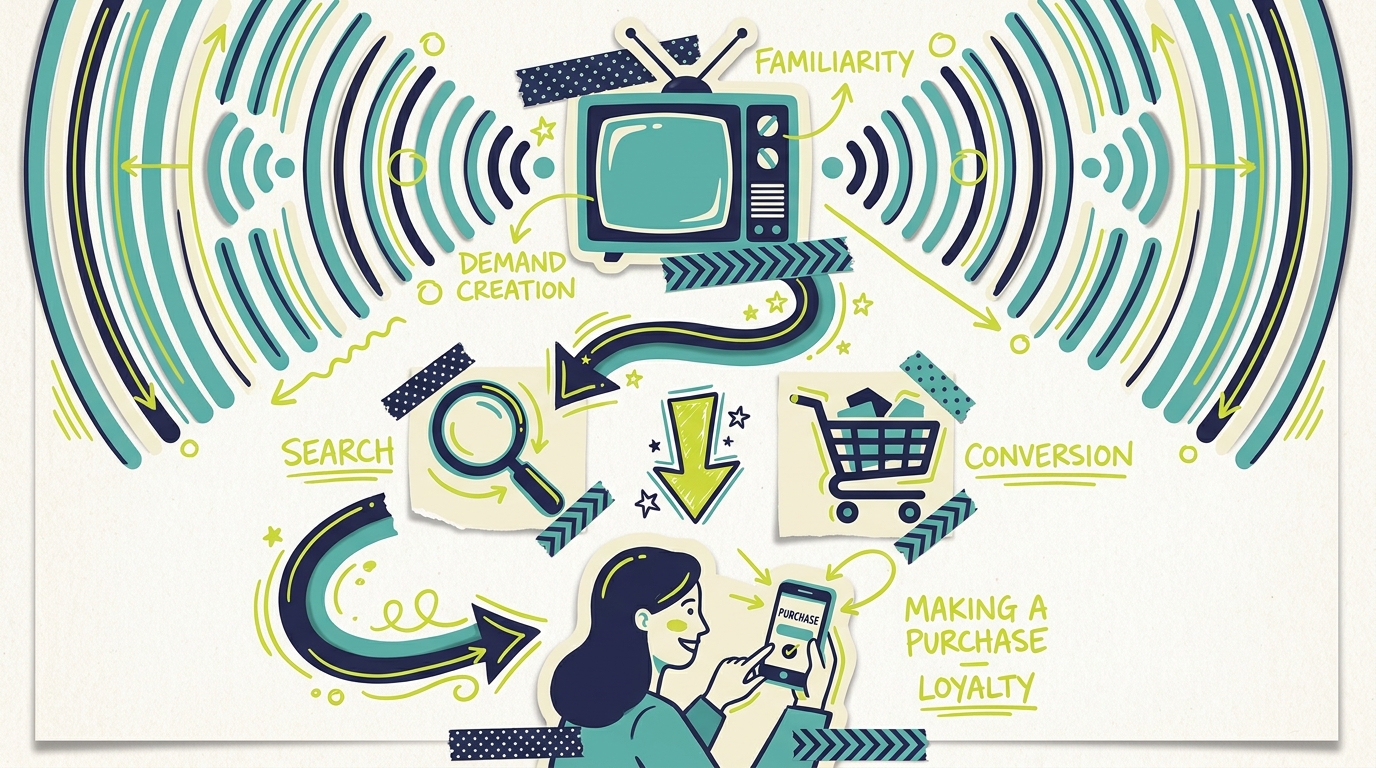
Performance channels (search, Meta retargeting) capture demand that already exists. Someone is looking for "auto repair near me" or scrolling Instagram with an open intent for a new gym. Performance channels intercept that moment and convert it.
TV (and CTV in particular) builds the demand that performance channels later capture. A viewer sees your CTV spot on a Tuesday night. They don't act. Three days later they need an oil change, search "auto repair near me," see your Google ad alongside three competitors, and click yours because your name feels familiar. That click looks like a Google conversion in your dashboard. The reason it converted was the Tuesday-night CTV impression.
When you treat TV as a performance channel and measure it that way, you'll under-invest because direct attribution captures only 30-50% of TV's real lift. When you treat TV as a demand-building channel and measure it through cross-channel lift, the math works.
What to keep steady while you test TV
The cleanest TV test holds your existing digital plan constant for the test window. Three reasons:
1. You need a stable baseline. If you cut Meta when you add CTV, you can't tell whether changes in your funnel are from gaining CTV or from losing Meta. Hold what's working, add what's new, then read the result.
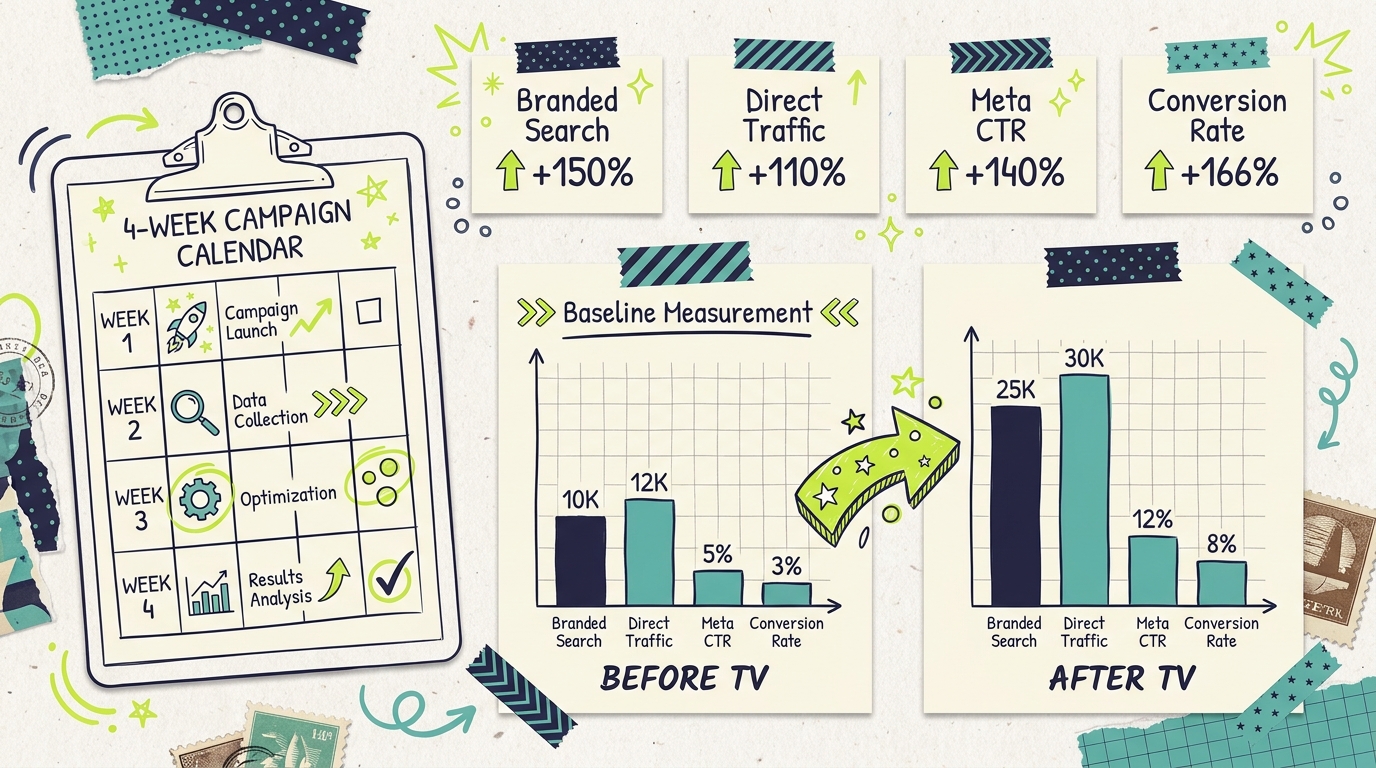
2. TV's lift often shows up in digital metrics. Branded search volume, direct traffic, Meta conversion rate, and Google CTR all tend to rise during active TV flights. If you've cut digital spend, you can't see those lift signals because there's less digital activity to measure.
3. The combined effect is the point. TV alone won't replace your performance channels; performance channels alone won't build category-level brand familiarity. Run them together, measure both, and you'll understand the multiplier rather than the substitution.
Plan for a 60-90 day window with TV layered in and the rest of your plan steady. After that window, you'll have a defensible read on TV's contribution and can rebalance.
Budgeting the TV addition
For most small businesses, the right initial TV budget falls in one of three tiers based on existing digital spend:
Tier 1: $500-$1,500 total monthly digital, adding TV. Start TV at $800-$1,200/month. Hold all existing digital steady. This is enough to produce meaningful local frequency and run a credible 60-day test, but small enough that you can sustain it if results take 90+ days to fully prove out.
Tier 2: $2,000-$5,000 total monthly digital, adding TV. Start TV at $1,500-$2,500/month. Hold all existing digital steady for the test window. At this tier, you have enough cross-channel signal to see TV's lift clearly, and the test produces a defensible read within 60-75 days.
Tier 3: $5,000+ total monthly digital, adding TV. Start TV at $2,500-$5,000/month. You may want to test in two geographic areas (one with TV, one without) to see the channel's lift in a near-controlled experiment. The data is cleaner and informs scaling decisions for the rest of the year.
A few rules across all three tiers:
Don't fund TV by cutting your highest-performing digital channel. If your Meta is producing strong leads, cutting it to make room for TV often produces a net negative.
Do redirect spend from underperforming channels. If you've been spending $400/month on a directory listing that produces almost no traffic, redirect that money. Underperforming spend is the easiest funding source.
Plan for a creative production cost. If you're using Adwave or similar AI tools, creative production is built into the platform cost and effectively free. If you're producing through an agency, budget $2,000-$8,000 for initial production.
Coordinating creative across channels
The TV layer works best when the creative across all your channels reinforces a single brand message during the test window. The mistake we see most often is running totally different creative on TV than on Meta, on Meta than on Google, on Google than on email. Each channel ends up doing its own thing, and the channels don't compound.
The synchronized approach:
Pick one core message for the campaign window. Maybe it's a seasonal offer, a new service launch, a "we've been here 25 years" trust message. Whatever it is, all channels reflect it during the test.
Use consistent visual identity. Same colors, same wordmark, same voice. A viewer who saw your CTV ad on Wednesday and your Meta ad on Thursday should recognize the brand instantly. Visual consistency multiplies the familiarity effect.
Adjust format to channel. A 30-second CTV spot becomes a 15-second Instagram reel becomes a Google search ad headline. Same message, format-appropriate execution. The 30-second can do emotional storytelling; the search ad has to deliver in 90 characters.
Synchronize timing. When your TV flight starts, your Meta creative refresh launches the same day. When the campaign ends, the wind-down is coordinated too. This synchronization is what produces the cross-channel lift signals.
Measuring cross-channel lift
The single most important measurement habit when adding TV is the pre/post baseline. Without it, you're stuck arguing whether TV "worked" based on partial attribution.
The baseline framework:
Capture 4 weeks of pre-TV performance. For every metric you care about (total inquiries, calls, foot traffic, online conversions, Meta CTR, Google CTR, branded search volume), get a clean 4-week reading before TV launches. This is your benchmark.
Run TV alongside steady digital for 60-90 days. Don't make other changes during this window. The cleaner the test, the cleaner the read.
Compare campaign-window performance against baseline. Total inquiries during weeks 5-12 vs. The baseline. Meta CTR during the TV window vs. before. Branded search volume during the window vs. before.
Attribute the lift across the funnel. If Meta CTR rose 18% during the TV window, some of those Meta conversions were lifted by TV. If branded search rose 35%, the search ads catching that branded search are partly TV-driven. The full picture of TV's contribution sits across all channels, not just in the TV-attributed conversions column.
For most small businesses, this baseline approach captures 70-90% of TV's true contribution, compared to 30-50% with direct attribution alone. The difference is often the difference between concluding "TV didn't work" and "TV is now our most efficient channel."
The first 90 days, week by week
A practical week-by-week framework for adding TV to a working digital plan.
Week -4 to -1 (pre-launch). Capture your baseline metrics. Tighten your Meta and Google geographic targeting so they match your TV targeting plans. Produce or generate your initial TV creative (one or two variations).
Week 1 (launch). TV launches. Watch the dashboard for delivery and pacing, but don't optimize. Don't make changes to Meta or Google.
Week 2. Check geographic distribution on TV. If a meaningful share of impressions is landing outside your real service area, tighten targeting now. Otherwise hold.
Week 3-4. First read on cross-channel signals. Is branded search up? Is direct traffic up? Are Meta CTR and conversion rate trending up? You're not making decisions yet; you're observing whether the lift signals are emerging.
Week 5-6. First serious cross-channel comparison. Pull total inquiries (or whatever your primary metric is) for weeks 1-6 vs. The same metric for weeks -4 to -1. The lift you see here is the early read on TV's contribution.
Week 7-8. Creative refresh consideration. If you launched with one TV creative, generate a second variation and run them side-by-side. If you launched with two, look at which one is producing stronger conversion signals.
Week 9-12. The clean read. Compare full 12-week campaign performance against the pre-baseline. This is where you make the call: keep TV at current spend, scale TV up, or wind it down and try a different approach.
Common mistakes and how to avoid them
A few patterns trip up small businesses adding TV to a digital plan.
Mistake 1: Cutting digital to make room for TV. Discussed above. The clean test holds digital steady. Funding TV from a budget cut to your best-performing digital channel often produces a worse net result.
Mistake 2: Judging TV in the first two weeks. TV needs 2-3 weeks to settle and another 4-6 weeks to demonstrate its lift on the rest of your funnel. Two-week judgments produce false negatives. Plan for 60-90 days.
Mistake 3: Different creative on every channel. The lift comes from synchronization. Different messages on every channel produce some good results on each channel but no compounding effect.
Mistake 4: Direct-attribution measurement only. If you only count "TV-attributed" conversions, you'll miss most of TV's real contribution. Pre/post baseline measurement is essential.
Mistake 5: Over-broad geographic targeting. TV that runs outside your real service area produces impressions that won't convert. Match your CTV targeting precisely to where your business serves customers.
Mistake 6: One creative for the entire campaign. Even great creative degrades after 8-10 weeks. Plan to refresh creative at the 8-week mark, or sooner if your conversion data is declining.
Mistake 7: Treating TV as the "experiment" forever. After 90 days, the data is in. If the lift is real, integrate TV into the permanent media mix and treat it as a core channel, not a perpetual experiment. The compounding benefits of sustained presence are real.
When to scale, when to pull back
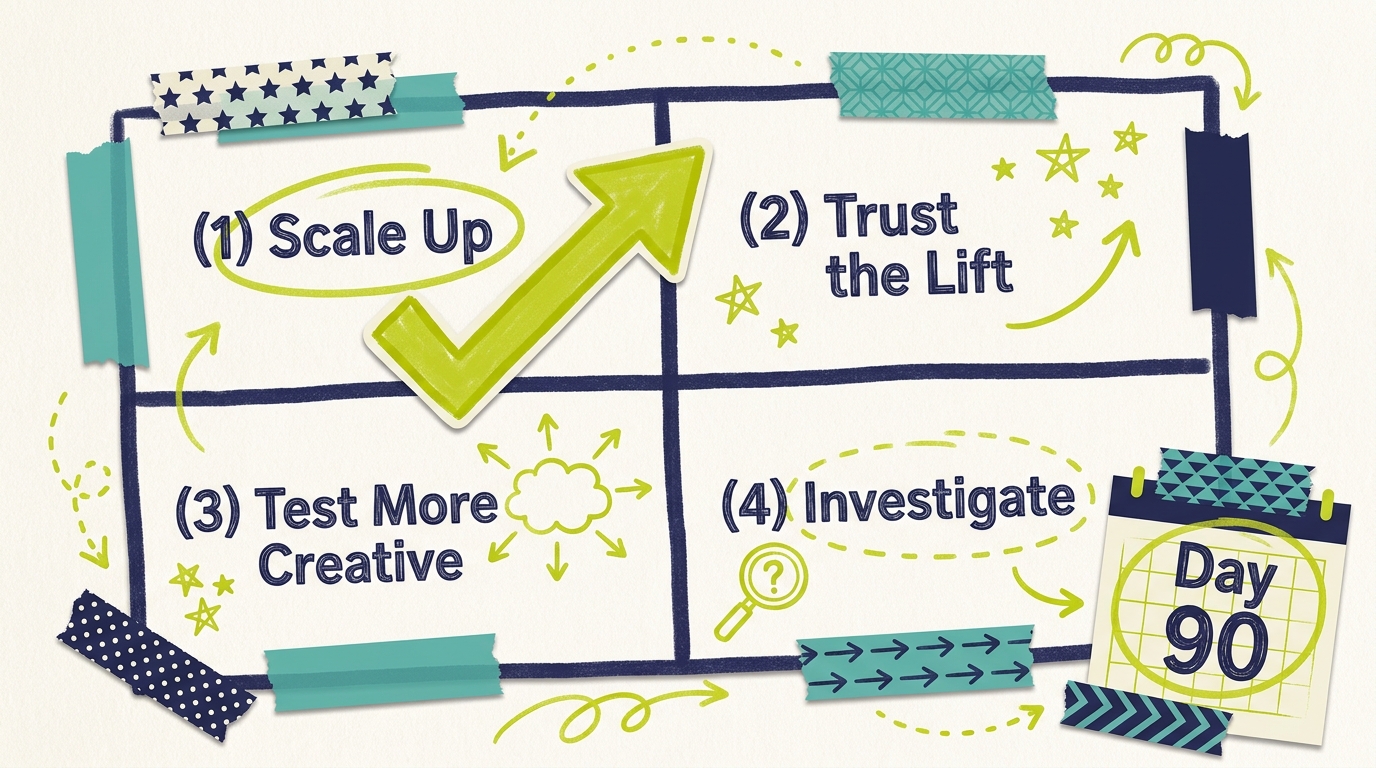
After 90 days, three patterns typically emerge:
Pattern 1: Strong cross-channel lift, healthy direct attribution. Total inquiries up 20%+ over baseline, Meta and Google metrics improving, branded search and direct traffic up. The right move is usually to scale TV by 25-50% and continue holding digital steady. Don't double overnight; gradual scale produces better unit economics than aggressive scale.
Pattern 2: Strong cross-channel lift, weak direct attribution. Total inquiries up, but the inquiries say "Google" or "word of mouth," not TV. This is a measurement situation more than a performance situation. Trust the baseline lift over the surveyed attribution; viewers don't remember TV exposure as cleanly as they remember Google. Scale modestly and continue.
Pattern 3: Modest lift, mixed signals. Total inquiries up 5-10%, Meta and Google metrics roughly steady. The right move depends on your business and budget tolerance. For local home services, 5-10% lift on a $1,500 TV spend is often profitable on the booked-revenue math. For retail with thin margins, the case is harder. Consider testing different creative for another 60 days before deciding.
Pattern 4: No meaningful lift. Total inquiries unchanged, no cross-channel signals, baseline holding steady. This is rare when TV is run cleanly, but it does happen. Common causes: too-broad geographic targeting, weak creative, frequency under 2 (audience never saw the ad enough times), or a category/audience that doesn't respond to TV. Most often the issue is one of the first three, all of which are fixable.
Common questions answered
How quickly will I see results after adding TV to my digital mix?
Expect 60-90 days before you have a clean read on TV's contribution. Cross-channel lift signals (branded search, direct traffic, Meta and Google metric improvements) often start emerging in weeks 3-4, but the most defensible measurement comes from a full 60-90 day pre/post baseline comparison.
Should I cut my Meta or Google spend when I add TV?
No, not during the test window. Hold all existing channels steady while you test TV. After the 90-day window, you'll have data to inform rebalancing. Cutting digital prematurely removes the conversion layer that TV's familiarity work is feeding into.
How do I know if my digital plan is "ready" for TV?
Four readiness signals: your website converts traffic at a reasonable rate, you have measurement infrastructure (UTMs, baselines, intake questions), your monthly digital spend is at least $1,500-$2,000, and your geographic targeting matches where you serve customers. If any of those are missing, fix them before adding TV.
Will adding TV cannibalize my other channels?
No, in our experience. Adding TV typically lifts the performance of other channels rather than cannibalizing them. Viewers exposed to TV recognize the brand when they encounter Meta and Google ads, which raises CTR and conversion rate. Direct cannibalization is rare.
How much should my first TV test budget be?
Start at $800-$2,500/month depending on your total existing digital spend. The right test budget is large enough to produce meaningful local frequency (3-5 impressions per household over the campaign window) but small enough that you can sustain it for a 90-day test without overextending.
Should I work with an agency to add TV, or can I self-serve through a platform like Adwave?
For most small businesses with monthly digital spend under $10,000, self-serving through a platform like Adwave produces strong results without the agency fee layer. The AI creative tools, simple campaign setup, and dashboard reporting are designed for owner-operators rather than media planning teams. Agencies make more sense when total media spend crosses into the $20,000+/month range and the coordination complexity justifies the fee.
What's the most common reason a TV test underperforms?
Geographic targeting that's too broad. The second most common is judging the campaign too early (in the first 2-3 weeks before signal stabilizes). The third is direct-attribution-only measurement that misses most of TV's true contribution. All three are fixable.
Make the layer work
Adding TV to a working digital plan is one of the highest-use moves a small business can make in 2026. The lift compounds across channels, the cost of testing has dropped dramatically with AI creative and subscription platforms, and the measurement gap between TV and digital is closing fast.
If your digital plan is producing real results and you've been wondering whether TV is the next step, the 90-day test framework in this guide is the practical path. Hold what's working steady, layer TV in, measure across the full funnel, and you'll have a defensible read on the channel by quarter's end.


