
You know you need to advertise your business. You also know you don't have thousands of dollars to throw at marketing experiments. The question isn't whether to advertise. It's how to advertise your business locally without wasting money on channels that don't work.
Here's the good news: the advertising landscape has changed dramatically in the past few years, and most of those changes favor small businesses. Channels that used to require enterprise budgets are now accessible to anyone. The playing field hasn't been this level in decades.
This guide covers practical advertising options for local businesses, organized by budget. We'll start with free options, move through low-cost paid channels, and end with an option that might surprise you.
The Advertising Landscape Has Changed
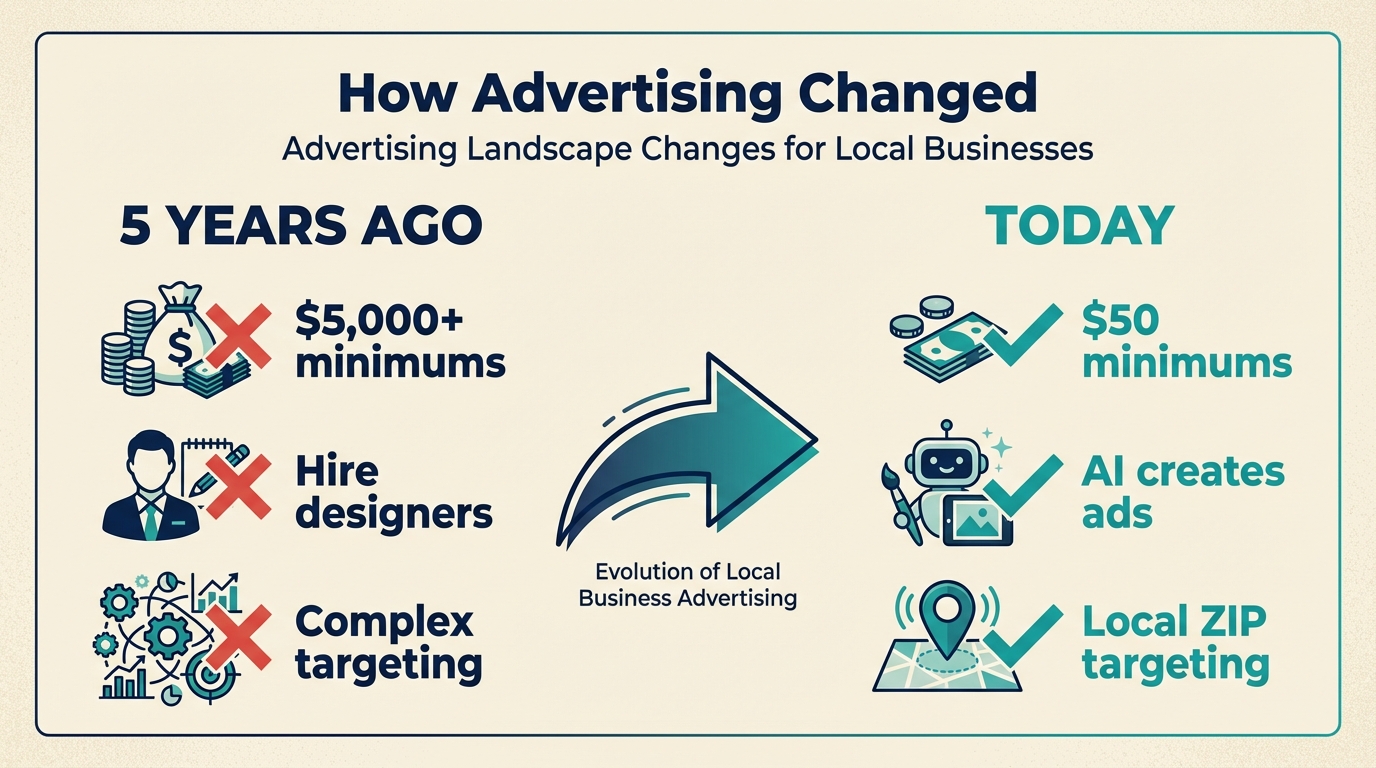
If you last looked at advertising options five years ago, it's time to look again. Several shifts have made advertising more accessible:
What's different now:
Lower minimums everywhere: Platforms that once required $5,000+ now accept $50-100 budgets
AI-powered creative: You don't need to hire a designer or video producer
Better targeting: Reach people in your actual service area, not the whole internet
New channels: Options exist today that literally didn't exist a few years ago
The myth of needing thousands to start:
Most local businesses assume "real" advertising requires a significant budget. That assumption is based on how advertising worked ten years ago. Today, you can run meaningful tests on most channels for under $100.
The goal isn't to pick one channel and commit your entire budget. It's to test multiple options, see what works for your specific business, and then scale what performs.
Free and Low-Cost Options: The Basics
Before spending money on advertising, make sure you've optimized the free channels available to every local business.
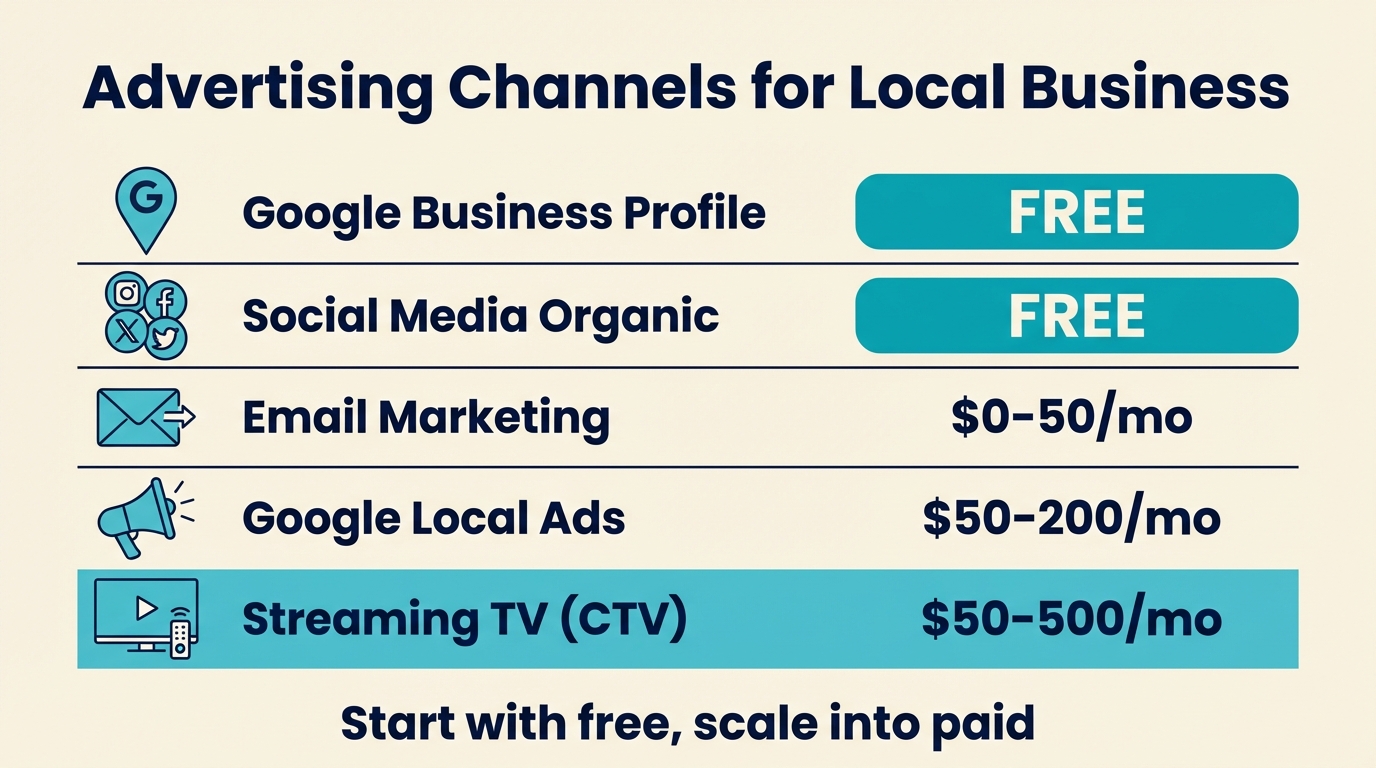
Google Business Profile
Your Google Business Profile (formerly Google My Business) is the single most important free marketing asset for a local business. When someone searches "[your service] near me," this is often what they see first.
Optimization priorities:
Complete every field in your profile
Add high-quality photos (businesses with photos get 42% more direction requests)
Respond to every review (yes, even the negative ones)
Post updates weekly to show you're active
Add your services and products with accurate descriptions
Time investment: 1-2 hours initially, then 30 minutes weekly for updates
Social Media (Organic)
Organic social media reach has declined, but it's not zero. For local businesses, social media serves two purposes: credibility (people check your profiles) and community engagement.
What works for local businesses:
Facebook: Still the largest local audience, especially for 35+
Instagram: Visual businesses (restaurants, retail, home services)
Nextdoor: Neighborhood-focused, high trust
Realistic expectations: Organic social won't drive significant new customer acquisition. It supports your other marketing by providing social proof and keeping existing customers engaged.
Email Marketing to Existing Customers
Your existing customers are your most valuable marketing asset. They already trust you, and reaching them costs almost nothing.
Simple email strategy:
Collect emails at every customer touchpoint
Send a monthly newsletter with updates and offers
Use a free tier of Mailchimp, Constant Contact, or similar
Focus on value, not constant selling
Review Management
Reviews influence purchasing decisions more than almost any marketing you can do. Actively managing reviews should be part of your marketing routine.
Review strategy:
Ask happy customers to leave reviews (timing matters: ask right after a positive experience)
Respond to every review, positive and negative
Monitor Google, Yelp, Facebook, and industry-specific sites
Address negative reviews professionally and promptly
Paid Options Under $100/Month
Once you've covered the basics, here are paid advertising options that work within a tight budget.
Google Local Ads
Google Local Services Ads appear at the very top of search results for service businesses. You pay per lead, not per click, which reduces waste.
Best for: Service businesses (plumbers, electricians, lawyers, etc.)
Budget: Pay only for actual leads, typically $15-50 per lead depending on industry
Minimum: No set minimum, you control your weekly budget
Facebook and Instagram Ads
Meta's advertising platform remains effective for local businesses, despite recent changes.
Best for: Visual businesses, events, special promotions
Budget: $5-10/day gets meaningful reach in a local area
Approach: Start with boosted posts to your existing followers, then expand to lookalike audiences
Nextdoor Ads
Nextdoor's hyper-local focus makes it valuable for businesses serving specific neighborhoods.
Best for: Home services, local retail, real estate
Budget: Starts around $2/day
Advantage: High trust environment, neighborhood-specific targeting
The Surprise Option: Streaming TV Advertising
Here's where things get interesting. Most local businesses assume TV advertising is completely out of reach. That assumption is about five years out of date.
Streaming TV (also called CTV or Connected TV) has made television advertising accessible to businesses of any size. We're talking about real TV ads that appear on the same screens and streaming services your customers watch every night.
What's changed:
No production budget required: AI creates professional ads from your website
Budgets start at $50: Not $50,000, fifty dollars
Local targeting: Reach only your service area, not a whole metro
Premium placement: Your ad runs on NBC, Hulu, ESPN, and 100+ channels
This isn't some off-brand streaming service. When you run a streaming TV campaign, your ad appears during the shows your customers are already watching, on the biggest screen in their house.
The "Big Brand" Channel You Can Afford
Let's dig deeper into streaming TV, because this is the advertising option most local businesses are completely missing.
Why TV Advertising Isn't What You Think
Traditional TV advertising (network, cable, broadcast) required big budgets because you paid for massive reach whether you needed it or not. A local plumber buying a TV spot was paying to reach the entire metro area, including the 95% of viewers who would never need a plumber.
Streaming TV works differently. You buy impressions targeted to specific geographic areas, demographics, and even interests. A local business can target just the ZIP codes they serve, reaching potential customers without paying for wasted impressions.
How It Works Today
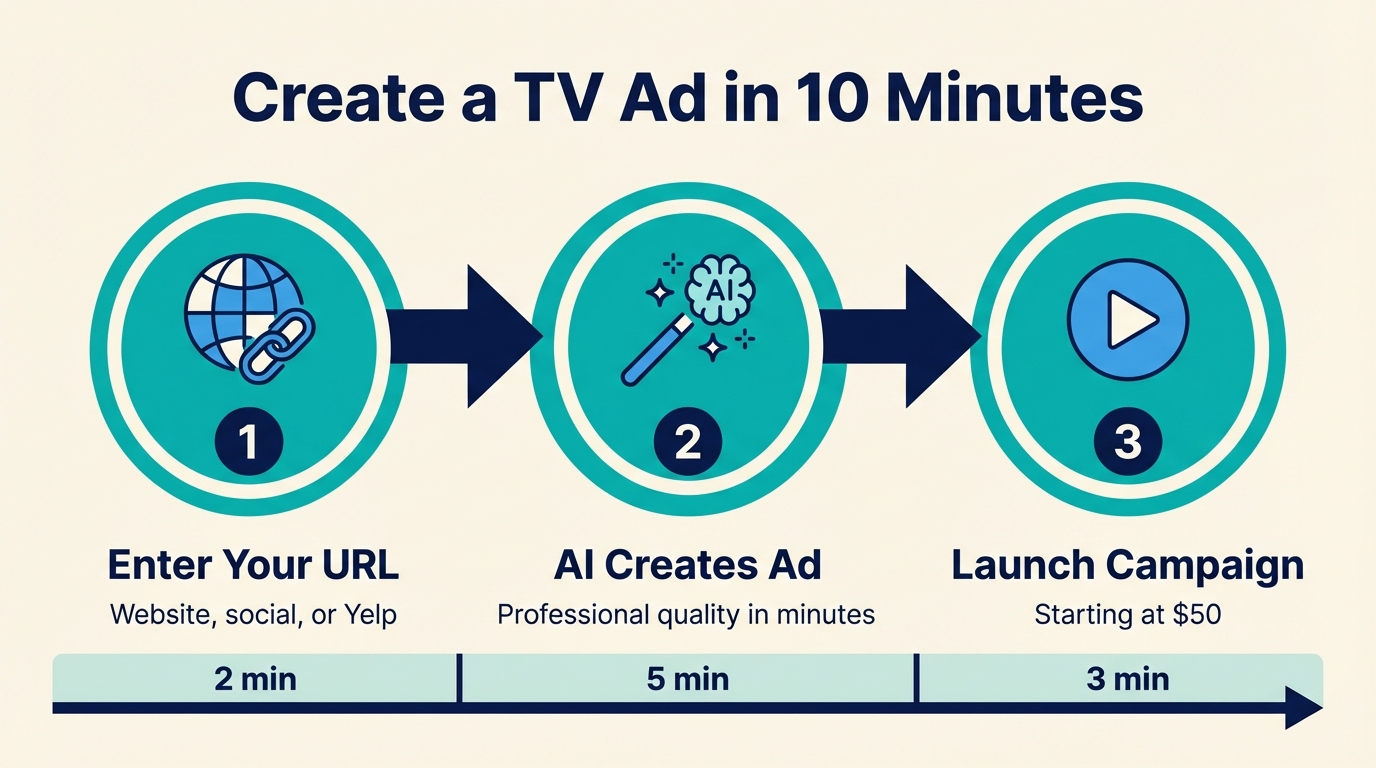
Modern streaming TV advertising for small businesses typically works like this:
Provide your website URL (or social media, Yelp, any online presence)
AI analyzes your business and gathers images, messaging, and brand elements
A professional TV ad is generated in minutes, not weeks
Set your targeting (local, regional, or national)
Set your budget (starting as low as $50)
Your ad runs on major streaming platforms
The entire process can take under 10 minutes. You can have a TV commercial running on Hulu by dinner time.
Why Local TV Works for Any Business
Television builds brand awareness in a way digital advertising struggles to match. When people see your business on the same screen where they watch the Super Bowl and their favorite shows, it creates a legitimacy that Google ads and Facebook posts don't provide.
For local businesses, streaming TV advertising offers:
Credibility: "I've seen them on TV" carries weight
Attention: Full-screen, sound-on, in the living room
Local targeting: Reach your actual service area
Affordable testing: Start small, scale what works
Platforms like Adwave have made this accessible to businesses that would never have considered TV advertising. If you haven't looked at this option, it's worth exploring.
How to Choose the Right Mix for Your Business
Different business types benefit from different advertising approaches. Here's how to think about your mix:
Restaurants and Retail (Foot Traffic Focus)
Primary channels:
Google Business Profile (critical for "near me" searches)
Instagram (visual, shows what you offer)
Streaming TV (builds local awareness)
Budget allocation suggestion: 40% digital, 40% TV, 20% local community
Service Businesses (Lead Generation Focus)
Primary channels:
Google Local Services Ads (pay per lead)
Google Business Profile with reviews
Streaming TV (brand building in service area)
Budget allocation suggestion: 50% Google, 30% TV, 20% social proof building
E-commerce with Local Presence
Primary channels:
Facebook/Instagram (proven for e-commerce)
Google Shopping
Streaming TV (brand awareness)
Budget allocation suggestion: 40% Meta, 30% Google, 30% TV
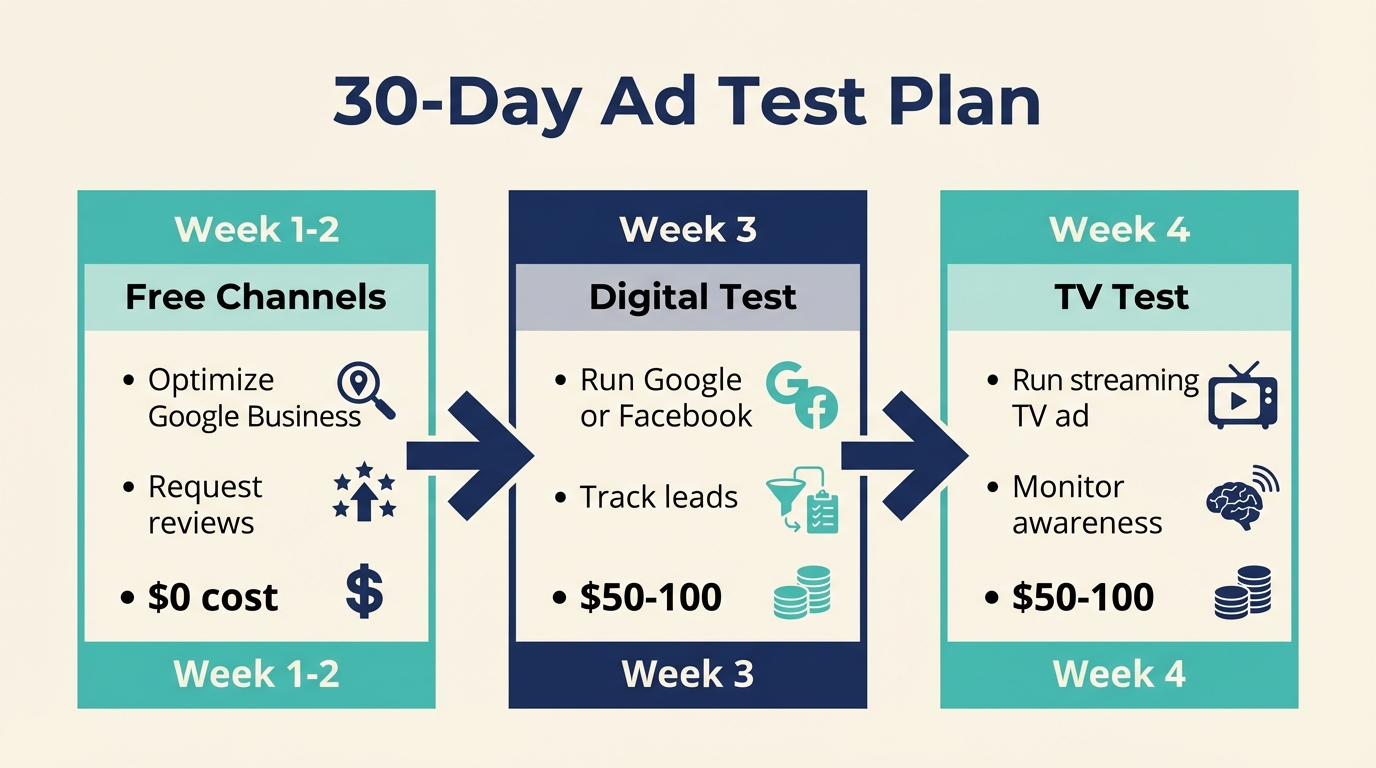
Creating a 30-Day Advertising Test Plan
Instead of picking one channel and hoping it works, run a structured 30-day test.
Week 1-2: Free Channel Optimization
Complete Google Business Profile optimization
Request reviews from recent customers
Post consistently on one social platform
Set up basic email collection
Cost: $0 (just your time)
Week 3: Paid Digital Test
Run a $50-100 Google Local Services or Facebook campaign
Target your immediate service area
Test one clear offer or message
Track leads or traffic closely
Cost: $50-100
Week 4: TV Advertising Test
Run a $50-100 streaming TV campaign
Target your local area
Monitor for brand awareness indicators
Cost: $50-100
Measuring What's Working
After 30 days, evaluate:
Which channel generated the most leads or customers?
Which felt most sustainable for ongoing effort?
What did customers say when you asked how they found you?
Which channel showed the best return on time and money?
Scale what works. Cut what doesn't. Repeat the test with new channels.
Common Local Advertising Mistakes to Avoid
Mistake 1: Spreading too thin Pick 2-3 channels and do them well. Don't try to be everywhere at once.
Mistake 2: Expecting instant results Advertising builds awareness over time. Give campaigns 2-4 weeks before judging.
Mistake 3: Never testing TV Most small businesses dismiss TV without realizing how accessible it's become. At least test it.
Mistake 4: Ignoring free channels Paid advertising should amplify a strong foundation, not replace it.
Mistake 5: Not tracking results "How did you hear about us?" is the most valuable question you can ask.
Common questions answered
What's the most effective advertising for a small budget?
For very limited budgets, focus on channels where you can target precisely and pay only for results. Google Ads with tight geographic and keyword targeting lets you reach people actively searching for your services. Facebook and Instagram ads allow micro-targeting your local area. Newer options like CTV advertising now start at just $50, making TV accessible for testing. The key is focus rather than spreading a small budget thin.
How do I advertise locally without wasting money?
Set tight geographic boundaries that match your actual service area. Target specifically rather than broadly: better to reach a smaller audience multiple times than a large audience once. Track everything so you know what's working. Start with one channel, optimize until you understand it, then expand. Most waste comes from poor targeting, inadequate tracking, or abandoning strategies before they've had time to work.
Is it better to do a little advertising consistently or save up for bigger campaigns?
Consistency usually wins. Marketing works through repeated exposure over time, and going dark between campaigns means starting over each time. A modest consistent presence builds cumulative awareness more effectively than periodic bursts followed by silence. That said, there's a minimum threshold below which you're not reaching enough people to matter, so don't spread your budget so thin that you're invisible.
What free or low-cost marketing should every local business do?
Optimize your Google Business Profile completely, including photos, services, and regular posts. Claim and complete profiles on Yelp and industry-specific directories. Build an email list and communicate regularly with past customers. Encourage reviews systematically. Engage on social media without trying to be everywhere. Ask happy customers for referrals. These free activities should be the foundation before adding paid advertising.
How do I know if my advertising budget is too small to be effective?
If you can't achieve meaningful frequency (reaching the same people multiple times) within your target audience, your budget may be too small for that channel. Different channels have different minimums for effectiveness. If you're getting impressions but no results, try concentrating your budget on a smaller geographic area or more specific audience. Sometimes a tight focus with a small budget outperforms a loose focus with a larger one.


