Amazon knows what people buy. Now imagine targeting your TV ads to households based on that data.
Amazon Fire TV advertising gives businesses access to something no other streaming platform can offer: targeting powered by the world's largest e-commerce dataset. When someone adds diapers to their cart, streams kids' shows on their Fire TV, and lives in your service area, you can reach them with your daycare commercial.
This guide breaks down how Amazon Fire TV advertising works, what it costs, and how small businesses can access this inventory without the massive minimums Amazon typically requires.
Understanding Amazon's TV Advertising Ecosystem
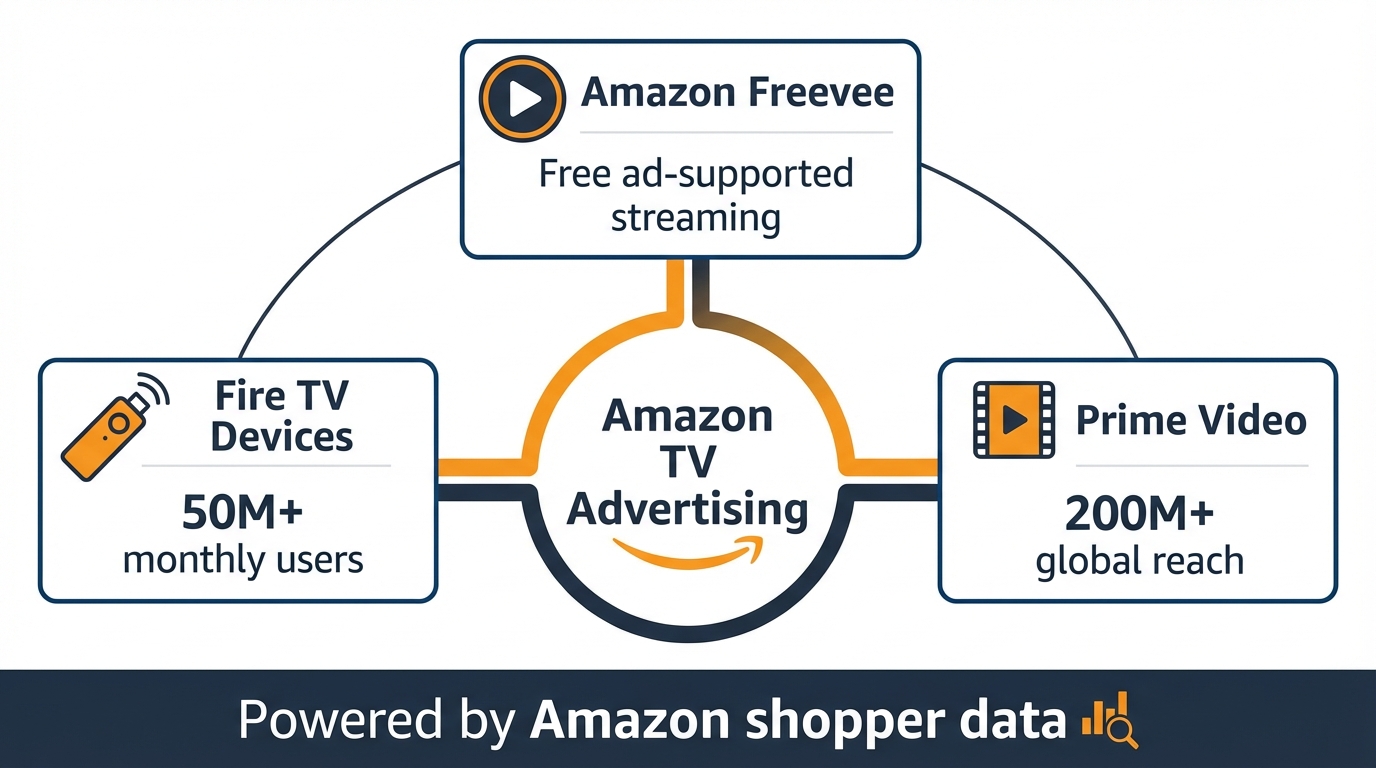
Amazon's streaming ad ecosystem is larger than most people realize. It's not just one platform.
Fire TV devices:
Fire TV includes streaming sticks, Fire TV Cube, and smart TVs with Fire TV built in. Over 50 million monthly active users in the US watch content through Fire TV devices. These viewers stream apps like Netflix, Hulu, and Disney+, plus Amazon's own content.
Amazon Freevee:
Formerly IMDb TV, Freevee is Amazon's free, ad-supported streaming service. It offers movies, TV shows, and original content at no cost to viewers, supported entirely by advertising. Freevee reaches viewers who want premium content without subscription fees.
Prime Video ads:
In 2024, Amazon introduced ads to Prime Video, creating one of the largest ad-supported streaming audiences overnight. Over 200 million global Prime members now see ads unless they pay an additional fee to remove them.
What this means for advertisers:
Amazon's ecosystem reaches viewers across all economic segments. Freevee attracts cost-conscious streamers, while Prime Video reaches households with disposable income (they're paying for Prime, after all). Fire TV devices serve as the gateway to all of it.
Amazon Fire TV Advertising Costs
Amazon advertising is known for being accessible to small sellers. Their streaming TV ads? Not quite as accessible, at least directly.
Amazon DSP minimums:
To run ads directly through Amazon's Demand Side Platform (Amazon DSP), you typically need:
Managed service: $50,000+ minimum spend
Self-service: Minimum varies, but often $35,000+
Agency access: Usually requires significant committed spend
For most small businesses, these minimums are prohibitive. You're not going to spend $35,000 to test whether Fire TV works for your local HVAC company.
CPM ranges on Fire TV:
When you can access the inventory, Fire TV CPMs typically range from:
Standard demographic targeting: $25-35 CPM
Amazon shopper targeting: $35-50 CPM (premium for the data)
Prime Video inventory: $30-45 CPM
The premium CPMs reflect the value of Amazon's targeting data. You're not just reaching "adults 25-54." You're reaching "adults who purchased home improvement products in the last 90 days."
Accessing Fire TV without Amazon's minimums:
Programmatic platforms can access Fire TV inventory through Amazon's Publisher Services, allowing smaller advertisers to run on Fire TV with budgets that make sense for small businesses.
With platforms like Adwave, you can access streaming inventory (including Fire TV) starting at just $50. You won't get Amazon's full shopper targeting at that level, but you can still reach Fire TV viewers with geographic and demographic targeting.
Targeting with Amazon's First-Party Data
Here's what makes Amazon Fire TV advertising different: Amazon knows what people buy.
The Amazon data advantage:
When you target ads on most streaming platforms, you're working with data like:
Age and gender
Geographic location
Content preferences (what they watch)
Device information
Amazon adds a layer no one else has:
Purchase behavior: What they've bought
Shopping intent: What they've browsed and added to cart
Category affinity: Whether they buy in specific categories
Lifestyle segments: Built from years of purchase patterns
Targeting examples:
A baby products retailer can use purchase data to reach households that bought diapers, formula, or baby gear in the last six months.
A fitness studio can target people who've purchased workout equipment, supplements, or athleisure wear on Amazon.
A luxury car dealership can target households with high-value purchase patterns and premium product preferences.
The caveat for small budgets:
Full Amazon shopper targeting is typically only available through Amazon DSP or partners with direct Amazon integrations. If you're accessing Fire TV through a programmatic platform with smaller budgets, you'll likely use geographic and demographic targeting rather than purchase-based targeting.
That's still valuable. Reaching Fire TV viewers in your local area is powerful even without the shopping data layer.
Ad Formats Available on Fire TV
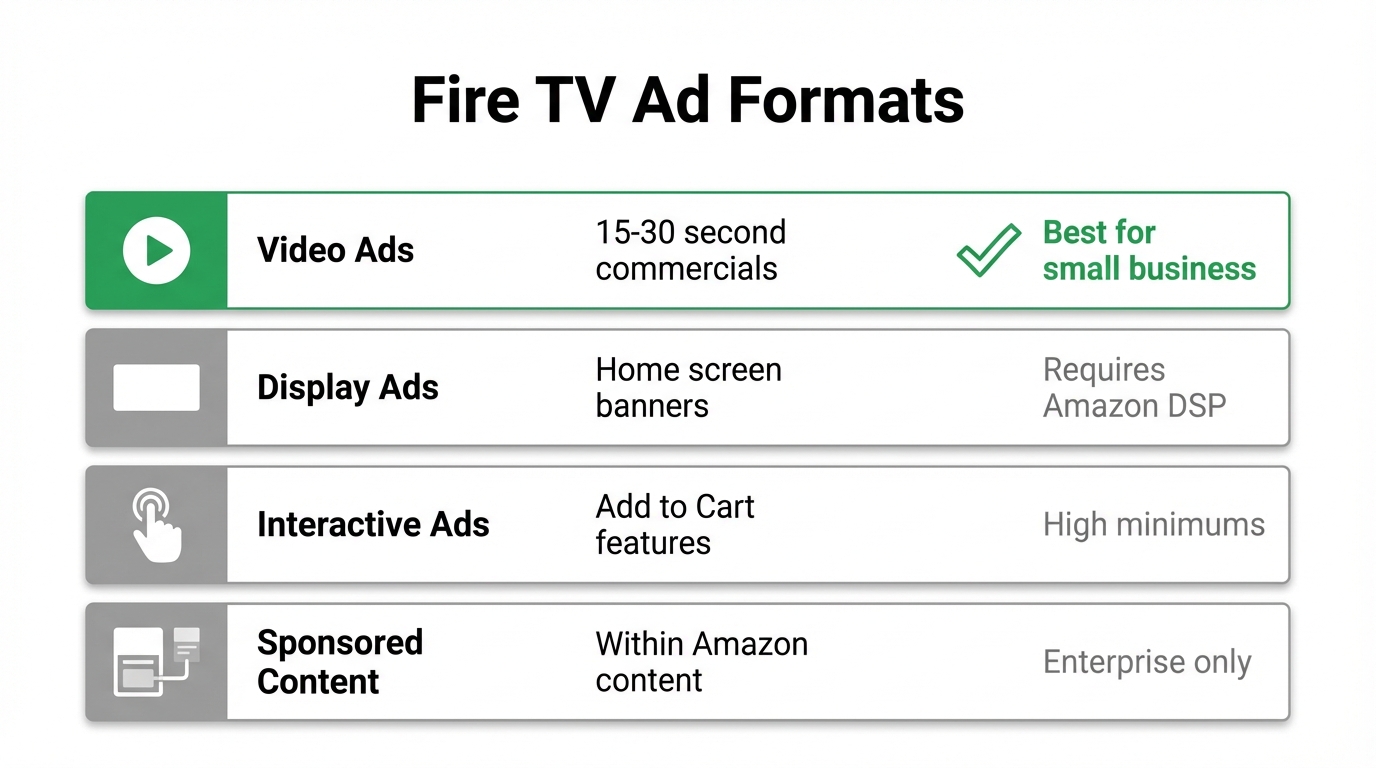
Fire TV offers several ad formats, each with different use cases.
Video ads (most common):
Standard 15 or 30-second video commercials that run before, during, or after streaming content. This is what most small businesses use. Your ad appears just like TV commercials always have, but on streaming instead of cable.
Display ads:
Banner ads on the Fire TV home screen and inside apps. These are visual placements that appear when users navigate their Fire TV interface. Less common for small businesses, but available through Amazon DSP.
Interactive ads:
Video ads that include clickable elements, like "Add to Cart" buttons or "Send to Phone" features. These are powerful for e-commerce but require Amazon DSP access and typically larger budgets.
Sponsored content:
Integrated placements inside Amazon's own content, like Freevee. These blur the line between content and advertising but are limited to larger advertisers.
For most small businesses:
Stick with video ads. They're the most accessible, most effective, and available at lower budget levels. A well-produced 30-second commercial reaching local Fire TV viewers is more valuable than complex interactive formats you can't afford to run at scale.
Creative Requirements and Best Practices
Fire TV has specific technical requirements, plus creative best practices that improve performance.
Technical specifications:
Video length: 15 or 30 seconds (30 preferred for storytelling)
Resolution: 1920x1080 (HD) minimum
Aspect ratio: 16:9
File format: MP4, MOV
Audio: Stereo, normalized levels
Creative best practices for Fire TV:
The viewing context matters. Fire TV viewers are typically watching on large screens in their living rooms, often with family. Your creative should work for that environment.
Bold visuals: Use high-contrast imagery that pops on large screens
Clear audio: Ensure dialogue is crisp since living room environments can be noisy
Early branding: Show your brand in the first 5 seconds
Strong CTA: Tell viewers exactly what to do (visit your website, call, scan QR code)
What works well:
Local businesses often succeed with straightforward commercials that emphasize:
Trustworthiness (real faces, real locations)
Local presence (mention your city or service area)
Clear value proposition (what you do, why you're different)
Simple call to action (one thing to remember)
Adwave's AI creative tools can generate Fire TV-ready commercials from your website in minutes, meeting all technical specs automatically.
How to Access Fire TV Inventory
You have several paths to advertising on Fire TV, depending on your budget and needs.
Amazon DSP (direct):
Best for large advertisers with $50,000+ budgets who want full access to Amazon's targeting capabilities. You get the complete Amazon data stack but need significant investment.
Programmatic platforms:
Third-party demand-side platforms can access Fire TV inventory through Amazon Publisher Services. This opens Fire TV to smaller budgets, though without Amazon's proprietary shopper targeting.
Adwave accesses streaming inventory including Fire TV through programmatic channels. You can start with budgets as low as $50 and reach Fire TV viewers in your local area. This is the practical path for most small businesses.
Agencies with Amazon partnerships:
Some advertising agencies have Amazon DSP access and will manage campaigns for smaller clients. Expect agency fees on top of media spend, typically 15-20% of budget.
Comparison:
For most small businesses, programmatic access through a platform like Adwave is the practical choice. You won't get Amazon's shopping data, but you'll reach Fire TV viewers in your area at budgets that make sense.
Measuring Results with Amazon Attribution
Measuring TV advertising has always been challenging. Amazon offers some advantages here.
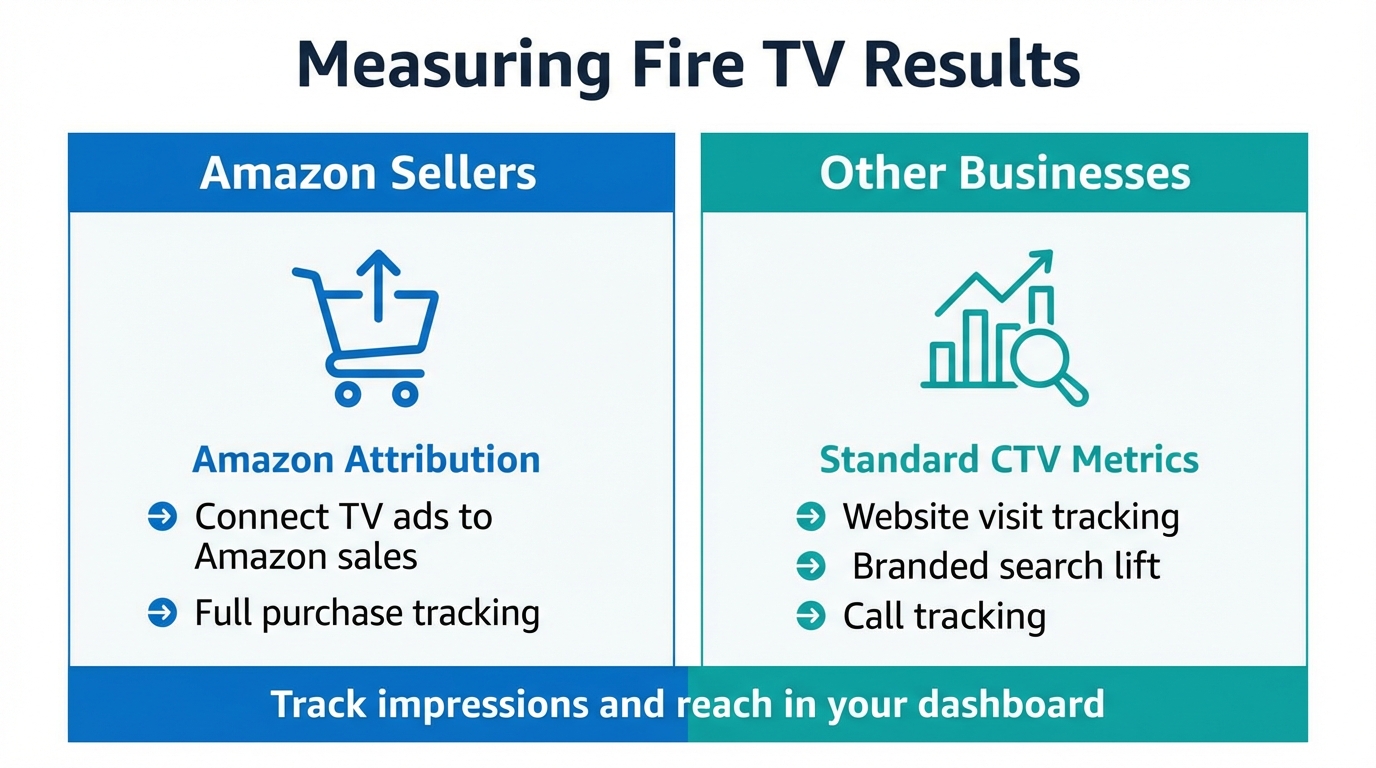
Amazon Attribution (for sellers):
If you sell products on Amazon, Amazon Attribution can connect your Fire TV ads to Amazon sales. This closed-loop measurement is valuable for e-commerce brands.
You can see whether someone who saw your Fire TV ad later searched for and purchased your product on Amazon. This level of attribution isn't possible on most TV platforms.
For non-Amazon sellers:
If you don't sell on Amazon, you'll use standard CTV measurement approaches:
Website visit attribution: Track visitors from exposed households
Branded search lift: Monitor increases in searches for your business name
Conversion attribution: Track leads or sales from exposed households
Call tracking: Use dedicated phone numbers to measure calls
With Adwave's dashboard, you can track impressions, see which channels your ads ran on (including Fire TV), and monitor geographic reach. For more advanced measurement, check out our CTV measurement guide.
Common questions answered
What's the minimum budget for Amazon Fire TV advertising?
Amazon DSP, which provides access to Fire TV inventory, is primarily a managed service with minimum commitments starting around $35,000 to $50,000. Some agencies offer Amazon DSP access at lower thresholds (around $10,000 to $15,000). For small budgets, aggregator platforms provide access to Fire TV inventory at much lower minimums through programmatic exchanges.
Can I use Amazon's shopping data to target my Fire TV ads?
Yes, this is one of Amazon's biggest advantages. You can target based on purchase behavior, product searches, and shopping intent. For example, a pet store could target households that have purchased pet food on Amazon. However, this granular targeting is typically only available through Amazon DSP with its higher minimums.
Do I need existing video to advertise on Fire TV?
Through Amazon DSP, yes. You'll need broadcast-quality video creative. If you don't have video, you'll either need to produce it separately or use an aggregator platform that includes creative generation tools. Amazon has some creative services for larger advertisers, but they're not designed for small business budgets.
How does Fire TV advertising compare to Roku?
Both reach streaming audiences on the big screen. Roku has a larger device footprint in the US, while Amazon offers unique shopping data for targeting. For most small businesses without specific Amazon shopping data needs, the choice comes down to budget and access. Aggregator platforms let you reach both Fire TV and Roku audiences through a single campaign.
What types of ads can I run on Fire TV?
Fire TV supports video ads that appear in streaming content, sponsored screensavers, and display ads on the Fire TV home screen. Most small business advertisers focus on video ads in streaming content, which is what you get through programmatic access. The more interactive ad formats typically require direct Amazon relationships and larger budgets.