-
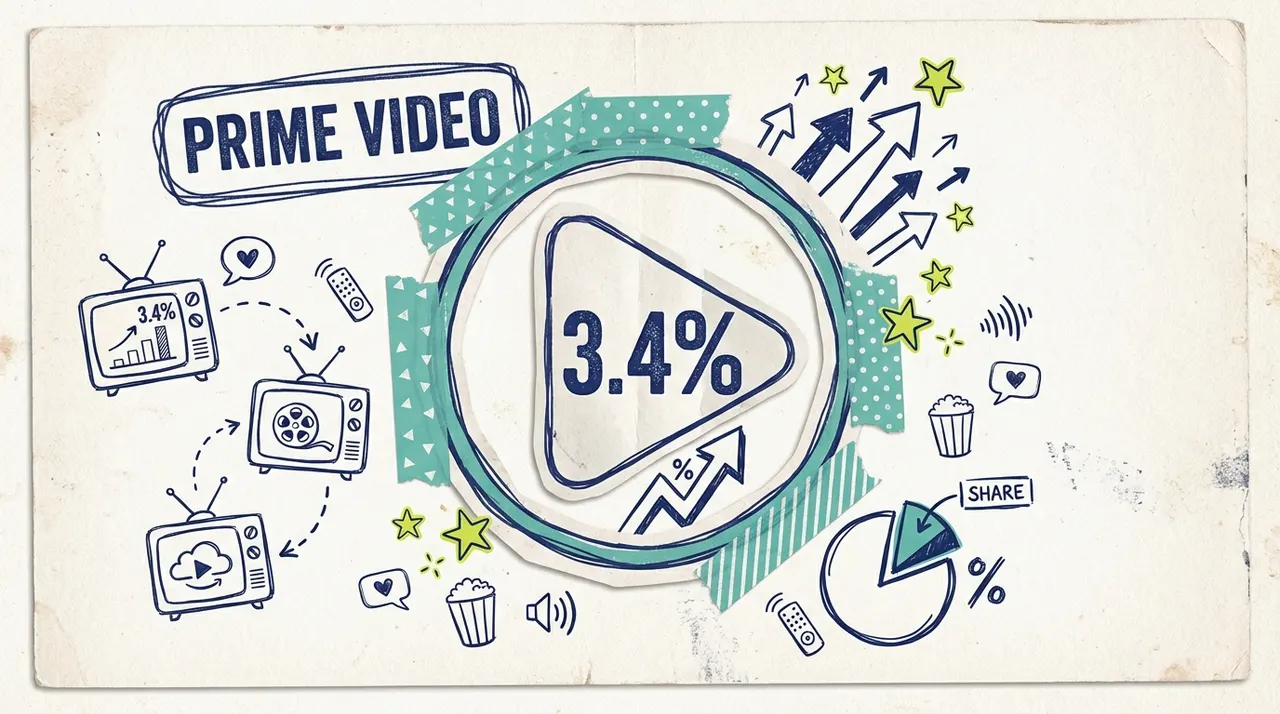
3.4%
Amazon Prime Video share of TV
-
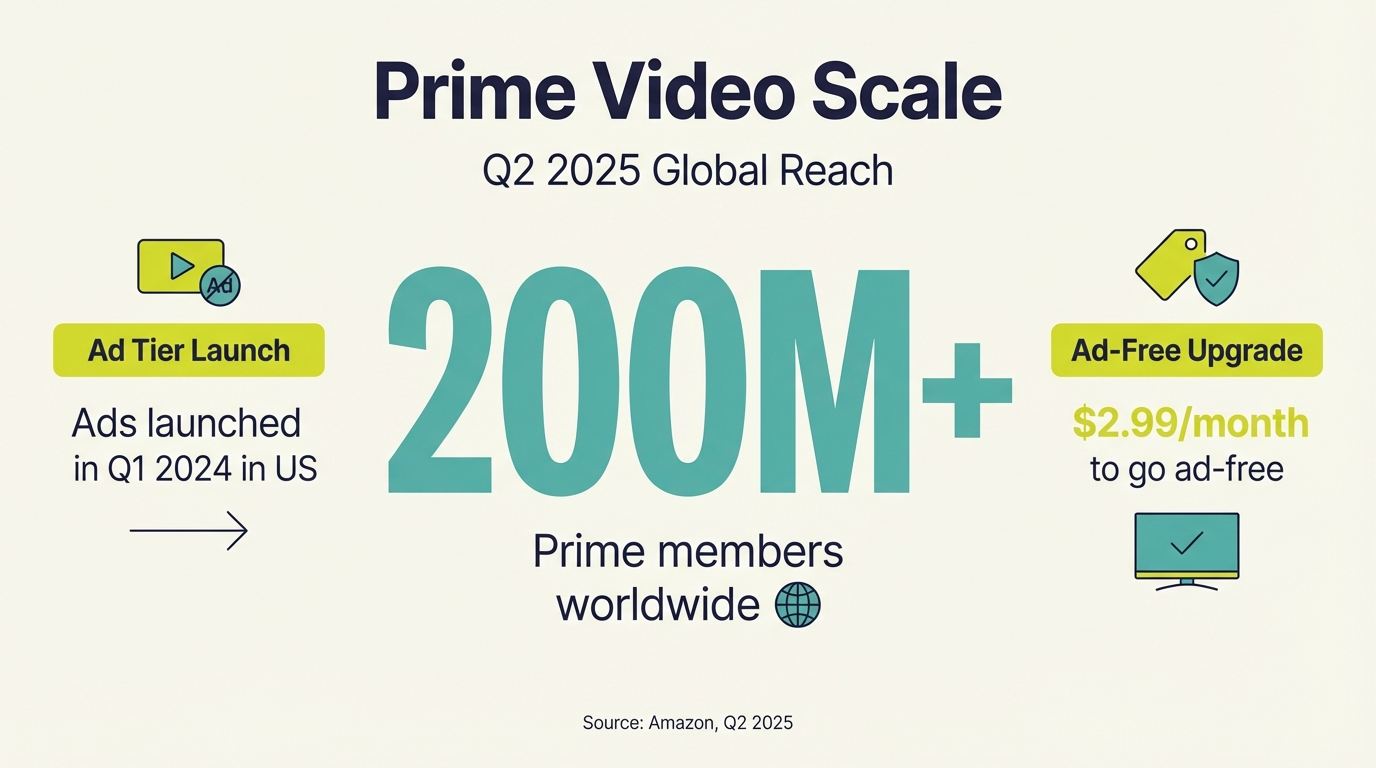
200M+
Global Prime Video subscribers
-
+12%
Month-over-month viewing growth
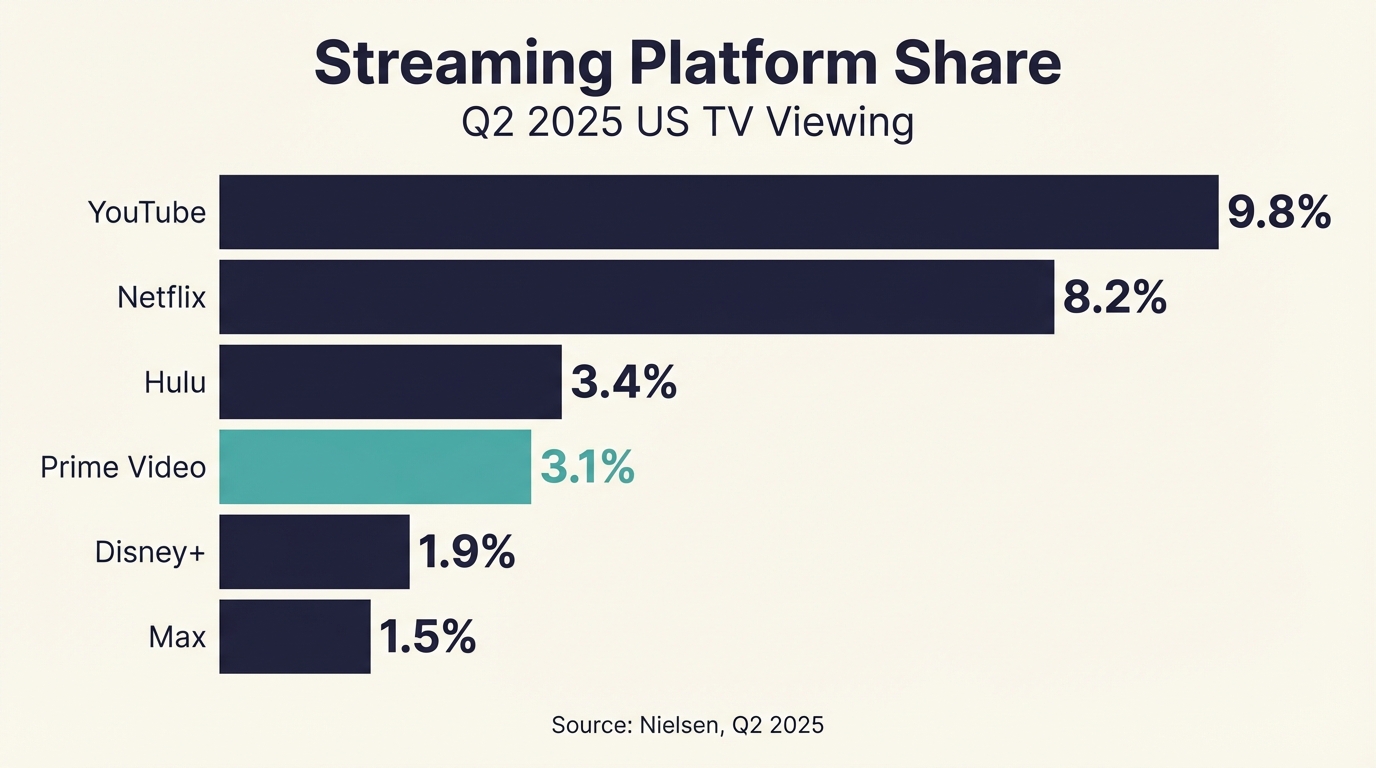
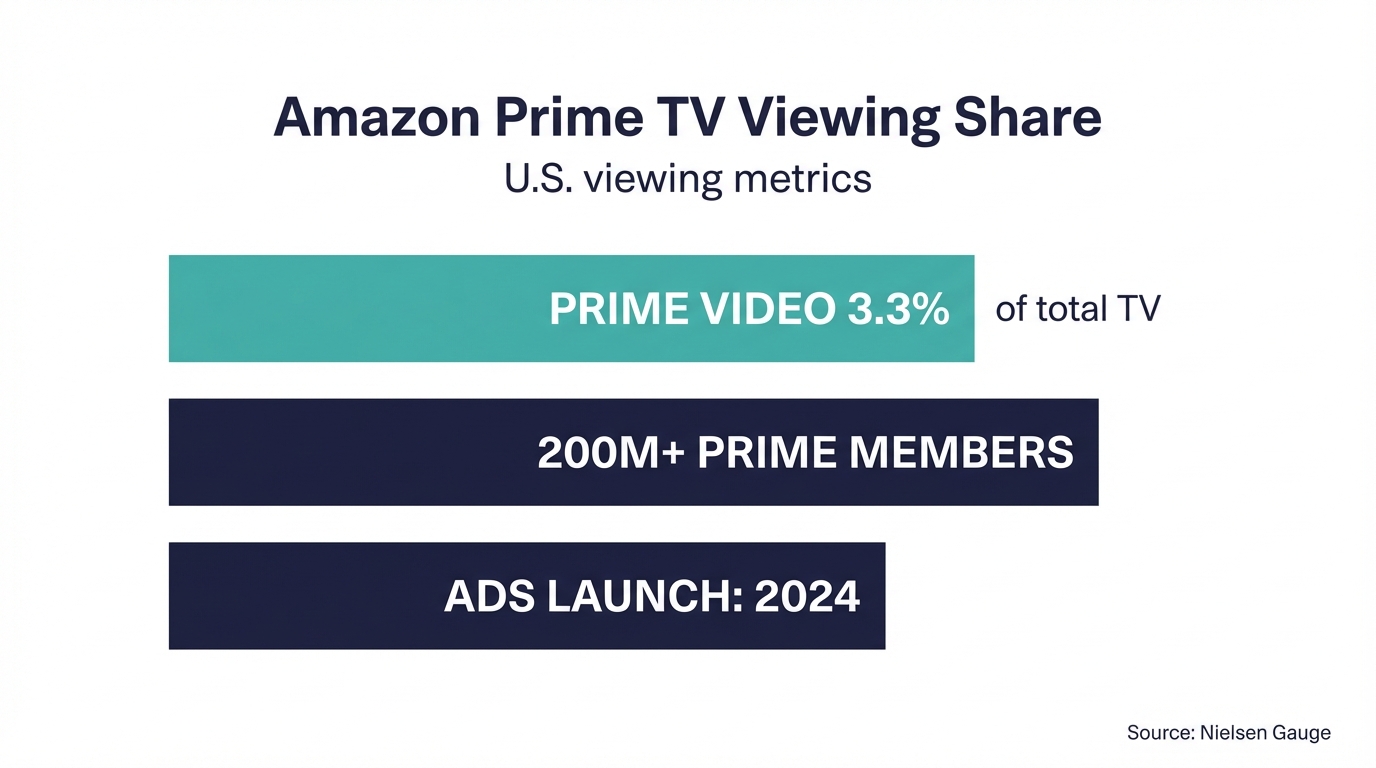
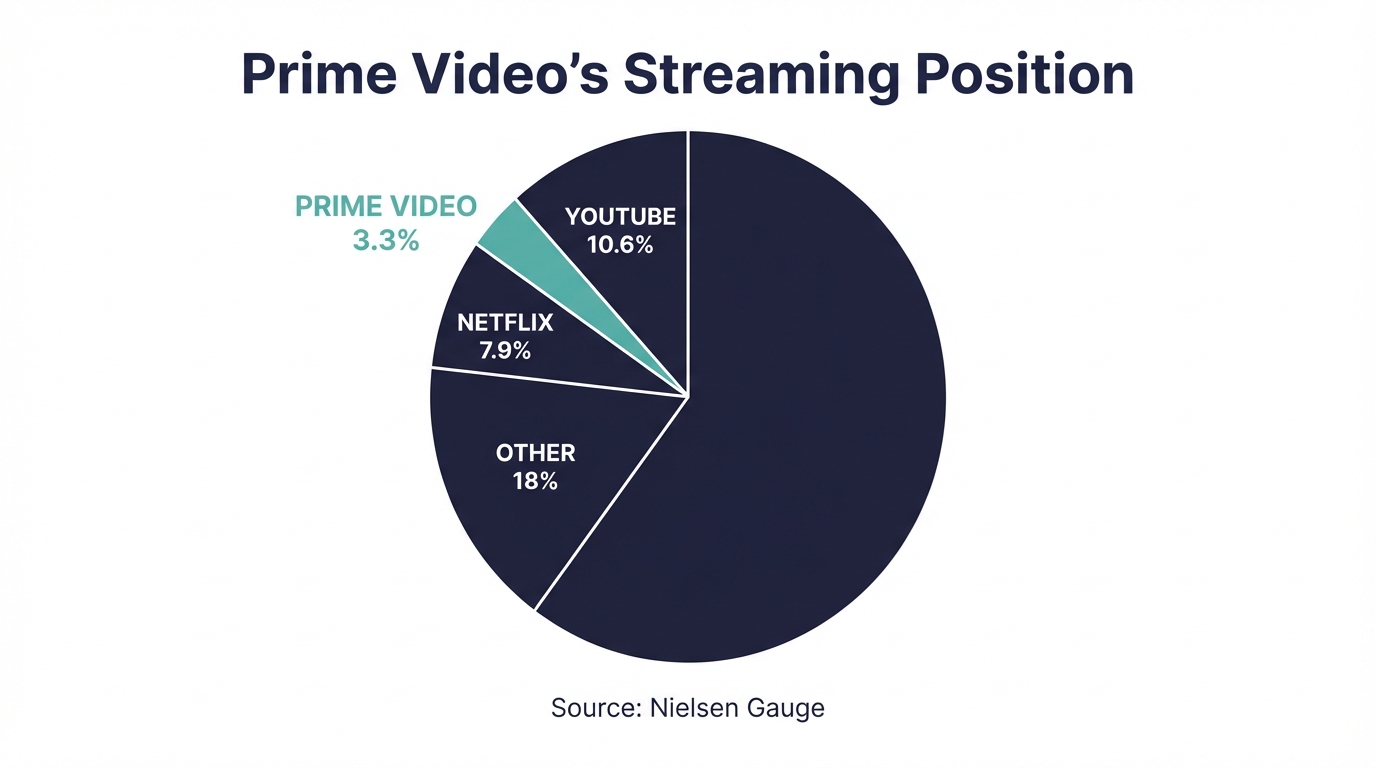
Amazon Prime Video commands approximately 3.5% of total TV viewing time in the United States, according to Nielsen's Gauge report and MediaPost data. This positions Prime Video as the third most-watched streaming platform, behind YouTube (approximately 12.5%) and Netflix (approximately 8.5%). With over 90 million U.S. subscribers and 200+ million globally bundled with Amazon Prime memberships, Prime Video represents one of the largest streaming advertising opportunities following Amazon's introduction of ads in early 2024.
Prime Video's unique position in the streaming landscape comes from its bundled distribution model. Unlike standalone streaming services that must acquire each subscriber individually, Prime Video is included with every Amazon Prime membership, giving it access to the massive Prime membership base. This distribution advantage, combined with Amazon's significant investment in original content and live sports rights, has made Prime Video a major player in the streaming advertising market.
What the data shows
Understanding Prime Video's market position requires examining viewing share, subscriber metrics, and the recent transformation to ad-supported streaming.
TV viewing share
According to Nielsen's monthly Gauge report and industry data, Prime Video maintains a significant position in streaming viewership:
3.5%: Prime Video's share of total U.S. TV viewing (May 2025)
#3 rank: Among streaming platforms by viewing share
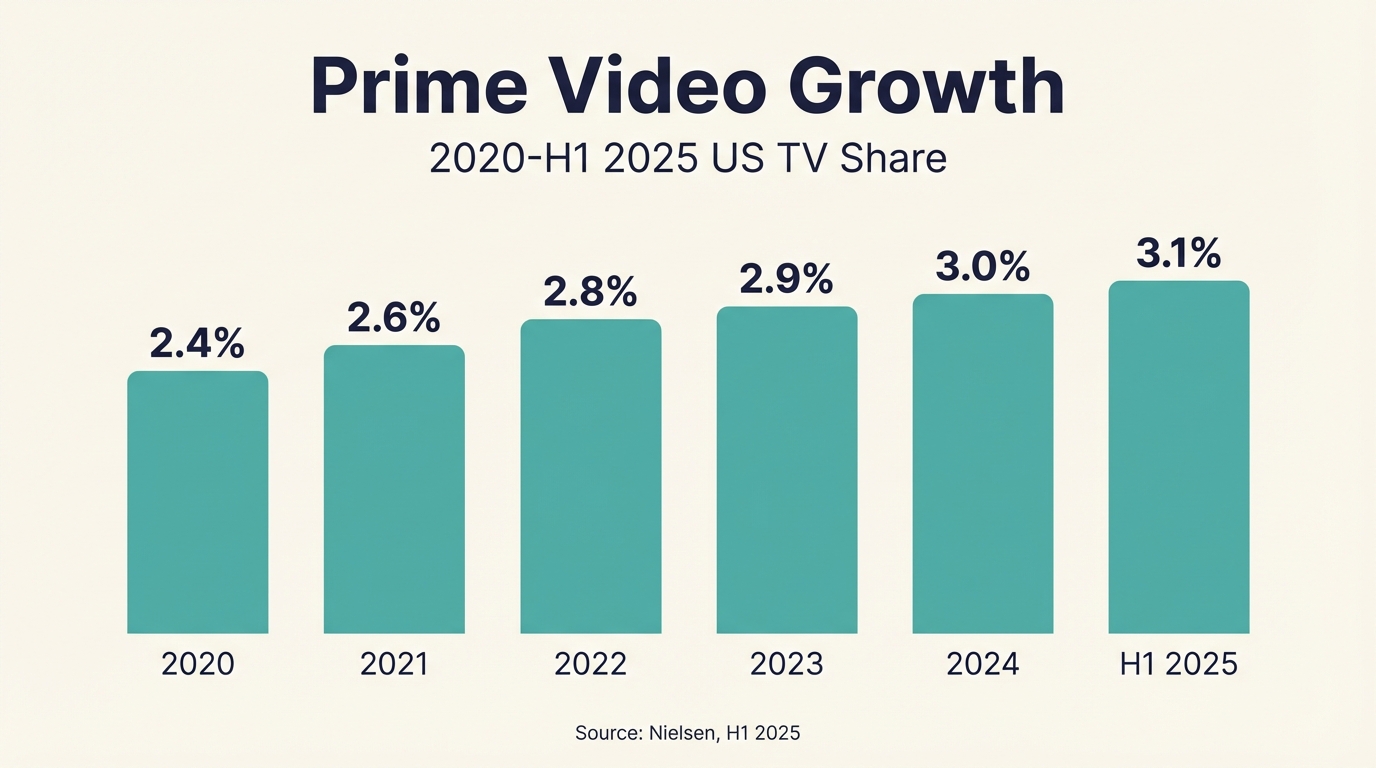
Stable share: Viewing share has remained consistent at approximately 3.5% year-over-year
+12% growth: Month-over-month viewing increases during content releases
Prime Video's 3.5% share, combined with streaming's 45%+ share of total TV viewing, represents substantial reach for advertisers seeking streaming audiences.
Subscriber and household metrics
Prime Video's subscriber base reflects its bundled distribution model:
90+ million: U.S. Prime Video subscribers (as of mid-2025) according to MediaPost
200+ million: Global Prime Video subscribers
~67% usage: Percentage of U.S. households using Prime Video according to Forbes
68%: Percentage of Prime Video viewers who see ads (chose not to pay for ad-free tier)
The high percentage of subscribers remaining on ad-supported viewing (68%) means Amazon's advertising inventory is substantial, with most of its massive subscriber base available for advertising.
Ad-supported viewing metrics
Amazon introduced advertising on Prime Video in January 2024, fundamentally changing its advertising potential:
68%: Subscribers on ad-supported tier (by default)
$2.99/month: Premium cost to remove ads
Limited ads: Lower ad load than traditional TV or free streaming services
Premium placement: Ads run in high-quality, professionally produced content
The opt-out rather than opt-in model for ads means Amazon immediately gained access to the majority of its subscriber base for advertising purposes.
Breaking down the numbers
Prime Video's market position reflects its unique distribution model, content strategy, and Amazon's broader ecosystem.
The Prime bundle advantage
Prime Video's distribution model is fundamentally different from competitors:
Bundled distribution: Every Amazon Prime member automatically gets Prime Video access. With Prime membership driven primarily by shipping benefits, Prime Video gains subscribers without the typical customer acquisition costs of standalone streaming services.
Subscriber stability: Because Prime Video comes with Prime membership, subscriber numbers are more stable than standalone services. Viewers don't "churn" from Prime Video specifically; they'd have to cancel Prime membership entirely.
Built-in scale: Amazon's Prime membership base of 200+ million members globally provides immediate scale that other streamers must build over years.
Economic efficiency: The marginal cost of adding video content to Prime is lower than building a standalone streaming business, allowing Amazon to compete on content while maintaining profitability.
Content strategy and viewing drivers
Prime Video's content investments drive its viewing share:
Original series: Shows like "The Rings of Power," "The Boys," "Reacher," and "Citadel" drive significant viewing. According to Puck News, Amazon originals have increased their representation on Nielsen's monthly top 10 lists from 5% in 2021 to 14% by mid-2024.
Live sports: Thursday Night Football gives Prime Video exclusive access to one of television's most valuable content categories. Amazon has also acquired NBA rights starting in 2025-26, further building its sports portfolio.
Licensed content: Extensive library of movies and TV series provides everyday viewing beyond tentpole releases.
Freevee integration: Free ad-supported content through Freevee (formerly IMDb TV) provides additional inventory and viewer engagement.
The advertising transformation
Amazon's 2024 decision to introduce ads transformed Prime Video's advertising potential:
Scale overnight: Rather than building an ad-supported tier from scratch, Amazon made advertising the default, immediately creating one of the largest ad-supported streaming audiences.
Premium inventory: Prime Video ads appear in high-quality original content and licensed programming, providing brand-safe premium environments.
Amazon data integration: Advertisers can use Amazon's retail and shopping data for targeting, creating capabilities other streamers lack.
Light ad load: Prime Video's ad load is lighter than traditional TV and even some competitors, potentially improving viewer experience and ad engagement.
Why it matters for your business
Prime Video's combination of scale, premium content, and Amazon's ecosystem creates distinct opportunities for advertisers.
Massive scale with ad support
With 90+ million U.S. subscribers and 68% on ad-supported viewing, Prime Video offers reach comparable to the largest streaming platforms. For small business TV advertising, this means access to a substantial audience through CTV advertising platforms.
The scale advantage is especially important for local businesses. Even a small percentage of Prime Video viewers in a geographic area can represent significant reach for local targeting.
Amazon's data advantage
Amazon's retail ecosystem provides unique advertising capabilities:
Shopping data: Target viewers based on Amazon purchase history and shopping behavior
Intent signals: Reach consumers who have demonstrated purchase intent in relevant categories
Measurement: Connect ad exposure to Amazon purchases for direct attribution
Closed-loop reporting: Understand the complete customer journey from ad exposure to purchase
For businesses selling products, Amazon's data integration enables targeting and measurement impossible on other streaming platforms.
Premium content environment
Prime Video's content quality provides favorable advertising context:
Original series: Award-winning programming with engaged audiences
Live sports: Thursday Night Football and upcoming NBA coverage
Movies: Major theatrical releases and Amazon original films
Brand safety: Professional content with content moderation
Ads appearing alongside premium content benefit from the prestige association of quality programming.
Fire TV device integration
Amazon's Fire TV devices create additional advertising touchpoints:
Fire TV home screen: Advertising on the Fire TV interface
Connected TV reach: Fire TV is among the most popular streaming devices
Unified experience: Connected integration between device and content
For advertisers, this means Prime Video reach extends beyond just video advertising to encompass the broader Fire TV ecosystem.
How to take advantage of this trend
Reaching Prime Video's audience requires understanding the various access points and strategies available.
Accessing Prime Video inventory
Prime Video advertising can be accessed through multiple channels:
Amazon DSP: Amazon's demand-side platform provides direct access to Prime Video inventory with Amazon's targeting capabilities. Typically requires larger budgets and direct Amazon relationships.
Aggregated platforms: Services like Adwave include Prime Video inventory alongside 100+ other streaming channels. Lower minimums (starting at $50) make Prime Video accessible to small businesses.
Programmatic exchanges: Some Prime Video inventory is available through programmatic buying, though with less Amazon data integration.
For most small businesses, aggregated platforms provide the simplest entry point to Prime Video audiences.
Targeting strategies
Effective Prime Video advertising uses available targeting options:
Geographic targeting: Target by DMA, state, or zip code for local TV advertising. Amazon's geographic capabilities support local business advertising strategies.
Demographic targeting: Age, gender, income, and household composition targeting
Behavioral targeting: Interests, viewing behavior, and engagement patterns
Amazon data (via Amazon DSP): Shopping behavior, purchase history, and intent signals
Through aggregated platforms, targeting is typically geographic and demographic. Direct Amazon buying provides access to shopping data targeting.
Creative considerations
Creating effective Prime Video advertising requires understanding the viewing context:
Premium environment: Prime Video viewers watch in a premium content environment. Creative should match the quality of surrounding content.
Big screen viewing: Most Prime Video viewing occurs on connected TVs. Design for large screen viewing with clear visuals and legible text.
Sound-on viewing: Unlike social video, Prime Video viewers typically have sound enabled. Use audio for message delivery.
Limited competition: Lighter ad loads mean less clutter and potentially higher attention per ad.
AI-powered creative tools from platforms like Adwave can generate Prime Video-ready commercials from existing assets.
Measuring Prime Video campaign performance
Prime Video measurement depends on buying approach:
Through Amazon: Full Amazon measurement including shopping attribution, conversion tracking, and closed-loop reporting
Through aggregated platforms: Standard CTV metrics including reach, frequency, completion rates, and attribution through platform measurement
Through programmatic: Varies by exchange and measurement integration
For businesses selling on Amazon, advertising through Amazon's platforms provides measurement advantages unavailable elsewhere.
The bigger picture
Prime Video's position reflects broader streaming industry dynamics and Amazon's strategic priorities.
Amazon's streaming ambitions
Amazon has made substantial investments in Prime Video:
Content spending: Billions annually on original content and rights acquisition
Sports rights: Thursday Night Football, NBA rights starting 2025-26, other sports properties
Global expansion: Significant content investment for international markets
Technology: Continuous improvement to streaming technology and user experience
These investments suggest Prime Video will remain a major streaming player for the foreseeable future.
The advertising transformation impact
Amazon's decision to make Prime Video ad-supported by default has reshaped the streaming advertising landscape:
Immediate scale: Created one of the largest ad-supported audiences overnight
Premium validation: Demonstrated that premium streaming can support advertising
Industry influence: Encouraged other premium services to expand ad-supported options
Pricing impact: Added significant inventory to the CTV market
The long-term impact of Amazon's entry into streaming advertising continues to unfold as advertisers learn to use its unique capabilities.
Competition and positioning
Prime Video competes in several dimensions:
Versus Netflix: Prime Video offers sports content Netflix lacks. Netflix has larger overall viewing share. Both now have ad-supported options.
Versus YouTube: Prime Video offers premium, professionally produced content. YouTube offers broader content types. Different advertising use cases.
Versus Disney/Hulu: Different content focus (general entertainment vs. family/broadcast). Both have significant ad-supported audiences.
Versus Apple TV+: Prime Video has broader content library. Apple TV+ has smaller catalog but high production values.
Understanding competitive positioning helps advertisers allocate budgets across streaming platforms.
Common questions answered
What is Prime Video's share of total TV viewing?
Amazon Prime Video commands approximately 3.5% of total U.S. TV viewing time, according to Nielsen's Gauge report. This ranks Prime Video third among streaming platforms, behind YouTube (approximately 12.5%) and Netflix (approximately 8.5%). The share has remained stable year-over-year.
How many subscribers does Prime Video have?
Prime Video has over 90 million U.S. subscribers and 200+ million globally. These subscribers come primarily through Amazon Prime membership bundles, with Prime Video included as a membership benefit. Approximately 67% of U.S. households use Prime Video.
Is Prime Video ad-supported?
Yes, Prime Video became primarily ad-supported in January 2024. Approximately 68% of Prime Video subscribers watch with ads (the default experience). Subscribers can pay an additional $2.99/month to remove ads, but most have remained on ad-supported viewing.
Can small businesses advertise on Prime Video?
Yes, small businesses can reach Prime Video viewers through aggregated CTV platforms like Adwave, which include Prime Video inventory alongside 100+ other streaming channels. These platforms offer low minimums (starting at $50). Direct advertising through Amazon typically requires larger budgets.
What makes Prime Video advertising unique?
Prime Video advertising offers several unique advantages: Amazon's retail and shopping data for targeting and measurement, integration with Fire TV devices, premium content environment, and massive scale from Amazon Prime membership bundling. For advertisers selling on Amazon, closed-loop measurement connecting ad exposure to purchases is possible.
Supporting data
Additional statistics that contextualize Prime Video's position in the streaming market:
3.5%: Prime Video's share of total U.S. TV viewing (Nielsen Gauge)
#3: Prime Video's rank among streaming platforms by viewing share
90+ million: U.S. Prime Video subscribers
200+ million: Global Prime Video subscribers
67%: U.S. households using Prime Video
68%: Prime Video subscribers on ad-supported tier
$2.99/month: Cost to remove ads from Prime Video
45%+: Total streaming share of TV viewing
$15-35: CTV CPM range through aggregated platforms
$50: Minimum budget to start CTV advertising on platforms like Adwave
Data sources:
Start advertising on Prime Video
Ready to reach Prime Video's 90+ million U.S. subscribers? Connected TV advertising makes it possible to access Prime Video and other premium streaming inventory without massive budgets or direct Amazon relationships.
Adwave provides access to Prime Video and 100+ other streaming channels with campaigns starting at just $50. Create professional TV commercials in minutes using AI, then launch targeted campaigns to streaming audiences.
No video production required. No agency fees. No complex platform negotiations.