-
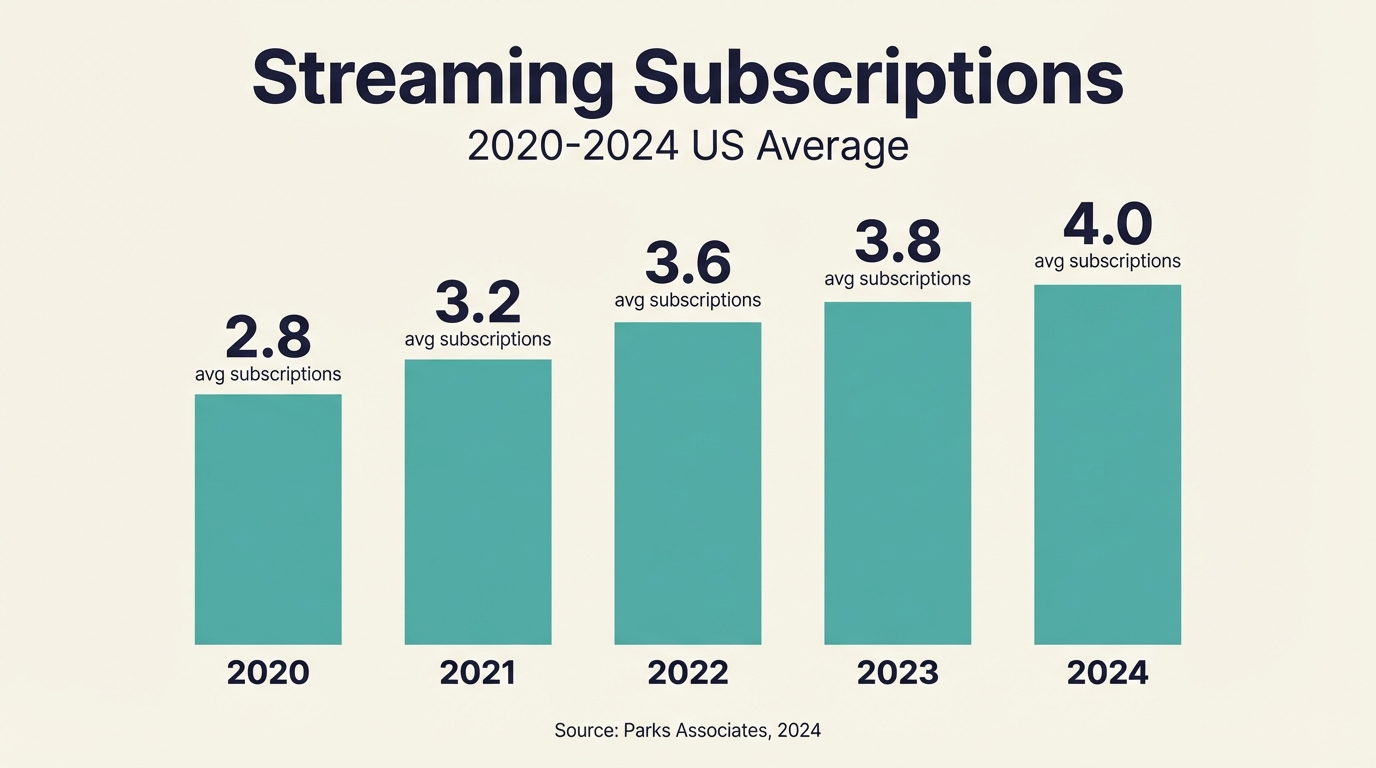
4
Average paid streaming subscriptions per U.S. household
-
$46/mo
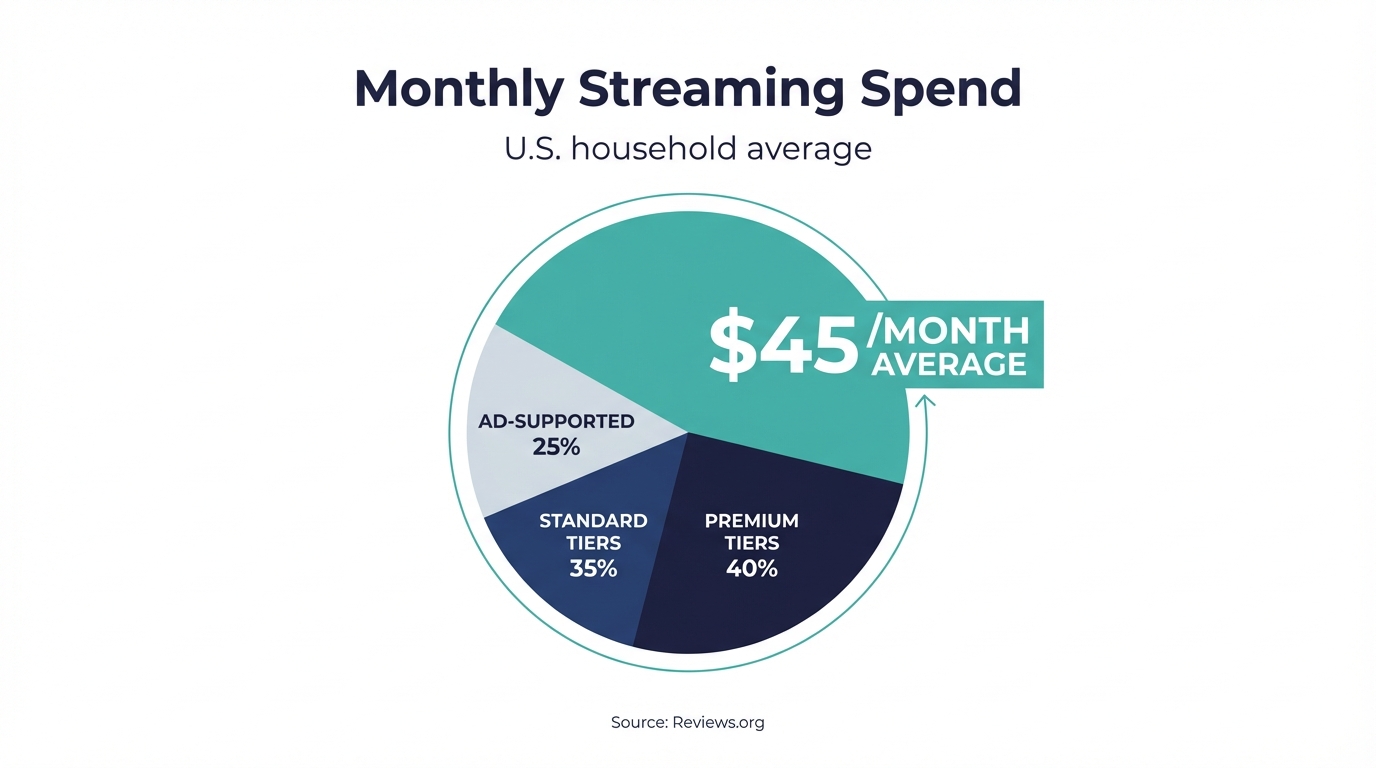
Average monthly spend on streaming services
-
83%
U.S. adults who use streaming services
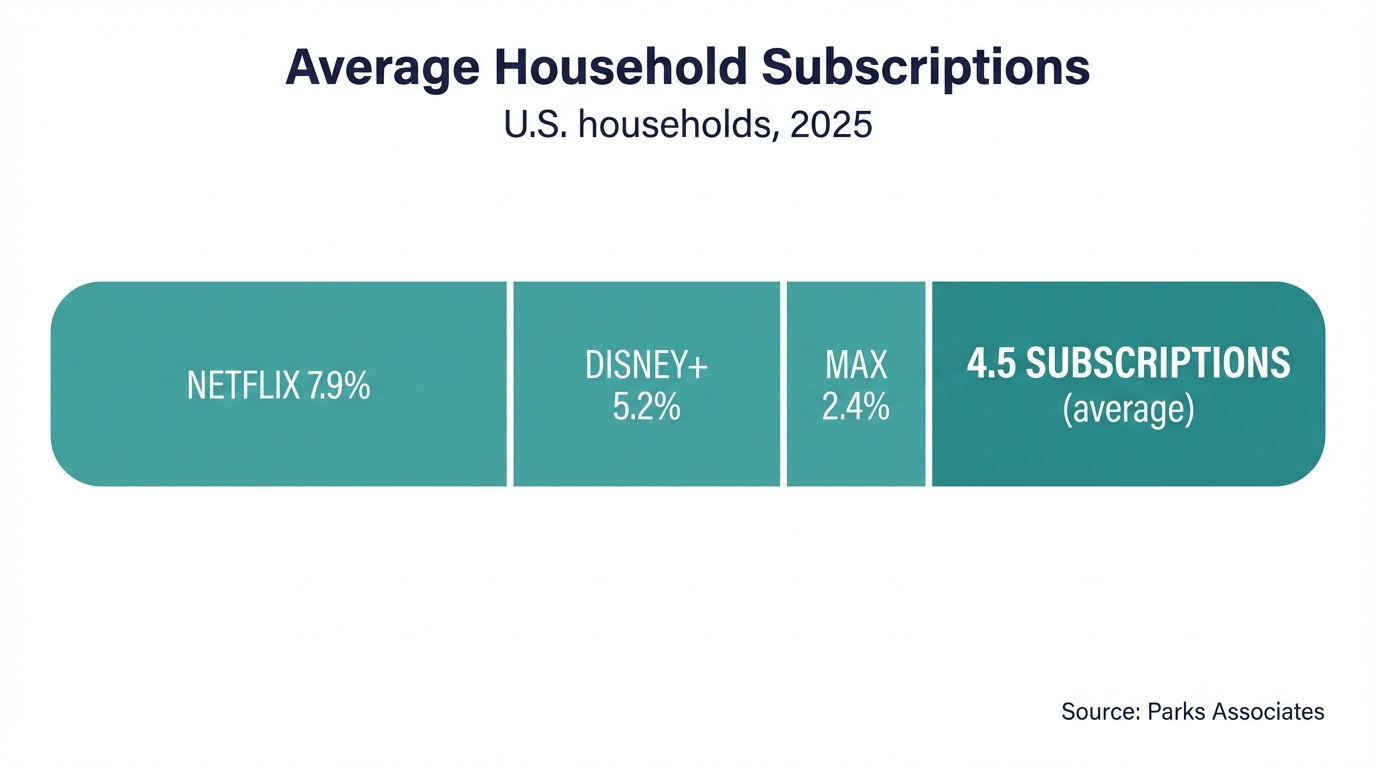
The average American household subscribes to approximately 4 streaming services, spending around $61-70 per month on streaming subscriptions, according to research from Cloudwards and Deloitte's 2025 Digital Media Trends report. Some studies suggest the number is even higher, with Tubefilter reporting that the average household pays for 6 streaming subscriptions at approximately $109 per month. This proliferation of streaming services represents a fundamental shift in how Americans consume video content and creates unique opportunities for advertisers.
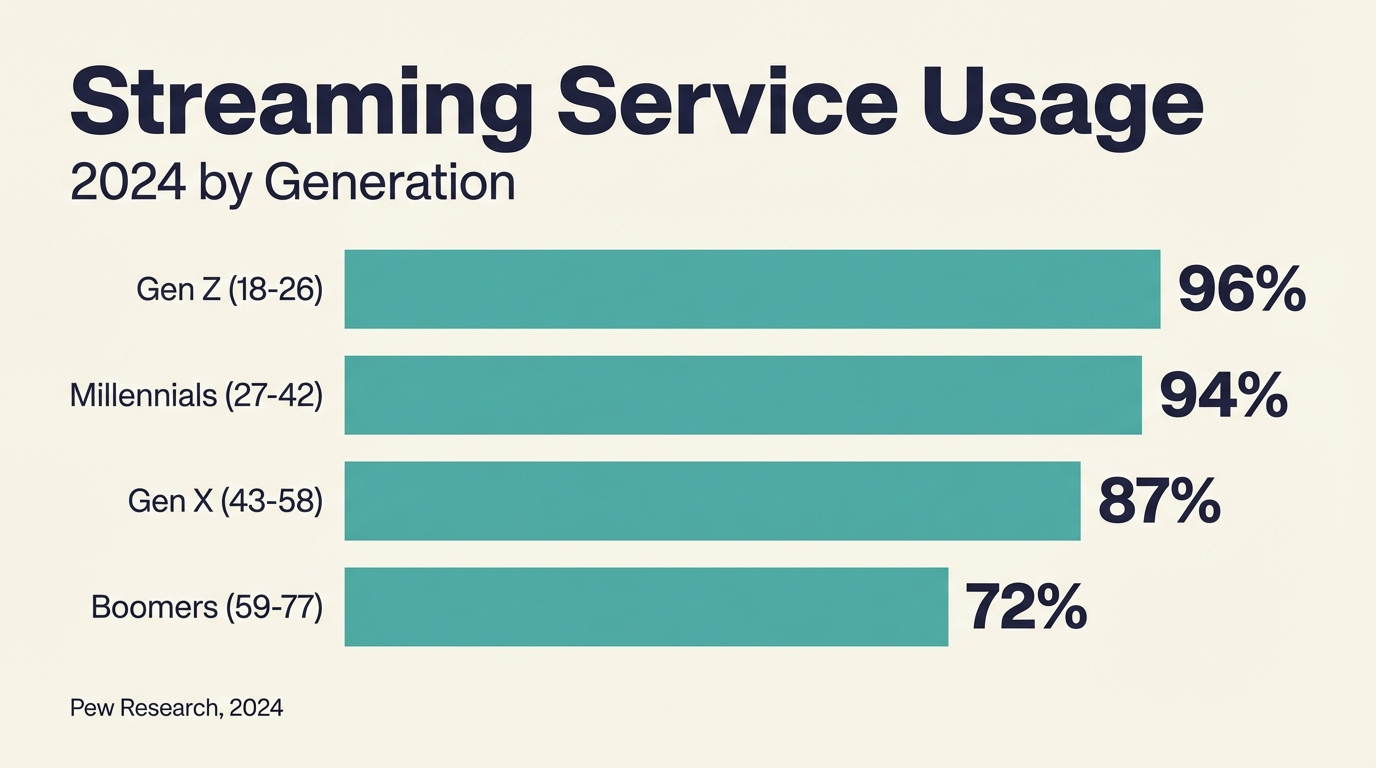
Understanding streaming subscription behavior is essential for businesses planning their advertising strategy. With 83% of U.S. adults using streaming services according to Pew Research, streaming has become the dominant form of television viewing. For advertisers, this fragmentation across multiple services means no single platform reaches the entire streaming audience, but it also means more opportunities to reach viewers through targeted advertising on multiple platforms.
The growth in streaming subscriptions has been accompanied by the rise of ad-supported tiers across virtually every major streaming service. Netflix, Disney+, Amazon Prime Video, Max, Peacock, and Paramount+ all now offer ad-supported options at lower price points. For small business TV advertising, this expansion of ad-supported inventory creates unprecedented access to premium streaming audiences.
What the data shows
The streaming subscription landscape reveals important patterns about consumer behavior and advertising opportunities. Here's what the latest research shows.
Subscription counts by source
Different research methodologies produce slightly different estimates of average streaming subscriptions:
Deloitte (2025): Average of 4 subscription services per household
Forbes analysis: Americans pay for 2.9 streaming subscriptions on average
Tubefilter research: Average household has 6 streaming subscriptions
Industry consensus: 3-5 paid streaming services per household
The variation reflects different definitions (paid only vs. including free services), survey populations, and timing. The consistent finding is that American households now maintain multiple streaming relationships rather than relying on a single service.
Household penetration rates
Exploding Topics' streaming statistics show the extent of streaming adoption:
83% of U.S. households have at least one streaming subscription
88% of U.S. households have at least one video streaming service (including free)
83% of U.S. adults watch streaming services regularly (Pew Research)
36% still subscribe to traditional cable or satellite TV
Near universal adoption among adults under 50
This penetration rate exceeds traditional pay TV and demonstrates that streaming has become the default mode of television viewing for most Americans.
Monthly spending on streaming
Streaming subscription costs have been rising steadily:
$61 average monthly spending on streaming across all services (Cloudwards)
$70 average monthly spending according to LA Times analysis
$109 average for households with 6 subscriptions (Tubefilter)
$22 increase year-over-year in household streaming spending
LA Times reporting notes that U.S. households now spend an average of $70 monthly on streaming services, up $22 from a year ago as major platforms raise prices. This spending rivals or exceeds what many households previously paid for cable television.
Most popular streaming services
Netflix and Amazon Prime Video dominate, but multiple services maintain substantial user bases:
Tier 1 (50+ million U.S. subscribers)
Netflix: ~75 million U.S. subscribers
Amazon Prime Video: ~70 million (included with Prime membership)
YouTube (Premium + free): Nearly universal reach
Tier 2 (30-50 million)
Disney+: ~46 million U.S. subscribers
Hulu: ~50 million subscribers
Max (HBO): ~35 million
Tier 3 (15-30 million)
Peacock: ~28 million paid subscribers
Paramount+: ~25 million
Apple TV+: ~20+ million estimated
Free ad-supported (FAST)
Tubi: 80+ million monthly active users
Pluto TV: 80+ million monthly active users
Roku Channel: 80+ million
For advertisers, this distribution means any single platform reaches only a portion of the streaming audience. Effective reach requires presence across multiple services or platforms that aggregate inventory from various sources.
Breaking down the numbers
Understanding who subscribes to what helps advertisers make informed decisions about where to allocate their streaming TV budgets.
Demographics of streaming subscribers
By age group
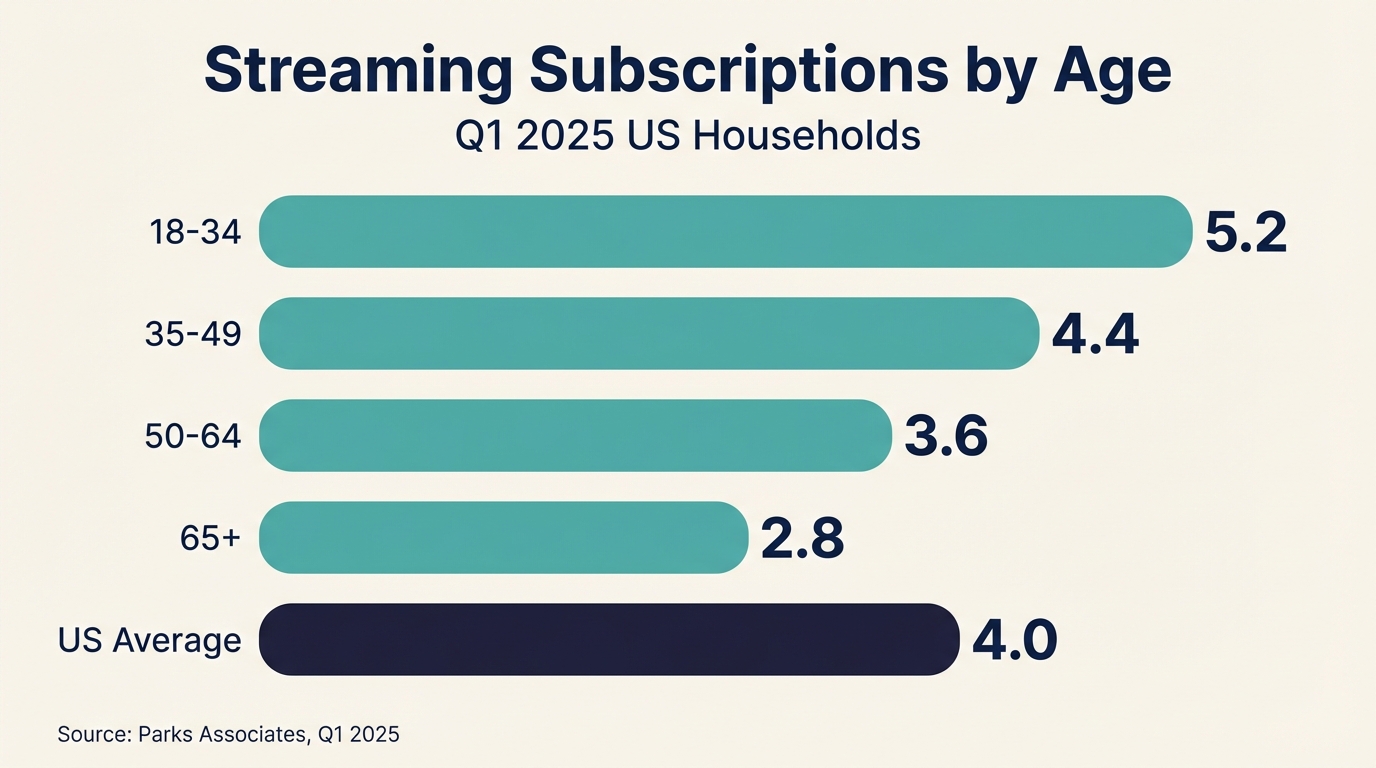
18-29: Highest streaming adoption (95%+), most likely to have 5+ subscriptions
30-44: High adoption (90%+), 4-5 subscriptions average
45-64: Strong adoption (80%+), 3-4 subscriptions average
65+: Growing adoption (60%+), 2-3 subscriptions average
By income
Higher income households subscribe to more services
Households earning $100,000+ average 5-6 subscriptions
Lower income households more likely to use free ad-supported services
Ad-supported tiers growing across all income levels
By household composition
Families with children: Highest subscription counts (5-7 services)
Young singles: Heavy users but more selective (3-4 services)
Empty nesters: Growing adoption (3-4 services)
Seniors: Increasing but lower average (2-3 services)
Subscription stacking behavior
Research reveals how households combine services:
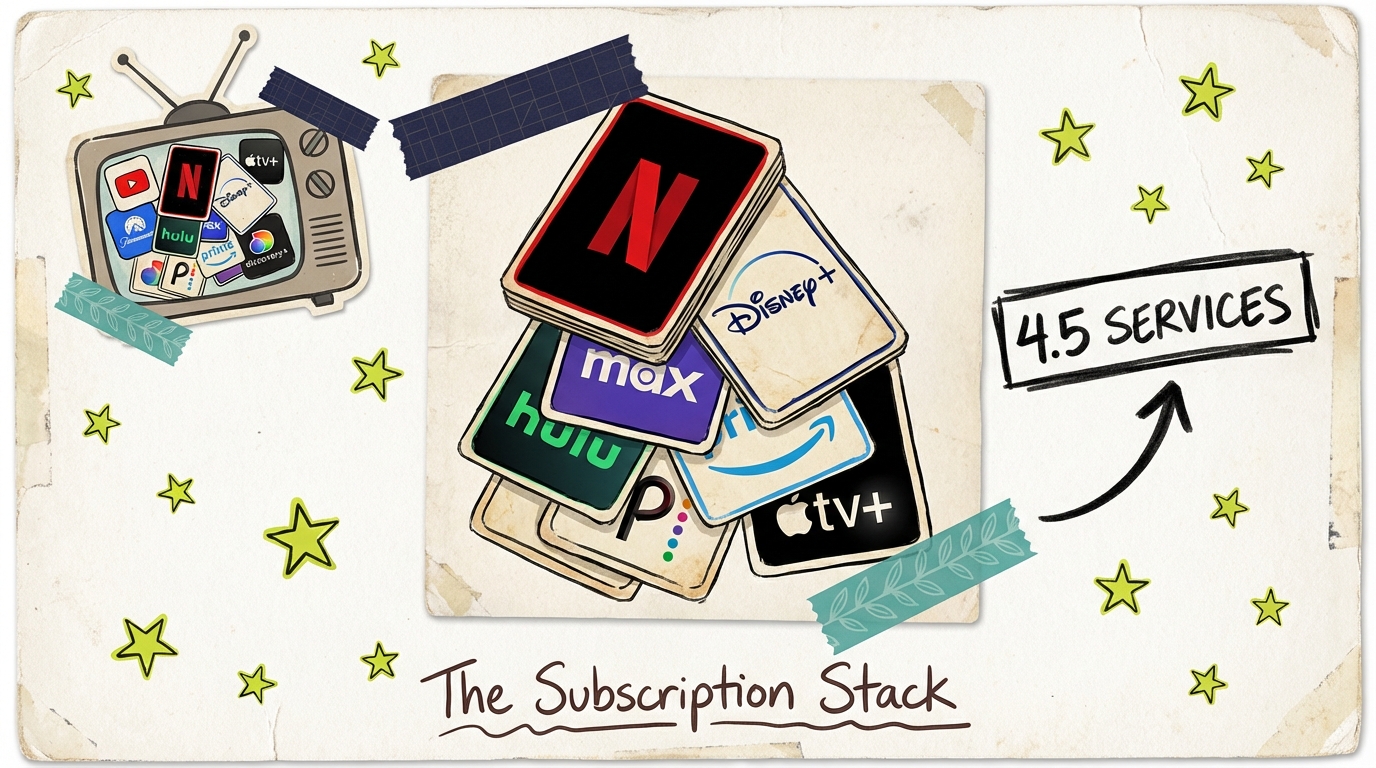
The typical streaming stack includes:
One major general entertainment service (Netflix, Amazon Prime)
One Disney/family-focused service (Disney+, Disney Bundle)
One news/live sports option (Peacock, Paramount+ with CBS Sports)
One or more free ad-supported services (Tubi, Pluto)
Optional premium add-ons (Max for HBO, Starz, Showtime)
Why multiple subscriptions?
Different content libraries (exclusive shows, movies)
Live sports distribution across platforms
Family members with different preferences
Bundle deals making additional services cheap
Rotating subscriptions to binge specific shows
Ad-supported vs. ad-free tiers
The rise of ad-supported streaming has been dramatic:
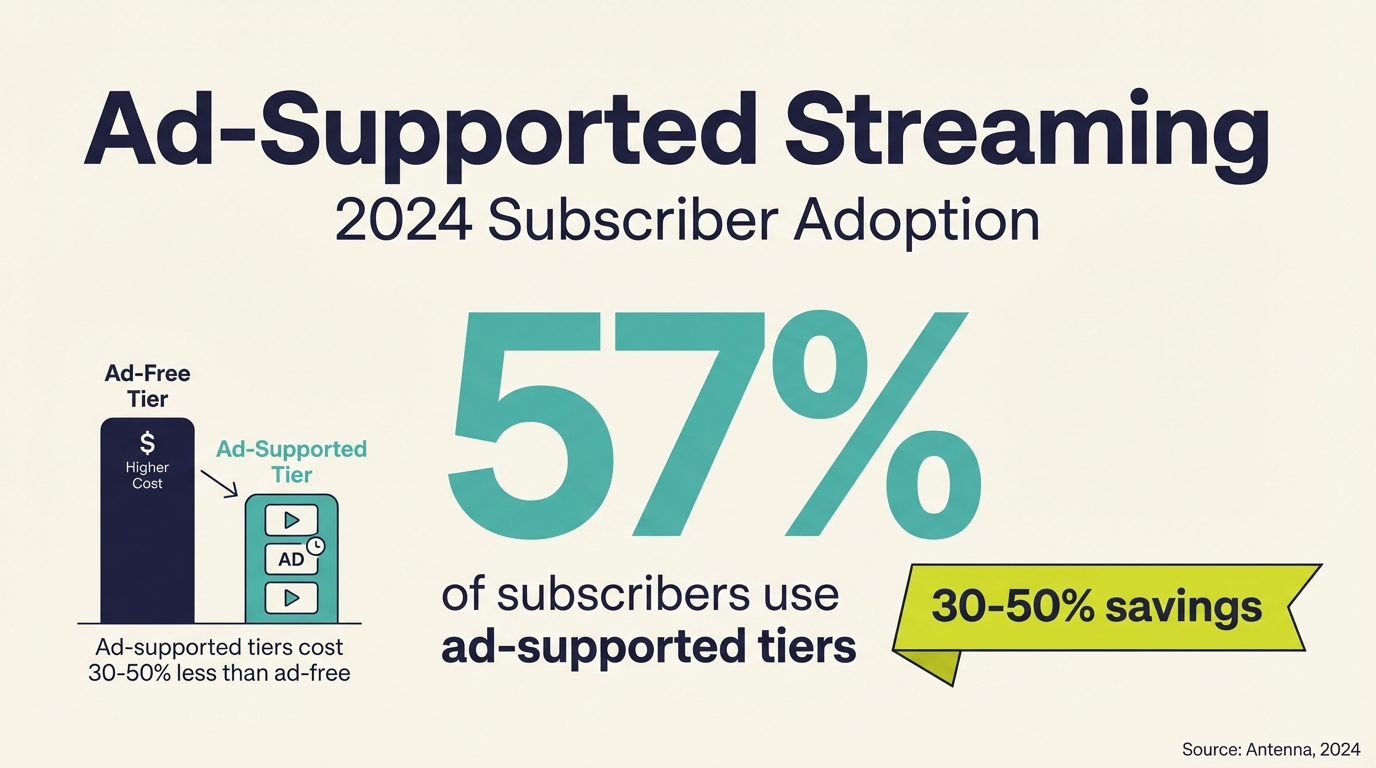
Netflix: Ad-supported tier reached 70+ million global subscribers in under two years
Disney+: Significant percentage of new subscribers choose ad tier
Max: Ad-supported tier offers substantial savings over ad-free
Industry trend: Ad-supported is now the default lower-cost option
According to Motley Fool research, 62% of streaming subscribers say there are "too many services," driving interest in lower-cost ad-supported options. This creates more advertising inventory across premium streaming platforms.
Subscription churn and fluidity
Streaming subscriptions are far more fluid than traditional cable:
High churn rates: Many subscribers rotate services monthly
Binge and cancel: Subscribe, watch desired content, cancel
Seasonal subscriptions: Sports fans subscribe during seasons
Bundle loyalty: Bundled services see lower churn
For advertisers, this fluidity means streaming audiences are dynamic. Reaching the same viewer may require presence across multiple platforms as they rotate subscriptions.
Why it matters for your business
The proliferation of streaming subscriptions creates both challenges and opportunities for businesses seeking to reach consumers through TV advertising.
The fragmentation challenge
With audiences spread across multiple streaming services, no single platform delivers complete reach:
Netflix alone reaches ~75 million households (about 55% of U.S. households)
Any single platform reaches less than two-thirds of the streaming audience
Complete reach requires presence across multiple services
This fragmentation means advertisers must think strategically about platform selection and budget allocation.
The opportunity in aggregation
Platforms that aggregate inventory across multiple streaming services solve the fragmentation problem:
Programmatic CTV platforms access inventory from dozens of streaming services
Self-serve platforms like Adwave offer access to 100+ channels
Single campaign can reach audiences across Netflix, Hulu, Peacock, Tubi, and more
Connected TV advertising through aggregated platforms simplifies reaching fragmented streaming audiences without managing multiple direct relationships.
The ad-supported advantage
The growth of ad-supported streaming tiers benefits advertisers:
More inventory
Netflix, Disney+, and Amazon adding ad-supported options
Premium content now available for advertising
FAST services continuing to grow
Better targeting
Streaming platforms know their subscribers
Behavioral and demographic data enables precision
Geographic targeting down to ZIP code level
Lower barriers
Increased supply moderating CPM rates
Platforms like Adwave offering $50 minimums
No production costs with AI-generated commercials
Audience quality on streaming
Streaming audiences are highly valuable:
Engaged viewers: Active content selection indicates engagement
Lean-back attention: Living room viewing means full attention
High completion rates: 90%+ ad completion on CTV vs. 40-60% digital video
Premium context: Ads alongside quality content
Streaming viewers represent premium advertising opportunities despite the fragmented landscape.
How to take advantage of this trend
The multi-subscription reality requires a strategic approach to streaming TV advertising.
Strategy 1: Use aggregated platforms
Rather than buying each streaming service individually, use platforms that aggregate inventory:
Benefits of aggregation:
Single campaign reaches multiple services
Simplified buying and management
Consistent targeting across platforms
Unified reporting and optimization
Adwave provides access to 100+ premium streaming channels through a single self-serve platform, solving the fragmentation challenge for small businesses.
Strategy 2: Embrace ad-supported tiers
Focus advertising efforts on ad-supported streaming:
Higher engagement: Ad-supported viewers are often more engaged
Cost-conscious audience: May be more responsive to deals/offers
Growing inventory: More ad spots becoming available
Premium content: Same shows and movies as ad-free tiers
Don't assume ad-supported means lower quality audience. Many subscribers choose ad-supported tiers for value, not inability to pay.
Strategy 3: Consider FAST channels
Free ad-supported streaming TV (FAST) services offer excellent value:
Tubi, Pluto, Roku Channel: 80+ million monthly users each
Lower CPMs: Often 20-40% below premium subscription services
Quality content: Movies, shows, and niche programming
High reach: Particularly strong with cord-cutters and younger viewers
FAST should be part of any detailed streaming strategy.
Strategy 4: Test and learn
Given audience fragmentation, testing is essential:
Start broad: Use aggregated platforms to reach across services
Analyze performance: Identify which platforms drive best results
Optimize allocation: Shift budget toward top performers
Iterate continuously: Streaming landscape changes rapidly
Strategy 5: Think reach, not platform
Focus on reaching your target audience, not specific platforms:
Define your audience: Demographics, geography, interests
Set reach goals: How many unique households?
Let platforms optimize: Modern DSPs find your audience across services
Measure holistically: Track brand metrics, not just platform metrics
The bigger picture
The multi-subscription streaming landscape reflects broader shifts in media consumption that will continue shaping advertising opportunities.
The end of the cable bundle
Streaming has fundamentally replaced the cable bundle for most households:
Then (cable era):
One provider, one monthly bill
All channels included (wanted or not)
Limited choice, limited flexibility
Advertising concentrated on few networks
Now (streaming era):
Multiple subscriptions, multiple bills
Choose only wanted services
Flexibility to add/drop monthly
Advertising distributed across platforms
For advertisers, this shift means adapting strategies from "buy cable networks" to "reach streaming audiences wherever they watch."
Subscription fatigue and consolidation
Signs suggest the market may be reaching saturation:
62% say there are too many services (Motley Fool survey)
Rising prices driving subscribers to evaluate value
Bundle deals attempting to reduce churn
Mergers (Paramount+/Showtime, Disney+/Hulu integration)
This fatigue may slow subscription growth but also drives adoption of ad-supported tiers, benefiting advertisers.
The streaming-first generation
Viewers under 35 have fundamentally different media habits:
Streaming as default: Traditional TV never their primary source
Platform agnostic: Comfortable with multiple services
Ad tolerance: Accepting of ads in exchange for lower costs
Mobile-first but TV-present: Watch everywhere, including living room
This generation will define media consumption for decades, making streaming advertising increasingly essential.
What this means for small businesses
The streaming subscription landscape creates specific implications:
Opportunity: Premium TV advertising is now accessible to small businesses through aggregated platforms and low minimum budgets.
Challenge: Reaching audiences requires thinking across platforms rather than individual services.
Strategy: Use platforms like Adwave that aggregate streaming inventory, enabling broad reach through a single campaign.
Measurement: Track holistic brand metrics rather than platform-specific performance.
What experts are saying
Industry analysts have noted the advertising implications of subscription proliferation.
Pew Research's 2025 study found that "most Americans (83%) say they watch streaming services, with Netflix and Amazon Prime Video being especially common." The research noted that "far fewer (36%) say they currently subscribe to cable or satellite TV," showing the complete shift to streaming dominance.
Forbes' streaming analysis reported that "Americans pay for an average of 2.9 streaming subscriptions," noting that this represents significant growth from just a few years ago when single-service households were common.
The Motley Fool's study observed that while "62% of streaming service subscribers say there are too many services," households continue maintaining multiple subscriptions because of exclusive content and different family preferences.
Industry consensus suggests that the multi-subscription reality is permanent. Advertisers who adapt to this fragmented landscape by using aggregated platforms will be best positioned to reach streaming audiences efficiently.
Common questions answered
How many streaming services does the average American have?
The average American household subscribes to 3-5 streaming services, with some research indicating 6 subscriptions for heavy streaming households. This includes a mix of paid subscription services (Netflix, Disney+, Max) and free ad-supported services (Tubi, Pluto TV). The exact number depends on definitions (paid only vs. including free services) and household characteristics.
Why do people subscribe to multiple streaming services?
Households maintain multiple subscriptions because streaming services have exclusive content (shows, movies, sports) that can't be found elsewhere. Different family members have different preferences, bundle deals make additional services affordable, and live sports are distributed across multiple platforms. Many also subscribe temporarily to specific services to watch particular shows.
How much does the average household spend on streaming?
The average U.S. household spends $61-70 per month on streaming subscriptions, with some heavy-user households spending over $100 monthly. This spending has increased approximately $22 per month year-over-year as streaming services raise prices. Many households now spend as much or more on streaming as they previously spent on cable television.
Are ad-supported streaming tiers becoming more popular?
Yes, significantly. Ad-supported tiers are now available on virtually every major streaming service (Netflix, Disney+, Max, Peacock, Paramount+, Amazon Prime Video), and adoption is strong. Netflix's ad-supported tier reached 70+ million global subscribers within two years of launch. Many subscribers choose ad-supported options to manage costs while maintaining access to premium content.
What does streaming subscription behavior mean for advertisers?
For advertisers, multiple subscriptions mean audiences are fragmented across platforms, but also that more advertising inventory is available than ever before. No single platform reaches the entire streaming audience, so effective advertising strategies use aggregated platforms that access multiple services simultaneously. The growth of ad-supported tiers creates more opportunities to reach premium streaming audiences.
Supporting data
Key statistics on streaming subscriptions:
3-5 subscriptions: Average per U.S. household depending on methodology
$61-70/month: Average household streaming spending
83%: U.S. adults who watch streaming services
88%: U.S. households with at least one streaming subscription
36%: U.S. households still subscribing to cable/satellite
6 subscriptions: Average for heavy streaming households (Tubefilter)
$22: Year-over-year increase in monthly streaming spending
62%: Subscribers who say there are "too many" streaming services
70+ million: Netflix ad-tier global subscribers (under 2 years)
100+ channels: Streaming services accessible via aggregated platforms
Data sources:
Get started with streaming TV advertising
The multi-subscription streaming landscape means your potential customers are watching content across multiple services. Reaching them doesn't require buying each platform individually.
Adwave provides access to 100+ premium streaming channels through a single platform, solving the fragmentation challenge. Create a professional TV commercial in minutes with AI, set your targeting and budget, and launch across Netflix, Hulu, Peacock, Tubi, and dozens more. Starting at just $50.