
Accountants and financial advisors face an advertising challenge that few other small businesses do: the people who need you most rarely know they need you yet, and the trust threshold to win their business is among the highest in any category. A new client isn't buying a haircut or a meal. They're handing you visibility into their money, their taxes, and their financial future. The advertising you run has to clear that trust bar before the client will pick up the phone.
This guide walks through the seven advertising channels that work best for accountants and financial advisors in 2026, what each one does, what realistic costs look like, and how to allocate a monthly budget across them. Whether you're a solo CPA, a growing tax practice, or a multi-advisor wealth management firm, the framework here applies.
What "best" advertising means for financial professionals
Before comparing channels, it's worth being clear about what success means for your category. Three measurable outcomes matter:
Qualified inquiry volume. People reaching out to learn more about your services, with at least basic alignment to your ideal client (revenue size for accountants, asset thresholds for advisors, life stage for tax practices).
Conversion to discovery call or consultation. Most accountants convert 25-50% of inquiries to a first consultation; most advisors convert 15-35%. The advertising mix that produces more inquiries at higher conversion rates wins.
New retained clients. The bottom line. A new tax client is worth $400-$3,500 in year-one fees; a new financial advisory client can be worth $4,000-$25,000+ in year-one revenue and far more in lifetime value.
Because the lifetime value is so high, the math on advertising for financial professionals is unusually patient. A $400 cost per new client is excellent for an accountant whose average client is worth $1,200/year. A $2,000 cost per new client is excellent for a wealth advisor whose average client produces $8,000/year over a 7-year average tenure.
The seven channels worth considering
1. Google Ads (Search)
What it does well: catches active demand. Someone searching "CPA near me" or "fee-only financial advisor Phoenix" is showing strong purchase intent. Search ads put you in front of that intent at the exact moment of need.
What it doesn't do: build awareness for prospects who aren't yet searching. Search captures active demand but doesn't grow the demand pool.
Cost per inquiry: $60-$200 for accountants, $90-$350 for financial advisors, with significant variance by market.
Best for: practices with strong, professional-looking websites that can convert search traffic. Search ads amplify what's already working; they can't fix a website that doesn't convert.
Practical setup: focus on long-tail intent keywords ("CPA for small business in Atlanta" beats "accountant"). Include negative keywords for "free," "quickbooks," and "DIY" if those don't match your services. Use location targeting tight to your service area. Build separate campaigns for tax services, advisory services, and any niche specialties (estate planning, business valuations, ESG investing) you offer.
2. Meta Ads (Facebook + LinkedIn)
What it does well: builds awareness and trust before active intent. Meta and LinkedIn together let you reach prospects with educational content (a market commentary, a tax-planning tip, a retirement-readiness checklist) that builds familiarity before they're shopping.
What it doesn't do: produce immediate inquiries. Most Meta and LinkedIn conversions happen weeks or months after the first impression, as the prospect's trust builds.
Cost per inquiry: $100-$400 for accountants on Meta, $150-$500 for advisors on LinkedIn. Higher in major metros and for high-net-worth-focused practices.
Best for: practices with a content marketing capability. The campaigns that work best on these platforms run educational content rather than direct service ads. If you can produce a useful 3-minute video on a tax topic or a 90-second LinkedIn commentary on a market trend, you can run it as paid content and build a meaningful pipeline of warm prospects.
Practical setup: focus on retargeting audiences (people who visited your website, watched a previous video, downloaded a guide) for direct service ads. Use cold-audience targeting for educational content that builds the audience to retarget later.
3. Connected TV (CTV) Advertising
What it does well: builds the kind of trust and familiarity that financial professionals specifically need. CTV reaches prospects in lean-back streaming hours when bigger financial decisions get discussed and considered, often with a spouse or family member present.
What it doesn't do: produce immediate inquiries. CTV is a top-of-funnel and mid-funnel channel for financial services, not a same-day conversion channel.
Cost per inquiry: $150-$500 directly attributed, $80-$250 when cross-channel lift is included.
Best for: practices serving a defined geography (most accountants and many advisors) where the household decision dynamic matters. Financial decisions are rarely made by individuals alone; CTV reaches the spouse or partner who often co-decides on who manages the household's money.
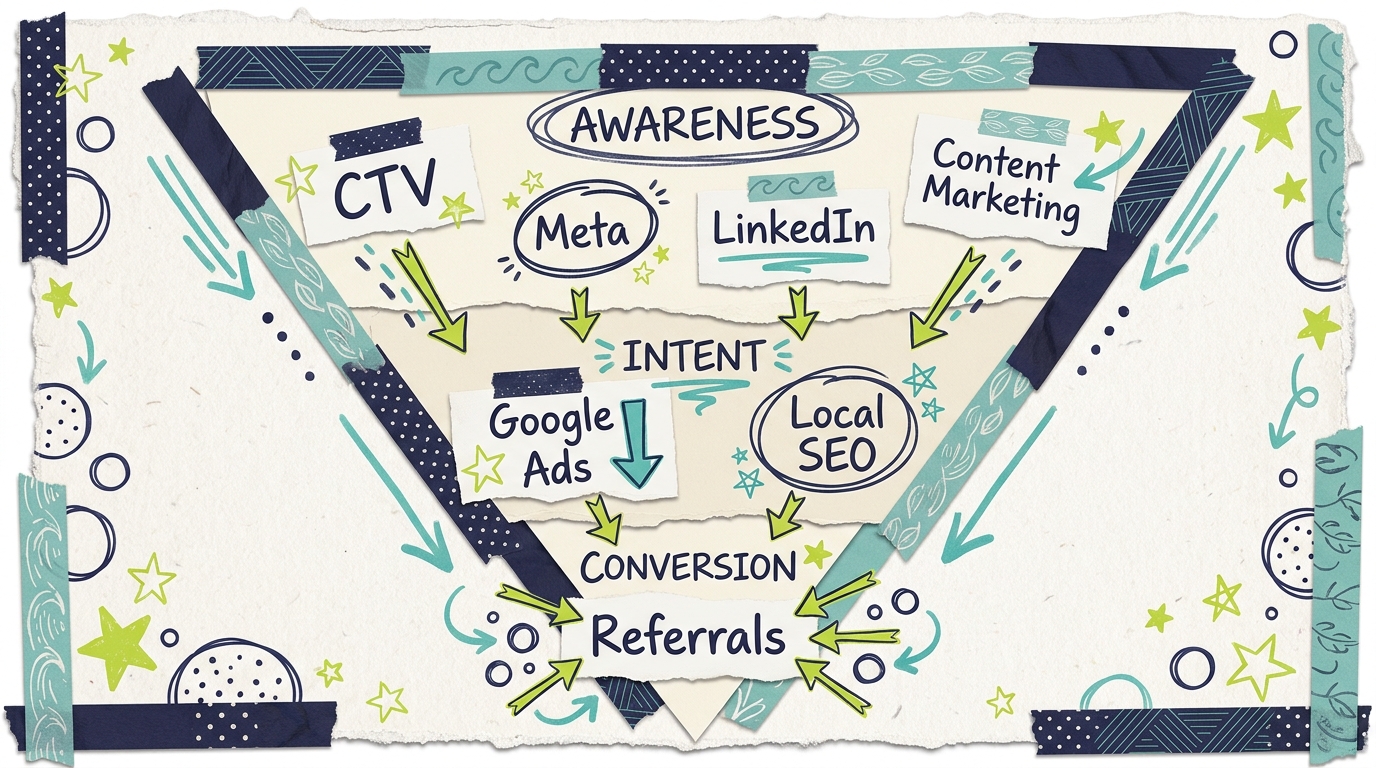
Practical setup: 30-second emotional spots that emphasize the relational nature of financial advice work better than spots that lead with services or credentials. Build creative around your team (real advisors, real CPAs) rather than stock-acting professionals. Tighten geographic targeting to your real service area. Pair CTV with content marketing for the strongest cross-channel lift.
Adwave's subscription tier starts at $50 and makes CTV accessible at practice budgets that previously couldn't justify TV. For accountants and advisors with monthly ad budgets of $2,000+, CTV is one of the most underutilized high-use channels.
4. Local SEO and Google Business Profile
What it does well: surfaces your practice when prospects search for accountants or advisors in your area. The Google "local 3-pack" above the organic results captures a meaningful share of local search clicks.
What it doesn't do: produce inquiries from prospects outside your geographic area. Practices serving a national clientele get only limited mileage from local SEO.
Cost: $0-$500/month in time and tools. Annual local SEO audits at $1,500-$5,000 are common for growing practices.
Best for: every accountant and advisor with a physical office. Local SEO is foundational. Even practices running paid ads aggressively should have a fully built-out Google Business Profile, an FAQ-driven website with rich schema, and consistent name-address-phone data across the web.
Practical setup: add new content (photos of the office, posts about market updates, FAQ entries) to your Google Business Profile monthly. Reply to every review within 48 hours. Make sure your practice is correctly categorized (Accountant, Tax Preparation Service, Financial Advisor, etc.).
5. Content marketing (blog, video, podcast)
What it does well: positions you as an expert. Financial professionals compete partly on credibility, and content that demonstrates expertise builds credibility faster than any ad ever will.
What it doesn't do: produce fast results. Content marketing typically requires 6-18 months of consistent investment before it produces meaningful inquiries.
Cost: $0-$3,000/month depending on production approach. Many solo practitioners produce content themselves; growing practices invest in content teams or freelance support.
Best for: practices with a long-term view and at least some bandwidth for production. The accountants and advisors who win on content are the ones who publish consistently for 12+ months and treat content as a permanent operations line rather than a campaign.
Practical setup: pick one channel and own it. A weekly market commentary on LinkedIn, or a biweekly podcast, or a strong blog with consistent search-optimized posts. Don't try to do all three at once. Repurpose across channels (the podcast becomes blog posts, social clips, and email newsletter content).
6. Referral programs and centers of influence
What it does well: uses the trust other professionals have already built. An accountant recommended by a client's attorney comes with pre-built credibility that no ad campaign can match.
What it doesn't do: produce immediate volume. Referral networks compound over years, not weeks. They also rarely scale beyond what one practitioner can personally maintain.
Cost: relationship investment, occasional gifts or events, sometimes formal referral compensation structures.
Best for: every accountant and advisor. Referral networks are the highest-converting channel for most financial professionals and produce the lowest-acquisition-cost clients. The constraint is usually time and personal capacity rather than dollars.
Practical setup: identify 8-15 centers of influence (attorneys, insurance agents, real estate professionals, bankers) in your community. Build genuine relationships through occasional lunches, joint educational events, and reciprocal referrals when appropriate.
7. Sponsorships, speaking, and community involvement
What it does well: builds local credibility and access. Financial professionals who speak at local Chamber of Commerce events, sponsor little league teams, or host community workshops build the local-presence equity that drives both direct inquiries and referral flow.
What it doesn't do: scale beyond what your time and budget can sustain. And the ROI is hard to attribute cleanly.
Cost: $500-$5,000 per major sponsorship, plus time. Free workshops cost mostly time.
Best for: practices serving a local clientele where in-person credibility matters. Most accountants and many advisors fit this profile.
Practical setup: pick 2-3 community involvements per year that align with your client base and your interests. Consistent presence beats sporadic high-budget sponsorship. Track which involvements produce referrals; double down on those.
Side-by-side channel comparison
Recommended budget allocation by practice stage
Solo or new practice (under 50 clients)
Foundation-focused. Most budget goes to channels that produce inquiry volume and reputation.
Local SEO and Google Business Profile: time investment, ~$0-$300/month
Google Ads: $800-$1,500/month
Meta/LinkedIn: $400-$800/month (especially LinkedIn for advisors)
Content marketing: time investment, one consistent channel
Referral programs: time investment
CTV: hold off until inquiry volume is steady from foundational channels
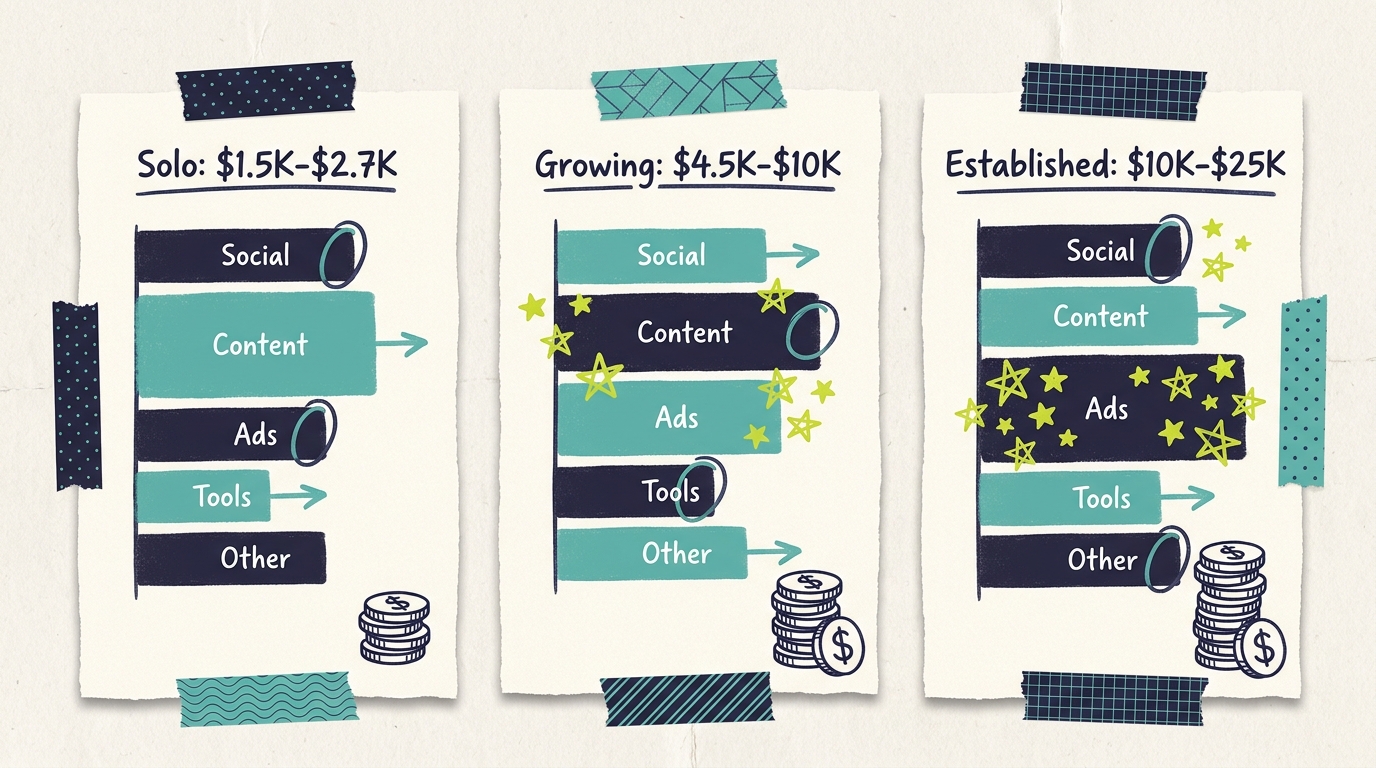
Total recommended monthly ad budget: $1,500-$2,700. Goal: 8-20 qualified inquiries per month.
Growing practice (50-200 clients)
The funnel is working. Now invest in awareness channels that grow inquiry quality and average client value.
Local SEO: maintain
Google Ads: $1,200-$2,500/month
Meta/LinkedIn Ads: $800-$1,500/month
Content marketing: $500-$2,000/month invested in production support
CTV: $1,500-$3,000/month (recommended starting point)
Referral programs: increased activity, occasional COI events
Sponsorships: 1-2 strategic local sponsorships per year
Total recommended monthly ad budget: $4,500-$10,000. Goal: rising average client value, 25-60 qualified inquiries per month.
Established practice (200+ clients, growing AUM or fee base)
The practice has strong inquiry volume but wants to move upmarket, win competitive RFPs, and build long-term brand equity.
Local SEO: maintain at high level
Google Ads: $2,000-$4,500/month
Meta/LinkedIn Ads: $1,500-$3,500/month
Content marketing: $2,500-$8,000/month with team or agency support
CTV: $3,000-$8,000/month, multi-market emphasis with quarterly refreshes
Referral programs: formalized program, regular COI engagement
Sponsorships and speaking: 4-6 major engagements per year
PR and media presence: investment in being quoted in regional or trade media
Total recommended monthly ad budget: $10,000-$25,000+. Goal: brand recognition, premium client acquisition, lower cost-per-client through brand-driven inquiries.
What's different for accountants vs financial advisors
Two categories that look similar from the outside but have meaningful advertising differences.
For accountants:
Seasonal pacing matters. Tax-prep oriented practices see massive inquiry concentration in January-April. Advertising spend should weight heavily toward late November through mid-March.
Industry specialization sells. "CPA for restaurant owners in Dallas" produces stronger inquiries than "CPA in Dallas." Specialty positioning often outperforms generalist positioning.
Client tenure is sticky. Once an accountant has a client, they typically retain them for 5+ years. Acquisition costs can be amortized over a longer client lifetime than most categories support.
For financial advisors:
Trust thresholds are higher than for any other small business category. Clients are being asked to entrust major life savings. Advertising needs to clear that bar.
Compliance requirements add friction. Most advertising creative needs compliance review before launch, and the language allowed varies by regulatory framework (RIA vs broker-dealer affiliated). Build review into your advertising workflow.
Relationship channels dominate. Most successful advisors get the majority of their clients from referrals, COI relationships, and word-of-mouth, with advertising serving as the awareness layer that warms prospects before the referral conversation happens.

Tracking what's working
The biggest mistake we see in accountant and advisor advertising is poor attribution. Prospects research for months before reaching out, and they rarely remember the first marketing touch when they finally inquire. Without clean attribution, you'll over-invest in last-click channels and under-invest in the trust-building work that fills the pipeline.
Three tracking habits worth building:
1. Multi-source attribution on intake forms. Ask every inquiring prospect two questions: "How did you first hear about us?" and "What made you reach out today?" The two answers together tell a more honest story.
2. UTM tagging on all digital channels. Tag every ad URL with a UTM source and medium. This cleanly separates Meta from Google from LinkedIn from content marketing in your analytics.
3. Pre/post baseline measurement. Whenever you add a new channel (especially CTV), don't just look at the channel's direct attribution. Compare total inquiry volume during the campaign weeks against the pre-campaign baseline. The lift in your other channels and your overall inquiry volume is often the campaign's biggest contribution.
Compliance considerations
A note specific to financial advisors that doesn't apply to most small business categories: advertising compliance.
If you're a Registered Investment Advisor or affiliated with a broker-dealer, your advertising creative is subject to regulatory rules under the SEC's Marketing Rule (for RIAs) or FINRA Rule 2210 (for broker-dealers). Common compliance issues that come up in TV and digital creative:
Performance claims. Specific claims about returns, growth rates, or outcomes generally require disclosures or are restricted entirely.
Testimonials and endorsements. Rules around client testimonials changed meaningfully under the SEC's Marketing Rule (2021). Confirm current compliance treatment before featuring client quotes.
Required disclosures. Most advisor advertising requires specific disclosures (firm name, regulatory status, fiduciary status if applicable). Disclosures must be legible and appropriately placed.
Approved language. Your compliance officer or designated principal needs to review and approve creative before launch.
This guide isn't legal or compliance advice. Every advisor's advertising should be reviewed by their compliance team before launch.
Common questions answered
How long does it take for accountant or financial advisor advertising to produce new clients?
For accountants, expect 60-120 days for direct-response channels (Google Ads, Meta) to start producing measurable client acquisition. Trust-building channels (CTV, content marketing, LinkedIn organic) typically need 90-180 days. Referral programs compound over multi-year horizons. For financial advisors, similar but somewhat longer: trust thresholds extend the inquiry-to-client conversion timeline.
Should a solo CPA or advisor advertise on TV?
Increasingly yes, with caveats. The cost of CTV has dropped dramatically (Adwave subscriptions from $50, with most solo practitioners testing CTV at $1,500-$2,500 monthly budgets). The trust-building effects of TV are especially valuable for financial professionals, where credibility is everything. The constraint is usually monthly budget capacity to sustain a meaningful test rather than category fit.
What's the most underrated advertising channel for accountants and advisors?
Centers of influence (COI) referral networks. Most accountants and advisors over-invest in their own paid ads and under-invest in being referable by other professionals (attorneys, insurance agents, real estate professionals, bankers). The compounding return on a single strong COI relationship often exceeds a year of paid Meta spend.
Is LinkedIn advertising worth it for financial advisors?
Yes, often more than Meta for this category. LinkedIn's professional context, audience targeting (by job title, company size, industry, income), and content format all align with how financial advisors typically attract clients. Most advisor practices benefit from running educational LinkedIn content paid + retargeting layer rather than direct service ads on cold audiences.
How do I measure ROI when client lifetime value is so high but acquisition cycles are so long?
Track two horizons. Short-term: cost per qualified inquiry and inquiry-to-consultation conversion rate. Long-term: 12-month client acquisition revenue divided by 12-month total ad spend, then multiplied by your typical client tenure for a lifetime ROAS read. Both matter. The short-term metrics tell you if a channel is working in its first 90 days; the long-term metrics tell you whether to scale it.
Can I run my own advertising or do I need an agency?
For monthly ad budgets under $5,000-$8,000, most accountants and advisors can self-serve through platform tools (Google Ads, Meta, Adwave for CTV) without paying agency fees. Above that budget level, the coordination complexity and creative production demands often justify agency partnership. For advisors with compliance requirements, even self-served campaigns should run through compliance review.
What's the single most important thing an accountant or advisor can do to improve their advertising results?
Tighten the inquiry-to-consultation conversion process. Most practices acquire inquiries faster than they convert them. A practice with a 30% inquiry-to-consultation rate is wasting more advertising spend than it realizes; bringing that rate to 50% effectively doubles the ROI of every channel. Audit your intake process, response time (under 4 business hours is the threshold), and consultation booking flow before increasing ad spend.
Building your practice's channel mix
The accountants and financial advisors growing fastest in 2026 don't run a single channel. They run a coordinated mix where each channel does its specific job: Google captures active demand, Meta and LinkedIn build awareness, CTV builds trust at the household level, content marketing establishes expertise, and referral programs convert warm introductions at high rates.
If you're early in your practice, start with the foundation: Google Business Profile, Google Ads, one or two social channels, and active COI relationships. As inquiry volume stabilizes, layer in CTV to build the household-level trust that makes every other channel work harder. As your practice matures, premium content marketing and brand-building investment become the levers that move average client value up.


