
The cleaning and janitorial services category sits in an unusual marketing position. The work is universally needed, the decision to hire is usually triggered by a specific moment (move-in, move-out, post-event, a one-time deep clean before guests arrive, or recurring service starting after a life change), and the choice of provider is often made within 48-72 hours of the trigger. That short decision window means your business needs to be familiar at when someone goes from "I should hire a cleaner" to "let me find one."
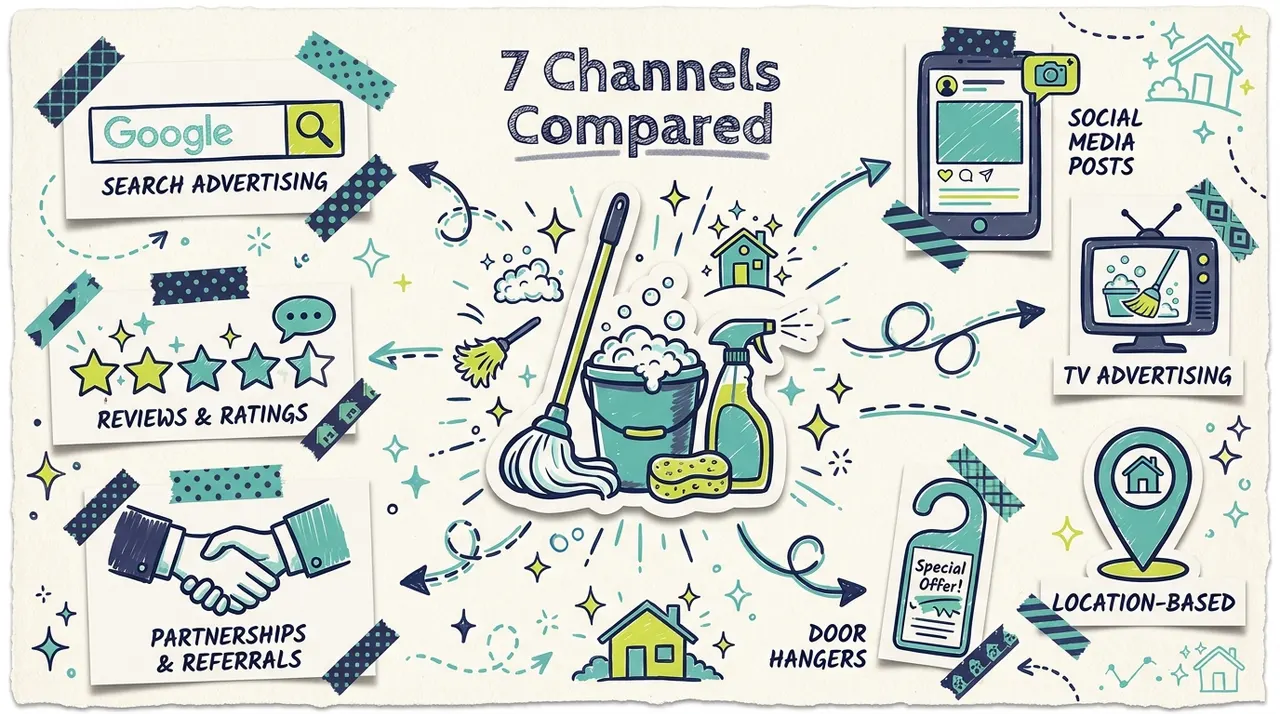
This guide walks through the seven advertising channels that work best for residential and commercial cleaning businesses in 2026, what each one does, what realistic costs look like, and how to split budget among them. Whether you're a solo residential cleaner, a growing residential team, or a commercial janitorial company, the framework here applies.
What "best" advertising means for cleaning businesses
Before comparing channels, it's worth being clear about what success means in this category. Three measurable outcomes matter:
Quote requests. People reaching out to learn pricing or book a service. Most cleaning businesses convert 30-55% of quote requests to first-job bookings, so the top of the funnel needs steady volume.
First-job bookings. The conversion from quote to confirmed appointment. A flood of quote requests that don't book is a different problem than a quote shortage.
Recurring service conversion. The most valuable outcome. A one-time deep clean is worth $200-$500; a converted weekly residential client is worth $3,000-$8,000/year; a commercial janitorial contract is worth $12,000-$80,000+/year. The advertising mix that produces customers who become recurring is more valuable than the mix that produces only one-time jobs.
Because the lifetime value gap between one-time and recurring customers is so large, the right ad spend math is patient. A $90 cost per quote that converts to a $5,000/year recurring client is dramatically different from a $90 cost per quote that produces only a $250 one-time job.
The seven channels worth considering
1. Google Ads (Search + Local Services Ads)
What it does well: catches active demand. Someone searching "house cleaning near me" or "commercial cleaning Phoenix" is showing strong purchase intent in real time. Google Local Services Ads (LSA) specifically are designed for service-area businesses and feature prominently above traditional search results.
What it doesn't do: build demand before active intent. Search captures the moment-of-need but doesn't create new demand.
Cost per quote request: $25-$95 for residential cleaning, $40-$180 for commercial janitorial.
Best for: every cleaning business with a working website. Google is the channel where most cleaning categories see strongest direct-response performance.
Practical setup: get Google Local Services verified (background-checked, license-verified) for the LSA badge. Run regular search ads with negative keywords for "DIY," "tips," "products," and "training" to avoid wasted clicks. Use location targeting tight to your service area. Build separate campaigns for residential, commercial, and specialty services (post-construction, move-out, etc.).
2. Meta Ads (Facebook + Instagram)
What it does well: builds awareness for prospects who aren't yet actively searching. Meta especially works for "lifestyle" cleaning content (transformation photos, day-in-the-life of a cleaner, satisfying before/after reels). Targeting can be tightly local.
What it doesn't do: capture peak-moment urgency. Most cleaning Meta conversions happen days or weeks after the first impression, which means Meta works as a long-cycle funnel-feeder rather than a same-day-conversion channel.
Cost per quote request: $40-$120 for residential, $60-$200 for commercial.
Best for: residential cleaning businesses with strong visual content. Before-and-after photos, satisfying cleaning reels, and team-driven creator content all work on Meta. Commercial janitorial sees weaker Meta performance and usually does better on LinkedIn for B2B targeting.
Practical setup: invest in regular content production (weekly or biweekly reels showing real work, customer testimonials, team faces). Use retargeting heavily; first-touch Meta visitors often need 3-7 touches before converting. Always include a clear quote-request CTA on landing pages.
3. Connected TV (CTV) Advertising
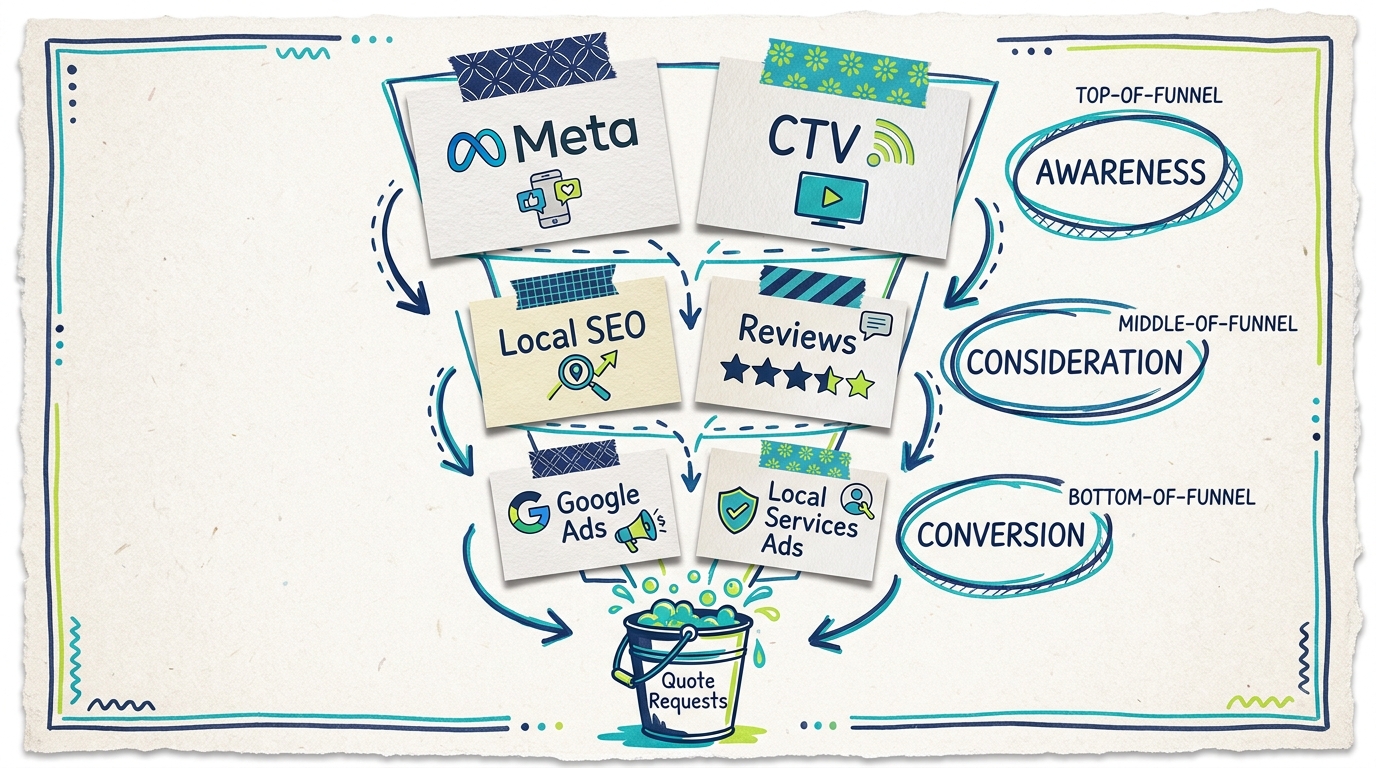
What it does well: builds the household-level trust that converts to "let's hire them" when the moment arises. CTV reaches both decision-makers in the household (most residential cleaning decisions are made jointly) and builds the recognition that converts quote-shopping into a direct call to your business.
What it doesn't do: produce same-day quote requests. CTV is a top-of-funnel and mid-funnel channel for cleaning, not direct-response.
Cost per quote request (direct attribution): $80-$220 for residential, $120-$350 for commercial. With cross-channel lift included: $50-$140 for residential, $80-$220 for commercial.
Best for: cleaning businesses with 12+ months of operating history serving a defined geography. Strong fit for residential services (where the household decision dynamic is biggest); selective fit for commercial (where direct outreach typically converts better than awareness campaigns).
Practical setup: 30-second creative focusing on trust, reliability, and team. Show actual cleaners (background-checked, uniformed, professional). Tight geographic targeting to real service area. Frequency target of 3-5 per household over 2-3 week flights. Pair with strong Google presence so the trust built on TV converts when prospects search for quotes.
Adwave's subscription tier starts at $50 and makes CTV accessible at cleaning-business budgets that previously couldn't justify TV. For residential cleaning businesses with monthly ad budgets of $1,800+, CTV is one of the most underexploited channels.
4. Local SEO and Google Business Profile
What it does well: surfaces your business when prospects search for cleaning services in your area. The "local 3-pack" above organic results captures a substantial share of local cleaning-service searches.
What it doesn't do: produce inquiries from outside your geographic service area.
Cost: $0-$500/month in tools and time.
Best for: every cleaning business with a service area. Foundational.
Practical setup: complete Google Business Profile with services, photos, hours, and team info. Reply to every review within 48 hours. Add new photos monthly. Make sure your business is categorized correctly (House Cleaning Service, Janitorial Service, Commercial Cleaning Service, etc.).
5. Direct mail and door hangers
What it does well: hyper-local geographic reach with tangible presence. A well-designed door hanger or postcard left at homes in a target neighborhood produces real quote requests for residential cleaning, especially in dense neighborhoods.
What it doesn't do: scale efficiently beyond physical distribution capacity. Quality declines fast when you try to scale.
Cost per quote request: $35-$150 for well-targeted residential mail; much higher for commercial.
Best for: solo residential cleaners and small teams building density in specific neighborhoods. The economics work best when you can route efficiently and the geographic targeting is tight.
Practical setup: target specific neighborhoods with high homeowner concentration, modest-to-strong household income, and proximity to existing clients (referral density is highest there). Don't blanket-mail. Distribute when you're already in the area for an existing job to keep costs down.
6. Industry partnerships and referral programs
What it does well: uses the trust other businesses or professionals have already built. Real estate agents, property managers, moving companies, and home services contractors all generate cleaning referral opportunities.
What it doesn't do: produce immediate volume. Referral networks compound over years.
Cost: relationship investment, occasional referral compensation.
Best for: every cleaning business. Especially valuable for residential cleaners (move-in/move-out from real estate referrals) and commercial janitorial (from property management partnerships).
Practical setup: identify 10-20 referral sources in your area. Build relationships through occasional gifts, joint promotion, and reciprocal referrals when appropriate. Track which sources produce which clients; double down on the strongest.
7. Reviews and reputation platforms (Yelp, Thumbtack, Angi)
What it does well: surfaces you to prospects in active comparison mode. Most cleaning prospects look at reviews and ratings before booking; strong reputation on the major platforms converts well.
What it doesn't do: produce inquiries without strong reviews. A new business or one with weak reviews on these platforms gets little traffic.
Cost: variable. Yelp paid placement runs $300-$2,500/month for cleaning categories depending on market. Thumbtack and Angi have lead-fee or membership models.
Best for: residential cleaning businesses with 6+ months of operating history and at least 15-25 strong reviews. The platforms reward sustained quality with sustained traffic.
Practical setup: claim and complete profiles on the major platforms. Make review collection part of your post-job routine. Reply professionally to every review (positive and negative). Don't pay for premium placement on platforms where you don't have strong organic ratings; the spend gets diluted by negative comparison.
Side-by-side channel comparison
Recommended budget allocation by business stage
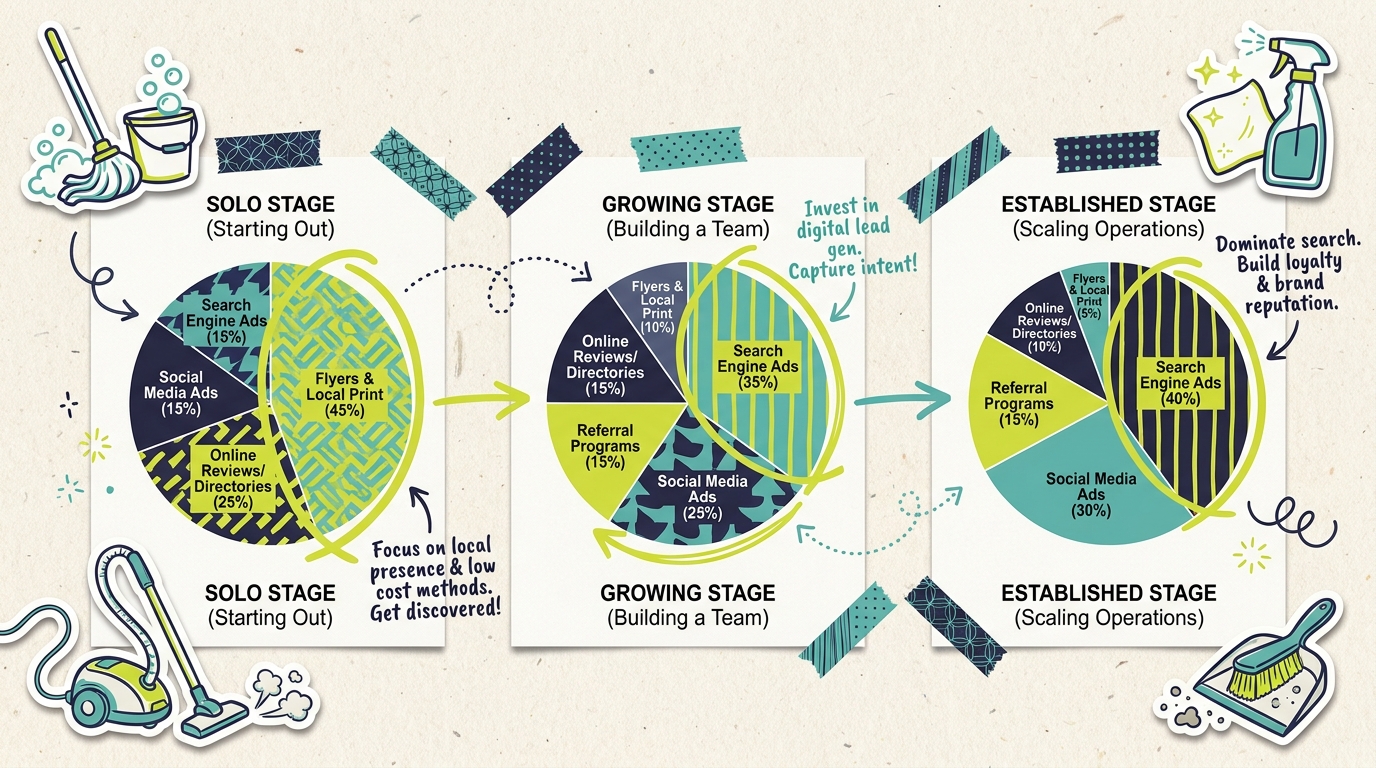
Solo or new cleaning business (under 25 clients)
Foundation-focused. Most budget goes to producing initial quote volume and reputation.
Local SEO and Google Business Profile: time investment, ~$0-$200/month
Google Ads (Search + LSA): $400-$1,000/month
Meta Ads: $300-$600/month
Direct mail / door hangers: $200-$500/month
Industry partnerships: time investment
Reviews platforms: free profile, no paid placement yet
CTV: hold off until quote volume is steady from foundational channels
Total recommended monthly ad budget: $1,000-$2,300. Goal: 15-35 quote requests per month.
Growing residential business (25-100 active clients)
The funnel is working. Now invest in trust-building channels.
Local SEO and GBP: maintain at high level
Google Ads: $800-$1,800/month
Meta Ads: $600-$1,500/month with regular content production
Direct mail: $400-$800/month in targeted neighborhoods
CTV: $1,500-$2,500/month (recommended starting point)
Industry partnerships: increased activity
Reviews platforms: paid placement on Yelp or similar if local market warrants
Total recommended monthly ad budget: $3,300-$7,100. Goal: 40-90 quote requests per month, rising average client value, higher recurring-service conversion rate.
Established residential or commercial business (100+ active clients)
Strong inquiry volume; now investing in brand, scale, and premium positioning.
Local SEO: maintain at highest level
Google Ads: $1,500-$3,500/month
Meta Ads: $1,200-$2,500/month
Direct mail: $500-$1,500/month in expansion neighborhoods
CTV: $2,500-$5,000/month, multi-market emphasis
Industry partnerships: formalized referral program
Reviews platforms: full premium presence on top 2-3 platforms
Total recommended monthly ad budget: $7,500-$17,000. Goal: brand-driven inquiries, premium client acquisition, lower cost-per-client through brand recognition.
For commercial-heavy businesses, also invest in:
LinkedIn Ads ($600-$1,500/month) for B2B targeting
Targeted account-based marketing for high-value prospects
Industry trade group memberships and visibility
What's different for residential vs commercial
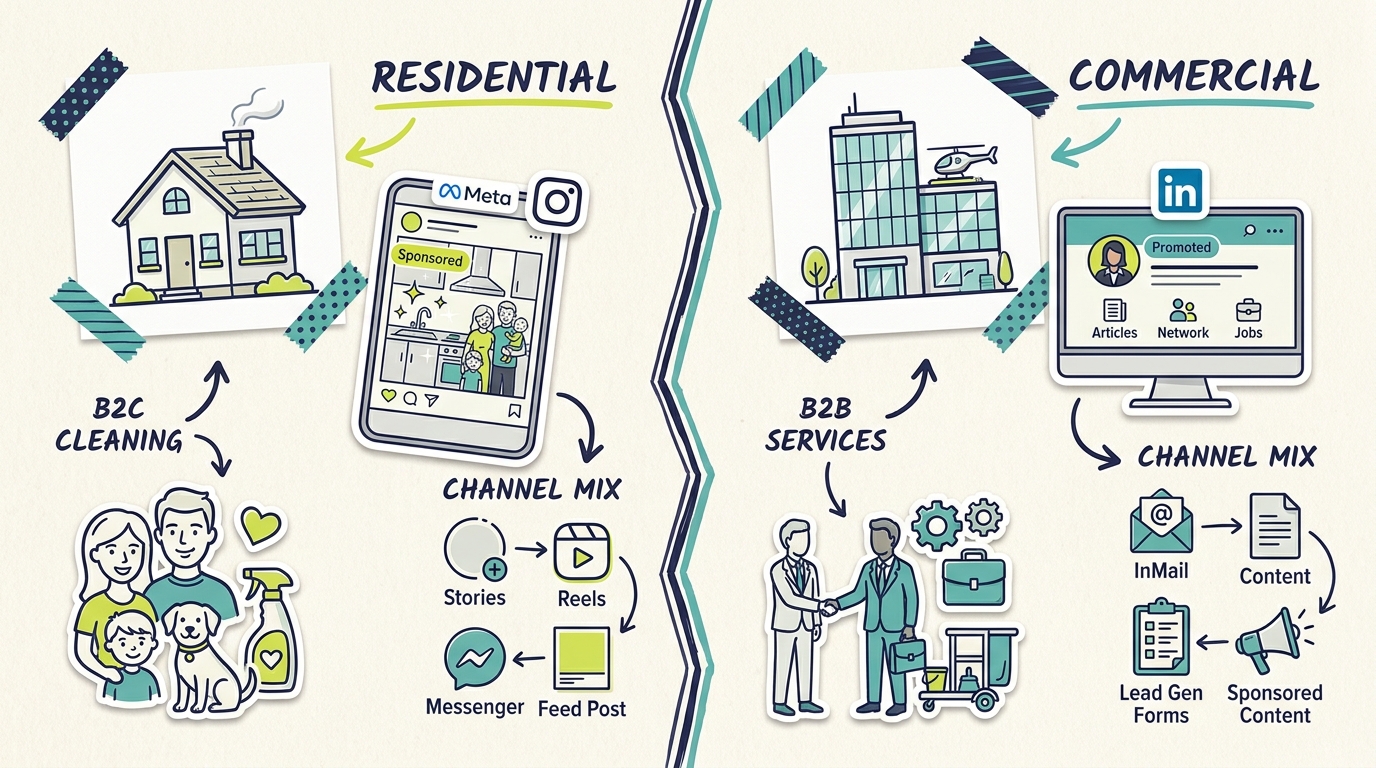
For residential cleaning:
Visual content marketing (before/after photos, satisfying reels) drives meaningful Meta performance
Household-level recognition matters; CTV's family-decision dynamic is especially valuable
Move-related triggers (real estate transactions) produce a meaningful share of demand
Recurring weekly or biweekly service is the financial foundation; advertising should emphasize sustained relationships
For commercial janitorial:
B2B direct outreach (cold calling, account-based marketing) typically converts better than awareness campaigns at small scale
LinkedIn paid and organic outperform Meta for many commercial categories
Decisions are made by office managers, facility managers, or operations leads; targeting should reflect this
Contract length and renewal rates are the financial foundation; advertising should support relationship-led sales
Tracking what's working
Cleaning business attribution is relatively clean because the quote request is a defined event you control. Three tracking habits worth building:
1. Multi-source intake. Ask every quote requester two questions: "How did you first hear about us?" and "What made you reach out today?" The two answers together tell a more honest story.
2. UTM tagging on every digital channel. Clean separation of which ads, on which platforms, produce which quote requests.
3. Pre/post baseline measurement. When adding a new channel (especially CTV), don't just look at directly-attributed quote requests. Compare total quote volume against pre-launch baseline. The total lift captures cross-channel benefit that direct attribution misses.
Common questions answered
How long does it take for cleaning business advertising to produce new clients?
For Google Ads and Local Services Ads, expect 30-45 days for measurable quote volume. For Meta, 60-120 days. For CTV, 60-90 days. For local SEO improvements, 60-180 days depending on starting position. Plan for a year of foundational investment before judging overall ROI; the compounding effects of multi-channel presence build over time.
Is CTV really worth it for a small residential cleaning business?
Yes, increasingly. Subscription-tier platforms have brought CTV access to the $50-$500 entry range, with most residential cleaning businesses testing CTV at $1,500-$2,500 monthly budgets. The trust-building effect of TV (especially for in-home services where homeowners are letting strangers into their houses) is especially valuable in this category.
Should a commercial janitorial business advertise on TV?
Selectively. Commercial decisions are typically made by office managers and facility managers, who can be reached on TV but are more efficiently targeted through LinkedIn and direct outreach. Commercial cleaning businesses with multi-market service areas often benefit from CTV; single-market commercial cleaning businesses usually do better concentrating on direct B2B channels.
What's the most underrated advertising channel for cleaning businesses?
Industry partnerships, especially with real estate agents, property managers, and moving companies. The trust transfer of a recommendation from an established local professional converts dramatically better than any cold ad channel. The constraint is usually time and personal capacity rather than dollars.
Are Yelp and Angi worth paying for in 2026?
It depends on your market and your current review base. In markets where Yelp drives meaningful cleaning-services traffic and you have at least 20-30 strong reviews, paid placement can produce real ROI. In markets where Yelp is less dominant or your review base is thin, the spend underperforms. Test both rather than assuming the platform that worked for a peer in another market will work for you.
How do I measure ROI on cleaning business advertising when client tenure is so variable?
Track two horizons. Short-term: cost per quote request, by channel, and quote-to-booking conversion rate. Long-term: 12-month gross revenue per client divided by 12-month total ad spend (lifetime ROAS). Recurring service customers compound the long-term measurement substantially; one-time job customers are valued at the single-job revenue.
What's the single biggest mistake cleaning businesses make in their advertising?
Treating quote requests as the success metric instead of recurring-service conversions. A channel that produces 30 quotes that convert to 5 one-time jobs is worse than a channel that produces 12 quotes that convert to 6 recurring weekly clients. Track quote-to-recurring conversion rate by source, not just quote volume.
Building your cleaning business's channel mix
The cleaning businesses growing fastest in 2026 don't run a single channel. They run a coordinated mix where Google captures active demand, Meta builds visual awareness, CTV builds household-level trust, local SEO surfaces them in moment-of-need searches, partnerships drive referrals, and reviews close the comparison.
If you're early in your business, start with the foundation: Google Business Profile, Google Ads + Local Services, basic Meta presence, partnerships with 5-10 local referral sources. As quote volume stabilizes, layer in CTV to build the household recognition that lifts every other channel. As your business matures, premium positioning and broader brand investment become the levers that move average client value and reduce CAC.


