
The wedding and events business has a strange marketing problem. Your customer is researching for 9 to 18 months before they book, comparing dozens of vendors across Pinterest boards, Instagram saves, vendor lists from their planner, and a wedding-industry directory or two. Your competitive set includes venues you've never heard of and Airbnb estates moonlighting as wedding venues on weekends. And the booking decision, when it finally happens, is rarely made on a single ad.
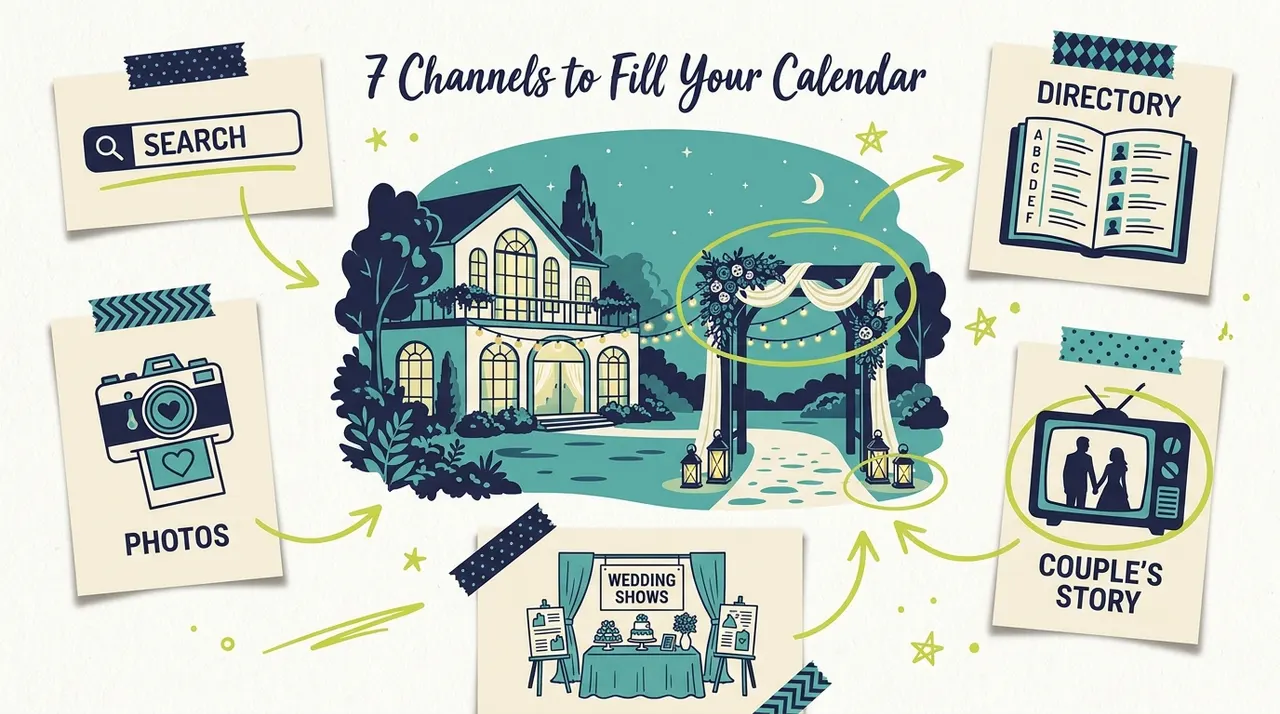
The venues and event planners winning in 2026 aren't running one ad channel. They're running a layered presence that meets couples at every step of the long research arc, from the first inspiration board to the final venue tour. This guide walks through the seven channels that matter most, what each one does, and how to allocate a realistic monthly budget across them.
What "best" advertising means for wedding venues
Before comparing channels, it's worth being honest about what success looks like in this category. Wedding and event marketing has three measurable outcomes:
Inquiry volume. How many couples reach out to learn more about your venue or services. Most venues need 4-8 inquiries to produce one booked event, so the top of the funnel needs steady volume.
Inquiry quality. Couples who match your venue's price point, capacity, and aesthetic. A flood of inquiries from couples with half your minimum spend is worse than fewer, better-fit inquiries.
Booked events. The number that pays the bills. For a venue, $15K-$45K per booking. For a planner, $4K-$25K. For specialty services (photographers, florists at-scale), $2K-$10K.
The right advertising mix prioritizes inquiry quality over raw volume, because every inquiry costs your team time to qualify. A channel that produces 30 inquiries with 5 fits is often worse than one producing 12 inquiries with 8 fits.
The seven channels worth considering
1. Google Ads (Search)
What it does well: catches couples in active research mode. Someone searching "wedding venues outdoor Austin" or "event planner downtown Chicago" is showing buying intent. Google Ads puts you in front of them with a clear path to your website or inquiry form.
What it doesn't do: build emotional preference. Search ads convert active demand; they don't create new demand.
Cost per inquiry: typically $25-$90 for wedding venues, $15-$65 for event planners. Higher in major metros, lower in mid-sized markets.
Best for: venues and planners who've already done the work to be findable on Google with a strong website. Search ads amplify a working funnel; they can't fix a broken one.
Practical setup: focus on long-tail keywords ("Texas hill country wedding venues with on-site lodging" beats "wedding venues"). Use location targeting tight to your service area. Include negative keywords for "free," "DIY," and "backyard" if those don't match your business model.
2. Meta Ads (Instagram + Facebook)
What it does well: visual inspiration. Wedding planning is one of the most Pinterest-and-Instagram-driven purchase journeys in any category. A great venue photo or a planner's portfolio reel can move a couple from "I should start looking" to "I need to tour this place."
What it doesn't do: convert immediately. Most wedding Meta ads drive saves, follows, and website visits rather than instant inquiries. The payoff is downstream when the couple narrows their list.
Cost per inquiry: $35-$120 for venues, $25-$80 for planners, with significant variance based on creative quality.
Best for: venues and planners whose physical product or portfolio photographs well. If your venue has obvious visual hooks (water views, historic architecture, dramatic light), Meta is one of your highest-use channels. If your venue is functional but visually average, Meta will work harder.
Practical setup: invest in two or three professional photo or video shoots per year. Use carousel ads for venue tours and reel ads for emotional moments. Always include a clear inquiry CTA, not just "follow our page."
3. The Knot, WeddingWire, and Zola directories
What it does well: surfaces you to couples who've signed up for wedding planning tools and are actively comparing options. The directories see meaningful traffic from couples in the active-shortlist phase.
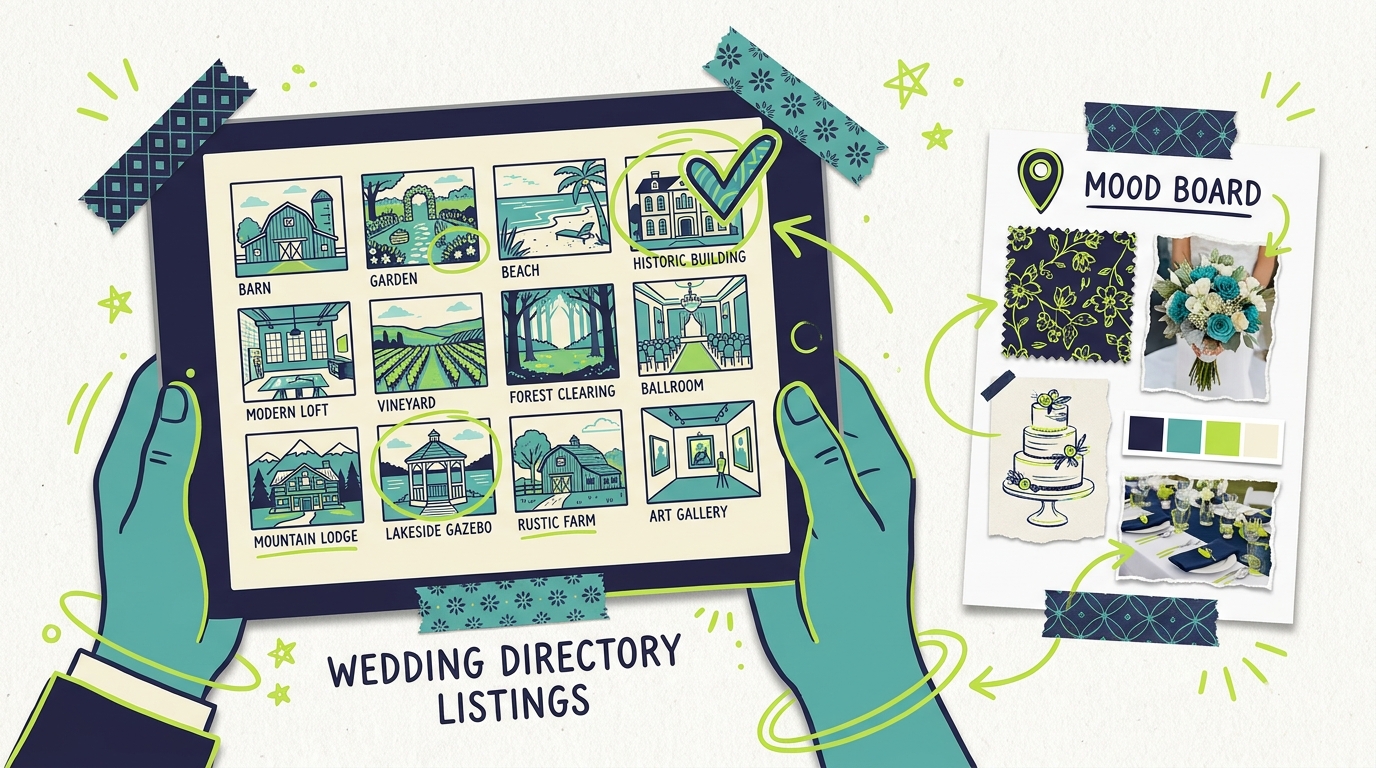
What it doesn't do: differentiate you in a sea of similar listings. Directory listings often surface 30-100 options for a couple's criteria, and you're one logo in a grid.
Cost: directory premium placement and lead-gen packages typically run $200-$800/month per directory, with some venues paying $1,500+ in major markets for top placement.
Best for: venues that show well on the directory's photo grid and have strong reviews on the platform. Directories reward businesses that have invested in their on-directory presence with multiple shoots and active review management.
Practical setup: don't just pay for the listing. Update photos seasonally, respond to every inquiry within an hour, and ask happy couples to leave a review on the same directory. The combination of investment and engagement outperforms premium placement alone.
4. Local SEO and Google Business Profile
What it does well: shows up when couples search for "[city] wedding venues" or "wedding planner near me." A well-optimized Google Business Profile with regularly added photos, recent reviews, and accurate availability info ranks in the local 3-pack that sits above the organic results.
What it doesn't do: produce inquiries from couples outside your geographic area. Destination venues, in particular, get only modest mileage from local SEO unless they invest in broader content strategy.
Cost: largely time rather than dollars. A few hundred dollars per year for a simple local SEO audit or schema markup work.
Best for: every venue and every planner, with no exceptions. Local SEO is foundational. Even a venue running paid ads aggressively should have a fully built-out Google Business Profile, an FAQ-driven website with rich schema, and consistent NAP (name, address, phone) data across the web.
Practical setup: add new photos to your Google Business Profile every month. Reply to every review (positive and negative) within 48 hours. Make sure your venue is correctly tagged with "Wedding Venue" as the primary category.
5. Wedding shows and bridal expos
What it does well: face-to-face contact with couples in active planning. A 30-second conversation at a bridal expo often does more to move a couple from "interested" to "scheduling a tour" than any ad ever will.
What it doesn't do: scale beyond the regional couples who attend the show. And expos are increasingly attended by couples in mid-to-late planning, which is too late for some venue categories.
Cost: $800-$3,500 per show booth, plus staff time and giveaway costs.
Best for: planners and venues with strong in-person presentation. If your team can engage warmly and follow up within 24 hours of every show conversation, expos can produce 3-10 bookings per show for venues and similar for planners.
Practical setup: bring a tablet for on-the-spot tour scheduling. Capture leads with a clean intake form that includes wedding date and rough budget. Follow up within 24 hours, then a second time at 7 days, then a third time at 21 days. Most show leads die from poor follow-up, not from poor initial interest.
6. Connected TV (CTV) advertising
What it does well: builds the emotional preference and trust that drives couples (and their families, who often co-decide on venues) to short-list your business. CTV reaches couples and parents-of-couples in the lean-back evening hours when wedding planning conversations happen.
What it doesn't do: catch active-research-moment intent the way search does. CTV is a top-of-funnel and mid-funnel channel for wedding venues, not a direct-response channel.
Cost: Adwave runs subscriptions from $50, with most venues testing CTV at $800-$2,000 monthly budgets. CPM typically lands in the $15-$35 range with an average around $25.
Best for: venues and event planners with broader geographic draw (destination venues, statewide event planners, multi-location operators) where the household co-decision dynamic matters. Couples rarely book a wedding venue alone; CTV reaches the couple AND the parent watching streaming TV with them.
Practical setup: 30-second emotional spots that capture the feeling of an event at your venue beat fact-heavy spots that list amenities. Frequency matters: aim for 3-5 impressions per household over a 2-3 week flight. Pair CTV with your social proof on Instagram and your inquiry form on Google so the trust built on TV converts when couples are ready.
For a deeper walkthrough of how CTV works for venues with broader geographic draw, see our TV advertising for wedding venues guide.
7. Industry partnerships and preferred-vendor lists
What it does well: word-of-mouth amplified by trust transfer. When a top wedding planner adds your venue to their preferred list, every couple they work with hears about you in the context of a recommendation, not an ad.
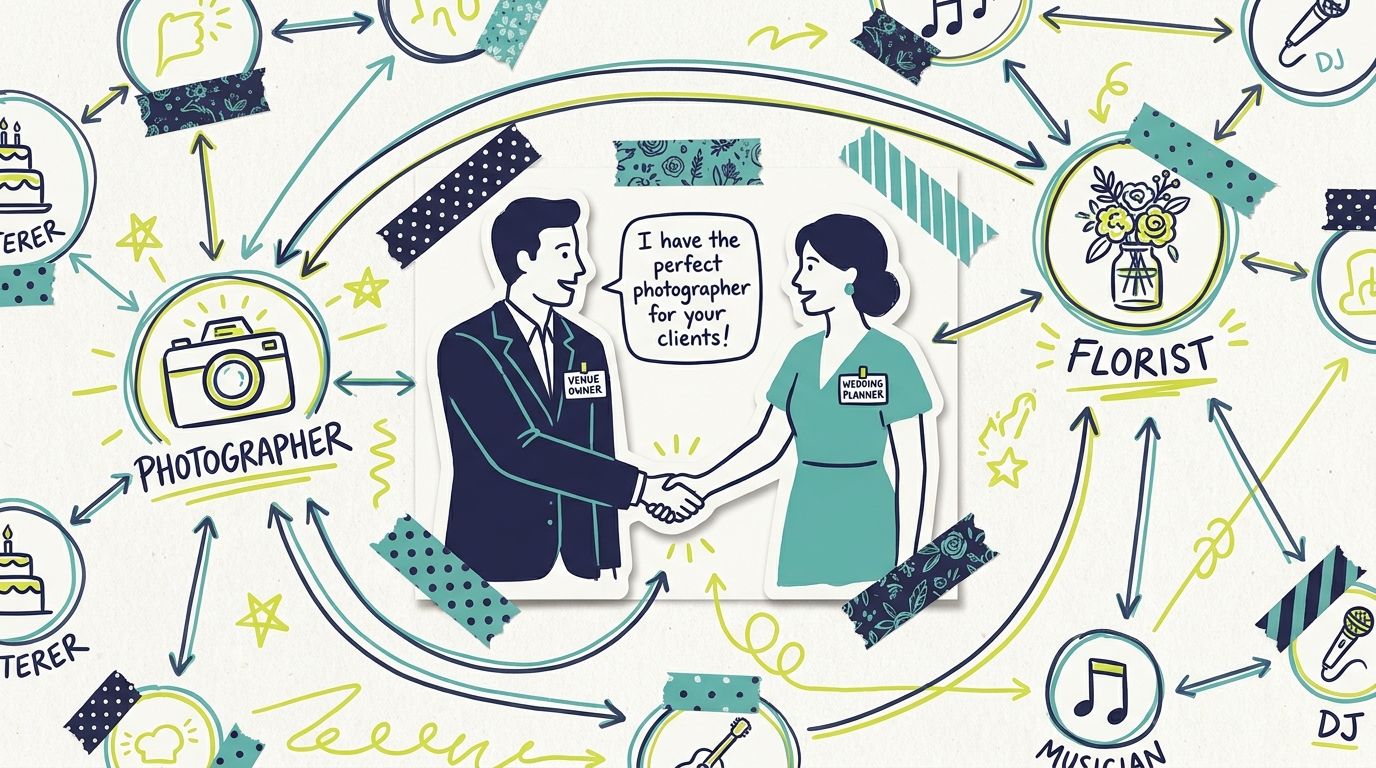
What it doesn't do: produce immediate volume. Partnership networks compound over years, not weeks.
Cost: relationship investment rather than ad spend. Hosting planner familiarization events, providing styled-shoot opportunities for photographers, and joining venue-association memberships.
Best for: every venue and planner. Industry partnerships are the second-most-underrated channel for wedding businesses (after local SEO). The venues with the strongest 5-year referral pipelines spent years investing in vendor relationships.
Practical setup: identify the top 8-12 planners, photographers, and florists in your service area and build genuine relationships with them. Host a vendor appreciation event once a year. Be referable: respond promptly to vendor inquiries, deliver well at every event, and acknowledge vendor referrals publicly.
Side-by-side channel comparison
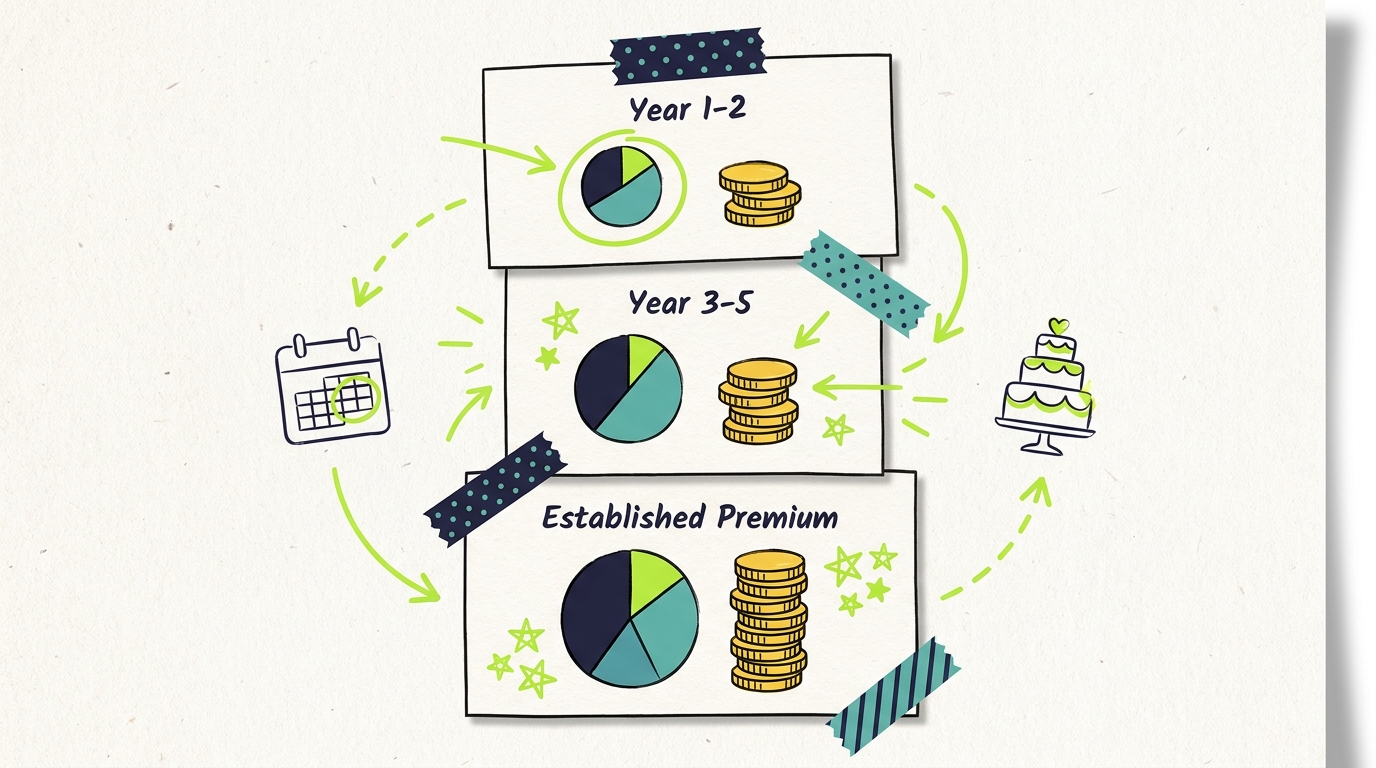
Recommended budget allocation by stage
The right channel mix depends on where your business is in its growth.
Year 1-2 venue or planner (building presence)
Focus on foundation. Most of the budget should go to channels that build inquiry volume and reputation.
Local SEO and Google Business Profile: time investment, ~$0-$300/month
Google Ads: $500-$1,200/month
Meta Ads: $400-$1,000/month
Wedding directories: $200-$600/month
Industry partnerships: time investment
Bridal expos: 2 shows per year
CTV: hold off until inquiry volume is steady from foundational channels
Total recommended monthly ad budget: $1,500-$3,500. Goal: 25-60 inquiries per month.
Year 3-5 established business (scaling)
The inquiry funnel is working. Now invest in lift channels that grow inquiry quality and average booking value.
Local SEO: maintain
Google Ads: $800-$2,000/month
Meta Ads: $800-$1,800/month
Wedding directories: $400-$1,200/month
Industry partnerships: increased investment in events
CTV: $1,000-$2,500/month (recommended starting point)
Bridal expos: 3-4 shows per year
Total recommended monthly ad budget: $4,500-$9,500. Goal: rising average booking value, 60-150 inquiries per month, improved inquiry-to-booking conversion.
Established business (premium positioning)
The business has strong inquiry volume but wants to move upmarket, win competitive comparisons, and build long-term brand equity.
Local SEO: maintain
Google Ads: $1,500-$3,500/month
Meta Ads: $1,200-$3,000/month, with heavier video investment
Wedding directories: premium placement
Industry partnerships: anchor sponsor on regional wedding events
CTV: $2,500-$5,000/month, regional emphasis with creative refreshes quarterly
Bridal expos: selective high-end shows only
PR and editorial: investment in being featured in regional wedding media
Total recommended monthly ad budget: $9,000-$18,000+. Goal: brand recognition, premium average booking value, lower cost-per-booking through brand-driven inquiries.
Tracking what's working
The biggest mistake we see wedding venues and planners make in their advertising is poor attribution. Couples often touch 6-12 sources before they inquire, and they remember the last one they saw, not the first. Without clean attribution, you'll over-invest in last-click channels and under-invest in the top-of-funnel work that's filling the pipeline.
Three tracking habits worth building:
1. Inquiry form questions. Ask every inquiring couple two questions on the form: "Where did you first hear about us?" and "How did you find this site today?" The two answers together tell a more honest story than either alone.
2. UTM tagging. Tag every ad URL with a UTM source and medium. This won't catch CTV (which isn't clickable) or in-person referrals, but it cleanly separates Meta from Google from directory traffic in your analytics.
3. Pre/post baselines. When you add a new channel (especially CTV), don't just look at the channel's directly-attributed conversions. Compare total inquiry volume during the campaign weeks against a pre-campaign baseline. The lift in your other channels is often the campaign's biggest contribution.
Common questions answered
How long does it take for wedding venue advertising to produce booked events?
For venues with 9-18 month booking windows, the lag between launching a new advertising channel and seeing booked events typically runs 4-9 months. Inquiry volume can lift within weeks, but the booked-event impact compounds slowly because of the long research cycle. Plan for a year of investment before judging a new channel's contribution.
Should a small wedding venue advertise on TV?
Yes, with caveats. Venues with broader-than-local draw (destination venues, statewide event planners, multi-location operators) get strong returns from CTV because they need to reach couples across a wide geography. A hyper-local venue serving only a 30-mile radius can still benefit from CTV but needs to weigh it against simpler local channels like Google Ads. The democratized cost of CTV in 2026 means even small venues can test the channel at modest monthly budgets.
What's the most underrated advertising channel for event planners?
Industry partnerships. Most event planners over-invest in their own paid ads and under-invest in being referable by other vendors. The planners with the strongest long-term pipelines spent years building relationships with venues, photographers, florists, and other planners. The compounding return on a single great partnership often exceeds a year of paid Meta spend.
How much should a new wedding venue spend on advertising in its first year?
A new venue might budget $1,500 to $3,500 per month in its first year for Google Ads, Meta, business listings, and wedding directories. Adjust the mix based on inquiry volume and booked events.
Do wedding directory listings still work in 2026?
Yes, but with less centrality than five years ago. The Knot, WeddingWire, and Zola still drive meaningful inquiry volume for venues with strong profiles, photos, and recent reviews. Directories work best when paired with other channels (Meta to drive saves, Google Business to capture local search). They no longer work as a standalone strategy for most venues.
Can a venue or planner skip Meta and rely on Google search?
Possible, but it leaves growth on the table. Google Ads catches couples in active research mode; Meta builds the awareness and inspiration that gets couples into active research mode. A search-only strategy converts active demand efficiently but doesn't grow the demand pool. Most venues benefit from both, with Meta closer to top-of-funnel and Google closer to bottom-of-funnel.
How do I measure ROI for wedding advertising when the booking cycle is so long?
Two complementary measures. Short-term: cost per qualified inquiry, by channel. Long-term: 12-month booked-event revenue divided by 12-month total ad spend (your advertising-driven revenue ratio). Look at both. Channels that produce qualified inquiries cheaply but rarely convert to bookings are different from channels that produce fewer inquiries that convert at high rates.
Building your channel mix
The wedding and events business rewards layered presence. No single channel wins on its own; the venues and planners that grow fastest run 4-6 channels in coordination, each doing its specific job in the customer journey.
If you're early in your business, start with the foundation: Google Business Profile, Google Ads, Meta, one or two directories, and active vendor relationships. As inquiry volume stabilizes, layer in CTV to build the emotional preference that moves couples from "researching options" to "this is the one." As your business matures, premium directory placement and brand-building CTV become the levers that move average booking value up.


