-
20%
Broadcast TV share of total TV viewing
-
43%
Streaming share of total TV viewing
-
28%
Cable TV share of total viewing
SEO Metadata
Title: What Percentage of TV is Broadcast? (Q3 2025)
Meta Description: Broadcast TV accounts for 20.1% of total U.S. TV viewing in 2025. Nielsen Gauge data shows streaming now dominates. Updated July 2025.
Primary Keyword: broadcast TV viewing share
Secondary Keywords: broadcast television statistics, broadcast TV vs streaming, network TV viewership, ABC CBS NBC viewership
---
Statistics Boxes
Create as separate Contentful entries, then embed as statisticGroup.
Stat 1:
Number: 20.1%
Text: Broadcast share of U.S. TV viewing
Stat 2:
Number: -21%
Text: Decline since May 2021
Stat 3:
Number: 4th
Text: Behind streaming, cable, and "other"
---
Article Content
# What Percentage of TV is Broadcast? (Q3 2025)
Broadcast television accounts for 20.1% of total U.S. TV viewing time, according to Nielsen's Gauge data from May 2025. That means the big four networks (ABC, CBS, NBC, and FOX) plus smaller broadcast channels now capture roughly one-fifth of all time Americans spend watching television. This marks a significant shift from just a few years ago, when broadcast regularly commanded over a quarter of viewing time. For advertisers, understanding where broadcast fits in the current TV landscape is essential for making smart media buying decisions, especially as streaming continues its rapid ascent.
---
What the data shows
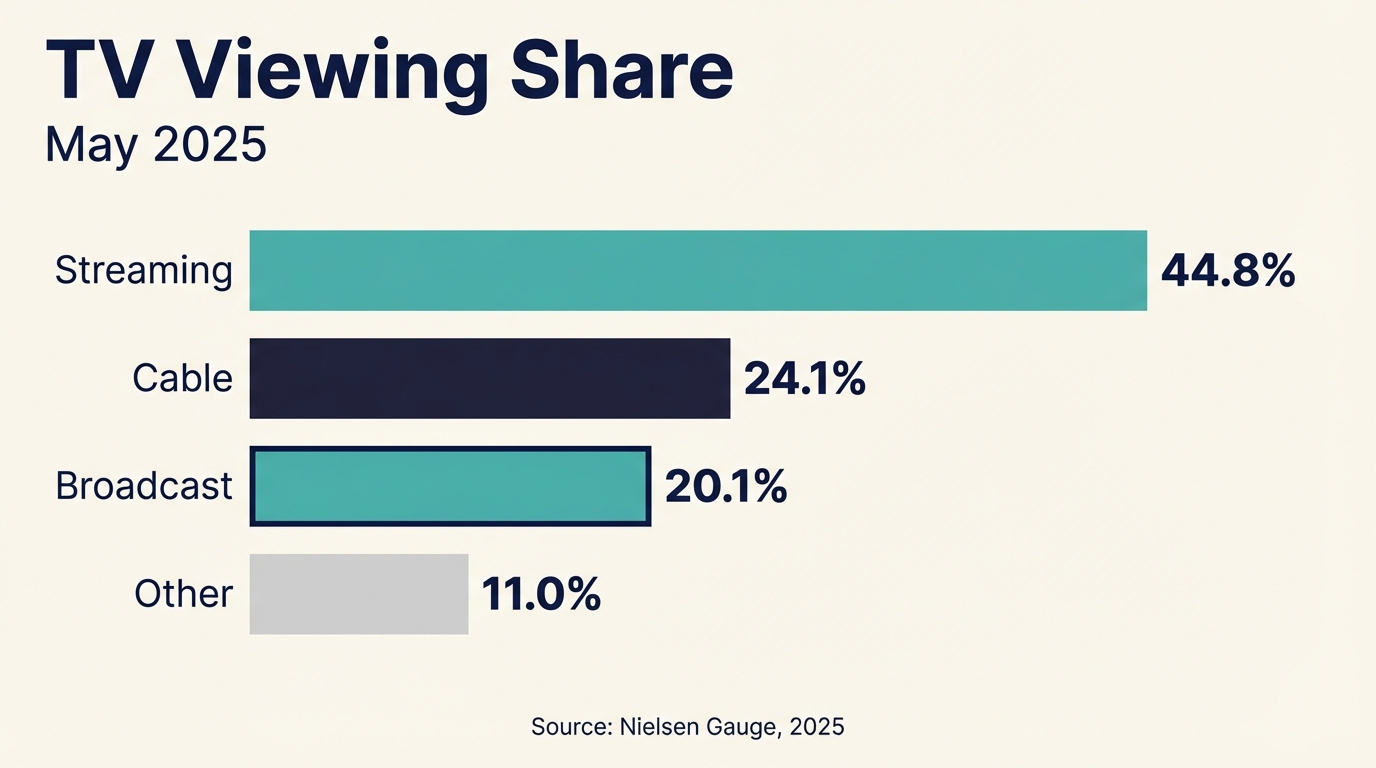
The broadcast television landscape has fundamentally changed over the past four years. Nielsen's May 2025 Gauge report revealed that broadcast TV now captures just 20.1% of total television viewing in the United States, placing it behind both streaming (44.8%) and cable (24.1%) in terms of audience attention.
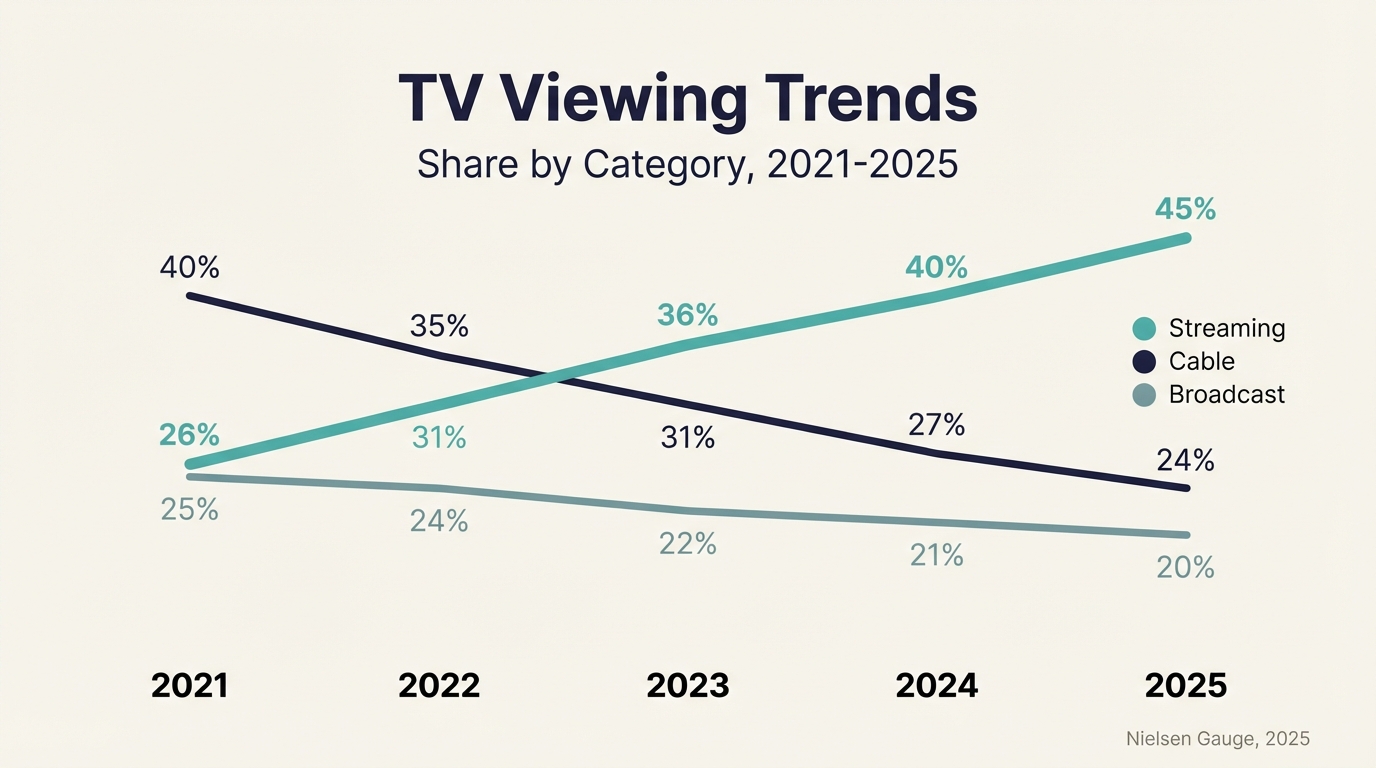
What makes this data especially striking is the trajectory. Broadcast viewing has declined 21% compared to May 2021, when Nielsen first launched The Gauge measurement system. During that same period, streaming viewership increased by 71%, demonstrating a clear and accelerating shift in how Americans consume television content. The numbers tell a story of structural change, not temporary fluctuation.
May 2025 marked a historic milestone in television history. For the first time ever, streaming viewership (44.8%) exceeded the combined viewing share of broadcast and cable (44.2%). This wasn't a close race that could reverse next month. Streaming has been gaining ground steadily, and traditional TV has been losing it at almost the same pace. The crossover point simply confirmed what industry observers had predicted for years.
Breaking down the broadcast numbers further reveals the competitive dynamics within the category. The big four broadcast networks (ABC, CBS, NBC, and FOX) together captured approximately 18% of total TV viewing, with smaller broadcast networks and local stations making up the remaining 2% or so. No individual broadcast network exceeded 5% of total TV viewing share, a stark contrast to streaming platforms like YouTube, which alone captured 12.5% of all television viewing in May 2025.
The seasonal patterns in broadcast viewing remain important to understand. Broadcast tends to perform better during the fall premiere season (September through November) when new shows launch, and during major sporting events. November 2025 data showed broadcast rebounding to 23.2% of TV viewing, driven largely by NFL coverage and fresh content. But these peaks increasingly represent temporary lifts rather than sustained viewership.
Live sports remains broadcast television's most powerful asset. NFL games on CBS, NBC, and FOX consistently rank among the most-watched programs on any platform. The Super Bowl, broadcast alternately by the major networks, still draws over 100 million viewers annually. But even here, simulcasting on streaming platforms has become standard practice, with networks increasingly offering parallel streams on their digital properties.
---
Breaking down the numbers
Understanding the full picture requires looking beyond the headline 20.1% figure. Broadcast's position varies significantly across different demographics, time slots, and content categories, and those variations matter for how advertisers should approach the medium.
By age group
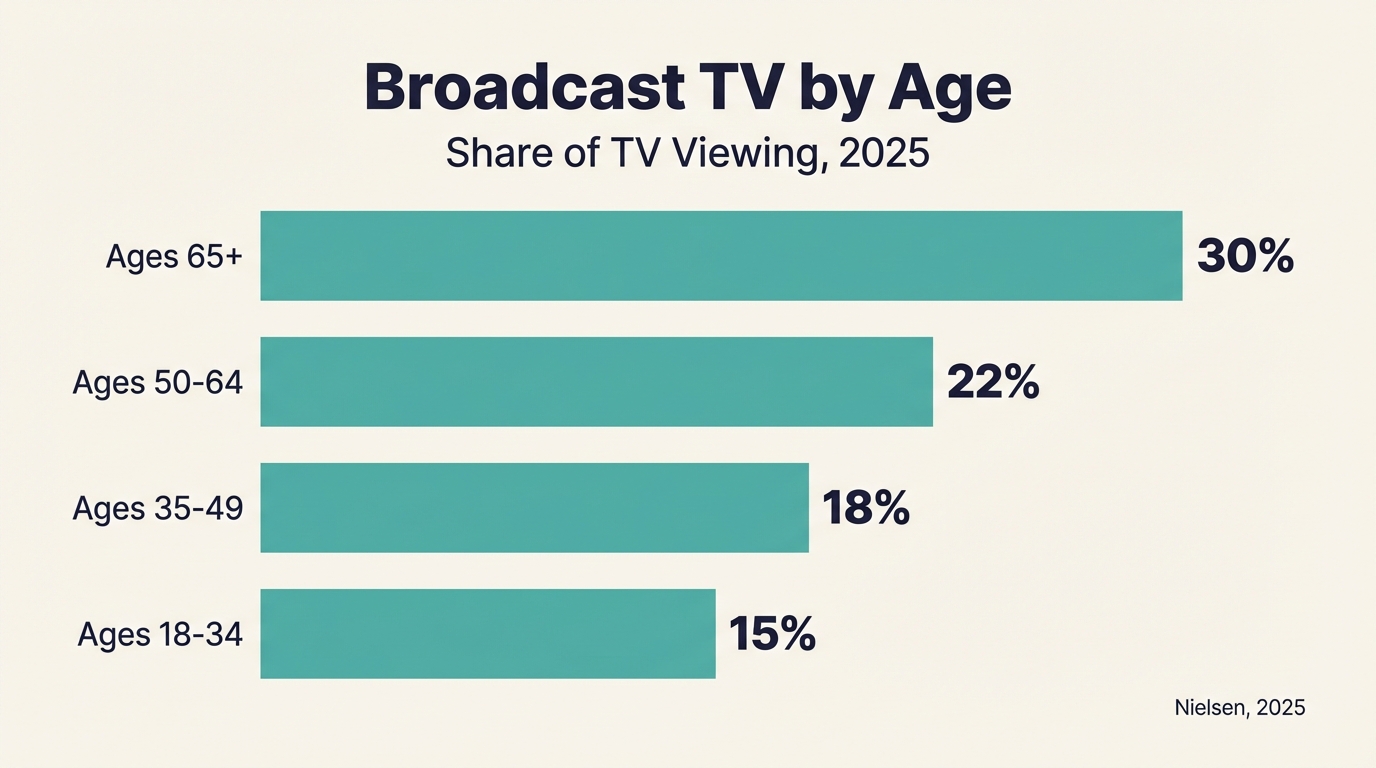
The generational divide in broadcast viewing is dramatic and growing. Among viewers 65 and older, broadcast television remains a significant force, capturing roughly 30% of their total TV time. This audience grew up with broadcast as the default option and maintains strong viewing habits around nightly news, primetime dramas, and daytime programming.
The picture changes substantially for younger demographics. Among viewers 18-34, broadcast captures less than 15% of TV viewing time, with streaming platforms commanding the majority of their attention. For viewers 35-49, broadcast sits around 18% of viewing, still below the overall average. The pattern is clear: younger viewers have largely moved away from broadcast, and they're unlikely to return as they age.
This age skew has significant implications for advertisers. The 18-49 demographic that advertisers traditionally prize has shrunk faster on broadcast than overall viewership numbers would suggest. The median viewer age for broadcast primetime programming has climbed into the mid-50s across most networks, and continues to rise each year.
By time of day
Broadcast viewing patterns follow predictable daily rhythms that differ from streaming behavior. Morning hours (6am-9am) see relatively strong broadcast performance driven by morning news programs on ABC, CBS, and NBC. This daypart captures a disproportionate share of broadcast's total viewing.
Daytime hours (9am-4pm) show mixed performance, with broadcast game shows and soap operas competing against streaming's vast on-demand libraries. Broadcast generally underperforms its overall average during these hours among working-age adults, though it maintains stronger share among retirees.
Primetime (8pm-11pm) remains broadcast's showcase window, with the highest-quality original programming and biggest promotional pushes. Even so, broadcast's primetime share has declined substantially as streaming platforms now release major content at midnight for immediate availability. The concept of "appointment viewing" has largely eroded outside of live events.
Compared to other TV categories
For context, here's how the major TV categories compared in May 2025:
The "Other" category includes video game consoles, DVD/Blu-ray playback, and other miscellaneous TV use. Even this catch-all category now exceeds half of broadcast's share, illustrating how fragmented television consumption has become.
What stands out is that broadcast isn't declining as fast as cable in absolute terms, but it started from a lower base. Cable's steeper decline reflects cord-cutting households eliminating cable packages entirely, while broadcast remains freely available over the air. This accessibility provides broadcast a floor that cable lacks.
---
Why it matters for your business
If you're advertising on television, understanding broadcast's 20.1% share means understanding both its limitations and its remaining strengths. The numbers don't lie: broadcast reaches fewer viewers than it once did, but it still reaches a substantial audience that may be harder to find elsewhere.
For businesses targeting older demographics, broadcast remains a strong option. The 65+ audience that still watches significant amounts of broadcast TV represents substantial purchasing power, especially in categories like healthcare, financial services, insurance, and home improvement. If your customers skew older, broadcast's concentrated audience might be more efficient than trying to piece together reach across multiple streaming platforms.
The economics of broadcast advertising have shifted as viewership has declined. Primetime broadcast rates remain premium, but the cost per thousand viewers (CPM) has generally remained stable or even increased as networks protect their revenue despite lower ratings. For small businesses with limited budgets, this means broadcast can be expensive relative to the audience delivered.
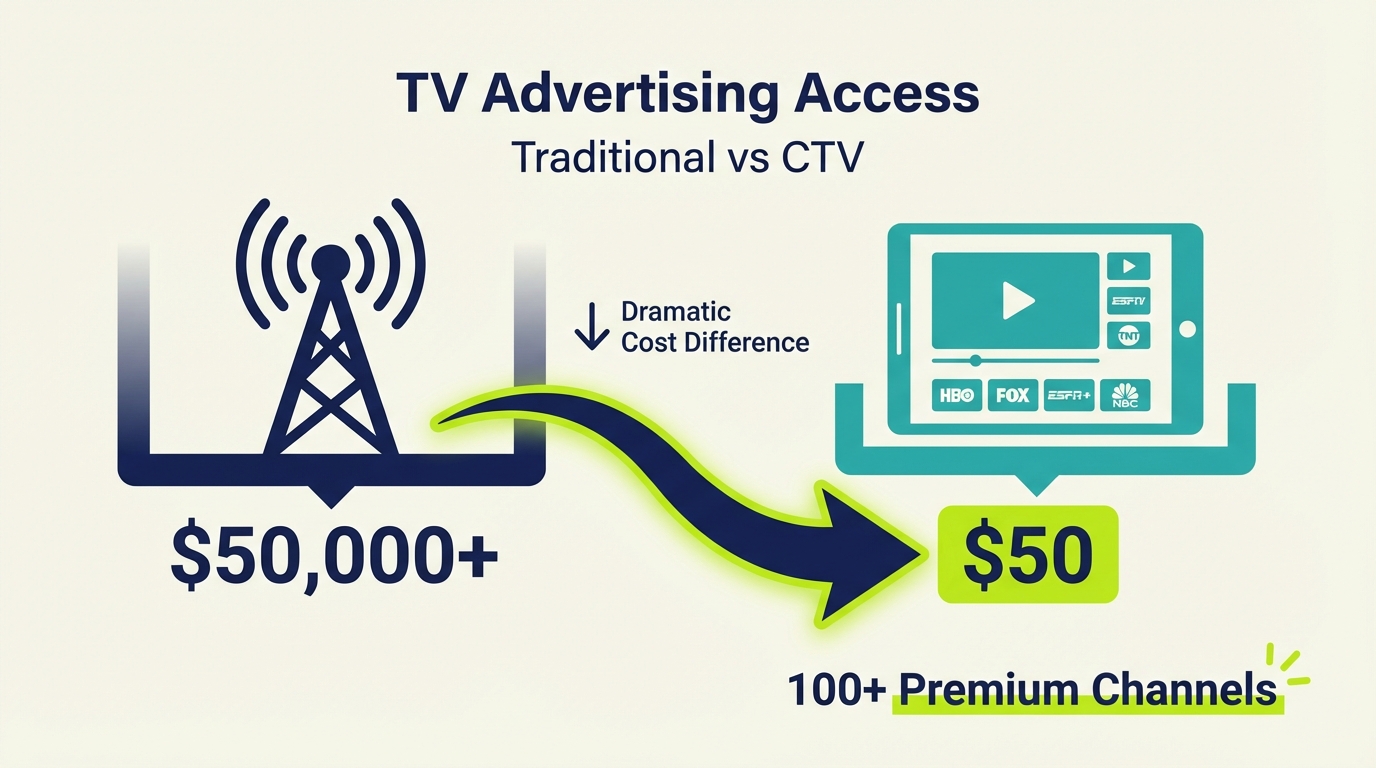
What's changed dramatically is accessibility. Traditional broadcast advertising required substantial minimum commitments, agency relationships, and advance planning measured in weeks or months. That world still exists for direct national broadcast buys. But CTV advertising has opened new paths to television audiences that bypass these traditional gatekeepers.
Platforms like Adwave allow small businesses to reach television viewers (including those watching broadcast content through streaming apps and CTV devices) starting at just $50. You don't need a $50,000 production budget because AI generates your commercial from your website. You don't need to negotiate with networks because programmatic buying handles placement automatically. The same audience that broadcast once exclusively controlled is now accessible through multiple channels.
For local businesses especially, this shift creates genuine opportunity. A restaurant or dental practice can now reach households in their service area during evening viewing hours (when broadcast was historically strongest) through streaming and CTV platforms, often at lower CPMs than equivalent broadcast time would cost. The playing field has fundamentally changed.
---
How to take advantage of this trend
Understanding that broadcast commands 20% of viewing is useful. Knowing how to allocate your advertising spend in response is what helps your business grow.
The most practical approach for most small businesses is to think about television audiences rather than television delivery methods. Your potential customers watch TV. Some of them watch broadcast, more watch streaming, many switch between both during a single evening. Rather than trying to buy broadcast specifically, focus on reaching TV viewers wherever they're watching.
Start with a test campaign on CTV platforms, which aggregate streaming and connected TV inventory. A $100-200 budget over two weeks gives you real data about how television advertising performs for your business. This approach lets you reach viewers across hundreds of channels and apps (including the streaming versions of broadcast content) without negotiating with individual networks.
Geographic targeting matters more than specific channel placement for most local businesses. If you run a plumbing company or dental practice, reaching households within your service area is far more important than whether your ad runs during CBS's primetime lineup or on a streaming app. Modern CTV platforms offer precise geographic targeting down to zip codes, something broadcast can only approximate.
When measuring success, recognize that television advertising (whether broadcast or streaming) works differently than performance marketing. You're not looking for immediate clicks. Instead, watch for brand search lift, meaning more people Googling your business name in the days following your campaign. Track overall website traffic during and after your ad runs. Use QR codes if you want direct response tracking. And simply ask new customers how they heard about you.
If you do want to incorporate broadcast specifically, consider a complementary approach. Run consistent CTV campaigns for ongoing brand presence, then add broadcast spots during specific high-value windows like local news or sports broadcasts. This hybrid strategy captures broadcast's remaining mass-reach moments while maintaining cost-efficient streaming presence the rest of the time.
The key insight is that broadcast's declining share doesn't mean television advertising is declining. Television viewing overall remains strong, with Americans watching over 4 hours daily on average. The viewing has simply redistributed across more platforms, and smart advertisers are following the audience rather than clinging to legacy buying patterns.
---
The bigger picture
Broadcast television's 20.1% share exists in a rapidly evolving media landscape that's reshaping advertising opportunities across the industry. Understanding the broader context helps explain why these changes are happening and where they're likely heading.
The streaming revolution continues
Streaming's 44.8% share of TV viewing represents a structural shift, not a temporary trend. The category has grown 71% since 2021, and industry analysts project continued gains through at least 2027. Within streaming, ad-supported options have become increasingly dominant. YouTube alone (12.5% of all TV viewing) now commands more audience than any individual broadcast network. Free ad-supported streaming television (FAST) services like Tubi, Pluto TV, and the Roku Channel combined for 5.7% of viewing in May 2025, larger than any single broadcast network.
This shift has profound implications for advertisers. Streaming inventory is largely programmatic, meaning it can be purchased efficiently through automated systems. Targeting capabilities exceed anything broadcast can offer. And minimum budgets have dropped dramatically, making TV advertising accessible to businesses that could never afford broadcast.
Cable's parallel decline
While broadcast has lost 21% of its viewership since 2021, cable has declined even faster at 39%. This steeper cable erosion reflects cord-cutting, where households cancel cable subscriptions entirely. Unlike broadcast (which remains free over the air), cable requires a paid subscription that many households have decided they no longer need.
The cable decline has accelerated as streaming services launched their own live TV options (YouTube TV, Hulu + Live TV) and as sports rights have increasingly moved to streaming platforms. ESPN's viewership, long a cornerstone of cable packages, has declined even as sports overall remains the most valuable live television content.
What's next for broadcast
Industry forecasts suggest broadcast will continue losing share, though potentially at a slower rate than the 2021-2025 period. Networks are adapting by making their content available on streaming platforms (sometimes simultaneously), investing in live events that don't travel well to on-demand viewing, and embracing ad-supported streaming tiers for their content.
The big four networks aren't disappearing. They retain valuable assets in live sports rights, established news operations, and legacy content libraries. But their dominance has definitively ended. For advertisers, this means treating broadcast as one option among many rather than the default choice it represented for decades.
---
What experts are saying
Industry analysts and media observers have noted broadcast's declining share as part of a broader transformation in how Americans consume television.
Nielsen CEO Karthik Rao commented on the May 2025 milestone, noting that "it's fitting that this inflection point coincides with the four year anniversary of Nielsen's The Gauge, which has become the gold standard for streaming TV measurement." He credited media companies for "deftly adapting their programming strategies to meet their viewers where they are watching TV, whether it's on streaming or linear platforms."
Advertising industry analysts have emphasized the opportunity this shift creates for smaller advertisers. The IAB has noted that the rise of ad-supported streaming, including streaming versions of broadcast content, is "the biggest shift in TV advertising since cable fragmented the broadcast monopoly." The key difference this time is that the beneficiaries aren't just large brands with existing TV relationships, but any business with a message and a modest budget.
Trade publications have highlighted the accessibility angle. The combination of programmatic buying, AI-generated creative, and low minimum spends has effectively removed every traditional barrier to TV advertising for small businesses. A local retailer today can access audiences on the same screens where national brands advertise, something that would have been impossible when broadcast dominated.
Media researchers have pointed to the demographic divergence as a lasting trend. Younger viewers who grew up with streaming show no signs of developing broadcast viewing habits as they age, unlike previous generations who naturally gravitated toward broadcast's appointment viewing model. This suggests broadcast's decline will continue as older cohorts are gradually replaced by streaming-native viewers.
---
Common questions answered
How is broadcast TV viewing share measured?
Nielsen's Gauge methodology measures TV viewing across all sources, including broadcast, cable, streaming, and other delivery methods. The data comes from a panel of representative U.S. households combined with set-top box data and smart TV automatic content recognition (ACR) technology. Nielsen tracks what's being watched on the TV screen regardless of how the content is delivered, releasing monthly reports approximately one month after the measurement period.
What counts as "broadcast TV" in these statistics?
Broadcast TV in Nielsen's measurement includes the major networks (ABC, CBS, NBC, FOX) plus smaller broadcast networks (like The CW, PBS, and Univision) and local affiliate stations. It specifically measures viewing of broadcast content on television screens, regardless of whether that content is received over the air, through a cable/satellite feed, or via the network's streaming app. The 20.1% figure represents all broadcast content viewed on TVs.
Is broadcast TV still profitable for networks?
Yes, though profitability has declined. U.S. broadcast stations are projected to generate approximately $33 billion in advertising revenue in 2025, down about 9% from 2024's $36 billion. Networks remain profitable primarily through high-value live sports rights, news programming, and their parallel investments in streaming platforms. The major broadcast networks (CBS, NBC, ABC, FOX) have all launched or acquired streaming services that complement their broadcast operations.
Will broadcast TV eventually disappear?
Complete disappearance is unlikely in the near term. Broadcast retains several structural advantages: free over-the-air availability, established distribution through affiliates, valuable sports rights (especially NFL), and local news operations that streaming hasn't replicated. However, broadcast's share of total viewing will likely continue declining as streaming platforms expand. Industry analysts project broadcast could fall below 15% of total TV viewing by 2030 if current trends continue.
How does broadcast TV compare to streaming for advertisers?
Broadcast offers mass reach during live events (sports, awards shows, breaking news) but limited targeting capabilities. Streaming offers precise demographic and geographic targeting, lower minimum budgets, and programmatic buying efficiency. CPMs are generally comparable, though streaming tends to offer better value for advertisers seeking specific audiences. Most sophisticated advertisers now use both in complementary strategies.
Can small businesses advertise on broadcast TV?
Direct national broadcast advertising typically requires substantial minimums and agency relationships. However, local broadcast spots are more accessible, with some stations accepting campaigns in the low thousands of dollars. Alternatively, CTV platforms like Adwave offer access to television audiences (including viewers watching broadcast network content through streaming apps) starting at just $50, with none of the traditional barriers to entry.
---
Supporting data
Additional context on broadcast television viewing and advertising:
Total streaming share: Streaming represents 44.8% of U.S. TV viewing time (Nielsen Gauge, May 2025)
Broadcast decline: Broadcast viewing down 21% since May 2021 (Nielsen)
Cable decline: Cable viewing down 39% since May 2021 (Nielsen)
YouTube dominance: YouTube captured 12.5% of all TV viewing in May 2025 (Nielsen Gauge, May 2025)
Broadcast ad revenue: U.S. broadcast stations projected to generate $32.97 billion in ad revenue in 2025 (S&P Global, 2025)
Total TV ad spend: U.S. television advertising approximately $60 billion annually (Statista, 2024)
FAST growth: Tubi, Pluto TV, and Roku Channel combined for 5.7% of TV viewing (Nielsen Gauge, May 2025)
Gen Z viewing: Less than half of 16-24 year olds regularly watch broadcast TV (BBC/Ofcom, 2024)
All sources linked above. Data current as of June 2025.
---
Get started with TV advertising
Your ad can reach the same audiences that major brands target on the biggest screen in the house, all from your laptop in under 10 minutes.