-
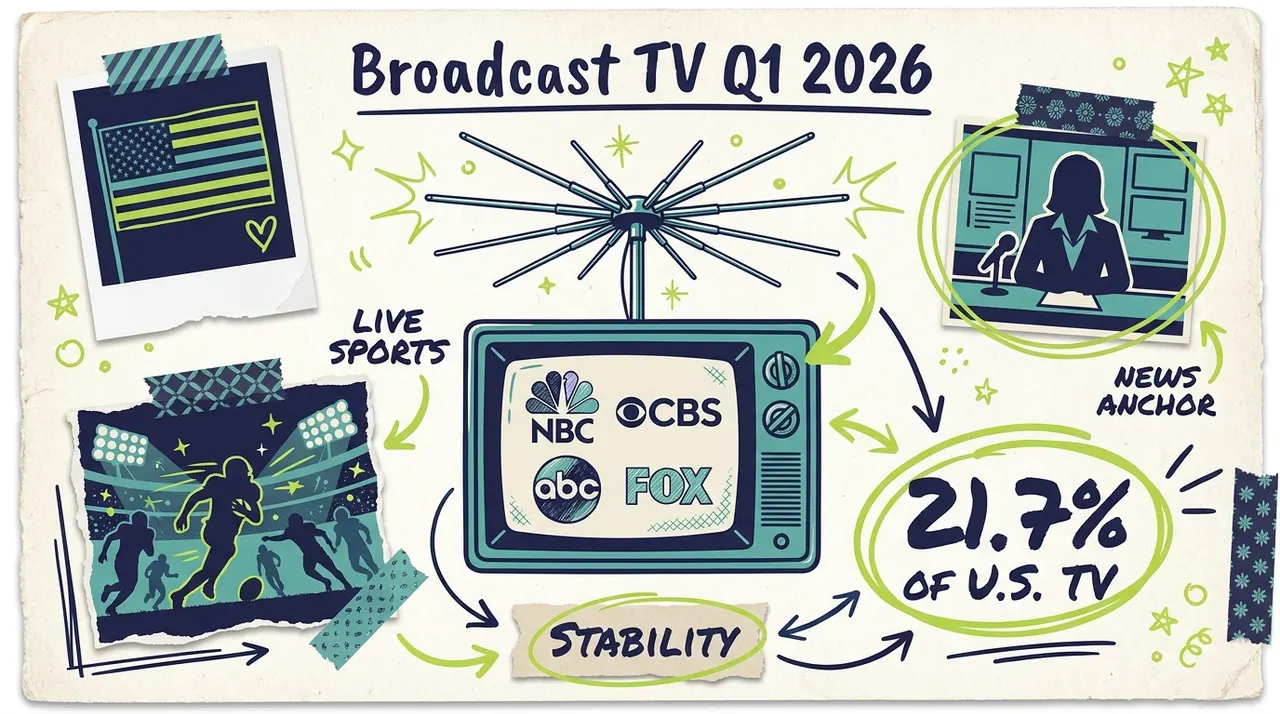
21.7%
Broadcast share of U.S. TV viewing (Feb 2026)
-
3+ yrs
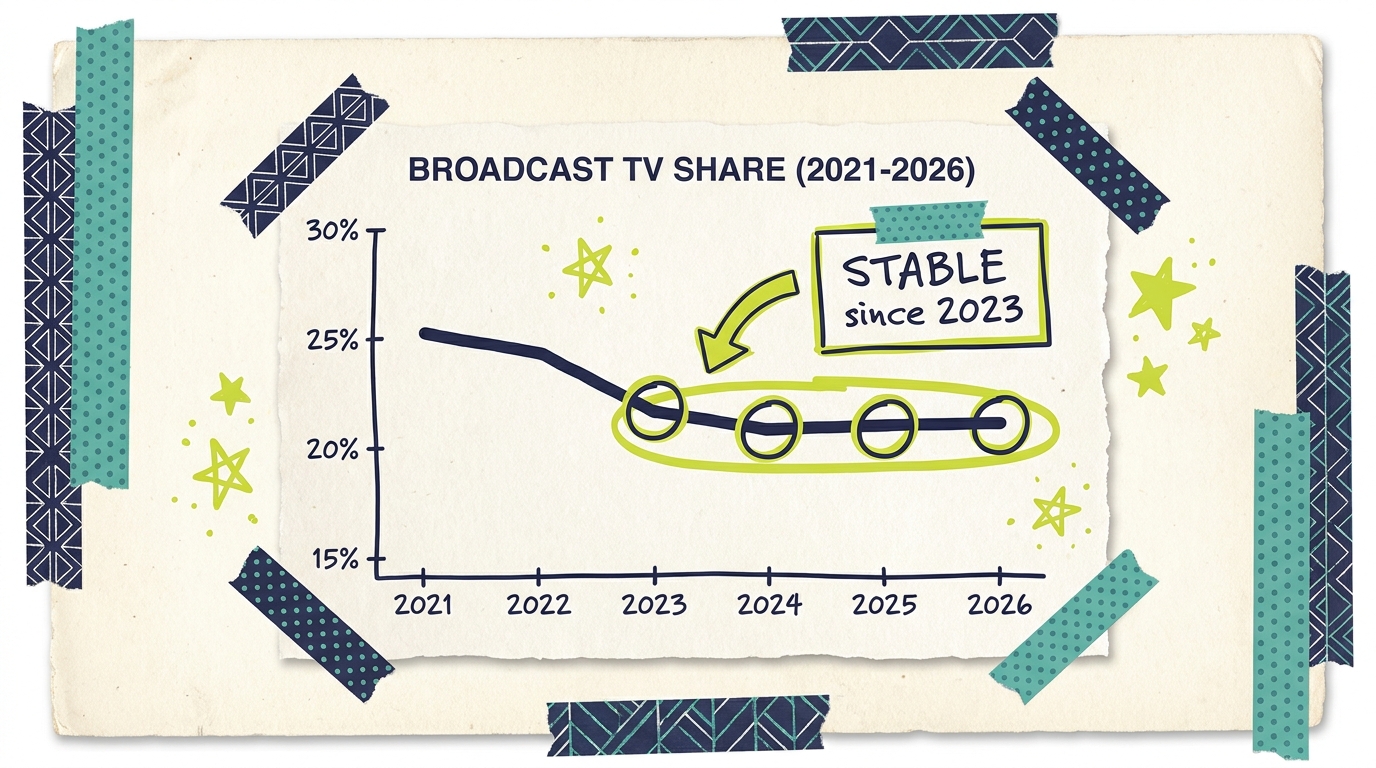
Broadcast share stable at 21-22% since 2023
-
135M
Super Bowl LX viewers (Feb 2026, NBC)
Broadcast TV has been the stable category in American television for several years while cable has declined and streaming has grown. Q1 2026 continued that pattern with a seasonal boost. In January 2026, broadcast held 21.2% of total U.S. TV viewing per Nielsen's The Gauge. In February 2026, broadcast rose to 21.7%, lifted by Super Bowl LX and the Winter Olympics on NBC.
For small business advertisers, broadcast's Q1 2026 performance matters because it shows broadcast is still a meaningful TV channel, especially for specific audiences and tentpole events, even as streaming gains overall share. This post breaks down what Nielsen reported for broadcast in Q1 2026 and translates the data into practical implications for local advertisers.
What the data shows
Based on Nielsen's The Gauge:
January 2026: Broadcast 21.2%, Streaming 47.0% (record), Cable approximately 25-26%, Other the remainder
February 2026: Broadcast 21.7%, Streaming 41.9%, Cable 20.0%, Other 16.4%
March 2026: Release delayed by Nielsen per MediaPost's March 20, 2026 report
The February 2026 broadcast surge was driven primarily by two specific events. Super Bowl LX aired on NBC on February 8, 2026. The Milan-Cortina Winter Olympics ran February 6-22, 2026, with heavy coverage on NBC and affiliated networks. Together, those events temporarily boosted broadcast's share and pulled viewers away from streaming.
Nielsen's April 14, 2026 commentary on the February Gauge (via MediaPost) described the February report as "showing little change" on overall viewing mix compared to January, aside from the NBCU-Versant surge that moved NBC to the top of the Media Distributor Gauge.
Broadcast has been remarkably stable through multiple quarters of Nielsen reporting. While cable has lost share quarter over quarter since The Gauge launched in 2021, and streaming has gained share over the same period, broadcast has hovered in the 20-22% range throughout the Gauge's history.
What counts as broadcast TV
For purposes of The Gauge, broadcast TV refers to the major over-the-air broadcast networks: NBC, CBS, ABC, Fox, the CW, PBS, and Spanish-language networks like Univision and Telemundo. These networks are distinguished from cable networks (which require a cable or streaming subscription to access) and streaming platforms (which require an internet connection and a platform app).
Broadcast TV reaches viewers through three main delivery mechanisms:
Over-the-air antenna. The original broadcast delivery method. Households with antennas can receive broadcast signals for free. A meaningful minority of U.S. households still access broadcast this way, especially in markets with good signal coverage.
Cable and satellite. Broadcast networks are carried through most cable and satellite bundles, often on the lowest channel numbers. Cable subscribers watch broadcast content through their cable delivery.
Streaming and vMVPD. Broadcast network content is also available through streaming services. Hulu + Live TV, YouTube TV, and the broadcast networks' own apps (NBC's Peacock has NBC content, Paramount+ has CBS, etc.) all deliver broadcast programming through streaming infrastructure.
Nielsen's Gauge measures viewing to broadcast network programming across all these delivery methods. The 21.7% February share includes viewers who watched broadcast through any of these routes.
Why broadcast TV still matters
For small business advertisers in 2026, broadcast TV remains relevant in specific situations even as streaming grows.
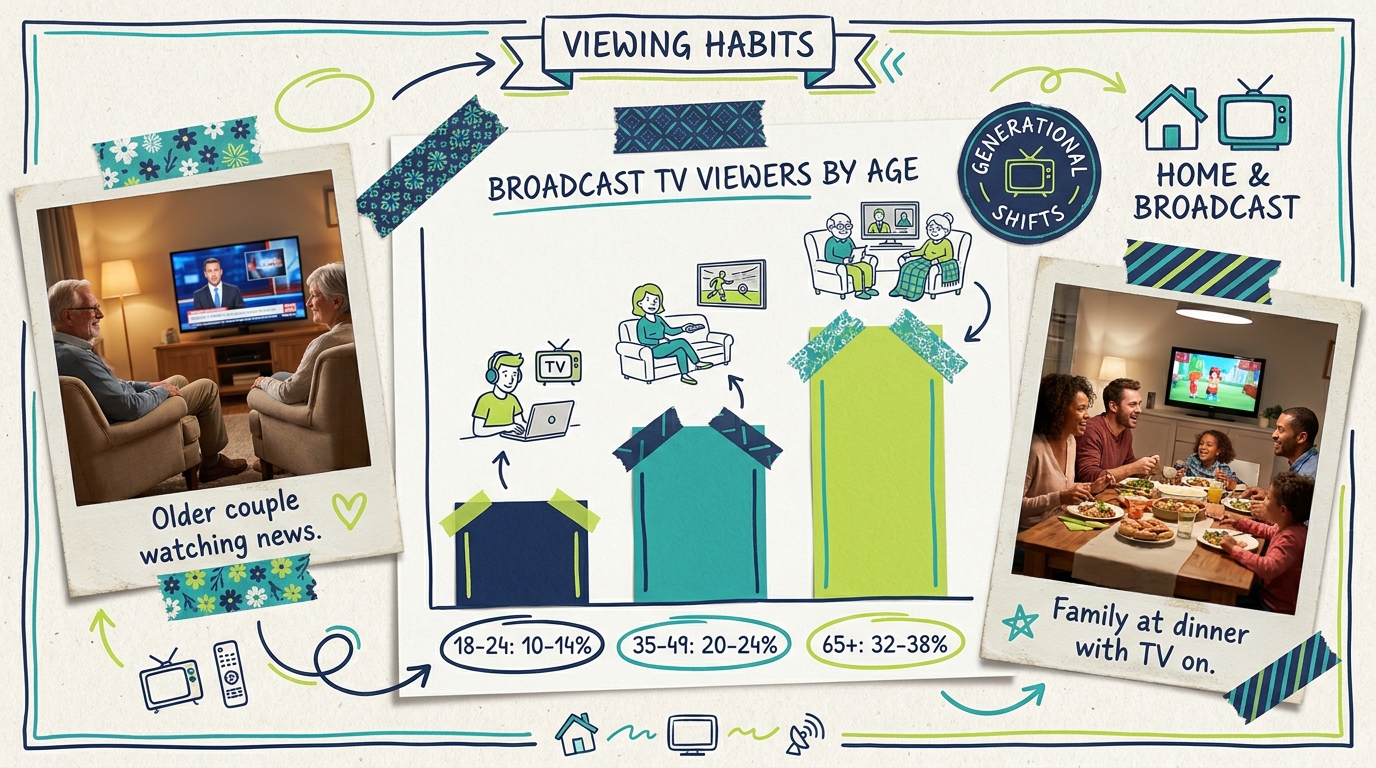
First, broadcast is strongest for older audiences. Industry analyses and Nielsen's demographic reporting consistently show older viewers spending more time on broadcast than younger viewers. For advertisers targeting adults 50+, broadcast reaches a larger share of that demographic's TV time than streaming does.
Second, live events still anchor broadcast. Super Bowl, Winter and Summer Olympics, NFL playoffs, and March Madness consistently draw audiences that streaming can't replicate at the same concentration. February 2026 proved this clearly: broadcast temporarily outperformed streaming share during the Super Bowl + Olympics window.
Third, local broadcast news delivers local market reach. In most DMAs, local broadcast news draws one of the largest local audiences of any video product. For advertisers needing DMA-level reach, local broadcast news remains an effective channel.
Fourth, broadcast is stable, not dying. The consistent 21-22% share through multiple quarters indicates broadcast has found a defensible floor. Advertisers planning medium-term budgets can allocate to broadcast with reasonable confidence about continued reach.
How small businesses can buy broadcast advertising
Broadcast TV advertising has three main access paths for small businesses:
Direct station buys. Local broadcast stations sell their own ad inventory, typically through a local sales team. This is the traditional path. Rates vary by DMA, daypart, and specific program. Stations generally require multi-week campaigns and minimum spending commitments, though many have introduced lower-minimum packages for small advertisers.
Local media buyers and agencies. Local media buying firms specialize in placing broadcast (and cable) advertising across multiple stations. They negotiate rates, handle trafficking, and provide reporting. Their fees add to the campaign cost but add expertise that small businesses often lack.
Bundled self-serve platforms. An increasing number of self-serve CTV platforms include broadcast OTT feeds (broadcast programming delivered through streaming apps) alongside their core streaming inventory. This lets small advertisers access broadcast audiences through the same buying interface they use for Hulu, YouTube, and other streaming services.
For most small business local advertisers in 2026, a mix of bundled CTV access (covering broadcast through streaming delivery) and targeted direct station buys for local news or specific programming is a reasonable approach. Pure direct station buying without bundled digital is becoming less common for small budgets.
Creative considerations for broadcast advertising
Broadcast TV creative has specific characteristics that affect what performs well:
Standard lengths are 15, 30, and 60 seconds. Most broadcast inventory runs in these formats. 30-second spots are the most common.
High production values expected. Broadcast viewers are used to decades of high-quality network advertising. Lower-production creative stands out negatively.
Sound matters. Broadcast viewers almost always watch with sound on. Music bed selection, voiceover clarity, and sound design affect performance.
Clear branding and call-to-action. Viewers can't click on broadcast ads. Phone numbers, website URLs, and location prompts need to be clear and memorable.
Daypart considerations. Daytime broadcast viewers differ from prime-time viewers. Morning news viewers differ from late-night talk show viewers. Creative that matches the audience tone performs better.
For small businesses without large production budgets, AI-powered ad generation tools can produce broadcast-quality creative efficiently. The same 30-second spots that work for streaming also generally work for broadcast delivery.
How to take advantage
Keep local broadcast news in your media plan for reach campaigns. Local news remains the highest-reach local video product available.
Budget for tentpole events. Super Bowl, Olympics, NFL playoffs, March Madness, election-night coverage. These are buying opportunities unique to broadcast.
Use broadcast for audiences 50+. If your customer base skews older, broadcast remains a primary reach channel.
Pair broadcast with streaming. Don't choose one. Run complementary campaigns. Broadcast delivers concentrated reach; streaming delivers targeted reach and frequency.
Exploit lower Q2 CPMs. Broadcast CPMs typically fall in Q2 after the Super Bowl/upfront cycle. This is often a strong buying window.
Consider Spanish-language broadcast. Univision and Telemundo deliver concentrated Spanish-speaking audiences that are difficult to match elsewhere.
Measuring broadcast campaign performance
Broadcast TV measurement is different from streaming in several ways:
Reach reporting is panel-based. Nielsen panel data or local market ratings provide the audience estimates. These are less granular than streaming's per-impression reporting.
No clickthrough tracking. Broadcast ads can't be clicked. Success is measured through brand lift and downstream conversion.
Local market attribution matters. For local advertisers, measurement focuses on whether your target DMA saw the ad and whether local business outcomes improved (foot traffic, phone calls, website visits from the DMA).
Frequency is part of the measurement. Broadcast campaigns build reach and frequency over weeks. Measurement timeframes are typically longer than streaming campaigns.
For small business broadcast campaigns, useful metrics to track include target audience GRPs (gross rating points, the industry standard for broadcast reach), brand search volume from the target DMA during and after the campaign, phone call volume to tracking numbers used in broadcast creative, and website traffic from the target market.
The bigger picture
Broadcast's 21-22% share in Q1 2026 reflects a category that has largely defended its position despite intense streaming competition. The audience that prefers broadcast (older, habit-driven, live-event oriented) has stuck with broadcast. The corporate structures that own broadcast networks (NBCUniversal, Paramount, Disney's ABC, Fox) have kept broadcast strategically important even as they invest in streaming.
At the same time, cable has continued its structural decline. Nielsen reported cable at 20.0% in February 2026, the lowest in the Gauge's history. That declining cable share is not flowing equally to broadcast and streaming; most of it is going to streaming. Broadcast's position appears to be a different story than cable's.
Industry analysts generally expect broadcast to remain relatively stable through the next several years, with live sports rights as the key variable. If the NFL, NBA, or MLB move significant rights away from broadcast to streaming, broadcast's share could decline. So far those migrations have been partial rather than complete.
What this data doesn't tell you
Nielsen's broadcast share figures are a useful anchor, but they have limitations:
Aggregate share masks significant variation by daypart and program. Local news has very different audience concentration than late-night syndication. Prime-time scripted series have different audiences than morning talk shows.
Network-level shares vary with programming schedules. NBC's share surge in February 2026 was event-driven. In a month without Super Bowl or Olympics, NBC typically holds a different share.
Demographic composition differs from streaming. Broadcast skews older than streaming. Aggregate share doesn't capture this directly.
Measurement methodology is panel-based. Nielsen's broadcast measurement relies on panel households rather than per-impression data. Smaller DMAs have smaller panels, which can introduce measurement volatility for local buyers.
Advertisers using Nielsen's broadcast share should factor in specific programming, daypart, and DMA data when making local buying decisions.
Common questions answered
Is broadcast TV still worth advertising on for a small business?
Yes, in specific situations. Broadcast reaches approximately 21-22% of U.S. TV time overall, with a much higher share among older viewers and during live events. For advertisers targeting 50+ demographics or wanting DMA-level reach through local news, broadcast remains effective. For campaigns targeting younger audiences without live event relevance, streaming is usually more efficient.
Why did broadcast surge in February 2026?
Super Bowl LX (NBC, February 8) and the Milan-Cortina Winter Olympics (February 6-22, NBC coverage) together pulled significant viewing toward broadcast. Broadcast rose from 21.2% in January to 21.7% in February. When those events ended, broadcast is expected to return to its baseline.
Can small businesses afford Super Bowl advertising?
National Super Bowl spots are far outside small business budgets. Local Super Bowl spots in specific DMAs are more accessible. Local TV stations sell local inventory during national events, often at a fraction of the national rate. Small businesses can also advertise during surrounding programming (pre-game, post-game, halftime station coverage) at significantly lower rates.
Is broadcast declining overall?
Slowly. Broadcast has held at 21-22% through Nielsen's recent Gauge reports. Industry analysts generally expect broadcast to continue declining at modest rates (roughly 0.5-1.0 percentage points per year) rather than the steeper declines cable has experienced. Live sports rights are the biggest variable.
How do broadcast CPMs compare to streaming?
Broadcast CPMs vary widely by daypart and market. General-audience broadcast CPMs are often in a similar range to streaming CPMs. Premium broadcast placements during live sports or tentpole events can command significantly higher rates. Local advertisers should request quotes from specific stations rather than rely on general industry estimates.
Should I buy broadcast through a traditional media buyer or self-serve?
Depends on campaign size. Smaller campaigns are often served by self-serve platforms that include broadcast OTT feeds or local streaming inventory. Larger campaigns benefit from a traditional media buyer relationship with local stations. Full agency relationships are generally appropriate for the largest budgets.
What about Spanish-language broadcast?
Univision and Telemundo together represent meaningful U.S. broadcast viewing, especially in markets with significant Hispanic populations. For advertisers targeting Spanish-speaking audiences, these networks often deliver concentrated reach at rates comparable to or lower than English-language broadcast.
Where to start
For small businesses planning TV advertising in 2026, broadcast remains a valid category but should generally be a supporting layer in a streaming-majority plan, not the default base buy it was a decade ago. Budget for tentpole events, older-audience reach, and local broadcast news, and shift the balance of budget toward streaming for everyday audience reach.

Adwave lets local advertisers create 30-second TV ads from their website URL and run them across 100+ premium streaming channels for as little as $50. See how it works.