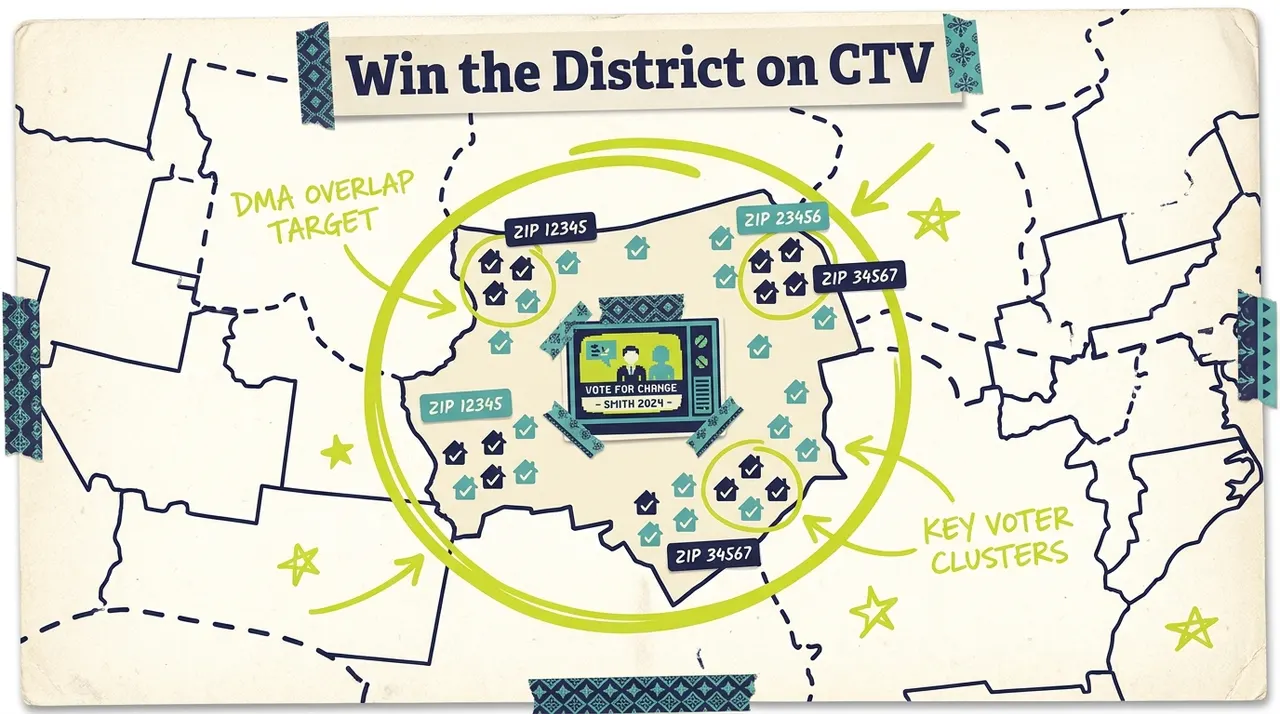
A congressional district is one of the hardest media-buying geographies in American politics. Most districts cut across multiple media markets, mix urban precincts with rural ones, and rarely line up with the DMAs broadcasters sell against. Spend $200,000 on broadcast TV in a competitive congressional race and you're paying to reach hundreds of thousands of voters who live outside your district and can't vote for you.
Connected TV (CTV) has reshaped what's possible. District-level digital targeting, addressable household-level delivery, and 24-48 hour creative turnarounds have made CTV the most efficient TV channel for congressional campaigns in the 2026 cycle. This guide walks through the strategy, the targeting, the creative, and the operational moves that win House races on CTV.
Why broadcast TV is the wrong default for House races
Most congressional candidates inherit a media plan that defaults to broadcast TV because that's what statewide and presidential campaigns use. The math falls apart at the House level for three reasons:
Reason 1: DMAs don't match districts. A typical congressional district overlaps with one to four DMAs, often dominated by major-metro signals that bleed across multiple districts. Buying a broadcast spot in the Chicago DMA reaches eight congressional districts at once. If you're running in just one of them, 87% of your impressions are landing on people who can't vote for you.
Reason 2: Broadcast inventory is rationed. Federal Communications Commission rules require equal time for opposing candidates, which creates inventory bottlenecks in competitive districts. By October of a competitive cycle, premium broadcast windows are sold out or priced beyond what most House campaigns can afford.
Reason 3: Younger voters and persuadable independents have shifted. In 2024, Nielsen reported that streaming overtook cable and broadcast combined for the first time. By 2026, voters under 55 in competitive districts are reachable on streaming far more reliably than on broadcast. A broadcast-heavy plan misses the persuadable middle that decides most House races.
The result is that broadcast still has a role (especially for older voters in rural districts and for closing-week ID lift), but it can no longer be the default. CTV needs to anchor the strategy.
What district-level CTV targeting does
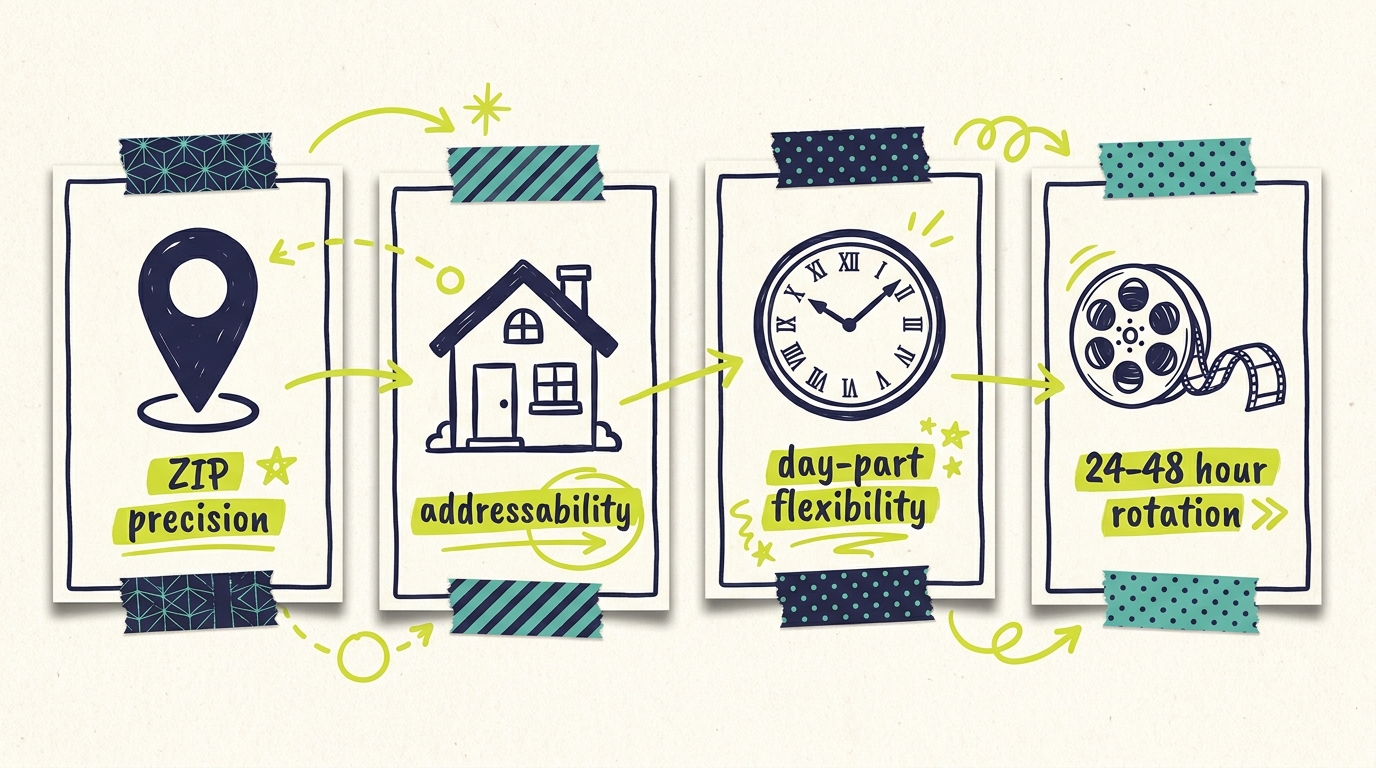
CTV's strategic advantage in congressional races comes down to four targeting capabilities that broadcast can't match:
Geographic precision at the ZIP and precinct level. CTV impressions can be targeted to specific ZIPs that fall inside your district boundary. For districts that cut through urban areas, this is the difference between paying to reach voters and paying to reach non-voters.
Household-level addressability. Modern CTV platforms can deliver different creative to different households based on voter file matching. Persuasion creative goes to undecided voters. Mobilization creative goes to base voters who need turnout reinforcement. Different messaging by household, delivered through the same TV screen.
Day-part flexibility. Broadcast cost varies wildly by daypart. CTV inventory is more elastic and more affordable in off-peak windows. A campaign running 4-7 p.m. weekday CTV spots reaches voters at dinner-prep time, before they're scrolling phones in bed, for substantially less per impression than network primetime.
Creative rotation in days, not weeks. A broadcast spot locked into a station's traffic system can take 5-10 days to swap. CTV creative can be refreshed in 24-48 hours, which matters in the final two weeks of a campaign when news cycles move fast and your opposition's vulnerabilities (or your own) shift overnight.
Building the district-level CTV plan
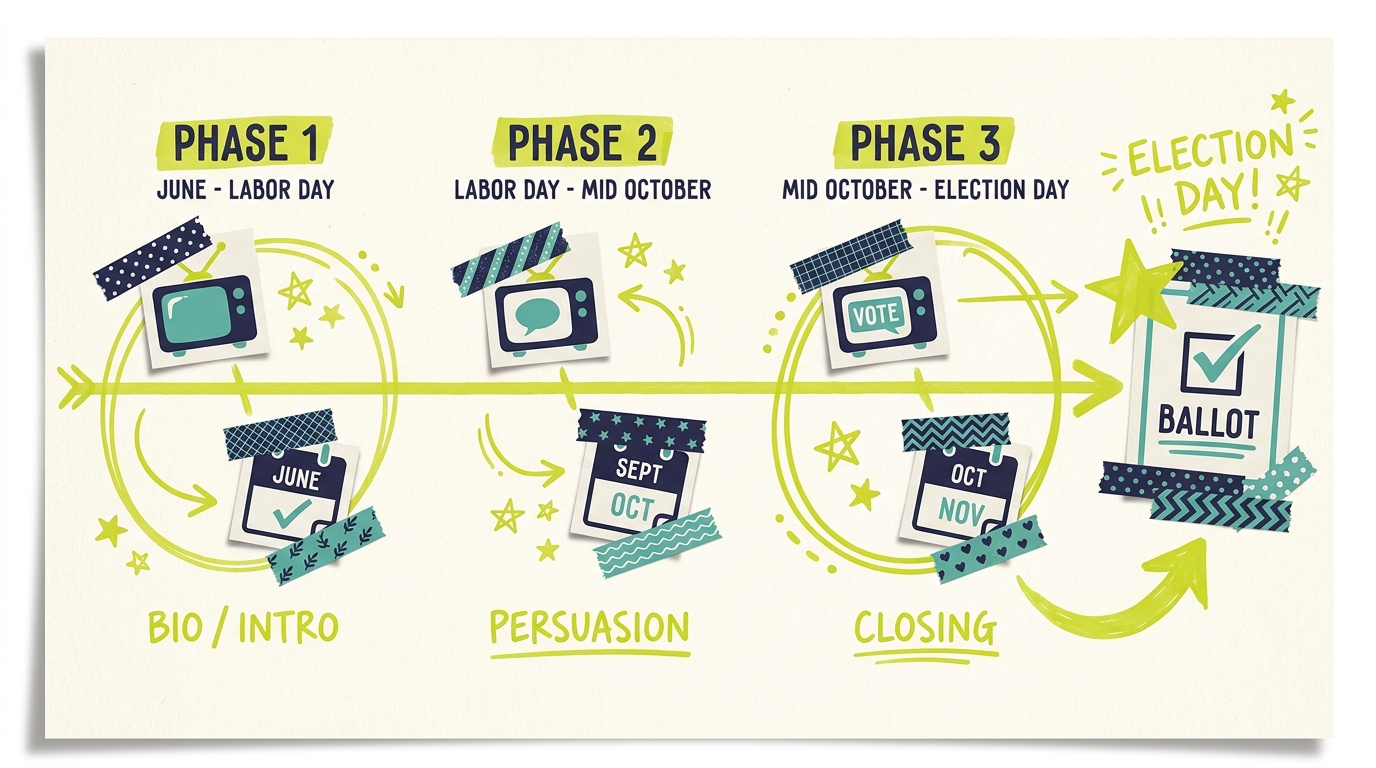
For most competitive congressional races, the CTV plan should be structured around three phases tied to the campaign calendar.
Phase 1: Introduction and contrast (June through Labor Day)
In open seats and competitive challenger races, the early summer is for introducing the candidate and beginning to build contrast with the opponent. CTV in this phase should focus on:
Bio and values content. The 30-second introduction spot that gives voters who've never heard of the candidate a quick story: who you are, where you grew up, what you stand for. Build name ID and positive favorables.
Issue framing. Pick the two or three issues that will dominate the race and stake out a position early. CTV makes it easy to test variations: one creative leaning into economic kitchen-table framing, another into community-and-values framing. The dashboard tells you which resonates.
Geographic emphasis on rural and exurban areas first. Voters in your urban core typically know you (or know the seat) earlier. Rural and exurban voters are where the persuasion lift is largest in this phase.
Recommended CTV spend share of total media: 45-60% in this phase.
Phase 2: Persuasion (Labor Day through mid-October)
This is when CTV's targeting precision pays the largest dividends. Persuasion universe modeling (the voter file work that identifies undecided or weakly-attached voters most likely to be moved) becomes the foundation of the targeting plan.
Household-level addressable delivery. Run different creative to different segments of your persuadable universe. Voters concerned about cost-of-living see economic spots. Voters concerned about reproductive rights see issue spots. Voters who supported your opponent's primary opponent see "I'm the moderate" or "I'm the principled conservative" spots, depending on the race.
Contrast creative. Mid-September is typically when the first significant contrast spots run. CTV is well-suited because you can target the contrast specifically at voters who haven't seen it yet, avoiding diminishing returns from over-exposure to the same households.
Geographic re-weighting. By mid-September your campaign has a better picture of where the lift opportunities are. Reweight CTV spend toward those specific ZIPs without losing reach in your base areas.
Recommended CTV spend share: 55-65% in this phase.
Phase 3: Closing and mobilization (mid-October through Election Day)
The final three weeks are where CTV's speed advantage compounds. Creative refreshes daily based on news cycles, polling movement, and opponent activity.
Late-breaking contrast. Any late-cycle vulnerability your opposition develops (a vote, a quote, an endorsement that backfires) becomes CTV creative within 48 hours. Adwave's AI creative tools have shortened this turnaround dramatically in the 2026 cycle.
Mobilization to base voters. The final week shifts targeting from persuadable to high-propensity supporters. CTV creative changes register: less argument, more "be sure your voice is heard" energy.
Election Day reinforcement. In states with same-day voting, the morning and afternoon of Election Day see meaningful CTV inventory for "polls are open" mobilization. This is one of the few places where broadcast and CTV both have real roles: broadcast for sheer reach to older base voters, CTV for younger-base mobilization.
Recommended CTV spend share: 60-75% in this phase, with broadcast filling in the closing-week reach gaps.
Targeting tactics that move districts
A few specific tactics have separated winning congressional CTV plans from average ones in the 2024 and 2026 cycles:
Match campaign targeting to the current district boundaries. Review ZIP-code coverage against the district map before launch.
Persuasion universe matching, not broad demographic targeting. A 35-54 college-educated woman in your district might be a hard supporter, a hard opponent, or a persuadable. CTV's voter-file matching lets you target only the persuadables, which means every dollar moves a movable voter.
Issue-specific creative for issue-specific audiences. A single contrast spot leaves persuasion on the table. Three or four spots, each pegged to a specific issue, each targeted to the voters who care most about that issue, compound persuasion.
Frequency capping. Without frequency caps, CTV campaigns over-deliver to active streaming households. A frequency cap of 6-8 per voter per week prevents the campaign from saturating its highest-engagement households while leaving lighter streamers under-served.
Geographic reweighting weekly. The campaigns that win districts close make weekly geographic adjustments based on internal polling, district event results, and CTV delivery patterns. Reweighting takes 10 minutes; the impact compounds over the final month.
Creative principles for congressional CTV
The grammar of effective CTV creative for congressional races is different from statewide or presidential creative.
30 seconds, not 60. Most CTV inventory is built for 30-second spots, which also happens to be the right length for House-race creative. Longer formats lose attention before payoff. Adwave's standardized 30-second format aligns with the platform's reality.
Hook in the first 5 seconds. Streaming viewers are pre-empted by their show, not actively engaged with the ad. The first 5 seconds need to establish "this is about something I care about" or they'll mentally check out. Avoid slow open-on-candidate-walking shots. Start with the problem, the contrast, or the stake.
Production grammar that signals seriousness. CTV ads inherit credibility from the premium content around them. Your spot should look like a TV ad, not a vertical phone video. Wide framing, professional pacing, network-quality audio. AI tools now produce this grammar at small-campaign budgets.
One message per spot, not three. The mistake most House campaigns make is trying to cram bio, contrast, and issue into the same spot. The winning campaigns run three separate spots, each doing one job, and trust CTV's rotation to put the right one in front of the right voter.
Call-to-action specific to phase. In the persuasion phase, CTAs are soft (visit the website, learn more about the candidate's plan). In closing, CTAs are hard (vote Tuesday, find your polling place, request your ballot today). The match between CTA and phase matters more than the slogan.
Compliance and disclaimer requirements
Congressional CTV creative has the same FEC disclaimer requirements as any other federal campaign communication. The standard "paid for by" disclosure must appear in the final seconds of the spot in legible text. Most CTV platforms enforce this at upload; campaigns should still check the final exported file before launch.
Other compliance points to verify with your media team and counsel:
State-specific disclosure requirements that exceed federal minimums (varies by state)
Coordination rules for joint fundraising committees or party committee co-branded ads
Equal time rules that apply differently to CTV than to broadcast (federal candidates have specific rights on cable systems and licensed broadcasters; pure streaming inventory operates under different rules)
Lowest unit charge does not apply on most pure-streaming CTV inventory, which means pricing can be more dynamic than on broadcast but also more competitive
This guide doesn't substitute for FEC counsel. Every congressional campaign should have its CTV plan reviewed by its compliance team before significant spend deploys.
Budgeting CTV in a House race
Congressional campaign budgets vary enormously, but the share allocation to CTV is converging across competitive races. Some directional benchmarks for a competitive 2026 House race:
Open seat with $4-7M cycle budget: CTV typically represents $1.5M-$3M, or 30-45% of the media budget. Cable and broadcast supplement.
Incumbent in safe-but-active seat with $2-4M cycle budget: CTV often represents $600K-$1.5M, or 30-40% of media spend.
Challenger in competitive race with $800K-$2M cycle budget: CTV is frequently the largest single channel, often 45-60% of media spend, because of its efficiency advantage at smaller scale.
Long-shot challenger under $500K: CTV can be 60-80% of media spend, since broadcast at this budget produces very limited reach. The targeting precision of CTV makes small budgets work harder.
Across all budget tiers, the strategic shift in 2026 is that CTV has moved from "supplemental" to "anchor" channel. Campaigns that still treat CTV as a digital add-on to a broadcast plan are paying broadcast premiums for inferior targeting.
Measurement and attribution
Congressional campaigns measure differently than commercial advertisers. The "conversion" isn't a click; it's a vote. The attribution framework needs to translate accordingly.
Persuasion lift studies. The gold standard is pre-post survey work in randomized geographic or household segments. CTV's targeting precision makes these studies easier than they are on broadcast, since you can hold out specific ZIPs as control groups.
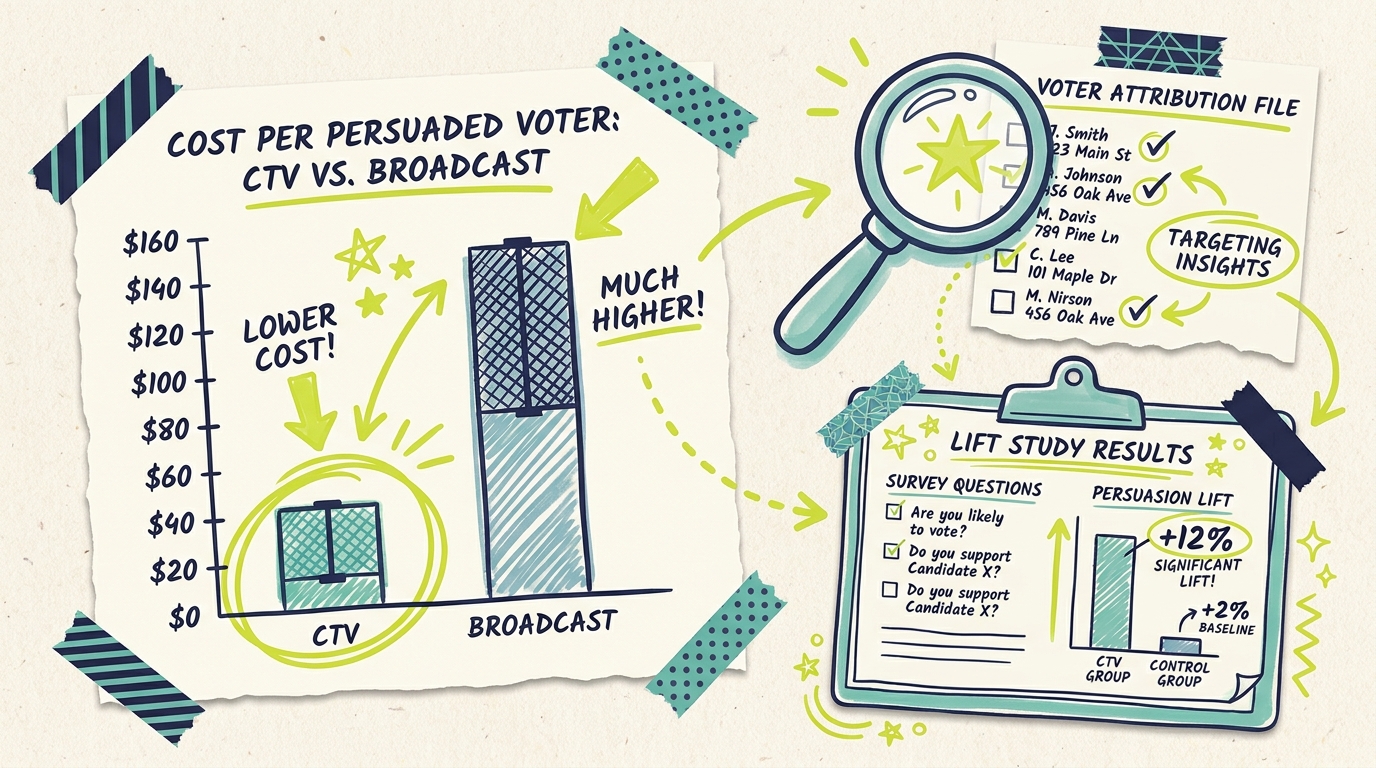
Voter file modeling. Most major campaigns now match CTV exposure data back to the voter file to measure candidate ID and vote-intention movement in exposed vs. unexposed households. This requires data partnerships with your CTV vendor.
Engagement signals. Branded search lift for the candidate's name, direct traffic to campaign website, donations from district-residents, and small-dollar contribution timing during CTV flights are all directional signals.
Dollar-per-persuaded-voter modeling. The most useful internal metric is cost per persuaded voter, calculated from lift studies and matched-back exposure data. Competitive 2024 House campaigns reported CTV costs per persuaded voter in the $15-45 range, dramatically below broadcast's typical $80-150 range.
The 2026 cycle reality
A few specific patterns shape 2026 House CTV planning:
Inventory will tighten in October. Even with the dramatic CTV inventory expansion of the past two cycles, the most competitive districts will see real inventory pressure in the closing weeks. Campaigns should book key inventory windows by mid-September and not assume late buys will be available.
Cost per persuaded voter is rising in top-tier races. As more campaigns move budget to CTV, the auction dynamics in top-tier districts push effective CPMs up. Plan for 10-15% CPM growth over 2024 levels in the most competitive 30 districts.
Down-ballot benefits remain underexploited. Most CTV planning in congressional races is happening at the House campaign level, with state legislative and local races buying their own modest plans. Coordinated buys across House + state legislative races in the same district yield meaningful efficiency gains, and most campaigns aren't yet structured to capture them.
AI creative compresses cycle-time advantage. The campaigns moving fastest in October will be the ones using AI-assisted creative tools to push refreshes in 24-48 hours rather than 5-10 days. The cycle-time gap between fast and slow campaigns matters more in CTV than it ever did in broadcast.
Common questions answered
How does CTV differ from cable for congressional campaigns?
Cable runs through a local cable system and is targetable to subscriber geography (typically at the system level, sometimes finer). CTV runs through streaming services on connected devices and is targetable to ZIP, household, and audience-segment level. CTV's targeting precision is meaningfully tighter than cable's for most congressional districts, and CTV inventory is now larger than cable's in most markets.
Should a campaign hire a digital agency or a traditional TV-focused firm for CTV planning?
The best CTV plans in 2026 sit at the intersection of digital-targeting expertise and TV-grammar instincts. Some traditional firms have built strong CTV practices; some digital firms have learned TV creative. The right partner is one that demonstrates both targeting precision (voter-file modeling, addressable delivery) and creative quality (production grammar that holds up next to network content).
How early in the cycle should a campaign start running CTV?
For open seats and challenger races, June of the election year is typically the earliest meaningful start. Some campaigns experiment with off-cycle CTV in the spring before the primary or for ID lift in the prior fall. The bulk of CTV spend in most House races concentrates in the September-November window.
Can a campaign self-serve CTV through a platform like Adwave, or do they need a media buyer?
Adwave is currently optimized for small business advertisers rather than political campaigns. Congressional campaigns typically work with political-specific CTV platforms that include voter-file integration, compliance disclosure handling, and persuasion-universe targeting. Some down-ballot or state legislative campaigns have used commercial CTV platforms for simpler bio-and-issue creative, but federal campaigns generally need political-CTV partners.
What's the right CTV-to-broadcast ratio in a competitive House race?
For competitive 2026 House races, CTV at 55-70% of TV spend and broadcast at 30-45% is increasingly common. The exact split depends on district demographics (older, rural districts skew more broadcast; younger, suburban districts skew more CTV) and on the campaign's persuasion-universe characteristics.
How does FEC disclosure work on CTV?
Federal disclosure rules require the "paid for by" disclaimer to appear visually in the final seconds of the spot, with the disclosure legible at standard viewing distance. CTV creative should be reviewed for compliance with current FEC guidance before launch. Some states impose additional disclosure requirements that exceed federal minimums.
The bottom line
Congressional campaigns in 2026 that anchor their TV strategy on CTV (with broadcast filling the reach gaps and cable supplementing where it adds incremental delivery) consistently outperform campaigns that default to a broadcast-led plan. The targeting precision, creative speed, and household-level addressability of CTV produce more persuaded voters per dollar spent than any other TV channel.
The campaigns that win competitive House races in 2026 will be the ones treating CTV not as a digital line item but as the foundation of the TV plan, with creative built for streaming, targeting built on the voter file, and measurement built on persuasion lift rather than vanity reach numbers.
If you're building a 2026 House plan, the question isn't whether CTV deserves a place in the strategy. It's how aggressively you're going to anchor your plan on it.