
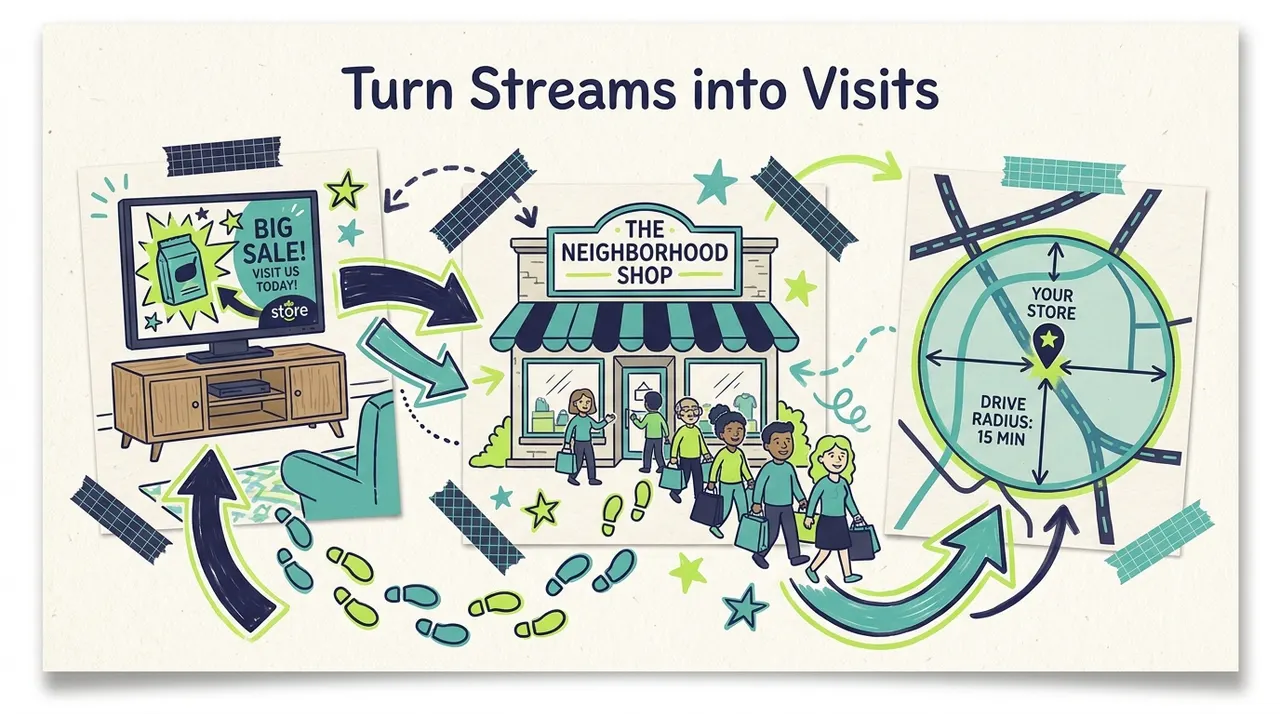
The story most small business owners hear about TV advertising sounds like a paradox: "TV builds awareness, but you can't really measure foot traffic from TV." That's been true for decades on broadcast and cable. On connected TV (CTV) in 2026, it's no longer true.
CTV's targeting precision, the maturity of cross-channel measurement, and the changes in how households make local shopping and visit decisions have all converged. Local retailers, restaurants, fitness studios, and service businesses with physical locations are now seeing measurable, repeatable foot traffic lift from well-built CTV campaigns. This guide walks through why, how, and what realistic results look like.
Why TV moves foot traffic
Three psychological and behavioral patterns make TV uniquely effective at driving in-person visits, and CTV amplifies all three.
1. Household decision-making happens during TV time. A meaningful share of local visit decisions ("where should we eat tonight?", "should we stop by that new home goods store this weekend?", "do we need to go to the auto shop before the trip?") happens in living rooms during evening streaming hours. Households are together. Phones are mostly down. The conversation is happening. Whatever brand is on the screen at that moment is part of the conversation.
2. TV builds the trust threshold for "let's go there." A household isn't going to drive 8 miles to visit a place they've barely heard of. They will drive 8 miles to visit a place that feels established, trustworthy, and worth the trip. TV's trust-building effect crosses the threshold faster than any other channel for local visit decisions.
3. CTV's geographic precision means the spend is on viewers who can visit. Broadcast and cable cast wide nets, with most impressions landing on viewers outside your real service area. CTV targeting concentrates impressions on households inside your real drive radius, which is where foot traffic comes from.
The combination produces a measurable foot traffic lift in most well-built campaigns. Not magic. Not instant. But predictable and repeatable when the campaign is structured correctly.
What "well-built" means for foot-traffic campaigns
Not every CTV campaign drives foot traffic. The campaigns that do share specific characteristics.
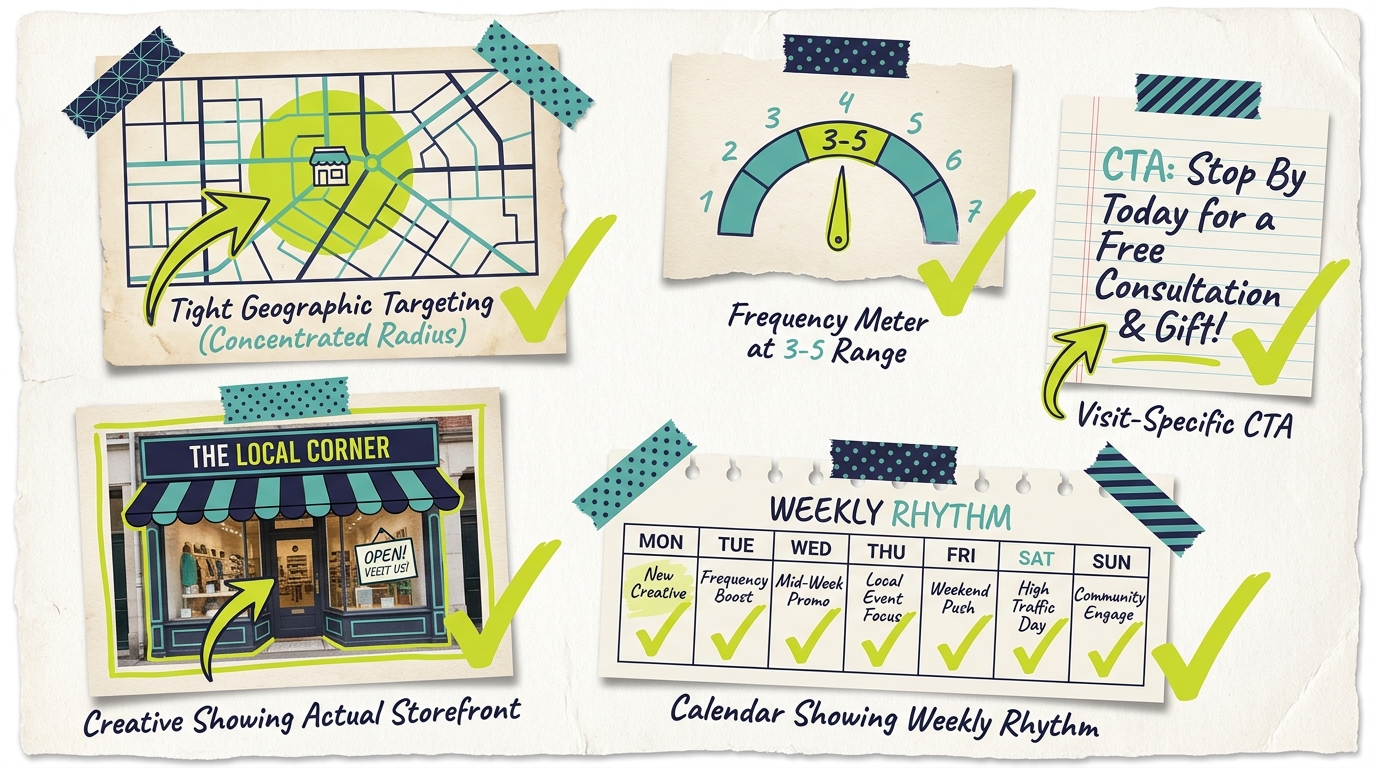
Tight geographic targeting matching real drive radius. The most common reason CTV campaigns produce weak foot traffic lift is geographic leakage. If 35% of impressions are landing 20+ miles outside your service area, your spend is paying for non-converters. Foot traffic-driving campaigns concentrate 80-90% of impressions in the real customer drive radius (typically 5-12 miles for most local retailers and restaurants).
Frequency in the 3-5 sweet spot. Frequency below 2 doesn't drive recall; frequency above 7 over-saturates already-converted households. The 3-5 window is where viewers remember the brand by the time they're making a visit decision.
Creative that shows the actual location. Generic stock-retail creative doesn't drive visits. Creative that shows the actual storefront, the actual interior, the actual staff, and the actual products builds the recognition that converts to "I want to go there." Specificity drives visits in a way that polish doesn't.
Visit-specific calls to action. "Visit us this weekend at [address]" beats "Learn more at our website." A direct visit CTA gives the viewer the action they need to take.
Time-of-week and seasonal alignment. Restaurant traffic decisions happen Thursday-Saturday. Home services scheduling happens Sunday and Monday. Retail visit decisions concentrate Friday-Sunday. Matching creative emphasis to your category's decision rhythm makes the campaign work harder.
Measuring foot traffic from CTV
The measurement gap that historically made TV's foot-traffic impact hard to track has been closing. Three measurement approaches that work for small business CTV campaigns:
1. Pre/post baseline measurement. The simplest and most reliable. Count weekly foot traffic for 4-6 weeks before the campaign launches. Compare against campaign weeks. The lift over baseline is the campaign's contribution. This works for retailers, restaurants, fitness studios, and anyone with countable visits.
How to count: a clicker at the door, a POS-based unique-customer count, a manual tally at peak times each week, or a foot traffic measurement device. The exact mechanism doesn't matter as long as it's consistent across the baseline and campaign weeks.
2. QR code or vanity URL at the location. Print a small in-store sign with a QR code reading "Saw us on TV? Show this for 5% off today." The number of scans gives you a direct count of TV-influenced visits. Direct attribution will undercount the true impact (most TV-influenced visitors won't bother with the QR), but the directionally-correct count provides a useful floor.
3. "How did you hear about us?" intake. At the register, the front desk, or the host stand, train staff to ask new customers "How did you hear about us?" with TV as an explicit option. Light-touch data, but compelling when patterns appear (a meaningful share mentioning TV during campaign weeks vs none during baseline weeks).
Most accurate measurement combines all three. Pre/post baseline captures the full lift; QR codes give you a directly-attributed floor; intake questions give you qualitative texture.
What realistic foot traffic lift looks like
Some directional benchmarks from well-built CTV campaigns for local businesses in 2024-2026:
Local retailers. Typical foot traffic lift of 15-30% during well-targeted CTV campaigns at $1,500-$2,500/month spend, in a 5-10 mile drive radius. Weekend foot traffic typically lifts more than weekday foot traffic.
Restaurants (full-service). Typical foot traffic lift of 12-25% during CTV campaigns, with the largest gains in dinner traffic Friday-Sunday. Lunch and weekday dinner usually see modest lift.
Quick-service restaurants and cafes. Lift of 8-20%, with stronger weekday lift than weekend lift because the decision is more routine.
Fitness studios and gyms. Intro-class signups (the foot-traffic equivalent for studios) typically lift 25-45% during well-targeted campaigns. The decision cycle is slightly longer than retail.
Auto services. Service appointment lift of 12-25%, with stronger lift for seasonal services (AC checks in spring, winter prep in fall) than for routine maintenance.
Home services. In-home visit (estimate appointment) lift of 15-35% during campaigns, with strongest lift for seasonal categories (HVAC, landscaping, exterior services).
These ranges assume:
Geographic targeting tight to real drive radius
Frequency in the 3-5 range
Creative that features the actual location
60-90 day campaign window for accurate measurement
Campaigns falling outside these ranges (well above or well below) usually have one of those four foundational factors off.
The 90-day campaign structure for foot traffic
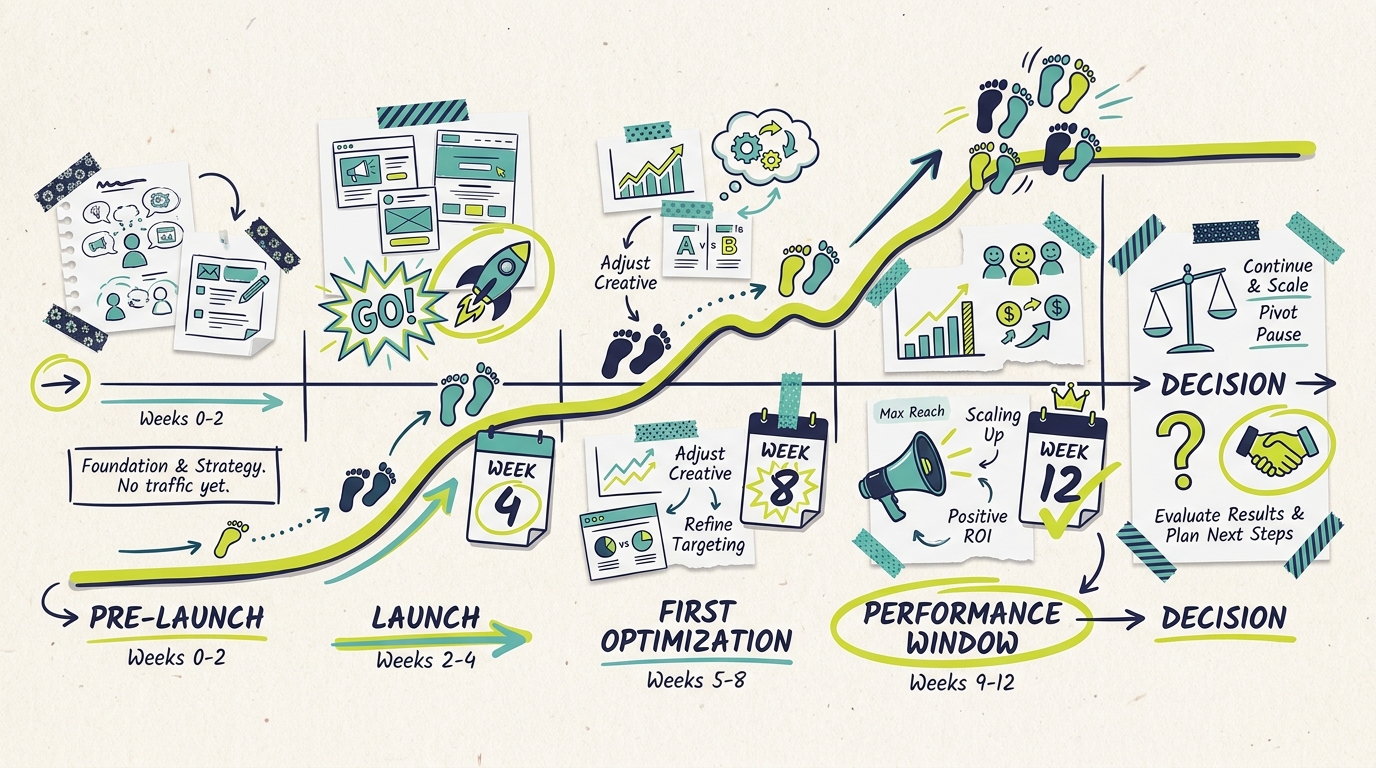
A practical 90-day framework for a foot traffic-focused CTV campaign:
Pre-launch (weeks -4 to -1)
Capture your 4-6 week pre-campaign foot traffic baseline. Set up your in-store QR code or vanity URL. Train front-of-house staff on the intake question. Tighten any existing digital channels' geographic targeting to match planned CTV targeting.
Generate two CTV creative variations through your platform (Adwave or similar). The first should be brand-focused, featuring the location and staff. The second should be promotion-focused with a specific weekend offer or visit incentive.
Weeks 1-2: Launch
Run both creatives in rotation. Daily cap consistent across the week. No optimization in this period. Watch dashboard for delivery and impressions; don't change targeting yet.
Weeks 3-4: First optimization
Review geographic distribution. If more than 20-25% of impressions are landing outside your real drive radius, contact platform support to tighten targeting. Check creative-level conversion data if you have QR or vanity URL tracking; consider pausing the weaker creative if there's clear separation.
Weeks 5-8: Performance window
Maintain steady delivery. Watch weekly foot traffic vs. baseline. Watch branded search and direct traffic for cross-channel lift signals. Make creative-level adjustments only if there's clear data driving them.
Weeks 9-12: Read and decision
Compare 12-week total foot traffic to pre-campaign baseline. Calculate cost per incremental visit (TV spend divided by incremental visits over baseline). Decision points:
Strong lift (15%+): Keep campaign at current spend or scale modestly. Foot traffic lift is real and the campaign is paying for itself.
Moderate lift (5-15%): Adjust creative or targeting and run another 60-day cycle. Often the second cycle produces clearer signal.
Weak lift (under 5%): Diagnose. Most often the issue is geographic leakage, weak creative, or under-frequency. Address the diagnosis before pulling the campaign entirely.
Cross-channel lift that complements foot traffic
A meaningful share of CTV's foot traffic impact happens through cross-channel signals rather than direct visits. Tracking these signals during your campaign captures the campaign's full effect.
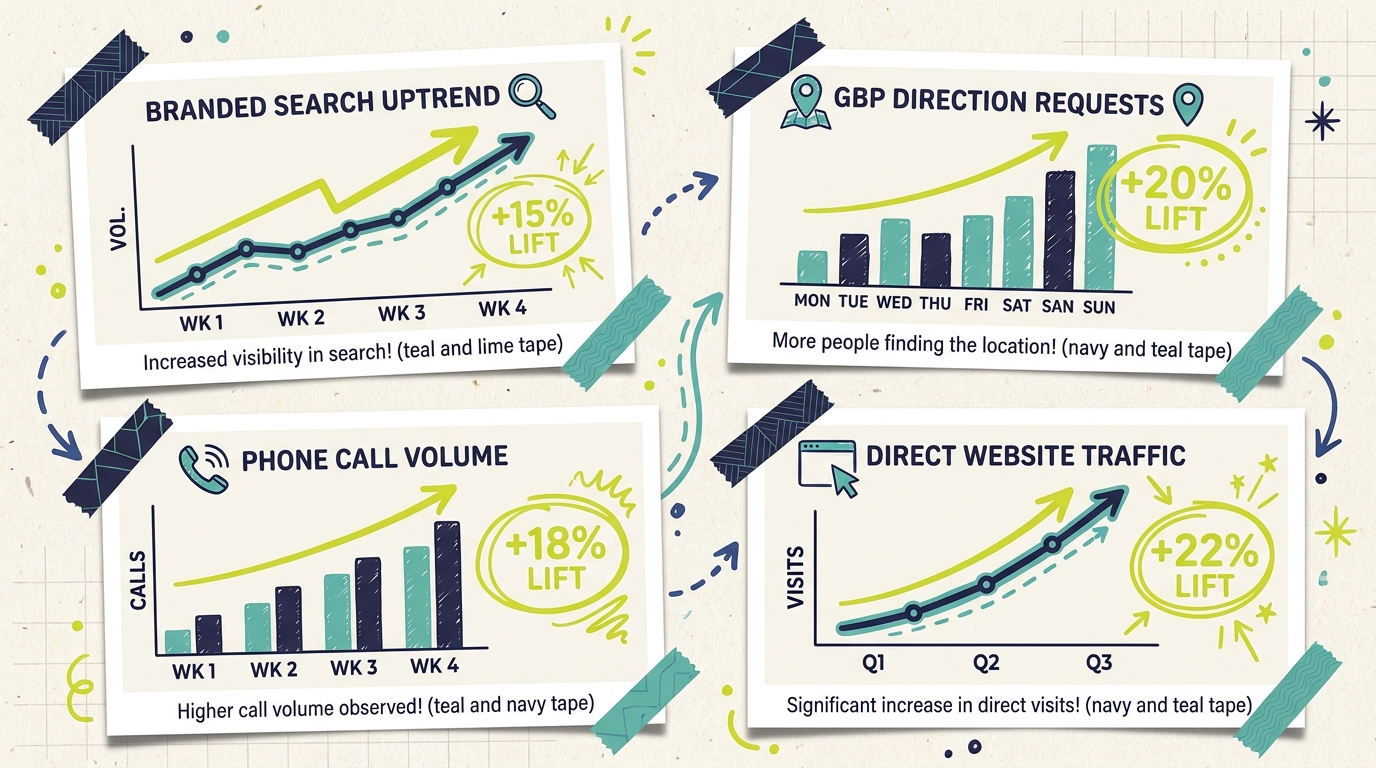
Branded search lift. Searches for your business name during the campaign window will typically rise 15-40% over baseline. Those searches lead to website visits, phone calls, and direct visits to the location.
Direct website traffic. Visitors typing your URL directly will typically rise 10-25%. Many of these are pre-visit "let me check your hours" or "where exactly are you located" researchers.
Google Business Profile views. Views and direction requests on your GBP often lift 20-50% during active CTV campaigns. Direction requests are a strong direct signal of intent to visit.
Phone call volume. For categories where phone calls are common (restaurants, salons, certain service businesses), call volume often lifts 15-35% during campaigns.
These cross-channel signals, combined with directly counted foot traffic lift, give you the complete picture of campaign value.
Common mistakes for foot-traffic campaigns
Five patterns that consistently underperform:
Mistake 1: Generic creative that doesn't show the actual location. Stock-style retail creative doesn't drive visits. The creative needs to show your actual storefront, your actual interior, your actual staff. Specificity drives the recognition that converts to a visit decision.
Mistake 2: Geographic targeting that's too wide. A 25-mile radius for a business with a 10-mile real drive radius wastes impressions on viewers who won't visit. Tighter is almost always better for foot-traffic campaigns.
Mistake 3: Soft "learn more" CTAs. Foot-traffic creative needs visit-specific CTAs. "Visit us this weekend at [address]" beats "Learn more at our website." The CTA is what gives the viewer the action.
Mistake 4: Skipping the pre-launch baseline. Without 4-6 weeks of pre-campaign foot traffic data, you can't measure the lift. Direct attribution alone undercounts the true impact dramatically.
Mistake 5: Pulling the campaign too early. Foot traffic lift builds across 4-8 weeks as viewers move from "first impression" to "this is a real place I might visit" to "let's go this weekend." Two-week judgments produce false negatives.
Seasonal foot traffic patterns
A few category-specific seasonal patterns that influence campaign planning:
Retail. Memorial Day weekend, July 4th weekend, back-to-school (mid-August through Labor Day), and Black Friday through Christmas Eve are the four highest-yield seasonal windows. Campaigns running in these windows typically see 1.5-2x the foot traffic lift of off-season campaigns.
Restaurants. Mother's Day, Father's Day, Valentine's Day, New Year's Eve, and various local festival weeks. Friday-Saturday dinner is the heaviest decision-making window year-round.
Fitness. January (resolution), March-April (summer body), September (back-to-routine), and late December (gift cards and reset). Off-peak summer often requires more campaign weight to produce similar foot traffic lift.
Home services. Spring (pre-summer service like AC, landscaping), early fall (pre-winter prep), and after-major-storm windows for relevant categories.
Hospitality. Matching to local-event calendars and weather windows. Campaigns timed to pre-event weeks (when households are deciding "should we go?") produce stronger conversion than campaigns timed during the event week itself.
What this means for your business
CTV is one of the most underused foot-traffic-driving channels available to local small businesses in 2026. The combination of geographic precision, household-level reach, trust-building effects, and democratized cost makes the channel newly accessible at independent business scale.
The campaigns producing measurable foot traffic lift share specific characteristics: tight targeting, healthy frequency, specific creative, and pre/post baseline measurement. The campaigns that underperform usually fail on one of those four foundations.
Common questions answered
How quickly will I see foot traffic lift from a CTV campaign?
Modest signals (small lifts in weekend traffic, increased GBP direction requests) often appear in weeks 2-3. The full lift typically builds through weeks 4-8 and stabilizes by weeks 8-10. Plan for at least a 60-day window before evaluating performance, ideally 75-90 days for a clean read.
Can a small local business afford CTV for foot traffic?
Yes, increasingly. Subscription-tier platforms have made CTV accessible at $50-$500 entry points, with most local foot-traffic campaigns running in the $1,000-$2,500/month range. The economics typically work at small budgets when targeting is tight to real drive radius.
Does CTV work for businesses with very small physical footprints (one storefront, one location)?
Yes. CTV works best for businesses with a defined drive radius (3-12 miles for most single-location businesses). The geographic precision matches the single-location business model well.
How do I count foot traffic for measurement purposes?
Several options. A handheld clicker at the door during peak times. A POS-based unique-customer count. A foot traffic measurement device that uses Wi-Fi or sensor data. Manual tallies during specific busy windows. The exact method doesn't matter as long as you're consistent across baseline and campaign weeks.
What's the most important targeting decision for a foot traffic campaign?
Matching geographic targeting to your real drive radius rather than your aspirational service area. A business with a 10-mile drive radius should target 10 miles, not 25. Concentrating impressions where actual customers come from produces dramatically better foot traffic lift.
Should CTV replace my Meta or Google ads for foot traffic?
Not by default. CTV produces foot traffic best when running alongside (not in place of) other channels. CTV builds the household-level recognition that lifts Meta and Google performance during the campaign window. The combined effect is stronger than any single channel alone.
What's the best creative approach for a foot traffic-focused CTV spot?
Show the actual location, actual staff, and a specific visit-driving offer. Avoid generic stock-retail creative. The viewer needs to recognize your actual storefront, see real moments from inside the location, and have a specific reason to visit (a weekend offer, a seasonal promotion, a known feature like Sunday brunch or Saturday early hours). Specificity beats polish.
Make CTV work for foot traffic
For local retailers, restaurants, fitness studios, and service businesses with physical locations, CTV is one of the most effective foot-traffic-driving channels available in 2026. The framework in this guide (tight targeting, healthy frequency, specific creative, baseline measurement) is the practical path to making it work for your business.


