-
$40B+
Projected U.S. CTV ad spend by 2026
-
20%+
Annual CTV ad market growth
-
90%
U.S. households with CTV devices
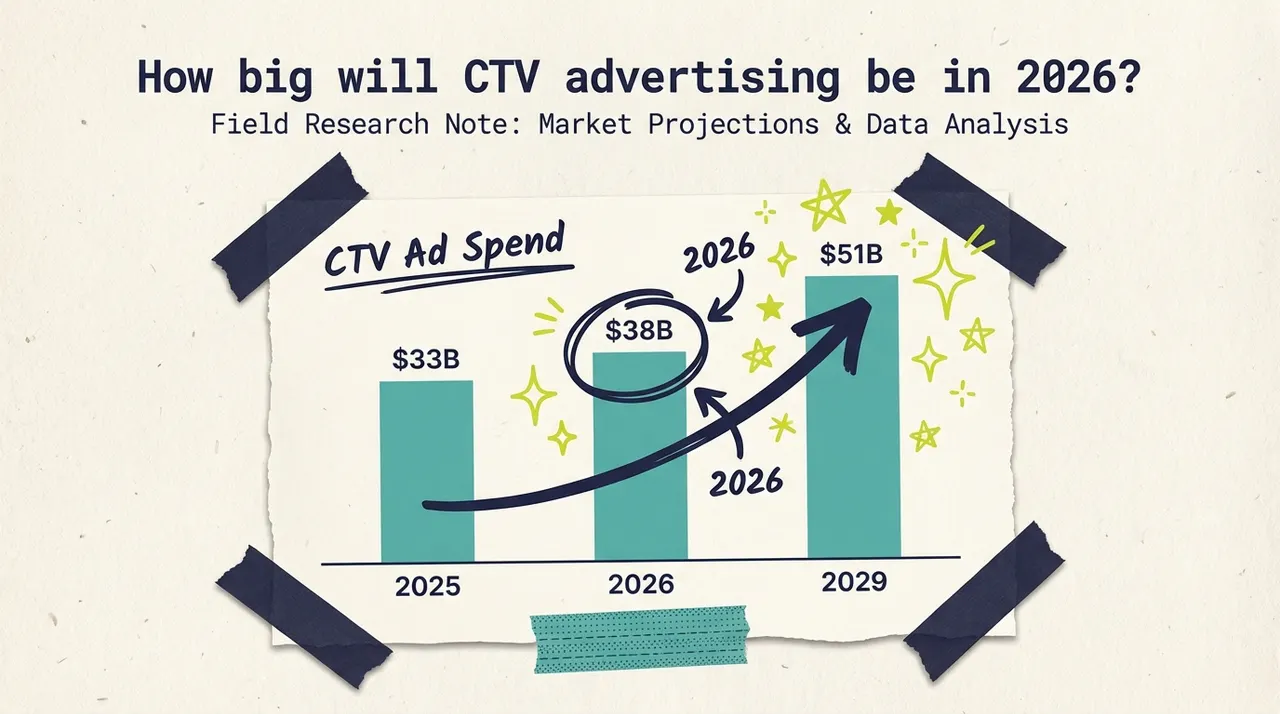
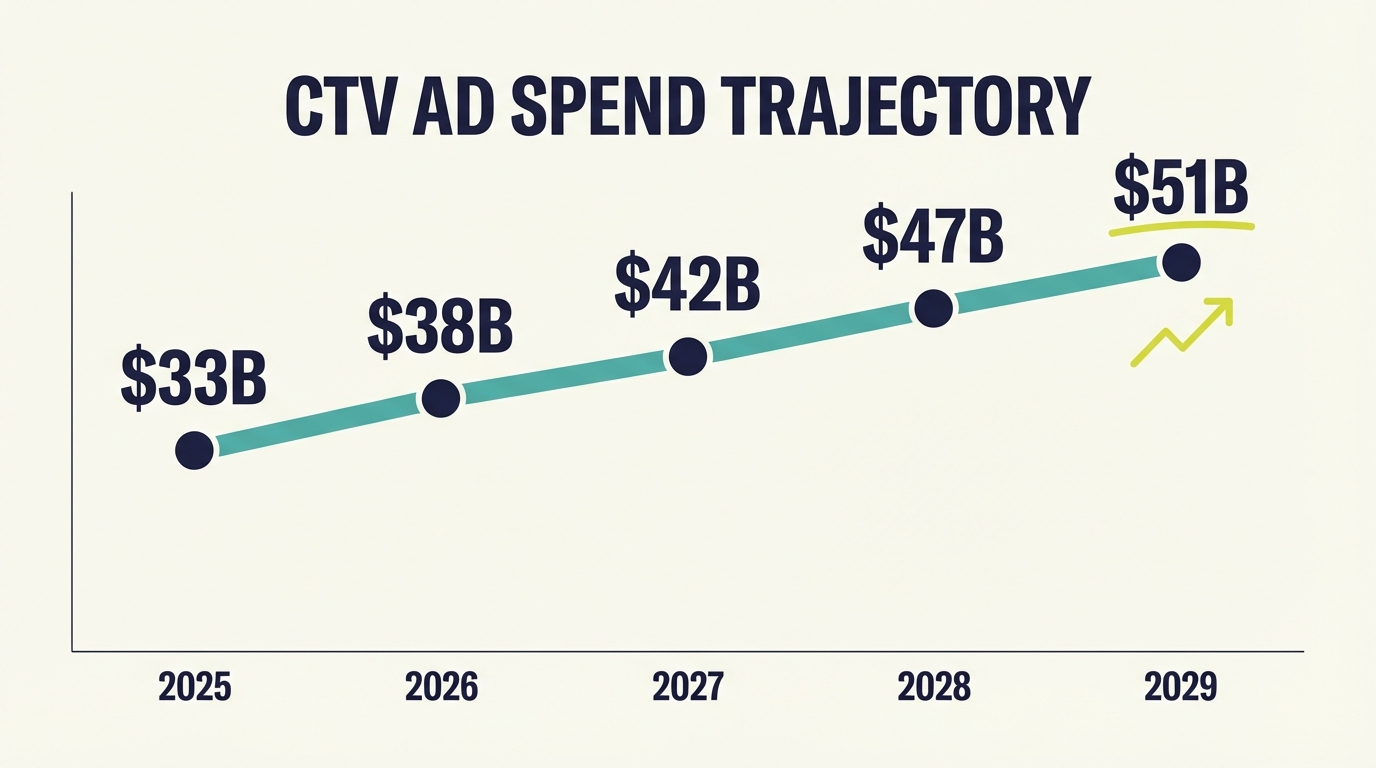
U.S. CTV advertising is projected to reach approximately $38 billion in 2026, continuing double-digit growth that has defined the channel for the past five years. According to eMarketer's latest forecast, connected TV ad spending will grow nearly 14% in 2026 before cooling to around 11% annual growth through 2029, when the market is expected to reach $51 billion. This trajectory makes CTV the fastest-growing major advertising channel in the United States, as linear television's share of ad spending continues its structural decline. For small businesses, the expansion of CTV advertising creates unprecedented opportunity to reach audiences on the biggest screen in the house, with targeting precision and budget flexibility that traditional TV never offered.
What the data shows
The numbers paint a clear picture of CTV's acceleration and linear TV's collapse.
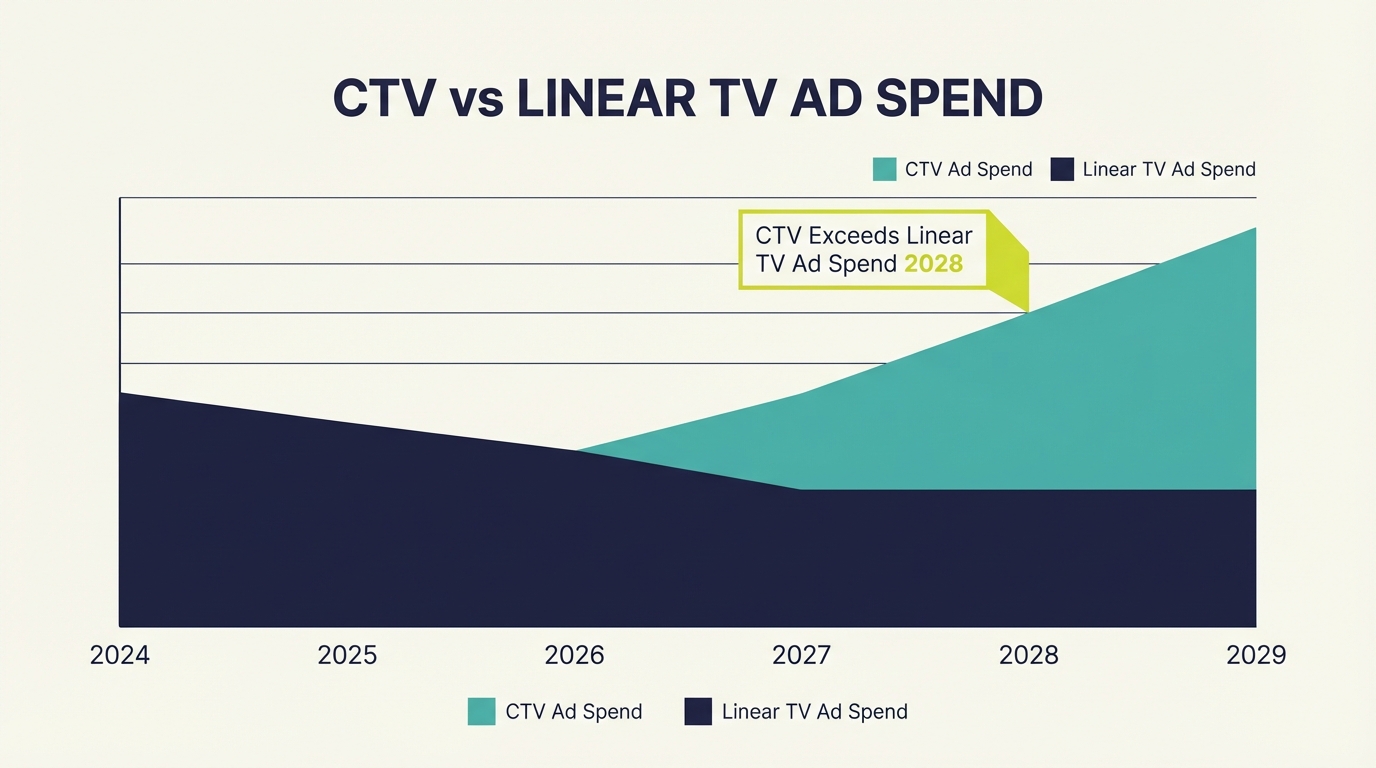
CTV ad spending reached $33.35 billion in 2025, according to MNTN Research. By 2028, that figure is expected to grow to $46.89 billion, surpassing traditional TV advertising for the first time in history. The shift represents more than a gradual transition. Linear TV has fallen to just 12% of global ad spending, while CTV is on pace to exceed 40% by 2030.
The growth trajectory tells the story. Annual CTV ad spending increases have consistently hit double digits, with eMarketer projecting approximately 14% growth in 2026 before moderating to 11% annually through the end of the decade. Even at these slower rates, CTV will add nearly $20 billion in U.S. ad dollars over the next five years.
What makes this growth especially significant is where the money is coming from. CTV isn't just capturing new digital ad budgets. It's absorbing spend that once went to cable and broadcast television. Linear TV's total prime-time ad sales amounted to $17.8 billion in 2024, down 3.2% from the previous year's $18.4 billion. The dollars that advertisers once committed to traditional TV are increasingly flowing to streaming platforms.
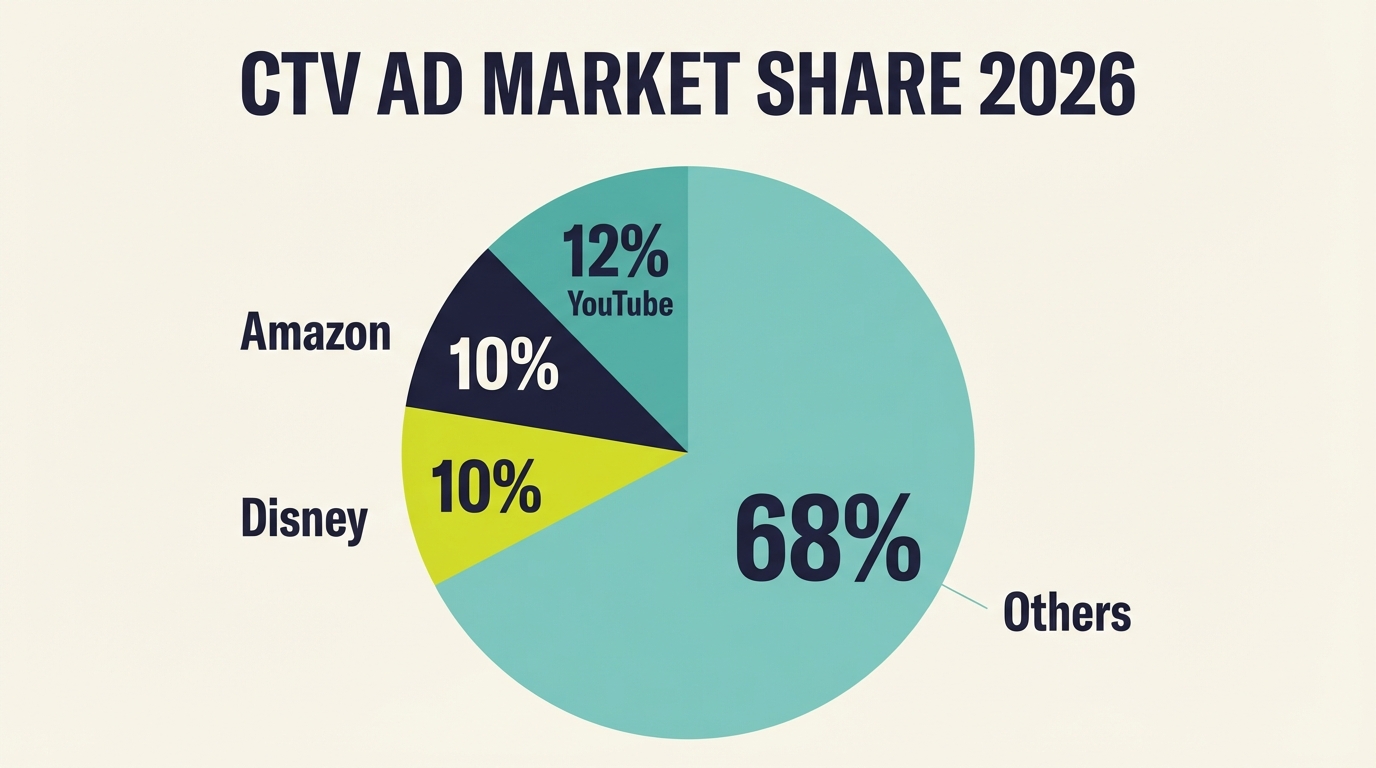
The market structure is consolidating around major players. YouTube is expected to account for nearly 12% of CTV ad revenues in 2026, driven by approximately $9.21 billion in net ad sales. Amazon and Disney (combining Hulu, Disney+, and ESPN) will each capture over 10% of the market. These three companies alone will control roughly a third of all CTV advertising.
Retail media networks represent an emerging force within CTV. Ad sales from retail media on connected TV are expected to grow from $4.99 billion in 2025 to $10.28 billion by 2028. While that represents only about 10.5% of the overall CTV market, the growth rate (more than doubling in three years) signals how commerce and television advertising are increasingly merging.
The viewing behavior underlying these ad dollars continues strengthening. According to Nielsen data, streaming captured 47.3% of all U.S. TV viewing in mid-2025, a record high. Cable has fallen below 27% and broadcast holds around 20%. The audience shift creates the inventory that supports ad spending growth. More viewers on streaming means more ad opportunities on CTV platforms.
Year-over-year comparisons illustrate the momentum. CTV ad spending grew approximately 16% from 2023 to 2024. The 2024 to 2025 growth rate was similar. While moderation toward 14% in 2026 and 11% by 2029 represents slowing, context matters. These are still extraordinary growth rates for a major advertising channel. For comparison, total U.S. advertising grows at roughly 5-7% annually. CTV is growing at twice that pace or more.
Breaking down the numbers
Understanding the components of CTV growth helps advertisers make smarter decisions about where to allocate budget.
By platform
The CTV landscape is highly fragmented, with only three companies expected to capture more than 10% of ad sales in 2026. Here's how the major players stack up:
YouTube: Nearly 12% market share, approximately $9.21 billion in net CTV ad sales
Amazon: Over 10% market share, driven by Prime Video, Fire TV, Twitch, and Freevee
Disney: Over 10% market share, combining Hulu, Disney+, and ESPN
Netflix: Growing rapidly since ad tier launch, but still smaller share
Roku: Significant through Roku Channel and platform advertising
Other streaming services: Peacock, Paramount+, Tubi, Pluto TV, and others divide the remainder
The fragmentation creates both opportunity and challenge. Advertisers gain access to diverse audiences across different viewing contexts, but managing campaigns across multiple platforms requires more sophistication than traditional TV buying.
By ad type
CTV advertising encompasses multiple formats and buying methods:
Subscription OTT with ads: 84.7% of subscription-based OTT ad sales will originate from CTV in 2026, totaling approximately $16.23 billion across all devices. This category includes the ad-supported tiers of Netflix, Disney+, Max, and similar services.
FAST (Free Ad-Supported Streaming TV): Services like Tubi, Pluto TV, and the Roku Channel continue growing rapidly, offering ad-supported content at no subscription cost to viewers.
Programmatic vs. direct: Increasingly, CTV inventory is available programmatically, lowering entry barriers for smaller advertisers. However, premium inventory on major platforms often still requires direct buying relationships.
By buyer type
The composition of CTV advertisers is shifting as the market matures:
National brands continue to represent the largest share of spending, using CTV to extend reach beyond declining linear audiences.
Retail media networks are the fastest-growing buyer segment. Amazon, Walmart, and other retailers are using CTV to connect commerce data with TV advertising, enabling attribution that linear TV could never provide.
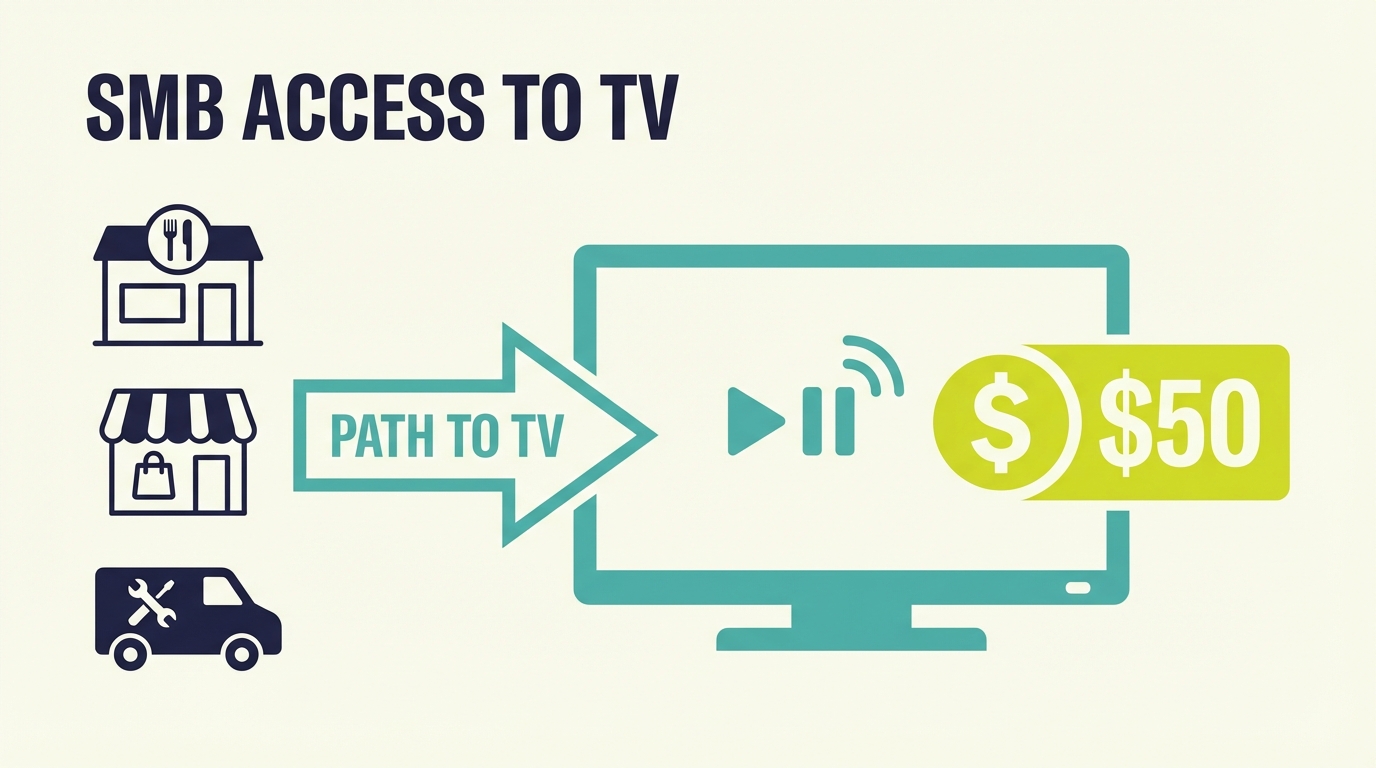
Small and medium businesses represent the most underserved opportunity. Entry-level platforms like Adwave enable businesses to access streaming TV inventory with budgets starting at $50, democratizing access that was once limited to large advertisers.
Why it matters for your business
The 2026 CTV forecast isn't just an industry statistic. It represents a fundamental shift in how businesses of all sizes can reach customers.
Traditional TV advertising operated on a simple principle: big reach required big budgets. A local business wanting to advertise on television faced minimum spends of tens of thousands of dollars, plus production costs that could easily add another $50,000 or more. The economics simply didn't work for most small businesses.
CTV changes that equation entirely. Programmatic buying enables advertisers to purchase inventory at whatever budget level makes sense for their business. Geographic targeting means a local restaurant doesn't pay to reach viewers three states away. And AI-powered creative tools eliminate the production barrier that once made TV advertising prohibitively expensive.
The growth to $38 billion in 2026 means more inventory becoming available across more platforms at more accessible price points. As the market scales, competition among platforms drives innovation in targeting, measurement, and advertiser tools. Small businesses benefit from infrastructure originally built for enterprise advertisers.
Consider the practical implications. A dental practice in Denver can now run streaming TV ads that reach potential patients within their service area, on channels like Hulu and Discovery, for a few hundred dollars per month. Five years ago, that same practice would have faced minimum buys of $10,000 or more for cable TV, with far less precise targeting.
The TV advertising landscape has fundamentally shifted. Platforms like Adwave make it possible to launch campaigns starting at just $50, with AI-generated creative that eliminates production costs entirely. The question for small businesses is no longer whether they can afford TV advertising. The question is whether they can afford to ignore it while competitors stake their claims on the most trusted advertising medium.
The trust factor deserves emphasis. Television remains the most trusted advertising medium among consumers. Viewers expect advertising on TV in ways they don't on social media or display. The premium environment of streaming, with professional content and intentional viewing, creates receptive audiences for brand messages. When a local business appears on the same screen as national brands, it gains implicit credibility.
Geographic targeting transforms the economics further. A local TV advertising campaign on streaming can reach households within a specific radius of your business. You're not paying to reach viewers who will never become customers. This precision, combined with frequency capping that prevents oversaturation, delivers efficiency that traditional TV could never match.
The trajectory toward $38 billion in 2026 means the market is maturing, not speculative. Infrastructure exists. Measurement works. Targeting is proven. The remaining barrier for most small businesses is simply awareness that the opportunity exists.
How to take advantage of this trend
Acting on CTV's growth requires a practical approach, not an overwhelming commitment.
Start with a test campaign. The beauty of CTV advertising is that you don't need to commit significant budget to learn what works. Allocate $200-500 for an initial two-week campaign. Focus on geographic targeting around your business location, typically a 15-25 mile radius. Use this test to establish baseline performance data before scaling.
Choose your platform strategy carefully. You have two primary approaches: working with individual streaming platforms directly, or using aggregated platforms that provide access to multiple channels through a single campaign. For most small businesses, aggregated access through platforms like Adwave provides simplicity and reach without requiring separate relationships with Netflix, Hulu, Amazon, and dozens of other services.
Prepare the ad for television viewing. Check the visuals, audio, text size, and duration on a large screen.
Measure what matters. CTV advertising isn't performance marketing in the traditional sense. Don't expect immediate clicks and conversions. Instead, track brand search lift (are more people Googling your business?), direct traffic increases, and customer survey responses. CTV advertising benchmarks show that video completion rates on streaming exceed 95%, meaning your message is being seen in full.
Increase spending after reviewing the test results. Change one major variable at a time so you can assess the effect.
The bigger picture
CTV's rise represents more than a shift in advertising budgets. It signals a fundamental transformation in how Americans consume video and how advertisers reach them.
The end of linear TV dominance
Linear television dominated advertising for 70 years, but that era is definitively ending. According to WARC Media's Global Ad Trends report, linear TV has fallen to just 12% of global ad spending. CTV is on pace to exceed 40% by 2030. The crossover isn't a matter of if but when, and for the U.S. market, it's happening within the next few years.
The implications extend beyond advertising. Cable networks are restructuring or shutting down. Broadcast networks are pivoting to streaming. Content that once premiered on linear TV now launches on streaming platforms. The viewing habits that sustained traditional TV advertising are simply not coming back.
Measurement and accountability
What makes CTV's growth sustainable is measurement. Unlike linear TV, where advertisers essentially trusted that ads aired to claimed audiences, CTV provides verification at the household and device level. Advertisers know their ads ran. They can track viewership. They can measure downstream impact through pixel tracking and attribution.
This accountability is driving budget reallocation. CMOs increasingly demand proof that advertising works. CTV provides that proof in ways linear TV never could. As the market matures toward $51 billion by 2029, measurement capabilities will only improve.
The democratization continues
For small businesses, the trajectory is unambiguously positive. Every dollar that shifts from linear TV to CTV represents inventory that's more targetable, more measurable, and more accessible to smaller budgets. The days when TV advertising required six-figure commitments are definitively over.
The $38 billion projected for 2026 represents not just market size but market opportunity. As platforms compete for advertiser dollars, tools and pricing become more accessible. Small businesses that establish CTV presence now will have advantages as the market continues expanding.
Industry applications
The CTV growth creates specific opportunities across business categories. Restaurants can target households during meal-decision hours. Home services businesses can reach homeowners when they're relaxed and thinking about projects. Healthcare providers can build trust through the premium TV environment. E-commerce brands can use CTV for brand awareness before retargeting on other channels.
Each industry benefits from CTV's combination of broad reach and precise targeting. A restaurant TV advertising campaign can reach diners in delivery radius during dinner consideration windows. A real estate agent can build name recognition across their farm area. The applications are as varied as the businesses that can benefit.
What experts are saying
Industry analysts and researchers have noted CTV's transformation of the advertising landscape.
WARC Media's Global Ad Trends report highlighted that "CTV already accounts for nearly half of viewing hours, fueling billions in ad revenues." The research firm noted that the shift "signals not just changing audiences but also a fundamental rewiring of how ads are bought, measured, and monetized."
EMarketer's analysis emphasized the market's maturation: "CTV is moving from experimentation to expectation. With US spending expected to balloon in the next few years, the question isn't if brands should shift budgets, it's how fast."
Advertising industry observers have pointed to the democratization effect. As one IAB analysis noted, programmatic buying combined with AI-generated creative has "effectively removed every traditional barrier to TV advertising for small businesses."
The consensus among researchers is clear: CTV growth represents a permanent structural shift, not a temporary trend. The viewing habits, technology infrastructure, and advertiser tools that enable CTV advertising will only strengthen in coming years.
Media strategists have also noted the importance of timing. Brands that establish streaming TV presence now, while the market is still growing rapidly, will have advantages over latecomers. Building creative assets, understanding what resonates with audiences, and developing measurement frameworks takes time. The advertisers who do that work during the growth phase will be better positioned as the market matures.
Common questions answered
How big will CTV advertising be in 2026?
CTV advertising in the U.S. is projected to reach approximately $38 billion in 2026, representing roughly 14% growth from 2025's $33.35 billion. By 2028, the market is expected to hit $46.89 billion, and by 2029, approximately $51 billion. These projections come from eMarketer and MNTN Research analysis of industry trends and advertiser spending patterns.
Is CTV advertising still growing?
Yes, CTV advertising continues growing at double-digit rates, though the pace is moderating as the market matures. Annual growth is expected to cool from approximately 14% in 2026 to around 11% by 2029. Even at these rates, CTV will add nearly $20 billion in ad spend over the next five years. The growth is structural, driven by ongoing cord-cutting and advertiser preference for measurable, targetable TV advertising.
Will CTV replace linear TV advertising?
CTV ad spending is projected to surpass traditional TV advertising by 2028 for the first time. However, linear TV won't disappear entirely. It will continue serving older demographics and live sports audiences, though at declining levels. For most advertisers, the shift to CTV-first strategies is already underway, with linear TV becoming a supplementary channel rather than the primary vehicle for television advertising.
What's driving CTV advertising growth?
Several factors drive CTV's growth. Cord-cutting continues, with streaming now capturing over 47% of all U.S. TV viewing. Advertiser demand for targeting and measurement pushes budgets toward CTV. Platform expansion of ad tiers (Netflix, Disney+, Max) creates more inventory. And lower entry barriers enable small and medium businesses to participate in television advertising for the first time.
How can small businesses take advantage of CTV growth?
Small businesses can access CTV advertising through aggregated platforms that provide reach across multiple streaming services without requiring individual platform relationships. Platforms like Adwave enable campaigns starting at $50, with AI-generated creative that eliminates production costs. Geographic targeting ensures local businesses reach relevant audiences without paying for national reach they don't need.
What are CTV CPMs in 2026?
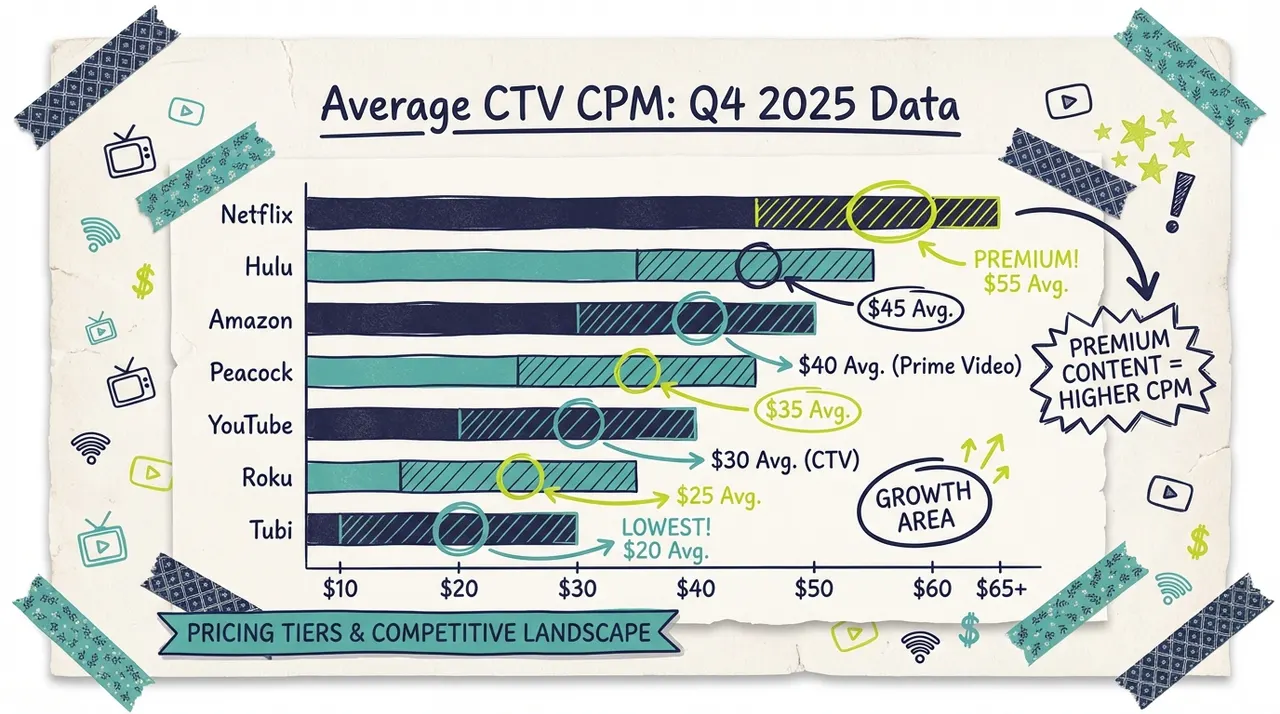
CTV CPMs (cost per thousand impressions) vary significantly by platform and buying method. Average CTV CPM ranges from $25-35 through aggregated platforms. Premium inventory on Netflix or Hulu direct can run $40-65. Free ad-supported streaming (FAST) channels typically offer lower CPMs. As the market grows and inventory expands, competitive pressure may moderate pricing.
Which streaming platforms have the most CTV ad inventory?
YouTube commands the largest share of CTV ad inventory, with nearly 12% market share projected for 2026. Amazon (through Prime Video, Fire TV, and Freevee) and Disney (through Hulu, Disney+, and ESPN) each capture over 10%. However, the market remains highly fragmented, with dozens of platforms sharing the remaining roughly two-thirds of inventory. For advertisers, this fragmentation argues for using aggregated platforms that provide access to multiple services through single campaigns.
How does CTV advertising compare to social media advertising?
CTV and social media serve different purposes in the marketing mix. Social media excels at performance marketing with immediate, trackable actions. CTV builds brand awareness and trust through the premium, lean-back viewing environment of television. The two channels complement each other effectively. Studies show that pairing streaming TV with social advertising boosts brand recall by 5x compared to social alone. Most sophisticated advertisers use both channels, with CTV building awareness and social driving conversion.
Supporting data
Key statistics on CTV advertising market size and growth:
2025 CTV ad spend: $33.35 billion (eMarketer, 2025)
2026 CTV ad spend projection: Approximately $38 billion, ~14% YoY growth (eMarketer, 2025)
2028 CTV ad spend projection: $46.89 billion (MNTN Research, 2025)
2029 CTV ad spend projection: $51 billion (eMarketer, 2025)
Linear TV share of global ad spend: 12%, declining (WARC Media, 2025)
CTV projected share by 2030: Over 40% of global ad spend (WARC Media, 2025)
YouTube CTV market share 2026: Nearly 12%, ~$9.21 billion (eMarketer, 2025)
Retail media CTV ad sales 2025: $4.99 billion (MNTN Research, 2025)
Retail media CTV ad sales 2028: $10.28 billion (MNTN Research, 2025)
All sources linked above. Data current as of December 2025.
Get started with CTV advertising
The CTV market is expanding rapidly, and small businesses have more opportunity than ever to reach streaming audiences. Whether the market hits $38 billion or $40 billion in 2026, the trajectory is clear: television advertising is moving to streaming.
Adwave makes CTV advertising accessible for any budget, with campaigns starting at just $50. Access 100+ streaming channels including Hulu, Discovery, and Peacock. Target by geography and demographics. AI-powered creative generates broadcast-quality commercials from your website in minutes.
No production budget required. No agency needed. No minimum spend that prices out small businesses.
See how it works | View pricing