-
$33B
U.S. CTV advertising market size in 2025
-
4x
Market growth since 2020 ($8B)
-
16%
Annual growth rate
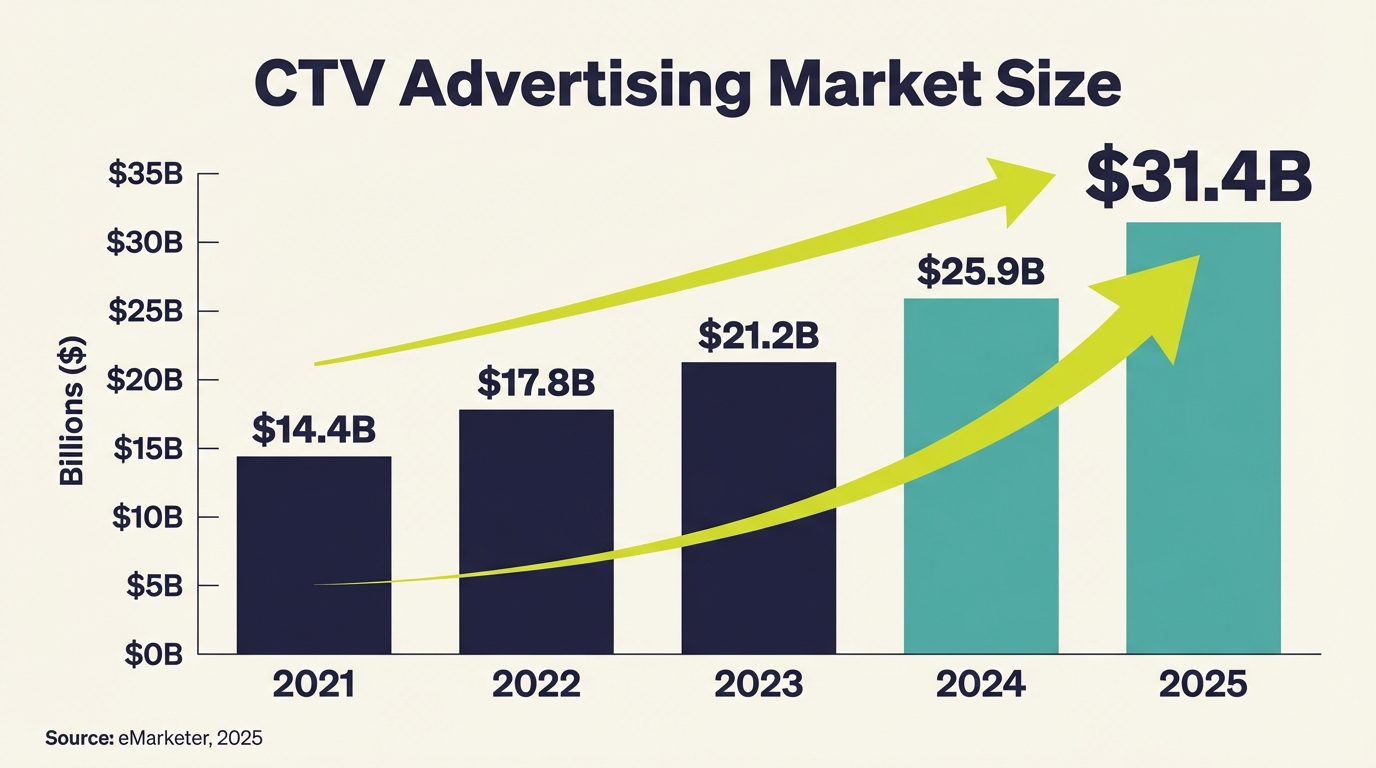
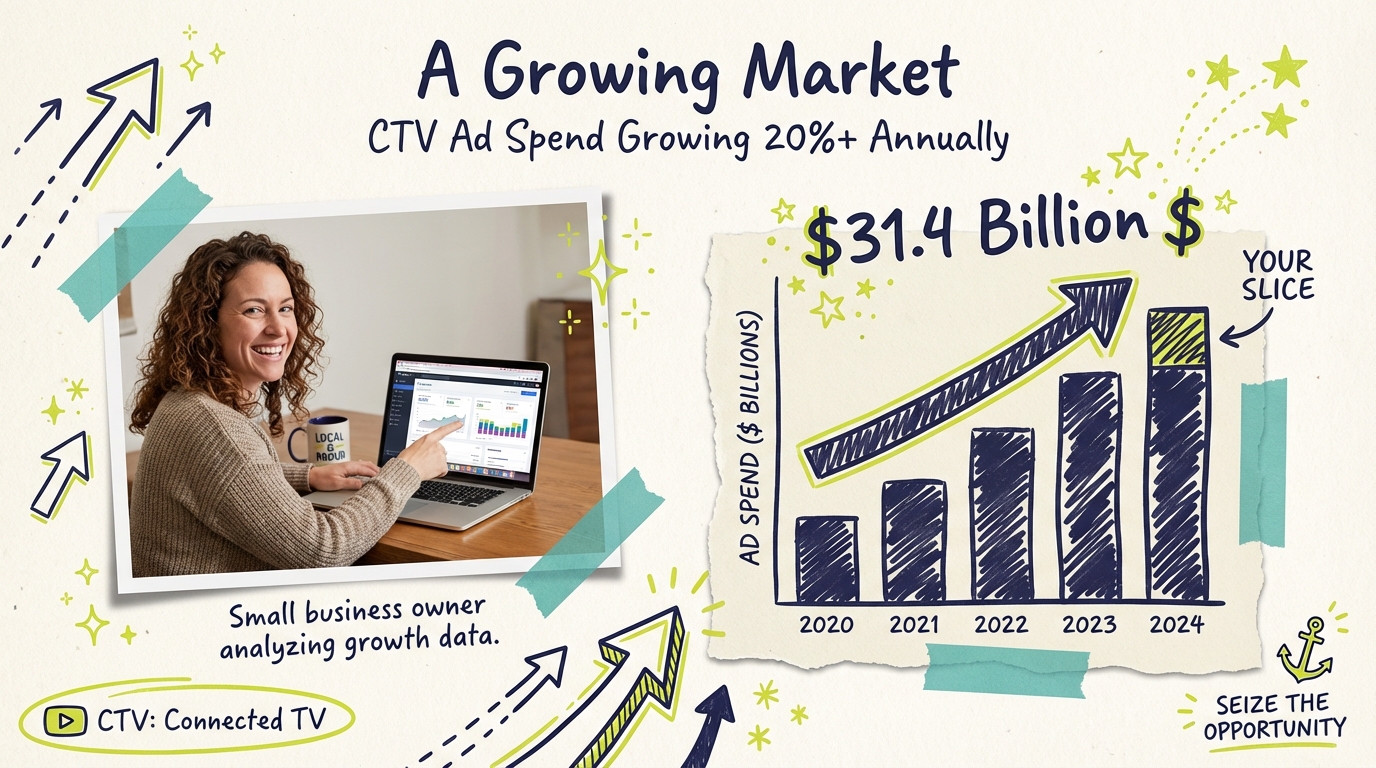
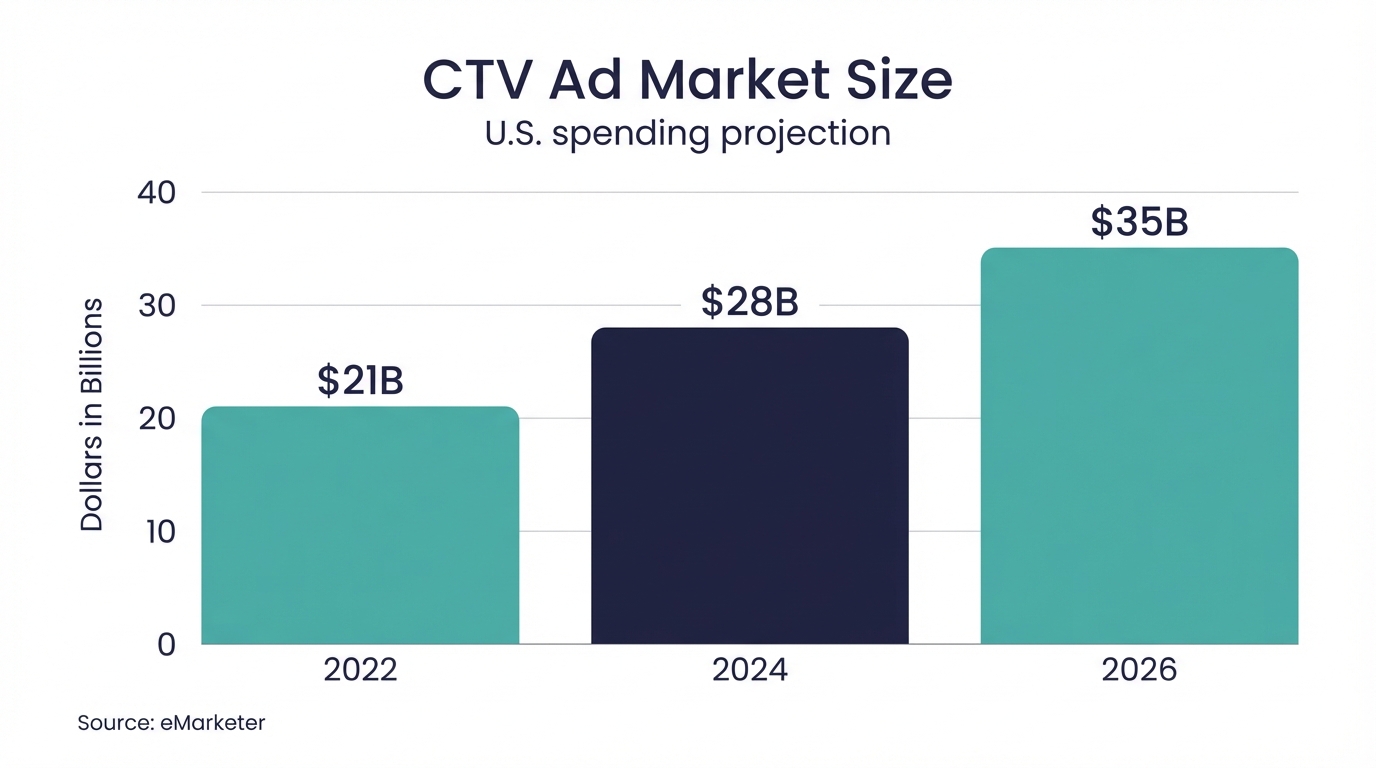
The U.S. connected TV advertising market is projected to reach $33.35 billion in 2025, according to eMarketer's latest forecast. This represents roughly four times the market size from just five years ago, when CTV advertising totaled approximately $8 billion in 2020. The explosive growth reflects a fundamental transformation in how Americans watch television and how advertisers reach them.
For small business owners who have long assumed TV advertising was beyond their reach, this expanding market creates unprecedented opportunities. More inventory, better tools, and competitive pricing now make premium television accessible at price points that work for businesses of all sizes.
What the data shows
Multiple authoritative sources project continued strong growth for the CTV advertising market. There's some variation in exact figures based on methodology and what each source includes in their definition of CTV.
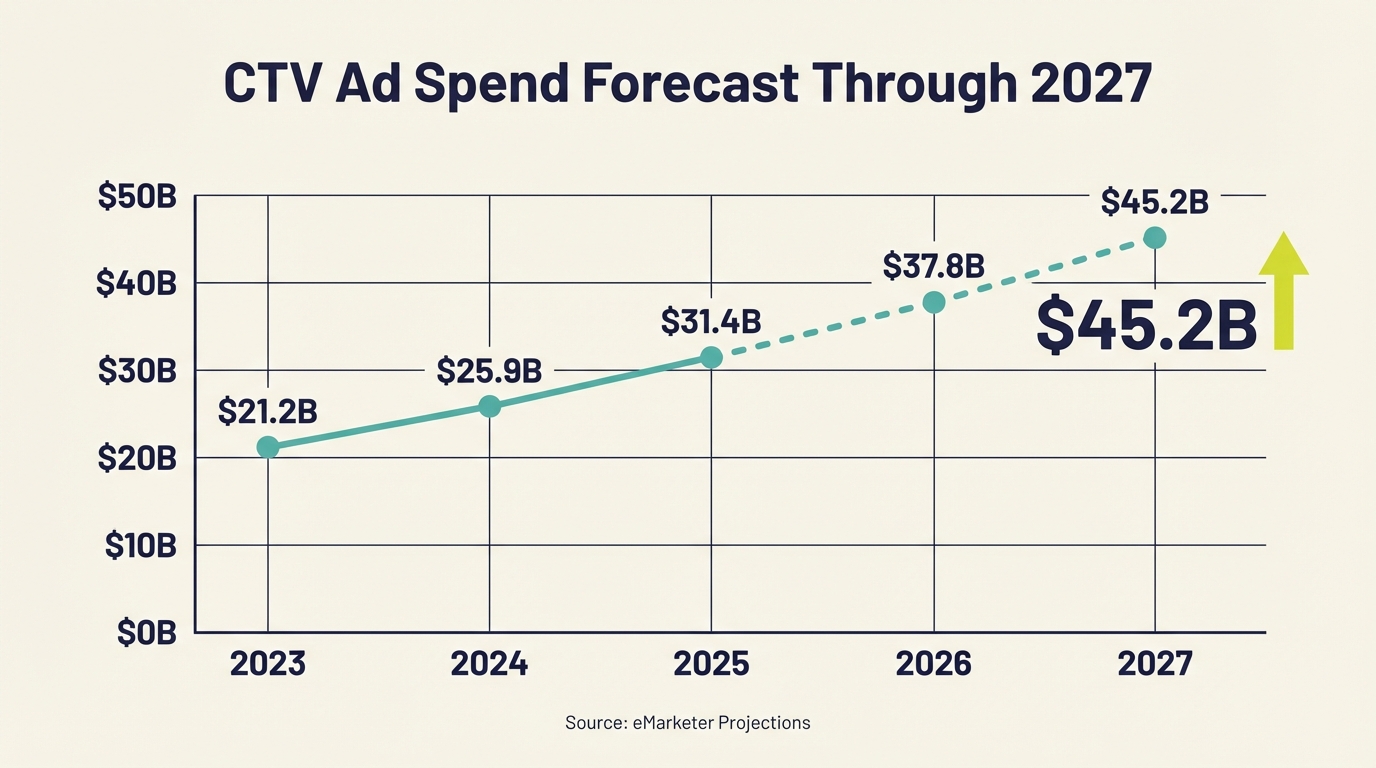
According to various industry sources, here's how the CTV market has evolved and is projected to grow. The baseline was $8 billion in 2020 before the streaming advertising boom accelerated. By 2023, the market nearly tripled to $20.3 billion according to IAB. In 2024, IAB's Digital Video Report showed 16% year-over-year growth bringing the market to $23.6 billion. IAB's projection for 2025 is $26.6 billion. eMarketer's projection for 2025 is $33.35 billion for CTV display ad spending, a broader measure. OnAudience's analysis projects the market reaching $42.4 billion by 2027. eMarketer forecasts $46.89 billion by 2028.
The difference between IAB and eMarketer numbers reflects methodology. IAB tracks advertiser-reported spend across a sample of major brands. eMarketer provides broader market forecasts that include the full ecosystem. Both point to the same directional story: double-digit annual growth reshaping the television advertising industry.
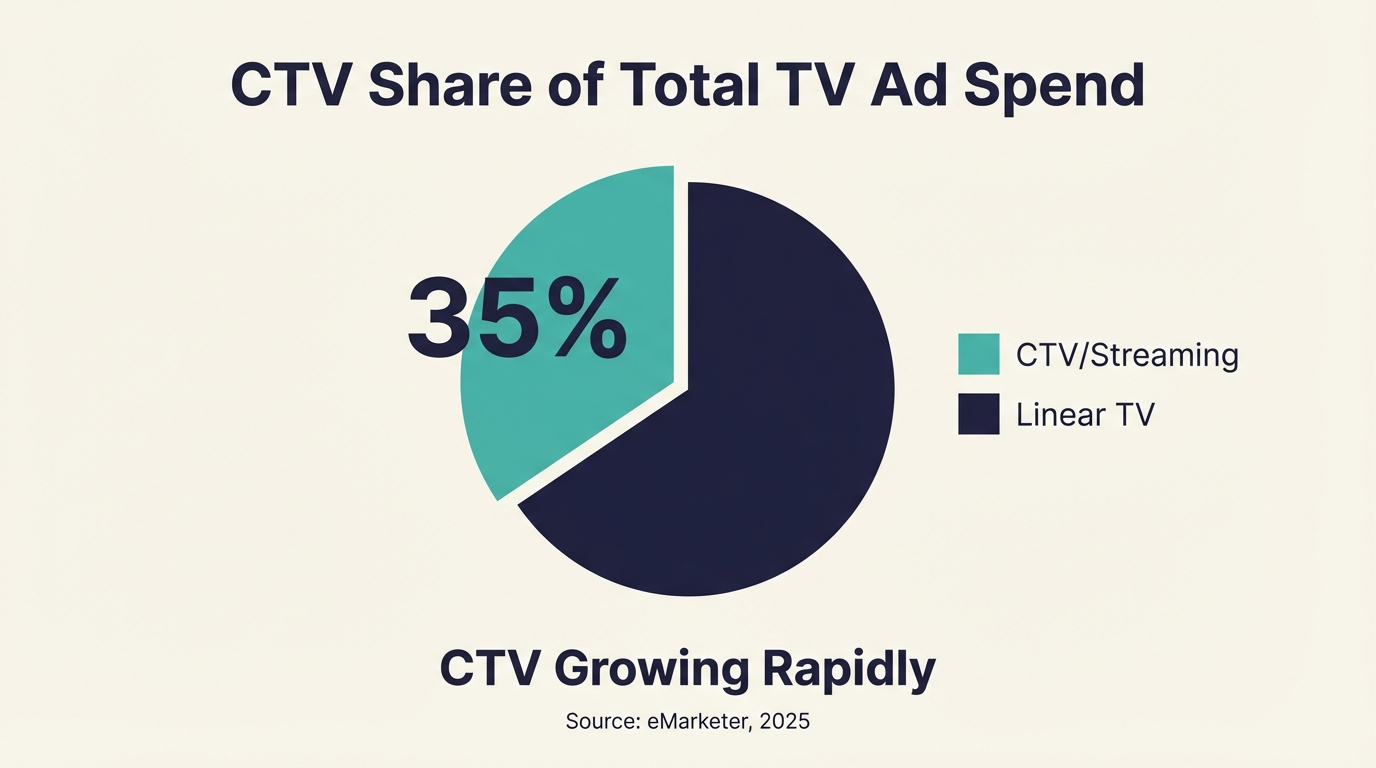
To contextualize these numbers, eMarketer reports that CTV ad spending will surpass traditional TV ad spending ($45.10 billion) for the first time in 2028. This crossover point marks a historic shift in how television advertising dollars flow. The medium that dominated advertising for decades is being overtaken by its streaming successor.
The IAB reports that digital video as a whole rose 18% in 2024 to $64 billion and is projected to reach $72 billion in 2025. This growth rate is two to three times faster than total media spending overall. CTV represents the fastest-growing segment within digital video, which reflects advertisers' enthusiasm for reaching cord-cutters and streaming audiences.
Breaking down the numbers
Understanding what's driving the CTV market's growth and how the dollars are distributed provides valuable context for advertisers considering the channel.
Growth drivers
Several converging factors fuel CTV advertising's expansion.
First, the launch of ad-supported tiers from major streaming services has dramatically increased available advertising inventory. Netflix launched its ad tier in late 2022, followed by Disney+, and Amazon Prime Video introduced ads to its base tier in 2024. These additions alone created billions of dollars in new advertising inventory.
Second, ongoing cord-cutting continues pushing viewers away from traditional TV advertising. As we've documented in our cord-cutting statistics, over 80 million American households have either cut the cord or never subscribed to traditional pay TV. These viewers haven't stopped watching content, they've shifted to streaming, and CTV advertising is how advertisers reach them.
Third, measurement improvements have increased advertiser confidence. CTV offers more precise impression tracking than traditional TV's estimated ratings. Advertisers can verify their ads were delivered, measure completion rates, and increasingly connect exposure to outcomes.
Fourth, the rise of self-serve and programmatic tools has democratized access. IAB notes that "CTV is no longer just for brands with big budgets" due to self-serve platforms that enable small and mid-size businesses to participate.
Market share by platform
The CTV advertising market is more fragmented than social media advertising, where Meta dominates. According to eMarketer, only three companies will account for more than 10% of CTV ad sales in 2026. YouTube leads with 11.9% of CTV ad revenues (24.4% of gross sales at $9.21 billion). Amazon is surpassing 10% through Prime Video, Fire TV, Twitch, and Freevee. Disney holds 10.8% combined across Hulu and Disney+.
This fragmentation creates opportunities for advertisers. Unlike social advertising where a few platforms dominate, CTV offers multiple entry points and diverse inventory sources. Platforms like Adwave aggregate access to 100+ channels, allowing advertisers to reach audiences across the entire streaming ecosystem without managing multiple platform relationships.
Where CTV dollars are coming from
The IAB reports that most dollars flowing into CTV represent reallocations from other channels rather than purely incremental spend. Linear TV accounts for 36% of the shift as traditional TV advertisers follow audiences to streaming. Social media also accounts for 36% as digital advertisers add CTV for its brand-building capabilities. Other digital channels including online video, paid search, and display make up the remaining portion.
This reallocation pattern suggests advertisers are treating CTV as a core channel rather than an experimental add-on. For businesses already advertising on Meta or other social platforms, CTV offers complementary reach and brand-building impact.
CPM and pricing trends
As the CTV market has grown, pricing has become more competitive. Current CTV CPMs range from $15-35 for small business advertisers, with an average around $25. This represents a significant improvement from the early days of CTV when premium rates and high minimums excluded smaller advertisers.
The increase in inventory from ad-supported streaming tiers has moderated CPM growth. While premium inventory on Netflix or Disney+ commands higher rates, the overall market offers accessible pricing for businesses of all sizes. Platforms like Adwave start at just $50, making TV advertising achievable for businesses that couldn't previously afford it.
Why it matters for your business
The expanding CTV advertising market creates tangible benefits for small business advertisers, even if you're not planning to spend millions on advertising.
More inventory means better access
A $33 billion market requires substantial advertising inventory to absorb that spending. This inventory growth works in advertisers' favor. More available ad slots mean less competition for any individual placement, which helps moderate pricing and improves the likelihood of reaching your target audience. Five years ago, CTV inventory was relatively scarce and expensive. Today, the proliferation of ad-supported streaming options creates abundance.
Platform investment benefits all users
The scale of CTV spending attracts investment in platform capabilities. Ad technology companies build better targeting tools, measurement solutions, and creative capabilities because the market size justifies the investment. Small advertisers benefit from these improvements even though enterprise budgets drove the investment.
Consider how AI-powered creative generation has emerged. Creating a TV commercial used to require production budgets of $5,000 to $50,000 or more. Now, platforms like Adwave can generate professional ads from your website assets at no additional cost. This innovation exists because the CTV market's scale justified the development investment.
Validation and maturity
A $33 billion market isn't experimental. When major brands allocate significant budgets to CTV, they validate the channel's effectiveness. When measurement firms develop sophisticated attribution solutions, they confirm the medium delivers results. For businesses considering TV advertising for the first time, the market's maturity provides confidence that you're not taking an unnecessary risk.
Timing advantages
Entering a growing market often provides advantages over waiting. As more advertisers discover CTV, competition for the best inventory will increase. Establishing your presence now, while the market is still developing and smaller advertisers have good access, may be more advantageous than waiting until the market becomes more crowded.
The learnings you accumulate from early campaigns compound over time. Which targeting works, what creative resonates, and how CTV fits your overall marketing mix are questions you'll answer through experience. Businesses that start now build institutional knowledge that late entrants won't have.
How to take advantage of this trend
The CTV market's growth creates opportunity, but capturing that opportunity requires action.
Start with accessible platforms
Direct relationships with streaming services like Netflix or Hulu typically require substantial minimum commitments. Self-serve platforms like Adwave aggregate inventory across 100+ channels, offering access to the same premium inventory with minimums starting at $50. This approach lets you test CTV without major budget commitments.
Look for platforms that offer geographic targeting for local businesses, audience targeting, and transparent pricing. The proliferation of self-serve options means you have choices. Select one that fits your specific needs and budget.
Allocate test budget appropriately
For initial CTV testing, consider allocating $200-$500 over two to four weeks. This budget provides enough impressions to gauge whether CTV drives meaningful results for your business while limiting risk. Successful tests can be scaled. Unsuccessful ones provide learning without major financial impact.
If you're currently spending on social or search advertising, consider reallocating a small percentage (5-10%) to CTV testing rather than adding purely incremental budget. This approach mirrors how larger advertisers are moving dollars into the channel.
Use AI creative tools
One of the biggest barriers to TV advertising has traditionally been creative production. AI-powered platforms now eliminate this barrier. By providing your website URL, social media profiles, or existing assets, you can generate professional TV commercials in minutes. This technology democratizes access to TV-quality creative that previously required substantial production investment.
The AI creative approach also enables testing. Generate multiple versions, see what resonates, and iterate quickly. This agility wasn't possible when each creative required weeks of production time.
Connect CTV to your broader strategy
CTV advertising works best as part of an integrated marketing approach. Consider how it complements your existing channels. CTV builds awareness and consideration. Digital channels can capture the resulting demand. Many advertisers use CTV to drive brand searches, then capture those searches through paid search or SEO.
For local businesses, CTV's geographic targeting enables television advertising within your specific service area. Combined with local TV advertising strategies, you can build local brand presence that supports all your marketing efforts.
The bigger picture
The CTV market's growth reflects broader transformations in media consumption and advertising that will continue shaping opportunities for years to come.
The streaming transformation is permanent
Viewers aren't returning to traditional cable. Each year, more households cut the cord, and younger generations have never subscribed to traditional pay TV. The streaming share of TV viewing continues growing, meaning CTV's importance will only increase.
For advertisers, this means CTV literacy isn't optional. Understanding how to reach streaming audiences, measure results, and integrate CTV with other channels is becoming a core marketing competency. The businesses that develop this capability position themselves well for a streaming-dominant future.
Traditional TV isn't disappearing immediately
While CTV grows, traditional TV advertising continues at scale. The projected 2028 crossover point when CTV surpasses traditional TV still leaves traditional advertising as a $45+ billion market. For some audiences, especially older demographics and sports viewers, traditional TV remains relevant.
The implication for advertisers is nuanced. CTV represents the growth opportunity, but traditional TV shouldn't be dismissed entirely for audiences where it remains effective. The most sophisticated advertisers use both, allocating based on audience composition and campaign objectives.
Market maturity brings new challenges
As the CTV market matures, new challenges emerge. Fragmentation across platforms requires either aggregated buying approaches or complex multi-platform management. Measurement standardization is improving but not yet solved. Brand safety in automated buying environments requires attention.
These challenges don't diminish CTV's opportunity. They highlight the importance of working with platforms and partners who address them effectively. Self-serve platforms that aggregate inventory, provide transparent reporting, and maintain brand safety standards help advertisers navigate market complexity.
What experts are saying
Industry analysts and marketing experts have taken note of CTV's growth trajectory.

David Cohen, CEO of the IAB, stated that "2024 was an important year for digital video advertising. With high-quality content moving to streaming, advancements in advertising technology, and an influx of new inventory accelerated growth for both consumers and advertisers."
Chris Bruderle, VP of Industry Insights at IAB, describes streaming TV and social video as complementary channels for reach, targeting, and measurement. (noted)
eMarketer's analysis highlights that CTV "will surpass traditional TV ad spending for the first time" in 2028, marking a historic transition in television advertising.
Common questions answered
How big is the CTV advertising market in 2025?
The U.S. CTV advertising market is projected at $26.6 billion to $33.35 billion in 2025, depending on the source and methodology. IAB projects $26.6 billion based on advertiser-reported data. eMarketer forecasts $33.35 billion including the broader ecosystem. Both represent double-digit growth from 2024 and approximately four times the market size from 2020.
Is CTV advertising still growing?
Yes, CTV advertising continues growing at double-digit rates. IAB reports 16% year-over-year growth in 2024, and projections show continued growth through the forecast period. The market is expected to reach $42-47 billion by 2027-2028. Growth is driven by streaming adoption, ad-supported tier launches, and advertiser migration from traditional TV.
When will CTV surpass traditional TV advertising?
EMarketer projects CTV ad spending will surpass traditional TV ad spending for the first time in 2028. At that point, CTV is projected to reach approximately $46.89 billion while traditional TV advertising is expected to be around $45.10 billion. This crossover represents a historic shift in television advertising economics.
What's driving CTV market growth?
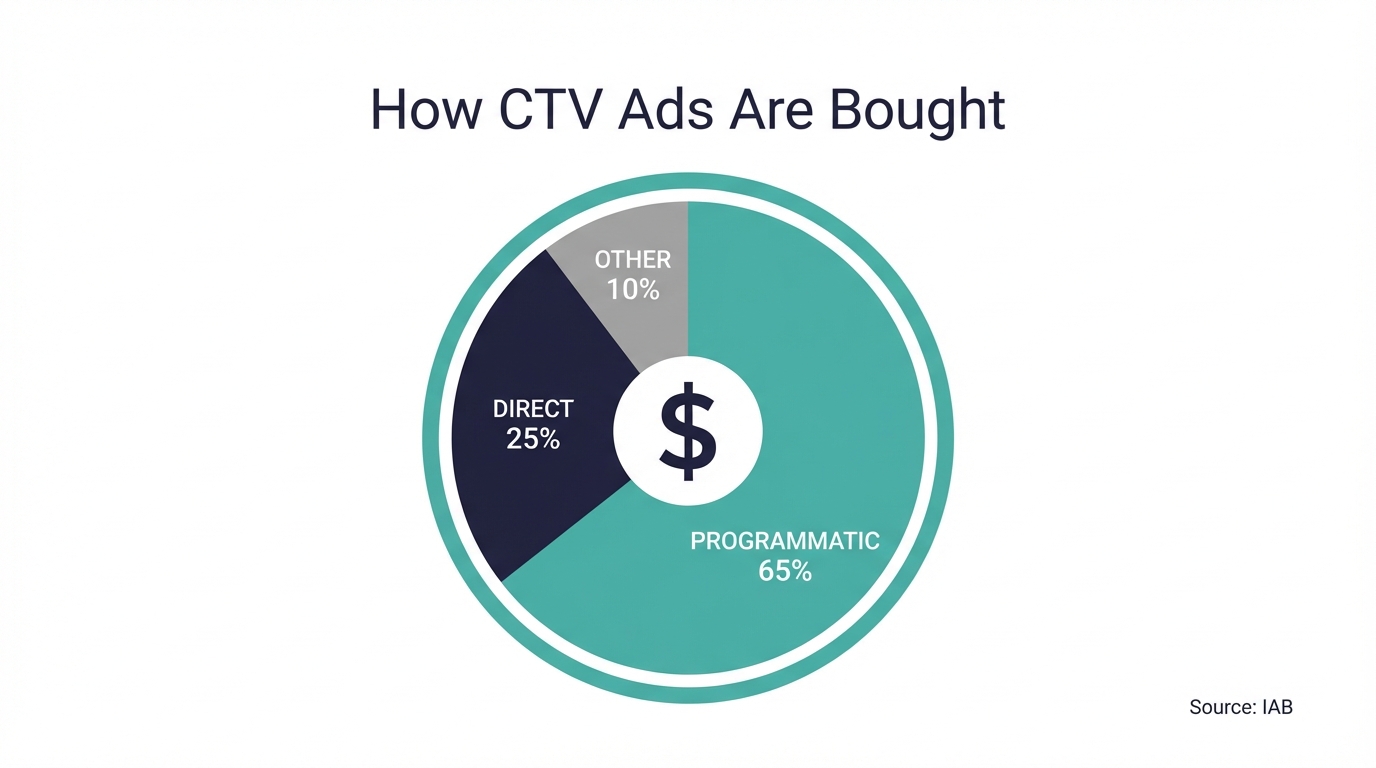
Multiple factors drive growth: continued cord-cutting shifting viewers to streaming, major streaming services launching ad-supported tiers (Netflix, Disney+, Amazon Prime Video), improved measurement and targeting capabilities, and self-serve platforms making CTV accessible to smaller advertisers. The IAB notes that 36% of CTV dollars are reallocated from linear TV and another 36% from social media.
Can small businesses participate in the CTV market?
Yes, self-serve platforms have democratized CTV access. While direct streaming service relationships may require substantial minimums, aggregated platforms like Adwave provide access to premium inventory starting at $50. The IAB specifically notes that "CTV is no longer just for brands with big budgets" due to these accessibility improvements.
Supporting data
Additional statistics that contextualize the CTV advertising market:
Total digital video ad spend in 2024 was $64 billion according to IAB. Projected digital video ad spend in 2025 is $72 billion. Share of total TV/video ad spend going to digital video in 2025 is 60%. CTV year-over-year growth rate in 2024 was 16%. Share of CTV display ad dollars going to video ads is 98.4% per eMarketer. Share of CTV dollars reallocated from linear TV is 36%. Share of CTV dollars reallocated from social media is 36%. Year CTV is projected to surpass traditional TV ad spending is 2028. Current CTV CPM range for small business advertisers is $15-35. Minimum budget to start CTV advertising on platforms like Adwave is $50.
Get started with TV advertising
The CTV advertising market's growth creates opportunity for businesses of all sizes. With accessible entry points, AI-powered creative tools, and sophisticated targeting capabilities, there's never been a better time to test television advertising.
Adwave makes CTV accessible to businesses of all sizes. Create a professional TV commercial in minutes using AI, then launch it across YouTube, Hulu, Peacock, and 100+ premium streaming channels starting at just $50.
No video production experience required. No massive budgets. No agency relationships needed.