
-
90%
U.S. households with CTV devices
-
250M+
CTV viewers in the U.S.
-
43.8%
Streaming's share of TV time (Mar 2025)
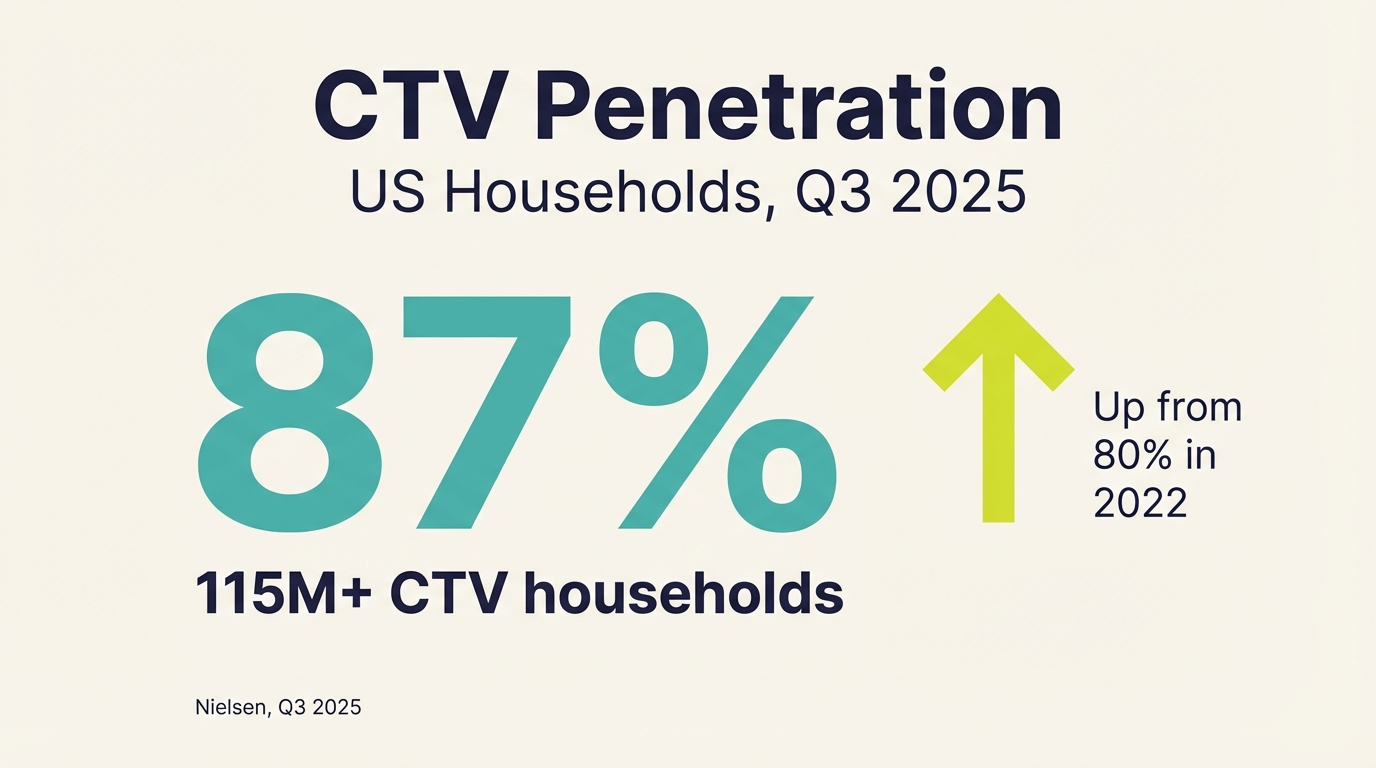
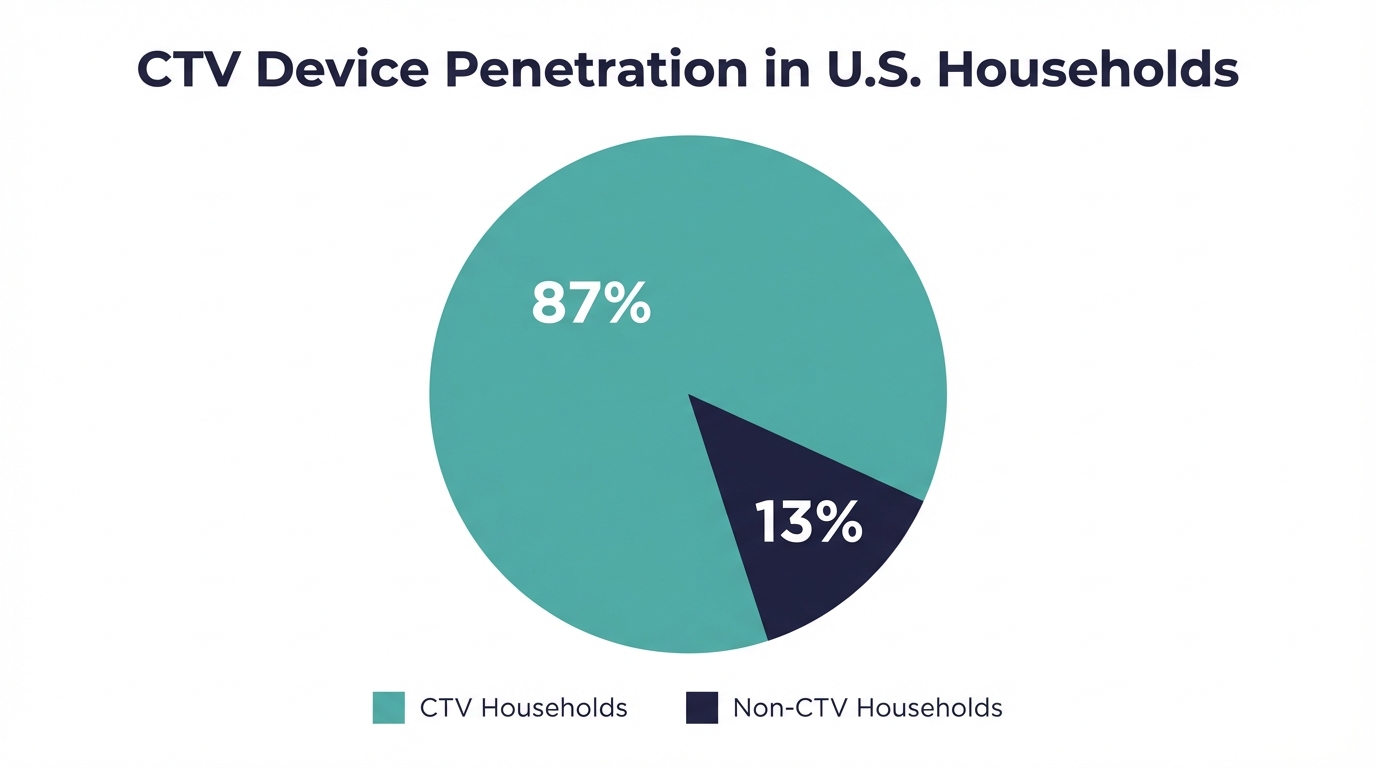
According to MNTN's 2025 CTV statistics, connected TV penetration in the United States hit a record level in 2025, with 90% of households using internet-connected TV devices at least once per month. Over 250 million Americans now watch CTV, and streaming represents 43.8% of all TV viewing time. This near-universal household penetration means CTV advertising can reach virtually any audience in America. For advertisers, the distinction between "TV households" and "streaming households" has essentially disappeared, with streaming TV now the primary viewing method for the majority of television consumption.
Understanding CTV household penetration requires defining what counts as a CTV device. Connected TV includes smart TVs with built-in streaming capabilities, streaming devices like Roku and Amazon Fire TV, gaming consoles used for streaming (PlayStation, Xbox), and internet-connected devices that stream to television screens. The 90% penetration figure represents households with at least one such device, meaning nearly every household with a television has streaming capability. This ubiquity transforms CTV from a niche channel into a mass-market advertising medium.
What the data shows
CTV household penetration metrics demonstrate near-universal streaming access.
Penetration and viewer metrics
Key statistics defining CTV household reach:
90%: U.S. households with CTV devices
250 million+: CTV viewers in the United States
43.8%: Streaming's share of total TV time (March 2025)
38.4%: Cable's share of TV time (March 2025)
Near-universal: CTV access approaching total TV household base
These metrics establish CTV as a mass-reach advertising medium comparable to traditional TV.
Growth trajectory
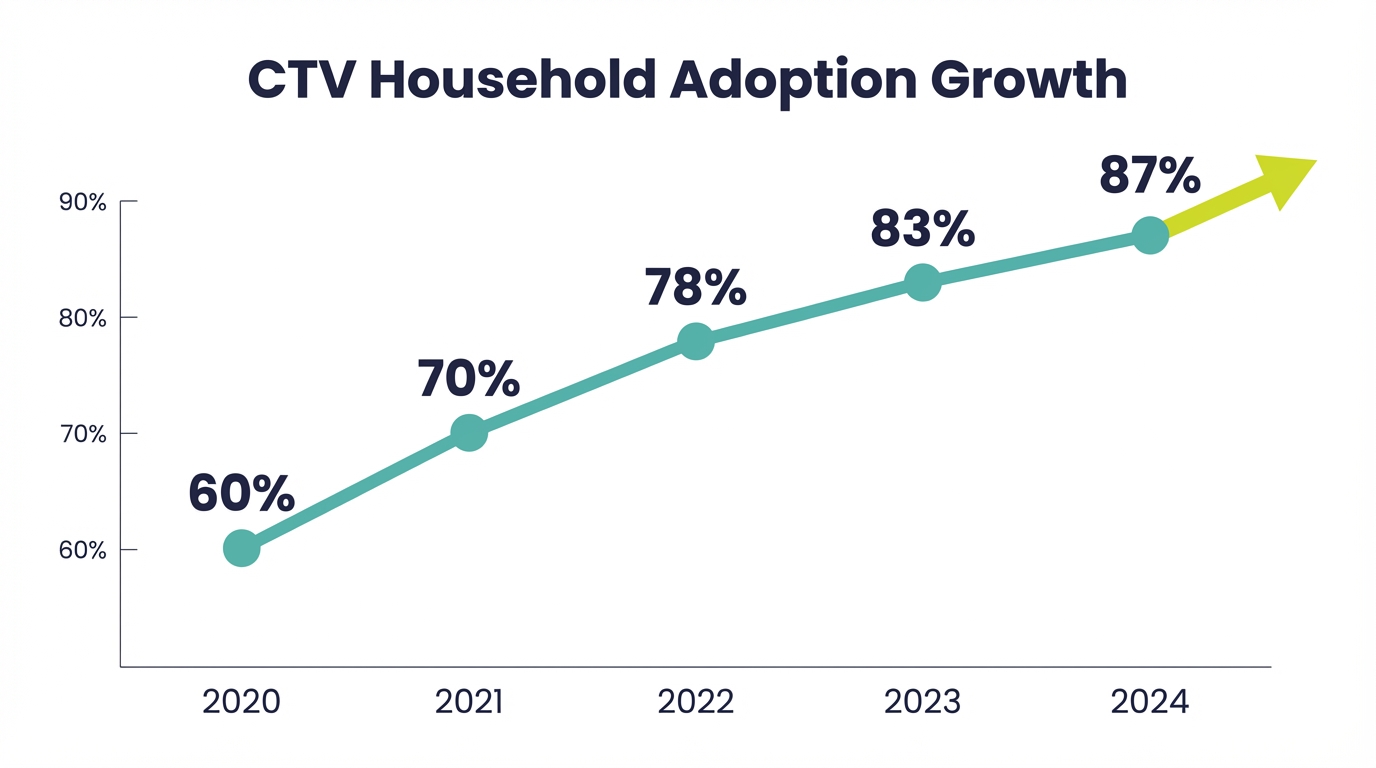
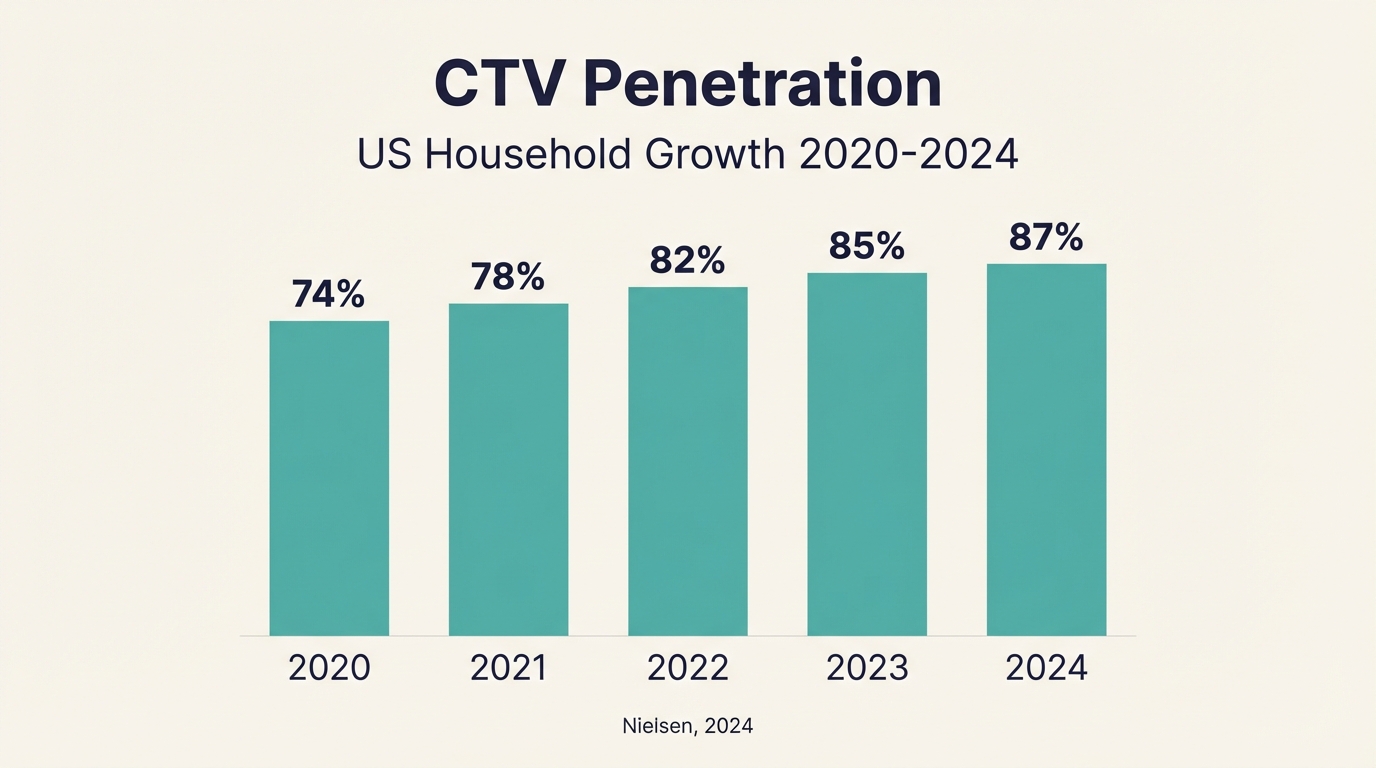
CTV penetration has grown rapidly over recent years:
2018: Approximately 60% household penetration
2020: Approximately 75% household penetration
2022: Approximately 85% household penetration
2025: 90% household penetration
This growth trajectory suggests penetration will approach saturation levels (95%+) in coming years, making CTV effectively universal.
Streaming share trends
Streaming's share of TV viewing continues growing:
43.8%: Current streaming share of TV time
38.4%: Current cable share of TV time
Crossover achieved: Streaming now exceeds cable viewing
Continued growth: Streaming share expected to keep expanding
The streaming share crossover (exceeding cable) represents a fundamental shift in television viewing behavior.
Device penetration breakdown
CTV access comes through multiple device types:
Smart TVs: Primary CTV access point for most households
Roku devices: 90+ million streaming households
Amazon Fire TV: 70+ million active users globally
Gaming consoles: Significant secondary streaming access
Apple TV, Google TV: Smaller but growing user bases
Most households have multiple CTV access points, increasing advertising reach opportunities.
Breaking down the numbers
Understanding what drives CTV penetration reveals the transformation in television consumption.
Smart TV market transformation
Smart TVs have driven CTV penetration to near-universality:
Default connectivity: Nearly all new TVs sold include smart functionality
Price parity: Smart TVs cost essentially the same as non-smart alternatives
Replacement cycle: Old TVs being replaced with smart TVs
Second TV expansion: Additional household TVs increasingly smart-enabled
With smart TVs as the default, CTV penetration grows automatically through normal TV replacement.
Streaming device saturation
Dedicated streaming devices have reached broad adoption:
Roku: Market-leading platform with 90+ million households
Amazon Fire TV: Strong adoption driven by Prime integration
Value pricing: Entry-level devices under $30
Holiday gifting: Streaming devices as common gifts
Multi-room deployment: Secondary devices in bedrooms
Affordable streaming devices closed the gap for households without smart TVs.
Content driving adoption
Streaming content availability drives CTV usage:
Exclusive content: Shows and movies only on streaming
Sports migration: NFL, soccer, Olympics on streaming
Live programming: News and events on streaming platforms
Cord-cutting motivation: Content access without cable subscription
Compelling content provides ongoing motivation for CTV usage beyond just device ownership.
Demographic universality
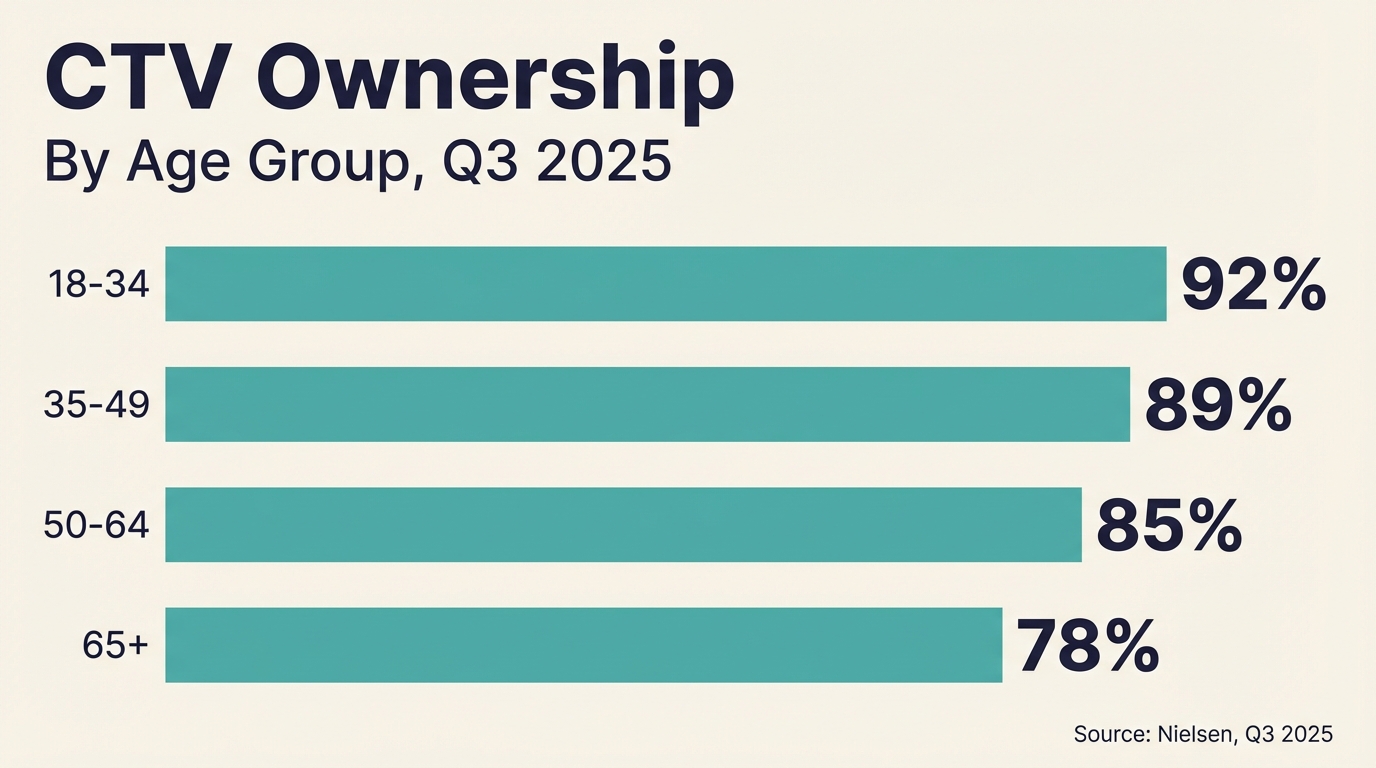
CTV penetration spans all demographic segments:
Age groups: From Gen Z to Boomers using streaming
Income levels: Budget options enable universal access
Geographic: Urban, suburban, and rural adoption
Household types: Families, singles, seniors all using CTV
This demographic universality means CTV advertising can reach any target audience.
Why it matters for your business
90% CTV household penetration transforms streaming from niche to mass-market advertising.
Near-universal reach potential
With 90% household penetration, CTV advertising can reach virtually everyone:
Mass market campaigns: Reach comparable to traditional TV
Demographic targeting: Access all age, income, and geographic segments
No coverage gaps: Nearly every household reachable
Audience scale: 250+ million viewers available
For small business TV advertising, this means streaming provides detailed market coverage.
Streaming exceeds cable viewing
Streaming's 43.8% share exceeding cable's 38.4% creates strategic implications:
Primary medium: Streaming is now the primary TV viewing method
Cord-cutting acceleration: Traditional TV continues declining
Audience migration: Viewers increasingly unreachable through cable
Budget allocation: Streaming should be primary TV investment
Advertisers following audiences must prioritize streaming over traditional TV.
Local and geographic targeting
CTV penetration enables local business advertising at scale:
Geographic precision: Target by DMA, zip code, or radius
Local scale: 90% penetration means large local audiences
No minimum market size: Even small markets have CTV reach
Competitive parity: Local businesses can compete on streaming
For local TV advertising, CTV provides reach that previously required expensive local broadcast.
Accessible to all business sizes
Universal penetration combined with self-serve platforms enables broad access:
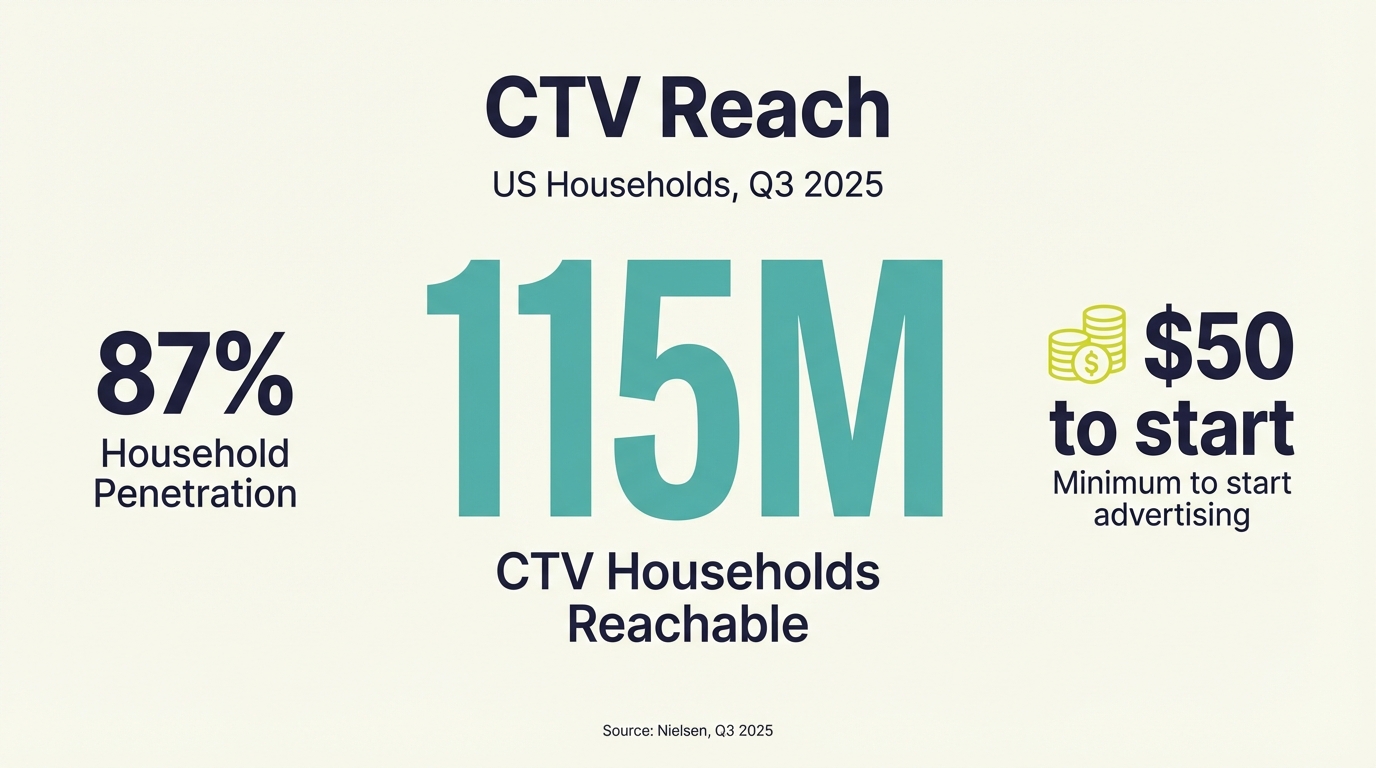
$50 minimums: Low barrier to entry through platforms like Adwave
No market restrictions: Advertise anywhere with CTV households
Scalable budgets: Start small, grow based on results
Professional environment: Big screen, premium content
The combination of universal reach and accessible pricing democratizes TV advertising.
How to take advantage of this trend
Capitalizing on 90% CTV penetration requires strategic approach to platform selection and campaign execution.
Access through aggregated platforms
Self-serve aggregated platforms provide efficient CTV access:
Adwave: $50 minimum, AI creative, 100+ channels
Universal reach: Access all major streaming platforms
Automatic optimization: Platform balances inventory sources
Simple execution: No complex negotiations required
This approach provides detailed CTV reach without complexity.
Plan for mass-market reach
With 90% penetration, CTV can support mass-market advertising strategies:
Broad targeting: Geographic focus with demographic breadth
Reach goals: Achievable at any scale with sufficient budget
Frequency building: Reach same households multiple times
Brand building: Create awareness across broad audiences
CTV's reach capabilities now match traditional TV for mass-market campaigns.
Integrate with existing marketing
CTV penetration enables integration with existing marketing:
Complement digital: CTV awareness supports search and social performance
Replace traditional TV: CTV can serve as primary TV investment
Retargeting: Reach website visitors on their TV screens
Attribution: Track CTV impact on other channels
CTV's scale makes it viable as a major marketing channel, not just a supplement.
Optimize creative for connected TV
CTV viewing typically happens on large screens in living room environments:
Design for big screens: Bold visuals visible at distance
Clear branding: Logo and brand elements prominent
Sound-on environment: Use audio for message delivery
Memorable messaging: Clear calls to action for non-clickable medium
AI creative tools can generate optimized CTV commercials from existing assets.
The bigger picture
90% CTV household penetration reflects fundamental transformation in television consumption.
The streaming television era
CTV penetration confirms television's streaming transformation:
Majority streaming: More TV time on streaming than cable
Universal access: 90% of households stream
Content migration: Programming moving to streaming
Industry restructuring: Networks launching streaming services
The "streaming television era" is no longer emerging; it has arrived.
Implications for traditional TV
Universal CTV penetration affects traditional television:
Audience erosion: Viewers continuing to leave cable/broadcast
Upfront model pressure: Traditional TV advertising model challenged
Sports as anchor: Live sports keeping some traditional TV viewing
Demographic skew: Traditional TV audiences trending older
Advertisers must recognize that traditional TV represents declining share of viewing.
Advertising industry adaptation
The advertising industry continues adapting to CTV reality:
Measurement evolution: CTV measurement maturing
Creative adaptation: Formats and approaches evolving
Budget migration: Ad dollars following viewers to streaming
Platform development: Self-serve tools improving accessibility
This adaptation is ongoing, with continued improvement in CTV advertising capabilities.
Future penetration trajectory
CTV penetration will continue evolving:
Approaching saturation: 90% moving toward 95%+
Multi-CTV households: More devices per household
Quality improvements: Better streaming technology and content
International expansion: Global CTV growth following U.S. pattern
The remaining 10% of households will gradually adopt CTV, approaching true universality.
Common questions answered
What is CTV household penetration?
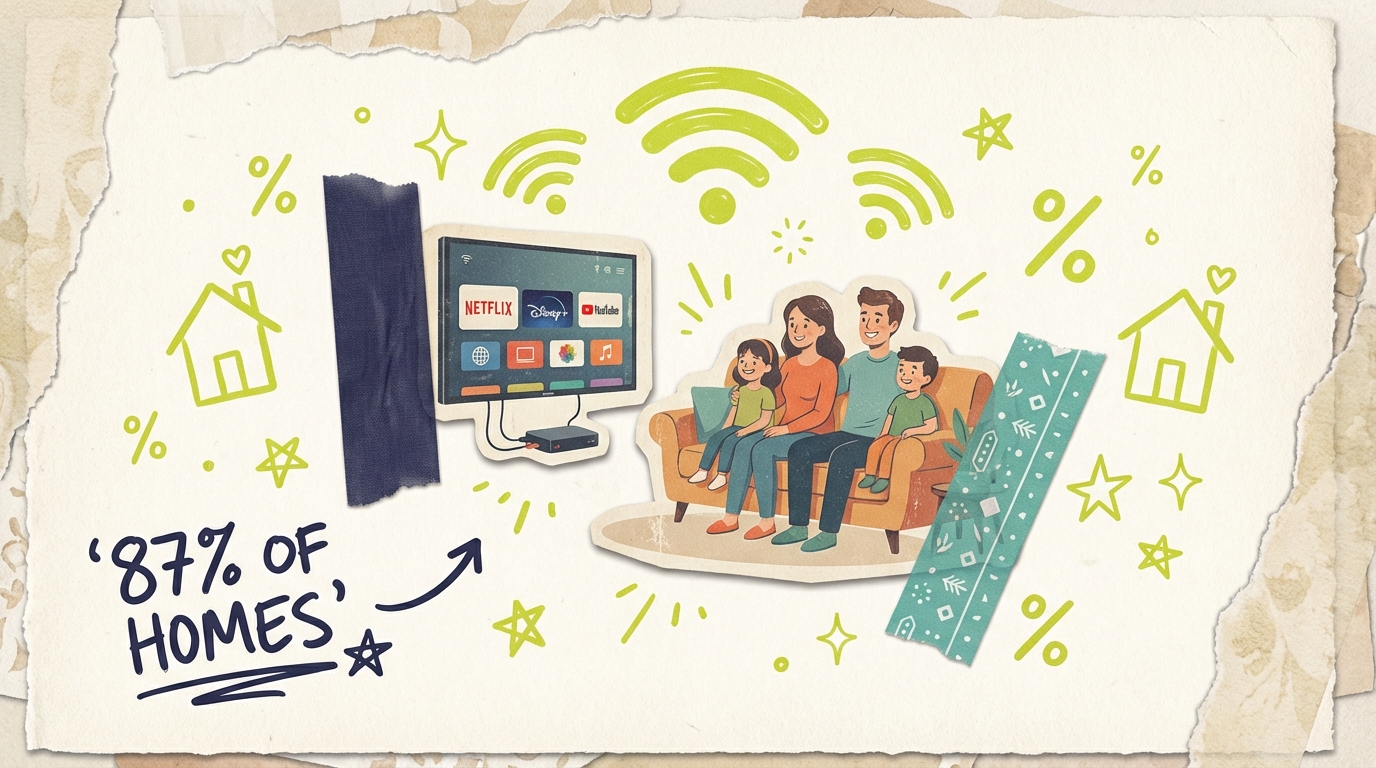
CTV household penetration measures the percentage of U.S. households with connected TV devices (smart TVs, streaming devices, gaming consoles used for streaming). At 90% in 2025, CTV penetration means nearly every household with a television has streaming capability, making CTV advertising a mass-market medium.
How many Americans watch CTV?
Over 250 million Americans watch CTV content, representing the vast majority of the television-viewing population. This figure includes viewers of all ages accessing streaming content through any connected TV device. The scale rivals and exceeds traditional TV audiences.
What percentage of TV viewing is streaming?
Streaming represents 43.8% of total TV viewing time, exceeding cable's 38.4% share. This makes streaming the largest category of television consumption. The streaming share continues growing as viewers shift consumption patterns.
What devices count as CTV?
CTV devices include: smart TVs with built-in streaming apps, streaming devices (Roku, Amazon Fire TV, Apple TV, Google Chromecast), gaming consoles (PlayStation, Xbox) when used for streaming, and any internet-connected device that streams content to a television screen.
Can small businesses reach CTV audiences?
Yes, small businesses can reach CTV audiences through self-serve aggregated platforms like Adwave. These platforms provide access to 100+ streaming channels with low minimums ($50), AI-generated creative, and geographic targeting. No agency relationships or large budgets required.
Supporting data
Additional statistics contextualizing CTV household penetration:
90%: U.S. households with CTV devices
250 million+: CTV viewers in the United States
43.8%: Streaming's share of TV time (March 2025)
38.4%: Cable's share of TV time (March 2025)
90 million: Roku streaming households
70 million+: Amazon Fire TV active users globally
$50: Minimum CTV advertising budget through Adwave
$25: Average CTV CPM for small businesses
100+: Streaming channels available through Adwave
Data sources:
Industry streaming reports
EMarketer projections
Start advertising on CTV
Ready to reach 90% of American households through connected TV? Streaming TV advertising makes it possible to access massive audiences without massive budgets.
Adwave provides access to 100+ streaming channels with campaigns starting at just $50. Create professional TV commercials in minutes using AI, then launch targeted campaigns to streaming audiences.
No production budget needed. No agency fees. No minimum commitments.