
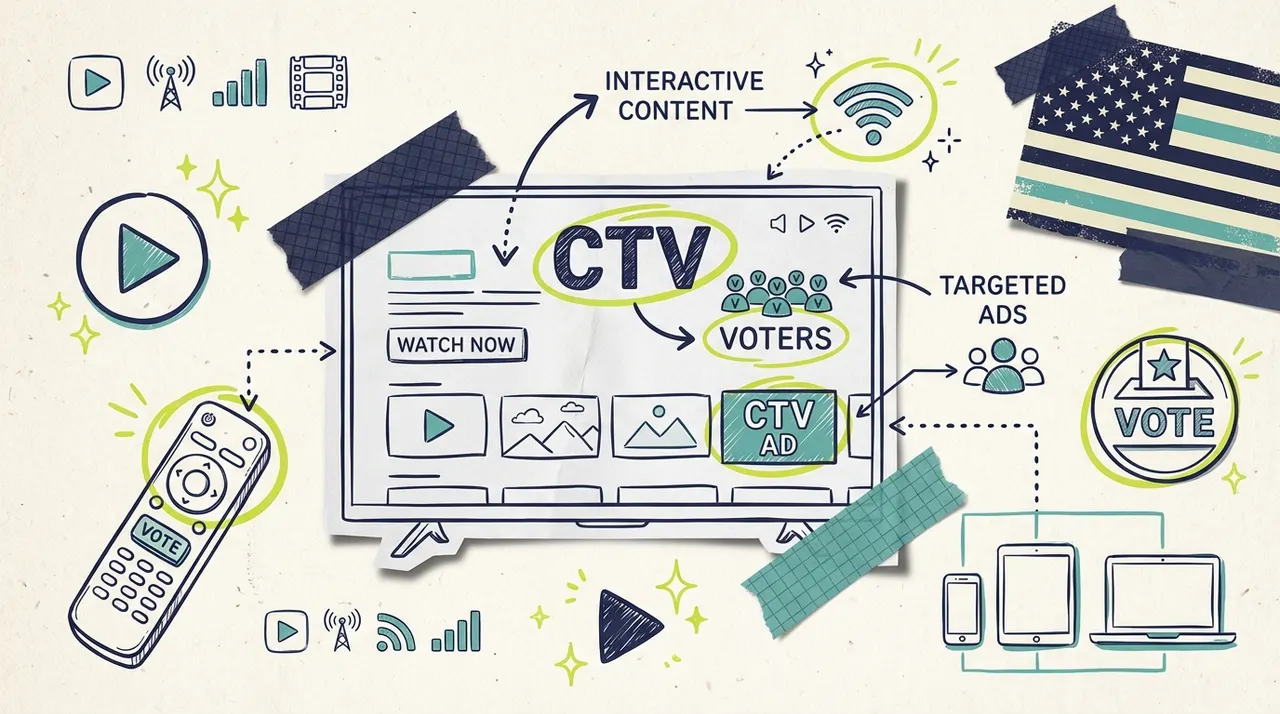
Connected TV has transformed political advertising. Where campaigns once needed six-figure budgets for broadcast TV, CTV makes TV advertising accessible to races from Congress to city council.
Over 88 million U.S. households now stream TV content, according to Nielsen. For political campaigns, this represents a massive audience that traditional broadcast and cable buys increasingly miss. More importantly, CTV offers precision targeting that broadcast TV never could.
This guide covers how political campaigns can use connected TV advertising effectively, from targeting strategies to creative best practices and budget planning.
Why CTV matters for political campaigns
The shift to streaming creates both challenges and opportunities for political advertisers.
The cord-cutting reality
Cord-cutting continues accelerating. eMarketer projects that by 2026:
60% of U.S. households will have cut the cord or never subscribed to pay TV
CTV/streaming will capture 45% of all TV viewing time
73 million households will be "cord-never" (never had traditional pay TV)
For political campaigns, this means broadcast and cable buys alone increasingly miss voters. Younger voters especially live in streaming environments: 79% of adults 18-34 use streaming services as their primary TV source.
The targeting advantage
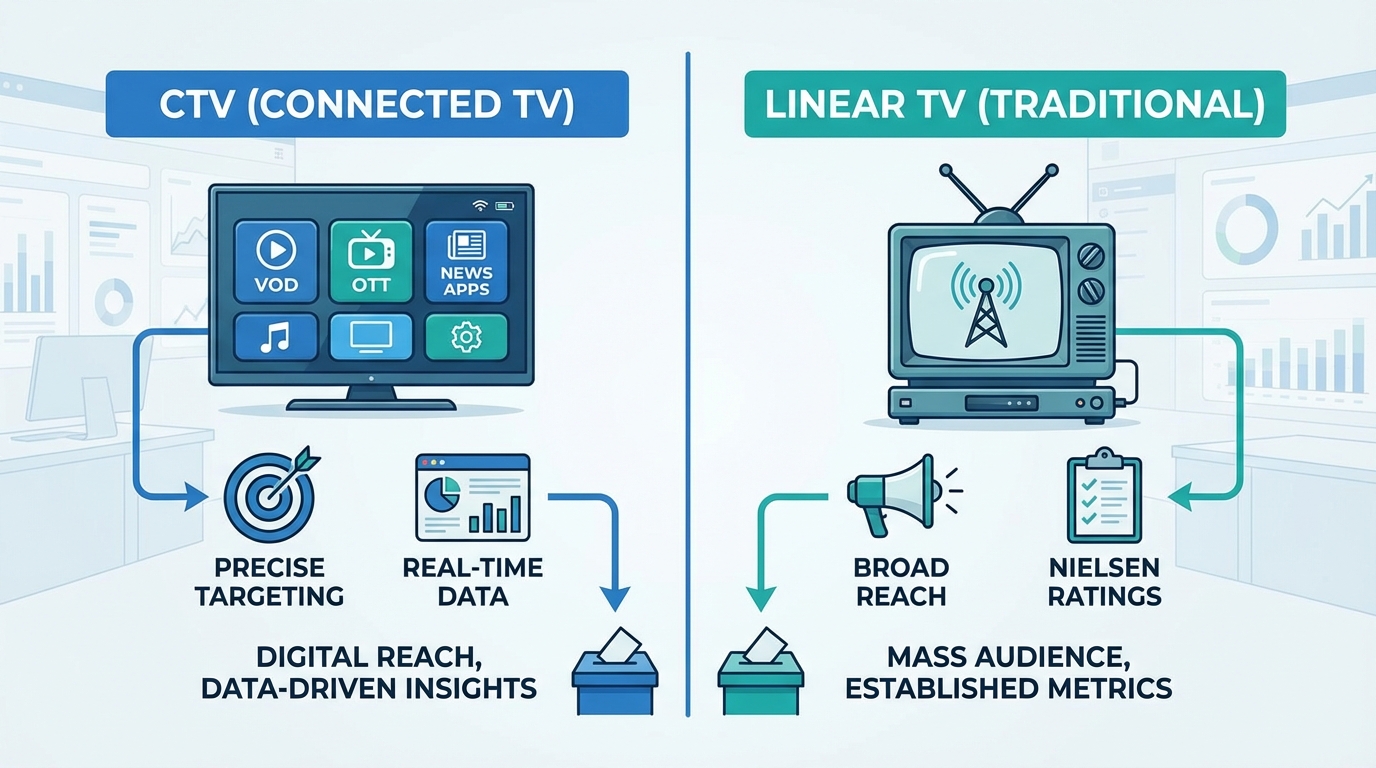
Broadcast TV buys cover designated market areas (DMAs), which rarely align with political districts. A congressional district might span three DMAs, or a DMA might contain five congressional districts.
The result: broadcast TV wastes budget reaching voters outside your race.
CTV changes this equation. District-level targeting ensures your ads reach voters in your specific race. For local and state campaigns, this precision transforms the economics of TV advertising.
Consider a state senate race covering 200,000 households:
Broadcast TV: Buy the entire DMA (1.2 million households), 80% waste
CTV: Target only the 200,000 households in district, zero waste
At similar CPMs, CTV delivers 5x more relevant impressions.
The budget advantage
CTV advertising has no minimums on self-serve platforms. Campaigns can start with $50 and scale based on performance and funds raised.
Traditional TV buying required:
Minimum broadcast TV buys: $5,000-50,000
Agency relationships and fees
Weeks of lead time for placement
Inflexible flight schedules
CTV enables:
Launch campaigns in days, not weeks
Adjust budgets and targeting in real time
Test messages before committing major spend
Start small and scale with fundraising
This flexibility is important for political campaigns where fundraising fluctuates and events require rapid response.
How CTV political advertising works
Understanding the CTV ecosystem helps you make smarter buying decisions.
The CTV supply chain
CTV advertising inventory flows through several layers:
Publishers: The streaming services themselves (Hulu, Peacock, Pluto TV, etc.) that own and distribute content.
Demand-side platforms (DSPs): Technology platforms that let advertisers buy CTV inventory programmatically across multiple publishers.
Supply-side platforms (SSPs): Technology that helps publishers sell their inventory to DSPs and direct buyers.
Self-serve platforms: End-to-end platforms like Adwave that bundle access to inventory, targeting, creative tools, and measurement in one interface.
For most political campaigns, self-serve platforms offer the simplest path to CTV advertising. They handle the complexity of programmatic buying while providing direct access to premium inventory.
Inventory types
Premium/Direct sold: Major streaming services sell inventory directly to large advertisers. Typically requires significant minimum spend ($50,000+) and advance booking.
Programmatic guaranteed: Reserved inventory bought through DSPs with guaranteed delivery. Mid-tier commitment levels.
Private marketplace (PMP): Invitation-only auctions with premium publishers. Better inventory quality than open exchange.
Open exchange: Real-time bidding on available inventory. Most accessible, variable quality.
Self-serve platforms typically aggregate across these inventory types, providing access to premium and programmatic inventory without the complexity of managing multiple buying relationships.
Ad formats
Most CTV political advertising uses these formats:
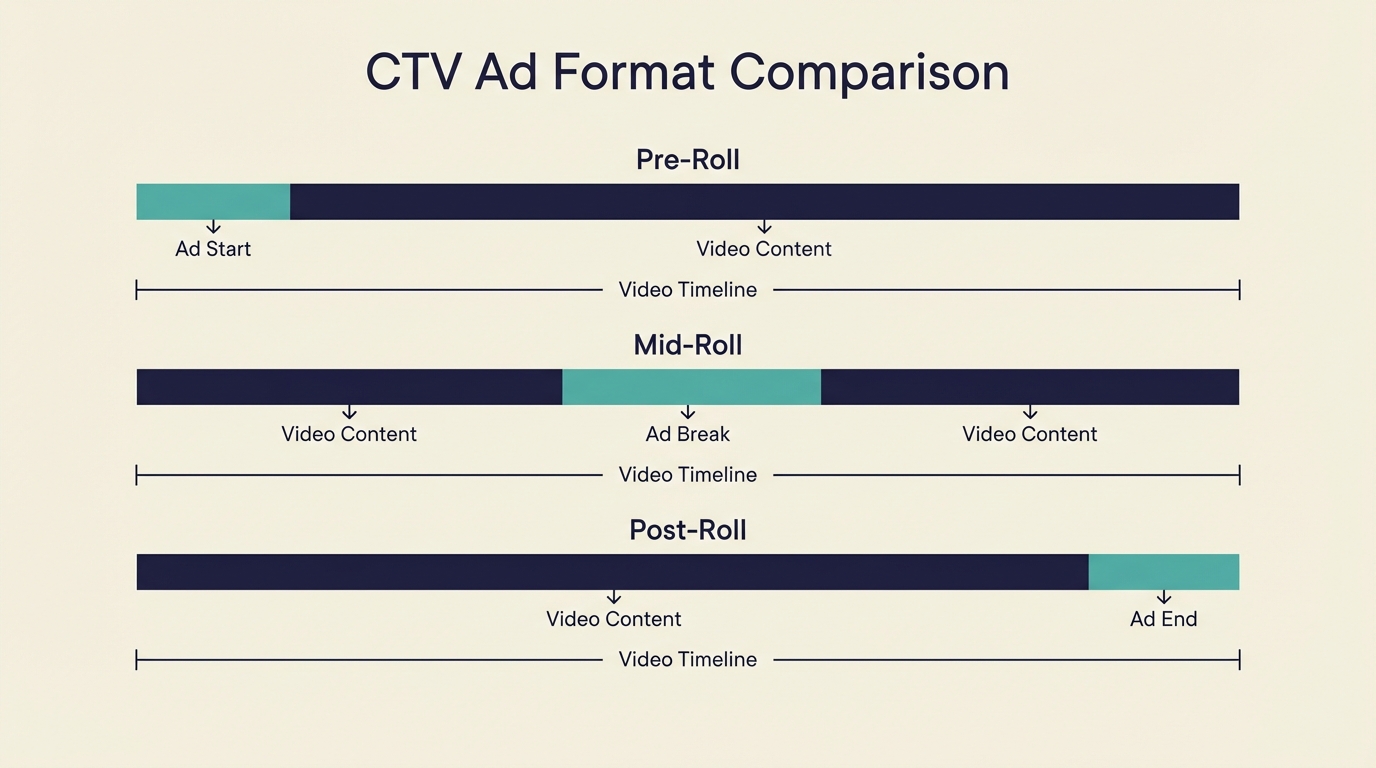
Pre-roll: Ads before content starts (most common for streaming)
Mid-roll: Ads during content breaks (similar to traditional TV commercial breaks)
Post-roll: Ads after content ends (less common, lower completion rates)
Standard political spot lengths work on CTV:
15 seconds: Quick message, high frequency
30 seconds: Standard political spot
60 seconds: Longer-form messaging for complex issues
Non-skippable ads dominate CTV inventory, meaning viewers watch your complete message, a significant advantage over skippable digital video.
Targeting strategies for political CTV
CTV's targeting capabilities give political campaigns unprecedented precision.
Geographic targeting
Congressional districts: Target the exact boundaries of House races, regardless of how they cross DMA lines.
State legislative districts: Reach only voters in your state senate or assembly race.
Municipal boundaries: Target city or county limits for local races.
Custom geography: Draw custom boundaries for irregular districts or split precincts.
Geographic targeting is foundational for political CTV. Every other targeting layer builds on this geographic base.
Demographic targeting
Layer demographic filters on top of geography:
Age: Target likely voters by age cohort (25-34, 35-44, etc.)
Income: Focus on neighborhoods by household income levels
Household composition: Target families, singles, etc.
Language: Reach Spanish-language or other multilingual households
Voter file matching
The most powerful political CTV capability: match your voter files against streaming audiences.
How it works:
Upload your voter file (name, address, other identifiers)
Match to household-level device graphs
Target ads to matched households
Applications:
Persuasion: Target undecided voters identified in polling
Base mobilization: Reach registered supporters with turnout messages
Issue targeting: Find voters who care about specific issues based on survey data
Lapsed voters: Target intermittent voters who skip midterms
Match rates vary by data quality and platform. Expect 50-70% match rates for clean voter files. Political data vendors like L2, TargetSmart, and Data Trust specialize in this matching.
Behavioral and interest targeting
Supplement voter data with behavioral signals:
Content affinity: Viewers of news, sports, specific genres
Purchase behavior: Shopping patterns suggesting political interest
Website visitors: Retarget visitors to campaign websites
For campaigns without robust voter data, behavioral targeting provides a starting point for reaching likely voters.
Targeting best practices
Layer strategically: Combine geography + demographics + voter data for precision without over-narrowing audiences.
Test audience segments: Run small tests with different targeting combinations before major spend.
Balance reach and precision: Hyper-targeting can limit scale. Find the right balance for your race.
Refresh targeting regularly: Update voter file matches and targeting as new data becomes available.
CTV creative for political campaigns
Effective CTV creative differs from digital video in important ways.
The lean-back viewing context
CTV viewers watch on large screens from across the room, often with others present. This "lean-back" context demands different creative approaches than mobile video:
Visual scale: Use larger text, bolder graphics, and simpler visuals that read from 10 feet away.
Audio importance: Sound is always on (unlike social video), so audio matters. Use clear narration and impactful music.
Attention span: Viewers are more relaxed and attentive than on mobile. You have time to tell a story.
Social viewing: Multiple people often watch together. Content may spark conversation.
Political creative best practices
Clear identification: Open with candidate name/race. Viewers should know who's speaking in seconds.
Single message focus: One clear message per spot. Don't try to cover your entire platform in 30 seconds.
Emotional connection: TV excels at emotional storytelling. Use the medium for impact, not information dumps.
Strong close: End with clear candidate branding and a takeaway message.
Compliant disclosures: Include required "Paid for by" disclosures. CTV ads need the same disclaimers as broadcast.
Production considerations
Political CTV ads don't require broadcast-level production budgets:
Quality threshold: CTV ads should look professional but don't need Hollywood production. Clean audio, stable video, and proper lighting suffice.
Resolution: 1080p minimum (1920x1080). 4K helpful but not essential.
Aspect ratio: 16:9 standard for TV screens.
File formats: Most platforms accept MP4 with H.264 encoding.
AI video creation tools have lowered production costs dramatically. Platforms like Adwave include AI-powered creative tools that generate professional political ads from photos, scripts, and campaign materials.
A/B testing creative
CTV platforms enable creative testing that broadcast never could:
Version testing: Run multiple ad versions simultaneously to identify top performers.
Message testing: Test different issue angles to find resonant messages.
Audience response: Compare creative performance across different audience segments.
Rapid iteration: Update creative based on performance data without reprinting tapes or renegotiating placements.
Allocate 10-20% of budget to creative testing, especially early in campaigns when early results can inform larger buys.
Budgeting and pricing
Understanding CTV pricing helps set realistic campaign budgets.
How CTV pricing works
CTV advertising uses cost-per-thousand (CPM) pricing. You pay for impressions delivered to targeted households.
2026 political CTV CPM ranges:
Premium inventory (Hulu, Peacock, direct): $30-50 CPM
Mid-tier inventory (Roku, Samsung TV+): $20-35 CPM
FAST channels (Tubi, Pluto): $12-25 CPM
Programmatic mix: $20-35 CPM
Political premiums apply during peak election windows. Expect 20-40% higher CPMs in October compared to February.
Budget planning by race type
Congressional/Senate races:
Statewide and district races require substantial reach. Budget recommendations:
Total CTV budget: $100,000-1,000,000+
Flight timing: Heavy up in final 8 weeks
Geographic focus: Primary markets in district
Frequency goal: 10-15+ impressions per household
State legislative races:
Smaller districts allow efficient targeting:
Total CTV budget: $15,000-100,000
Flight timing: Final 6-8 weeks
Geographic focus: District-only targeting
Frequency goal: 8-12 impressions per household
Local races (city, county, school board):
Hyper-local targeting maximizes small budgets:
Total CTV budget: $3,000-25,000
Flight timing: Final 4-6 weeks
Geographic focus: Municipal boundaries
Frequency goal: 6-10 impressions per household
For local campaigns, CTV advertising often delivers better value than any other TV option.
ROI calculation example
A state senate race with 150,000 households in district:
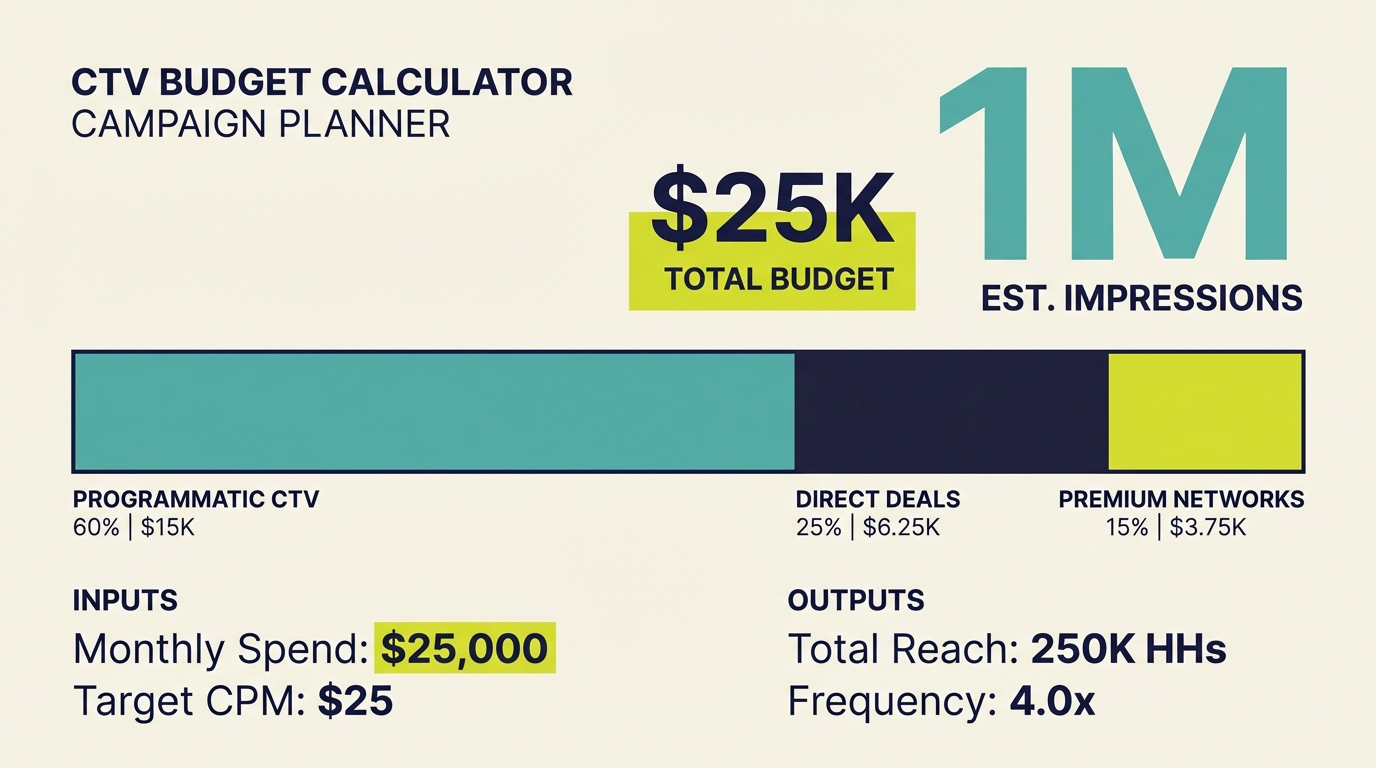
Budget: $25,000 CTV spend
CPM: $25 average
Impressions: 1,000,000 (25,000 / 25 × 1,000)
Frequency: 6.7 impressions per household (1,000,000 / 150,000)
Cost per household reached: $0.17
Compare to broadcast TV in the same market at $8,000 per spot reaching 500,000 households (only 30% in district):
In-district impressions per spot: 150,000
Spots affordable: 3 spots ($24,000)
Total in-district impressions: 450,000
Frequency: 3.0 impressions per household
Cost per in-district impression: $0.053
CTV delivers 2.2x the frequency at a similar budget due to targeting efficiency.
Compliance and disclosures
Political CTV advertising faces regulatory requirements campaigns must follow.
FCC and FTC requirements
While the FCC's lowest unit rate doesn't apply to streaming (only broadcast), other regulations do:
Sponsor identification: All political ads must identify who paid for them. "Paid for by [Committee Name]" disclosures are required.
Truthfulness: False statements about opponents can expose campaigns to legal liability. Fact-check claims before airing.
Record keeping: Maintain records of ad content, spend, and targeting for potential audits.
Platform policies
Streaming platforms have their own political advertising policies:
Verification requirements: Most platforms require advertiser verification for political content. Complete verification early, it can take days or weeks.
Content restrictions: Some platforms limit certain political content (issue advertising, attack ads) or require additional review.
Targeting limitations: Some platforms restrict voter file matching or certain demographic targeting for political ads.
Advance submission: Plan for creative review periods of 24-72 hours.
Work with platforms or self-serve providers who specialize in political advertising. They navigate compliance requirements and expedite approvals.
State-level requirements
Many states have additional disclosure requirements:
Disclosure text formatting and size
Filing requirements for ad spending
Content restrictions specific to state elections
Consult election law counsel to ensure compliance with applicable state regulations.
Measuring CTV campaign performance
CTV offers measurement capabilities that broadcast TV lacks.
Core metrics
Impressions: Total ad views delivered
Completion rate: Percentage of ads watched to completion (typically 90%+ on CTV)
Reach: Unique households exposed to ads
Frequency: Average impressions per household
CPM: Cost efficiency of delivery
Advanced measurement
Tune-in attribution: Did viewers exposed to your ads tune in to debates or events?
Website lift: Traffic increases to campaign websites from CTV-exposed households
Search lift: Increases in searches for candidate names after CTV exposure
Survey-based measurement: Track message recall, favorability, and vote intent among exposed vs. unexposed voters
Reporting frequency
CTV platforms provide real-time or next-day reporting. Review performance:
Daily during heavy flights: Check delivery pacing and adjust
Weekly for optimization: Shift budget to top-performing targeting, creative, inventory
End of flight: Full analysis for future planning
Integration with overall media strategy
CTV works best as part of a coordinated media plan.
CTV + broadcast integration
For campaigns with budget for both:
Use CTV to fill broadcast gaps: Reach cord-cutters broadcast misses
Use broadcast for massive reach: Important events, final push
Coordinate messaging: Consistent message across both channels
Manage frequency holistically: Avoid oversaturation by coordinating reach
CTV + digital integration
CTV and digital video should complement each other:
Sequential messaging: CTV for awareness, digital for deeper engagement
Cross-device retargeting: Retarget CTV viewers on mobile/desktop
Attribution: Measure how CTV exposure affects digital engagement
CTV + direct mail coordination
For persuasion campaigns:
Matched audiences: Target the same households on CTV and mail
Sequential timing: Mail arrives after CTV exposure for reinforcement
Testing: Compare performance of CTV-only vs. CTV+mail audiences
Getting started with political CTV
Pre-launch checklist
Define geographic targeting - Know your district boundaries
Prepare voter data - Clean voter files for matching
Set budget and timeline - Determine spend and flight dates
Create ad content - Produce or generate video creative
Complete verification - Register with platforms for political ads
Plan measurement - Define success metrics and reporting needs
Platform selection
For most political campaigns, self-serve platforms offer the best combination of access, efficiency, and simplicity.
Look for platforms that offer:
Political advertising expertise
District-level geographic targeting
Voter file matching capabilities
AI creative tools (for campaigns without production resources)
Transparent pricing without hidden fees
Responsive support for campaign timelines
Platforms like Adwave specialize in making CTV accessible to political campaigns of all sizes.
Launch timeline
8-12 weeks before election:
Complete platform verification
Finalize targeting strategy
Begin creative production
Launch initial test flights
4-8 weeks before election:
Scale successful campaigns
Introduce new creative variations
Optimize based on performance data
Final 4 weeks:
Maximum media weight
Turnout-focused messaging
Daily performance monitoring
Rapid creative updates if needed
Common questions
How much does CTV political advertising cost?
CTV political advertising typically costs $20-35 CPM for programmatic inventory, with premium inventory at $30-50 CPM. At $25 CPM, a $5,000 budget delivers 200,000 impressions. Self-serve platforms like Adwave have no minimum spend, allowing campaigns to start at $50 and scale based on performance and fundraising.
Can small campaigns afford CTV advertising?
Yes. CTV's lack of minimum spend requirements and precise targeting make it accessible to campaigns of all sizes. A city council campaign can run effective CTV advertising for $3,000-5,000 by targeting only their district. This is often more cost-effective than direct mail or digital advertising for TV-quality creative delivery.
How does CTV targeting compare to broadcast TV?
CTV offers dramatically more precise targeting than broadcast TV. Broadcast buys cover entire DMAs (designated market areas), often reaching millions of households outside your district. CTV enables congressional district, state legislative district, or even municipal boundary targeting. This precision eliminates wasted spend on non-voters.
Do I need professional video production for CTV ads?
Not necessarily. While professional production is ideal, AI video creation tools have made quality political ads accessible without production budgets. Platforms like Adwave include AI creative tools that generate professional-quality spots from photos, scripts, and campaign materials. The key is clear audio, stable video, and a focused message.
How do I target specific voters on CTV?
Upload your voter file to platforms that support voter file matching. The platform matches voter data (name, address) against household device graphs to identify streaming households. Match rates typically range 50-70% for clean voter files. You can then target ads specifically to these matched households for persuasion or turnout campaigns.
What disclosures are required for political CTV ads?
Political CTV ads require "Paid for by" disclosures identifying the sponsoring committee, similar to broadcast TV requirements. Some states have additional disclosure requirements. Platforms may also require advertiser verification before approving political content. Complete verification early as it can take several days.
CTV vs. other political advertising channels
How does CTV compare to other advertising options for political campaigns?
CTV vs. broadcast TV
CTV advantages:
Precise geographic targeting (district vs. DMA)
No minimum spend requirements
Real-time performance data
Faster launch times
Reaching cord-cutters
Broadcast advantages:
Massive reach for large campaigns
Lowest unit rate savings for federal candidates
Older voter demographics
Established media buyer relationships
Best for: CTV works best for local and state races, and for reaching younger voters. Broadcast works best for statewide and federal races with large budgets.
CTV vs. digital video (YouTube, Meta)
CTV advantages:
Premium viewing environment (TV screen vs. phone)
Non-skippable inventory (complete message delivery)
Higher attention and recall
Less ad clutter
Digital advantages:
Lower CPMs
Click-through capability
More targeting options
Easier frequency control
Best for: Use CTV for awareness and persuasion (TV-quality impact). Use digital video for frequency and direct response (website visits, donations).
CTV vs. direct mail
CTV advantages:
Video storytelling capability
Faster production timelines
Real-time tracking
Better for emotional appeals
Direct mail advantages:
Physical presence in home
Longer consideration time
Better for detailed policy content
High delivery certainty
Best for: Combine both for maximum impact. CTV builds awareness; mail reinforces with detail.
Start your CTV campaign today
CTV advertising has democratized TV for political campaigns. Whether you're running for Congress or school board, streaming TV offers a path to reach voters that was simply unavailable five years ago.
The technology handles the complexity. Your job is the message.


