
-
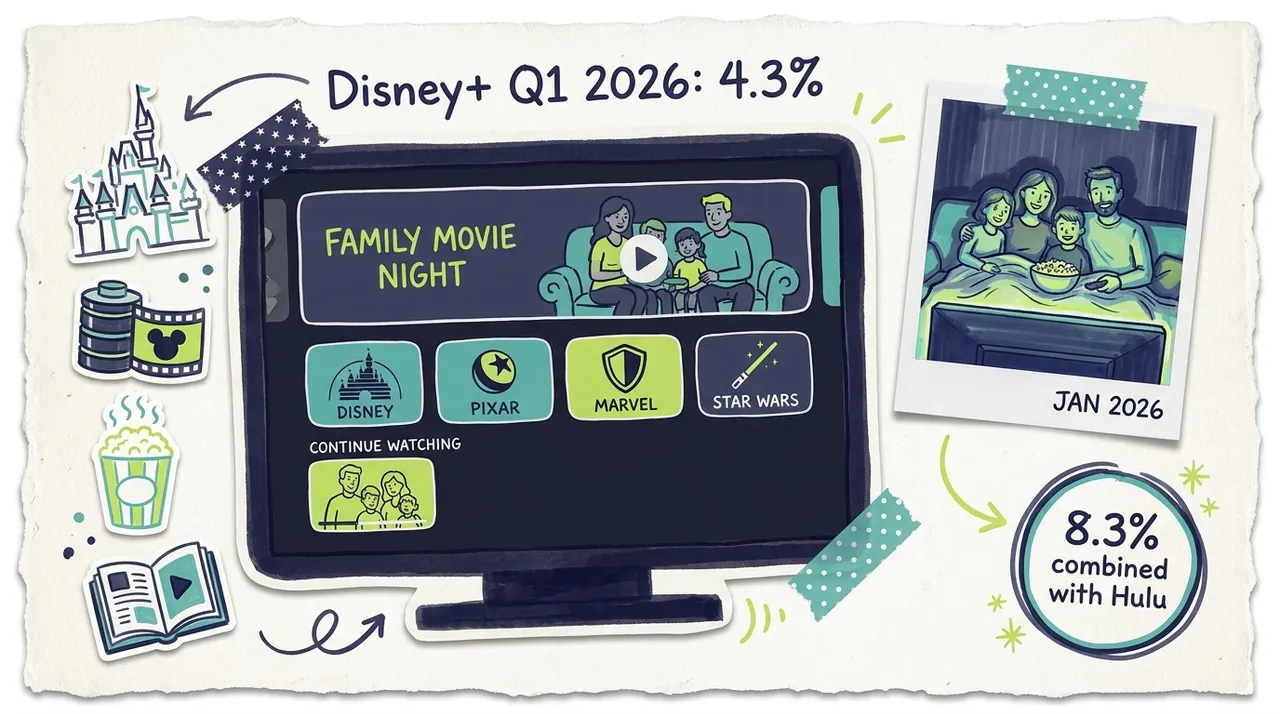
4.3%
Disney+ share of U.S. TV viewing (Jan 2026)
-
8.3%
Disney combined (Disney+ and Hulu) share
-
#3
Disney rank among U.S. media distributors
Disney had a strong start to 2026 in Nielsen's monthly Gauge reports. Nielsen's January 2026 Media Distributor Gauge described Disney as having "the best performance in a year" among major media companies. In February 2026, Disney held 5.0% of total U.S. TV viewing as an individual platform share per Nielsen's February Gauge, continuing steady performance.
For small business advertisers, Disney's streaming ecosystem (Disney+ plus Hulu, with ESPN+ integrated) offers one of the most flexible family-targeting advertising environments available. This post summarizes what Nielsen reported for Disney's streaming performance in Q1 2026 and translates the data into practical implications for local advertisers.
What the data shows
Based on Nielsen's publicly released Q1 2026 Gauge data:
Disney individual platform share, February 2026: 5.0% of total U.S. TV viewing (Nielsen's February Gauge)
Nielsen's January 2026 Media Distributor Gauge commentary: Disney scored its best performance in a year, driven by strong performance across its streaming services
Total streaming share, January 2026: 47.0% (Nielsen, record high)
Total streaming share, February 2026: 41.9% (Nielsen, event-driven pullback due to Super Bowl and Olympics on NBC)
March 2026 Gauge release: Delayed by Nielsen per MediaPost, March 20, 2026
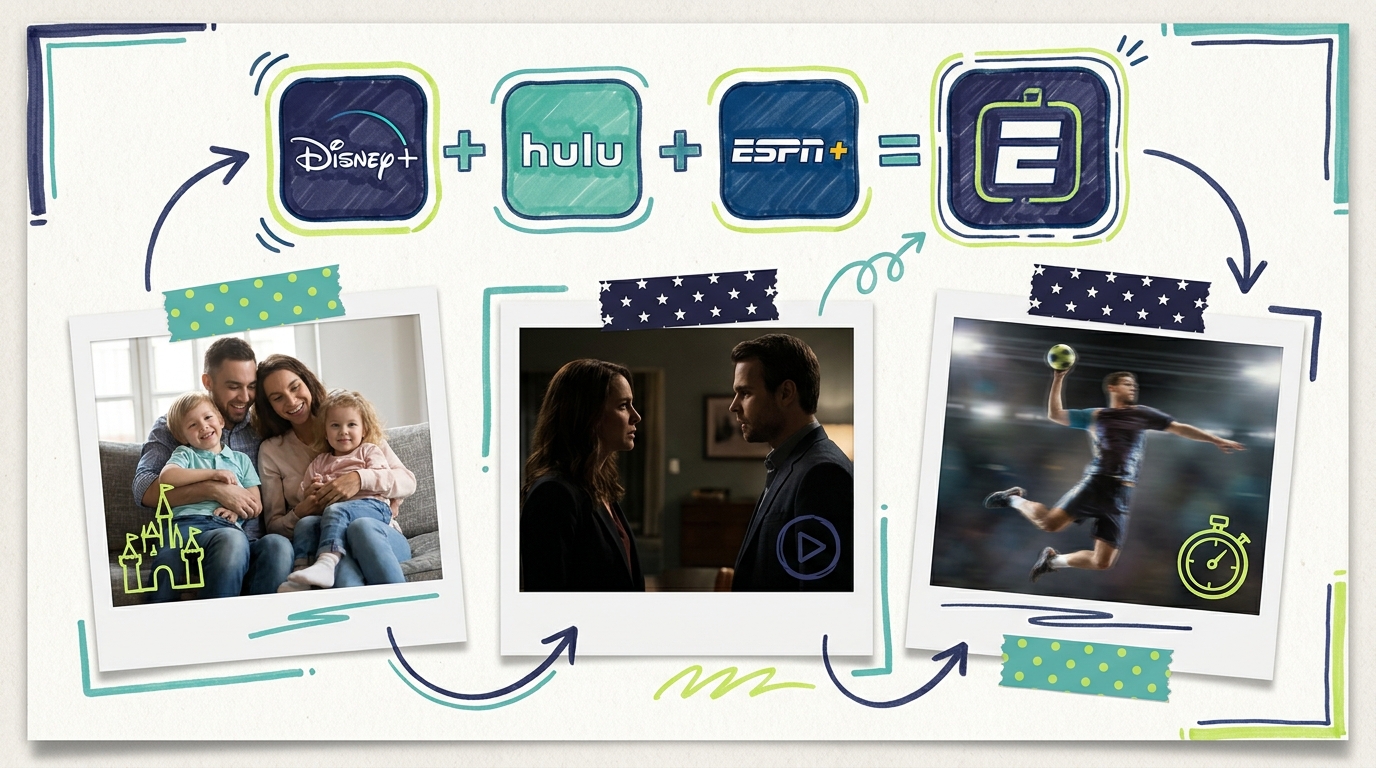
Disney owns three streaming services that frequently appear in TV viewing share reporting: Disney+ (family-focused), Hulu (adult general entertainment), and ESPN+ (sports). Nielsen typically reports on Disney+ and Hulu individually within The Gauge and combines them under Disney in the Media Distributor Gauge. ESPN+ content is increasingly integrated into Disney+.
Disney also owns ABC (broadcast) and multiple cable networks. Those are not part of Disney's streaming share figures in The Gauge, though they contribute to Disney's total company presence in TV viewing.
Disney's streaming strategy in context
Disney's current streaming position is the result of a multi-year strategic pivot that started before Disney+ launched in November 2019. Several milestones shaped Disney's streaming ecosystem:
2019: Disney+ launches. The platform debuted on November 12, 2019 with Disney's animation library, Marvel, Star Wars, Pixar, and National Geographic content. Disney+ grew rapidly in its first two years, reaching subscriber milestones faster than any major streaming predecessor.
2019-2020: Hulu integration begins. Disney had acquired majority ownership of Hulu through its purchase of 21st Century Fox assets in 2019. Disney immediately began positioning Hulu as the adult-entertainment complement to Disney+'s family positioning.
2022 (December): Disney+ launches ad-supported tier. The Basic with Ads plan made Disney+ ad inventory commercially available. This followed Netflix's November 2022 ad tier launch and marked Disney+'s transition from subscription-only to hybrid.
2024: Disney completes full Hulu ownership. Disney bought out Comcast's remaining minority stake in Hulu in 2024, giving Disney full ownership of the platform. This simplified Disney's ability to bundle Disney+ and Hulu.
2025: ESPN direct-to-consumer expansion. ESPN's direct-to-consumer streaming service launched in 2025, giving sports fans a standalone streaming option outside of traditional cable bundles. ESPN content increasingly appears within Disney+ as well.
The cumulative result is a streaming ecosystem that covers family (Disney+), adult entertainment (Hulu), and sports (ESPN+) through a coordinated set of services that Disney sells as a bundle. That ecosystem structure is what drives Disney's strong consolidated Media Distributor Gauge performance.
Why Disney+ matters for your business
Disney+'s streaming share has specific characteristics that differentiate it from other streaming platforms.
First, Disney+ is the cleanest family-targeting streaming environment available. The platform's content (Disney animation, Pixar, Marvel, Star Wars, National Geographic) draws disproportionate viewing from households with children. For advertisers targeting parents or families with kids, Disney+ delivers audience concentration that other platforms don't match.
Second, Disney's bundle strategy provides broader audience reach. When advertisers buy Disney streaming inventory, they typically get access across Disney+, Hulu, and ESPN+. The family audience (Disney+), adult general entertainment audience (Hulu), and sports audience (ESPN+) together cover most household video preferences.
Third, Disney+ advertising inventory is brand-safe by design. Disney maintains strict content standards. Ad adjacency is carefully managed. For brand-conscious advertisers, Disney+ is among the safest CTV environments available.
Fourth, Disney+'s ad-supported tier (launched December 2022) has reached mainstream scale. Inventory is accessible through Disney's ad sales team and through bundled CTV platforms. Local advertisers can access Disney+ as part of multi-platform streaming campaigns.
How to access Disney+ advertising
Disney+ advertising is available through multiple buying channels:
Disney Advertising direct sales. Disney operates a unified ad sales organization that covers Disney+, Hulu, ESPN+, ABC, and Disney's cable networks. Direct buys generally require larger budgets (typically starting in the $25,000-$50,000 range per campaign) and negotiated terms. Direct buying is typical for large brands that want specific targeting, content adjacencies, or integration opportunities.
Disney Ad Server. Disney's self-serve ad platform has expanded over time to allow more advertisers to access Disney inventory programmatically. Minimum commitments are lower than direct sales, though still above typical small business entry points.
Programmatic through major DSPs. Disney streaming inventory is available through major demand-side platforms (The Trade Desk, Google DV360, etc.). Advertisers with DSP expertise can bid on Disney placements programmatically.
Bundled CTV platforms. For small businesses, the most accessible path is through third-party CTV platforms that aggregate Disney+ and Hulu inventory alongside other streaming services. These platforms lower the entry point significantly, making Disney accessible for campaigns starting at $500-$1,000 per month.
For most local small business advertisers, the bundled CTV route is the practical starting point. It provides Disney+ and Hulu exposure alongside other major streaming platforms through a single self-serve interface.
Creative considerations for Disney+ advertising
Disney+'s content environment has specific characteristics that affect creative performance:
Brand-safe content standards. Disney maintains strict content guidelines across Disney+ programming. Ad creative that doesn't fit the premium family-friendly environment stands out negatively.
Production values matter. Disney+ viewers are accustomed to Disney, Pixar, and Marvel production quality. Lower-budget creative can feel out of place.
15 and 30-second standard formats. Most Disney+ inventory runs in these lengths. Format specs are consistent with broader CTV standards.
Family-appropriate messaging. Disney+ ad standards restrict certain content categories (gambling, alcohol restrictions vary by content context, adult themes generally prohibited). Check Disney Advertising's current policy requirements before producing creative.
Sound-on viewing. Disney+ viewers watch on TV screens with sound enabled. Audio quality matters.
For small businesses without cinematic production budgets, AI-powered ad generation tools can produce polished creative that meets Disney+'s quality bar. The same 30-second spots that work for premium streaming broadly also generally fit Disney+'s environment.
How to take advantage
Include Disney+ for family-targeted campaigns. If your customer base includes parents with kids, Disney+ deserves a line item.
Use the Disney streaming bundle for broader reach. Buys across Disney+, Hulu, and ESPN+ reach different audience segments within the same household.
Target content adjacency where available. Disney's ad platform supports targeting by franchise (Marvel, Star Wars, Pixar) and by content type.
Match creative to premium content environment. Disney+'s ad environment rewards polished, cinematic creative.
Measure brand impact, not clicks. Disney+ viewers don't click through. Track brand search volume, website traffic, and downstream conversion.
Measuring Disney+ campaign performance
Disney+ advertising measurement includes several useful metrics:
Reach and frequency: How many unique households saw your ad and how many times. Disney+'s tighter ad-load caps compared to some platforms mean frequency build takes longer.
Video completion rate (VTR): Disney+ ads are typically non-skippable, so VTR is generally very high. Small variations in VTR between campaigns are usually not meaningful differentiators.
Brand lift measurement: Disney Advertising offers brand lift studies for larger campaigns that measure changes in awareness, consideration, or favorability.
Downstream attribution: Website visits, branded search volume, foot traffic, or sales among households exposed to your ad. Can be tracked via pixels, data clean rooms, or third-party attribution services.
Content-adjacency reporting: Understanding which specific content your ads ran against can inform future buying decisions.
For small business Disney+ campaigns, start with reach, frequency, and branded-search lift as baseline metrics. Allow 30-60 days before drawing conclusions about campaign performance.
The bigger picture
Disney's streaming position in Q1 2026 reflects a multi-year strategic pivot that has successfully transitioned Disney from a legacy broadcast and cable company into a top-tier streaming operator. Disney+ launched in November 2019 and reached 100+ million subscribers within two years. Disney acquired full control of Hulu (having previously held majority ownership through the Fox acquisition) in 2024. ESPN continues its streaming transition with direct-to-consumer initiatives.
The corporate context matters for advertisers. Disney's streaming segment has become a strategic priority for the company. Investment in content, advertising technology, and measurement capabilities has increased through 2024 and 2025. Industry analysts generally expect Disney to continue growing streaming share gradually.
eMarketer's December 2025 forecast projects U.S. CTV advertising spending to reach $37.95 billion in 2026, up 14.5% year-over-year. Disney's combined streaming services are expected to capture a meaningful share of that CTV ad revenue growth.
What this data doesn't tell you
Nielsen's Disney figures are useful directional signals, but they have limits:
Disney share is a composite. The 5.0% individual platform share combines Disney+ and closely-related properties. The 8.3% combined figure adds Hulu. Different aggregation conventions produce different numbers.
Family audience varies by content cycle. A month with a major Marvel or Star Wars release looks different than a month without. Content scheduling affects monthly share.
Ad-tier audience composition differs from total Disney+ audience. Ad-supported subscribers may skew differently than premium-tier subscribers. Advertisers should think about which subscription tier their target audience occupies.
ESPN+ integration is ongoing. How ESPN+ content and viewing are reported within Disney's streaming metrics continues to evolve as the platforms integrate.
Advertisers should use Disney's Nielsen figures as directional and request specific inventory and audience data from Disney Advertising or their bundled CTV platform for campaign planning.
Common questions answered
Is Disney+ counted separately from Hulu in Nielsen's data?
Nielsen typically reports Disney+ and Hulu as separate individual platforms in The Gauge and combines them under Disney in the Media Distributor Gauge. In February 2026, Disney as a unified entity held 5.0% of U.S. TV viewing per Nielsen.
Can small businesses advertise directly on Disney+?
Direct Disney+ advertising through Disney Advertising typically requires larger budgets. Smaller advertisers generally access Disney+ inventory through bundled CTV platforms that aggregate multiple streaming services.
What audiences does Disney+ reach best?
Disney+ is family-heavy. Households with children consume significantly more Disney+ than households without. Disney+ is among the most efficient platforms for reaching parents and family-targeted audiences.
How does Disney+ compare to other family-targeting platforms?
Disney+ is the largest dedicated family-focused streaming platform. Other platforms have kids content (Paramount+ has Nickelodeon, Max has Cartoon Network) but Disney+ has the largest family audience concentration.
Is Disney+ ad inventory brand-safe?
Yes. Disney maintains strict content standards. Ad environment is carefully managed. Disney+ is among the safest CTV environments for brand-conscious advertisers.
Did Disney gain share in Q1 2026?
Nielsen's January 2026 Gauge commentary described Disney as having "the best performance in a year." In February 2026, Disney held 5.0% individual platform share per Nielsen. Industry analysts generally interpret the Q1 2026 data as indicating modest share gains for Disney streaming.
How should advertisers use Disney+ with Hulu?
Disney+ and Hulu reach different audiences (family vs. adult general entertainment). Many advertisers buy both together to cover full-household viewing. Bundled CTV platforms typically include both in single campaign buys.
What's happening with ESPN+ integration?
Disney has progressively integrated ESPN+ content into Disney+ and launched a standalone ESPN direct-to-consumer streaming service in 2025. The ecosystem is designed to provide sports access both as a standalone product and as part of the Disney bundle. Advertisers can target sports-adjacent audiences through ESPN's inventory across these delivery paths.
Where to start
For small businesses evaluating Disney+ advertising in 2026, the platform has reached mainstream scale and is accessible through bundled CTV platforms at small-business budget levels. Direct Disney buys require larger budgets, but aggregated access is available for campaigns starting around $500-$1,000 per month.

Start with a 30-60 day test if your customer demographic includes parents, families with kids, or affluent household audiences. Measure brand lift and downstream conversion over the test window.
Adwave lets local advertisers run CTV campaigns across Disney+, Hulu, Peacock, and 100+ other premium streaming channels through a single self-serve platform with campaigns starting at $50. See how it works.


