
You've probably seen TV commercials your entire life. Big brands with big budgets, slick production, prime-time slots. It's easy to assume that creating your first TV ad requires six figures and a film crew. This TV ad guide is here to show you otherwise.
TV advertising for beginners is more accessible than ever. You can have a TV commercial running on streaming platforms like Hulu, Roku, and Peacock for as little as $50. No production company. No media buyer. No prior experience required.
This guide walks you through everything about how to make a TV commercial, step by step. By the end, you'll know exactly how to start TV advertising, even if you've never done anything beyond boosting a Facebook post.
Step 1: Define What Success Looks Like
Before spending a dollar, get clear on what you're trying to accomplish. TV advertising works differently than the digital ads you might be used to.
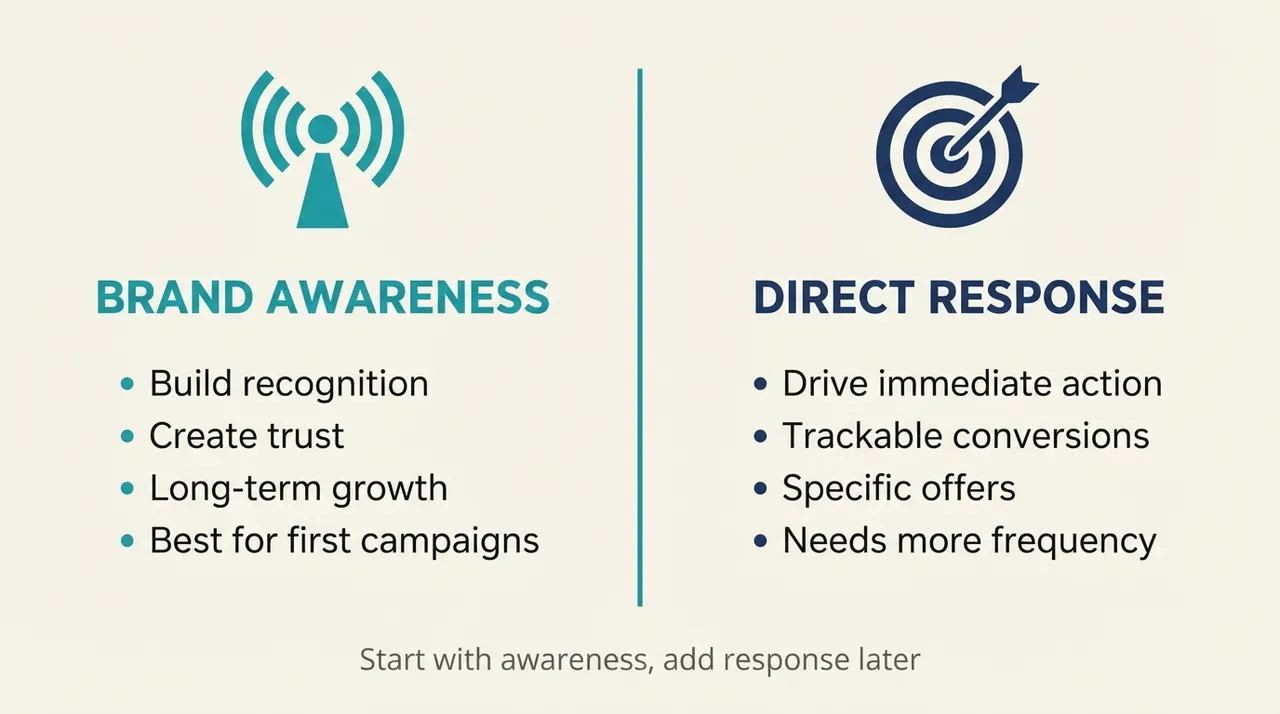
Brand Awareness Goals:
Getting your name in front of local households
Building familiarity so people recognize you when they need your service
Creating trust through the "as seen on TV" effect
Direct Response Goals:
Driving phone calls or website visits
Promoting a specific offer or event
Generating leads for your sales process
For your first TV campaign, brand awareness is usually the smarter starting point. Why? TV is a top-of-funnel channel that works best when people see your ad multiple times before taking action.
Realistic First-Campaign Expectations:
A $100-$500 budget gets you thousands of impressions
Most viewers need 3-7 exposures before taking action
Results often appear gradually over 2-4 weeks
Brand lift (recognition, recall) happens before measurable sales lift
Don't expect your phone to ring off the hook the day after your ad airs. That's not how TV works. Think of your first campaign as planting seeds.
Step 2: Set Your Budget
Here's the honest conversation about money. TV advertising has traditionally been expensive because of two costs: production (making the commercial) and media (running it).
Traditional TV Costs:
Production: $5,000-$50,000+ for a professionally shot commercial
Media buying: Often $10,000+ minimum commitments
Modern Streaming TV Costs:
Production: $0 with AI-powered tools (Adwave creates your ad free)
Media: Starting at $50 minimum
What does each budget level get you?
$50-$100: Testing the waters. A few thousand impressions over a week or two. Good for seeing how the process works and getting your first ad live. Think of it as a learning investment.
$250-$500: A real starter campaign. Enough impressions for meaningful reach in a local area. You'll start seeing how your ad performs across different times and channels.
$1,000-$2,500: Serious local presence. Multiple weeks of consistent exposure. Enough data to understand what's working. This is where many small businesses find their sweet spot.
$5,000+: Market saturation. High frequency, broader geographic targeting, potential for measurable business impact.
The beauty of streaming TV advertising is you can start small, learn, and scale what works. You don't need to commit $50,000 to find out if TV is right for your business.
Step 3: Know Your Audience
TV targeting has evolved dramatically. On streaming platforms (also called Connected TV or CTV), you can target with precision that rivals digital advertising.
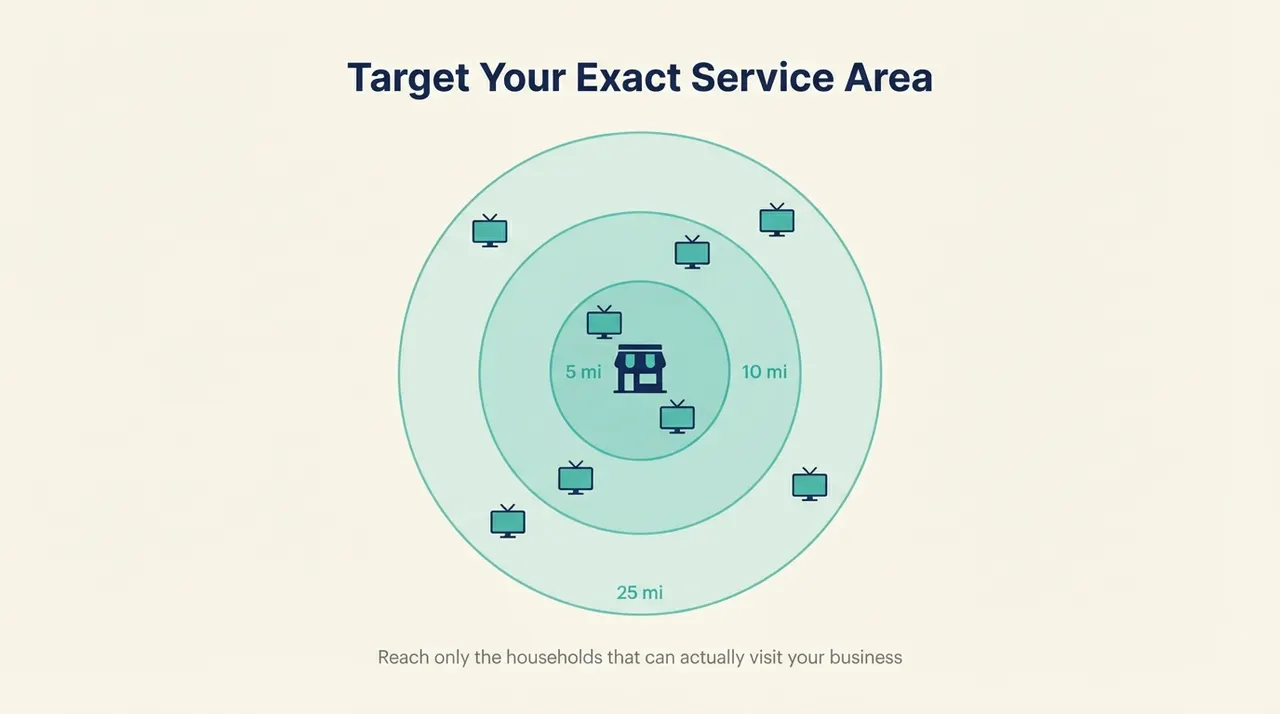
Geographic Targeting: This is the most important decision for local businesses. You can target:
A radius around your business address (5, 10, 15, 25 miles)
Specific ZIP codes
Cities, counties, or metro areas
State or national (for e-commerce or broader businesses)
Most local service businesses start with a 10-15 mile radius. A restaurant might go tighter (5 miles). A specialty retailer might go wider (25+ miles).
Demographic Targeting: Behind the scenes, platforms optimize for relevant households based on:
Age ranges
Household income
Presence of children
Homeownership status
Interest categories
The good news for beginners: you don't need to obsess over demographic targeting for your first campaign. Start with geographic targeting and let the platform's algorithms do the optimization work.
Step 4: Create Your Commercial
This is where most beginners get stuck. How do you make a TV commercial?
You have three options:
Option 1: AI-Powered Creation (Recommended for Beginners)
Platforms like Adwave can generate a broadcast-ready commercial from just your website URL. The AI:
Pulls your images and branding
Creates a script based on your business
Assembles a 30-second commercial
Adds professional voiceover and music
Time required: 2-5 minutes. Cost: Free (you only pay to run the ad).
This is the best option for your first TV ad because it removes the biggest barrier to entry. You can always upgrade to custom production later once you've proven TV works for your business.
Option 2: DIY Video
If you have video footage of your business, products, or services, some platforms accept uploaded videos. Requirements:
15 or 30 seconds in length
High resolution (1080p minimum)
Clear audio
No music with copyright issues
This works if you already have professional video content. It's harder if you're starting from scratch.
Option 3: Professional Production
For businesses with larger budgets or specific creative visions, hiring a production company remains an option. Expect:
$5,000-$25,000 for local production
4-8 weeks from concept to finished ad
Excellent quality but significant investment
For your first TV ad, we recommend starting with AI creation. If TV proves effective for your business, you can always invest in custom production for future campaigns.
Step 5: Choose Where to Run Your Ad
Streaming TV advertising runs across 100+ premium channels including NBC, Hulu, ESPN, Peacock, Tubi, and more. Unlike traditional cable where you pick specific channels, modern CTV advertising uses programmatic technology to place your ad where your target audience is watching.
What This Means For You:
You don't need to guess whether your customers watch HGTV or ESPN. The platform analyzes viewing behavior and places your ad accordingly. Your 30-second spot might run during:
A cooking show on Food Network
A drama series on Peacock
Local news on NBC
Sports content on ESPN
Timing Considerations:
Most platforms optimize timing automatically, but here's what you should know:
Prime time (7-11 PM) has the highest viewership but also highest demand
Daytime and late-night have lower CPMs (cost per thousand impressions)
Weekends typically see higher streaming viewership
For your first campaign, trust the platform's optimization. You can get more granular with timing after you have baseline data.
Step 6: Launch and Learn
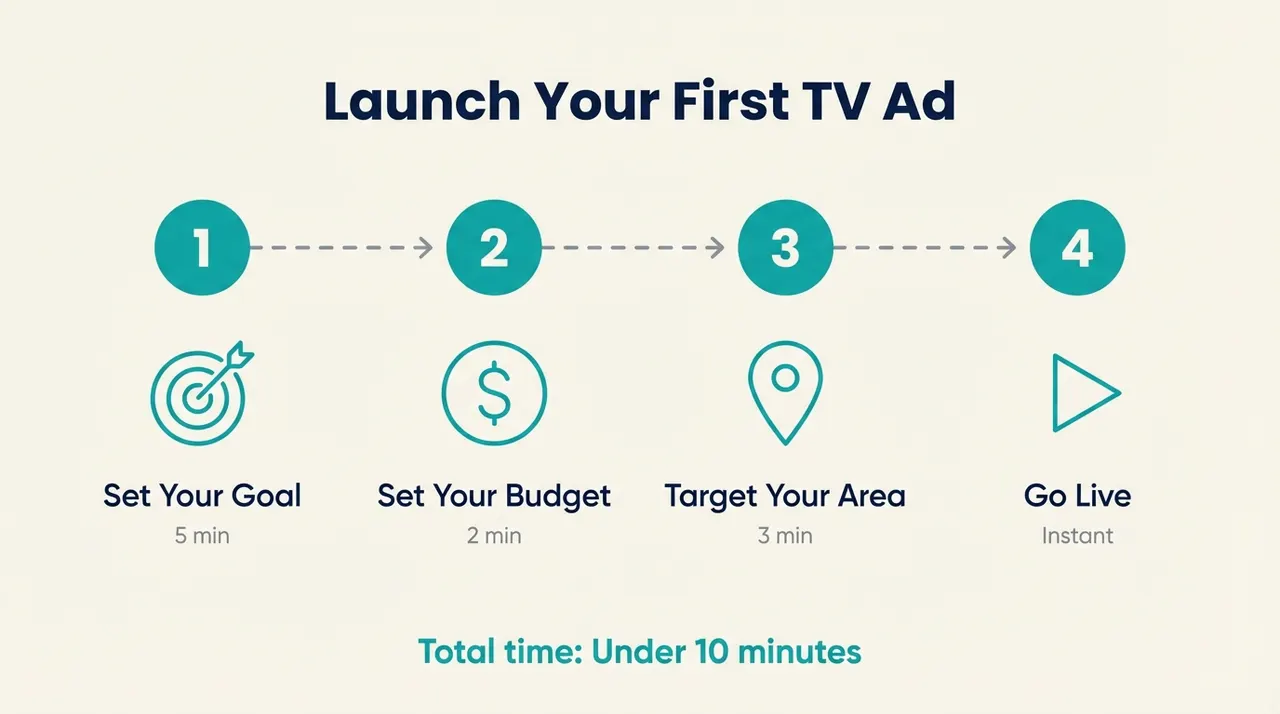
You've set your goals, established your budget, defined your audience, created your ad, and selected your platforms. Now it's time to launch.
What Happens When You Go Live:
Your ad enters the programmatic marketplace and begins appearing on streaming platforms in 24-48 hours. You'll be able to see:
How many times your ad has been viewed (impressions)
Which channels your ad ran on
Geographic distribution of your viewers
Budget pacing (how your spend is tracking)
What to Watch in Week One:
Delivery pace: Is your budget spending as expected?
Completion rate: Are viewers watching your full ad?
Geographic reach: Are impressions concentrated where you targeted?
Don't make changes in the first few days. Let the campaign run and gather data before drawing conclusions.
Tracking Results:
Some results you can measure directly:
QR code scans (if you include one)
Website traffic spikes
"How did you hear about us?" tracking
Some results take longer to appear:
Brand awareness lift
Increased foot traffic
More customers mentioning they "saw your ad"
Adwave's dashboard shows your campaign performance in real-time, including impressions, spend, and an interactive map of where your audience watched.
Common First-Timer Mistakes to Avoid
After helping thousands of small businesses run their first TV ads, these are the patterns that trip people up:
Mistake 1: Expecting Instant Results TV builds brand awareness over time. If you're expecting phone calls the next morning, you'll be disappointed. Plan for a 2-4 week minimum campaign to see meaningful impact.
Mistake 2: Targeting Too Broadly Excitement about reaching "everyone" leads to diluted impact. A tighter geographic focus with higher frequency beats broad reach with low frequency. Start local, expand what works.
Mistake 3: Overthinking Creative Your first ad doesn't need to be perfect. It needs to exist. AI-generated ads perform well because they're consistent and professional. You can refine creative in future campaigns based on what you learn.
Mistake 4: Setting and Forgetting Check your campaign at least weekly. Look for patterns. Ask new customers how they found you. The data you gather informs smarter decisions for your next campaign.
Mistake 5: Comparing to Social Media Metrics TV doesn't generate clicks the same way Facebook ads do. You won't see cost-per-click or conversion attribution the way you might with Google Ads. That doesn't mean it's not working. It means it works differently.
Common questions answered
How long does it take to create my first TV ad?
With AI-powered platforms like Adwave, you can generate a professional TV commercial in about 2 minutes. The AI pulls information from your website, creates a script, selects visuals, and produces a broadcast-ready ad. Traditional production takes weeks and costs thousands, but modern tools have dramatically shortened the process.
Do I need any special equipment or skills?
No equipment or video production skills are needed. AI platforms can create professional TV ads from your existing website content and images. If you want to add your own video footage later, you can, but it's not required to get started. The goal is to make TV advertising accessible to business owners without production backgrounds.
What should my first TV ad say?
Focus on one clear message. Introduce who you are, what makes you different, and how viewers can take action. Don't try to cram everything about your business into 30 seconds. A simple structure works well: problem, solution (you), call to action. Your first ad should build awareness and make people remember your name.
How much should I spend on my first campaign?
Start small to learn. A $50 to $100 test campaign gives you enough data to see if TV advertising works for your business without significant risk. Once you see results, you can scale up. It's better to run a small test and learn than to commit a large budget before you understand how the channel performs for you.


