
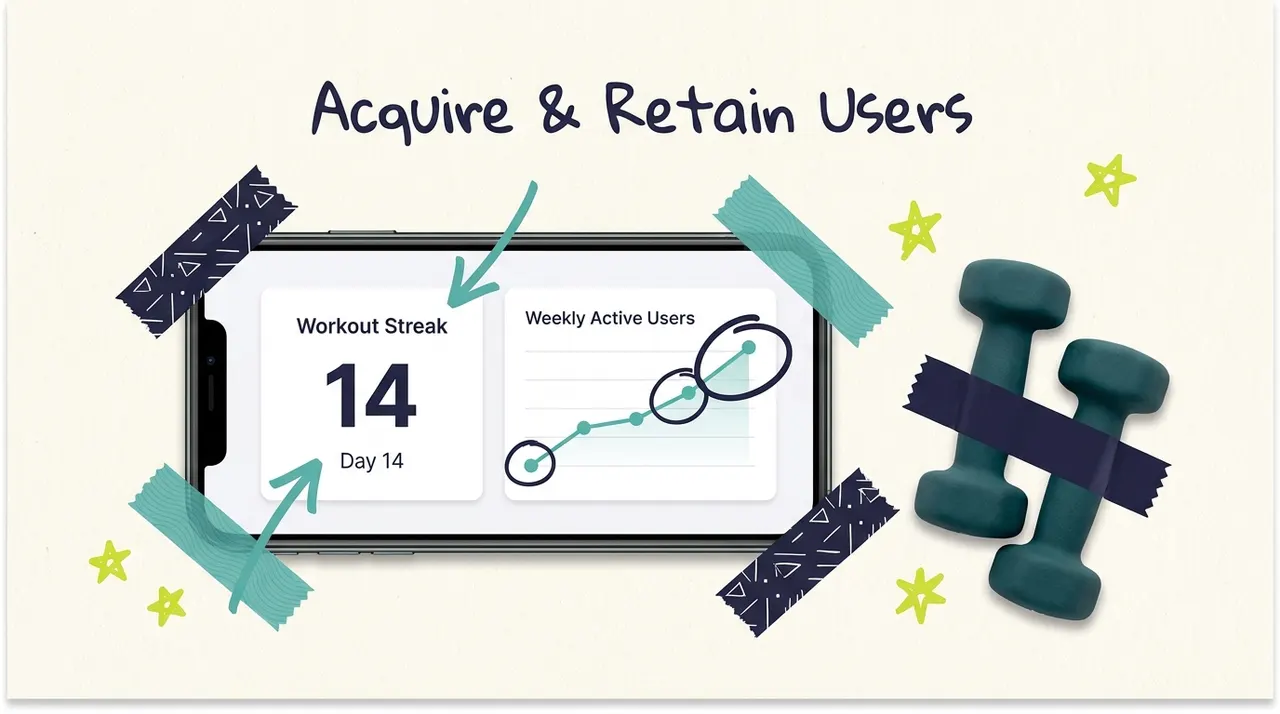
The U.S. fitness and wellness app market generated more than $5.7 billion in revenue in 2024 and is projected to keep growing as consumers shift workouts and health management into mobile-first formats (Statista, 2024). Apple Health, Strava, MyFitnessPal, Peloton, ClassPass, Whoop, and a long tail of niche fitness apps have proven that consumers will pay for digital fitness when the experience delivers.
The app market is brutal. Average install-to-paid-subscription conversion rates for fitness apps run 3-8%. Cost per install (CPI) creeps up year after year. Apple's iOS privacy changes broke last-click attribution. Most fitness apps that launch in 2026 will struggle to turn paid acquisition into profitable LTV.
Fitness apps that win share a pattern: they layer 5-7 acquisition channels, treat user retention as a marketing function (not just product), and invest in compounding assets like community, content, and brand recognition alongside direct-response campaigns.
This guide covers seven advertising channels for fitness apps: Apple Search Ads, Google App Campaigns, Meta and Instagram, TikTok Ads, influencer and creator partnerships, CTV advertising, and affiliate and partnership programs. You'll get realistic budgets, what works for early-stage versus scaling apps, and where to focus first.
Why Fitness App Marketing Is Different
Mobile fitness apps face dynamics most marketers don't encounter elsewhere.
The conversion is two-step. Users have to install AND open AND convert to paid (or to retention milestones). Most ad platforms only optimize for one step. You need to model the full funnel.
iOS attribution is broken. SKAdNetwork is the new standard but it lags by days and provides limited signal. MMP-based attribution (Adjust, AppsFlyer, Branch) helps but isn't perfect. Plan for 30-50% of conversions being unattributed.
Retention is everything. A user with 7-day retention is worth 5-10x a user with 1-day retention. Marketing campaigns that drive low-quality installs at high CPI can destroy unit economics even at low CPIs.
Creative is the lever. Targeting matters but creative drives outsized differences in install rates, retention, and LTV. The difference between a 2x ROAS app and a 0.5x ROAS app is almost always creative quality.
Seasonal patterns matter. January is the peak month for fitness app installs (3-5x baseline). September (back-to-school energy) is second. Late spring (April-May, beach-body season) is third. Summer (June-August) and December are typically slowest.
Subscription LTV is the math. Most fitness apps live or die on subscription LTV vs CAC. A great-converting ad at high CAC is still a losing proposition if monthly churn is too high.
Channel 1: Apple Search Ads
When a user searches the App Store for a fitness app or category, they're past discovery and into evaluation. Apple Search Ads puts your app at the top of those high-intent searches.
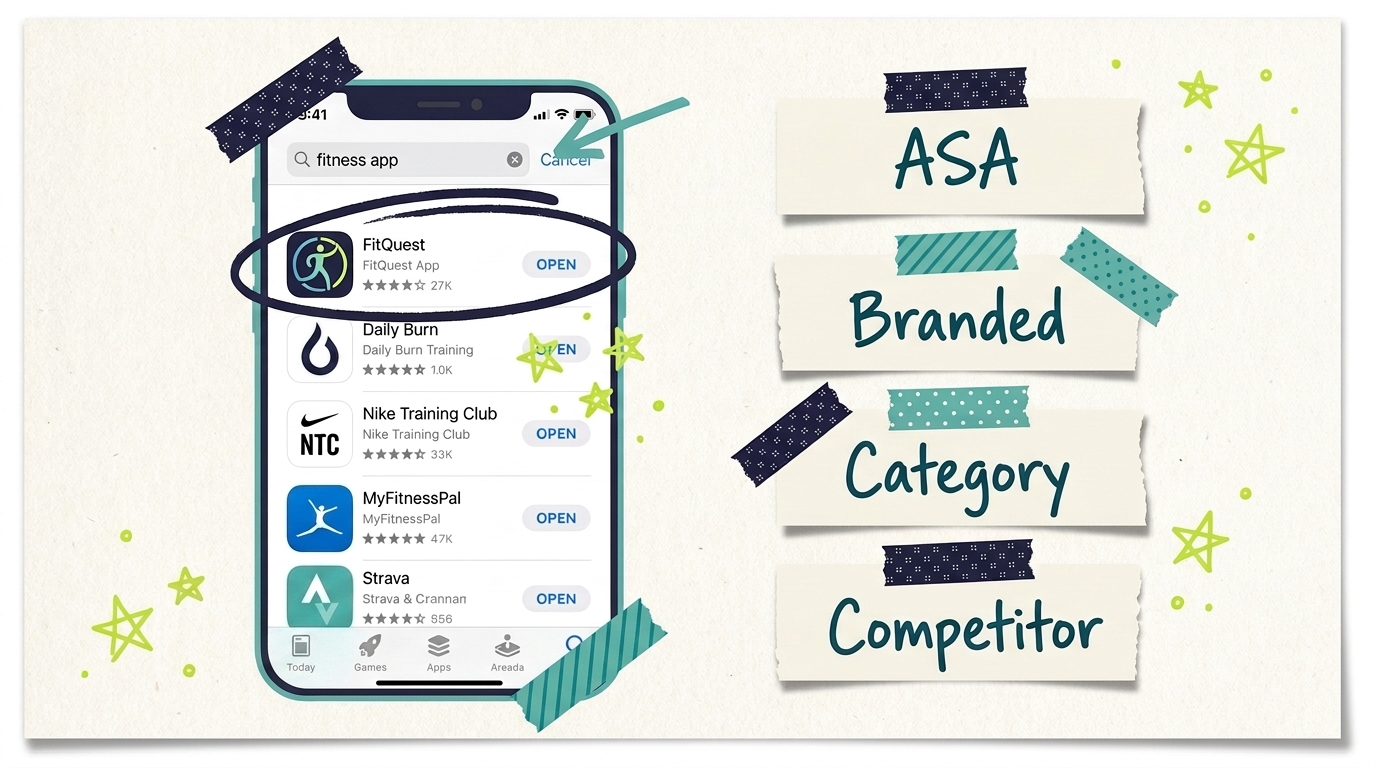
Apple Search Ads consistently produces the highest install-to-paid-conversion rates of any paid channel for most fitness apps because users are actively searching for what you're selling.
Campaign Types for Fitness Apps
Search Match campaigns automatically match your ad to relevant searches Apple thinks fit your app. Good starting point and discovery vehicle.
Branded keyword campaigns on your own app name. Often the highest-ROAS spend if you have any organic awareness.
Competitor keyword campaigns on competitor app names. Aggressive but effective for differentiated apps.
Category keyword campaigns on terms like "workout app," "yoga app," "running tracker," "calorie counter," etc.
Discovery campaigns with broader keywords for new audience reach.
Budget and Expectations
Early-stage fitness apps should budget $1,000-$5,000 per month on Apple Search Ads. Scaling apps run $10,000-$100,000+ monthly. Cost per install (CPI) typically lands at $1.50-$8 for category terms; $0.50-$3 for branded. Install-to-paid-subscription conversion rates run 5-15% for well-positioned apps.
Tips for Better Results
Set up daily monitoring; Apple Search Ads costs spike fast on poorly-set bids
Run separate campaigns by keyword theme; combining waters down optimization
Add negative keywords aggressively: "free," "calculator," competitor names you don't want
Update creative every 4-8 weeks; Apple's ad placements rotate
Apple Search Ads is the highest-quality install channel for most fitness apps. Strong starting point if you're not currently advertising in the App Store.
Channel 2: Google App Campaigns
Google App Campaigns (formerly Universal App Campaigns) automatically run install ads across Google Search, YouTube, the Display Network, and Google Play. For Android-first fitness apps, this is the largest acquisition channel after Apple Search Ads (which is iOS-only).
Campaign Types for Fitness Apps
Install campaigns optimized for new app installs. Most appropriate when first scaling an app.
Engagement campaigns target existing users who haven't been active recently. Critical for retention-focused budget.
In-app event campaigns optimize toward specific in-app events (subscription, premium upgrade, workout completion). Higher CPI but better LTV alignment.
YouTube placements within Google App Campaigns drive significant volume but variable quality. Monitor closely.
Budget and Expectations
Plan $500-$5,000 per month early-stage; $10,000-$100,000+ at scale. CPIs for fitness category run $2-$8 on Android; $4-$20 on iOS. ROAS varies dramatically by category fit and creative quality. Consider blended ROAS targets, not channel-specific.
Tips for Better Results
Provide 5-10 high-quality creative variants for Google's algorithm to test
Use both video and image creative; video often outperforms but image is cheaper
Target by specific in-app events (sub-purchase, retention day-7), not just installs
Layer campaigns by geography; some markets have meaningfully different unit economics
Google App Campaigns is essential for Android-first apps and complementary for iOS-first apps. Together with Apple Search Ads, they often comprise 40-60% of total paid budget.
Channel 3: Meta and Instagram
For most fitness apps, Meta is the primary "audience-driven" acquisition channel after platform-native ads (Apple Search and Google App Campaigns). Fitness audiences are dense on Instagram and Facebook, and Meta's targeting reaches users by interests, behaviors, life events, and lookalikes.
Campaign Types for Fitness Apps
App install campaigns with Meta's mobile install objective. Standard early-stage approach.
Conversion campaigns optimized for in-app events (subscription, free trial start, workout completion). More expensive per install but better LTV alignment.
Reels ads with vertical video creative. Often the best-performing format for fitness apps in 2026.
Stories ads for younger audiences and time-sensitive campaigns.
Retention/re-engagement campaigns target lapsed users via custom audiences from MMP data.
Lookalike campaigns built from your highest-LTV subscriber segments. The single highest-impact targeting move for most fitness apps.
Creative That Works
Workout demonstrations. Real workouts being completed, with the app visible.
Before/after transformations. Users sharing real results (with consent and disclaimers).
Trainer / coach personalities. Real coaches on camera explaining their philosophy.
App walkthroughs. Quick screen-recording of the app's core experience.
Member testimonials. Short clips of real users explaining what changed.
Specific challenge content. "30-day glute challenge," "21-day mobility reset," etc.
Budget and Expectations
Plan $1,000-$10,000 per month early-stage; $25,000-$250,000+ at scale. CPMs run $10-$30. CPIs typically $3-$15. Cost per paid subscriber $20-$120. Plan for 3-7 day attribution window post-iOS14.
Tips for Better Results
Test 5-15 new creative variants per week
Build custom audiences from your highest-retention subscriber cohort, then lookalikes
Pre-warm cold audiences with awareness campaigns before install campaigns; saves on CPI
Use Conversions API alongside MMP for better signal post-iOS14
Meta is essential for most consumer fitness apps. Plan for ongoing creative iteration as the lifeblood of performance.
Channel 4: TikTok Ads
TikTok has become the discovery engine for fitness apps targeting users under 35. Workout content, transformation stories, and trainer personalities drive massive organic reach that often translates to paid amplification.
Campaign Types for Fitness Apps
Spark Ads boost organic content (yours or creator-permissioned). Often produces the best ROAS because it feels native.
App install campaigns with TikTok's standard mobile install objective.
In-app event campaigns optimized for trial start or subscription.
Lead generation for higher-AOV apps or apps with consultative onboarding flows.
Creative That Works
POV workout videos ("I did the [app name] beginner program for 30 days...")
Coach/founder personalities explaining their training philosophy
Transformation reveals with before/after content
Workout-of-the-day clips with the app interface visible
Trend-hijacking content adapting trending audio to fitness messaging
Mistake/myth-busting content ("3 things you're doing wrong on push days")
Budget and Expectations
Plan $500-$5,000 per month for fitness apps targeting Gen Z/younger millennials. CPMs typically $5-$15. CPIs $3-$10. Cost per paid subscriber $25-$100. Highly variable by creative quality.
Tips for Better Results
Run organic TikTok alongside paid; organic reach feeds the paid algorithm
Partner with fitness creators for authentic Spark Ad inventory
Vertical-native video is non-negotiable; reformatted Instagram content underperforms
Heavy budget January (resolution season) and April-May (beach-body season)
TikTok is high-upside but volatile. Best for apps targeting users 18-35 with strong visual product experiences.
Channel 5: Influencer and Creator Partnerships
For fitness apps, creator partnerships often produce the strongest blended ROI of any channel after platform-native ads. Fitness creators have built trust with audiences who actively engage with their workout recommendations.
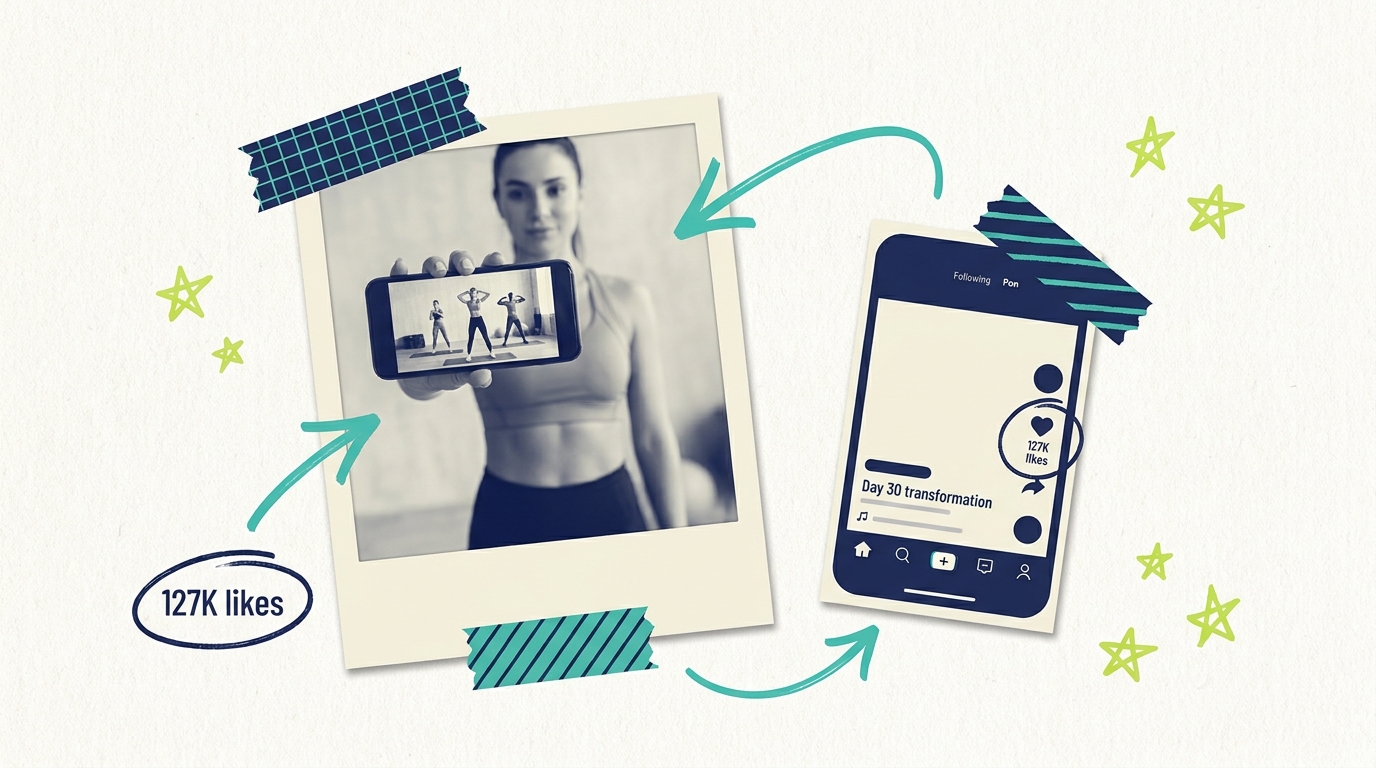
Micro-influencer partnerships ($500-$5,000 per partnership). Fitness creators with 10K-200K engaged followers in your specialty (yoga, running, strength, mobility, etc.) often deliver better ROI than mega-influencers.
Creator gifting / app access programs. Provide free premium access to 50-200 creators per quarter. 10-30% will post organically, with strong word-of-mouth effect.
Affiliate programs through platforms like Impact, Refersion, or app-specific platforms. Pay 20-40% revenue share on attributed subscribers. Pure performance.
Whitelisting / dark posts. Run ads from creator accounts targeting your audiences. Native-feeling content that outperforms branded creative.
Long-term creator partnerships. 6-12 month deals with 2-5 creators who use and integrate your app into their training. Higher per-partnership cost but significantly deeper authenticity.
Coach/expert partnerships. Work with established trainers, nutritionists, or PT specialists to build co-branded programs inside your app. Drives both acquisition and retention.
Tactics That Work
Track creator-specific install codes for clean attribution
Negotiate usage rights upfront; you'll want creator content as paid ads
Reuse creator content across Meta, TikTok, YouTube, and email
Focus on creators whose audience demographics match your highest-LTV user profile
Budget and Expectations
Plan $2,000-$25,000 per quarter on influencer programs. Cost per paid subscriber varies wildly: $30-$200 directly attributed. Brand-building value typically exceeds direct attribution by 2-3x.
Channel 6: CTV Advertising
For most of mobile app history, TV was reserved for category leaders with $50M+ budgets. That changed with connected TV.
Connected TV (CTV) means streaming services like Hulu, Peacock, Tubi, and Roku. App marketers can now buy targeted streaming campaigns starting at $50, with audience targeting by demographics, interests, and behaviors (eMarketer, 2024).
For fitness apps generating $1M+ in annual subscription revenue, CTV builds the brand recognition that compounds across all other channels. A polished 30-second spot during prime-time streaming reaches users on the same screens where they watch fitness content. CTV ads consistently lift branded search and direct app downloads in ways direct-response channels can't replicate.
Platforms like Adwave make CTV realistic for app brands. Generate a broadcast-quality 30-second spot from your app's website in about two minutes, target your audience, and launch on 100+ premium streaming channels for as little as $50.
For a deeper look at TV strategy specifically for mobile apps, see our guide to TV advertising for mobile apps and CTV.
Budget: $1,000-$15,000 per month. Best for fitness apps with proven product-market fit, $1M+ in annual recurring revenue, and meaningful creative assets. Pre-product-market-fit apps typically get faster ROI from Apple Search Ads, Meta, and TikTok.
Channel 7: Affiliate Networks and Partnership Programs
Beyond influencer marketing, fitness apps can scale through formal affiliate networks and strategic partnerships.
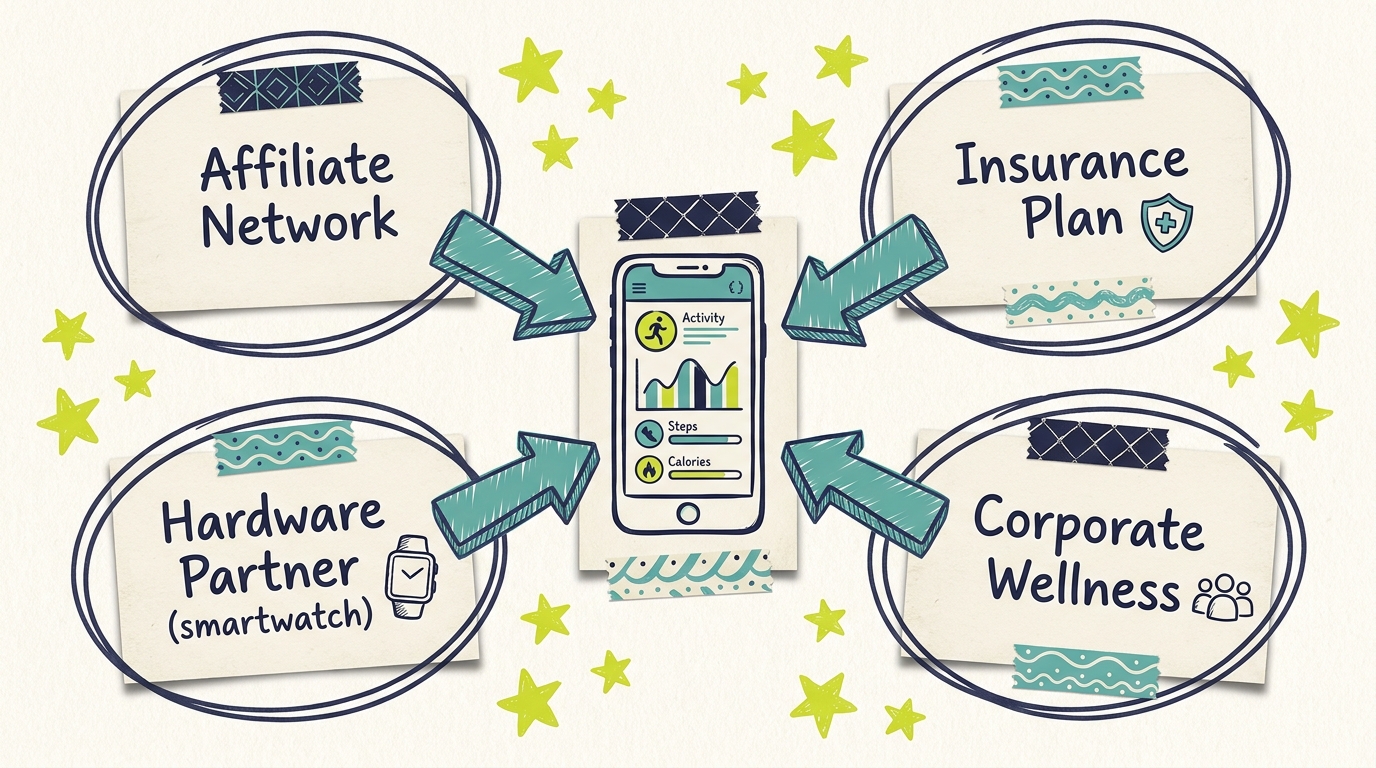
Affiliate networks like Impact, Awin, ShareASale, and Skimlinks. Reach thousands of publishers, deal sites, content sites, and reviewers paid on performance.
Cashback and rewards platforms (Rakuten, Honey, Capital One Shopping). Fitness apps offering generous referral commissions can reach the cashback-aware audience.
Content publisher partnerships. Sponsored placements in fitness publications, newsletters (Morning Brew, theSkimm Wellness, Athletic Greens-style health newsletters).
Hardware partnerships. Apple Watch, Garmin, Whoop, Fitbit integrations and co-marketing. Strong for apps that complement wearables.
Corporate wellness partnerships. Many companies offer fitness app subsidies to employees. Reach out to HR teams and benefits brokers.
Insurance partnerships. Some health insurers reimburse or subsidize fitness app subscriptions. Long sales cycles but stable subscription bases.
Gym partnerships. Many gyms offer member-only access to fitness apps. Cross-promotional deals can drive both subscriber growth and gym retention.
Podcast advertising. Fitness, health, and self-improvement podcasts drive meaningful direct response with engaged audiences.
Budget and Expectations
Most affiliate programs are revenue-share based (20-40% of first-year subscription revenue). Effective budgets vary widely. Strategic partnerships typically need 6-18 months to materialize; budget patience.
Channel Comparison
Here's how the channels stack up for a typical fitness app generating $500K-$5M in annual subscription revenue.
Most early-stage fitness apps should run 3-4 channels at any time. Established apps ($1M+ ARR) should run 5-7. Channel selection depends heavily on category, target user demographics, and unit economics.
Recommended Budget Allocation by Stage
Stage 1: Pre-Product-Market-Fit (Year 0-1, $3,000-$10,000/month)
Apple Search Ads: 30% ($900-$3,000)
Google App Campaigns: 25% ($750-$2,500)
Meta / Instagram: 30% ($900-$3,000)
TikTok Ads (if relevant audience): 10% ($300-$1,000)
Influencer gifting: 5% ($150-$500)
Goal: Find product-market fit, validate creative, identify which channels and audiences convert and retain.
Stage 2: Scaling (Year 1-3, $10,000-$100,000/month)
Apple Search Ads: 25% ($2,500-$25,000)
Google App Campaigns: 20% ($2,000-$20,000)
Meta / Instagram: 25% ($2,500-$25,000)
TikTok Ads: 10% ($1,000-$10,000)
Influencer / Affiliate: 15% ($1,500-$15,000)
Brand and retention: 5% ($500-$5,000)
Goal: Profitable scaling. Diversify channels to reduce platform risk.
Stage 3: Established Brand ($100,000+/month)
Apple Search Ads: 20%
Google App Campaigns: 15%
Meta / Instagram: 20%
TikTok / Reels: 10%
Influencer / Affiliate: 10%
CTV: 15%
Partnership / B2B: 10%
Goal: Build brand authority that supports premium subscription pricing and reduces dependence on direct response.
Common Questions Answered
How much should a fitness app spend on user acquisition?
Most successful fitness apps spend 30-50% of LTV on user acquisition during growth phases. If your blended LTV is $80 (12-month subscription), you can afford $24-$40 fully-loaded CAC. Established apps with stronger retention often run higher CAC profitably; pre-PMF apps need much lower CAC to survive.
Which channel produces the best ROAS for fitness apps?
For most apps, Apple Search Ads produces the highest install-to-paid conversion because of high search intent. Meta and Google App Campaigns produce the largest scale. Influencer marketing produces the best blended ROI when measured for brand impact, not just direct attribution. Most healthy apps run all four simultaneously rather than picking one.
How important is creative versus targeting for fitness apps?
Creative is dramatically more important than targeting in 2026. Algorithms find audiences efficiently if creative resonates. The difference between a 3x ROAS app and a 0.8x ROAS app is almost always creative quality and asset volume. Plan for 10-30 new creative variants per week as a baseline.
Should a fitness app advertise on TV?
For pre-product-market-fit apps, no. Apple Search Ads, Google, and Meta produce faster, more measurable results. For fitness apps generating $1M+ in annual recurring revenue with strong creative assets and proven product-market fit, CTV builds the brand recognition that compounds across other channels. CTV starts at $50 and is realistic via platforms like Adwave.
What's the best way to measure performance post-iOS14?
Use a Mobile Measurement Partner (MMP) like Adjust or AppsFlyer for cross-channel attribution. Layer in Conversions API for Meta. Run geo-holdout tests quarterly to measure incrementality. Don't rely solely on platform-reported ROAS; model your true ROAS through media-mix modeling.
How important is retention for fitness app marketing?
Critical. A user with 7-day retention is worth 5-10x a user with 1-day retention. Marketing campaigns that drive low-quality installs at low CPI can destroy unit economics. Track install-to-active-user-day-7 conversion as your primary marketing KPI; CPI alone tells you nothing.
Where to Start This Week
If you're a fitness app founder or marketer without a clear advertising system, here's a 30-day plan:
Week 1: Set up Apple Search Ads if iOS-relevant. Launch a small $30-$50/day budget on branded and category keywords. Set up MMP (Adjust, AppsFlyer) for attribution.
Week 2: Launch Google App Campaigns with $30-$50/day budget. Provide 10 creative variants (5 video, 5 image). Optimize toward your in-app subscription event.
Week 3: Set up Meta with the mobile install objective. Launch one prospecting campaign and one custom-audience retargeting campaign. Begin creative iteration cycle.
Week 4: Launch a creator gifting program. Identify 30-50 fitness creators with 10K-100K engaged followers, send free premium access, and measure organic posts and resulting installs.
After 60-90 days, layer in TikTok Ads if your category fits, formalize affiliate program, and consider CTV advertising once you have $1M+ in run-rate ARR.
Fitness app success is a creative, retention, and unit-economics game. Apps that test consistently, layer 4-6 channels, and treat acquisition as a function of LTV (not just CPI) build defensible growth. Single-channel apps stay vulnerable to algorithm changes, attribution shifts, and rising CPIs.


