
Zero-budget marketing strategies that actually drive customers, plus knowing when it's time to invest.
Looking for free advertising for small business options? You're not alone. Every small business owner wants to stretch their marketing budget as far as possible, and "free" sounds perfect when you're watching every dollar.
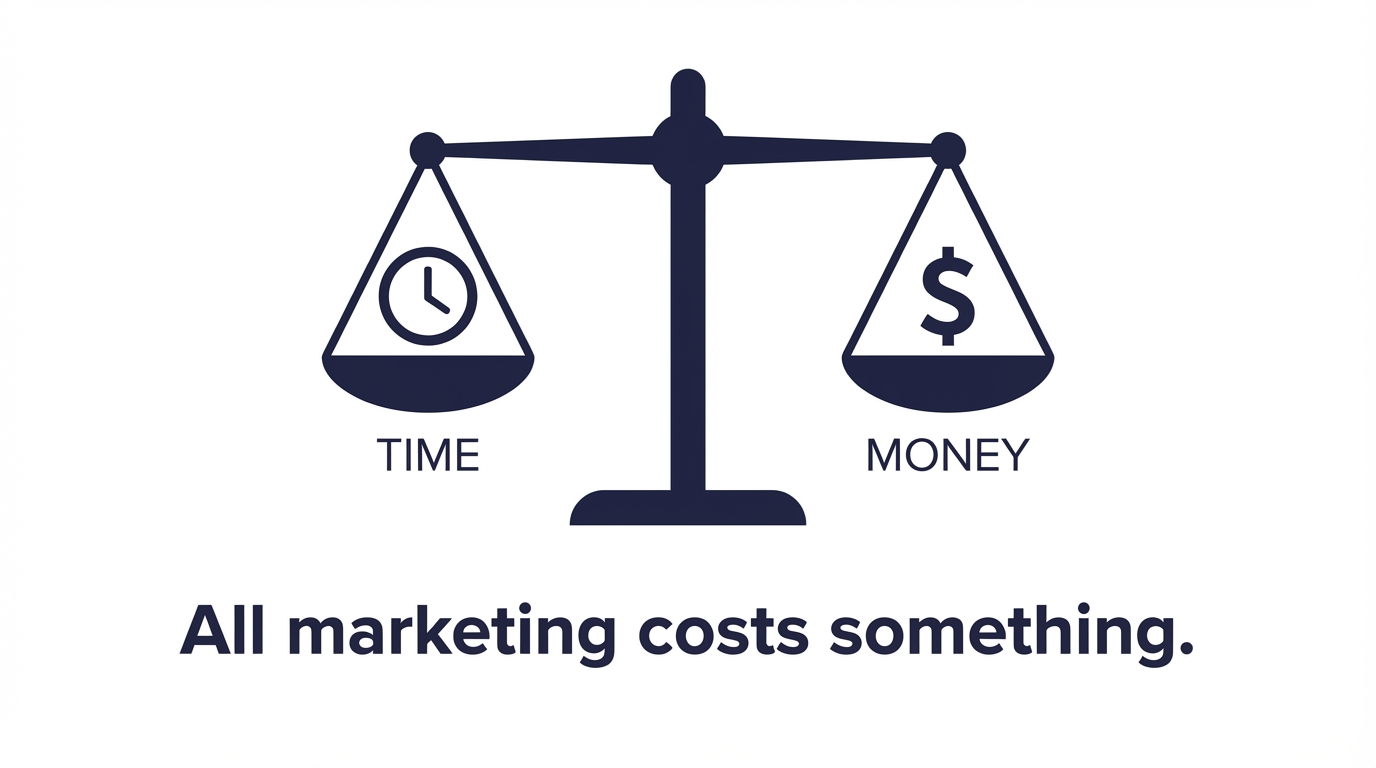
Here's the truth: genuinely free advertising does exist, and some of it works remarkably well. But "free" usually means you're paying with time instead of money. This guide covers the advertising ideas that actually deliver results, organized by how much effort they require, so you can decide which ones fit your situation.
We'll also be honest about where free tactics hit their limits, because knowing when to invest a little money can actually save you time and accelerate your growth.
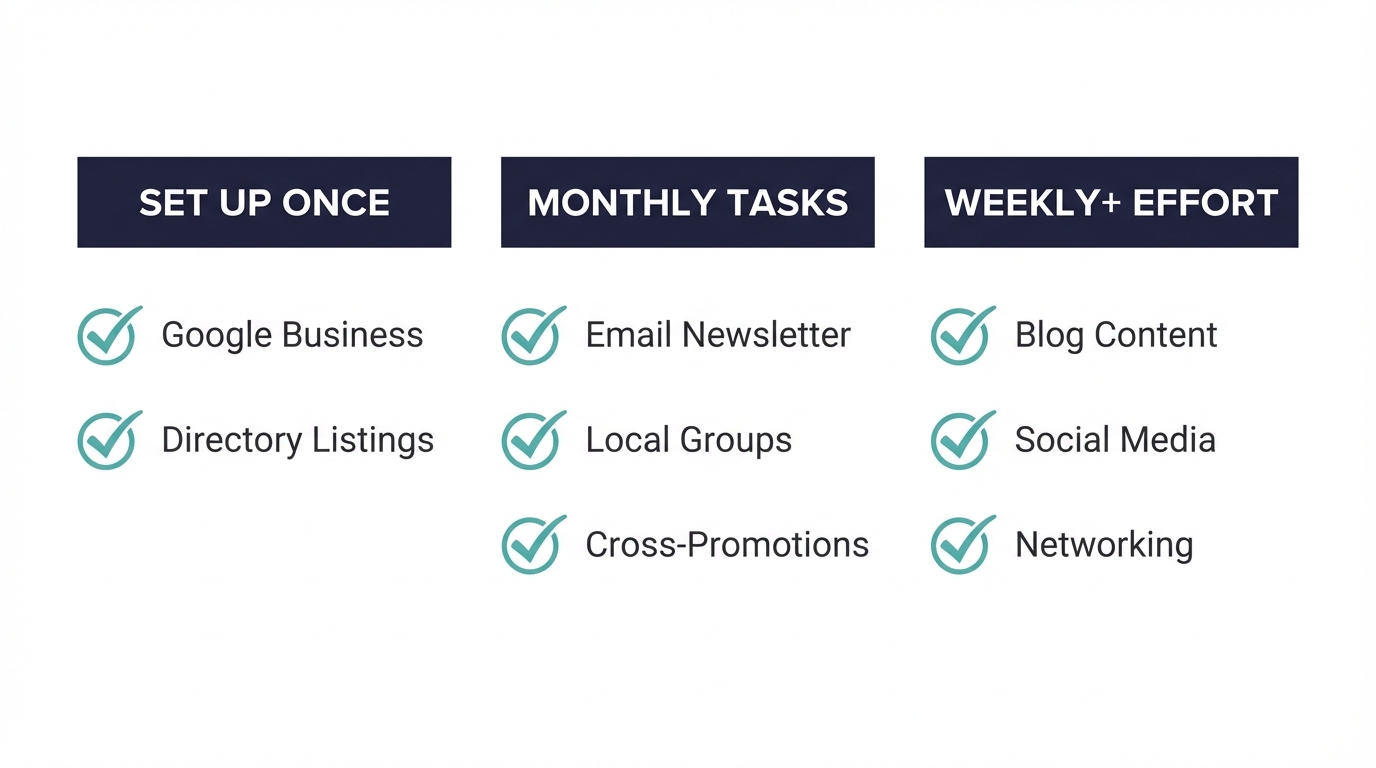
Truly Free Advertising: No Money Required
Let's start with channels that cost nothing but your time. These are the foundations every small business should have in place before spending a dime on paid advertising.
Google Business Profile: Your Most Valuable Free Asset
If you do only one thing on this list, make it this. Your Google Business Profile (formerly Google My Business) is free to claim and optimize, and it directly impacts whether you show up when locals search for businesses like yours.
A complete, optimized profile can drive significant traffic. Here's how to maximize it:
Complete every section: Hours, services, attributes, description, and categories. Google rewards completeness.
Add photos weekly: Businesses with photos receive 42% more requests for directions and 35% more click-throughs to websites.
Post updates: Google Business posts appear in search results. Share offers, news, or updates regularly.
Respond to every review: Whether positive or negative, responses show you're engaged and build trust.
This isn't just about being found. It's about converting searchers into customers. A well-maintained profile with recent photos and reviews outperforms competitors who "set it and forget it."
Customer Reviews: Free Social Proof
Reviews are free word-of-mouth at scale. The challenge isn't getting good reviews (you probably have happy customers). It's remembering to ask.
Make asking systematic:
Send a follow-up email after every service
Include a direct link to your Google review page
Train staff to mention reviews after positive interactions
Consider a small sign at checkout: "Loved your experience? Leave us a review!"
Don't just focus on Google. Yelp, Facebook, and industry-specific platforms (like Healthgrades for medical practices or Houzz for contractors) all matter depending on your business type.
Email Marketing to Existing Customers
You already have an audience: your past customers. Reaching them costs nothing if you use free email tools like Mailchimp (free up to 500 contacts) or similar platforms.
This is one of the most underused free advertising ideas for small business owners. A monthly newsletter keeps you top-of-mind, encourages repeat business, and generates referrals.
What to send:
Business updates and news
Special offers for loyal customers
Helpful tips related to your industry
Behind-the-scenes content
Requests for reviews or referrals
Low-Effort Free Tactics
These tactics take minimal ongoing effort once you set them up. They're the "set it and mostly forget it" options for free small business promotion.
Business Directory Listings
Beyond Google, there are dozens of directories where you can list your business for free:
Bing Places
Apple Business Connect
Yelp
Yellow Pages online
Industry-specific directories
The key is consistency. Your name, address, and phone number (NAP) should be identical everywhere. Inconsistencies confuse search engines and customers.
Local Facebook Groups and Nextdoor
Most communities have Facebook groups where local businesses can share (appropriately, not spammy). Nextdoor specifically encourages residents to recommend local businesses.
The approach that works:
Be helpful first, promotional second
Answer questions in your area of expertise
Share genuinely useful information
Only promote when directly relevant or when allowed
Businesses that build reputation in these communities get organic recommendations when neighbors ask, "Anyone know a good plumber?"
Cross-Promotions with Complementary Businesses
Partner with non-competing businesses that serve similar customers:
A wedding photographer and florist cross-referring
A gym and healthy meal prep service displaying each other's cards
A real estate agent and mortgage broker sending joint mailers
These cost nothing beyond relationship-building and can expand your reach to pre-qualified audiences.
Time-Intensive Free Marketing
These tactics are genuinely free but require significant ongoing effort. They're powerful for businesses with more time than money, but be honest about whether you'll actually maintain them.
Content Marketing and Blogging
Creating helpful content that answers your customers' questions can drive traffic for years. A plumber writing about "how to unclog a drain" or a dentist explaining "when to replace a filling" attracts people actively seeking help.
The catch: this takes real time and consistency. One blog post won't move the needle. A library of helpful content, built over months, can become a major source of leads.
If you're going to try this, commit to at least one piece per month for six months before evaluating results. Learn more about local business marketing strategies that complement content efforts.
Social Media (With Realistic Expectations)
Social media can be free advertising, but let's be honest about what it takes:
Posting occasionally won't work: Algorithms reward consistency. Think 3-5 posts per week minimum.
Organic reach is limited: Facebook pages reach maybe 2-5% of followers per post. Instagram isn't much better.
It's a slow build: Growing a meaningful following takes months or years.
Social media works best as a relationship-maintenance tool for existing customers rather than a new customer acquisition channel. If you're expecting to "go viral" and grow your business overnight, read our guide on marketing without trying to go viral.
Networking and Community Involvement
Joining your local Chamber of Commerce, attending networking events, sponsoring little league teams (even just with your time as a coach), and participating in community events all build visibility.
This is "free" in that there's no ad spend, but it costs significant time. For many local businesses, however, the relationships built through community involvement drive more referrals than any other channel.
The Limitations of Free Advertising
Here's what most "free advertising" articles won't tell you: free tactics have real limitations.
Reach Caps Out
You can only post so much on social media. You can only write so many blog posts per month. You can only attend so many networking events. Free channels have built-in ceilings.
Your Time Has Value
If you spend 10 hours a week on free marketing activities, that's time not spent on billable work, serving customers, or improving your product. At what hourly rate do you value your time?
If your time is worth $50/hour (conservative for many business owners), 10 hours of "free" marketing costs you $500 in opportunity cost. Suddenly, $200 on paid advertising that saves you 8 hours doesn't seem expensive at all.
Scaling Is Hard
Free tactics don't scale well. You can double your ad budget and roughly double your reach. You can't double your networking hours without sacrificing something else.
Some Audiences Are Unreachable
Not everyone is on social media. Not everyone reads blogs. Not everyone attends networking events. If your ideal customers consume different media, free online tactics might miss them entirely.
For example, people watching streaming TV in the evening are a huge audience that free digital marketing barely touches. See how small business TV ads compare to social media.
When to Transition from Free to Paid
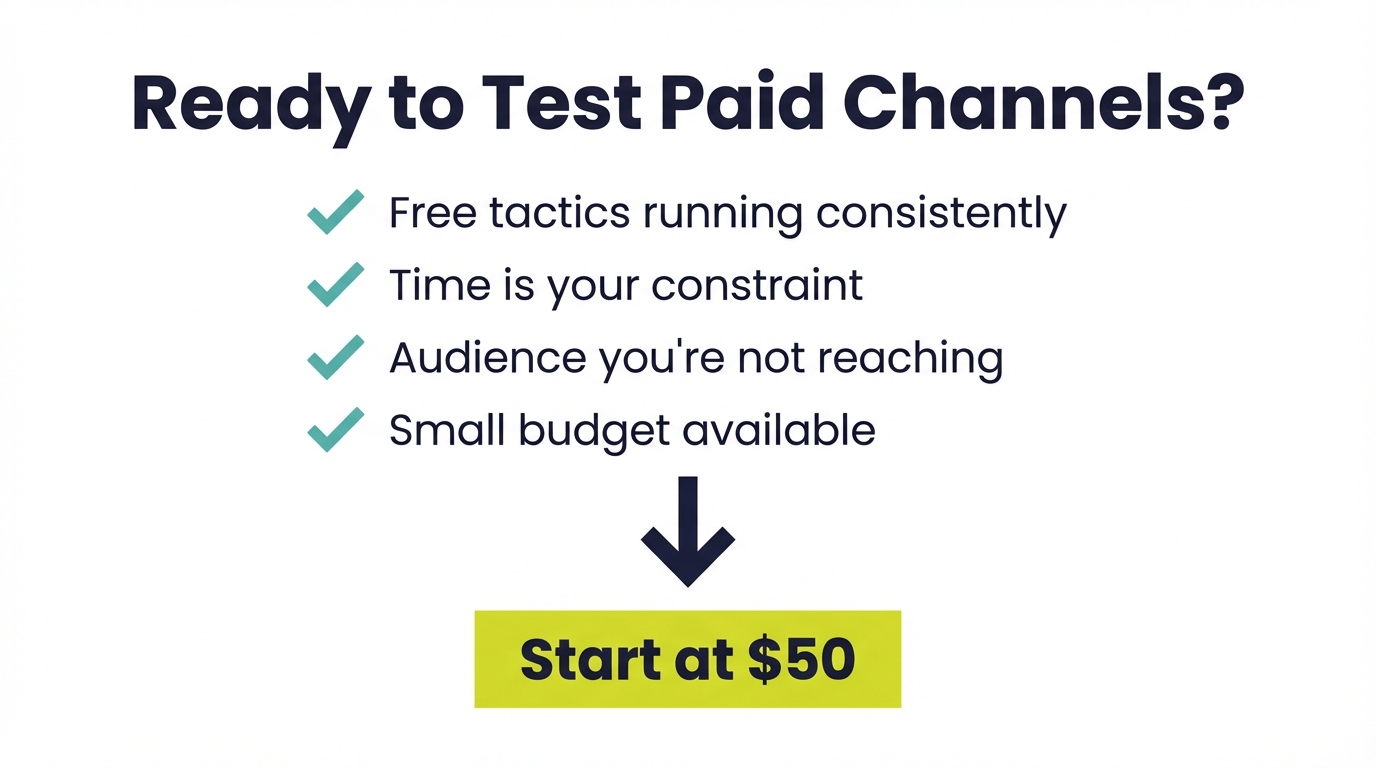
Free advertising is a great starting point, but most businesses eventually need to invest in reaching larger audiences. Here are signs you've maximized free tactics:
You're doing everything on this list consistently. Google profile optimized, reviews coming in, email list engaged, social media active, and you're still not growing fast enough.
Your time is maxed out. You literally can't do more free marketing without neglecting your actual business.
You've identified who you're missing. You know there are potential customers you're not reaching through free channels.
You have some budget. Even a small one. You don't need thousands of dollars to test paid channels.
Starting Small: Low-Risk Paid Advertising
When you're ready to invest, you don't have to spend thousands. Here are low-risk options to test:
Google Ads: Start with $5-10/day targeting specific keywords. You'll learn quickly whether paid search works for your business.
Social media ads: Facebook and Instagram let you start at $5/day. Great for testing whether your audience responds to paid promotion.
Local sponsorships: Sometimes $50-100 sponsoring a community event gets your name in front of hundreds of neighbors.
And here's one most small business owners don't know about: streaming TV advertising.
Yes, TV ads. The same platform where you see ads for Toyota and Coca-Cola. Thanks to connected TV and platforms like Adwave, you can run TV ads starting at just $50.
It sounds surprising, but think about it: your potential customers are watching Hulu, Peacock, and other streaming services every evening. Free online marketing doesn't reach them there. But for less than a nice dinner out, you can put your business on their TV screen alongside major brands.
The Best Strategy: Free Foundation + Strategic Investment
The smartest small businesses don't choose between free and paid. They build a foundation of free tactics (Google profile, reviews, email list) and then strategically invest in channels that extend their reach.
Here's a practical approach:
Month 1-2: Optimize all free channels. Claim Google Business, set up email, get reviews flowing.
Month 3-4: Maintain free tactics while testing one paid channel with a small budget ($50-100).
Month 5+: Scale what works, cut what doesn't.
The goal isn't to advertise for free forever. It's to be smart about where your marketing dollars go, which means maximizing free options first and then investing strategically.
Ready to Go Beyond Free?
Free advertising ideas get you started, but they have limits. When you've built your foundation and you're ready to reach more customers, consider this:
For the same price as a few social media posts that reach 2% of your followers, you could put your business on actual TV, reaching households in your area on channels like NBC, Hulu, and ESPN.
Adwave lets you create a TV commercial from just your website URL and launch campaigns starting at $50. No production costs, no six-figure budgets, no media buyer required.
When free hits its ceiling, affordable paid advertising is closer than you think.
Common questions answered
Can free advertising really help grow my business?
Yes, but with realistic expectations. Free advertising builds visibility over time rather than driving instant results. The most effective free approaches include optimizing your Google Business Profile, creating valuable social media content, earning media coverage, generating word-of-mouth through exceptional service, and building an email list. These methods require time and effort instead of money, and they compound as you stay consistent.
What's the most effective free advertising for local businesses?
Google Business Profile optimization delivers the highest impact for local businesses because it affects whether you appear in local search results. Complete every field, add photos regularly, respond to reviews, post updates, and encourage customers to leave reviews. Beyond that, referral programs, community involvement, and consistent social media presence provide free visibility that builds over time.
How do I get free publicity and media coverage?
Media coverage requires having something genuinely newsworthy or useful to share. Develop expertise that journalists can cite, host events that create stories, share data or insights relevant to local audiences, or position yourself as a source on industry topics. Build relationships with local reporters before you need coverage. A genuine, helpful approach works better than promotional pitches.
Should I rely only on free advertising or also invest in paid advertising?
Free and paid advertising serve different purposes and work best together. Free approaches build a foundation of organic visibility and credibility. Paid advertising accelerates growth and reaches audiences you can't access organically. Starting with free advertising makes sense when budgets are tight, but most growing businesses eventually add paid channels to complement their organic efforts.
How long does free advertising take to show results?
Free advertising typically takes three to six months of consistent effort to generate meaningful results. SEO improvements can take even longer. Social media following and engagement build gradually. The good news is that results compound: your sixth month is usually more productive than your first because you're building on accumulated effort. Patience and consistency are essential.


