

Finding new customers isn't about some secret trick or a lucky break. It’s about building a solid, repeatable system that works for your business. The real answer to "how do I get customers?" is creating a clear playbook that takes you from pinpointing your audience to crafting a killer offer and getting it in front of them through the right channels. This is how you build an engine that consistently brings people through your door.
Building Your Customer Acquisition Playbook
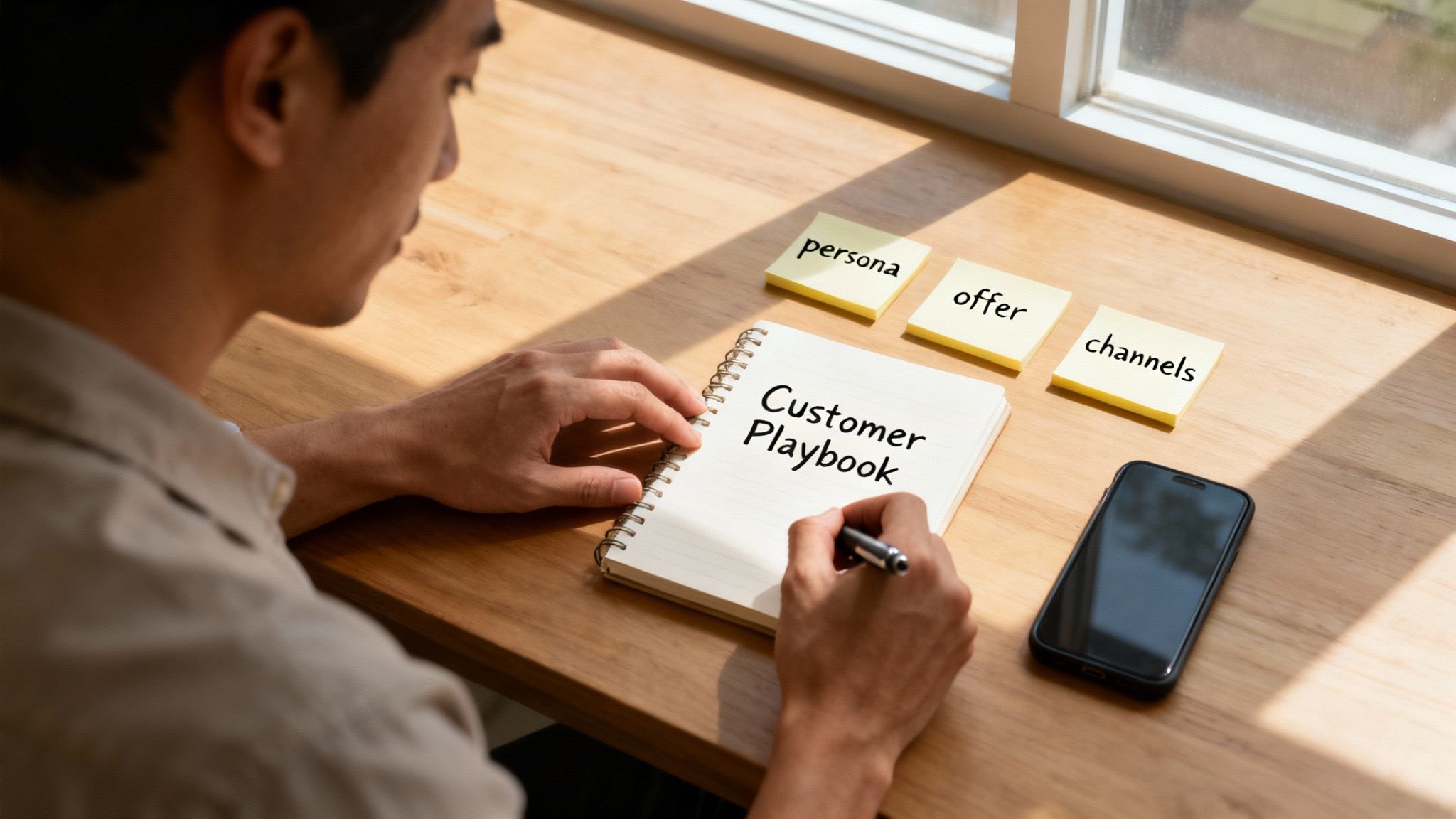
This simple planning process forces you to nail down the two most important questions first: Who are we trying to reach? and What do they care about? The answers you come up with will shape everything that follows, from the words you use in your ads to the channels you choose, including powerful and newly accessible options like TV advertising through Adwave.
This entire process can be visualized as a cycle, where each stage builds momentum for the next.
The Customer Acquisition cycle
Here's a quick look at the core stages we'll be breaking down. Each step logically flows into the next, creating a self-reinforcing system for growth.
By thinking of customer acquisition as a continuous cycle rather than a one-off task, you build a sustainable engine for your business.
Define Your Ideal Customer Persona
First things first, you have to get laser-focused on your ideal customer. This is so much more than basic demographics like age and zip code. A real customer persona is a sketch of your perfect client, brought to life with actual data and some thoughtful market research.
Get inside their head. What’s a daily frustration they have that you can solve? What really drives them to make a purchase? A local HVAC company, for instance, isn't just selling air conditioners; they're selling comfort and peace of mind to a homeowner who’s dreading a brutal summer heatwave.
Key Takeaway: Stop trying to sell to everybody. When you have a deep understanding of one specific persona, your message becomes powerful because it speaks directly to their world, making them feel like you get them.
To start building out your persona, ask yourself:
Pain Points: What specific problems are keeping them up at night?
Goals: What are they trying to accomplish where you can lend a hand?
Watering Holes: Where do they hang out? Think both online (like specific Facebook groups or local news sites) and offline (community events or even certain TV channels).
Craft an Irresistible Offer
Once you know exactly who you’re talking to, you can create an offer that feels like a no-brainer. This isn't just about slapping a discount on something; it's about presenting a value proposition that hits their main pain point head-on. A great offer makes it easy and low-risk for a new customer to say "yes" to you.
As you start pulling your playbook together, this complete guide to digital marketing for lead generation provides a great foundation for growth strategies.
For example, a new local gym shouldn't just offer "10% off membership." A much more compelling offer would be a "Free 7-Day Fitness & Wellness Kickstart" that includes a personal training session and a simple nutrition guide. It directly addresses the customer's goal of getting healthier while completely removing the initial financial risk.
Doing this groundwork is essential because it forces you to think about the long-term value of a customer, which then tells you how much you can afford to spend to get them in the door. To make sure your plan is profitable from the start, check out our guide on customer acquisition cost calculation.
Finding Customers Where They Are
It’s one thing to know who your ideal customer is, but it’s a whole different ballgame to know where to find them. Your customers aren't everywhere, so your marketing shouldn't be either. Spreading your budget thinly across a dozen channels is a surefire way to get mediocre results and burn through cash.
The real key is to be selective. You need to focus on just one or two channels where your target audience spends their time and attention. This isn't about chasing what's popular; it’s about figuring out what’s effective for your business and your customers.
Picking Your Primary Battlegrounds
For most local businesses, the list of potential marketing channels can feel endless and a little overwhelming. You've got your digital standbys and your more traditional, high-impact platforms. The goal is to pick a combination that builds broad awareness while giving interested customers an easy way to find you when they're ready to buy.
Here are a few of the heavy hitters to consider:
Local SEO & Google Business Profile: For any business with a physical address, this is non-negotiable. When someone searches for a "plumber near me," you absolutely have to be there.
Social Media (Facebook/Instagram): This is fantastic for visual businesses like boutiques, cafes, or landscapers, and it's great for building a local following. The real power here is in its ability to hyper-target ads to specific demographics and interests in your town.
Television & Streaming: I know what you’re thinking, but this is a channel that’s too often overlooked by small businesses. It offers unmatched reach and builds a level of credibility that’s hard to get elsewhere. It's the ultimate tool for becoming a household name in your service area, especially with platforms like Adwave making it accessible.
A powerful strategy I’ve seen work time and again is using a high-reach channel like TV to create demand and then using a high-intent channel like local search to capture it. It's a classic one-two punch.
The Overlooked Power of Television
Why does TV work so well for local? It’s simple: it’s where people discover new brands when they’re relaxed and receptive. Global TV advertising, including streaming, is on track to generate around US$101.6 billion in ad spend for a reason. And study after study shows that TV drives brand recall far more effectively than many digital-only channels.
For a local business, this means getting your name and face in front of millions of potential customers on the biggest screen in their home.
Making TV Work on a Small Business Budget
This is where platforms like Adwave change everything. Adwave was designed specifically to knock down the old barriers (sky-high costs, complicated ad production, and confusing media buys) that kept small businesses out of the TV game. It lets you place your ads on major networks and streaming services, but you can target just the zip codes that matter to your business.
Instead of hiring a film crew, you can generate a professional-looking ad in minutes. Instead of locking into a massive contract, you can launch a test campaign for as little as $50. This approach turns TV from an untouchable dream into a practical, measurable tool that builds serious local awareness.
If you want to dig deeper into choosing the right mix, check out our guide on the best local advertising channels for small businesses.
Ultimately, getting customers is about being visible in the right places at the right time. By combining the broad-stroke brand building of accessible TV with the pinpoint accuracy of digital channels, you create a complete customer-attraction system. TV makes them know who you are, and when they pull out their phone to search, your optimized digital presence is right there waiting for them.
Making TV Advertising Your Secret Weapon
What if you could put your local business on channels like NBC, Hulu, and ESPN for less than you spend on a few social media ads? It’s not a pipe dream. For decades, TV felt like a walled garden, open only to huge brands with equally huge budgets. The high costs, complicated production, and confusing media buys put it completely out of reach for the very local businesses that stood to gain the most.
TV Advertising Reimagined For Local Business
Traditional TV requires separate budgets for production and airtime. A crew, script, and edit can cost thousands of dollars before you buy placements.
The process is straightforward. Instead of hunting for a production team, you can generate a professional, broadcast-ready ad in just a few minutes. All you have to do is enter your website URL, and Adwave's AI gets to work, creating a polished spot that’s ready for major networks.
Here’s a glimpse of the Adwave platform interface, which makes ad creation a breeze. This view shows just how easy it is to get started, a user simply inputs their website to kick off the AI-driven ad generation, making the first step toward a TV campaign quick and painless.
From Website URL To Broadcast In Minutes
Think about what this means for a busy business owner. You don't have to learn video editing or hire expensive agencies. Adwave's technology does the heavy lifting, freeing you up to run your business while your brand gets seen on the biggest screen in your customers' homes.
This new level of accessibility is a direct result of major shifts in the advertising world. Cost has always been a major barrier to using TV to win customers, but AI and Connected TV (CTV) are quickly tearing it down. Advances in generative AI, in particular, are giving small and medium-sized businesses access to ad spots that used to be out of reach. In 2020, CTV ads were only 5.9% of total broadcast TV ad revenue; by 2024, that share skyrocketed to 21.5% and is projected to hit 44.7% by 2029. You can get more insights on this trend from PwC.
Restaurant campaign goal: Give nearby diners a reason to book. The Harbor & Pine ads pair oak-grilled seafood with a dockside setting and a direct invitation to reserve a table.
Precision Targeting Meets Transparent Pricing
Another old myth about TV advertising is that it's a "spray and pray" medium, you buy a spot and just hope the right people are watching. That's simply not true anymore. Modern platforms give you precise local targeting, making sure your ad only reaches the households most likely to become your customers.
With Adwave, for instance, you can target specific zip codes. A plumber in one part of town isn't wasting money showing ads to people on the complete other side of the city. This level of control brings digital-style precision to the world of television.
The pricing model has also been turned on its head. Instead of vague negotiations and massive upfront commitments, you get transparent pricing with cost-per-thousand-impressions (CPMs) that often go toe-to-toe with digital channels.
Here’s a quick look at what that means for you:
Campaigns Start Small: You can test the waters with a campaign starting at just $50.
Competitive CPMs: Typical CPMs range from $15 to $35, putting TV right on par with many social media and search ad platforms.
No Surprises: You set your budget, and the platform's automatic pacing makes sure you never spend more than you intended.
This model lets you tap into the immense power and credibility of television to make your business a household name in your community. To learn more about how accessible TV can be, check out our complete guide on TV advertising for small business. It’s your playbook for turning the biggest screen into your biggest advantage.
Launching and Measuring Your First Campaign
Ideas are great, but execution is what gets customers walking through your door. This is where the planning stops and the real work begins. It’s time to take your ideal customer profile, that killer offer, and your channel strategy and bring them to life in a campaign that generates actual business.
The focus now shifts to action and measurement. You need to make sure every dollar you put into this is working hard for you. It's not about having a massive budget; it's about being smart and knowing what's delivering results.
Setting a Realistic First Budget
One of the biggest myths that paralyzes small business owners is the belief that you need a huge marketing budget to make a dent. That’s just not true anymore. The trick is to start with a small, manageable test budget that you're comfortable with and use it to see what sticks.
You don’t need to bet the farm on your first go. In fact, starting small is the smarter play.
For TV Advertising: With a platform like Adwave, you can get a targeted local TV campaign on the air for as little as $50. This lets you test the waters on major channels and see the impact without a scary financial commitment.
For Digital Ads: A budget of just a few hundred dollars is plenty to run a meaningful test on local search or social media for a couple of weeks and gather some solid initial data.
The whole point of this first budget isn't to take over the market overnight. It's to prove your concept. Can you reach your intended audience? Does your message get them to act? Answering these questions with a small budget is far more valuable than blowing thousands on a campaign built on pure guesswork.
Defining What Success Looks Like
Before you spend a single cent, you absolutely must define what a "win" means for your business. If you don't, you'll be flying blind with no way to know if your campaign was a success or a total flop. This means setting clear Key Performance Indicators (KPIs) that are tied directly to your business goals.
Your KPIs are the hard numbers that tell you if you're on the right track. They cut through vague goals like "brand awareness" and focus on things you can count.
My Two Cents: Don't get distracted by vanity metrics like social media likes or impressions. They can feel good, but they don't pay the bills. I'd rather have one phone call from a serious lead than a thousand empty clicks.
For a local business, your most important KPIs will probably be things like:
Website Visits: The number of people who land on your special offer page from an ad.
Phone Calls: Tracking calls that come directly from your campaign (a unique phone number is great for this).
Form Submissions: How many people fill out your "Request a Quote" or contact form.
In-Store Traffic: Measuring the change in foot traffic during your campaign.
This is where you see if your ads are working. After you launch, measuring their effectiveness is everything; an enhanced analytics dashboard for an AI receptionist can provide the kind of deep insight you need to sharpen your strategy. It’s all about connecting your ad spend to real-world results.
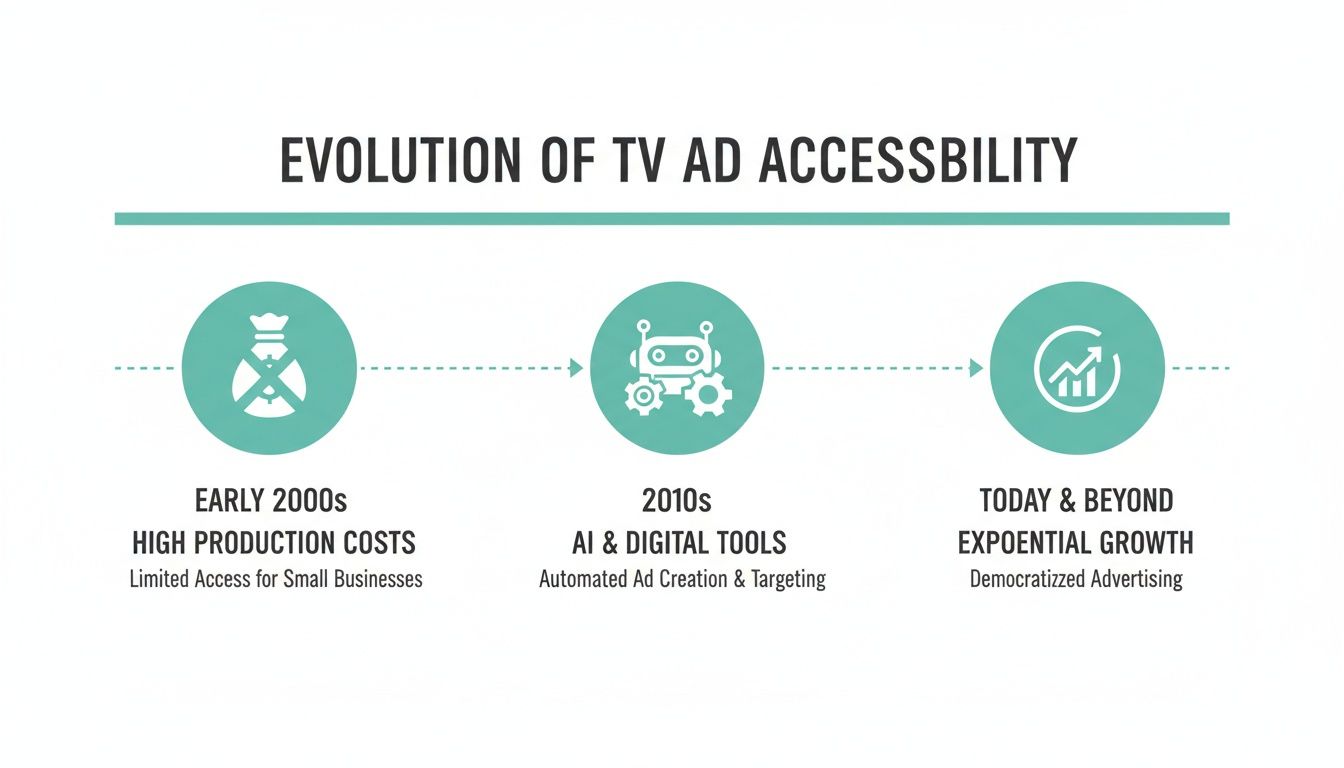
This shift is a big deal. It means tools and platforms are knocking down the financial barriers, letting businesses like yours use channels that were once out of reach.
Sample 30-Day Customer Acquisition Plan
So, what does this look like in the real world? Below is a simple but effective 30-day plan that shows how you can layer different channels to build momentum. Imagine you're a local HVAC company trying to book more service calls.
This kind of structured approach turns spending into a smart investment. You're not just throwing ads out there; you're building a system, learning from the data, and getting better with each cycle.
At the end of the month, you can clearly see what worked and what didn't, allowing you to double down on your winners for the next campaign. For a deeper dive on this, check out our guide on how to measure advertising effectiveness. It'll help you avoid common mistakes and make your next campaign even more profitable.
Don't Let Your Marketing Channels Work in Silos
Think of your marketing channels like a band. You can have a great drummer and a great guitarist, but if they're playing different songs, all you get is noise. The real music (the part that gets new customers in the door) happens when everything works together.
Running disconnected campaigns is one of the fastest ways to burn through a marketing budget. A customer might see a TV ad, then a social media post, and finally land on your website. If those three experiences don't tell the same story, you've lost them.
An integrated strategy makes every dollar you spend work harder. It builds trust and makes your brand memorable, guiding a potential customer from "I've heard of them" to "I'm ready to buy."
TV: The Ultimate Amplifier for Your Digital Ads
One of the most effective plays I've seen local businesses run is using a massive-reach channel like TV to supercharge their digital efforts. TV acts as the lead singer, grabbing everyone's attention and creating a buzz. This makes all your other marketing (like search and social media) far more effective.
Let's say you're a local plumber. You run a TV ad with Adwave, and a homeowner in your area sees it. They don't have a leaky pipe right then, but your brand is now filed away in their mind. A week later, when the kitchen sink explodes, what do they do? They don't just Google "plumber near me." They Google your company's name.
This is a useful option for a few reasons:
It drives branded search. When people search for you by name, that traffic is essentially free. You're not paying to compete for generic keywords.
It lowers your ad costs. Bidding on "emergency plumber" can be expensive. Bidding on your own brand name? Pennies on the dollar.
It sky-rockets conversion rates. Someone who remembers your TV ad is a warm lead. They already trust you more than a random name on a search results page.
This is the secret to getting customers efficiently. You use a platform like Adwave to build that broad local awareness on TV. Then, you make it easy for people to find you online when they're ready to act.
Create a Consistent Customer Journey
Your messaging has to be rock-solid across every channel. The promise you make in a 30-second TV spot needs to match the feeling a customer gets on your website. Any disconnect creates friction and erodes trust instantly.
Imagine a local dentist runs a TV ad promoting a "Gentle, Stress-Free" experience for new patients. But when you click to their website, it's a mess of confusing navigation and pushy pop-ups. The trust built by that ad just vanished.
Pro Tip: Make your offer the glue that holds everything together. If your Adwave TV campaign is pushing a "Free Roof Inspection," that exact offer needs to be the first thing people see on your homepage and in your social media posts.
Consistency makes it dead simple for a customer to take the next step. They see the ad, recognize the offer on your site, and feel confident they're in the right place.
A Simple, Practical Integration Plan
So, how does this look in the real world? Here’s a straightforward playbook for a local business.
Blanket Your Area with TV: Use a service like Adwave to run a targeted TV campaign in the zip codes that matter most. Keep the ad simple: focus on one key problem and a single, irresistible offer. The goal is pure brand recall.
Be Ready for the Search: Make sure your Google Business Profile is polished and perfect. When someone who saw your ad searches for you, they should immediately see great reviews, correct hours, and a clear button to call or get directions.
Keep the Conversation Going on Social: Use your social channels to share customer testimonials, behind-the-scenes videos, and friendly reminders about your offer. You can even run retargeting ads to website visitors, keeping your brand fresh in their minds.
If your main goal is simply to "get more customers," the quickest way there isn't by picking one channel. It's by making a few channels work together, with TV acting as the demand generator. Global ad spend is projected to hit US$1.14 trillion in 2025, and a huge chunk of that, US$178.2 billion, will be in commerce and retail media, which is set to overtake TV ad revenue. The takeaway is clear: your next customer will likely interact with you in multiple places before making a purchase. You can see more on these global ad trends.
By integrating your channels, you build a system that smoothly guides people from seeing your ad to becoming a paying customer. It’s not just more effective, it's far more profitable.
Common Questions About Getting New Customers
Even with a solid playbook in hand, it's natural for questions to pop up when you're getting serious about customer acquisition. Here are some straight answers to the things we hear most often from local business owners, designed to help you move forward with clarity.
What’s the Best Way for a Small Business to Get Customers Fast?
If speed is what you're after, don't put all your eggs in one basket. The fastest way to get new customers through the door is to hit them from two angles at once: one channel for broad reach and another for high-intent searches.
Think of it as a one-two punch.
First, you need a compelling, can't-miss offer. Once you have that, blast it out using a low-cost, high-reach channel like local TV advertising with Adwave. This is your "push" marketing, it builds instant awareness across your entire service area and gets your name in front of people who aren't even looking for you yet.
At the exact same time, you need to nail your "pull" marketing. Make sure your Google Business Profile is completely filled out and optimized for local searches. When the TV ad sparks someone's interest, their first move is often to pull out their phone and search for you. You have to be right there waiting for them. Combining this push-and-pull strategy is a proven recipe for getting quick, measurable results.
How Much Should I Spend on Marketing to Get New Customers?
There's no magic number here. A common rule of thumb you'll hear is to set aside 5-10% of your revenue for marketing, but that can feel like a huge leap when you're just starting. The key is to forget the percentages for a moment and instead start with a small, manageable test budget you're comfortable with.
Modern platforms have made this easier than ever.
With Adwave, you can get a targeted TV campaign live for as little as $50.
For local search or social media ads, a few hundred dollars is usually plenty for a meaningful first test.
The whole point of this initial spend is to measure your return on investment (ROI). You need to figure out your cost per acquisition (CPA), what does it cost you to bring in a new customer? Once you find a channel that brings in customers profitably, you can confidently reinvest your earnings and scale up what’s working.
My Two Cents: Don't get fixated on hitting an arbitrary percentage. Start small, prove a channel works with your own data, and then let profitable performance (not industry benchmarks) dictate your budget.
Is TV Advertising Really Affordable for a Local Business?
Not long ago, the answer was a hard "no." TV was the exclusive playground for big national brands with massive budgets for production crews and expensive ad buys. Thankfully, that world is long gone.
Technology has completely leveled the playing field. Platforms like Adwave use AI to tear down all the old barriers, making TV a real possibility for main street businesses. You don't need a film crew or a six-figure media buy anymore.
Now, you can:
Generate a broadcast-quality TV commercial in minutes, often just by plugging in your website URL.
Pinpoint your ads to specific local zip codes on major channels like Hulu, ESPN, and NBC.
Launch a campaign for as little as $50, with the cost per thousand impressions (CPM) typically falling between $15-$35.
This shift turns television into an affordable and effective tool. It gives you a chance to build the kind of brand credibility that used to be out of reach and become a recognized name in your community.
How Do I Know if My Marketing Is Working?
You'll know it's working when you stop guessing and start tracking. The only way to be sure is to measure the metrics that tie directly back to your business goals.
Before you spend a single dollar, decide what a "win" looks like. Is it a phone call? A form filled out on your website? Someone walking through your front door?
Once you know your goal, tracking is pretty straightforward. You can use simple attribution methods, like putting a unique phone number in your ads or sending people to a dedicated landing page (e.g., yourwebsite.com/tv).
For TV ads run through a platform like Adwave, the process is even simpler. Your dashboard will show you core metrics like impressions and reach. The real magic happens when you line that data up with your own. Watch for a lift in website traffic, an increase in people searching for your brand name directly on Google, and a bump in phone calls or form submissions that coincides with your campaign flight dates. Connecting your marketing efforts to these real-world business outcomes is how you know what's working.


