
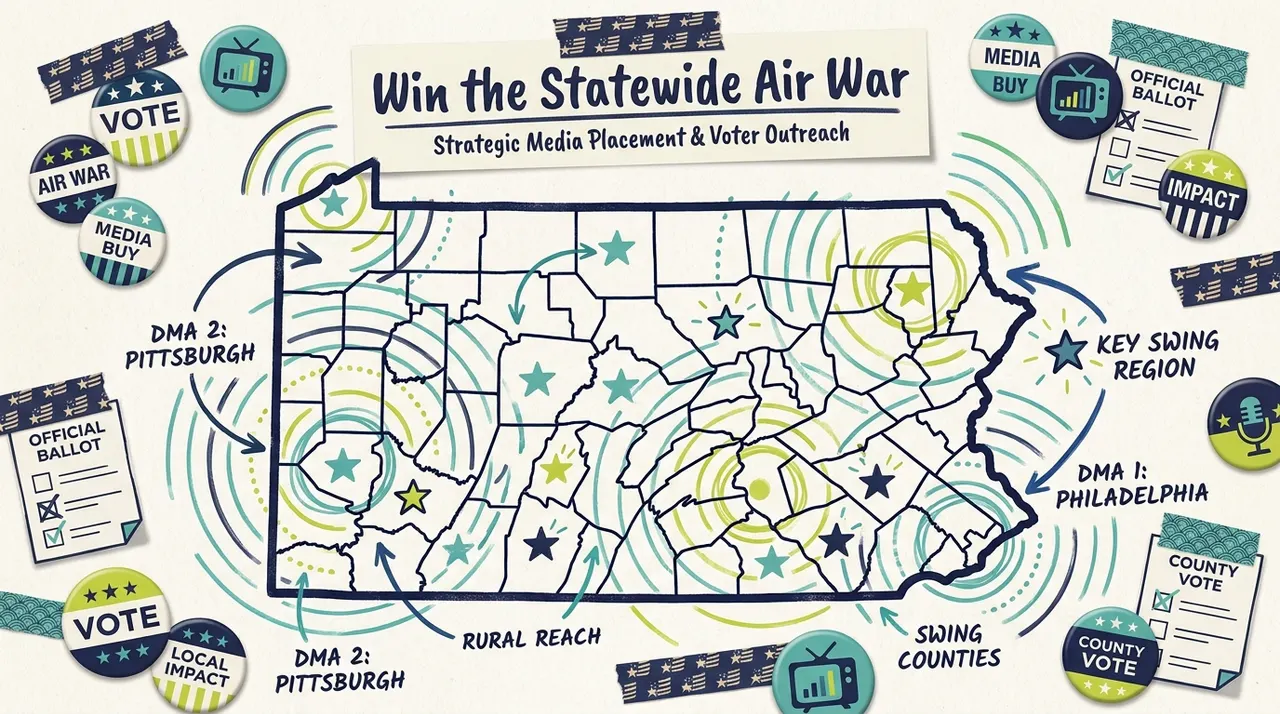
Statewide campaigns may cover 6 to 15 media markets in larger states, including distinct urban and rural audiences. Plan the media budget around that geographic spread.
In 2026, the campaigns winning gubernatorial races are anchoring their TV strategy on connected TV (CTV), with broadcast and cable filling specific roles rather than serving as the default. This guide walks through how to build a statewide TV plan that uses CTV's targeting precision while preserving the reach broadcast still delivers in older and rural-leaning electorates.
Why broadcast-only no longer wins statewide
For decades, gubernatorial campaigns ran broadcast-heavy plans. The economics made sense: statewide DMAs are large, broadcast inventory in those DMAs scales to statewide reach, and the cost-per-reach calculus favored broadcast at scale. That math has shifted.
Three changes in 2024 and 2026 have reshaped the optimal allocation:
1. Streaming surpassed cable+broadcast. Nielsen reported streaming overtaking the combined viewing share of cable and broadcast for the first time in 2024. By 2026, that share has continued to expand, especially in the 25-54 demographic that decides most competitive governor races.
2. CTV inventory expanded. Connected TV inventory across premium streaming networks grew dramatically through 2024 and 2025, with state-level political CTV inventory specifically becoming more programmatically targetable.
3. AI creative compressed turnaround time. Spots that used to take 7-14 days to produce and traffic now go from script to air in 48-72 hours, which fundamentally changes how campaigns respond to news cycles and opponent moves.
The result is that broadcast-only plans are now leaving meaningful persuasion on the table among younger and middle-aged voters, while CTV-led plans are gaining on broadcast's traditional advantage of total reach.
The statewide CTV planning framework
Effective statewide CTV planning has three layers: geographic strategy, persuasion universe targeting, and channel coordination with broadcast and cable.
Geographic strategy
Unlike a congressional district, where you want every impression inside a tight boundary, a statewide campaign needs to allocate impressions across the state's media ecosystems thoughtfully.
A typical state has three distinct geographic buckets for CTV planning:
Major metro DMAs. Where the bulk of the state's population lives. Atlanta in Georgia. Detroit in Michigan. Philadelphia and Pittsburgh in Pennsylvania. Major metros typically deliver 40-65% of total state vote and dominate CTV inventory availability.
Mid-sized DMAs and statewide secondary markets. Smaller cities that serve as regional hubs. These markets often have meaningful undecided populations and are where statewide elections are frequently decided. CTV inventory in mid-sized DMAs is improving but still less dense than in major metros.
Rural and exurban areas. Where broadcast retains its strongest advantage and CTV inventory is thinner. Rural counties often skew older and have lower streaming penetration, which means CTV-only plans miss persuadable voters here.
The right CTV-broadcast-cable allocation differs by bucket. Major metros lean CTV-heavy (60-75% of TV spend). Mid-sized DMAs run more balanced (CTV 45-60%, with broadcast and cable filling reach). Rural areas often need broadcast 50-65% with CTV serving as a complement.
Persuasion universe targeting
The single biggest efficiency gain CTV provides over broadcast in a gubernatorial race is the ability to target persuadable voters specifically, rather than all viewers in a DMA.
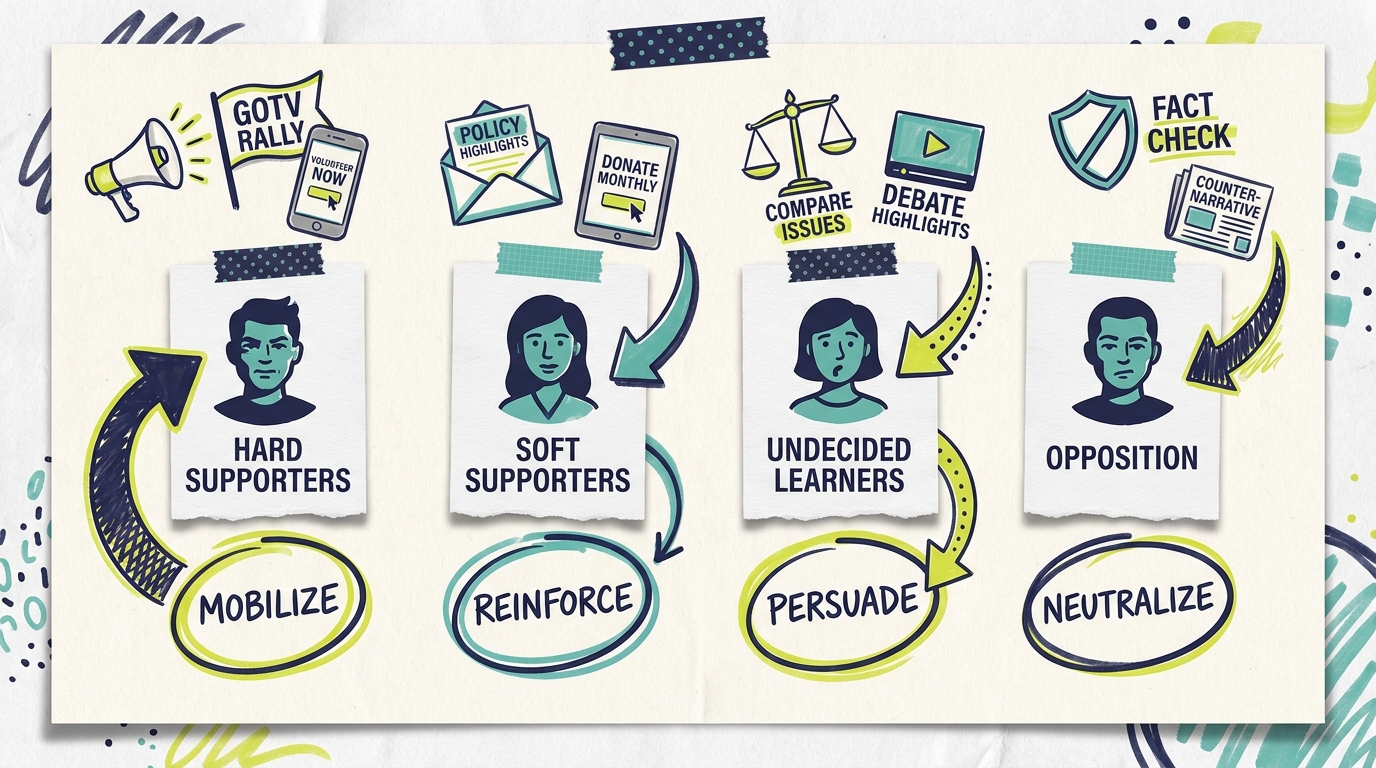
A modern statewide campaign typically operates with 4-6 persuasion universe segments:
Hard supporters who need mobilization, not persuasion
Soft supporters who could be persuaded to vote
Undecided voters leaning toward the candidate
Undecided voters leaning toward the opponent or third party
Hard opposition who shouldn't be targeted (waste of dollars)
High-propensity opposition who should not be reminded to vote
CTV's voter-file matching capability lets you deliver different creative to different segments. Persuasion creative goes to undecided leaners. Mobilization creative goes to soft supporters in the final two weeks. Contrast creative goes to undecided voters who haven't yet seen it. Broadcast can't do any of this; it reaches everyone in the DMA the same way.
Channel coordination
The campaigns winning gubernatorial races in 2026 use CTV, broadcast, and cable for specific coordinated purposes rather than substitutable channels.
CTV's role: persuasion universe targeting, household-level addressability, fast creative iteration, urban and suburban reach.
Broadcast's role: total reach to older and rural voters, news/local-event proximity, statewide "I'm running" awareness in earlier phases.
Cable's role: complement to broadcast in major metros where cable subscription rates remain meaningful, supplemental reach during specific cable-watched events (statewide news programming, regional sports).
When these channels work together rather than against each other, the same total budget produces dramatically more persuasion than channels run in isolation.
The campaign calendar
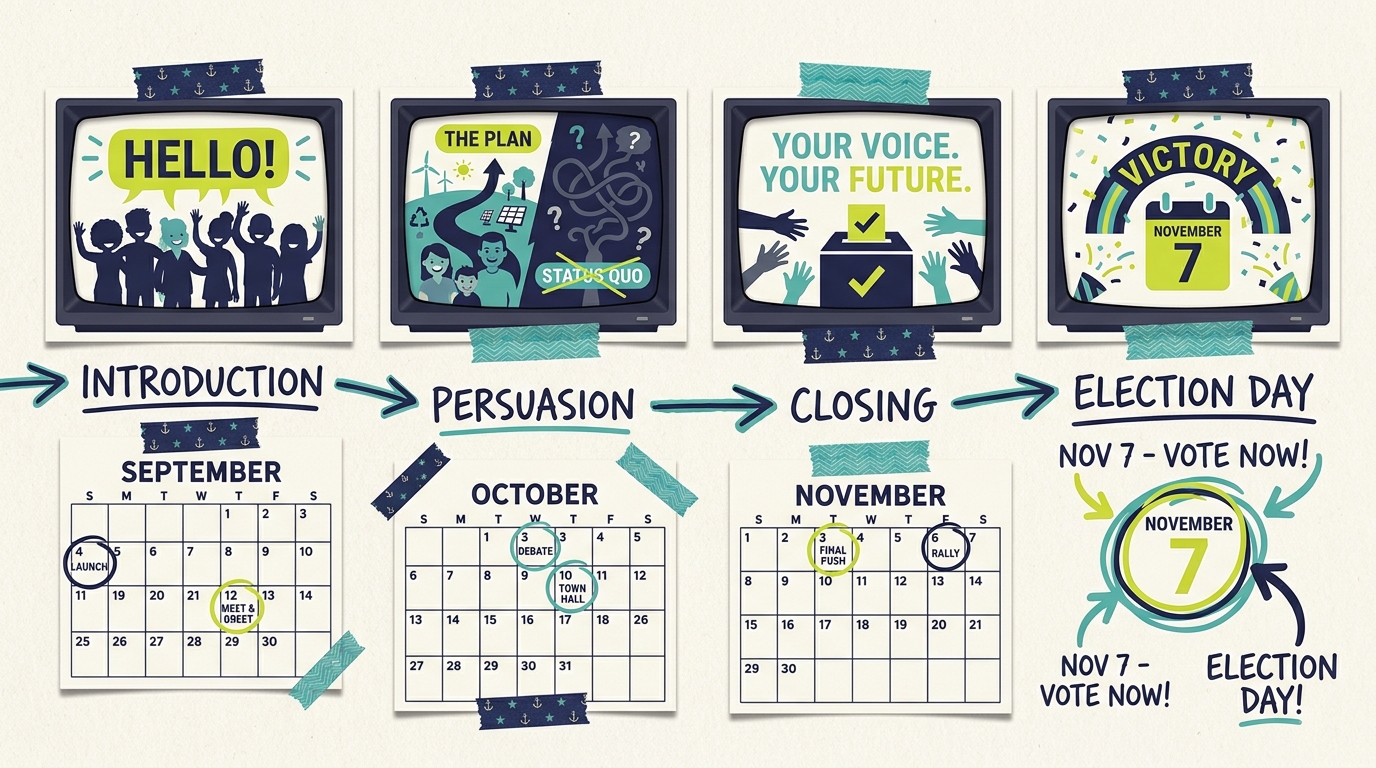
A typical competitive gubernatorial race in 2026 runs three or four advertising phases.
Phase 1: Introduction and contrast (May through Labor Day)
Most campaigns launch significant statewide TV in late spring or early summer of the election year. The work in this phase is establishing or extending name ID and starting contrast with the opponent.
CTV emphasis: Bio and values content in major metros. Issue framing in mid-sized DMAs. Persuasion universe begins targeting soft supporters and undecided leaners.
Broadcast emphasis: Statewide name-ID lift in rural and older-skewing DMAs. Generally lighter weight in this phase than later.
Cable emphasis: Selective use in major metros during news programming and statewide cable events.
Recommended TV spend share: CTV 50-60%, broadcast 30-40%, cable 5-10% in this phase.
Phase 2: Persuasion (Labor Day through mid-October)
This is the heart of the gubernatorial race. Persuasion universe targeting becomes the foundation, contrast spots run heavy, and creative iteration speeds up.
CTV emphasis: Heavy household-level addressable delivery. Different creative to different persuasion segments. Geographic reweighting weekly based on internal polling.
Broadcast emphasis: Continued reach to older and rural voters. Some contrast spots that benefit from broad audience exposure rather than targeted delivery.
Cable emphasis: Issue spots targeted to cable-rich major-metro suburbs.
Recommended TV spend share: CTV 55-65%, broadcast 28-38%, cable 5-10% in this phase.
Phase 3: Closing and mobilization (mid-October through Election Day)
The final three weeks compress all of TV's strategic muscle. Creative refreshes daily based on news, opponent moves, and polling shifts. Mobilization creative ramps for base voters.
CTV emphasis: Late-breaking contrast in 48-72 hour creative cycles. Mobilization creative to high-propensity supporters in the final week. Geographic shifts based on where polling is closest.
Broadcast emphasis: Closing-week reach to broaden total impressions. Some campaigns run heavy broadcast in the final 10 days specifically to maximize total reach.
Cable emphasis: Continued issue and contrast targeting in specific markets.
Recommended TV spend share: CTV 50-60%, broadcast 35-45%, cable 5-10% in this phase. (Some campaigns shift broadcast share up in the closing window for reach saturation.)
Phase 4 (optional): Election Day reinforcement
In states with same-day voting and competitive races, the morning and early afternoon of Election Day see meaningful media activity. Broadcast and CTV both play roles here, with creative shifting to pure mobilization framing.
Creative principles for gubernatorial CTV
The grammar of effective CTV creative for a governor race differs from federal or down-ballot creative.
Statewide identity, not district-specific. Your spot needs to feel like a statewide campaign, not a local one. Visual cues that signal the state's identity (geography, civic landmarks, cultural touchstones) anchor the brand. Specific local references work better in down-ballot creative than statewide.
Personal narrative early in the cycle, contrast later. The introduction phase rewards spots that tell the candidate's story: where they grew up, what shaped them, what they stand for. Contrast spots come later as the race tightens.
One message per spot. Same as in House races, but at statewide scale the discipline matters more because the impression-per-dollar cost is higher. A bio spot is a bio spot. A contrast spot is a contrast spot. Combining diluted both.
Production grammar that signals statewide gravity. Statewide creative should look and sound like a statewide campaign. Wide cinematography, professional voiceover, music that supports rather than dominates. AI creative tools now produce this grammar at small-campaign budgets.
Hook in 5 seconds. Streaming attention is fast. The first 5 seconds need to establish "this is about something I care about" or the spot loses attention. Avoid slow open-on-candidate-walking shots.
FEC and state-specific compliance disclosures. Gubernatorial creative has both federal-style and state-specific disclosure requirements. Compliance review before launch is non-negotiable.
Targeting tactics that move states
A few specific tactics have separated winning gubernatorial CTV plans from average ones in the 2024 and 2026 cycles:
Voter-file matched persuasion universe. Targeting only voters identified by the campaign's modeling as movable. Most efficient way to spend statewide dollars.
Geographic reweighting based on internal polling. Weekly adjustments to where CTV impressions are weighted, based on which counties or DMAs are tightening or moving in your direction.
Household addressable for spouse and family. Reaching the candidate's persuadable voter is one thing; reaching that voter's spouse who may also be persuadable is another. CTV's household-level reach is one of its biggest underused advantages.
Frequency caps tuned to phase. Lower caps (5-7 per voter per week) in introduction phase. Higher caps (8-12) in closing weeks as you push for recall. Without caps, CTV over-delivers to heavy-streaming households.
Cross-channel coordination with paid digital. When a voter sees your statewide CTV spot, then your Meta retargeting ad references the same theme, then your Google search ad confirms it, the persuasion compounds. Statewide campaigns coordinating CTV with paid digital outperform campaigns running them separately.
Budgeting a gubernatorial CTV plan
Gubernatorial budgets vary enormously, with some races topping $100M in total spend and others running under $5M. Some directional benchmarks for 2026 cycle TV allocation:
Open seat in a large competitive state with $40M+ total budget: TV typically $18M-$28M, with CTV at $9M-$16M (50-60% of TV).
Competitive race in mid-sized state with $15M-$25M total budget: TV typically $7M-$13M, with CTV at $4M-$8M.
Smaller-state competitive race with $5M-$12M total budget: TV typically $2.5M-$6M, with CTV at $1.4M-$3.5M.
Long-shot challenger or open-seat in safe state with under $3M total budget: TV typically under $1M, with CTV at 70%+ of TV spend because of the efficiency advantage at smaller scale.
Across all budget tiers, the strategic shift in 2026 is that CTV is no longer the experimental supplement to broadcast. It's the anchor of the TV plan, with broadcast and cable filling reach roles.
Measurement and attribution
Gubernatorial campaigns measure differently than commercial advertisers because the "conversion" is a vote, not a purchase.
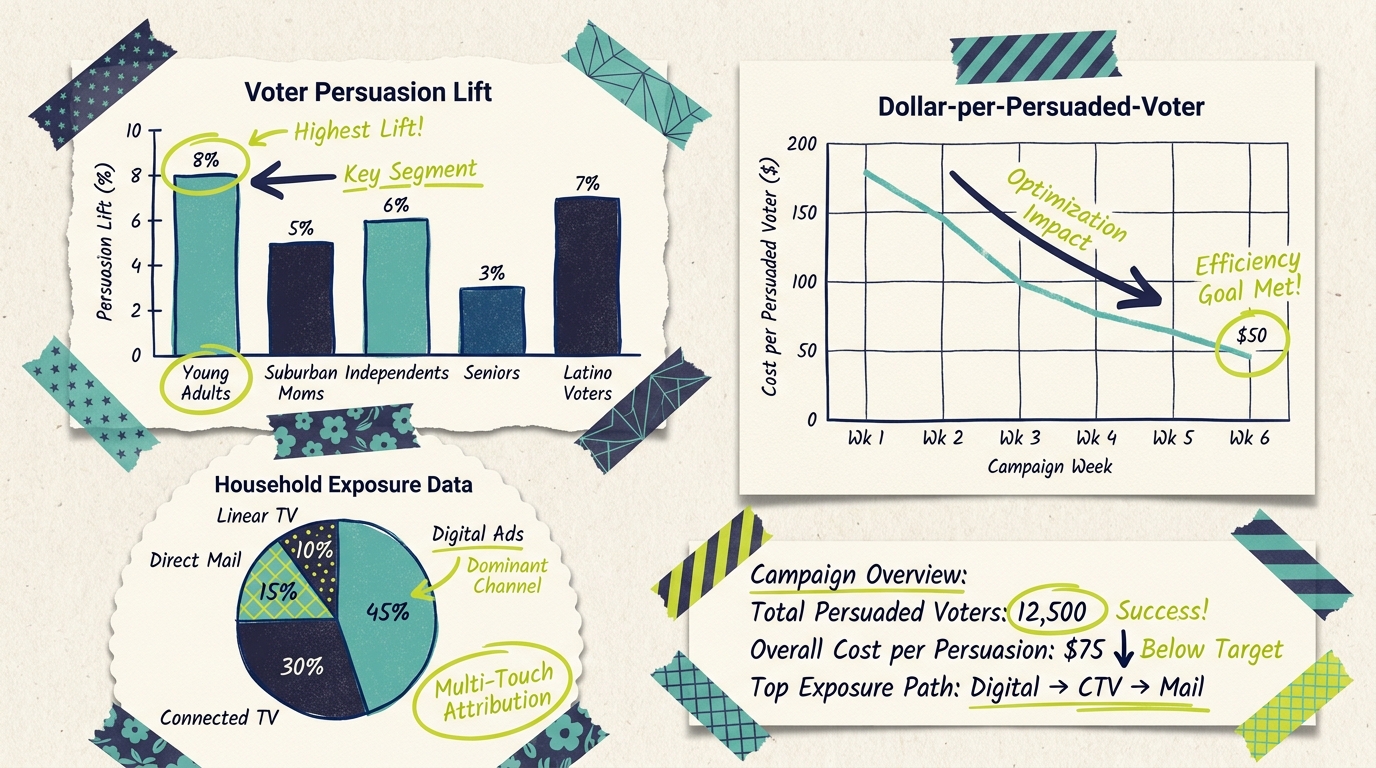
Persuasion lift studies. Pre/post survey work in randomized geographic or household segments. CTV's targeting precision makes these studies more accurate than they can be on broadcast.
Voter file modeling. Matching CTV exposure data to the voter file to measure candidate ID and vote-intention movement in exposed vs. unexposed households.
Branded search and digital engagement signals. Searches for the candidate's name, donations from state residents, small-dollar contribution timing during CTV flights.
Dollar-per-persuaded-voter modeling. The most useful internal metric, calculated from lift studies and matched-back exposure data. Competitive 2024 gubernatorial campaigns reported CTV costs per persuaded voter in the $25-$70 range, versus broadcast's typical $90-$180 range.
The 2026 cycle reality
A few specific patterns shape 2026 gubernatorial CTV planning:
Inventory will tighten in October. Even with the dramatic CTV inventory expansion of the past two cycles, the most competitive states will see real inventory pressure in the closing weeks. Book key inventory windows by early September.
AI creative compresses cycle-time advantage. The campaigns moving fastest in October will use AI-assisted creative to push refreshes in 24-48 hours. The cycle-time gap between fast and slow campaigns matters more in CTV than it ever did in broadcast.
Down-ballot benefit remains underexploited. Coordinated buys across gubernatorial + state legislative races in the same regions can yield meaningful efficiency, but most campaigns aren't yet structured to capture them.
State-specific compliance complexity is rising. State campaign finance and advertising disclosure rules have grown more complex in several states. Build compliance review into the workflow rather than treating it as a final check.
Common questions answered
How does gubernatorial CTV differ from congressional CTV?
Geography is the biggest difference. Congressional CTV targets a specific district where you want every impression inside the boundary. Gubernatorial CTV targets the whole state with strategic allocation across major metros, mid-sized DMAs, and rural areas. The persuasion universe targeting capability is similar, but the geographic strategy is more layered.
Should a gubernatorial campaign use broadcast at all?
Yes, but not as the anchor. Broadcast still delivers reach to older and rural voters more efficiently than CTV in most states. The right approach is using broadcast for that reach role while anchoring the persuasion and targeting work on CTV. Broadcast-only plans miss meaningful persuasion among younger and middle-aged voters; CTV-only plans miss reach in rural and older-skewing populations.
What's the right CTV-to-broadcast ratio in a competitive governor's race?
For most 2026 competitive gubernatorial races, CTV at 55-65% of TV spend and broadcast at 30-40% (with cable at 5-10%) is increasingly common. Exact splits depend on state demographics (older, more rural states skew slightly more broadcast; younger, more urban states skew more CTV) and on the campaign's persuasion universe characteristics.
How does FCC/FEC compliance work for CTV in gubernatorial races?
Federal disclosure rules (FEC "paid for by" disclaimer) apply to all federal-related communications. For gubernatorial races specifically, state-level disclosure requirements vary widely; some states impose additional disclosures that exceed federal minimums. Equal-time rules apply differently to CTV than to broadcast (pure streaming inventory operates under different rules than licensed broadcasters). Every campaign should have compliance counsel review CTV creative before launch.
Can a gubernatorial campaign self-serve through a platform like Adwave?
Adwave is currently optimized for small business advertisers rather than political campaigns. Gubernatorial campaigns typically work with political-specific CTV platforms that include voter-file integration, compliance disclosure handling, and persuasion-universe targeting. The platforms designed for commercial advertising lack the political-specific capabilities most statewide campaigns require.
How early in the cycle should a gubernatorial campaign start CTV?
For open seats and challenger races in larger states, late spring of the election year (April-May) is typical. Some campaigns experiment with off-cycle CTV in the prior fall for ID lift, especially in states with strong incumbent challenges. The bulk of CTV spend in most gubernatorial races concentrates in the August-November window, with the heaviest weight in the final 8 weeks.
What's the most common mistake gubernatorial campaigns make with CTV?
Treating CTV like broadcast (running statewide creative without persuasion universe targeting). The targeting precision is where CTV produces its efficiency advantage. Running broadcast-style "everyone in the state sees the same spot" creative through CTV inventory wastes most of what makes CTV valuable.
The bottom line
Gubernatorial campaigns in 2026 that anchor their TV strategy on CTV (with broadcast filling reach gaps and cable supplementing where it adds value) consistently outperform campaigns defaulting to a broadcast-led plan. The targeting precision, creative speed, and household-level addressability of CTV produce more persuaded voters per dollar than any other TV channel.
The campaigns winning competitive governor's races in 2026 will be the ones treating CTV not as a digital line item but as the foundation of the TV plan, with creative built for streaming, targeting built on the voter file, and measurement built on persuasion lift rather than vanity reach numbers.
If you're building a 2026 gubernatorial TV plan, the question isn't whether CTV belongs in the strategy. It's how aggressively your plan is anchored on it.


