Making a commercial used to be a huge, expensive headache. Thankfully, those days are over. The modern process is much simpler: know your goal, pinpoint your audience, and pick a smart production method. Today, any small business can create a broadcast-quality ad without the Hollywood budget or a complicated production team.
The New Rules for Making a Commercial
Let’s get one thing straight: the old idea that you need a massive budget, a full camera crew, and months of planning to make a commercial is dead. Technology has completely leveled the playing field for small businesses, making high-quality advertising accessible to everyone. The focus has shifted from complicated logistics to smart, data-driven strategy.
This guide will walk you through a practical workflow for creating commercials that get results. We're going to ditch the old-school thinking and show you how to grab attention on major platforms like Hulu, NBC, and ESPN, even if you’re working with a modest budget. The ad world is moving fast, and understanding how to use AI for marketing is becoming essential for creating effective ads and staying ahead.
TV Advertising Is More Accessible Than Ever
The single biggest change is the cost of entry. What once required tens of thousands of dollars can now be done for a tiny fraction of that, all thanks to new platforms and channels. The explosion of connected TV (CTV) has been a useful option, opening up premium ad space on streaming services that used to be reserved for the big national brands. You can learn more about this in our guide: https://adwave.com/resources/what-is-connected-tv-advertising.
This isn’t just a small shift; it’s a seismic one. According to PwC's Global Entertainment & Media Outlook, CTV ad revenue was just 5.9% of traditional TV ad spend in 2020. By 2024, that number shot up to 21.5%, and it's on track to hit a massive 44.7% by 2029. This trend is what allows local businesses to launch targeted campaigns for as little as $50.
Your Secret Weapon: AI-Powered Production
So, what's powering this newfound accessibility? Artificial intelligence. Platforms like Adwave are completely turning the old production process on its head. Just think about it, creating a polished, broadcast-ready commercial without ever hiring a film crew or a voice actor.
With a tool like Adwave, you can generate a complete ad simply by plugging in your website URL. The AI does all the heavy lifting for you:
It analyzes your brand to nail your message and vibe.
It finds high-quality stock footage and licensed music.
It writes a professional script and generates a voiceover.
It puts it all together into a final commercial in minutes, not weeks.
This isn't just about saving money; it's about reclaiming your time. For a busy small business owner, being able to create and launch a professional TV ad in less time than it takes to brew a pot of coffee is a massive advantage. It puts you on the same turf as your much larger competitors.
Building Your Commercial Strategy Foundation
Before you think about a script or a camera, let’s talk strategy. I've seen too many businesses jump straight into production, excited about the creative process, only to end up with a beautiful ad that does absolutely nothing for their bottom line.
Think of it this way: launching a commercial without a solid plan is like building a house without a blueprint. It's a recipe for disaster. This initial planning phase is where you tie your real-world business needs directly to the creative choices you'll make later.
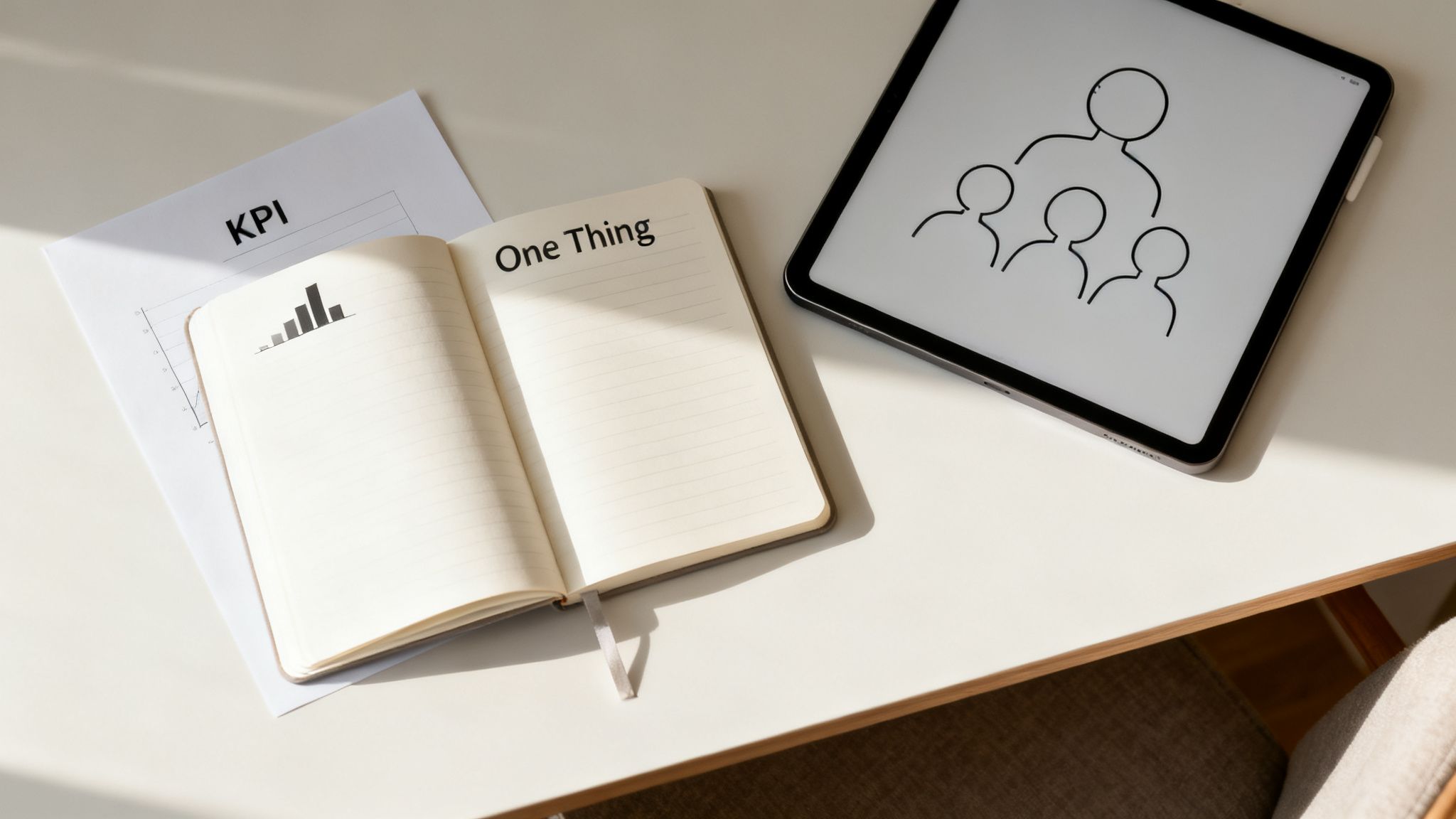
The very first thing you need to do is define your "one thing." It’s tempting to make your ad do everything at once, build brand awareness, announce a new product, drive web traffic, and promote a sale. Resist that urge. An ad that tries to do everything will accomplish nothing.
Defining Your Primary Goal
Let's get specific. Is your main goal to get more people walking through your shop's door? Or is it to drive traffic to your website to book appointments? Maybe you're brand new, and your only mission is to get your name out there so people in the neighborhood know you exist.
Each of these objectives demands a completely different ad. A different message, a different tone, a different call to action. Nailing this down from the get-go is the only way to create commercials that deliver a real return.
A commercial without a single, clear goal is just noise. Your 'one thing' is the guiding star for every decision that follows, from the script and visuals to the final call-to-action. It ensures your ad has a purpose beyond just looking good.
For a deeper dive into setting effective campaign objectives, our guide on strategic advertising account planning is a great resource. Once you've locked in that primary goal, we can move on to the next critical piece of the puzzle.
Understanding Your Target Audience
Knowing who you’re talking to is just as important as knowing what you want to say. And please, don't say your audience is "everyone." To create an ad that connects, you have to dig deeper than basic demographics like age and gender.
What problems keep your ideal customer up at night? What are their daily frustrations or aspirations? A plumber isn't just selling a service; they're selling the peace of mind that comes when a burst pipe is handled at 2 a.m. A local coffee shop isn't just selling caffeine; it's selling a comfortable third space to work or a moment of sanity in a hectic day.
This is how you craft a message that resonates. It’s the difference between an ad that gets immediately skipped and one that makes someone stop and think, "Hey, they get me."
Setting Your Budget and KPIs
Finally, let’s talk money and metrics. You need a realistic budget and a clear way to know if your ad is working. Your budget will naturally guide your production choices and where you can afford to place your commercial.
While big TV campaigns used to be out of reach for most small businesses, that's no longer the case. Platforms like Adwave have opened the door for highly targeted campaigns with budgets starting as low as $50.
Your Key Performance Indicators (KPIs) are the numbers that prove whether your ad is a success. These metrics must tie directly back to that "one thing" you defined earlier.
Matching Your Commercial Goal to the Right KPI
Use this framework to align your advertising objective with the right metrics for measuring success.
This foundation (a clear goal, a deep audience understanding, and measurable KPIs) is the bedrock of a successful commercial. It ensures every dollar you spend and every ounce of creative energy is pushing toward a tangible business result.
Scripting a Commercial That Connects
Let's talk about the heart of your commercial: the script. This is where all that groundwork on your goals and audience pays off. You're turning strategy into a story that has to grab someone's attention in the blink of an eye. In TV and streaming, you have seconds (literally) so every single word is critical.
The commercials that stick with us don't just sell. They connect. They often tap into a narrative structure that's as old as storytelling itself: the classic problem-solution framework. It's your secret weapon for making a 30-second ad feel less like an interruption and more like a helpful conversation.
The Problem-Solution Blueprint
There’s a reason this framework is the backbone of so much great advertising, it just works. People instantly get it. Your script needs to flow through three distinct beats to take your viewer on a quick, compelling journey.
Kick off with a relatable problem. You need to show a challenge your audience knows all too well. This creates an immediate "aha, they get me" moment.
Introduce your business as the clear solution. After setting up that pain point, bring in your product or service as the perfect answer.
Finish with a strong call to action (CTA). Don't be shy. Tell them exactly what to do next, and make it sound urgent and easy.
Imagine a local home services company. Their ad could open with a shot of a homeowner just staring at a messy, overgrown yard in despair (the problem). The next scene? A friendly, professional crew quickly turns that jungle into a pristine backyard oasis (the solution). The ad closes with a clear, direct offer: "Visit our website for a free estimate today!" (the CTA).
This structure is effective because it mirrors how we think. It presents a common frustration and then offers a clear path to relief. That’s how you make your brand both helpful and memorable.
The real trick isn't to list your features. It's to tell a story where your customer is the hero, and your business is the guide helping them win the day. This simple shift in perspective is what separates a forgettable ad from one that moves the needle.
Visualize Your Story with a Storyboard
Once you’ve got a script draft, it's time to see how it looks. This is where a storyboard becomes invaluable, and you definitely don't need to be an artist to make one. A storyboard is just a simple, scene-by-scene visual map of your commercial.
Think of it like a comic strip version of your ad. For each key moment or line of dialogue, sketch out a quick frame that answers a few questions:
Setting: Where is this happening?
Characters: Who's on screen and what are they doing?
Key Visuals: Will your logo, a product, or any text appear?
Camera Angles: Even a simple note like "close-up shot" or "wide shot" helps.
Laying it all out visually before you start filming is a useful option. You’ll immediately spot if the story flows well, if the pacing feels right for a 30-second spot, and if the "solution" scene has the punch it needs. It ensures your words and your pictures are telling the same powerful story.
How Adwave Handles the Script
Let's be honest, writing a tight, effective script is tough, especially when you're busy running a business. This is where a tool like Adwave can give you a serious leg up. Instead of starting with a blank page, Adwave’s AI scans your website to get a feel for your brand's voice, what you offer, and what makes you special.
It then automatically generates a script built on that proven problem-solution framework, already optimized for a 30-second commercial. It takes the guesswork out of the creative process, giving you a professional-grade script that’s designed to connect. To dive deeper into the art of message-crafting, check out our guide on how to write a script for advertising over on the blog. It’s a huge time-saver and gives you a solid foundation to build on.
Picking Your Production Path: DIY, Agency, or AI?
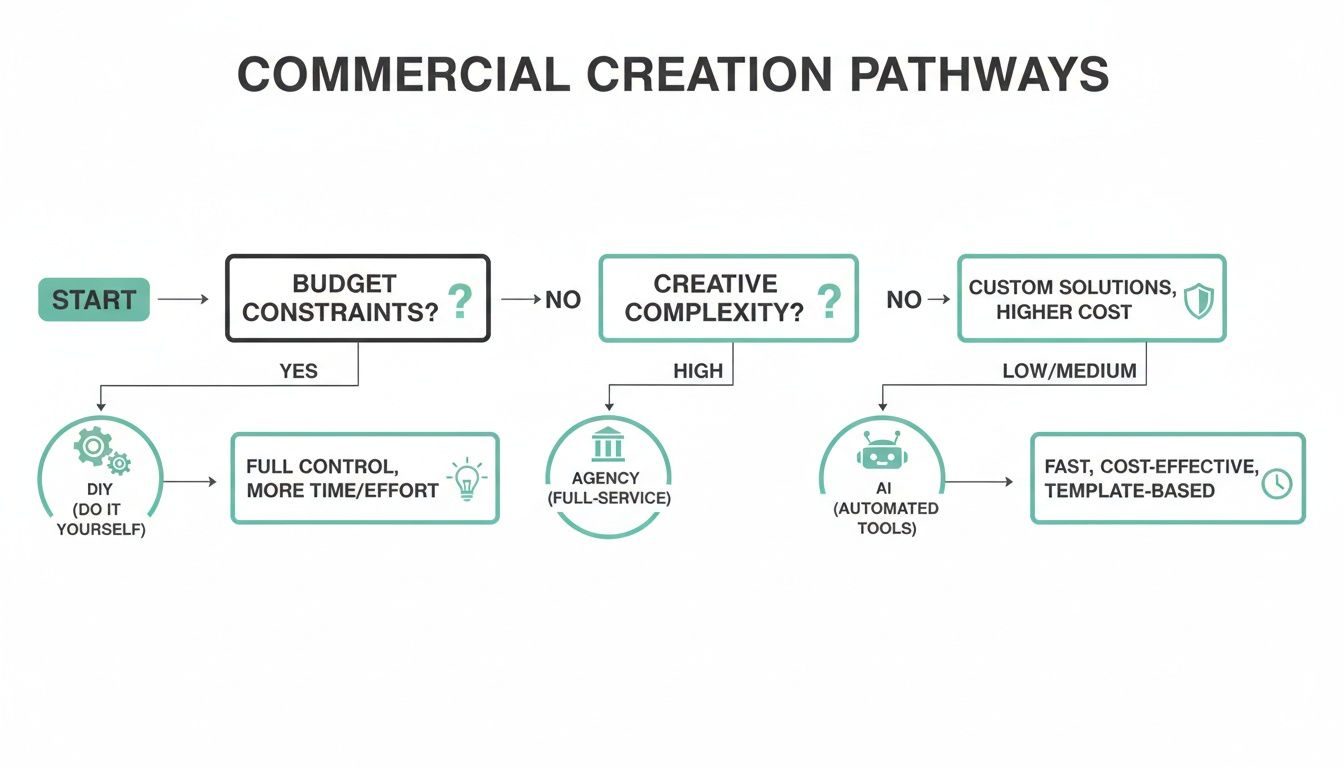
You've nailed down your strategy and polished your script. Now comes the big question: how are you going to make this thing? This is where your vision turns into a real commercial people can see and hear. For a small business, this decision usually boils down to three main routes, each with its own pros and cons when it comes to cost, time, and creative heavy lifting.
What you decide here will shape your budget, your timeline, and the final vibe of your commercial. There’s no single "right" answer, it all comes down to what you have to work with and what you’re trying to achieve.
Think of it like this: your budget, how much time you can spare, and your comfort level with the creative process will point you toward the best path for your business.
The DIY Approach: Rolling Up Your Sleeves
Going the Do-It-Yourself route gives you total creative control and is often the cheapest option upfront. Honestly, with the quality of today's smartphones, you can shoot some surprisingly good-looking video. Combine that with some user-friendly editing software, and you've got the basic toolkit.
The trade-off? This path will eat up a massive amount of your most precious resource: time. You're the director, camera operator, and sound engineer, all in one.
You’ll be responsible for everything:
Filming: Getting steady, well-lit shots is harder than it looks.
Audio: Capturing clean sound without the hum of the air conditioner or a dog barking is a real challenge.
Editing: Stitching it all together, adding text, and making the colors look right.
Sourcing Music: Finding and licensing royalty-free music so you don't get hit with a lawsuit.
It can be a super rewarding process if you have a knack for it, but be prepared for a steep learning curve.
Hiring the Pros: Freelancers and Agencies
If you're weighing the pros and cons of keeping work internal versus hiring out, a deep dive into in house vs agency marketing can be really enlightening. Bringing in professionals means they handle the entire production process from start to finish.
A good agency or freelance team brings years of experience, pro-level gear, and a trained eye to the project. They take care of the nitty-gritty stuff like casting actors, scouting locations, and all the post-production magic, delivering a broadcast-quality commercial while you focus on your business.
The obvious downside is the price tag. Professional video production is a serious investment. A simple project might start in the low thousands, but a more involved shoot can easily run you $25,000 or more. It's the perfect option if you have a dedicated marketing budget and need a highly polished, custom-made ad.
My Takeaway: Choosing a production path is a classic balancing act between three things: cost, time, and quality. You can usually get two out of three right, but the third one will always be a compromise. The trick is knowing which two are most important to you from the get-go.
A Modern Alternative: The AI-Powered Path with Adwave
There's a third option that’s really changing the game, especially for small businesses. AI-driven platforms like Adwave offer a compelling middle ground, you get the speed and affordability of DIY but with a professional polish that rivals what an agency can produce.
With Adwave, the heavy lifting is done for you. You just feed it your website URL, and the AI takes over:
It analyzes your brand's voice and visual style.
It finds high-quality, fully licensed stock footage and music.
It writes a script and generates a surprisingly human-like voiceover.
It pieces it all together into a broadcast-ready commercial in a matter of minutes.
This approach pretty much eliminates the production headache. No cameras to buy, no software to master, and no endless email chains with a creative team. You end up with a high-quality ad ready for TV and streaming on platforms like Hulu and ESPN. For a deeper look, check out our guide on AI TV commercial production.
To give you a better sense of how these options stack up, let’s break them down.
Comparing Commercial Production Methods
Ultimately, the best path depends on your specific circumstances.
This kind of efficiency is becoming non-negotiable. Reports project that commerce media ad revenue will hit a staggering $178.2 billion by 2025, quickly overtaking traditional TV ad spend. This shift highlights the growing need for data-driven ads that can be created quickly.
AI platforms like Adwave make advertising more accessible, allowing smaller businesses to create targeted spots that can generate impressive ROIs of 200% to 400%, sometimes even higher. For a small business, this isn't just about making an ad, it’s about being able to compete and win in a market that moves at lightning speed.
Getting Your Ad on Screen and Tracking Its Success
You’ve poured your heart and soul into creating the perfect commercial. It looks fantastic, the message is spot-on, and you're ready to see it work its magic. But creating the ad is just the starting point. The real test begins when you get it in front of the right audience and, importantly, figure out if it's making a difference.
This is where your commercial transforms from a creative file on your computer into a hard-working, revenue-generating asset for your business. Thankfully, the old days of needing a specialized media buyer and wrestling with complicated network contracts are long gone. Modern platforms have opened the doors for anyone to launch a TV campaign.
You Don't Need to Be a Media Buyer Anymore
Media buying used to be this walled-off garden, a confusing world of negotiations, rate cards, and insider jargon. It was intimidating. Today, technology has completely leveled the playing field, giving small businesses the keys to premium ad space that was once only available to giant corporations with bottomless budgets.
This is where a platform like Adwave really changes the game. You don't have to become an expert in ad placement because the system handles it all for you. Once your commercial is ready to go, Adwave automatically pushes it out across a network of over 100 premium channels, think big names like Hulu, ESPN, and NBC.
Even better, it's not just a shotgun blast. The platform uses smart targeting to zero in on the most relevant local viewers. That means your ad for, say, a local roofing company isn't just shown to random people; it’s strategically placed in front of homeowners right in your service area who are far more likely to need your services.
Watching Your Campaign's Performance in Real Time
The biggest leap forward in TV and streaming advertising is the ability to measure everything. Gone are the days of buying a TV spot, crossing your fingers, and hoping for the best. Now, you get a live look at the data, showing you exactly how your ad is performing from the moment it airs.
Remember those Key Performance Indicators (KPIs) we talked about in the strategy phase? This is when they come back into play. A good ad platform will give you a clean, simple dashboard to keep an eye on these metrics as your campaign rolls out.
Being able to track performance in real time is a useful option for small businesses. It turns advertising from a blind expense into a measurable investment. You can see what's working, what isn't, and make smart decisions to get a better return.
This data-first approach is absolutely essential today. According to the IAB’s Digital Video Ad Spend Report, digital video ad spending in the U.S. is projected to hit $72 billion in 2025. This explosion is fueled by Connected TV (CTV) and online video, which are on track to make up nearly 60% of all TV and video ad investment. These platforms let small businesses get the massive reach of traditional TV with the laser-focused targeting of a digital ad, all while tracking results just like you would an online campaign.
Key Metrics to Keep an Eye On
When you log into a platform like Adwave, you won’t be buried under a mountain of confusing charts. Instead, you’ll find a handful of core metrics that give you a clear picture of your campaign's health. For a local business, these are the ones that matter:
Impressions: This is simply the total number of times your commercial was shown. It's your baseline metric for brand awareness.
Reach: This tells you how many unique households saw your ad. It's a great way to gauge how far and wide your message is spreading within your target market.
View-Through Rate (VTR): What percentage of people watched your entire commercial? A high VTR is a strong signal that your creative is hitting the mark and keeping people engaged.
Frequency: This shows you the average number of times a single household saw your ad. Finding the right frequency is key, you want your message to stick without becoming annoying.
Watching these numbers allows you to react and adjust on the fly. For instance, if you notice your VTR is disappointingly low, it might mean the first few seconds of your ad aren't grabbing people's attention. If your impressions are through the roof but your website traffic isn't budging, you might need to make your call to action punchier and more direct. This constant feedback loop is what makes modern advertising so powerful for small businesses learning how to create commercials that drive growth.
Got Questions? We’ve Got Answers.
Jumping into TV and streaming ads for the first time? It's natural to have a few questions. Let's tackle some of the most common ones we hear from small business owners who are new to the game.
How Long Should My Commercial Be?
For most small businesses, the 30-second commercial is the sweet spot. It gives you just enough time to hook the viewer, present a problem, offer your solution, and close with a call to action, all without breaking the bank.
You'll also see shorter 15-second ads. Think of these as powerful reminders; they work best for building brand recall after an audience has already seen your main 30-second spot. On the flip side, 60-second spots are great for telling a deeper, more emotional story, but be prepared for a much higher price tag on both production and the ad slot itself.
This is why a tool like Adwave focuses on creating effective 30-second commercials. It’s the perfect length to capture attention and get results on major streaming services and broadcast channels.
What Are the Biggest Mistakes to Avoid?
It’s easy to make a few missteps when you're starting out. If you can steer clear of these common pitfalls, you'll be way ahead of the curve and get a much better return on your ad spend.
Here are the top three mistakes we see all the time:
A Muddy Message. Don't try to say everything at once. Your ad needs one clear takeaway. Cramming in too many details just confuses people. Stick to your "one thing" and hammer it home.
A Weak (or Missing) Call to Action. You’ve got their attention... now what? You have to tell viewers exactly what to do next. "Visit our website!" or "Call for a free quote!" seems obvious, but it’s a critical step that many people forget.
Bad Audio. This is a deal-breaker. People will forgive slightly grainy video, but muffled, scratchy, or inconsistent audio feels unprofessional and makes them reach for the remote. It instantly kills your credibility.
Using an AI-powered tool like Adwave helps you sidestep these issues from the get-go. It’s designed to generate a focused script with a clear call to action and ensures a professional audio mix, giving your ad the polish it needs.
Do I Really Need to Worry About Music Rights?
Yes. 100%. This is not something you can afford to get wrong.
Using a popular song (or any copyrighted music) without the proper license is a fast track to serious legal trouble and eye-watering fines. Licensing a well-known track can cost thousands, sometimes tens of thousands, of dollars.
This is one of the biggest hidden traps in DIY video production. Many business owners simply don't realize the legal risk until it's too late. The safest bet is to assume any music you find online is protected by copyright unless it is explicitly marked as royalty-free.
This is a huge advantage of a service like Adwave. It comes with a built-in library of fully licensed, royalty-free music and stock video. This completely eliminates the legal headaches and financial risk, so you know your commercial is 100% ready for broadcast with no hidden strings attached.
How Much Does It Really Cost to Get on TV?
Not long ago, getting a commercial on TV was a pipe dream for most small businesses, often costing tens of thousands of dollars. Thankfully, that's changed dramatically. The total cost breaks down into two parts: production (making the ad) and media placement (buying the airtime).
A traditional production shoot can easily run anywhere from $2,000 to $25,000 or more. With an AI platform like Adwave, that production cost is simply part of the service.
Media placement costs vary based on the channels, times, and locations you choose. But with modern platforms, you can get started small. Adwave, for instance, offers campaigns that start at just $50, giving you an affordable way to test the TV advertising waters on major networks without any long-term commitments.