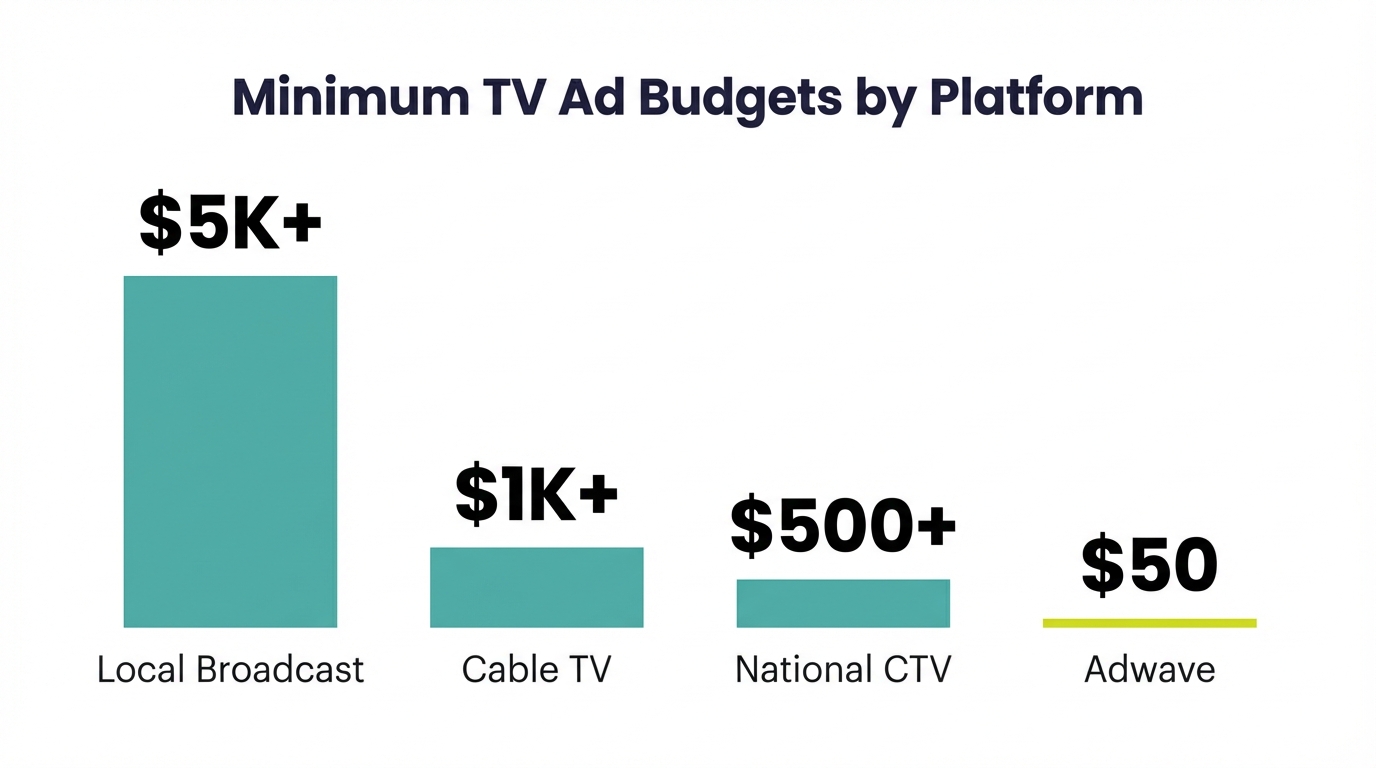
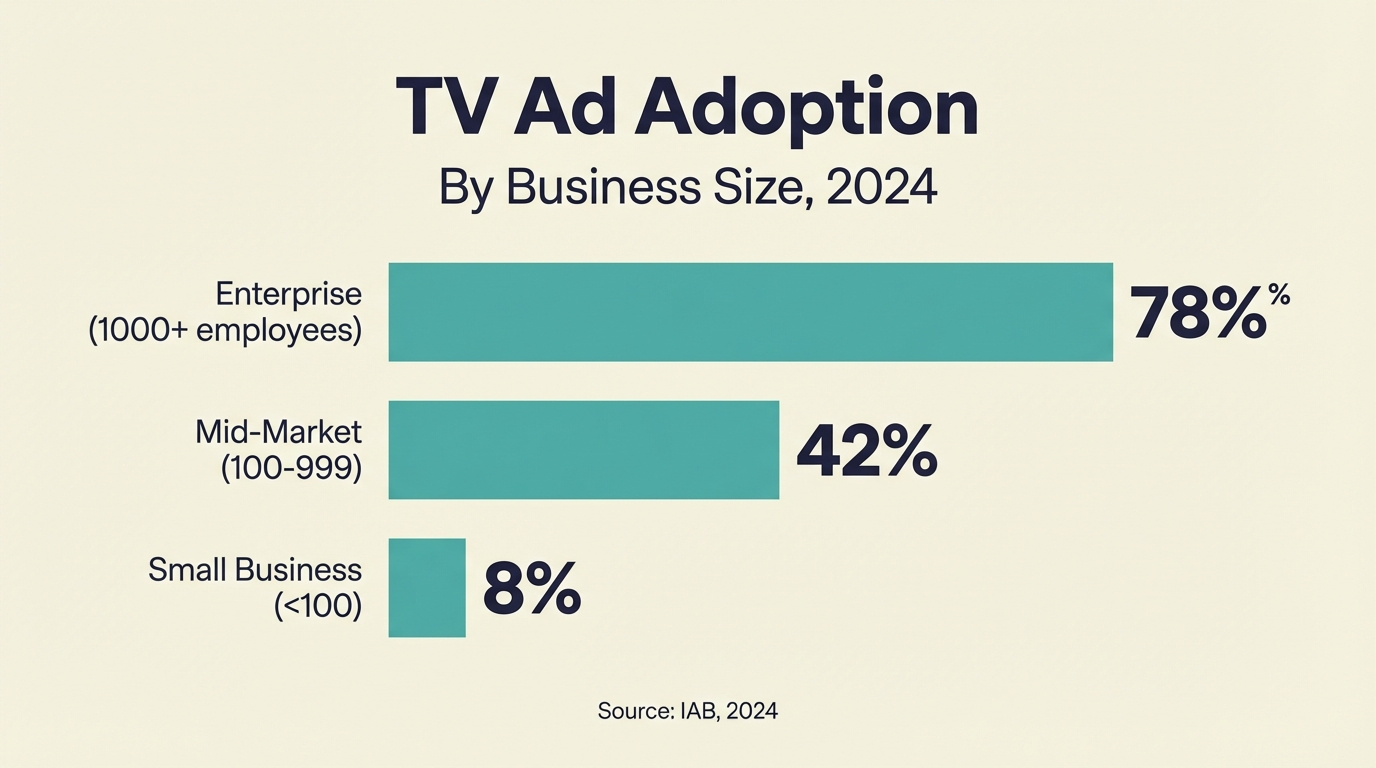
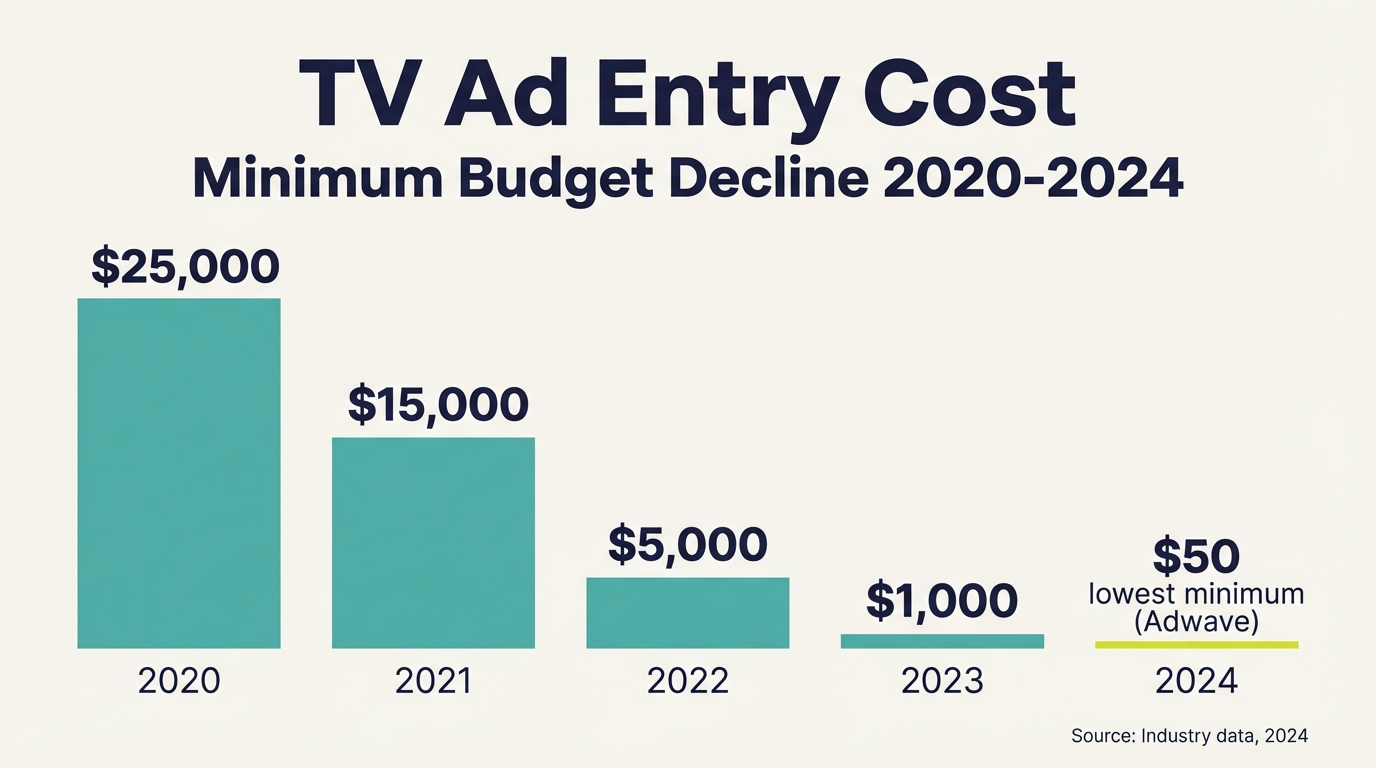
The minimum budget for TV advertising varies dramatically depending on your platform choice. According to Simulmedia's cost guide, traditional TV advertising typically requires $5,000-$25,000+ to get started, with commercial production adding thousands more. However, self-serve streaming TV platforms like Adwave have lowered the barrier to just $50, with AI-powered creative generation included at no additional cost.
This transformation has fundamentally changed who can access television advertising. Small businesses that could never previously afford TV now have a clear path to the largest screen in the home.
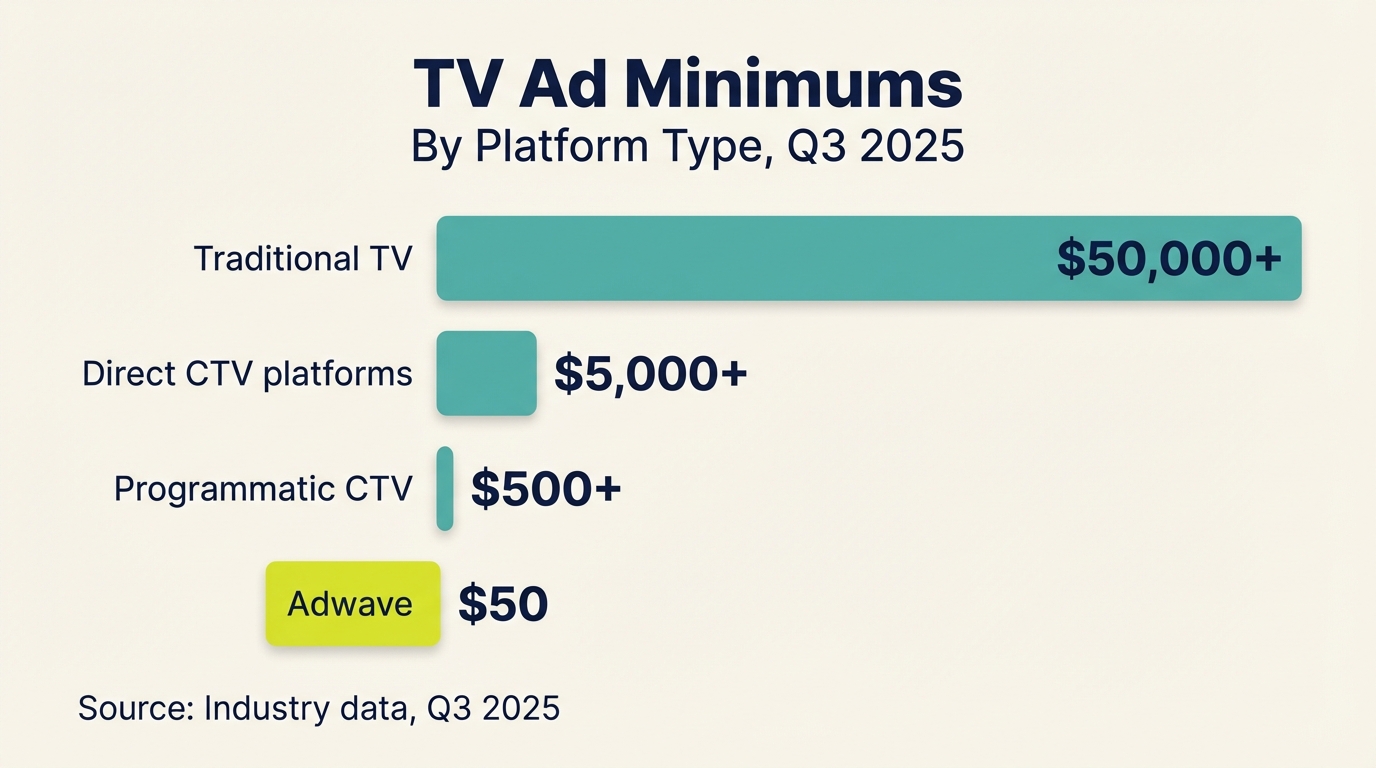
Understanding minimum TV advertising budgets requires distinguishing between different platform types and buying approaches. Traditional TV (broadcast and cable) maintains high minimums due to spot-based buying, agency involvement, and production requirements. Direct streaming platform advertising (Netflix, Hulu, Disney+) typically requires four to five-figure minimums. Self-serve aggregated platforms like Adwave have created accessible entry points starting at $50. For small businesses evaluating TV advertising, these variations determine whether TV is practical.
What the data shows
Minimum budget requirements vary significantly across TV advertising options.
Platform minimum comparison
Different platforms and approaches have dramatically different minimums. Adwave and similar self-serve aggregated platforms start at $50. Some programmatic DSPs have minimums of $500-$5,000. Direct streaming platform self-serve minimums typically run $5,000-$10,000. Agency-managed streaming campaigns usually require $10,000-$50,000. Traditional TV broadcast and cable campaigns start at $25,000-$100,000+.
The 500x difference between the lowest ($50) and highest ($25,000+) minimums represents the transformation in TV advertising accessibility.
Total campaign cost components
Understanding total cost requires accounting for all components. Media spend covers your budget for running ads. Creative production ranges from $0 on AI platforms to $50,000+ for traditional production. Agency fees run from 0% on self-serve platforms to 15-25% for agency-managed campaigns. Platform fees are often included in CPM, sometimes separate. Measurement is often included, though premium measurement may cost extra.
With self-serve platforms offering free AI creative and zero agency fees, total cost can equal media spend alone.
Entry-level campaign economics
At the $50-$500 minimum budget level, what can advertisers expect?
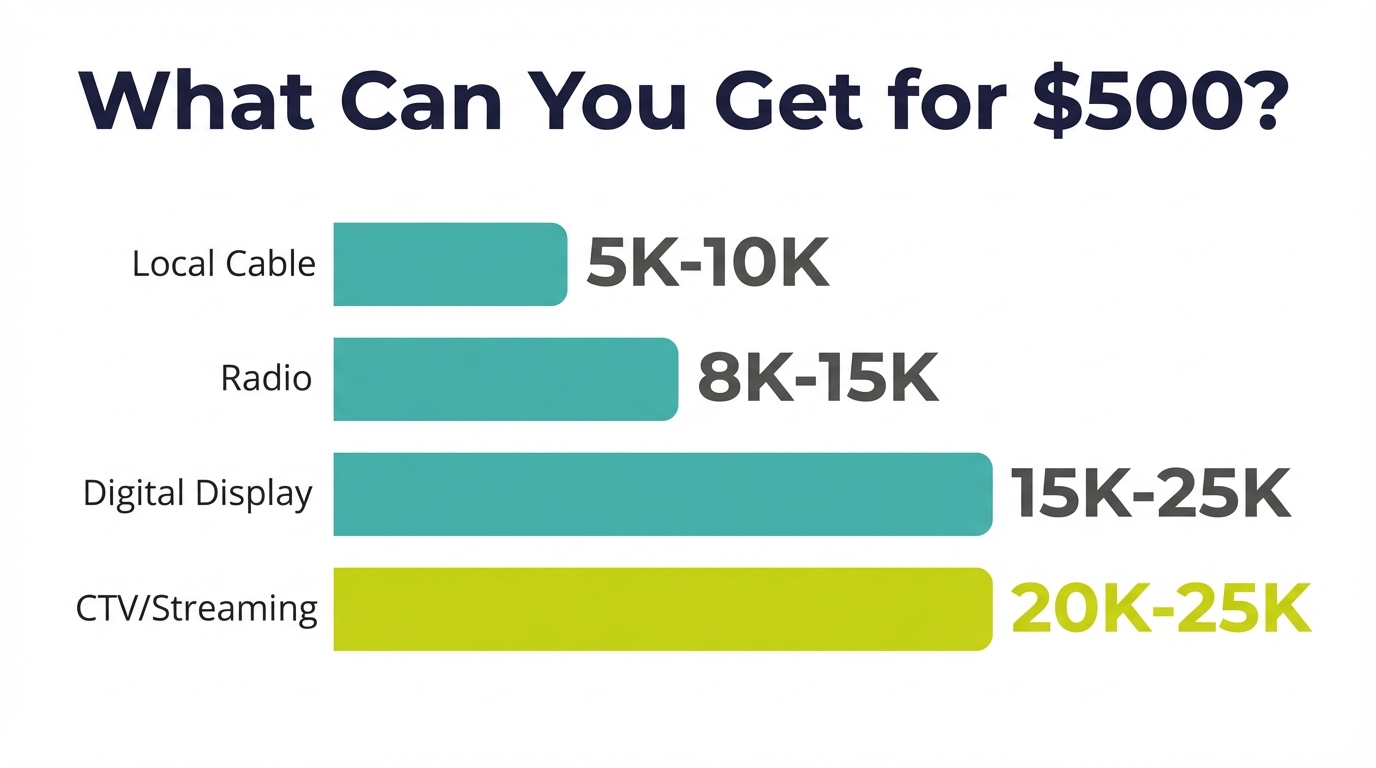
A $50 campaign delivers approximately 2,000 impressions at $25 CPM, reaching several hundred households. This level works for technical validation and creative testing.
A $250 campaign delivers approximately 10,000 impressions at $25 CPM, reaching several thousand households. This level works for initial market response testing.
A $500 campaign delivers approximately 20,000 impressions at $25 CPM, reaching thousands of households. This level provides meaningful performance indicators.
These entry-level budgets enable testing and learning without significant financial risk.
Breaking down the numbers
Understanding what drives minimum budget requirements helps advertisers find the right approach.
Why traditional TV minimums are high
Traditional TV advertising maintains high minimums due to structural factors.
Spot-based buying requires advertisers to purchase multiple time slots to achieve frequency, driving up minimum viable spend. Agency involvement means most traditional TV buying goes through agencies that have minimum client requirements and add fees of 15-25% of spend. Production requirements mean traditional TV requires professionally produced commercials, adding thousands to tens of thousands in costs. Relationship-based selling means traditional TV often requires established advertiser relationships, favoring larger, established brands. Measurement limitations mean that without precise measurement, small campaigns can't demonstrate value, discouraging small tests.
How streaming reduced minimums
Streaming TV advertising has lower minimums due to different economics.
Programmatic buying means ads are bought automatically on an impression basis rather than spot-based, enabling smaller purchases. Self-serve platforms enable advertisers to manage campaigns without agencies, eliminating those fees. AI creative tools can generate TV-quality commercials from existing assets, eliminating production costs. Aggregated inventory combines inventory across services, creating efficient buying at any scale. Precise measurement with impression-level tracking enables small campaigns to demonstrate results.
The Adwave model
Adwave represents the most accessible TV advertising entry point. The $50 minimum is the lowest meaningful media spend available. Free creative means AI generates commercials from website and social assets. Access to 100+ channels provides aggregated inventory across streaming services. Self-serve operation means no agency required for campaign management. Transparent pricing uses CPM-based pricing without hidden fees.
This model eliminates every traditional barrier to TV advertising.
Meaningful test budgets
While $50 is the minimum, what budgets enable meaningful testing?
Technical validation at $50-$100 confirms creative plays correctly, targeting works, and tracking functions. It provides limited performance insights.
Initial response testing at $200-$500 provides enough impressions to observe initial response patterns and can identify obvious creative issues.
Statistically meaningful testing at $500-$1,000 generates enough data for reliable performance conclusions and can inform scaling decisions.
Confident scaling basis at $1,000-$2,500 provides solid foundation for optimization and scaling, with multiple creative or targeting tests possible.
Starting with technical validation budgets and scaling based on results minimizes risk while enabling learning.
Why it matters for your business
Low minimum budgets have transformed TV advertising accessibility for small businesses.
TV advertising is no longer exclusive
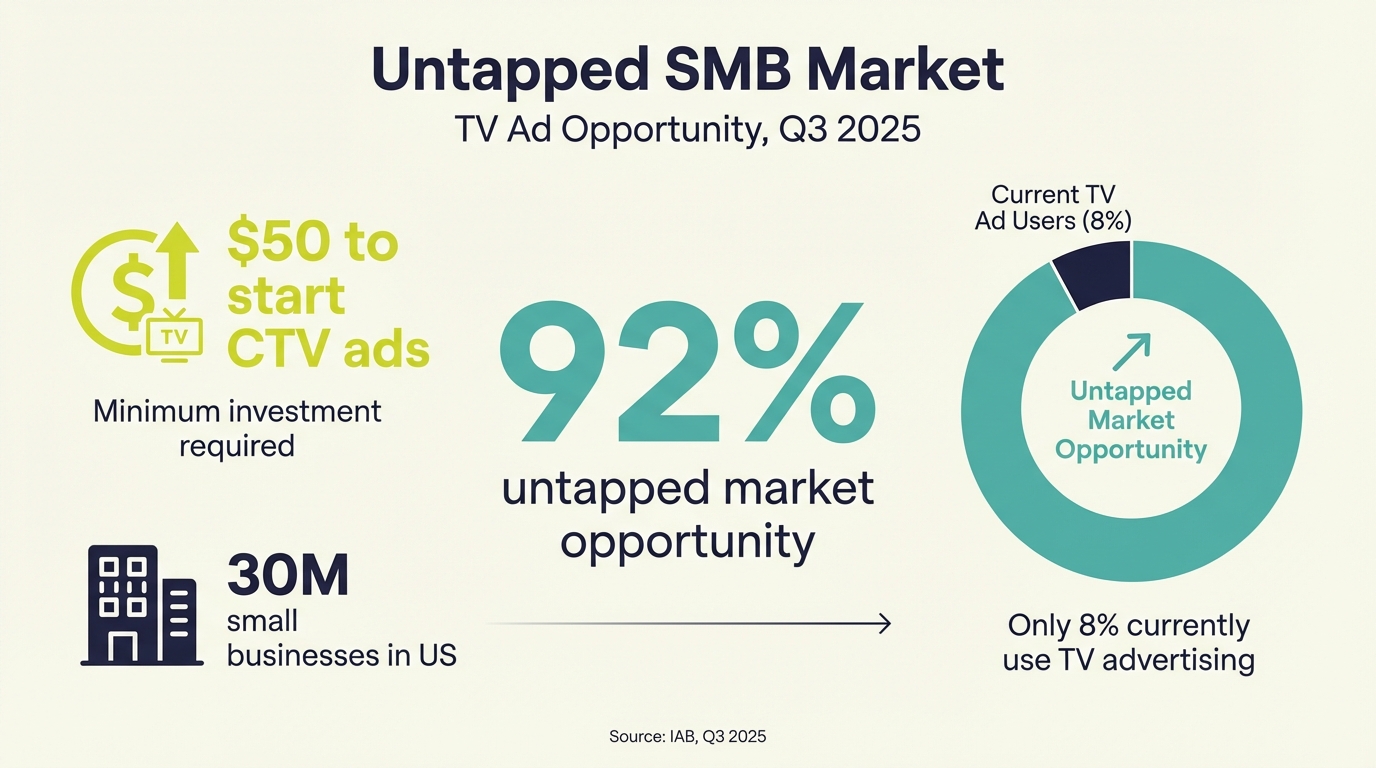
The $50 minimum entry point means local businesses can test TV advertising without financial risk. Small businesses can add TV to their marketing mix. Startups can build brand awareness from early stages. Solo operators can reach local streaming audiences.
The historical barrier where TV required five-figure minimum investments no longer exists.
Risk-appropriate testing
Low minimums enable appropriate risk management. You can test a new channel with minimal commitment. You can validate creative messaging before scaling. You can confirm targeting reaches your intended audience. You can build a data foundation for optimization.
This testing approach, impossible with high-minimum platforms, enables informed decisions about TV advertising investment.
Budget allocation flexibility
Low minimums provide budget allocation flexibility. Start with a small test and scale based on results. Run multiple small campaigns to test approaches. Allocate budget across streaming and traditional digital. Adjust allocation based on performance data.
This flexibility matches how sophisticated digital marketers approach new channels.
Competitive accessibility
As TV advertising becomes accessible to smaller businesses, competitors may already be advertising on streaming. Early testing builds expertise and data advantages. The playing field has leveled for local market competition. Brand awareness is no longer reserved for well-funded competitors.
Understanding that competitors can now access TV advertising should inform your strategic planning.
How to take advantage of low minimums
Capitalizing on accessible TV advertising requires strategic approach to platform selection and budget allocation.
Start with self-serve platforms
For testing and initial campaigns, self-serve platforms offer the best value. Adwave provides a $50 minimum, free AI creative, and access to 100+ channels. No agency is needed for direct campaign management. Quick launch gets campaigns live within hours. Full control lets you adjust budget, targeting, and creative as needed.
Self-serve platforms eliminate barriers while providing sufficient capabilities for effective campaigns.
Plan a testing progression
Structure testing to build understanding.
Phase 1 is the technical test at $50-$100. Validate creative plays correctly. Confirm targeting functions as expected. Establish measurement baselines.
Phase 2 is the response test at $250-$500. Measure initial audience response. Identify creative performance differences. Refine targeting based on results.
Phase 3 is the optimization test at $500-$1,000. Test multiple creative approaches. Optimize targeting based on data. Establish reliable performance benchmarks.
Phase 4 is the scale phase at $1,000+. Apply learnings at larger budget. Expand geographic or demographic targeting. Build sustained presence.
This progression minimizes risk while building campaign optimization capability.
Budget allocation considerations
When determining TV advertising budget allocation, consider your starting point.
If you're new to TV, start with 5-10% of marketing budget for testing. If you're adding to an existing mix, allocate 10-20% of video/TV budget to streaming. If you're shifting from traditional, move 20-40% of traditional TV budget to streaming. For ongoing optimization, adjust based on comparative channel performance.
These guidelines provide starting points. Actual allocation should reflect business-specific results.
Avoid over-spending early
Low minimums don't mean higher budgets aren't worthwhile, but be strategic. Don't scale before validating basic campaign function. Don't commit large budgets before testing creative. Don't expand targeting before confirming core audience response. Don't increase spend faster than you can measure results.
The accessibility of low minimums enables patient, data-driven scaling.
The bigger picture
Low minimum budgets reflect fundamental changes in television advertising.
The democratization of TV advertising
TV advertising has transformed from exclusive to accessible. The historical model required large brands, big budgets, agency relationships, and professional production. The current model works for any business, any budget, with self-serve platforms and AI creative.
This democratization parallels what happened in search (Google Ads) and social (Meta Ads) advertising, where self-serve platforms made previously exclusive channels accessible.
Traditional TV's continued premium
Despite streaming accessibility, traditional TV maintains higher minimums. Spot-based buying requires larger commitments. The agency model persists in traditional TV. Production requirements remain. Established advertiser relationships are favored.
For businesses seeking traditional TV for specific audiences or programming, higher budgets remain necessary. Streaming provides the accessible alternative.
Industry investment in accessibility
Significant industry investment has driven accessibility. Self-serve platform development continues. AI creative tools advance rapidly. Measurement solutions mature. Aggregated inventory platforms expand.
This investment continues, likely further improving accessibility and capabilities.
What experts recommend
Industry experts increasingly recommend testing-based approaches. Start with accessible minimum budgets. Build understanding through controlled tests. Scale based on demonstrated results. Don't commit large budgets without data.
This approach, enabled by low minimums, aligns with modern marketing best practices.
Common questions answered
What is the minimum budget to advertise on TV?
The minimum budget for TV advertising ranges from $50 through self-serve platforms like Adwave to $25,000+ for traditional TV campaigns. Streaming TV has dramatically lowered the entry point, making TV advertising accessible to businesses of all sizes.
Can you advertise on TV with a small budget?
Yes, you can advertise on streaming TV with budgets as low as $50 through self-serve aggregated platforms. These platforms include AI-powered creative generation at no additional cost, eliminating the production barrier that historically required thousands of dollars. Small business TV advertising is now practical at any budget level.
Why do some TV advertising platforms have high minimums?
High minimums on some platforms reflect spot-based buying models requiring multiple time slot purchases, agency involvement and fees, professional production requirements, and relationship-based selling favoring established advertisers. Streaming and self-serve platforms have eliminated these factors, enabling lower minimums.
Is the $50 minimum enough for meaningful results?
A $50 minimum is sufficient for technical validation (confirming campaigns function correctly) and very early creative testing. For statistically meaningful results that can inform scaling decisions, budgets of $500-$1,000 are typically needed. The low minimum enables risk-free testing before committing larger budgets.
What's included in the minimum budget?
Through platforms like Adwave, the minimum budget covers media spend (actual ad delivery). AI creative generation is included at no additional cost. There are no agency fees, platform fees, or hidden costs. Your budget goes directly to ad delivery at the stated CPM.
Supporting data
Additional statistics contextualizing TV advertising minimum budgets:
Minimum budget through Adwave is $50. Typical programmatic DSP minimums run $500-$5,000. Traditional TV campaign minimums run $5,000-$25,000+. Creative production cost with AI platforms is $0. Traditional commercial production costs $5,000-$50,000+. Typical agency fees on managed campaigns run 15-25%. Average CPM for small business streaming TV is $25. Approximate impressions at $50 and $25 CPM is 2,000. Channels accessible through aggregated platforms exceeds 100.
Start advertising with $50
Ready to test TV advertising without committing thousands of dollars? Streaming TV has made television accessible at any budget level.
Adwave offers streaming TV advertising starting at just $50. AI generates your commercial for free from your existing assets. Your ads run on 100+ premium channels including YouTube, Netflix, Hulu, and more.
No production budget needed. No agency fees. No massive minimum spend.