-
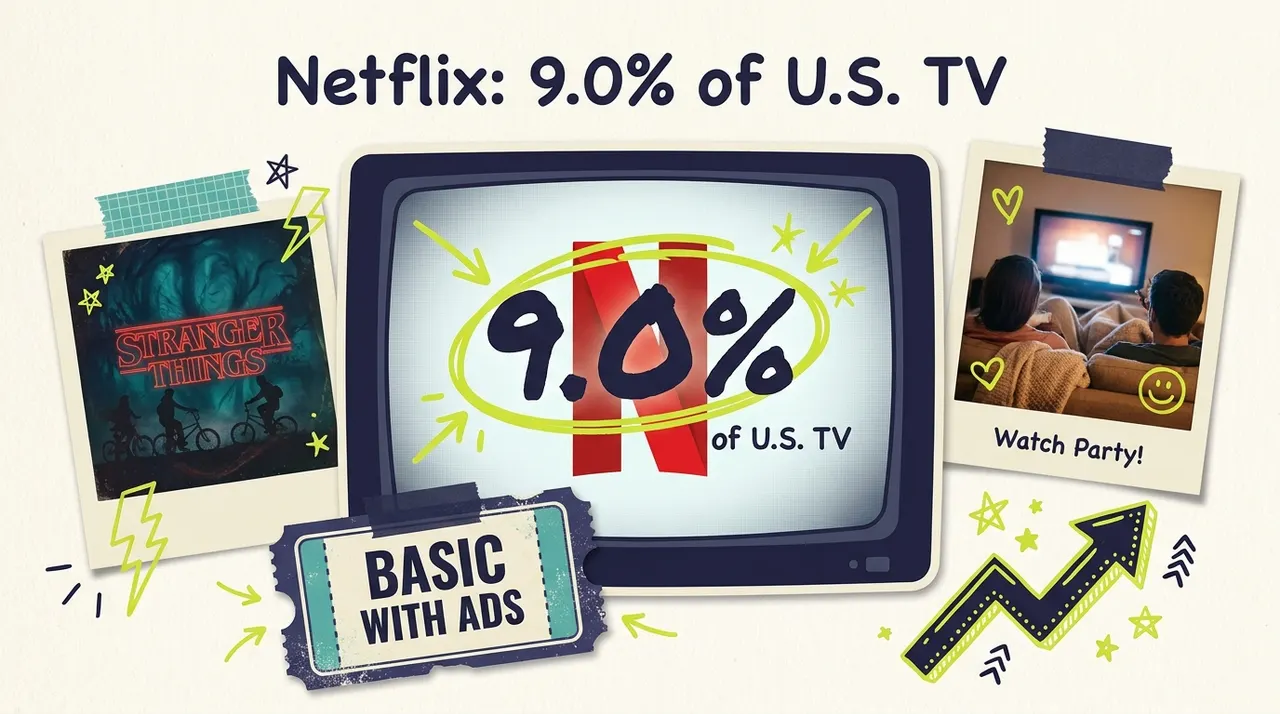
9.0%
Netflix share of U.S. TV viewing (Jan 2026)
-
#2
Second-largest platform, behind only YouTube
-
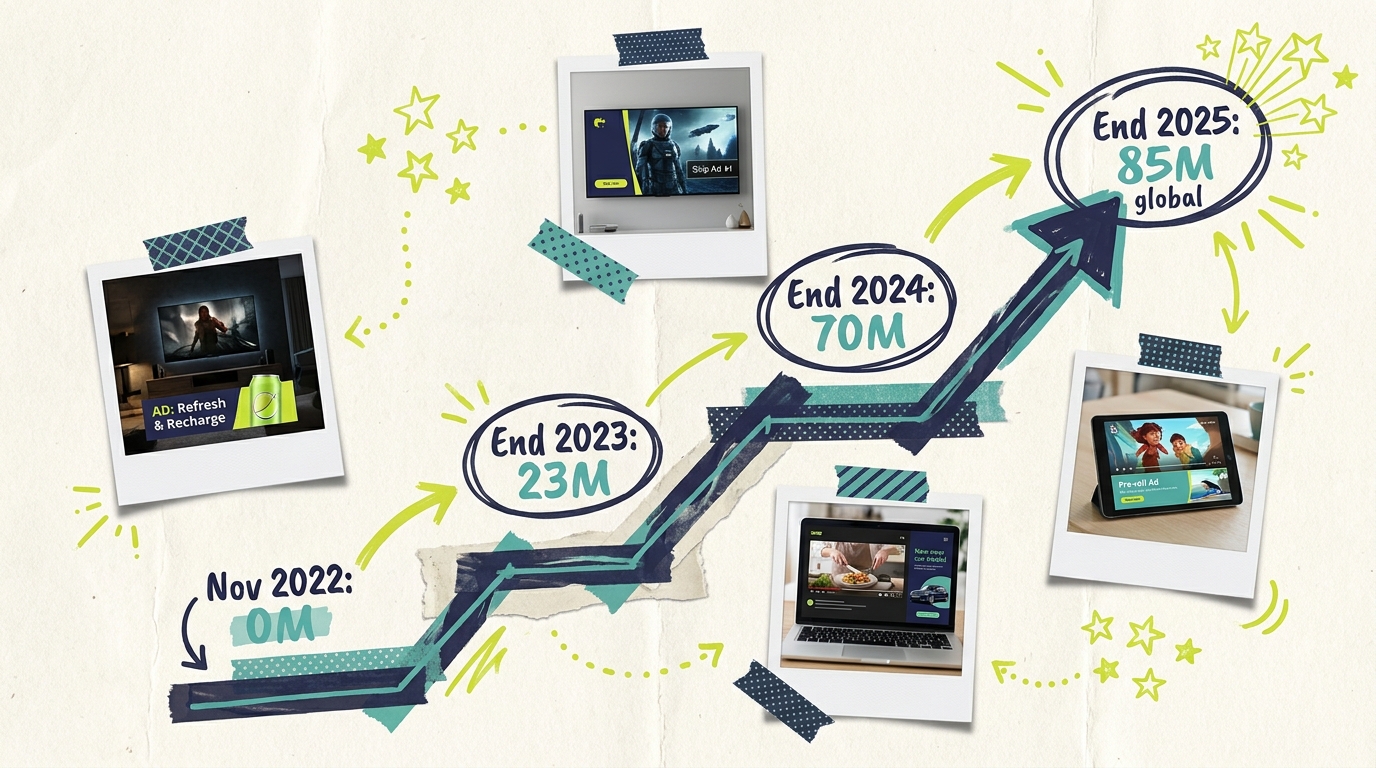
85M
Global ad-tier users (Netflix, late 2025)
Netflix entered 2026 as the second-largest individual media entity on American television, trailing only YouTube. In January 2026, Netflix captured 9.0% of all U.S. TV viewing time per Nielsen's The Gauge. Netflix's January 2026 performance was driven by Stranger Things Season 5, which drew 15.4 billion viewing minutes in January alone, a record for any streaming title in a single month per Nielsen.
February 2026 brought a small reset. Super Bowl LX and the Winter Olympics pulled viewing toward broadcast, and Nielsen noted that most streaming platforms lost share for the month. Netflix's structural position at #2 held even with the event-driven disruption.
For small business advertisers, Netflix's Q1 2026 position matters because Netflix has become a genuine ad platform. The Basic with Ads tier that launched in November 2022 has reached the scale where local advertisers can meaningfully access Netflix inventory through bundled CTV platforms, not just through direct buys at five-figure minimums.
What the data shows
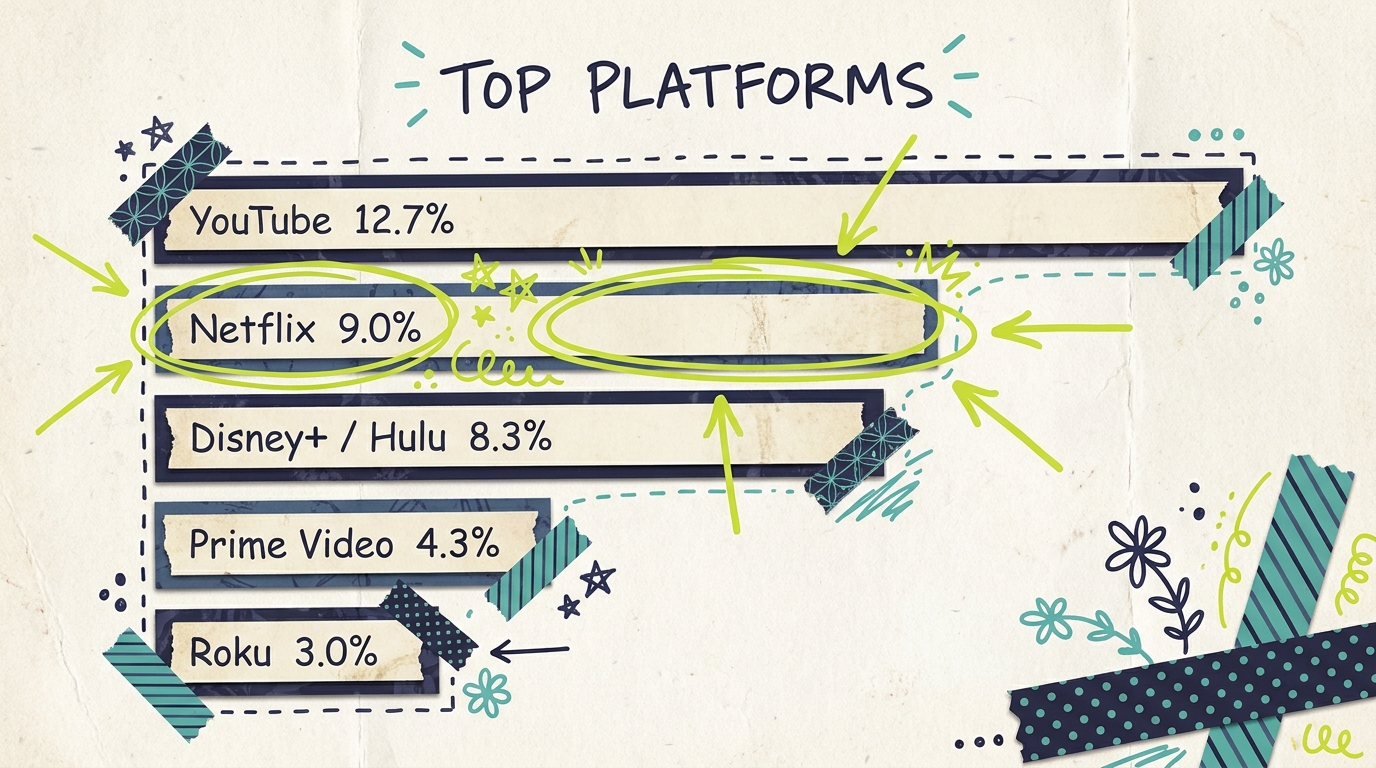
Netflix held 9.0% of total U.S. TV viewing in January 2026 according to Nielsen's The Gauge, behind YouTube (12.7%) and ahead of every other individual platform.
Relevant figures from Nielsen's publicly released Q1 2026 data:
Netflix U.S. TV viewing share, January 2026: 9.0%
Netflix U.S. TV viewing share, December 2025: 8.8% (Nielsen press release)
Stranger Things January 2026 viewing: 15.4 billion minutes (single-month streaming record per Nielsen)
Netflix February 2026: Nielsen's February Media Distributor Gauge (released April 2026) noted most streaming platforms lost share; individual platform breakdown for Netflix was not published at the same detail as January
March 2026 Gauge release: Delayed by Nielsen per MediaPost, March 20, 2026
The 9.0% January figure places Netflix solidly in the top tier of individual media properties. Only YouTube (12.7%) and combined Disney (Disney+ plus Hulu at 8.3% combined) reach comparable scale.
Netflix's transition from a subscription-only business to a hybrid ad-plus-subscription business has been the main structural story for the platform since late 2022, when Netflix launched Basic with Ads. Netflix has publicly reported strong growth in ad-tier subscribers, though specific audit-ready subscriber counts vary by reporting date. Industry analysts generally expect Netflix's ad tier to continue growing through 2026 as more of Netflix's existing and new subscribers choose the ad-supported plan.
Netflix's ad tier: the structural shift
For most of Netflix's history, advertisers had no way to buy Netflix inventory. The company operated as a purely subscription business, and its content environment was ad-free by design. That changed on November 3, 2022, when Netflix launched its Basic with Ads plan.
Several milestones in the ad-tier's growth are worth noting for advertisers:
Launch (November 2022): Netflix partnered with Microsoft Advertising to handle ad sales and technology.
First 12 months: Netflix reported steady subscriber growth on the ad tier, initially modest but accelerating.
2024: Netflix expanded ad formats, targeting options, and measurement capabilities. The platform integrated with more demand-side platforms (DSPs) and bundled CTV aggregators.
2025: Netflix continued to scale ad-tier subscribers and began experimenting with live programming (WWE Raw, live boxing events) that carries ad breaks in more traditional TV-style formats.
2026: Netflix's ad inventory is now accessible through a growing set of buying channels, including direct sales, Microsoft Advertising's ad platform, programmatic through major DSPs, and bundled CTV platforms for smaller advertisers.
The practical implication for small businesses is that Netflix has moved from "aspirational but inaccessible" to "a standard line item in CTV media plans." Advertisers who were priced out of Netflix in 2023 are now able to access the platform through several paths.
Why it matters for your business
Netflix's 9.0% TV viewing share in Q1 2026 matters to small business advertisers because Netflix is now a genuine ad platform at scale. For most of Netflix's history, Netflix had no ad inventory. That changed in November 2022.
Three practical implications:
First, Netflix inventory is premium-priced. Industry estimates put Netflix CPMs in the range of $30-$55 for programmatic placements, roughly 2x average YouTube CTV CPMs. That premium reflects Netflix's brand-safe environment, limited ad load, and subscriber quality. Actual CPMs vary by targeting and content.
Second, Netflix is accessible to local advertisers through bundled CTV platforms. Direct Netflix buys through Microsoft Advertising (Netflix's ad sales partner) typically require large budgets. All-in-one CTV platforms bundle Netflix inventory with other streaming services for smaller budgets.
Third, Netflix's ad growth expands total CTV supply. As Netflix adds ad-supported subscribers, more ad inventory comes to market. That affects CPMs across the streaming ecosystem.
How to access Netflix advertising as a small business
Netflix advertising has three main access paths:
Direct buys through Microsoft Advertising or Netflix's sales team. This is the original path and still the main one for large brands. Direct buys typically require minimum commitments in the tens of thousands of dollars per campaign, with negotiated terms on targeting, placement, and measurement.
Programmatic through major DSPs. Netflix has progressively expanded programmatic access since 2024. Advertisers using The Trade Desk, Google DV360, or other major DSPs can bid on Netflix inventory through programmatic channels. This route still tends to favor larger advertisers with dedicated DSP teams.
Bundled CTV platforms. For small businesses, the most accessible path is through self-serve CTV advertising platforms that aggregate Netflix inventory alongside YouTube, Hulu, Peacock, and other streaming services. These platforms abstract away the complexity of direct or programmatic buying, making Netflix accessible for monthly budgets of $500-$2,000.
For most small business advertisers, the bundled CTV route is the right starting point. You get Netflix exposure alongside the other major streaming platforms in a single campaign, with simpler management and lower minimums.
Creative best practices for Netflix advertising
Netflix's ad environment has specific characteristics that affect what creative works:
Brand-safe premium environment. Netflix's content library is carefully curated. Ads sit alongside high-production original series and films. Creative with cinematic production values tends to perform better than lower-budget direct-response spots.
Limited ad load. Netflix caps ads per hour at a level lower than most linear TV and most free ad-supported streaming. This means each individual ad gets more attention, but fewer impressions are available for any given budget.
30-second and 15-second standards. Most Netflix ad inventory runs in these two formats. Shorter 6-second or longer 60-second formats exist but are less common.
Sound-on viewing. Netflix viewers watch on TV screens with sound enabled. Audio quality and music bed selection matter.
No clickthrough. Netflix ads can't be clicked. Success is measured by brand lift, downstream conversion, and incrementality.
For small businesses, the Netflix creative bar is higher than YouTube or FAST platforms. If your 30-second spot looks homemade, it will stand out negatively in Netflix's polished environment. Invest in creative that matches the content quality.
How to take advantage
Include Netflix in premium CTV plans. If your campaign targets affluent adults or values premium content adjacency, Netflix is worth the CPM premium.
Buy Netflix through a bundled platform for local budgets. Direct Netflix buys require large minimums; bundled platforms lower the entry point.
Match creative to Netflix's brand-safe environment. Polished 30-second spots perform better on Netflix than lower-production direct-response creative.
Plan for lower frequency than YouTube. Netflix maintains tighter ad-load caps than most platforms.
Measure brand lift, not clicks. Netflix viewers do not click through the way search or social audiences do. Track brand search volume, website traffic, and downstream conversion.
Measuring Netflix ad performance
Netflix viewers don't click ads, so attribution requires a different measurement approach than search or social advertising. Useful metrics include:
Reach and frequency: How many unique households saw your ad and how many times. Netflix campaigns tend to deliver lower frequency than YouTube because of ad-load caps.
View-through rate (VTR): Netflix ads are typically non-skippable, so VTR is usually very high (95%+). VTR isn't a good differentiator between campaigns; other metrics matter more.
Brand lift studies: Microsoft Advertising (Netflix's ad partner) offers brand lift measurement that tracks changes in awareness, consideration, or favorability among audiences exposed to your ad versus control groups.
Downstream conversion: Website traffic, app installs, branded search volume, or store visits among households exposed to your ad. This requires a measurement framework that ties exposure to outcome.
Incrementality testing: The lift in conversions attributable specifically to Netflix advertising versus what you would have gotten otherwise. This is the most rigorous measurement approach but also the most complex.
For local advertisers with modest budgets, start with reach/frequency and branded search lift. These are the easiest metrics to track consistently and give a reasonable picture of whether the campaign is working.
The bigger picture
Netflix's Q1 2026 position reflects the continued shift of American TV viewing toward streaming. Nielsen's January 2026 Gauge reported streaming at 47.0% of total U.S. TV viewing (a record high), with Netflix as one of the four or five platforms driving that majority.
EMarketer's December 2025 forecast projects U.S. CTV advertising spending to reach $37.95 billion in 2026, up 14.5% year-over-year, and to surpass linear TV advertising by 2028. Netflix is expected to capture a meaningful share of that CTV ad spend growth as the ad tier scales.
For small business advertisers, the practical implication is that Netflix has moved from an experimental ad channel to a standard line item in many CTV media plans.
What this data doesn't tell you
Netflix's 9.0% Nielsen share is a useful anchor, but it has limitations as a planning tool:
Total viewing time is not ad-reachable time. Netflix's 9.0% share includes both ad-free subscribers and ad-supported subscribers. Advertisers can only reach the ad-supported portion, which is a subset of total Netflix viewing.
Ad-tier audience composition may differ from total Netflix audience. Ad-supported subscribers skew toward price-sensitive demographics. Premium tier subscribers may differ. Advertisers targeting specific demographics should understand how the ad-tier audience compares to Netflix's overall audience.
Monthly figures reflect content cycles. Stranger Things Season 5 drove January 2026 viewing. Months without similar tentpole launches look different. Quarterly or annual averages smooth the effect.
CPM ranges vary widely by specific placement. Published industry CPM estimates are broad ranges. Actual pricing depends on targeting, content adjacency, daypart, and demand.
Advertisers evaluating Netflix should use the 9.0% share as directional and request specific inventory quotes for pricing decisions.
Common questions answered
Is Netflix's ad tier big enough to buy against for local advertising?
Yes. Netflix's ad-supported subscriber base has grown through 2025 and into 2026 to the point where local advertisers can generate meaningful impression volume on targeted campaigns. Platforms that bundle Netflix with other streaming inventory make it accessible for campaigns as small as $500-$1,000 monthly.
How does Netflix compare to YouTube for advertisers?
Netflix and YouTube reach different audiences with different content environments. Netflix is a premium-content, premium-CPM buy. YouTube is a scale-and-frequency buy at lower CPMs. Most thorough CTV media plans include both.
Can small businesses buy Netflix ads through Google Ads?
No. Netflix operates a separate ad-sales channel through Microsoft Advertising and direct relationships. Self-serve CTV platforms that bundle Netflix alongside other streaming inventory are the typical path for smaller advertisers.
Will Netflix's TV viewing share keep growing?
Industry analysts generally expect Netflix's viewing share to continue growing gradually, though at slower rates than the rapid growth Netflix saw as the ad tier launched. Growth is ultimately bounded by the size of total U.S. TV viewing time.
How did Super Bowl and Olympics affect Netflix in Q1 2026?
Super Bowl LX (February 8, NBC) and the Winter Olympics (February 6-22, NBC) pulled significant viewing toward broadcast in February. Nielsen reported that most streaming platforms lost share for the month as a result. The effect is event-driven and doesn't change Netflix's structural position.
Is Netflix investing in live programming?
Yes. Netflix launched WWE Raw on the platform in January 2025 and has continued to add live sports and boxing events. Industry analysts are watching whether Netflix extends into broader live-sports rights (NFL, NBA) over the next several years.
What's the typical campaign length on Netflix?
Most Netflix advertising campaigns run for 30-90 days, with some advertisers running always-on presence campaigns. Given Netflix's lower ad frequency caps compared to YouTube or FAST, campaigns may need longer timeframes to achieve meaningful reach.
Where to start
For small businesses evaluating Netflix advertising, Q1 2026 data shows Netflix has reached the scale and accessibility that justify including it in CTV media plans. Direct buys still require larger budgets, but bundled CTV platforms have made Netflix inventory accessible for smaller campaigns.

Adwave lets local advertisers create 30-second TV ads from their website URL and run them across Netflix's ad tier alongside 100+ other premium streaming channels for as little as $50. See how it works.