-
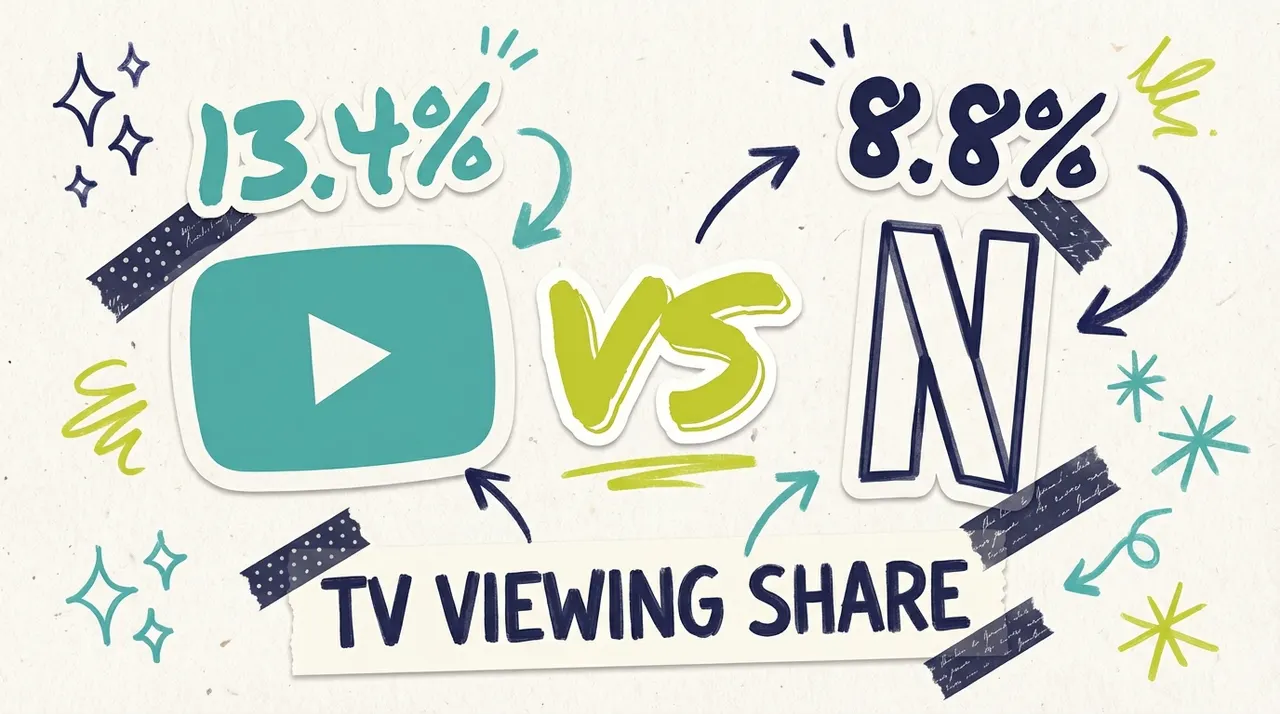
13.4%
YouTube TV viewing share
-
8.8%
Netflix TV viewing share
-
300M+
Netflix global subscribers
YouTube has emerged as the dominant force in television viewing, capturing 13.4% of all US TV watch-time and holding the top position among media distributors for six consecutive months according to Nielsen's Media Distributor Gauge. Netflix trails in second place among streaming platforms with 8.8% of TV viewing, though it remains the most popular subscription service with over 300 million global subscribers. Together, these two platforms account for more than 20% of all television viewing in the United States, fundamentally reshaping how Americans consume video content.
The competitive dynamics between YouTube and Netflix reveal distinct strategic approaches to capturing audience attention. YouTube's dominance stems from its vast library of user-generated content, creator-driven programming, and free access model that attracts viewers across all demographics. Netflix competes through premium original content, licensed programming, and an increasingly important ad-supported tier that now serves 45% of US households on the platform. Understanding these differences helps advertisers identify which platform best serves their marketing objectives.
For advertisers evaluating streaming TV opportunities, the viewership comparison illuminates reach potential and audience characteristics. YouTube's scale advantage in raw viewing time creates massive reach opportunities, while Netflix's subscription model delivers engaged audiences in premium content environments. Both platforms offer advertising options that make reaching their respective audiences accessible to businesses of all sizes.
Breaking down the numbers
Current viewership data reveals YouTube's commanding lead and Netflix's sustained strength:
YouTube TV share: 13.4% of all US TV viewing time, leading for 6 consecutive months (Nielsen)
Netflix TV share: 8.8% of TV viewing, platform-best performance with 0.5 point gain month-over-month (Nielsen)
Combined dominance: Together YouTube and Netflix capture over 22% of all US TV viewing
Netflix global subscribers: 300+ million worldwide subscribers as of Q4 2024 (Forbes)
YouTube monthly users: Over 2 billion logged-in users monthly watching over 1 billion hours daily
Netflix household penetration: 55% of Americans use Netflix, the most popular streaming service (Forbes)
Ad-supported adoption: 45% of Netflix US households now use the ad-supported tier, up from 34% in 2024 (Comscore)
YouTube growth trajectory: Platform share increased 62% since July 2021 through consistent growth (Nielsen)
The Nielsen Media Distributor Gauge tracks viewing across all television content, providing apples-to-apples comparisons between platforms. YouTube's 4.0 point lead over second-place Disney (9.4%) represents the largest gap since Nielsen began these calculations in November 2023.
Netflix's audience growth metrics tell an equally compelling story. The platform added 215,000 average minute audience viewers month-over-month, the largest volume gain among all streaming platforms. Netflix also demonstrated unique demographic breadth, being the only streaming platform to show increases across all viewing demographic categories in the same period.
The household reach metrics further contextualize the viewership data. Two-thirds of American households viewed both Netflix and YouTube on their televisions in 2024, indicating that most households engage with both platforms rather than choosing one exclusively. This dual usage pattern suggests complementary rather than substitutional relationships between the platforms for many viewers.
Amazon's position in the landscape provides additional context. With 3.9% TV share approaching its platform-best 4.0%, Amazon demonstrates that third-tier competitors can build meaningful positions. The platform's 62% growth in TV viewing share since July 2021 shows that streaming audience dynamics remain fluid rather than locked in permanent patterns.
Why YouTube leads in viewing time
YouTube's dominance in TV viewing time stems from fundamental differences in content model, accessibility, and viewing behavior that create structural advantages over subscription services.
The free access model eliminates financial barriers that limit other platforms' addressable audiences. Anyone with an internet connection can watch YouTube without subscription commitments or payment decisions. This accessibility translates to viewing from demographics that might not subscribe to premium services, including younger viewers without payment methods and price-sensitive households.
YouTube hosts videos on a wide range of topics, from niche hobbies to mainstream entertainment. Its creators upload over 500 hours of video each minute.
The creator economy model produces content that builds parasocial relationships between viewers and creators. These relationships generate loyalty and repeated viewing that traditional entertainment struggles to replicate. Viewers return to their favorite creators like visiting friends, creating habitual engagement patterns that drive cumulative viewing time.
YouTube's integration with connected TV devices has transformed it from a computer and mobile platform into a living room presence. YouTube is now the most-watched streaming service on smart TVs, capturing the same big-screen viewing occasions that traditional television has always dominated. This migration brings YouTube into direct competition for the same viewing time that Netflix and other streaming services pursue.
Algorithm-driven content discovery on YouTube creates engagement loops that extend viewing sessions. The recommendation engine learns viewer preferences and surfaces content that maintains attention, often introducing viewers to new creators and content types they wouldn't have actively sought. This discovery mechanism drives incremental viewing that accumulates into YouTube's dominant time share.
The live streaming component of YouTube adds real-time content that traditional media has always used to drive appointment viewing. Live events, creator streams, and premieres create moments that audiences show up for, supplementing the on-demand library with the urgency of real-time content. This hybrid approach captures viewing occasions across the full spectrum of content consumption behaviors.
Why Netflix leads in subscriber value
While YouTube wins on raw viewing time, Netflix maintains advantages in subscriber economics, content quality, and advertising environment that make it valuable for different strategic objectives.
Subscription relationships create predictable, recurring revenue that supports massive content investment. Netflix spent approximately $17 billion on content in 2024, funding productions that attract and retain subscribers. This investment capacity produces premium content that generates cultural moments and sustained engagement that ad-supported platforms struggle to match.
The ad-supported tier's rapid growth to 45% of US households demonstrates successful market segmentation. Netflix can serve price-sensitive viewers with advertising while premium subscribers pay for ad-free experiences. This hybrid model captures value across consumer preferences while building advertising scale that makes the platform increasingly attractive to marketers.
Content quality and production values on Netflix typically exceed user-generated platforms. Professional production creates brand-safe environments where advertising appears alongside content that meets broadcast standards. For advertisers concerned about brand adjacency, Netflix's curated content library provides confidence that YouTube's open platform cannot guarantee.
Viewing intent differs meaningfully between platforms. Netflix viewers have chosen to subscribe and actively select content, indicating higher engagement intent than casual YouTube browsing. This intentional viewing translates to better attention and recall metrics for advertising, potentially justifying premium CPMs despite smaller overall reach.
The cultural impact of Netflix originals creates marketing opportunities beyond direct advertising. Shows that dominate cultural conversation generate organic awareness and provide context for brand messaging that references or aligns with popular content. This cultural influence represents value that raw viewership numbers don't fully capture.
International expansion positions Netflix for global reach that YouTube has already achieved through different means. With 300+ million subscribers worldwide, Netflix offers multinational advertisers access to premium environments across markets. YouTube's global presence is even more extensive, but Netflix's subscription data provides richer audience information for international targeting.
Advertising opportunities on each platform
Both YouTube and Netflix now offer advertising options, though with different characteristics, reach, and targeting capabilities that suit different marketing objectives.
YouTube advertising offers massive scale through Google's advertising infrastructure. Advertisers can reach over 2 billion monthly users with sophisticated targeting based on viewing behavior, demographics, and intent signals. Cost efficiency varies by format and targeting, but CPMs generally run lower than premium streaming due to volume and auction dynamics.
YouTube advertising formats include skippable and non-skippable pre-roll, mid-roll in longer content, display ads, and sponsored content integrations. The variety enables tactics ranging from broad awareness campaigns to targeted direct response, with measurement through Google's attribution ecosystem.
Netflix advertising through their ad-supported tier delivers premium environment at scale. With 45% of US households on the ad tier, Netflix reaches substantial audiences in brand-safe, high-production content contexts. Limited ad load (approximately 4 minutes per hour) reduces clutter and potentially improves attention compared to heavier ad environments.
Both platforms increasingly compete for the same advertising budgets as streaming TV consolidates. Advertisers choosing between them should consider reach objectives (YouTube advantage), environment quality (Netflix advantage), targeting sophistication (YouTube advantage), and brand safety requirements (Netflix advantage).
How this impacts streaming TV advertisers
The YouTube-Netflix viewership dynamic shapes advertising strategy across the streaming landscape. Understanding platform positioning helps advertisers allocate budgets effectively across the ecosystem.
Reach-focused campaigns benefit from YouTube's massive scale. When the objective is maximizing unique reach across demographics, YouTube's 13.4% TV share and free accessibility deliver more eyeballs per dollar than premium subscription services. Brand awareness campaigns with broad targeting often find YouTube most efficient.
Quality-focused campaigns may favor Netflix despite smaller reach. When brand environment, content adjacency, and viewer attention matter more than raw scale, Netflix's premium positioning delivers advantages. Consideration-stage marketing and brand building in premium categories often warrant the higher CPMs.
Multi-platform strategies increasingly make sense as both platforms mature their advertising offerings. Using YouTube for reach and Netflix for quality within the same campaign can capture benefits of both approaches. CTV advertising platforms like Adwave provide access to both ecosystems through unified campaign management.
The broader streaming landscape beyond YouTube and Netflix includes Disney (9.4% share), Amazon (3.9%), and numerous smaller players. Comprehensive streaming strategies consider the full ecosystem rather than treating any single platform as sufficient for reaching streaming audiences.
Audience overlap between platforms creates reach efficiency considerations. Since two-thirds of households view both YouTube and Netflix, advertisers running on both platforms will reach some households through both. This overlap isn't necessarily inefficient if frequency objectives align, but pure reach campaigns should account for duplication when projecting unduplicated audience.
Creative format differences between platforms affect campaign planning. YouTube's varied format options (skippable, non-skippable, bumpers, etc.) require format-specific creative development. Netflix's 15- and 30-second format specifications align more closely with traditional TV creative. Advertisers planning cross-platform campaigns should budget for format-specific creative versions.
Why it matters for your business
The YouTube-Netflix competition reflects broader streaming TV dynamics that affect marketing strategy regardless of which specific platforms you advertise on.
Total streaming viewership continues growing at the expense of traditional television. As of mid-2025, streaming represents 43.8% of all TV viewing, up 10 percentage points in just two years. This shift means streaming TV advertising increasingly represents where audiences spend their viewing time.
Advertising-supported streaming has become mainstream rather than a budget tier. When 45% of Netflix households choose ad-supported options, the stigma around streaming ads has clearly diminished. Viewers increasingly accept advertising as part of the streaming experience, creating expanding inventory for advertisers.
Platform consolidation makes detailed reach increasingly achievable. YouTube and Netflix alone capture over 22% of TV viewing. Adding Disney, Amazon, and other major streamers covers the majority of streaming time. This consolidation simplifies media planning compared to the fragmented cable landscape.
For local businesses building brand awareness, streaming's geographic targeting capabilities make TV advertising practical at reasonable budgets. Rather than paying for entire markets, advertisers can focus on specific regions, cities, or even neighborhoods where their customers live.
How to take advantage of this trend
Advertisers looking to capitalize on the YouTube-Netflix viewership landscape should consider several strategic approaches:
Assess reach versus quality tradeoffs: Determine whether your campaign priorities favor YouTube's scale or Netflix's premium environment. Most campaigns benefit from some combination of both.
Test ad-supported Netflix: With 45% household adoption, Netflix's ad tier has achieved scale that warrants testing for most consumer-focused advertisers.
Consider YouTube for performance: YouTube's integration with Google's measurement and attribution makes it especially strong for performance-oriented campaigns where conversion tracking matters.
Plan for streaming-first: With streaming at 43.8% of TV viewing and growing, streaming platforms should receive primary consideration rather than afterthought allocation.
Use unified buying where possible: Platforms like Adwave that provide access to multiple streaming environments simplify campaign management and optimization.
Monitor viewer fragmentation: As new platforms launch and existing ones evolve, staying current on viewership distribution helps optimize budget allocation.
The accessibility of streaming advertising continues improving. Minimum budgets have dropped dramatically, making streaming TV available to advertisers who couldn't access traditional television.
Measurement and attribution capabilities on streaming platforms provide accountability that traditional television never offered. YouTube's integration with Google Analytics enables conversion tracking through to purchase. Netflix and other CTV platforms increasingly support outcome measurement through partnerships with measurement providers. This accountability makes streaming advertising more defensible in budget discussions than traditional TV spending.
Frequency management across platforms remains challenging but improving. As advertisers run campaigns across multiple streaming services, controlling how often individual households see ads requires coordination tools that are still maturing. Premium programmatic platforms are developing cross-platform frequency capabilities that will make multi-platform campaigns more efficient over time.
The bigger picture
YouTube and Netflix's combined 22%+ share of TV viewing represents a fundamental restructuring of the media landscape. Traditional television's historical dominance has given way to a streaming-centric world where these two platforms command the largest audiences.
The competition between free and subscription models will continue shaping content investment, advertising opportunities, and viewer behavior. YouTube's creator-driven approach produces infinite variety at minimal marginal cost, while Netflix's premium model funds productions that define cultural conversations. Both models appear sustainable, suggesting ongoing coexistence rather than one approach prevailing entirely.
Advertising on streaming platforms has matured from experimental to essential. The scale of YouTube and Netflix's audiences, combined with targeting capabilities and measurement infrastructure, makes streaming advertising central to detailed media strategies. Advertisers who haven't yet engaged streaming TV face growing competitive disadvantages as audiences continue migrating.
The viewer data advantages that streaming platforms possess exceed traditional television significantly. This data enables targeting and measurement that broadcast and cable cannot match, creating efficiency advantages that compound over time. As streaming's data infrastructure continues developing, the measurement gap with traditional TV will only widen.
The competitive pressure between YouTube and Netflix benefits advertisers through continued innovation in targeting, measurement, and advertising experiences. Neither platform can afford to stagnate as both compete for advertising dollars alongside their core businesses. This competition drives improvements that make streaming advertising increasingly sophisticated and effective.
Sports and live content represent a frontier where both platforms are investing. YouTube has secured NFL Sunday Ticket rights, bringing appointment sports viewing to the platform. Netflix has experimented with live events including boxing matches and comedy specials. As both platforms expand into live content, they capture viewing occasions that traditional television has historically dominated, further accelerating the streaming transition.
Frequently asked questions
Which platform has more viewers, YouTube or Netflix?
YouTube leads in total viewing time with 13.4% of all US TV viewing compared to Netflix's 8.8%. However, Netflix leads in subscription popularity with 55% of Americans using the service and over 300 million global subscribers. YouTube's larger viewing share reflects its free access model and diverse content library, while Netflix's subscription model delivers different engagement patterns.
Can small businesses advertise on YouTube and Netflix?
Yes, both platforms offer advertising accessible to small businesses. YouTube advertising through Google Ads has no minimum spend and supports geographic targeting for local campaigns. Netflix advertising is available through various CTV advertising platforms that aggregate inventory across streaming services. Platforms like Adwave provide access to both ecosystems with minimum budgets starting at $50.
Which platform has better advertising results?
Results depend on campaign objectives and measurement approaches. YouTube typically delivers better cost efficiency for reach and direct response due to scale and Google's attribution infrastructure. Netflix often delivers better brand metrics like awareness lift and recall due to premium environment and viewer attention. Most detailed strategies use both platforms for different objectives.
Is Netflix's ad-supported tier worth advertising on?
Netflix's ad-supported tier has achieved meaningful scale with 45% of US households using it, up from 34% in 2024. The limited ad load (approximately 4 minutes per hour) and premium content environment create favorable conditions for brand advertising. For advertisers targeting Netflix's demographic profile, the platform merits serious consideration.
How do YouTube and Netflix viewership trends affect TV advertising?
The dominance of YouTube and Netflix in streaming viewership indicates that streaming TV advertising has become essential for reaching modern audiences. With streaming at 43.8% of total TV time and these two platforms capturing over 22% share, advertisers must include streaming in their TV strategies. Traditional TV-only approaches increasingly miss large portions of target audiences.
Supporting data
The viewership comparison between YouTube and Netflix draws from authoritative measurement sources:
Nielsen Media Distributor Gauge: Monthly tracking of TV viewing by platform showing YouTube at 13.4% and Netflix at 8.8% (Nielsen)
Forbes streaming survey: Consumer research showing 55% Netflix usage among Americans (Forbes)
Comscore State of Streaming: Research showing 45% Netflix ad-tier adoption (Comscore)
Netflix investor reports: Company data on 300+ million global subscribers
Nielsen's The Gauge: Overall streaming share at 43.8% of TV viewing
These sources provide consistent perspective on platform positioning and viewership dynamics shaping the streaming landscape. The consistency across measurement methodologies strengthens confidence in the reported viewership patterns and competitive positioning.
The longitudinal tracking from Nielsen's Media Distributor Gauge enables trend analysis that point-in-time surveys cannot provide. YouTube's six consecutive months atop the rankings and 62% growth since 2021 represent sustained patterns rather than momentary fluctuations. This consistency indicates structural advantages rather than temporary conditions.
Consumer survey data from Forbes and other sources provides perspective on subscription preferences and usage patterns that complement viewing measurement. The combination of behavioral measurement and attitudinal research paints a detailed picture of how audiences engage with these platforms across the full spectrum of their video consumption.